• 검색 결과가 없습니다.

Density Effect and Diversity of Fish in Water System at Both Reservoirs in the Youngsan-ri, Goseong-gun

N/A
N/A
Protected

Academic year: 2021

Share "Density Effect and Diversity of Fish in Water System at Both Reservoirs in the Youngsan-ri, Goseong-gun"

Copied!
6
0
0

로드 중.... (전체 텍스트 보기)

전체 글

(1)

Density Effect and Diversity of Fish in Water System at Both Reservoirs in the Youngsan-ri, Goseong-gun

Man Kyu Huh* and Byoung-Ki Choi

Department of Molecular Biology, College of Natural Sciences, Dong-eui University, Box 995 Eomgwangno, Busan 614-714, Korea Received February 26, 2015 /Revised March 23, 2015 /Accepted March 23, 2015

Four sites and one site were used to analyze fish diversity at the water systems of the Sineun reser- voir and the Jeonchon reservoir, respectively. The field experiments were conducted to test the density dependence that could lead to population regulation by artificial inferences and environmental changes. We examined the effects of environmental factors on fish densities using SMATR freeware.

It was estimated to be reduced to the density effect at four sites in 2012. Shannon-Weaver indices of the diversity (H’) of the Sineun reservoir were similar to those of the Jeonchon reservoir. Species di- versity was in a range of 0.645 to 2.105. The H’ value of the upper region was higher than those of middle and low regions were, and values of richness were lower in downstream than upstream.

Using the maximum likelihood solution for the removal estimators of two low regions of the river stations, the estimated migration probabilities from the resident fish to the migrated fish for five spe- cies (Cyprinus cuvieri, Carassius auratus, Pseudorasbora parva, Misgurnus mizolepis, and Oryzias latipes) had a mean of 0.623. Especially, migration probabilities from the Jeonchon reservoir to the Sineun reservoir for five species were high (a mean of 0.681). The period of migration was suggested to be about one month because of short geographical distances (50 m). We found no significant difference between the three categories in the distribution of the other four species, indicating the species probability was similar among stations.

Key words : Density dependence, environmental factor, fish, species diversity, Youngsan-ri

*Corresponding author

*Tel : +82-505-182-6870, Fax : +82-51-890-1529

*E-mail : [email protected]

This is an Open-Access article distributed under the terms of the Creative Commons Attribution Non-Commercial License (http://creativecommons.org/licenses/by-nc/3.0) which permits unrestricted non-commercial use, distribution, and reproduction in any medium, provided the original work is properly cited.

Journal of Life Science 2015 Vol. 25. No. 5. 533~538 DOI : http://dx.doi.org/10.5352/JLS.2015.25.5.533

Introduction

The relationship between species diversity and ecosystem properties such as stability, productivity, and resistance to physical environment has long a topic of theoretical concern to ecologists [8]. Ecosystems provide a wealth of benefits to human society, and the provision of such ecosystem serv- ices depends fundamentally on functions performed by or- ganisms [11]. Nevertheless, recently the loss of biodiversity resulted in mainly human activities has renewed interest in what the actual functional consequences of biodiversity in ecosystems might be. Additionally, the recognition that nat- ural clines in diversity across environmental destruction could produce parallel gradients in productivity or stability has led to a broadening of the scope of this research beyond

applied conservation concerns. Species diversity, richness, and evenness in biological communities appear to be con- trolled by several, non-exclusive factors such as biological interactions (composition and predation), both habitat size and heterogeneity, and artificial disturbances and [3, 13].

Current and expected changes in biodiversity have moti- vated major experiments, which reported a positive relation- ship between animal species diversity and richness.

Lakes and ponds can be considered as islands within a

“sea” of land [5]. In particular irrigation reservoirs extremely remote systems usually far from human impact where aquatic biota undergo extreme physical conditions such as low temperatures and volume of water. In addition, there valleys of mountains and irrigation reservoirs are sensitive to environmental changes [14]. Therefore, this micro water system appears to be suitable places to test island-bio- geography predictions for fishes.

Fishes are excellent subjects for experimental testes of

density dependence because they are easily observed and

manipulated in situ (Forresster et al., 2008). Such studies

have been particularly valuable in demonstrating the preva-

lence of spatial density dependence across small habitat

patches [10].

(2)

Table 1. The lists of fish species at the five sites

Scientific species

Site and year Rate of

dominance (%)

St. 1 St. 2 St. 3 St. 4 St. 5

09 10 11 12 09 10 11 12 09 10 11 12 09 10 11 12 09 10 11 12

Family Cyprinidae Cyprinus cuvieri Cyprinus carpio Carassius auratus Pseudorasbora parva Phoxinus oxycephalus Family Cobitidae

Lefua costata Misgurnus mizolepis Family

Adrianichthyoidae Oryzias latipes Family Gasterosteidae

Gasterosteus aculeatus Species

Individuals

3

2

2 5

1

3

2

4 0 0

4

3

2 7

2

2

2

4 0 0

2 2 4 8 4

7 6

7 33

4 2 6 9 3

4 3

7 31

5 2 8 4 1

2 2

7 24

2 4 3

2 1

5 12

5 3 5 17

4 3 9 18

3 9 67

6 2 8 15

3

11 20

2 8 67

8 5 17 21 2 2 15 27

8 7

5 2 10 13 2

10 19

8 61

8 4 17 23 2 5 12 23

4 9 98

8 5 19 25 1 4 13 18

3 9 96

7 5 18 20 3 4 14 15

3 9 89

7 4 16 21 2 4 11 16

4 9 85

8.59 4.62 16.92 24.23 3.462 2.82 15.38 21.54

2.44 100

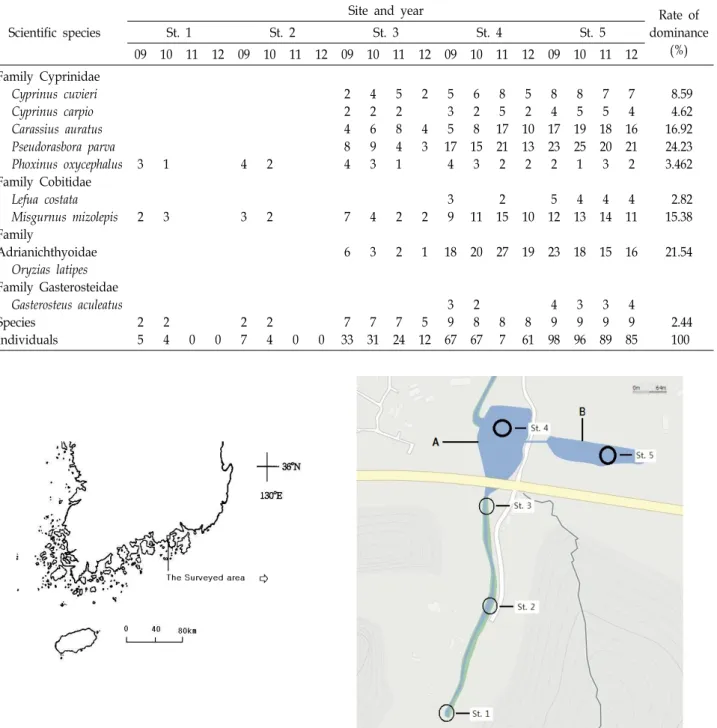
Fig. 1. The surveyed sites: Youngsan-ri, Georyu-myeon, Goseong-gun, Gyeongsangnam-do in Korea. A: The Sineun reservoir. B:

The Jeonchon reservoir.

Materials and Methods

Studied area and spatial density dependence The study sites were located around Youngsan-ri (34°58′

N, 128°23′E), Georyu-myeon, Goseong-gun, Gyeongsang- nam-do, and lied between one kilometer east of industrial complex and 0.8 kilometer north of Mt. Byeokbang (651 m) (Fig. 1). The four sites (St. 1 ~ St. 4) were water system of

Sineun reservoir. The remainder (St. 5) was Jeonchon reser- voir which was located closer to Sineun reservoir. We estab- lished more than 50 permanent 20 ㎡ quadrates in the aquat- ic communities per sites. The original collecting maps have been digitized and the data are available in tabular or spatial formals.

We performed two density manipulations to test for den-

sity-dependent individual mortality. The experiments were

(3)

performed to maintain initial target densities by either re- moving untagged immigrants from fishes, or transplanting new individuals. The instantaneous per capita mortality rate (m), with time measured in days, was estimated from the initial (I) and final (F) density of marked fishes as

m = [In(I) - In(F)]/d (1)

where d is the number of days between the start and the end of the experiment.

The instantaneous per capita mortality rate was also esti- mated separately for five sites in each year. For the con- venience, we assumed that each monthly settler cohort ar- rived at exactly the midpoint of the month in which it was collected. Let ti represent the middle day of the ith month, xi represent the estimated density of individuals that settled on the fishes during month I and X the density of fishes in all cohorts combined that remained on the individuals experience the same instantaneous per capita mortality rate m [12]. It can be recognize in the following expression.

X =

x e

-m(T-ti)

Collecting fish

The trammel net (20 m long, 1~5.0 m deep), with two outer walls of 28 cm multifilament netting and one inner wall of 5 cm multifilament netting, was stretched across the length of the tank and gently moved from side to side to ensure all fish in the tank were entangled. The fish remained entangled in the net for 2 hr, from 1.0 to 2.0 hr in every trial. Once all fish were placed in the live well, fish were individually weighed, measured (total length and fork length), and injected with a passive integrated transponder tag to allow for identification of individuals. Identifications of fishes were based on Choi [4]. Classification system of fishes followed the methods of Nelson [15]. We examined the effect of fish densities using SMATR freeware [20] with standardized critical axes.

Biotic indices

We are able to analyze data sets that may be in the pos- session of organization for trends in the data or statistical differences between sites or before and after treat- ments/activities.

Shannon–Weaver [18] index of diversity (H’): the for- mula for calculating the Shannon diversity index is

H’ = – Σ pi In pi

pi = the proportion of important value of the ith species

( pi = ni / N, ni is the important value index of ith species and N is the important value index of all the species).

N1 measures the number of abundant species in the sam- ple and N2 is the number of very abundant species.

N1 = e

H'

N2 = 1/ƛ

ƛ is Simpson's index.

Species diversity may be thought of as being composed of two components. The first is the number of species in the community, which ecologists often refer to as species richness. Two well-known richness indices are as follows:

R1 and R2 indices [16].

R1 = s-1 In(n)

R2 = s

√n

s: the total number of species in a community, n: the total number of individuals observed.

The second component is species evenness or equitability.

The common evenness indices used by ecologists are E1~E5 [1, 17].

Results and Discussion

The 210 individuals on 2009, the 202 individuals on 2010, the 210 individuals on 2011, and the 158 individuals on 2012 were identified. They classified 4 families, 8 genera, and 9 species. Specifically, the St. 1 and St. 2 were not observed any fishes in both years of 2011 and 2012. The decline of fish species was observed at the St. 3 on 2011 and 2012. Fish moved from St. 1 and St. 2 to St. 4 via St. 3. The fish species increased at St. 4 on 2011 and decreased by density effect or competition within and among species on 2012. It was estimated to be reduced to the density effect at St. 4 on 2012.

Differential responses to the environment may concentrate intraspecific density dependence relative to interspecific density dependence, hence fishes of Sineun reservoir (St. 4) might altered by population densities for stabilizing mecha- nism [7], St. 5 did not change significantly the density for 4 years because of lacking the influx of fish form up-stream of Sineun reservoir. St. 1 and St. 2 were only two species.

St. 3 was observed an average of 7 species for four years.

St. 4 and St. 5 were observed an average of 9 species for

four years. The relative abundances of fishes were Pseudoras-

bora parva (33.1%), Oryzias latipes (28.8%), Carassius auratus

(18.40%), Cyprinus cuvieri (14.7%), Cyprinus carpio (4.3%), and

Misgurnus mizolepis (0.6%).

(4)

Mortality

0.10 ○ ○

○ ○ ●

0.08 ● ○ ●

○ ● ◇

0.06 ○● ● ◇ ◇ ◆

○ ● ● ◇ ◆ ◆

0.04 ● ◇ ◆ ◆

◇ ◆◇ ◆ ◆

0.02 ◇ ◆

○◇

0.0

2.0 4.0 6.0 8.0 10.0 12.0

Density (No./㎡)

Fig. 2. Spatial density dependence in fish mortality. Density was manipulated in four experiments: the first in 2009 (○ symbols), the second in 2010 (● symbols), the third in 2011 (◇ symbols), and the 4rd in 2012 (◆ symbols).

Table 2. Diversity index in the studied areas

Indices St. 1 St. 2 St. 3 St. 4 St. 5 Richness

No. of species R1 R2

2 0.721 1.000

2 0.514 0.756

7 1.674 1.167

8 1.763 1.099

9 1.946 1.152 Diversity

H' N1 N2

0.645 1.906 2.000

0.683 1.980 2.333

1.843 6.316 6.495

2.015 7.498 7.920

2.105 8.210 8.394 Evenness

E1 E2 E3 E4 E5

0.931 0.953 0.906 1.049 1.103

0.985 0.990 0.980 1.179 1.361

0.947 0.902 0.886 1.028 1.034

0.969 0.937 0.928 1.056 1.065

0.958 0.912 0.901 1.023 1.026

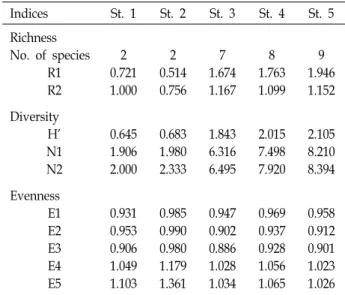
Shannon-Weaver indices of diversity (H’) of the Sineun reservoir were similar to those of the Jeonchon reservoir (Table 2). The H’ value at upper region was higher than those of middle and low regions. Species diversity was the range of 0.645 (St. 1) to 2.105 (St. 5). St. 1 and St. 2 were shown low diversity. St. 5 showed the highest diversity and was to maintain a rather stable community structure than other points. Richness indices were same trend. Values of richness (R1 and R2) were lower in downstream than upstream. N1 and N2 were also same trend like H'. Values of evenness were similarly distributed at five sites.

In scale experiments, mortality of fishes increased sig- nificantly with conspecific density (regression for 2009, r²

= 0.25, P = 0.05; r² = 0.21 for 2000, P = 0.05; r² = 0.18 for

2001, P = 0.05; and r² = 0.13 for 2000, P = 0.05) (Fig. 2).

The strength of this density dependence, however, was al- most five times more in the 2012 than in 2009 (regression for 2009, m = 0.0133, regression for 2012, m = 0.0027). There was not shown significant difference for mortality of fishes and strength of this density dependence at St. 5 during same periods (from 2009 to 2012). Using the maximum likelihood solution for the removal estimators of two stations (St. 1 and St. 2), the estimated migration probabilities (St. 5 → St. 4 and/or St. 4 → St. 3) from the resident fish to the migrated fish for five species (Cyprinus cuvieri, Carassius auratus, Pseudorasbora parva, Misgurnus mizolepis, and Oryzias latipes) were a mean of 0.623. Especially, migration probabilities from St. 5 to St. 4 for five species were high (a mean of 0.681). The period of migration was suggested about one month because of short geographical distances (50 m). We found no significant difference between the three categories in distribution of the other four species, indicating that the species probability was similar among three stations (St. 3, St. 4, and St. 5).

There was shown significant difference for instantaneous per capita mortality rate in both fish communities (Fig. 3).

Many fishes of Sineun reservoir were experienced more

competition than those of Jeonchon reservoir. Many species

of family Cyprinidae were shown more competition than

some species of other families. St. 5 was Jeonchon reservoir

and isolated from Euldae industrial complex. Although

Jeonchon reservoir was located closer to Sineun reservoir,

but it was not connected the water system of Sineun

reservoir.

(5)

Fig. 3. The instantaneous per capita mortality rate in both fish communities. Cc: Cyprinus cuvieri, Cr: C. carpio, Ca:

Carassius auratus, Pp: Pseudorasbora parva, Po: Phoxinus oxycephalus, Lc: Lefua costata, Mm: Misgurnus mizolepis, Ol: Oryzias latipes, Ga: Gasterosteus aculeatus.

Empirically testing for density dependence is problematic enough in demographically closed, typically terrestrial and freshwater populations [6]. Our results that spatial depend- ence in the fishes was detectable both in small habitat patch- es and also across much larger natural reefs mirrors finding for two other reef fishes [12, 19]. Conclusionally, we recog- nize that human-modified ecosystems such as collecting con- struction materials from forests are shaped by our activities and their side effects. It is necessary to recall the words of Francis et al. [7]. “An ecosystem is a geographically specified system of organisms, including humans, the environment, and the processes that control its dynamics. An ecosystem approach to management is management that is adaptive, specified geographically, takes into account ecosystem knowledge and uncertainties, considers multiple external in- fluences, and strives to balance diverse social objectives.”

References

1. Alatato, P. A. 1981. Problems in the measurement of even- ness in ecology. Oikos 37, 199-204.

2. Caley, M. J. 1998. Age-specific mortality rates in reef fishes:

evidence and implications. Aust. J. Ecol. 23, 241-245.

3. Chesson, P. 2000. Mechanisms of maintenance of species diversity. Annu. Rev. Ecol. Syst. 31, 343-366.

4. Choi, K. C. 2001. Guide of Korean Fresh Water Fish in Color (excluded Lepidoptera), pp. 1-671, Hyeoamsa, Seoul, Korea.

5. Dodson, S. I., Arnott, S. E. and Cottingham, K. L. 2000. The relationship in lake communities between primary pro- ductivity and species richness. Ecology 81, 2662-2679.

6. Forresster, G. E., Steele, M. A., Samhouri, J. F., Evans, B.

and Vance, R. R. 2008. Spatial density dependence scales up but does not produce temporal density dependence in a reef fish. Ecology 89, 2980-2985.

7. Francis, R. C., Hixon, M. A., Clarke, M. E., Murawski, S.

A. and Ralston, S. 2007. Ten commandments for ecosystem based fisheries scientists. Fisheries 32, 217-233.

8. Gamfeldt, L., Hillebrand, H. and Jonsson, P. R. 2008.

Multiple functions increase the importance of biodiversity for overall ecosystem functioning. Ecology 89, 1223-1231.

9. Hixon, M. A., Anderson, T. W., Buch, K. L., Johnson, D.

W., Mcleod, J. B. and Stallings, C. D. 2012. Density depend- ence and population regulation in marine fish: a large-scale, long-term field manipulation. Ecol. Monog. 82, 467-489.

10. Holbrook, S. J. and Schmitt, R. J. 2002. Competition for shel- ter space causes density-dependent predation mortality in damselfishes. Ecology 83, 2855-2868.

11. Jawad, L. 2003. Impact of environmental change on the freshwater fish fauna of Iraq. Inter. J. Environ. Stud. 60, 581- 593.

12. Johnson, D. W. 2006. Predation, habitat complexity, and var- iation in density-dependent mortality of temperate reef fishes. Ecology 87, 1179-1188.

13. Mittelbach, G. G., Steiner, C. F., Scheiner, S. M., Gross, K.

L. and Gough, L. 2001. What is the observed relationship between species richness and productivity? Ecology 82, 2381-2396.

14. Neale, P. J., Bossard, P., Huot, Y. and Sommaruga, R. 2001.

Incident and in situ irradiance in Lakes Cadagno and Lucerne: A comparison of methods and models. Aquat. Sci.

63, 250-264.

15. Nelson, J. S. 1984. Fishes of the World, pp. 1-523, 2nd ed., John Wiley and Sons, NY.

16. Pielou, E. C. 1969. An Introduction to Mathematical Ecology, pp. 1-326, John Wiley, NY.

17. Pielou, E. C. 1975. Ecological Diversity, 1-165, John Wiley and Sons, NY.

18. Shannon, C. E. and Weaver, W. 1963. The Mathematical Theory of Communications, pp. 1-117, University of Illinois press, Urbana.

19. Steele, M. A. and Forrester, G. E. 2005. Small-scale field ex- periments accurately scale up to predict density dependence in reef fish populations at large scales. Proc. Natl. Acad. Sci.

USA 102, 13513-13516.

20. Warton, D. I., Wright, I. J., Falster, D. S. and Westoby, M.

2006. Bivariate line fiting methods for allometry. Biol. Rev.

81, 259-291.

(6)

초록:고성군 용산리의 두 저수 수계에서 어류의 다양성과 밀도 효과 허만규*․최병기

(동의대학교 자연생활과학대학 분자생물학과)

경상남도 고성군 거류면 용산리 신은저수지 수계 4곳과 정촌 저수지 1곳 수계에서 어류 다양성 분석을 실시하 였다. 인위적 교란과 환경변화에 따른 집단조절을 유도하는 밀도 의존성을 평가하였다. SMATR freeware를 사용 하여 어류 밀도에 영향을 미치는 환경 요인 분석을 실시하였다. 2012년에 4과 8속 9종 158개체가 동정되었다. 비교 적 풍부한 어종은 참붕어(Pseudorasbora parva)로 빈도는 33.1%였다. 그 다음은 송사리(Oryzias latipes)로 28.8%였다.

2012년에는 4곳에서 밀도 효과가 감소하였다. 신은저수지의 Shannon-Weaver의 다양도 지수(H’)는 정촌 저수지의

다양도와 유사하였다. 종 다양도는 0.645에서 2.105로 다양하게 나타났다. 상류지역의 다양도(H’)는 중류와 하류지

역보다 높았다. 풍부도 지수 역시 상류가 하류보다 높았다. 강의 하류 두 지점을 제외한 최대 가능성 분석을 이용

하면 한 지점에서 다른 지점으로 이동한 5종의 가능성은 평균 0.623이였다. 특히 신은저수지와 정촌저수지 간 이

동 가능성은 높았다(평균 0.681). 이는 두 저수지간 지리적으로 짧은 탓에 기인한다(50 m). 나머지 4종에 대한 최대

이동가능성은 유의성이 없어 지점간 유사함을 시사한다.

수치

Table  1.  The  lists  of  fish  species  at  the  five  sites
Fig.  2.  Spatial  density  dependence  in  fish  mortality.  Density  was  manipulated  in  four  experiments:  the  first  in  2009  (○ symbols),  the  second  in  2010  (● symbols),  the  third  in  2011  (◇ symbols),  and  the  4rd  in  2012  (◆ symbol
Fig.  3.  The  instantaneous  per  capita  mortality  rate  in  both  fish  communities

참조

관련 문서

Second, analyzing students' level of interest in the unit of Clothes and Life Style revealed that there was significant difference between genders and students in the two

In addition, using the properties of water shown in diverse shapes, Ki Hyung-do's recognition on the reality and future consciousness from regression of

This will involve the solution of (n+1) linear systems.. Write a routine that determines the flux at each region and currents at the external boundary. Generate the edit shown

Fourth, for the sub-factors of personality traits according to weight lifters’ education, while there was a high difference in neuroticism and agreeableness

As for the number of participation, significant difference was found in accessibility, attractiveness and comfort of physical environment, recognition and

Conclusions : No significant corelation of the patency rate was shown in the study on the effects of local irrigation and systemic application of heparin

Third, there was no significant difference in the frequency of second hospital evacuation after moving to the medical room due to experience and

The change in active oxygen was decreased after exercise in the exercise group than in the control group, and there was a statistically significant