• 검색 결과가 없습니다.

Comorbidity of Paraphilia and Personality Disorders in Sex Offenders

N/A
N/A
Protected

Academic year: 2021

Share "Comorbidity of Paraphilia and Personality Disorders in Sex Offenders"

Copied!
11
0
0

로드 중.... (전체 텍스트 보기)

전체 글

(1)

1. Introduction

Researchers in the field of forensic psychology have performed several studies and found that convicted male sex offenders including rapists, child molesters, and men convicted of other sexual crimes are likely to

recidivate, or recommit sex crimes even after undergoing treatment. The likelihood of recidivism is even higher when taking mental illnesses like paraphilia and various personality disorders into account[1-7]. Disregarding this important phenomenon could possibly result in a greater threat to our society

*Corresponding Author : Eunjoo Kim([email protected]) Received November 12, 2018

Accepted February 20, 2019

Revised January 17, 2019 Published February 28, 2019

Comorbidity of Paraphilia and Personality Disorders in Sex Offenders

Jimin Kwon

1

, Eunjoo Kim

2*

1

Research Assitant, Division of Social Science of Graduate School, University of Chicago

2

Professor, Departmnet of Health Management, Hyupsung University

성범죄자들의 성격장애와 성도착증 중복이환 보고 연구

권지민1, 김은주2*

1

시카고대학교 대학원 연구원,

2

협성대학교 보건관리학과 교수

Abstract Despite various treatments, there is a tendency of convicted sex offenders to recidivate by committing additional sex crimes. Especially when the offenders are diagnosed comorbidly with paraphilia and personality disorders, effective treatment is critical because this difficult condition can be harmful to their psychological well-being and the security of the communities in which these men live. The aim of this review is to examine the comorbidity of personality disorders and paraphilia in the male sex offender population. This study is highly meaningful as not only it is the first domestic research on the link between paraphilia and sex crimes, integrating the preceding data from both domestic and international research, but also as it synthesizes the studies of criminal psychology, social welfare and clinical psychology.

Key Words : Paraphilia, Integrative Review, Treatment designs, Practioner

요 약 많은 치료법에도 불구하고, 유죄 선고를 받은 성범죄자들은 또 다른 성범죄를 저지르는 경향이 있다. 특히 성범죄자 들이 성도착증과 성격장애를 동시에 앓고 있는 상태는 그들이 살고 있는 지역 사회의 안전에도 위험을 끼치기 때문에, 이에 대한 효과적 치료법이 매우 중요하다. 본 연구의 목적은 성범죄자 인구들이 앓고 있는 성도착증과 성격장애의 중복이환을 검토하기 위함이다. 실증 연구들의 사례 리뷰에 의하면 성도착증을 가진 범죄자들은 상당히 높은 확률로 성격 장애를 앓고 있음이 밝혀졌다. 본 연구는 국내에서는 처음으로 성범죄자의 성도착증 연관성에 대하여 국내외 선행자료를 종합하였다는 데 큰 의의가 있으며 성범죄, 중복이환 등은 보건부문에서 단독으로 추진하기에는 한계가 있기에 향후 다부문, 다학제적 접근이 가능한 연구여건의 형성이 요구된다.

주제어 : 성범죄자, 통합적 문헌고찰, 치료법 설계, 임상인

(2)

and neglect of those individuals suffering from mental illnesses. This issue is critical in a country like the United States where 15% of women and 7% of men will become victims of sexual abuse before their 18

th

birthday[4].

It is important to understand the trend of comorbidity of paraphilia and personality disorders, to understand the characteristics of personality disorders in sex offenders, and to use that information to develop more effective treatment.

Over the years, treatment for sex offenders has ranged from different types of talk therapy, to medication, to castration[1,2,4,6,7]. This specific topic of interest should concern those psychologists and psychiatrists seeking to evaluate and effectively treat those suffering from both paraphilia and personality disorders. Taking into consideration that the subgroup of sex offenders diagnosed comorbidly with paraphilia and personality disorders has unique characteristics and is not often studied thoroughly, this review aims to describe this type of sex offender and examine the effectiveness of current treatments.

So far, much has been studied about other areas such as drug addiction, alcohol addiction gambling addiction and media addiction, but few have studied sex offenders' sex addiction.

In theory and based on this topic, including leading research in terms of preventing smaller comorbidity of paraphilia is the wider social crime prevention, perspective for effectiveness of the medication or chemical castration to discuss issues for now.

This study is highly meaningful as not only it is the first domestic research on the link between paraphilia and sex crimes, integrating the preceding data from both domestic and international research, but also as it synthesizes the studies of criminal psychology, social welfare and clinical psychology.

2. Research Method

This is a methodological study to identify and

anlyaze the characteristics of the studies related to comorbidity with paraphilia and personality disorder among sex offenders. As a method of the study, we attempted a systematic review of domestic and international empirical studies on paraphilia among sex offenders.

This study used the PRISMA (Preferred Reporting Items for Systematic Reviews and Meta-Analysis) method, which is an international research reporting guide for the systematic literature analysis research[8].

PRISMA suggests a use of checklists and research flow, thereby pursuing a systematic reporting of the studies with various types of research design.

Literatures reviewed in this study are domestic and international empirical research on topics regarding paraphillia and a population of sex offenders, conducted from the year 2000 to December 2017.

For the search of literatures, databases of DBpia, KISS, Riss4U, and PubMed, SAGE Journal Online, Sciencemag were used When selecting search terms, the words 'paraphillia,' 'sex offender,' and 'comorbidity' were combined and serached. Detailed criteria for selection and exclusion of the literatures to be reviewed are as follows.

After identification of the literatures to be reviewed, which is the very first phase of PRISMA, 60 literatures were found through database searching. Among the literatures that were reviewed in the precedent research, 6 additional liteatures that were considered to be appropriate for the current research topic, identifying a total of 66 research studies.

In the second phase, which is a screening process of literatures, 3 duplicate literatures were excluded from 320 literatures that were found. For the remaining 38 literaturees, researchers of the current study alternately reviewed their titles and abstracts to exclude literatures that were considered inappropriate or insufficient to examine the subject and topic of this study.

In selecting target literatures, which is the third and

the final phase, all of the researchers read the full text

of 25 literatures that were reviewed in the second

(3)

phase and confirmed their eligibility for this study.

Articles identified through Database searching : Publication dares 2000.1.1.~2018.12.31

(n=60) ProblemIdentification Screening andEvaluation Screening andEvaluation

Articles after duplicate removed (n=38)

Dupliacte articles Removed

(n=3)

Articles duplicate removed

(n=35) Articles excluded

(n=16)

Full-text articles assessed for eligibility (n=25)

Full-text articles excluded, with

reasons (n=2)
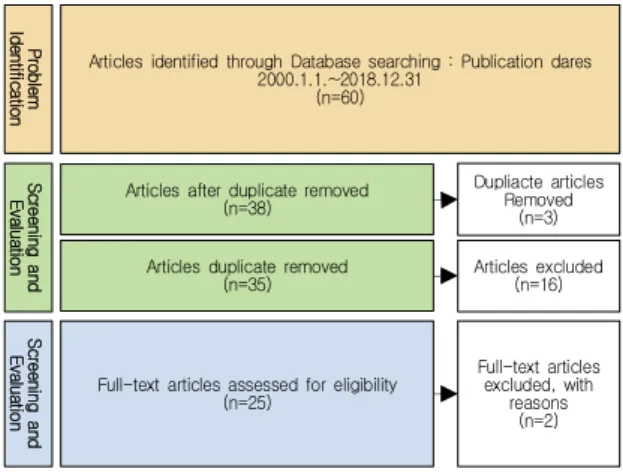
Fig. 1. Flow chart of study selection

Through this process, a total of 25 literatures were finally selected for analysis. For these 25 literatures, all researchers for this study went through a process to jointly review them, after each researcher has independently conducted his/her own initial review of the literatures.

Criteria that were established in the process of literature review are as follows: year or publication, research design, geographical region of the research subject, research and analysis methods. These criteria were used as standards to confirm the topic this research. Additionally, characteristics, variables, and measures of the reviewed literatures were also reviewed.

3. Prevalence of Comorbidity of Paraphilia and Personality Disorders

Sex offenders often describe themselves as socially anxious and depressed[9]. It is critical that society express concern for both the mentally ill offenders and the community members who may be affected.

Treatments are crucial for the diagnosed offenders, especially for prevention of recidivism. Individuals diagnosed with personality disorders reported more

common experience of physical and sexual abuse than those with no history of diagnosis[3]. It is also important to examine sex offenders’ personality characteristics in order to find what factors are driving them to commit the offenses. Among the population of sex offenders, child molesters often have a detached personality style with predominant dependent personality features. Adult rapists often have emotionally detached personalities with independent personality styles characterized by narcissism and antisocial features[3]. Fifty percent of sex offenders are known to have dependent personality disorder, and 36%

of them are diagnosed with passive-aggressive personality disorder[3].

Such statistics demonstrate that the need for effective treatment of sex offenders is a serious matter.

Researchers must perform studies on the behaviors related to sex offenders’ mental conditions in order to fully understand the population, and moreover, to appropriately treat them.

Paraphilia and antisocial personality disorder are the most common diagnoses in the sex offender group[11].

Paraphilia is a range of clinically recognized patterns of unconventional sexual behavior[11].

The term personality disorder is “an enduring pattern of inner experience and behavior that deviates markedly from the expectation of the individual’s culture, is pervasive and inflexible, has an onset in adolescence or early adulthood, is stable over time, and leads to distress or impairment”[12].

Paraphilic sex offenders are often diagnosed with at

least one comorbid condition. Thirty five out of 36

convicted male sex offenders had at least one axis I

disorder (i.e., clinical disorders that show acute

symptoms and require treatment, including major

mental disorders, learning disorders and substance use

disorders), and 28 men showed three or more comorbid

axis I disorders[13]. The estimated rate of personality

disorders among these men was between one third and

two thirds[9]. There are ten personality disorders listed

in the DSM-V: paranoid, schizoid, schizotypal,

(4)

antisocial, borderline, histrionic, narcissistic, avoidant, dependent and obsessive-compulsive personality disorders. Anti-social, borderline, schizotypal and narcissistic personality disorders are the most common among sex offenders, and are accompanying factors for sexual delinquency with the symptoms of disregard of others, need for admiration and attention, unstable relationships and impulsivity[9]. These rates of diagnosis of personality disorders among sex offenders exceed lifetime prevalence rates in the non-convicted population[9]. The order of personality disorders from most prevalent to least prevalent was antisocial followed by avoidant and borderline personality disorders. On the other hand, some researchers argue that only obsessive-compulsive personality disorder best explains paraphilic behaviors, noting that compulsive acts of paraphilia may be related to characteristics shown in obsessive-compulsive personality disordered individuals[11].

They specifically focus on prevalence of personality disorders in paraphilic child molesters. Many empirical findings confirmed that most child molesters suffer from one or more personality disorders[11]. The present study emphasizes that paraphilic offenders have significantly higher rate of personality disorders than do non-paraphilic offenders[11]. Personality disorders and paraphilia are deeply related, and this comorbidity among sex offenders can be very dangerous because it can lead to impulsive acts.

Understanding of such high prevalence confirms that comorbidity of paraphilia and personality disorders must be closely monitored and studied in order to avoid offenders’ compulsion to commit crimes due to their unstable mental conditions.

Although there were multiple studies that focused on the prevalence of mental illness in sex offenders, there is not much known specifically about the comorbidity of personality disorders and paraphilia. Some studies have discussed sex offenders who were diagnosed with personality disorders. Although the men in those studies were not always also diagnosed with paraphilia,

the fact that many were diagnosed with personality disorders indicates that the appropriate treatment and thorough analysis of personality disorders is critical to decrease the rate of recidivism. In the Sex Offender Appraisal Guide and the Sexual Violence Risk-20, which includes assessments of individuals’ risk to commit sexual violence or to recidivate, diagnosis of personality disorders is known to be one of the predictor variables for sexual offense risk[3]. It is vital to examine the ways personality disorders and paraphilia influence sex offenders and additionally, appropriate treatments must be discussed in more detail.

4. Characteristics of Personality Disorders and their Relevance to

Paraphilia

Considering that the prevalence of comorbidity of paraphilia and personality disorders is significant in sex offenders, it is appropriate for researchers to acknowledge these individuals as a unique population.

There must be an understanding of which characteristics or deficits of personality disorders influence sexually deviant crimes. Two mental illnesses interacting together to produce dysfunction in the mood, thought, and behavior of an individual may have an even more dangerous effect on that person and on society. Consequently, better treatment will develop with careful consideration of this comorbid condition.

Personality disorders affect the minds of sex offenders within biological, emotional, and social realms.

First, there is a biological component. A personality disorder changes the way the brain functions which then is able to affect sexual arousal and behavior[13].

People living with personality disorders are likely to

feel distressed and their behavior may be impulsive and

out of their control. Due to the neurological factor, over

time many journals have continued to suggest the use

of medication along with psychotherapy to treat sex

(5)

offenders with personality disorders[11,14,7, 9]. This approach would attempt to resolve the behavioral issue of sex offense from the inside out.

More striking are the consistent behavioral and personal attributes of the comorbid subgroup in question. Researchers find that generally, people diagnosed with antisocial personality disorder specifically tend to be manipulative, impulsive, and aggressive[15,5,16]. Thus, sex crimes fit the nature of these traits. For example, a child molester must manipulate the child and his or her family conditioning them to gain trust and be allowed closer to the child.

Sex offenders who target children are often not allowed to live near schools because they may act on impulse and reoffend[15] rapists, for example, are particularly aggressive and may sometimes use rape as a release of tension and not primarily for sexual gain[14]. It becomes clear that these traits influence sex offenders to act without logical reasoning.

Another motivating factor behind violent sexual crimes is the allure of power. Desire for control and selfish drives are factors in the behavior of sex offenders with personality disorders[3,15,16]. Taking advantage of non-consenting individuals gives offenders personal gratification. Perhaps throughout childhood development or even in their adult lives these men felt a sense of powerlessness or insecurity that they strive to overcome in this irrational and violent way. Sex offenders might prey on young children or smaller individuals, for example. These individuals seek domination disregarding feelings of people they harm.

The mind of a sexually deviant and personality disordered individual is not like that of a well-adjusted person who functions in society. Most people are aware, consciously or unconsciously, of what appropriate behavior is in their surroundings. Lack of moral thought and disregard for social norms are common among sex offenders[15].

Maudsley.(as cited in Saleh et al., 2010) went on to describe an individual suffering from a personality disorder as[16]: a creature of such antisocial bias, so

destitute of moral sensibilities and their fit reactions, so imbued with vicious inclinations, that it is truly a moral imbecile whom no culture, gentle or severe, be it never so patient, will raise to the level of moral feeling and conduct.. (p. 215).

Therefore, sex offenders may impulsively act on their desires for children or other non-consenting persons without the weight of guilt or shame on their conscience. An understanding of these intrapersonal feelings leads to a clearer view of the way sex offenders with personality disorders tend to view their victims.

In regard to their actions and the people they harm, the comorbid group of sex offenders dealing with personality disorders display very shallow emotion if any at all. Sex offenders with personality disorders tend to lack guilt, empathy, and remorse[14-16].

The lack of human connection may be motivation for offenders to view their victims as objects and commit violent sexual crimes against them.

These characteristics of individuals with personality disorders influence sexual deviance and subsequent actions harm the individual, the victim, and society. Not only do personality disorders strongly influence the actions of sex offenders, but these mental illnesses also inhibit their recovery.

Traditionally, treatment has been of the cognitive behavioral kind and may take place one on one or in groups. However, offenders suffering from paraphilia and antisocial personality disorder comorbidly find treatment rigorous and confrontational which does not agree with their consistent dysfunctional personality traits[5,7]. Attributes of personality disorders, specifically antisocial personality disorder, which is very prevalent, both strongly influence the actions of offenders and interferes with their chances of recovery.

When researchers find that two mental illnesses

occur comorbidly, there is a need to consider that

population a special subgroup when designing

treatment. In this case, individuals with paraphilia also

suffer from personality disorders which can agitate and

(6)

worsen their condition. It is critical to consider what type of psychotherapy, medication, or a combination of both will most effectively treat sex offenders and decrease chances of recidivism.

5. Current Treatments for Sex Offenders with Paraphilia and

Personality Disorders

Sexual crimes can traumatize the lives of victims;

however, it is often the case that these crimes are forced upon victims by individuals who suffers from mental and behavioral deviances (e.g., paraphilia and personality disorder). These individuals are known as clinical sex offenders—sex offenders who are suffering from psychological and behavioral deviance[2,4].

Although sex predators are treatable through longitudinal coercive treatments (e.g., 86 group sessions of 2 to 2 1/2 hours) the trend of recidivism among mentally ill sex predators is high[1,2,4,7].

Sex offenders diagnosed with personality disorders appeared sane in terms of cognition but continued to knowingly exhibit negative behavior[16]. Thus, treatment of sex offenders with personality disorders is a complicated task to tackle, and psychiatrists have been struggling for decades to obtain positive outcomes[2].

Continuous enhancements are made to identify the level of mental illness in sex offenders before applying treatment. Since the early nineteenth century, there have been numerous therapies and techniques (e.g., psychotherapeutic techniques, aversion therapy, covert sensitization, and satiation) focusing on treating behaviorally oriented sexual deviation that proved to be failures in the treatment of mental illness of sex offenders. Incapacitation was considered to be the best method[2]. According to the assessment of sex predators’ crimes and illnesses, they can be treated as inpatient or outpatient, and in some cases, the treatment continues after they have served their

sentence with a combination of supervision of their daily conduct. Due to some of those unsuccessful treatments, the legal policies are stricter, and sex offenders are closely provisioned along with coercive mental treatments[4].

In addition to modified psychotherapy and behavior treatments, there are two new treatments:

cognitive-behavioral and medical treatment[2]. In accordance to their assessment, the interventions are carefully selected, and depending on the level of severity of their mental illness and crime, treatments vary from only talk therapy to medication, or if needed, a combination of both.

In cognitive behavioral therapy, a clinical discursive approach is practiced to obtain information directly from the sex offenders to assess their illness;

pragmatic results are expected. Through these methods the sex offenders are taught self-control in order to prevent release of untamed sexual arousal and victimization of an innocent and helpless individual. In addition, practitioners approach treatment with the goal of teaching sex offenders to feel remorse for their actions[2]. This therapy attempts to increase decision-making and social skills. However, due to a false conception of reality, confusion, loss of reason, or hallucinations caused by their mental illness, sex offenders can deviate toward recidivism [2,6]. In order to maintain the positive effects of this treatment, psychiatrists observe sex offenders closely even after incarceration—sometimes for life[6]. However, with severe mental illness, the process extends to medical treatment.

There are two medical treatments being used in

particular: chemical castration (also called hormonal

treatment) and surgical castration. In chemical

castration, sex offenders receive a hormonal drug

known as Depo Provera to reduce sexual arousal. Yet,

this method has limitations in that it can be effective

only when the sex offenders are supplied with the

medication[2]. On the other hand, in the United States

of America, surgical castration is used very rarely, and

(7)

it is only limited to when and if the sex offenders volunteer for this treatment. Nevertheless, the medical treatments are often accompanied with clinical treatments. These treatments may not be completely effective, however, they can help to reduce or prevent the reoccurrence of the sexual offenses[2].

Regardless of numerous types of treatments, the recidivism of sex crimes continues. Behavior that harms the innocent may be punished; however, diagnosis and treatment of sex offenders suffering from paraphilia and personality disorders has no purpose if not to effectively manage the comorbid mental illnesses and reduce sex crime recidivism. If there are coercive treatments that are not being applied strictly and correctly to those in need, then medical and legal organizations may also be responsible for recidivism because it is their responsibility to provide assistance to those mentally ill individuals who often times are not in control of their compulsive thoughts or behaviors.

It is necessary to understand that sex offenders need urgent help especially when suffering from comorbidity of both paraphilia and personality disorder. Appropriate treatments and sufficient numbers of skilled clinicians will not only alleviate frustration on their behalf, but it will also reduce the threat to society. Therefore, more effective treatments will take into account the specific mental illnesses of each sex offender and attempt to decrease treatment termination and recidivism.

6. Domestic research on paraphilia among sex offenders in Korea

Much research has been done to explain the link between sex crimes and paraphilia in other countries, including the United States. For example, research has been done in other countries to investigate the history of sexual offense of those with paraphilia since the 1970s until today, and empirical research to identify various characteristics of paraphilia among sex

offenders is being conducted to date. On the contrary, there is a lack of domestic research examining paraphilia as a sexual uniqueness and a factor that triggers recidivism among sex offenders. This study aims to review recent findings about paraphilia among sex offenders.

Paraphilia conveys symptoms of exhibiting sexual behaviors that are against social norms and having recurrent, intense sexually arousing fantasies, sexual urges or behaviors generally involving nonhuman objects, the suffering or humiliation of oneself or one's partner, or children or other nonconsenting persons.

Terminology of paraphilia was first used and introduced to the academic community by a doctor named Friedrich Salomon Krauss in 1903, as defined as a “habitual form of behaivor to satisfy sexual desires that cannot be satisfied with normal sex practices[20].

The study “Paraphilas as Recidivism Predictors of Korean Sex Offenders” analyzed a Korean Sexual Deviance Inventory and investigated former sexual crime records of 84 sexual offenders and 123 non-offender. Among the sexual offenders, recidivists were 45 and non-recidivists were 39.

The Korean Sexual Deviance Inventory consisted of 122 questions, including 11 subscales/measures; Social Desirability, Sexual Cognitive Distortion, Sexual Masochism Disorder, Sexual Sadism Disorder, Fetishistic Disorder, Transvestic Disorder, Frotteuristic Disorder, Pedophilic Disorder, Voyeuristic Disorder, Exhibitionistic Disorder and Sexual Addiction Disorder.

A multivariate analysis was conducted to see the significant difference in the scales between non-sexual, sexual non-recidivist and sexual recidivist groups.

The results of the major effects of individual scales

showed significant group differences in each scales

apart from the fetishistic disorder and frotteuristic

disorder. A correlation analysis was also conducted

between the number of sexual crime records and sexual

deviant scores, which indicated a significant positive

correlation between transvestic disorder, pedophilic

disorder, voyeuristic disorder and exhibitionistic

(8)

disorder. With the regression model, sexual crime records was set as a dependent measure whereby, pedophilic disorder had significant influence among the sexual deviant scales. In addition, to verify sexual recidivists among sexual offenders, a logistic regression analysis was conducted and proved pedophilic disorder also had a significant predictive power in adult sexual recidivism.

Finally, the individual sexual deviant specificity of sexual offenders’ adoption in the correction field is discussed[21].

The study “Evaluations and Suggestions of the Programs for Sexual Crime Prevention:Based on Prevention Programs for Child Sexual Abuse”

evaluated on prevention programs for child sexual abuse. It is serious and destructive problem for child.

For this, reviewed precedent studies related to prevention programs for child sexual abuse, and proposed to create developmental prevention programs for child sexual abuse. Process of the study was to find some papers related to prevention programs for child sexual abuse in Korea, and then analysed the papers through used programs, age, forms and term, goals, measurement, methods for analysis and results.

Concretely, this study suggested some alternatives for creating developmental prevention programs for the crime of child sexual abuse[22].

The study “Psychological Characteristics of Sex Offenders Based upon Their Recidivism and Diagnosis upon Pre-trial Evaluation” examined psychological and criminal characteristics as well as demographical features of 119 sex offenders who were classified based upon their recidivism and diagnoses which were made upon their pre-trial evaluation. No significant differences were found in their demographical data between first-offense and re-offense groups, but there was significant difference in their types of sex offenses.

Significant differences were found in MMPI-2 scales such as F, FB, FP, K, S, F-K, Pa, and Sc. Re-offense group scored significantly high on scales of D, Pa, Pt, and Sc; they also scored significantly higher on

SCL-90-R scales such as SOM, OC, IS, DEP, ANX, HOS, PSY, GSI, PSDI. Groups who were classified on the basis of diagnosis showed significant differences in gender of the victims, age of the victims, and alcohol intake at the time of offense. Significant differences were found in MMPI-2 scales such as D, Hy, Pd, and PSDI of SCL-90-R among these groups. The results of the study indicate that re-offense group reported significantly more psychopathological symptoms than first-offense group, which suggested that sensitive measures to rule out malingering should be developed and utilized, and that counter plans for recidivism prevention should take into consideration the offense-related characteristics of sex offenders to be effective[23].

The study “The analysis of the effectiveness of Sexual Crime prevention policy by intervention time-series: Focusing on general deterrence effect of Sexual Crime of Electronic Monitoring System”

analysed general deterrence effect of Sexual crime of

electronic monitoring system. For it, an official data

related to the number of sexual crime and recidivism

rate of the same kind of sexual crime was collected and

it was analyzed by the intervention time-series. The

analysis showed that electronic monitoring system has

an some effect on sexual crime prevention according to

a result of intervention time-series analysis. Through

the analysis result, this study is suggest that there are

the need to extend the scope of the application of

electronic monitoring system in order to alert the

potential sex offenders to attention of the

punishment[24]. The study “Macro-Level Factors of

Sex Crime Depending on Its Type and Community

Size: Negative Binomial Regression Analysis Using

Nation-Wide Eup·Myeon·Dong Data” attempted to

discover macro-level factors leading to sex crime,

depending on its type (rape vs. harassment) and

community size (urban vs. rural). Using the entire 3,468

Eup·Myeon·Dong data, this study constructed a

Negative Binomial Regression model for sex crime in

recent four years (2010-2013) based on the ecological

(9)

perspective. Results showed that there is little difference between the types. But those of community size discovered notable differences: While population mobility made a positive effect only in urban areas, non-apartment residency negatively affected only in rural communities. Single household increased sex crime in urban neighborhoods, but lowered it in rural areas. Other structural variables made a positive effect regardless of the community size. It suggested that more detailed and systematic research and policy initiative are necessary to fit the community characteristics[25].

7. Conclusion and Suggestion

Much of the literature supports the idea that in order to manage the prevalence of comorbid paraphilia and personality disorders among male sex offenders, clinicians must understand, diagnose, and treat this condition from a focused perspective. Sex offenders with paraphilia tend to also suffer from varied types of personality disorders. These personality disorders have characteristics that affect sex offenders biological drives, emotional stability, and social behavior.

Considering this specific comorbid subgroup of offenders, it is essential to carefully carry out appropriately prescribed treatment (i.e., psychotherapy, medication, or combination of both) but researchers have not come to an agreement on which treatments are most effective.

Despite the fact that there are over 170 types of therapies (e.g., meta-theory, self-determination theory) for treating mental illnesses of sex offenders, recidivism is very likely among sex offenders with personality disorders[3]. This poses a threat to the mental well-being of those offenders and to the societies in which they live. Given that we haven’t found a consensus on which treatment is most effective in the current literature, our question for further research is as follows: What treatment perspectives (e.g., medical, coercive, cognitive behavioral perspectives)

and what treatment designs (e.g., long term, short term, individual, or group treatments) can effectively take into consideration the needs of male sex offenders suffering from both paraphilia and personality disorders and therefore help to reduce treatment termination and sex crime recidivism? Future studies should take into consideration that each individual will be a unique case but that examining the results of several different treatments over time will progress toward a clearer idea of what constitutes the most effective treatment type. The treatment prospects and models for professional treatment of sex offenders will require a combined program with cognitive, behavioural, psychological and pharmacological approaches. In other words, clinicians will need to provide and secure professional treatment by correctional facilities and local community, in addition to professional workforce to operate the treatment program for sex offenders.

Lastly, there is a need for the multidisiplinary research and development and implementation of multi-dimensional strategies based on comorbidity associated with a population of sex offenders that were confirmed thorugh this research. Additionally, attempts for qualitative, mixed-method, and participatory research are expected to continue, focusing on increasing incidents of the sex offenses. Yet, there is a limitation for the health-related areas to single-handedly push ahead for the studies on topics of sex offenders and comorbidity. Therefore, there is a necessity for the research conditions to be created that will make multi-dimensional and multidisciplinary approach for these topics feasible.

REFERENCES

[1] Auburn, T. (2010). Doing cognitive distortions: A discursive psychology analysis of sex offender treatment talk. British Journal of Social Psychology, 42(2), 281-298.

[2] Burdon, W. M., & Gallagher, C. A.(2002). Coercion and

sex offenders: Controlling sex-Offending behavior

(10)

through incapacitation and treatment. Criminal Justice and Behavior, 29(1), 87-108.

[3] Craissati, J., Webb, L., & Keen, S. (2008). The relationship between developmental variables, personality disorder, and risk in sex offenders. Sexual Abuse: Journal of Research and Treatment, 20(2), 119-138.

[4] Harris, A. J., Fisher W., Veysey, B. M., Ragusa, L. M.,

& Lurigio, A. J.(2010). Sex offending and serious mental illness: Directions for policy and research. Criminal Justice and Behavior, 37(5), 596-605.

[5] Larochelle, S., Diguer, L., Laverdière, O., & Greenman, P.

S. (2011). Predictors of psychological treatment noncompletion among sexual offenders. Clinical Psychology Review, 31(4), 554-562.

[6] Reardon, J. D.(1995). Sexual predators: Mental Illness or abnormality? A psychiatrist’s perspective. University of Puget Sound Law Review, 15, 849-853.

[7] Stanislaus, A., & Reid, W. H.(2015). Sex offender commitment in illinois. Journal of Psychiatric Practice, 11(4), 262-267.

[8] Moher, D., A., Tetzlaff, J., Altman, D. G., & PRISMA Group.(2010). Preferred reporting items for systematic reviews and mata-analyses:The PRISMA statement.

International Journal of Surgery, 8(5), 336-341.

[9] Leue, A., Borchard, B., & Hoyer J. (2004). Mental disorders in a forensic sample of sexual offenders.

European Psychiatry, 19(3), 123-130.

[10] Levenson, J.S.(2004). Sexual predator civil commitment:

A comparison of selected and released offenders.

International Journal of Offender Therapy and Comparative Criminology, 48(6), 638-648.

[11] Bogaerts, S., Daalder, A., Vanheule, S., Desmet, M., &

Leeuw, F.(2008). Personality disorders in a sample of paraphilic and nonparaphilic child molesters: A comparative study. International Journal of Offender Therapy and Comparative Criminology, 52(1), 21-30.

[12] American Psychiatric Association. (1994). Diagnostic and statistical manual of mental disorders.(4

th

Edition).

Washington,DC:Author.

[13] McElroy, S. L., Soutullo, C. A., Taylor, P., Nelson, E. B., Beckman, D. A., Brusman, L. A.,. Keck, P. E.(1999).

Psychiatric features of 36 men convicted of sexual offenses. Journal of Clinical Psychiatry, 60(6), 414-420.

[14] Dunsieth, N. W., Nelson, E. B., Brusman-Lovins, L. A., Holcomb, J. L., Beckman, D., Welge, J. A.. McElroy, S.

L.(2004). Psychiatric and legal features of 113 men convicted of sexual offenses. Journal of Clinical

Psychiatry, 65(3), 293-300.

[15] DeClue, G.(2006). Paraphilia NOS (nonconsenting) and antisocial personality disorder. Journal of Psychiatry &

Law, 34(4), 495-495-514,433.

[16] Saleh, F. M., Malin, H. M., Grudzinskas, A. J., & Vitacco, M. J.(2010). Paraphilias with co-morbid psychopathy:

The clinical and legal significance to sex offender assessments. Behavioral Sciences & the Law, 28(2), 211-223.

[17] Personality disorders.(2010). In Encyclopedia of Mental Disorders. Retrieved from http://www.minddisorders.com /Ob-Ps/Personality-disorders.html

[18] Raymond, N. C., Coleman, E., Ohlerking, F., Christenson, G. A., & Miner, M.(2009). Psychiatric comorbidity in pedophilic sex offenders. The American Journal of Psychiatry, 156(5), 786-788.

[19] Stinson, J. D., & Becker J. V.(2011). Sexual offenders with serious mental illness: Prevention, risk, and clinical concerns. International Journal of Law and Psychiatry, 34, 239-245.

[20] Janssen, D.F.(2014). How to Ascertain Paraphilia?, Archives of Sexual Behavior. 43(7), 1245-1246.

[21] S. J. Lee & H. J. Wee.(2015). Paraphilas as Recidivism Predictors of Korean Sex Offenders. Korean Police Studies Review, Korean Police Studies Association, 14(4), 403-428.

[22] S. G. Kim & H. J. Kang.(2012). Evaluations and Suggestions of the Programs for Sexual Crime Prevention:Based on Prevention Programs for Child Sexual Abuse. Corrections Review, Korean Society for Corrections Service, 24(1), 237-259.

[23] S. H. Cho & J.S. Jung.(2008). Study on Psychological Characteristics of Sex Offenders Based upon Their Recidivism and Diagnosis upon Pre-trial Evaluation.

Korean Journal of Social and Personality, The Korean Social and Personality Psychology Association, 22(4).

15-26.

[24] I.H.Cho & G.H. Kwon.(2011). The analysis of the effectiveness of Sexual Crime prevention policy by intervention time-series: Focusing on general deterrence effect of Sexual Crime of Electronic Monitoring System.

The Korean Journal of Public Administration, The Korea Institute of Public Administration, 20(1).225-253.

[25] J.S.Cheong & J.H.Park.(2015). Macro-Level Factors of Sex Crime Depending on Its Type and Community Size:

Negative Binomial Regression Analysis Using

Nation-Wide Eup·Myeon·Dong Data. Journal of Korean

Official Statistics, Statistics Korea, 20(2). 70-92.

(11)

권 지 민(Kwon, Jimin) [정회원]

․2012년 5월 : New York

University Applied Psychology (B.S) 졸업

․2014년 12월 : University of Michigan 석사졸업

․2015년 1월〜5월 : Partnerships in Prevention Science Institute, Iowa State University.

․2015년 9월〜2016년 8월: University of Chicago, Research Assitant

․관심분야 : 다양성, 사회심리, 경영조직

․E-Mail : [email protected]

김 은 주(Kim, Eun Joo) [정회원]

․1986년 2월 : 이화여자대학교 보건교육과(이학사)

․1993년 2월 : 이화여자대학교 보건교육과(이학박사)

․1988년 2월~1998년 2월: 한국보 건사회연구원

․1998년 3월 ~ 현재 : 협성대학교 보건관리학과 교수

․관심분야 : 보건정책, 보건교육, 학교보건

․E-Mail : [email protected]

수치

Fig.  1.  Flow  chart  of  study  selection

참조

관련 문서