• 검색 결과가 없습니다.

Induction of c-Jun Expression by Breast Cancer Anti-estrogen Resistance-3 (BCAR3) in Human Breast MCF-12A Cells

N/A
N/A
Protected

Academic year: 2021

Share "Induction of c-Jun Expression by Breast Cancer Anti-estrogen Resistance-3 (BCAR3) in Human Breast MCF-12A Cells"

Copied!
9
0
0

로드 중.... (전체 텍스트 보기)

전체 글

(1)

Induction of c-Jun Expression by Breast Cancer Anti-estrogen Resistance-3 (BCAR3) in Human Breast MCF-12A Cells

Myung-Ju Oh

2

, Ji-Hyun Kim

1

and Byung Hak Jhun

1

*

1

College of Nanoscience and Nanotechnology, Pusan National University, Miryang, Geongnam 727-706, Korea

2
Hazardous Substances Analysis Division, Seoul Regional Food and Drug Administraion, Ministry of Food and Drug Safety, Mokodong, Yangcheon 07978, Korea

Received October 15, 2016 /Revised November 19, 2016 /Accepted November 28, 2016

Anti-estrogen drugs such as tamoxifen have been used for treating patients with ER-positive, early breast cancer. However, resistance to anti-estrogen treatment is inevitable in most patients. Breast can- cer anti-estrogen resistance-3 (BCAR3) has been identified as the protein responsible for the induction of tamoxifen resistance in estrogen-dependent human breast cancer. We have previously reported that BCAR3 regulates the cell cycle progression and the signaling pathway of EGF and insulin leading to DNA synthesis. In this study, we investigated the functional role of BCAR3 in regulating c-Jun tran- scription in non-tumorigenic human breast epithelial MCF-12A cells. A transient transfection of BCAR3 increased both the mRNA and protein of c-Jun expression, and stable expression of BCAR3 increased c-Jun protein expression. The overexpression of BCAR3 directly activated the promoter of c-jun, AP-1, and SRE but not that of NF-κB. Furthermore, single-cell microinjection of BCAR3 ex- pression plasmid in the cell cycle-arrested MCF-12A cells induced c-Jun protein expression, and co-in- jection of dominant negative mutants of Ras, Rac, and Rho suppressed the transcriptional activity of c-Jun in the presence of BCAR3. Furthermore, stable expression of BCAR3 increased the proliferation of MCF-12A cells. The microinjection of inhibitory materials such as anti-BCAR3 antibody and siRNA BCAR3 inhibited EGF-induced c-Jun expression but did not affect IGF-1 induced upregulation of c-Jun. Taken together, we propose that BCAR3 plays a crucial role in c-Jun protein expression and cell proliferation and that small GTPases (e.g., Ras, Rac, and Rho) are required for the BCAR3-mediated activation of c-Jun expression.

Key words : Anti-estrogen resistance, BCAR3, breast cancer, c-Jun expression, EGF

*Corresponding author

*Tel : +82-55-350-5291, Fax : +82-55-350-5299

*E-mail : [email protected]

This is an Open-Access article distributed under the terms of the Creative Commons Attribution Non-Commercial License (http://creativecommons.org/licenses/by-nc/3.0) which permits unrestricted non-commercial use, distribution, and reproduction in any medium, provided the original work is properly cited.

Journal of Life Science 2016 Vol. 26. No. 12. 1383~1391 DOI : http://dx.doi.org/10.5352/JLS.2016.26.12.1383

Introduction

Over the past three decades, tamoxifen and other anti-es- trogen drugs have been used for patients with estrogen re- ceptor (ER)-positive, early breast cancer [7]. However, in metastatic breast cancer, more that 40% of patients even- tually relapse and die from their disease. Several mecha- nisms underlying primary anti-estrogen resistance and pro- gression of breast cancer have been proposed. Among them, new expression of genes including breast cancer anti-estro- gen resistance (BCAR’s) has been shown to induce resistance [24]. Among the six BCAR genes identified, BCAR3 has been of particular interest, as BCAR3 regulates cell proliferation,

cell motility and invasion in breast cancer cells in the pres- ence of anti-estrogen. Overexpression of BCAR3 in ER-pos- itive human breast cancer cell lines (e.g., ZR-75-1 and MCF-7) results in a bypass of estrogen dependence for pro- liferation leading to anti-estrogen resistance [8, 15]. In addi- tion, BCAR3 induces cell motility and migration of breast cancer cells [5, 15, 27]. We previously reported that micro- injection of the BCAR3 gene into cell cycle-arrested human breast MCF-12A cells induces DNA synthesis comparable to oncogenic Ras gene [16].

BCAR3 is a member of the Novel SH2-containing Protein (NSP) 1-3 family and their crystal structures show structural similarities, containing an N-terminal SH2 domain, a pro- line/serine-rich (P/S) domain and a C-terminal GEF domain [13]. The structural features of BCAR3 suggest that the BCAR3 may act as a signal transducer of growth factors.

We previously reported that BCAR3 directly interacts with

tyrosine-phosphorylated EGF receptors through the SH2 do-

main of BCAR3 and regulates DNA synthesis induced by

EGF and insulin [16, 17]. In addition, BCAR3 directly inter-

(2)

acts with a downstream p130Cas, also known as BCAR1, through C-terminal GEF domain and acts as an adaptor mol- ecule regulating cell transformation and cancer progression [26]. This BCAR3 association with receptors and signal trans- ducers suggests an important functional role in the signaling pathway of growth factors.

c-Jun is a component of the transcription factor activator protein-1 (AP-1) and regulates the expression of a wide array of genes involved in cell proliferation, cell differentiation, transformation, and cell death [14, 21]. It is well-known that c-Jun is overexpressed and associated with human breast cancers and with model cell and animal systems, and also plays a critical role in ras transformation and TPA-mediated carcinogenesis [1, 6, 11, 25, 29, 30]. Besides its oncogenic property, c-Jun is associated with anti-estrogen action in sev- eral ways. c-Jun mediates anti-estrogen-induced inhibition of breast cancer cell proliferation [28]. In addition, c-Jun overexpression followed by increased AP-1 activity pro- duces anti-estrogen resistance in human breast cancer cells [11, 19, 22]. Therefore, it is important to understand a func- tional role of c-Jun in the development of anti-estrogen resistance.

Although the function of BCAR3 has been implicated in tamoxifen-resistant proliferation of breast cancer cells, its functional role in the proliferative process has been in- completely understood. In particular, the relationship be- tween BCAR3 and c-Jun expression has not been studied.

In this study, we examined the functional roles of BCAR3 in c-Jun expression in normal breast MCF-12A cells. We pro- pose that BCAR3 overexpression induces c-Jun expression through direct activation of its promoter and that BCAR3-mediated c-Jun induction is dependent on Ras, Rac and Rho. We also investigated the role of BCAR3 in the sig- nal transduction pathways of EGF receptor associated with c-Jun protein expression.

Materials and Methods

Materials

Rabbit polyclonal anti-BCAR3 antibodies were produced by Eurogentec (Belgium). Antibodies to c-Jun, were obtained from BD Biosciences (San Jose, CA). Rabbit polyclonal an- ti-GAPDH antibodies were from Cell Signaling Technology, Inc. (Beverly, MA). Horseradish peroxidase conjugated an- ti-rabbit or anti-mouse secondary antibodies were obtained from Amersham (Piscataway, NJ). Goat anti-mouse and an-

ti-rabbit antibodies conjugated with fluorescein isothiocya- nate (FITC) or tetramethyl rhodamine isothiocyante (TRITC) were from Jackson Immunoresearch Laboratories Inc. (West Groove, PA). siRNA SMARTpool reagents of BCAR3 were obtained from Dharmacon (Lafayette, CO). Dulbecco’s modi- fied Eagle’s medium (DMEM), DMEM/F12, fetal bovine se- rum (FBS), horse serum, IGF-1, EGF and other culture reagent were from Invitrogen Life Technologies (Carlsbad, CA).

Cells culture

Immortalized normal human breast MCF-12A cells and MCF-7 cells were purchased from the ATCC (Mannassa, VA) and grown as suggested by the ATCC and maintained as described previously [16, 17].

Plasmid Constructs, transfection, real-time PCR analysis

Myc-tagged BCAR3 expression vector was constructed by inserting the PCR product of BCAR3, Ras

V12

, Ras

N17

, Rac1

N17

and RhoA

N19

into EcoRI/XhoI cloning sites of pCMV-Myc vector (Clontech, Mountain View, CA). Correct clones were selected using 100 μg/ml ampicillin. MCF-12A cells were transfected with control or BCAR3 containing myc plasmid with media including serum for 24 hr using DMRIE-C re- agent (Invitrogen, Carlsbad, CA) as described previously [17]. To measure c-jun mRNA level, real-time fluorescence quantitative PCR was used as described previously [17]. The primer sequences used for real-time PCR were as follows:

c-jun, forward, 5'-ggatcaaggcggaga-3'; reverse, 5'-gggcgattct ctccagctt-3'; β-actin, forward, 5’-ggacttcgagcaagagatgg-3’; re- verse, 5’-agcactgtgt tggcgtacag-3’. PCR cycling conditions were 94°C for 3 min and 35 cycles (94°C for 5 s, 54°C for 30 s and 72°C for 20 s). Data were analyzed by a comparative cycle threshold method in Bio-Rad iQ5 software. In order to detect BCAR3 protein expression, transfected MCF-12A cells and MCF-7 cells were immunoblotted with BCAR3 anti- body [16].

Preparation of BCAR3-overexpressing cells and cell proliferation analysis

MCF-12A cells were transfected with either empty LNCX

or BCAR3 expression LNCX vector [17]. Transfected cells

were selected using G418 (100 μg/ml) and BCAR3 ex-

pression was verified by Western analysis. MCF-12A-LNCX

and MCF-12A-BCAR3 cells were plated at a density of 5×10

4

cells in 35 mm plate. At indicated days, cells were collected

(3)

by trypsinization, stained with trypan blue, and counted twice using a hemocytometer. For siRNA assay, MCF-12A and MCF-7 cells were plated at each density of 2.5×10

4

and 1×10

5

. After 24 hr, cells were transfected with control or BCAR3 siRNA for 24 hr, and then media change with com- plete media. After incubation for additional 24 hr, cells were harvested by trypsinization and counted.

Luciferase assays

MCF-12A cells were grown on 12-well plate and trans- fected with the luciferase reporter containing c-jun, AP-1, SRE or NF-κB promoter construct (100 ng) using 3 μl of DMRIE-C reagent. The transfection mixture also included 50 μg of BCAR3, Ras

V12

or pCMV-myc vector alone. After 24 hr of transfection, the cells were lysed with reporter lysis buffer and luciferase activities were determined using Luciferase Assay System (Promega, Madison, WI) according to the manufacturer’s instructions.

Microinjection of antibodies, siRNA, and expression vectors

We previously reported single cell microinjection using a semiautomatic Eppendorf microinjection system [16, 17].

Briefly, MCF-12A cells were grown on acid-washed cover- slips for 24 hr and rendered quiescent by starvation for 24 hr in starvation medium. The following injection materials were diluted in PBS buffer for cytosolic injection or in nu- clear injection buffer (50 mM HEPES, pH 7.2, 100 mM KCl, 50 mM NaPO

4

) for nuclear injection injection: 2 mg/ml of anti-BCAR3 antibody, anti-Ras antibody, 10 ng/ml of plas- mid of Ras

V12

, Ras

N17

, Rac1

N17

, RhoA

N19

and BCAR3, and 5uM siRNA of BCAR3. All microinjection materials contained rabbit IgG (3 mg/ml) for the detection of injected cells.

Immunofluorescent staining as described below revealed that over 80% of the injected cells successfully survived. The results of the microinjection experiments represent the mean of at least duplicates of three independently performed experiments. In each experiment, at least 200 cells were injected. Therefore, the results represent the average of 1,200 injected cells.

Immunostaining and detection of c-Jun protein expression

Following 1 hr stabilization after microinjection, the in- jected cells were stimulated with EGF (20 ng/ml) or IGF-1 (20 ng/ml) for 4 hr to detect c-Jun expression, respectively.

c-Jun expression was examined as described previously [17].

The cells were fixed, permeabilized, and sequentially in- cubated with mouse anti-c-Jun antibody for 1 hr at 37°C fol- lowed by incubation with TRITC-conjugated anti-mouse IgG antibody for 30 min. To identify the injected cells were in- cubated with FITC-conjugated anti-rat IgG antibody for 30 min.

Statistical analysis

Results are obtained from three independent experiments.

Data are expressed as means ± standard error of the mean (SEM). The results were statistically analyzed by one-way ANOVA method. The results were analyzed by one-way ANOVA and the significance was examined with Fischer’s Protected LSD post-hoc test. A P values <0.05 was consid- ered statistically significant.

Results

Transfection and microinjection of BCAR3 promotes c-Jun protein expression

It has been demonstrated that c-Jun overexpression in- duces proliferation and invasiveness of breast cancer cells.

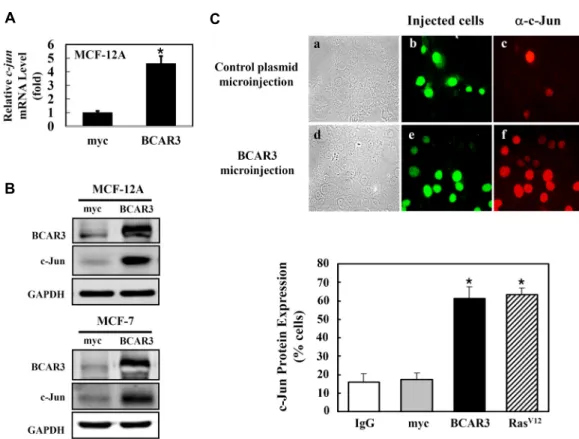
As such, we examined effects of BCAR3 on the expression of both c-Jun mRNA and protein. BCAR3 was transiently transfected in non-tumorigenic human mammary epithelial MCF-12A cells, and c-Jun mRNA were examined in cell-cy- cle arrested cells (Fig. 1A). Overexpression of BCAR3 in- creased c-Jun mRNA expression in MCF-12A cells. Next, we examined c-Jun protein expression in MCF-12A cells and MCF-7 cells and detected the increased expression of c-Jun protein in both cells (Fig. 1B). To further confirm BCAR3- induced c-Jun expression, we microinjected a BCAR3 ex- pression plasmid into cell cycle-arrested MCF-12A cells, and examined the induction of c-Jun expression. As shown in Fig. 1C, microinjection of a CMV-driven mammalian BCAR3 expression plasmid strongly induced c-Jun expression. In contrast, microinjection of control plasmid did not exhibit any effect. Microinjection of oncogenic H-Ras

V12

plasmid as a positive control also induced c-Jun expression. The extent of c-Jun protein induction between BCAR3 and Ras

V12

was similar. These results suggest that BCAR3 itself has mito- genic activity that induces c-Jun protein expression.

BCAR3 regulates proliferation of MCF-12A cells

Next, the functional role of BCAR3 on the proliferation

(4)

A

B

C

Fig. 1. Transient introduction of BCAR3 plasmid by transfection or microinjection induced c-Jun protein expression in cell cycle-ar- rested MCF-12A and MCF-7 cells. (A) MCF-12A and MCF-7 cells were transfected with control myc plasmid or myc-tagged BCAR3 plasmid. After 24 hr incubation in serum-free medium, the expression level of BCAR3 in MCF-12A cells was analyzed by real-time PCR. (B) The cells lysates were immunoblotted with antibodies against BCAR3 and c-Jun. (C) Cell cycle-arrested MCF-12A cells were microinjected into the nucleus with either pcDNA-myc control plasmid (a-c) or myc-BCAR3 plasmid (d-f) and further incubated for 8 hr. The injected cells were fixed and c-Jun protein induction in the injected cells was de- termined by immunostaining. Results are obtained from three independent experiments in which at least 1,200 cells were injected. The data are expressed as the percentage of total injected cells. Bars, the mean result ±SEM. *p<0.05 relative to control myc plasmid injected cells.

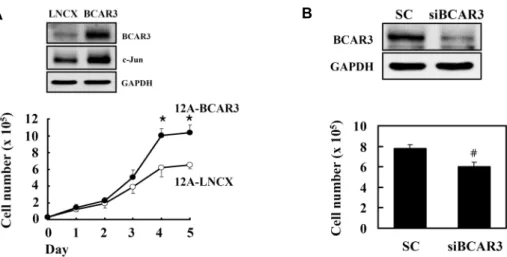
of MCF-12A cells was examined. Stably BCAR3-expressed MCF-12A cells (12A-BCAR3) were selected and its pro- liferation was compared with control LNCX vector MCF- 12A cells (12A-LNCX). BCAR3 expression was confirmed and, as expected, c-Jun protein expression was increased by BCAR3 overexpression (Fig. 2A). The growth rate of MCF- 12A-BCAR3 cells were two-fold greater than that of control MCF-12A-LNCX cells, suggesting an important role of BCAR3 in breast cell proliferation. To further confirm the role of BCAR3 in breast cell proliferation, BCAR3 in MCF- 12A cells was transiently suppressed using siRNA BCAR3, followed by examination of its effects on cell proliferation.

As shown in Fig. 2B, level of BCAR3 protein was reduced, and rate of MCF-12A growth was also suppressed by 24%.

Similar results were observed in MCF-7 breast cancer cells (data not shown). These results suggest that BCAR3 plays an important role in the proliferation of normal breast MCF-

12A cells as well as breast cancer MCF-7 cells.

BCAR3 activates c-jun promoter and induces DNA synthesis through Ras, Rac and Rho

Having shown that BCAR3 induces c-Jun protein ex- pression and cell proliferation, we assessed whether BCAR3 expression leads to the direct activation of c-jun promoter in MCF-12A cells. BCAR3 was cotransfected with the lucifer- ase cDNA controlled by a promoter containing either c-jun, AP-1, SRE or NF-κB in MCF-12A cells. Oncogenic Ras

V12

plasmid was used as the control. BCAR3 expression led to the activation of c-jun, AP-1 and SRE, but not NF-κB (Fig.

3A). These results suggest that BCAR3 activates the c-jun

promoter in c-Jun protein induction. Interestingly, the in-

tensity of the activation of promoters by BCAR3 was com-

parable to that by oncogenic Ras

V12

, suggesting BCAR3 may

have strong mitogenic activity even in the absence of any

(5)

A B

Fig. 2. Effects of BCAR3 on proliferation of MCF-12A cells. (A) MCF-12A cells were stably transfected with 50 ng of BCAR3 (12A- BCAR3) or empty LNCX vector (12A-LNCX), and clones were obtained after G418 selection. Proliferation of cloned cells was determined by cell counting at the indicated days. BCAR3 and c-Jun protein expression were measured by antibodies.

(B) MCF-12A cells were transiently transfection with either scramble siRNA or BCAR3 siRNA (100 nM) for 24 hr. The ex- pression level of BCAR3 was analyzed by anti-BCAR3. Proliferation of the siRNA transfected MCF-12A cells was determined by cell counting after 24 hr. Results are obtained from three independent experiments. Bars, the mean result ±SEM. *p<0.05 relative to control vector LNCX transfected cells and

#

p<0.05 relative to control siRNA transfection.

oncogenic mutation.

Next, we investigated the downstream pathway of BCAR3 signaling on activation of c-jun promoter (Fig. 3B). The BCAR3 expression plasmid with inhibitory materials was co-transfected into MCF-12A cells along with a reporter con- struct controlled by the c-jun promoter. BCAR3-induced acti- vation of the c-jun promoter was inhibited by co-transfected dominant-negative mutants of H-Ras (Ras

N17

), Rac1 (Rac1

N17

) and RhoA (RhoA

N19

). These results suggest that BCAR3- mediated c-jun promoter activation requires small GTPases, such as Ras, Rac and Rho. The results described above dem- onstrated that BCAR3 over-expression significantly in- creased proliferation of MCF-12A cells. Therefore, we as- sessed whether BCAR3-mediated G1/S cell cycle progression requires the small GTPases, such as Ras, Rac and Rho. We co-injected BCAR3 plasmid with dominant-negative Ras

N17

, Rac1

N17

and RhoA

N19

, and examined the induction of c-Jun protein expression. As shown in Fig. 3C, microinjection of a CMV-driven, myc-tagged BCAR3 expression plasmid strongly induced c-Jun protein expression, and the co-in- jected Ras

N17

completely inhibited BCAR3-induced c-Jun protein expression, while Rac1

N17

and RhoA

N19

partially in- hibited c-Jun protein expression. Taken together, these re- sults suggest that BCAR3 itself has mitogenic activity that activates c-Jun gene expression, and that BCAR3 mitogenic signaling requires Ras, Rac and Rho.

BCAR3 is differentially involved in c-Jun protein expression induced by EGF, but not by IGF-1

Next, we examined a functional role of BCAR3 in c-Jun protein expression stimulated by EGF and IGF-1, which are important mitogens in breast cancer cells. Using siRNA BCAR3, we transiently suppressed the expression of BCAR3 in MCF-12A cells and examined its effects on growth fac- tor-induced c-Jun protein expression (Fig. 4A). EGF and IGF-1 induced c-Jun protein expression. While EGF-induced c-Jun expression was suppressed by siRNA BCAR3, IGF-1- induced c-Jun expression was unaffected. These results sug- gest that BCAR3 differentially regulates the signaling path- ways of EGF and IGF-1.

To further confirm the differential regulation by BCAR3,

we microinjected BCAR3 inhibitory materials (e.g., an-

ti-BCAR3 antibody and siRNA BCAR3) into cell cycle-ar-

rested MCF-12A cells and examined growth factor induced

c-Jun expression (Fig. 4B). c-Jun expression induced by EGF

was suppressed by microinjection of anti-BCAR3, while

IGF-1-stimulated c-Jun expression was not inhibited. In ad-

dition, microinjection of siRNA BCAR3 inhibited EGF-in-

duced c-Jun expression. In the controls, microinjection of in-

hibitory anti-Ras antibody inhibited c-Jun expression by both

EGF and IGF-1. These results demonstrate that BCAR3 is

directly involved in c-Jun expression by EGF but not by

IGF-1. Our results demonstrate that BCAR3 is differentially

involved c-Jun expression induced by EGF and IGF-1.

(6)

A

B

C

Fig. 3. BCAR3 activates c-jun promoter through Ras, Rac and Rho in MCF-12A cells. (A) MCF-12A cells were transfected with either control myc plasmid, BCAR3 plasmid or oncogenic H-Ras

V12

plasmid. All transfections included reporter plasmid of c-jun, SRE, AP-1 or NK-κB. Luciferase activity was normalized to a vector control set to a value of 1. (B) MCF-12A cells were transfected with BCAR3 or cotransfected with dominant-negative mutants of Ras (Ras

N17

), Rac (Rac1

N17

), or RhoA (RhoA

N19

). All transfections included the c-jun-Luc reporter plasmid. Luciferase activity was normalized to a vector control set to a value of 1. Results are obtained from three independent experiments. (C) Serum-starved MCF-12A cells were injected with a BCAR3 expression construct alone or plus Ras

N17

, Rac1

N17

, or RhoA

N19.

c-Jun protein expression in the injected cells was determined in which at least 1,200 cells were injected. The data are expressed as the percentage of total injected cells.

Bars, the mean result ±SEM. *p<0.05 relative to control myc plasmid transfected cells,

#

p<0.05 relative to only BCAR3 plasmid transfection and **p<0.05 relative to only BCAR3 plasmid injected cells.

A

B

Fig. 4. BCAR3 differentially regulated c-Jun expression induced by EGF and IGF-1. (A) MCF-12A cells were transiently transfected with negative control or BCAR3 siRNA (100 nM) for 24 hr. After transfection, cells were starved with serum-free media for 4 hr, and stimulated with either EGF (10 ng/ml) or IGF-1(10 ng/ml) for 5 min. Levels of c-Jun protein expression were determined by immunoblotting. (B) Serum-starved MCF-12A cells were microinjected with the indicated inhibitory materials including anti-BCAR3 antibody or BCAR3 siRNA or anti-Ras antibody, and stimulated with either EGF or IGF-1 for 4 hr.

c-Jun protein expression in the injected cells was determined by immunostaining with anti-c-Jun antibody in which at least 1,200 cells were injected. The data are expressed as the percentage of total injected cells. Bars, the mean result ±SEM. *p<0.05 relative to control IgG-injected cells.

Discussion

BCAR3 overexpression has been known to increase pro- liferation and motility of breast cancer cell lines [8, 15, 20,

23]. However, the mechanism underlying BCAR3-mediated

proliferation of breast cancer cells remains unclear. In this

study, we report that BCAR3 plays a functional role in the

proliferation of normal non-tumorigenic human breast

(7)

MCF-12A cells. Stable expression of BCAR3 in MCF-12A cells increased proliferation, while depletion of BCAR3 by its siRNA decreased cell proliferation. Previously, we re- ported that microinjection of the BCAR3 gene into cell-cycle arrested MCF-12A cells induced cell cycle progression [16].

Therefore, we conclude that BCAR3 regulates proliferation of normal and tumorigenic human breast cells.

In order to understand the molecular mechanism of BCAR3-regulated cell proliferation, we examined whether BCAR3 regulates c-Jun transcription factors. We found that BCAR3 directly induced c-Jun protein expression in both transfected cells and microinjected cells. This induction of c-Jun was mediated through activation of c-Jun promoter.

BCAR3 has been shown to activate the cyclin D1 promoter [4, 15], and c-Jun transcription factor is known to regulate the expression of cyclin D1, a critical regulator of cell cycle progression. We also observed that BCAR3 induced cyclin D1 protein expression (data not shown). Therefore, c-Jun protein induction by BCAR3 may be important in increasing expression of cyclin D1, resulting in the proliferation of nor- mal and cancer breast cells. Our results imply that BCAR3- mediated induction of c-Jun expression and cyclin D1 ex- pression could in part be responsible for tamoxifen resist- ance.

c-Jun also acts as a positive regulator of mitogenic re- sponses to growth factors such as EGF and IGF-1 in cell cycle progression [1, 2, 11]. In this study, we report that c-Jun ex- pression induced by growth factor requires BCAR3. When anti-BCAR3 antibody, BCAR3-SH2, or BCAR3 siRNA was introduced to MCF-12A cells by either single cell micro- injection or transient transfection, the ability of EGF (but not IGF-1) to stimulate c-Jun expression was differentially abrogated. Previously, we reported that BCAR3 plays an im- portant role in DNA synthesis stimulated by EGF, but not IGF-1 [16]. EGF and IGF-1 are important mitogenic growth factors in enhancing breast cancer cell proliferation as well as in inducing tamoxifen resistance [3, 10, 12, 18]. Taken to- gether, these results are consistent with the hypothesis that BCAR3 is an important and necessary signaling molecule mediating the mitogenic effect of EGF, but not IGF-1.

In this study, we demonstrated that both BCAR3-mediat- ed c-Jun promoter activation and BCAR3-stimulated DNA synthesis require small GTPases including Ras, Rac1 and RhoA. Among three functional domains of BCAR3, the car- boxy-terminal domain has homology with the Cdc25 family of Ras GDP-exchange factors (GEF domains) and activates

various Ras-like small GTPases. BCAR3/AND-34 promotes GDP-GTP exchange on Ral, R-Ras and Rap1 but not on H-Ras [9]. In addition, BCAR3-dependent growth of ZR-75-1 breast cancer cells in the presence of anti-estrogen was de- pendent on PI3K-mediated Rac1 activation [4, 8]. Therefore, small GTPases may play a critical role in c-Jun expression and DNA synthesis induced by BCAR3.

In summary, our data suggest that BCAR3 plays an im- portant role in cell cycle progression and c-Jun induction in normal human breast cells. In addition, BCAR3 is an im- portant signal transducer of EGF, leading to c-Jun expression. In contrast, BCAR3 is not involved in IGF-1 signaling. Lastly, BCAR3 itself transmits a mitogenic signal requiring Ras, Rac, and Rho.

Acknowledgement

This work was supported by a 2-Year Research Grant of Pusan National University.

References

1. Alani, R., Brown, P., Binetruy, B., Dosaka, H., Rosenberg, R. K., Angel, P., Karin, M. and Birrer, M. J. 1991. The trans- activating domain of the c-Jun proto-oncoprotein is required for cotransformation of rat embryo cells. Mol. Cell. Biol. 11, 6286-6295.

2. Babu, R. L., Naveen Kumar, M., Patil, R. H., Devaraju, K.

S., Ramesh, G. T. and Sharma, S. C. 2013. Effect of estrogen and tamoxifen on the expression pattern of AP-1 factors in MCF-7 cells: role of c-Jun, c-Fos, and Fra-1 in cell cycle regulation. Mol. Cell. Biochem. 380, 143-151.

3. Boyd, D. B. 2003. Insulin and cancer. Integr. Cancer Ther.

2, 315-329.

4. Cai, D., Iyer, A., Felekkis, K. N., Near, R. I., Luo, Z., Chernoff, J., Albanese, C., Pestell, R. G. and Lerner, A. 2003.

AND-34/BCAR3, a GDP exchange factor whose over- expression confers antiestrogen resistance, activates Rac, PAK1, and the cyclin D1 promoter. Cancer Res. 63, 6802- 6808.

5. Cross, A. M., Wilson, A. L., Guerrero, M. S., Thomas, K.

S., Bachir, A. I., Kubow, K. E., Horwitz, A. R. and Bouton, A. H. 2016. Breast cancer antiestrogen resistance 3-p130Cas interactions promote adhesion disassembly and invasion in breast cancer cells. Oncogene advance online publication, 25 April 2016 (DOI:10.1038/onc.2016.123).

6. Domann, F. E., Levy, J. P., Birrer, M. J. and Bowden, G.

T. 1994. Stable expression of a c-JUN deletion mutant in two malignant mouse epidermal cell lines blocks tumor for- mation in nude mice. Cell Growth Differ. 5, 9-16.

7. Early Breast Cancer Trialists' Collaborative 2011. Relevance

(8)

of breast cancer hormone receptors and other factors to the efficacy of adjuvant tamoxifen: patient-level meta-analysis of randomised trials. Lancet 378, 771-784.

8. Felekkis, K. N., Narsimhan, R. P., Near, R., Castro, A. F., Zheng, Y., Quilliam, L. A. and Lerner, A. 2005. AND-34 acti- vates phosphatidylinositol 3-kinase and induces anti-estro- gen resistance in a SH2 and GDP exchange factor-like do- main-dependent manner. Mol. Cancer Res. 3, 32-41.

9. Gotoh, T., Cai, D., Tian, X., Feig, L. A. and Lerner, A. 2000.

p130Cas regulates the activity of AND-34, a novel Ral, Rap1, and R-Ras guanine nucleotide exchange factor. J. Biol. Chem.

275, 30118-30123.

10. Ibrahim, Y. H. and Yee, D. 2004. Insulin-like growth factor-I and cancer risk. Growth Horm. IGF Res. 14, 261-269.

11. Johnson, R., Spiegelman, B., Hanahan, D. and Wisdom, R.

1996. Cellular transformation and malignancy induced by ras require c-jun. Mol. Cell. Biol. 16, 4504-4511.

12. Lo, H. W., Hsu, S. C. and Hung, M. C. 2006. EGFR signaling pathway in breast cancers: from traditional signal trans- duction to direct nuclear translocalization. Breast Cancer Res.

Treat. 95, 211-218.

13. Mace, P. D., Wallez, Y., Dobaczewska, M. K., Lee, J. J., Robinson, H., Pasquale, E. B. and Riedl, S. J. 2011. NSP-Cas protein structures reveal a promiscuous interaction module in cell signaling. Nat. Struct. Mol. Biol. 18, 1381-1387.

14. Meng, Q. and Xia, Y. 2011. c-Jun, at the crossroad of the signaling network. Protein Cell 2, 889-898.

15. Near, R. I., Zhang, Y., Makkinje, A., Vanden Borre, P. and Lerner, A. 2007. AND-34/BCAR3 differs from other NSP homologs in induction of anti-estrogen resistance, cyclin D1 promoter activation and altered breast cancer cell morphol- ogy. J. Cell. Physiol. 212, 655-665.

16. Oh, M. J., van Agthoven, T., Choi, J. E., Jeong, Y. J., Chung, Y. H., Kim, C. M. and Jhun, B. H. 2008. BCAR3 regulates EGF-induced DNA synthesis in normal human breast MCF-12A cells. Biochem. Biophys. Res. Commun. 375, 430-434.

17. Oh, M. J., Yi, S. J., Kim, H. S., Kim, J. H., Jeong, Y. H., van Agthoven, T. and Jhun, B. H. 2013. Functional roles of BCAR3 in the signaling pathways of insulin leading to DNA synthesis, membrane ruffling and GLUT4 translocation.

Biochem. Biophys. Res. Commun. 441, 911-916.

18. Pietras, R. J. 2003. Interactions between estrogen and growth factor receptors in human breast cancers and the tumor- as- sociated vasculature. Breast J. 9, 361-373.

19. Schiff, R., Reddy, P., Ahotupa, M., Coronado-Heinsohn, E., Grim, M., Hilsenbeck, S. G., Lawrence, R., Deneke, S., Herrera, R., Chamness, G. C., Fuqua, S. A., Brown, P. H.

and Osborne, C. K. 2000. Oxidative stress and AP-1 activity in tamoxifen-resistant breast tumors in vivo. J. Natl. Cancer Inst. 92, 1926-1934.

20. Schrecengost, R. S., Riggins, R. B., Thomas, K. S., Guerrero, M. S. and Bouton, A. H. 2007. Breast cancer antiestrogen resistance-3 expression regulates breast cancer cell migra- tion through promotion of p130Cas membrane localization and membrane ruffling. Cancer Res. 67, 6174-6182.

21. Shaulian, E. and Karin, M. 2002. AP-1 as a regulator of cell life and death. Nat. Cell Biol. 4, E131-136.

22. Smith, L. M., Wise, S. C., Hendricks, D. T., Sabichi, A. L., Bos, T., Reddy, P., Brown, P. H. and Birrer, M. J. 1999. cJun overexpression in MCF-7 breast cancer cells produces a tu- morigenic, invasive and hormone resistant phenotype.

Oncogene 18, 6063-6070.

23. van Agthoven, T., Godinho, M. F., Wulfkuhle, J. D., Petricoin 3rd, E. F. and Dorssers, L. C. 2012. Protein pathway activa- tion mapping reveals molecular networks associated with antiestrogen resistance in breast cancer cell lines. Int. J.

Cancer 131, 1998-2007.

24. van Agthoven, T., van Agthoven, T. L., Dekker, A., van der Spek, P. J., Vreede, L. and Dorssers, L. C. 1998. Identification of BCAR3 by a random search for genes involved in anti- estrogen resistance of human breast cancer cells. EMBO J.

17, 2799-2808.

25. Vleugel, M. M., Greijer, A. E., Bos, R., van der Wall, E. and van Diest, P. J. 2006. c-Jun activation is associated with pro- liferation and angiogenesis in invasive breast cancer. Hum.

Pathol. 37, 668-674.

26. Wallez, Y., Riedl, S. J. and Pasquale, E. B. 2014. Association of the breast cancer antiestrogen resistance protein 1 (BCAR1) and BCAR3 scaffolding proteins in cell signaling and antiestrogen resistance. J. Biol. Chem. 289, 10431-10444.

27. Wilson, A. L., Schrecengost, R. S., Guerrero, M. S., Thomas, K. S. and Bouton, A. H. 2013. Breast cancer antiestrogen resistance 3 (BCAR3) promotes cell motility by regulating actin cytoskeletal and adhesion remodeling in invasive breast cancer cells. PLoS ONE 8, e65678.

28. Xu, Y., Zou, S. T., Zhu, R., Li, W., Gu, C. W., Wei, S. H., Xie, J. M. and Wu, H. R. 2013. Inhibition of proliferation of estrogen receptor positive MCF7 human breast cancer cells by tamoxifen through cJun transcription factors. Mol Med. Rep. 7, 1283-1287.

29. Zhang, Y., Pu, X., Shi, M., Chen, L., Song, Y., Qian, L., Yuan, G., Zhang, H., Yu, M., Hu, M., Shen, B. and Guo, N. 2007.

Critical role of c-Jun overexpression in liver metastasis of human breast cancer xenograft model. BMC Cancer 7, 145.

30. Zhao, C., Qiao, Y., Jonsson, P., Wang, J., Xu, L., Rouhi, P., Sinha, I., Cao, Y., Williams, C. and Dahlman-Wright, K. 2014.

Genome-wide profiling of AP-1-regulated transcription pro-

vides insights into the invasiveness of triple-negative breast

cancer. Cancer Res. 74, 3983-3994.

(9)

초록:정상적인 인간유방상피세포인 MCF-12세포에서 유방암 항에스토젠 내성인자-3 (BCAR3)에 의 한 c-Jun 발현 유도 연구

오명주

2

․김지현

1

․전병학

1

*

(

1

부산대학교 나노과학기술대학,

2

서울식품의약청 유해물질분석과)

타목시펜과 같은 항에스트로젠은 ER 양성의 초기 유방암 환자에게 사용되고 있다. 그러나 대부분의 환자에서 이 항에스트로젠에 대한 내성 발현은 불가피하게 발생한다. BCAR3 유전자는 사람의 에스트로젠 의존성 유방암에 서 tamoxifen 내성유도를 야기하는 단백질로 발견되었다. 우리들은 이전에 이 BCAR3 유전자가 세포주기 진행과 EGF와 인슐린에 의한 DNA 합성 신호전달경로를 조절한다고 보고하였다. 본 연구에서는, 비종양성 정상적인 인 간유방상피세포인 MCF-12A세포에서 c-Jun 전자의 조절에 대한 BCAR3유전자의 기능적인 역할을 조사하였다.

BCAR3의 일시적인 발현 또는 지속적인 발현이 c-Jun mRNA와 단백질의 발현을 증가하는 것을 발견하였다. 또한

BCAR3 발현 유전자의 미세주사에 의해 세포 증식이 증가하였다. 이 c-Jun의 발현 증가는 promoter의 활성화를

통해 일어난다. 또한 BCAR3에 의한 c-Jun 발현 유도가 억제성 Ras, Rac, Rho에 의해 억제되었다. 다음으로 EGF

성장인자에 의한 c-Jun 발현 유도에 대한 BCAR3의 영향을 단일 세포 미세주사법에 의해 조사하였다. BCAR3 항

체, BCAR3의 siRNA와 같은 BCAR3의 기능을 억제할 수 있는 물질들을 세포로 미세주사하면 EGF에 의한 c-Jun

의 발현을 억제하였지만, IGF-1 성장인자에 의한 c-Jun 발현은 억제하지 않았다. 이러한 결과들로부터 BCAR3는

c-Jun 단백질 발현 유도와 세포 증식에 중요한 역할을 하며, 여기에는 Ras, Rac, Rho와 같은 GTPase들이 필요하다

는 것을 발견하였다.

수치

Fig.  1.  Transient  introduction  of  BCAR3  plasmid  by  transfection  or  microinjection  induced  c-Jun  protein  expression  in  cell  cycle-ar- cycle-ar-rested  MCF-12A  and  MCF-7  cells
Fig.  2.  Effects  of  BCAR3  on  proliferation  of  MCF-12A  cells.  (A)  MCF-12A  cells  were  stably  transfected  with  50  ng  of  BCAR3  (12A-  BCAR3)  or  empty  LNCX  vector  (12A-LNCX),  and  clones  were  obtained  after  G418  selection
Fig.  3.  BCAR3  activates  c-jun  promoter  through  Ras,  Rac  and  Rho  in  MCF-12A  cells

참조

관련 문서