서 론
환경에서 많은 오염 물질은 단일 물질 상태보다 혼합물의 형태
로 존재함에도 불구하고 기존에는 단일 화학 물질에 대한 연구를 바탕으로 오염 물질의 환경 내 농도를 규제해 왔다(Kortenkamp and Faust, 2018). 이처럼 복합적으로 존재하는 오염 물질은 서로
JMLS
벤조피렌과 수은에 대한 기수산 물벼룩
Diaphanosoma celebensis
의 복합 독성 영향유제원·조하영·전민정·이영미* 상명대학교 자연과학대학 생명과학과
Combined Toxicity in the Brackish Water Flea
Diaphanosoma celebensisExposed to Benzo[a]pyrene and Mercury
Je-Won Yoo, Hayoung Cho, Jeon Min Jeong, Young-Mi Lee*
Department of Life Science, College of Natural Sciences, Sangmyung University, Seoul 03016, Korea
Corresponding Author Young-Mi Lee
Department of Life Science, College of Natural Sciences, Sangmyung University, Seoul 03016, Korea
E-mail : [email protected]
Received : September 20, 2019 Revised : September 23, 2019 Accepted : December 04, 2019
다환방향족탄화수소류(PAHs)는 해양 환경에 오랜 기간 잔류하며 해양 생태계에 유해한 보편적 인 환경 오염 물질이다. PAH류는 대부분 해양 환경에서 금속을 비롯한 다양한 오염 물질과 복 합적으로 존재하지만 혼합 오염 물질이 개체에 미치는 영향에 대한 연구는 부족하다. 본 연구 는 HgCl2와 Benzo[a]pyrene (B[a]P)이 해양 생물에 미치는 영향을 개체 수준에서 평가하기 위하 여 기수산 물벼룩(Diaphanosoma celebensis)을 이용하여 단일 및 혼합 급성 독성 시험을 진행 하였다. 혼합 독성 평가에 사용한 혼합물의 농도는 단일 독성 시험을 통하여 얻은 각각의 LC50
을 기준으로 3:7 (Mixture A), 5:5 (Mixture B), 7:3 (Mixture C)의 비율로 혼합하여 결정하였다. 실 험 결과 B[a]P와 HgCl2의 48 h - LC50은 각각 25.75 μg l-1와 3.6 μg l-1로 나타났다. 혼합 독성 평 가 결과 Mixture A, B, C에서 TU는 각각 1.06, 0.83, 0.96로 나타났다. 이는 Mixture A, B, C가 CA 모델에 따라 작용함을 보여주며, HgCl2와 B[a]P의 상호작용을 연구하기 위해 CA 모델을 사용 하는 것이 적합할 것으로 생각된다. 본 연구는 금속과 PAH류의 혼합 독성 평가를 위한 기초 자료가 될 수 있을 것이다.
Polycyclic aromatic hydrocarbons (PAHs) are persistent and commonly detected in marine ecosystem. They coexist with a various contaminants including heavy metals in real environment, but most studies have been still focused on single effects of these contaminants to aquatic organisms. In this study, the single and combined effects of benzy[a]pyrene (B[a]P) and HgCl2 were investigated in the brackish water flea, Diaphanosoma celebensis. For combined effect study, three mixtures A (3:7), B (5:5), and C (7:3) of benzy[a]pyrene (B[a]P) and HgCl2 were determined by 48 h - LC50 values of single exposure. Combined effects of both chemicals were estimated by concentration addition (CA) model and independent action (IA) model. As results, 48 h - LC50 values of benzy[a]pyrene (B[a]P) and HgCl2 was 25.75 μg l-1 and 3.6 μg l-1, respectively. TU values of mixture A, B, and C were 1.06, 0.83, and 0.96, respectively, indicating additive effects of mixtures using CA model. This study will be helpful as basic data for understanding the combined effects of contaminants in marine environment.
Keywords: Combined effects(혼합 독성), Mercury(수은), Benzo[a]pyrene(벤조[a]피렌), Concentration addition model(농도 가산 모델), Independent action model(독립 기전 모델)
상호작용하여 상승(synergy), 길항(antagonism), 가산(addition)적인 효과를 일으킬 수 있다(Xie et al., 2006; Meng et al., 2008). 실제로 해양 식물 플랑크톤인 Dunaliella tertiolecta에 제초제, 살충제, 살 균제를 복합적으로 노출시켜 상승작용을 분석한 연구(DeLorenzo and Serrano, 2003)와 카드뮴과 벤조[a]피렌을 갯지렁이인 Hediste diversicolor에 복합적으로 노출시켜 생체 변화 및 항산화 반응을 분석한 연구(Banni et al., 2009) 등 다양한 해양 생물을 이용한 중 금속과 농약, 의약품, 위생용품, 제초제와 같은 여러 화학 물질의 혼합 독성 연구가 진행되고 있다(Backhaus et al., 2011; Deruytter et al., 2017; Mercurio et al., 2018).
대기 및 토양 환경으로부터 유출된 오염 물질들은 토양의 지 하수, 담수, 강우를 통해 최종적으로 해양에 유입된다(Ahn et al., 2005). 대표적으로 중금속과 다환방향족탄화수소류(Polycyclic Aro- matic Hydrocarbons, PAHs)는 해양 환경에 보편적으로 존재하는 오염 물질이다(Gauthier et al., 2014). 카드뮴, 납, 비소, 수은과 같 은 중금속은 생물체에서 산화적 스트레스를 야기하며, DNA, 지질, 단백질 등과 같은 생체 고분자를 손상시키고, 신경 독성 및 유전 독성 등을 유발한다(Flora et al., 2008; Badr and El-Habit, 2018). 특 히 수은은 해양 환경에 널리 퍼져있으며, 생물체 내에 축적되기 쉬운 대표적인 중금속이다(Abbott et al., 2017). Kim 등 (2017b)에 따르면 수은을 노출시킨 담수산 물벼룩(Daphnia magna)에서 산 화적 스트레스가 증가하는 것을 확인하였으며, Puga 등 (2016)에 따르면 수은을 처리한 백색 참돔(Diplodus sargus)의 뇌에서 수은 의 축적 및 시신경의 손상이 관찰되었다. PAH류 및 그 대사체 또 한 생물체에서 산화적 스트레스를 유발하며, 생식 독성, 발달 장 애, 면역 독성 등을 유발하는 것으로 알려져 있다(reviewed by Abdel-Shafy and Mansour, 2016). B[a]P는 대표적인 PAH류 중 하 나로, Palanikumar 등 (2012)의 연구 결과, B[a]P에 노출된 갯농어
Chanos chanos에서 지질과산화물과 카탈라아제의 양이 증가하였
으며 아세틸콜린에스터라아제 활성이 감소하였다. 이는 B[a]P가 산화적 스트레스 및 신경 독성을 야기하는 것을 의미한다.
물벼룩류(지각목, Cladocera)는 수생 생태계의 먹이사슬에서 1차 소비자로서 생산자와 최종 소비자를 연결해주는 에너지 전달자 로 중요한 역할을 담당하며(Lal et al., 1984), 다양한 유해 화학 물질에 대한 생물 독성 평가에 주로 사용되어 왔다(Freitas and Rocha, 2011; Jemec et al., 2016). 기수산 물벼룩인 Diaphanosoma celebensis는 열대 아시아 지역에서 주로 서식하며 광염성을 나타 내어 연안 생태계 모니터링에 적합하다(Korovchinsky, 1989). D.
celebensis 성체의 크기는 413 μm에서 1,112 μm으로 크기가 작아 실험실에서 관리하기가 쉬우며 4~5일의 짧은 생활사를 가지고 있 어 번식력이 높고, 단성생식(parthenogenesis)을 함에 따라 개체 간 유전적 동질성이 높아 독성 물질 평가 연구에 적합하다(Marcial and Hagiwara, 2007; Kim et al., 2018).
본 연구에서는 기수산 물벼룩 D. celebensis를 이용하여 수은과 B[a]P에 대한 단일 및 혼합 노출에 따른 급성 독성 영향을 조사하
였다. 본 연구의 목적은 두 물질에 혼합 노출되었을 때 독성 영향 을 이해하고, 향후 보다 다양한 물질에 대한 복합 독성 연구를 위 한 기초 자료로 활용하고자 한다.
재료 및 방법 1. 시험 물질
Benzo[a]pyrene (B[a]P; purity, ≥96%)와 HgCl2 (purity, ≥99.5%) 을 포함한 모든 시약은 Sigma-Aldrich (St. Louis, MO, USA)에서 구 입하여 사용하였다. 노출 실험에 사용된 B[a]P와 HgCl2의 stock solution은 각각 1 mg ml-1와 10 mg ml-1 농도가 되도록 dimethyl- sulfoxide (DMSO; Sigma-Aldrich, St. Louis, MO, USA)에 희석하여 제조하였다.
2. 시험생물
본 연구에서 실험생물로 사용한 D. celebensis는 상명대학교 분 자 독성학 실험실에서 배양하고 있는 것을 사용하였다. 배양액은 인공해수염(Instant Ocean; Aquariumsystems, Sarrebourg, France) 을 증류수에 녹인 후 0.2 μm 필터로 걸러 15 psu의 인공해수를 제조하였다. D. celebensis의 사육을 위하여 수온은 25 ± 1℃, 광주 기는 12 : 12 (light : dark)로 유지하였다. 밀도는 1개체 당 2 ml가 넘지 않도록 유지하였으며, 먹이는 녹조류인 Chlorella vulgaris를 1.0~3.0 × 10⁵ cells ml-1의 밀도로 매일 공급하였다.
3. 단일 물질 노출 시험
단일 물질에 대한 독성 시험은 OECD test guideline 202 (TG202;
OECD, 2004)를 변형하여 48시간 노출 후 치사율을 관찰하였다. D.
celebensis는 neonate (<24 h)를 3일 간 배양하여 4일 차 개체를 사용하였다. Six-well cell culture plate (SPL life science, Korea)에 4일 차 D. celebensis를 5마리씩 넣은 후 5 ml의 working solution을 처 리하였다. 실험은 농도 당 4회 반복하였으며, 각각 20개체를 사 용하였다. Working solution의 농도는 B[a]P 1.875~30 μg l-1, HgCl2
3.75~60 μg l-1로 처리하였다. 이때 최종 DMSO 농도는 0.01%를 넘지 않았다. 노출 기간 동안 먹이는 공급하지 않았다.
4. 혼합 물질 노출 시험
B[a]P와 HgCl2의 혼합 물질에 대한 독성 시험은 Kortenkamp 등 (2009)이 언급한 방법에 따라 단일 물질 시험을 통해 얻은 LC50을 근거로 하여 진행하였다. 단일 물질의 LC50을 기준으로 하여 혼합 물을 제조하였으며, B[a]P : HgCl2의 LC50 비율을 3:7 (Mixture A), 5:5 (Mixture B), 7:3 (Mixture C)로 총 3가지 혼합물에 대해 노출을 진
행하였다. 노출 시험은 단일 물질 시험과 동일한 방식으로 진행 하였다. 혼합 물질의 농도는 각각 2.56~40.98 μg l-1 (Mixture A), 3.67~ 58.7 μg l-1 (Mixture B), 4.78~76.42 μg l-1 (Mixture C)로 하였다.
5. 혼합 물질 독성 예측값 계산 5.1 농도 가산 모델
농도 가산 모델(Concentration Addition 모델; CA 모델)은 두 가 지 이상의 오염 물질이 동일한 작용 기작(mode of action)을 가질 때 혼합 물질에 대한 독성 영향을 예측하기 위해 사용되는 모델 이다. 혼합 물질에 대한 독성 영향은 식 (1)을 통해 계산하였다 (Puckowski et al., 2017).
(1)
C 는 혼합 물질에 포함되어 있는 단일 물질 의 농도를 의미 하며, EC50 물질 에 대한 EC50 값을 의미한다.
혼합 물질의 독성을 예측하기 위해 toxic unit (TU)의 개념이 이 용된다. 특정 반응수준(예, EC50, LC50, LC10)을 나타내는 물질의 농 도를 1 TU로 정의하며, 일반적으로 EC50 또는 LC50 값을 나타내는 농도를 1 toxic unit (1 TU)으로 정의한다(Broderius et al., 1995). 혼 합 물질의 TU는 식 (2)를 통해 계산하였다.
(2)
TU 는 혼합 물질에 포함되어 있는 단일 물질(물질 )의 TU를 의미한다. 예측된 TU와 실제 TU를 비교하여 혼합 물질의 영향을 판단할 수 있다. 혼합 물질의 TU가 0.8~1.2인 경우 가산작용(addi- tive effect)를 나타낸다고 보며, 혼합물의 TU가 0.8보다 낮으면 상 승작용(synergistic effect), 1.2보다 높은 경우를 길항작용(antagon- istic effect)로 본다(Broderius et al., 1995; Puckowski et al., 2017).
5.2 독립 기전 모델
독립 기전 모델(Independent Action 모델; IA 모델)은 CA 모델의 대안 중 하나이며, 혼합물이 서로 다른 작용 기작을 가지는 물질 로 구성된 경우 혼합물의 독성을 예측하기 위해 사용하는 모델이 다(Kortenkamp et al., 2009). IA 모델에 의한 독성의 예측값은 식 (3)을 통해 계산하였다.
(3)
E(C)는 개별 물질이 혼합물 내에 존재하는 농도에서 나타내 는 영향이며, E(Cmix)는 혼합 물질에 의한 영향(0부터 1)을 의미 한다.
IA 모델을 적용하기 위해서는 개별 물질들이 서로 상호작용하 지 않고, 동일한 종말점(end point)를 가져야 한다(Backhaus and Faust, 2012). 일반적으로 개별 물질의 농도가 무영향관찰농도(No Observed Effect Concentration, NOEC) 이하일 경우 혼합물은 독 성이 없다고 가정한다.
6. 통계분석
단일 물질 및 혼합 물질의 급성 노출 실험에 따른 LC50 값은 EPA probit analysis program (version 1.5)를 통해 구하였다. IA 모델 을 이용한 LC50을 예측하기 위해 R language (version 3.6.1, www.r- progect.org)를 이용하였다. EPA probit analysis program을 통해 구 한 LC01-LC99을 R language의 drc packages를 이용해 dose-response curve를 만들었다. 단일 물질에 대한 dose-response curve를 이용 해 LC 값에 대한 식을 얻어낸 후 식 (3)을 이용해 IA 모델의 LC50
을 예측하였다.
결 과
1. B[a]P와 HgCl2의 단일 노출에 따른 급성 독성
본 연구에서는 B[a]P와 HgCl2에 48시간 노출된 D. celebensis에 서 B[a]P와 HgCl2의 농도가 증가함에 따라 생존율이 감소하는 것 을 확인하였다(Fig. 1). 48 h - LC50은 각각 25.75 μg l-1 (B[a]P, 95%
CI: 21.03~31.63 μg l-1), 3.60 μg l-1 (HgCl2, 95% CI: 2.92~4.39 μg l-1) 로 계산되었다(Table 1). 단일 물질의 단위무게 당 독성은 HgCl2가 B[a]P에 비해 더 높은 것으로 나타났다.
2. B[a]P와 HgCl2의 혼합 노출에 따른 급성 독성
B[a]P와 HgCl2의 혼합 물질에 대한 노출 결과 단일 물질 시험 과 마찬가지로 농도가 증가함에 따라 생존율이 감소하는 양상을 확인하였다(Fig. 2). 단일 물질 및 혼합물의 LC50과 CA, IA 모델을 이용해 예측한 LC50은 Table 1에 나타내었다. Mixture A, B, C의 48 h - LC50은 각각 10.90 μg l-1 (Mixture A, 95% CI: 8.32~14.34 μg l-1), 12.24 μg l-1 (Mixture B, 95% CI: 9.44~13.12 μg l-1), 18.25 μg l-1 (Mixture C, 95% CI: 15.28~21.76 μg l-1)로 관찰되었다. CA 모델을 통해 예측한 48 h - LC50은 Mixture A, B, C에서 각각 10.25 μg l-1
(TU 1.06), 14.68 μg l-1 (TU 0.83), 19.11 μg l-1 (TU 0.96)로 나타났다 (Fig. 3). Mixture A의 경우 CA 모델을 통해 예측한 값보다 낮은 독성을 보였으며, Mixture B와 C의 경우는 예측값보다 높은 독성 을 나타냈다. 반면 IA 모델을 통해 예측한 48 h - LC50은 14.29 μg l-1 (Mixture A), 22.77 μg l-1 (Mixture B), 26.70 μg l-1 (Mixture C)로 모든 경우에서 실제 값보다 높게 나타났다.
고 찰
D. celebensis에 B[a]P와 HgCl2를 단일 노출한 결과 B[a]P에 비 해 HgCl2의 독성이 강한 것으로 나타났다. 유사한 결과로 담수산
물벼룩(Daphnia magna; <24 h)을 이용한 기존의 연구에 따르면 HgCl2의 경우 48 h - LC50이 0.65~3.82 μg l-1로 보고되었으며 (Okamoto et al., 2014; Kim et al., 2017a), B[a]P의 경우 48 h - LC50
이 4.7~250 μg l-1로 보고되었다(Atienzar et al., 1999; Ikenaka et al., 2013). 이는 HgCl2가 B[a]P에 비해 새각류(Branchiopoda)에서 상대 적으로 높은 독성을 나타내는 것으로 보인다.
본 연구에서는 HgCl2와 B[a]P의 상호작용을 확인하기 위해 단일 물질 시험의 결과를 바탕으로 혼합 독성 시험을 진행하였으며, 혼 합 독성 평가에 이용되는 대표적인 모델인 CA 및 IA 모델의 개념 을 이용해 혼합 물질의 독성값을 예측하였다. 실제 독성의 측정 치는 모든 혼합물에서 IA 모델을 통해 예측한 값보다 독성이 강 Table 1. 48 h - LC50 values and 95% CI (Confidence Interval) of Diaphanosoma celebensis exposed to single and mixture of B[a]P and HgCl2
Compound
LC50 in this study (95% Confidence Interval)
[μg/l]
LC50
CA-Predicted [μg/l]
LC50
IA-Predicted [μg/l]
Benzo[a]pyrene 25.75
CI (21.03~31.63) - -
HgCl2 3.60
CI (2.92~4.39) - -
Mixture A (3:7) 10.90
CI (8.32~14.34) 10.25 14.29
Mixture B (5:5) 12.24
CI (9.44~13.12) 14.68 22.77
Mixture C (7:3) 18.25
CI (15.28~21.76) 19.11 26.70
한 것으로 나타났다. 반면 CA 모델을 통해 예측한 LC50은 IA 모델 을 통한 예측값보다 실제 결과와 유사한 결과를 나타냈다. Mixture
B와 C의 경우 관찰된 TU가 1보다 낮게 나타났으며, 이는 예측한 독성보다 더 높은 독성을 가지는 것을 의미한다. 반면 Mixture A 의 경우 관찰된 TU가 1.06으로 CA 모델을 통해 예측된 독성보다 더 낮은 독성을 가지는 것으로 나타났다(Fig. 3). 하지만 일반적으 로 혼합물의 TU가 0.8~1.2 범위 내에 포함되는 경우 유의미한 상승작용이나 길항작용을 갖지 않는 것으로 판단하기 때문에, 세 가지 혼합물 모두 가산작용(additive effect)을 나타내는 것으로 해 석할 수 있다. Mixture A, B, C 내의 B[a]P 및 HgCl2의 개별 농도가 무영향관찰농도보다 낮거나(B[a]P: 7.5 μg l-1), LC01 값(B[a]P: 8.31 μg l-1, HgCl2: 1.19 μg l-1)의 절반 이하로 존재하는 농도에서 개체의 생 존율에 영향이 나타났다(Fig. 2). 이는 두 물질이 IA 모델에 의해 작용하지 않는 것을 의미한다.
수은은 생물체 내에서 sulfhydryl groups 뿐만 아니라 phos- phoryl, carboxyl, amide, amine groups 등과 결합하여 이러한 작용 기를 갖는 단백질의 작용을 억제할 수 있으며, 활성산소종의 생 성과 DNA 손상 등을 통해 세포 죽음, 신경 독성 등과 같은 광범 위한 독성작용을 야기하는 것으로 알려져 있다(Rice et al., 2014;
Nesci et al., 2016; Kim et al., 2017a). B[a]P 또는 그 대사체 역시 생물체 내에서 지질, 단백질, DNA 등 생체 고분자 물질과 상호작 용하여 손상을 일으키는 것으로 알려져 있으며, 산화적 스트레스 를 야기하고, 면역 독성 및 신경 독성 등 다양한 독성작용을 일으 키는 것으로 알려져 있다(Boysen and Hecht, 2003; Wu et al., 2007;
Das et al., 2016). 이처럼 두 물질이 가지는 광범위한 독성으로 인 해 B[a]P와 HgCl2가 D. celebensis에 복합적으로 노출되었을 때 농 도 부가적인 반응을 나타냈으며 CA 모델에 따라 작용한 것으로 보인다. CA 모델은 IA 모델과 비교해 많은 오염 물질에서 적합성
이 확인되었으며, 비교적 높은 독성값을 예측하기 때문에 많은 연 구자들은 CA 모델의 중요성을 언급하고 있다(Kortenkamp et al., 2009; Backhaus and Faust, 2012; Altenburger et al., 2013; Puckowski et al., 2017). 본 연구의 결과 또한 CA 모델의 적합성을 나타냈으 며, 수은과 B[a]P를 비롯해 광범위한 독성을 나타내는 오염 물질 의 혼합 독성을 평가하기 위해서는 CA 모델을 사용하는 것이 적 합하다고 생각된다.
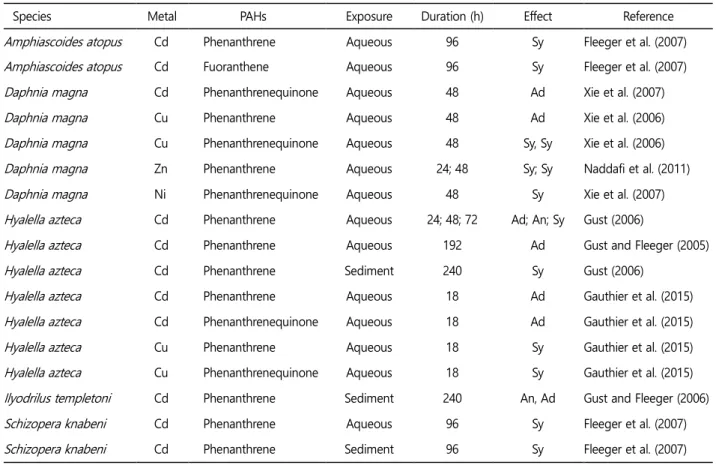
Table 2에서 보는 바와 같이, 기존의 금속과 PAH류의 복합 독성 연구에 따르면 D. magna에서 CdCl2과 phenanthrenequinone의 혼합 독성 시험 결과, 가산작용을 나타냈다(Xie et al., 2007). 또한 CuSO4의 경우, phenanthrene과의 혼합 독성 시험에서 가산작용을 보였으며, phenanthrenequinone과의 조합에서는 상승작용을 나타 냈다(Xie et al., 2006). Gust (2006)의 Hyalella azteca를 이용한 연구 에 따르면 CdCl2과 phenanthrene의 혼합 독성 시험 결과, 처리 기 간에 따라 가산, 길항, 상승작용을 모두 보인 바 있다. 이처럼 수 생 무척추동물에 대한 금속과 PAH류의 혼합 독성은 생물, 물질의 종류, 처리 기간, 처리 방법 등에 따라 상호작용의 종류에 차이를 나타내기 때문에 다양한 생물 및 노출방법을 이용하여 혼합물의
상호작용에 대한 추가적인 연구가 진행되어야 한다.
본 연구에서 기수산 물벼룩 D. celebensis에 B[a]P와 HgCl2를 단 일 및 혼합 노출시킨 결과 생존율에 영향을 미쳤으며, 이를 토대 로 단일 물질 및 혼합물의 48 h - LC50을 결정하였다. CA 모델을 적용한 경우 B[a]P와 HgCl2의 혼합물 3:7, 5:5, 7:3의 TU는 각각 1.06, 0.83, 0.96이었으며 이는 0.8~1.2 범위에 해당되어 농도 가산 효과를 갖는 것으로 나타났다. 두 물질의 혼합 노출의 결과는 IA 모델을 따르지 않는 것으로 확인되었다. 본 연구는 해양에 존재하 는 다양한 오염 물질의 혼합 독성효과를 이해하는데 기초 자료로 활용될 수 있을 것이다.
사 사
본 연구는 상명대학교 대학혁신지원사업 SM-URP 프로그램 (2019-1)의 지원을 받아 수행하였음.
Table 2. Previous studies on combined effects of heavy metals and PAHs to survival of aquatic invertebrates
Species Metal PAHs Exposure Duration (h) Effect Reference
Amphiascoides atopus Cd Phenanthrene Aqueous 96 Sy Fleeger et al. (2007)
Amphiascoides atopus Cd Fuoranthene Aqueous 96 Sy Fleeger et al. (2007)
Daphnia magna Cd Phenanthrenequinone Aqueous 48 Ad Xie et al. (2007)
Daphnia magna Cu Phenanthrene Aqueous 48 Ad Xie et al. (2006)
Daphnia magna Cu Phenanthrenequinone Aqueous 48 Sy, Sy Xie et al. (2006)
Daphnia magna Zn Phenanthrene Aqueous 24; 48 Sy; Sy Naddafi et al. (2011)
Daphnia magna Ni Phenanthrenequinone Aqueous 48 Sy Xie et al. (2007)
Hyalella azteca Cd Phenanthrene Aqueous 24; 48; 72 Ad; An; Sy Gust (2006)
Hyalella azteca Cd Phenanthrene Aqueous 192 Ad Gust and Fleeger (2005)
Hyalella azteca Cd Phenanthrene Sediment 240 Sy Gust (2006)
Hyalella azteca Cd Phenanthrene Aqueous 18 Ad Gauthier et al. (2015)
Hyalella azteca Cd Phenanthrenequinone Aqueous 18 Ad Gauthier et al. (2015)
Hyalella azteca Cu Phenanthrene Aqueous 18 Sy Gauthier et al. (2015)
Hyalella azteca Cu Phenanthrenequinone Aqueous 18 Sy Gauthier et al. (2015) Ilyodrilus templetoni Cd Phenanthrene Sediment 240 An, Ad Gust and Fleeger (2006)
Schizopera knabeni Cd Phenanthrene Aqueous 96 Sy Fleeger et al. (2007)
Schizopera knabeni Cd Phenanthrene Sediment 96 Sy Fleeger et al. (2007)
(Sy - Synergistic effect, Ad - Additive effect, An - Antagonistic effect)
참고문헌
Abbott LC, Moussa EAM, Carl TL, Cortez D, Clayton HL, Holland CS, Lindsay K, Hassan SAH. 2017. Early Exposure to Mercuric Chloride or Methylmercury Alters Zebrafish Embryo (Danio rerio) Development.Poult Fish Wildl Sci05.
Abdel-Shafy HI, Mansour MSM. 2016. A review on polycyclic aromatic hydrocarbons: Source, environmental impact, effect on human health and remediation. Egypt J Pet 25: 107-123.
Ahn JH, Grant SB, Surbeck CQ, DiGiacomo PM, Nezlin NP, Jiang S. 2005. Coastal Water Quality Impact of Stormwater Runoff from an Urban Watershed in Southern California. Environ Sci Technol 39: 5940-5953.
Altenburger R, Backhaus T, Boedeker W, Faust M, Scholze M. 2013.
Simplifying complexity: mixture toxicity assessment in the last 20 years. Environ Toxicol Chem 32: 1685-1687.
Atienzar FA, Conradi M, Evenden AJ, Jha AN, Depledge MH. 1999.
Qualitative assessment of genotoxicity using random ampli- fied polymorphic DNA: Comparison of genomic template stability with key fitness parameters in Daphnia magna ex- posed to benzo[a]pyrene. Environ Toxicol Chem 18: 2275 -2282.
Backhaus T, Faust M. 2012. Predictive environmental risk assess- ment of chemical mixtures: a conceptual framework. Environ Sci Technol 46: 2564-2573.
Backhaus T, Porsbring T, Arrhenius Å, Brosche S, Johansson P, Blanck H. 2011. Single-substance and mixture toxicity of five pharmaceuticals and personal care products to marine peri- phyton communities. Environ Toxicol Chem 30: 2030-2040.
Badr FM, El-Habit O. 2018. Heavy Metal Toxicity Affecting Fertility and Reproduction of Males. Bioenvironmental Issues Affecting Men's Reproductive and Sexual Health 293-304.
Banni M, Bouraoui Z, Clerandeau C, Narbonne JF, Boussetta H.
2009. Mixture toxicity assessment of cadmium and benzo[a]- pyrene in the sea worm Hediste diversicolor. Chemosphere 77: 902-906.
Boysen G, Hecht SS. 2003. Analysis of DNA and protein adducts of benzo[a]pyrene in human tissues using structure-specific methods. Mutat Res 543: 17-30.
Broderius SJ, Kahl MD, Hoglund MD. 1995. Use of joint toxic re- sponse to define the primary mode of toxic action for diverse industrial organic chemicals. Environ Toxicol Chem 14: 1591 -1605.
Das SK, Patel B, Patri M. 2016. Neurotoxic Effect of Benzo[a]pyrene and Its Possible Association with 6-Hydroxydopamine Induced
Neurobehavioral Changes during Early Adolescence Period in Rats. J Toxicol 2016: 1-7.
DeLorenzo ME, Serrano L. 2003. Individual and mixture toxicity of three pesticides; atrazine, chlorpyrifos, and chlorothalonil to the marine phytoplankton species Dunaliella tertiolecta. J Environ Sci Health B 38: 529-538.
Deruytter D, Baert JM, Nevejan N, De Schamphelaere KAC, Janssen CR. 2017. Mixture toxicity in the marine environment: Model development and evidence for synergism at environmental concentrations. Environ Toxicol Chem 36: 3471-3479.
Fleeger JW, Gust KA, Marlborough SJ, Tita G. 2007. Mixtures of metals and polynuclear aromatic hydrocarbons elicit complex, nonadditive toxicological interactions in meiobenthic cope- pods. Environ Toxicol Chem 26: 1677-1685.
Flora SJ, Mittal M, Mehta A. 2008. Heavy metal induced oxidative stress & its possible reversal by chelation therapy. Indian J Med Res 128: 501-523.
Freitas EC, Rocha O. 2011. Acute Toxicity Tests with the Tropical Cladoceran Pseudosida ramosa: The Importance of Using Native Species as Test Organisms. Arch Environ Contam Toxicol 60: 241-249.
Gauthier PT, Norwood WP, Prepas EE, Pyle GG. 2014. Metal-PAH mixtures in the aquatic environment: A review of co-toxic mechanisms leading to more-than-additive outcomes. Aquat Toxicol 154: 253-269.
Gauthier PT, Norwood WP, Prepas EE, Pyle GG. 2015. Metal- Polycyclic Aromatic Hydrocarbon Mixture Toxicity in Hyalella azteca. 2. Metal Accumulation and Oxidative Stress as Inter- active Co-toxic Mechanisms. Environ Sci Technol 49: 11780 -11788.
Gust KA. 2006. Joint Toxicity of Cadmium and Phenanthrene in the Freshwater Amphipod Hyalella azteca. Arch Environ Contam Toxicol 50: 7-13.
Gust KA, Fleeger JW. 2005. Exposure-related effects on Cd bio- accumulation explain toxicity of Cd-phenanthrene mixtures in Hyalella azteca. Environ Toxicol Chem 24: 2918-2926.
Gust KA, Fleeger JW. 2006. Exposure to Cadmium-Phenanthrene Mixtures Elicits Complex Toxic Responses in the Freshwater Tubificid Oligochaete, Ilyodrilus templetoni. Arch Environ Contam Toxicol 51: 54-60.
Ikenaka Y, Sakamoto M, Nagata T, Takahashi H, Miyabara Y, Hanazato T, Ishizuka M, Isobe T, Kim JW, Chang K-H. 2013.
Effects of polycyclic aromatic hydrocarbons (PAHs) on an aquatic ecosystem: acute toxicity and community-level toxic impact tests of benzo[a]pyrene using lake zooplankton com-
munity. J Toxicol Sci 38: 131-136.
Jemec A, Horvat P, Kunej U, Bele M, Kržan A. 2016. Uptake and effects of microplastic textile fibers on freshwater crustacean Daphnia magna. Environ Pollut 219: 201-209.
Kim B-M, Kang S, Kim R-O, Jung J-H, Lee K-W, Rhee J-S, Lee Y-M.
2018. De novo transcriptome assembly of brackish water flea Diaphanosoma celebensis based on short-term cadmium and benzo[a]pyrene exposure experiments. Hereditas 155.
Kim H, Yim B, Bae C, Lee Y-M. 2017a. Acute toxicity and antioxidant responses in the water flea Daphnia magna to xenobiotics (cadmium, lead, mercury, bisphenol A, and 4-nonylphenol).
Toxicol Environ Health Sci 9: 41-49.
Kim H, Kim J-S, Lee Y-M. 2017b. Changes in activity and trans- cription of antioxidant enzymes and heat shock protein 90 in the water flea, Daphnia magna - exposed to mercury. Toxicol Environ Health Sci 9: 300-308.
Korovchinsky NM. 1989. Redescription of Diaphanosoma celebensis Stingelin, 1900 (Crustacea, Cladocera). Hydrobiologia 184: 7 -22.
Kortenkamp A, Faust M. 2018. Regulate to reduce chemical mixture risk. Science 361: 224-226.
Kortenkamp A, Backhaus T, Faust M. 2009. State of the art report on mixture toxicity. European Commission.
Lal H, Misra V, Viswanathan PN, Krishna Murti CR. 1984. The water flea (Daphnia magna) as a sensitive indicator for the assess- ment of toxicity of synthetic detergents. Ecotoxicol Environ Saf 8: 447-450.
Marcial HS, Hagiwara A. 2007. Multigenerational effects of 17 beta-estradiol and nonylphenol on euryhaline cladoceran Diaphanosoma celebensis. Fisheries Sci 73: 324-330.
Meng Q, Li X, Feng Q, Cao Z. 2008. The Acute and Chronic Toxicity of Five Heavy Metals on the Daphnia Magna. In: Bioinfor- matics and biomedical engineering, 2008, ICBBE 2008. The 2nd international conference, 4555-4558.
Mercurio P, Eaglesham G, Parks S, Kenway M, Beltran V, Flores F, Mueller JF, Negri AP. 2018. Contribution of transformation products towards the total herbicide toxicity to tropical marine organisms. Sci Rep 8.
Naddafi K, Zare MR, Nazmara S. 2011. Investigating potential tox-
icity of phenanthrene adsorbed to nano-ZnO using Daphnia magna. Toxicol Environ Chem 93: 729-737.
Nesci S, Trombetti F, Pirini M, Ventrella V, Pagliarani A. 2016.
Mercury and protein thiols: Stimulation of mitochondrial F1FO-ATPase and inhibition of respiration. Chem Biol Interact 260: 42-49.
Okamoto A, Yamamuro M, Tatarazako N. 2014. Acute toxicity of 50 metals to Daphnia magna. J Appl Toxicol 35: 824-830.
Palanikumar L, Kumaraguru AK, Ramakritinan CM, Anand M. 2012.
Biochemical response of anthracene and benzo [a] pyrene in milkfish Chanos chanos. Ecotoxicol Environ Saf 75: 187-197.
Puckowski A, Stolte S, Wagil M, Markiewicz M, Łukaszewicz P, Stepnowski P, Białk-Bielińska A. 2017. Mixture toxicity of flu- bendazole and fenbendazole to Daphnia magna. Int J Hyg Environ Health 220: 575-582.
Puga S, Pereira P, Pinto-Ribeiro F, O'Driscoll NJ, Mann E, Barata M, Pousão-Ferreira P, Canário J, Almeida A, Pacheco M. 2016.
Unveiling the neurotoxicity of methylmercury in fish (Diplodus sargus) through a regional morphometric analysis of brain and swimming behavior assessment. Aquat Toxicol 180: 320 -333.
Rice KM, Walker EM, Wu M, Gillette C, Blough ER. 2014. Environ- mental Mercury and Its Toxic Effects. J Prev Med Public Health 47: 74-83.
Wu Y, Wang CG, Wang Y, Zhao Y, Chen Y, Zuo Z. 2007. Antioxidant responses to benzo[a]pyrene, tributyltin and their mixture in the spleen of Sebasticus marmoratus. J Environ Sci 19: 1129 -1135.
Xie F, Lampi MA, Dixon DG, Greenberg BM. 2007. Assessment of the toxicity of mixtures of nickel or cadmium with 9,10- phenanthrenequinone to Daphnia magna: impact of a re- active oxygen-mediated mechanism with different redox- active metals. Environ Toxicol Chem 26: 1425-1432.
Xie F, Koziar SA, Lampi MA, Dixon DG, Warren NP, Borgmann U, Huang XD, Greenberg BM. 2006. Assessment of the toxicity of mixtures of copper, 9,10-phenanthrenequinone, and phen- anthrene to Daphnia magna: evidence for a reactive oxygen mechanism. Environ Toxicol Chem 25: 613-622.