1. Introduction
Leadership is one of the important engines in business operation. The concept of leadership has existed from the past as an essential component of operating a country and a company. Today’s
fast-paced business environment underscores the roles of leaders and those of leadership[1].
Leadership has been well-documented in business administration, politics, sociology and many other disciplines. Research on leadership
A Study on Leadership Typology in Sports Leaders Based on Big Data Analysis
Eun-Mi Park
1, Joung-Hae Seo
2*1Doctor’s Course, School of Business Administration, Kyungpook National University
2Professor, School of Business Administration, Kyungpook National University
빅데이터 분석을 활용한 스포츠 지도자들의 리더십 유형에 관한 연구
박은미
1, 서정해
2*1경북대학교 경영학부 박사과정, 2경북대학교 경영학부 교수
Abstract This paper investigates different types of leadership found in foreign coaches in charge of the Korean national soccer team. To that end, news articles published during the tenure of those coaches were crawled for analysis. The analysis highlighted the following results. First, successful sports leaders showed their own specific types of leadership. Second, failed sports leaders showed specific types of leadership. The findings have the following implications. The leadership established based on the analysis results have practical implications in that they suggest the types of effectiveness leadership that are required of sports leaders in managing and leading athletes whilst generating tangible results and performance.
Key Words : Bigdata, Bigdata Analysis, Textmining, Jsoup, Leadership type, Sport Leadership
요 약 본 연구에서는 한국의 스포츠 지도자 중에서 축구국가대표팀 감독중에서 외국인 감독의 리더십 유형을 살펴보 고자 한다. 이를 위해 감독의 재임기간 동안의 뉴스 기사들을 크롤링하고 이를 분석하였다. 본 연구의 결과는 다음과 같다. 첫째, 성공한 스포츠 지도자들이 갖추고 있는 리더십의 유형이 있는 것으로 나타났다. 둘째, 실패한 스포츠 지도 자들이 갖추고 있는 리더십의 유형이 있는 것으로 나타났다. 본 연구 결과에서 나타난 리더십 유형 및 특성은 지도자들 이 갖추어야 할 효과적인 리더십을 규명하여, 선수들을 지도하는데 있어 필요한 리더십이 무엇인지를 파악하고 이를 통해 선수들을 지도하고 성과를 창출하는데 활용이 가능하다는 점에서 실무적 차원의 시사점이 있다.
주제어 : Bigdata, Bigdata Analysis, Textmining, Jsoup, Leadership type, Sport Leadership
*Corresponding Author : Joung-Hae Seo([email protected]) Received June 13, 2019
Accepted July 20, 2019
Revised July 2, 2019 Published July 28, 2019
has adopted multi-disciplinary approaches involving the trait theory, behavioral theory and situation theory. In sports, researchers have paid attention to proposing and analyzing the socio-psychological profiles of coaches as leader groups rather than analyzing the components of leadership contributing to the performance, result and satisfaction of athletes[2].
In sports, particularly, results may vary with the interactions between leaders and athletes.
Certainly, the interactions between leaders and organizational members are part of an important issue across the board. Yet, leaders’ leadership, that is, their leadership style and traits exert more substantial effects and impacts on athletes.
In other words, leadership plays pivotal roles in athletes’ results. In sports situations, referring to a behavioral process impacting on individuals or teams with intent to achieve the collective goals, leadership is a very important element of an effective sports team operation[3,4].
Korea used to be on the periphery of sports but has been growing and developing consistently and achieved substantial results. It is one of the few countries that have hosted international events such as the Olympic Games, the World Cup, Asian Games and world championships, and joined the ranks of the greatest sports countries by moving up to the semifinals in 2002 World Cup, winning second place in 2009 WBC, and ranking 10th and 4th places in 1984 and 1988 Olympic Games, respectively.
Undeniably, the phenomenal achievements were underpinned by not only athletes’ exertion but also leaders’ commitment. Therefore, leadership is important in sports. Yet, the leadership in sports has not been well-documented. Mostly, previous research subclassifies leadership into transformational leadership, transactional leadership, servant leadership and empowerment leadership and sets up models and hypotheses through surveys followed by discussions.
Nonetheless, there is a paucity of research
analyzing the informal data mentioned in media, news articles and SNS to investigate the types of leadership in sports leaders. Hence, this paper investigates different types of leadership found in foreign coaches in charge of the Korean national soccer team. To that end, news articles published during the tenure of those coaches were crawled for analysis.
This paper is organized as follows. Chapter 2 describes the theoretical background of leadership, big data and text mining. Chapter 3 deals with the method and procedure of analyzing the informal data. Chapter 4 discusses the analysis results and visualization. Chapter 5 draws a conclusion.
2. Theoretical Background
2.1 Bigdata Analysis
The processing and analysis of big data enables the situational awareness, problem solving and future prediction, whilst at the same time data has emerged as the benchmark of financial assets and competitiveness. The applicability of big data is at the center of the major paradigms of a smart age such as intelligence and personalization, and determines competitiveness as well as success and failure[5].
Big data goes through a cycle of data extraction, data storage, data analysis, visualization of analysis results, prediction of future behaviors and application of results, in pursuit of continuous improvements. In a smart age, the entire process of data storage-search-control-sharing-analysis-inference is upgraded and its development is differentiated from the information age.
The value of big data cannot be discussed without mentioning the word, analytics. Analytics refers to making better decisions by analyzing diverse data arising in real time. Analytics is a decision-making framework designed to solve the issues facing businesses with statistical and
mathematical analyses of internal and external data[6].
That is, analytics is a strong solution, or an analysis framework for solving strategic, tactical and operational business decision-making problems with data analysis capacity including statistics, mathematics, data programming and specialized knowledge.
Big data analytics largely involves formal and informal data. The informal data accounts for more than 80%. The informal big data analytics is important now and will become more important in the future.
2.2 Text mining
Mention the statistical details, the number of samples used, statistical tools/software used/
SD/level of significance, repeatability etc.
Informal data literally means the data that is not formalized, or specifically the data that does not have any predefined data models. For example, documents, videos and voices that are not formalized but have different structures and forms with large volumes of data are informal data. As over 80% of data in big data environment is informal data, data mining in big data is focused on informal data mining.
Informal data mining includes text mining, opinion mining, web mining and SNA. Such techniques as data mining and information search, natural language processing, extraction of features including terms and information, document classification, clustering and text link analysis are used as part of the text mining. For the purpose of this paper, text mining is used. In general, text mining involves preparation, pre-processing and knowledge extraction[7,8].
2.3 Types of leadership
Transformational leadership goes one step further from the traditional exchange relationship between leaders and members,
where leaders motivate their members with enthusiasm and vision while having them perceive the value of organizational goals and achieve more than expected beyond personal interests[9,10].
Transactional leadership is a collective term for traditional leadership theories based on the transactions between leaders and members, where the former motivate the latter with rewards depending on situations[11].
Servant leadership is a type of futuristic alternative leadership based on the ethics valuing human dignity and worthiness[12].
Authentic leadership refers to the leadership where leaders advocate the relational transparency with their members based on articulated self-awareness and internalized morality, communicate openly with them, make balanced decisions and act coherently in accordance with their values and beliefs[13].
Formed by one’s voluntary cognitive judgement involving the senses of choice, competence and meaningfulness and progress about sports activities, empowerment facilitates the active attitude toward given goals[14].
2.4 Literature Review
Park et al.(2016) analyzed the leadership of the coaches in charge of the National Soccer Team by crawling news articles to find out the differences in leadership between successful and failed leaders. Their analysis shed light on significant differences between the two[1].
Focused on the case of Guus Hiddink to determine how transformational leadership applied to sports, and asserted leaders’ leadership including their instructions and efforts was the most important factor underlying athletes’ excellent achievements[15].
Leaders’ leadership in the context of sports is a highly important component for achieving collective goals and effectively running sports teams as a behavioral process impacting on
individual athletes or their teams[16].
Widneyer & Williams(1991) stated that when sports team leaders demonstrate leadership in a way that team members unite, feel satisfied with the team and colleagues and willingly build trust and ethos among team members to sacrifice and serve for the team’s goals, not only individual athletes’ abilities but also team achievements would be maximized[17].
3. Research Methods
3.1 Procedure
The purpose of this paper is to identify the types of leadership in sports leaders. To that end, the analysis was performed in accordance with the following procedure Fig. 1.
Fig. 1. Procedure
First, the study question was defined. Second, relevant data was gathered. Third, the gathered data was preprocessed. Fourth, text mining was used to derive meaningful information[1].
3.2 Defining the study question
This paper focuses on the types of leadership in foreign coaches in charge of Korea’s National Soccer Team. The leadership displayed by the subjects for the duration of their tenure was analyzed. The subjects were former or incumbent national soccer team coaches.
3.3 Necessary information and data
The data necessary for this study was media and news articles. First, Jsoup was used to gather news articles on Naver. Table 1 shows the data volumes by the tenure of each coach. Unlike
previous studies, this study sought the types of leadership in sports leaders from the perspective of media as in Park et al.(2016)[1].
3.4 Analysis techniques
To collect the data, JDK, Eclipse and Jsoup were used. R, Rstudio and text mining were used for analysis as you can see in Fig 2.
Fig. 2. Analysis Tools
4. Results
4.1 Data collection and pre-processing
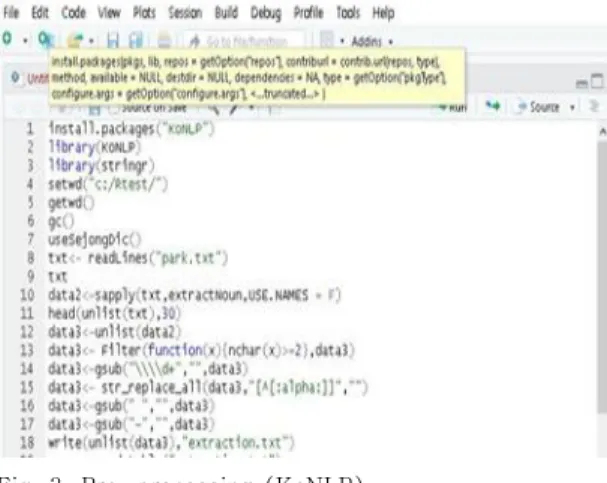
Data was collected as shown in the Figure below. Jsoup was used via Eclipse to crawl news articles on Naver. R and Rstudio were used for preprocessing the data. Also, R package KoNLP was used for preprocessing Fig. 3.
Fig. 3. Pre-processing (KoNLP)
4.2 Analysis results
4.2.1 Paulo Jorge Gomes Bento
The analysis returned the following results. First, organization, serious consideration, analysis, experience, culture, development, improvement, sharing, decisiveness, positivity and atmosphere emerged as the most important word as you can see in Fig 4.
Fig. 4. Paulo Jorge Gomes Bento
Successful leaders demonstrated leadership in favor of sharing, positivity, analysis and culture.
Importantly, they boosted athletes’ confidence, communicated based on scientific analysis and shared visions.
To be a successful sports leader, one need to be able to care about athletes and present a vision to athletes with a genuine heart. This is consistent with the aspects emphasized in the abovementioned types of leadership, particularly the servant, authentic, transformational and transactional leadership.
4.2.2 Uli Stielike
Remarks, beliefs, criticism, appointment, organization, competition, problems, improvement, incompetence, condemnation, wild, insufficiency,
demote, belittlement and disbelief were the most important words as you can see in Fig 5.
Failed leaders were relevant to such important words as criticism, remarks, incompetence, condemnation and insufficiency. That is, they always showed a negative attitude in treating athletes, did not present a vision and failed to communicate.
Fig. 5. Uli Stielike
As the failed leaders’ leadership assumed incompetence, belittlement, distrust, criticism and problems, they should actively communicate with athletes before those issues surface. In particular, foreign coaches may suffer from misunderstandings resulting from cultural difference, different ways of thinking and miscommunications.
4.3 Association analysis
Support: Indicates the frequency of a transaction involving an item and another at the same time.
Confidence: Indicates the intensity of association rules, which can be denoted as the following conditional probability.
Lift: Indicates the percentages of X purchased with and without Y, respectively.
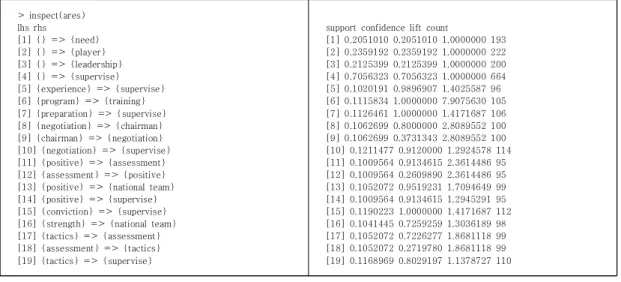
In the association analysis, the extent of association is determined by the support, confidence and life. Here, the association analysis returned the following results as shown below as you can see in Table 1 and Table 2.
5. Conclusion
The purpose of this study was to identify and
characterize different types of leadership in sports leaders. Unlike previous theoretical studies focused on transformational and transactional leadership, this study utilized media and news articles to extract some important types of leadership from the texts associated with sports leaders.
The analysis highlighted the following results.
First, successful sports leaders showed specific types of leadership. Second, failed sports leaders Table 1. Association Rules (Paulo Jorge Gomes Bento)
> inspect(ares) lhs rhs
[1] {} => {need}
[2] {} => {player}
[3] {} => {leadership}
[4] {} => {supervise}
[5] {experience} => {supervise}
[6] {program} => {training}
[7] {preparation} => {supervise}
[8] {negotiation} => {chairman}
[9] {chairman} => {negotiation}
[10] {negotiation} => {supervise}
[11] {positive} => {assessment}
[12] {assessment} => {positive}
[13] {positive} => {national team}
[14] {positive} => {supervise}
[15] {conviction} => {supervise}
[16] {strength} => {national team}
[17] {tactics} => {assessment}
[18] {assessment} => {tactics}
[19] {tactics} => {supervise}
support confidence lift count
[1] 0.2051010 0.2051010 1.0000000 193 [2] 0.2359192 0.2359192 1.0000000 222 [3] 0.2125399 0.2125399 1.0000000 200 [4] 0.7056323 0.7056323 1.0000000 664 [5] 0.1020191 0.9896907 1.4025587 96 [6] 0.1115834 1.0000000 7.9075630 105 [7] 0.1126461 1.0000000 1.4171687 106 [8] 0.1062699 0.8000000 2.8089552 100 [9] 0.1062699 0.3731343 2.8089552 100 [10] 0.1211477 0.9120000 1.2924578 114 [11] 0.1009564 0.9134615 2.3614486 95 [12] 0.1009564 0.2609890 2.3614486 95 [13] 0.1052072 0.9519231 1.7094649 99 [14] 0.1009564 0.9134615 1.2945291 95 [15] 0.1190223 1.0000000 1.4171687 112 [16] 0.1041445 0.7259259 1.3036189 98 [17] 0.1052072 0.7226277 1.8681118 99 [18] 0.1052072 0.2719780 1.8681118 99 [19] 0.1168969 0.8029197 1.1378727 110
Table 2. Association Rules (Uli Stielike)
> inspect(ares) lhs rhs
[1] {} => {selection}
[2] {} => {tactics}
[3] {} => {philosophy}
[4] {} => {leadership}
[5] {} => {player}
[6] {} => {ability}
[7] {} => {conviction}
[8] {demand} => {nation team}
[9] {effectiveness} => {improve}
[10] {improve} => {effectiveness}
[11] {effectiveness} => {change}
[12] {change} => {effectiveness}
[13] {effectiveness} => { tactics}
[14] {tactics} => {effectiveness}
[15] {words and actions} => {leadership}
[16] {leadership} => {words and actions}
[17] {words and actions} => {supervise}
[18] {improvement} => {change}
[19] {change} => {improvement}
[20] {improvement} => {tactics}
[21] {tactics} => {improvement}
[22] {communication} => {nation team}
[23] {nation team} => {communication}
[24] {communication} => { supervisor}
support confidence lift count
[1] 0.2108295 0.2108295 1.0000000 183 [2] 0.2004608 0.2004608 1.0000000 174 [3] 0.2177419 0.2177419 1.0000000 189 [4] 0.2430876 0.2430876 1.0000000 211 [5] 0.2615207 0.2615207 1.0000000 227 [6] 0.2511521 0.2511521 1.0000000 218 [7] 0.2891705 0.2891705 1.0000000 251 [8] 0.1013825 1.0000000 1.7642276 88 [9] 0.1025346 1.0000000 8.1886792 89 [10] 0.1025346 0.8396226 8.1886792 89 [11] 0.1025346 1.0000000 6.8346457 89 [12] 0.1025346 0.7007874 6.8346457 89 [13] 0.1025346 1.0000000 4.9885057 89 [14] 0.1025346 0.5114943 4.9885057 89 [15] 0.1002304 1.0000000 4.1137441 87 [16] 0.1002304 0.4123223 4.1137441 87 [17] 0.1002304 1.0000000 1.0445247 87 [18] 0.1140553 1.0000000 1.0445247 99 [19] 0.1221198 1.0000000 6.8346457 106 [20] 0.1221198 0.8346457 6.8346457 106 [21] 0.1059908 0.8679245 4.3296465 92 [22] 0.1059908 0.5287356 4.3296465 92 [22] 0.1140553 0.9252336 1.6323228 99 [23] 0.1140553 0.2012195 1.6323228 99 [24] 0.1163594 0.9439252 0.9859532 101
showed specific types of leadership. The findings have the following implications.
First, most previous studies on the typology and characteristics of leadership relied on questionnaire surveys and interviews. In contrast, this study should be noted for its differentiated scholarly approach of utilizing the informal data mining, or text mining, which is used to find out the meanings hidden in texts, to determine the types of leadership.
Second, the types and characteristics of leadership established based on the analysis results have practical implications in that they suggest the types of leadership that are required of sports leaders in managing and leading athletes whilst generating tangible results and performance.
Despite the foregoing implications, this study had limitations on the grounds that it did not fully identify the causality between the meanings extracted from texts and the actual leadership and that the analysis just focused on soccer.
Hence, further studies need to classify the types of leadership that is applicable to all fields of sports as well as soccer, and include the Delphi and AHP techniques to verify any results derived.
REFERENCES
[1] E. M. Park, J. H. Seo & M. H. Ko. (2016). The effects of leadership by types of soccer instruction on big data analysis. Cluster computing, 19(3),1647-1658.
DOI: 10.1007/s10586-016-0609-2
[2] B. M. Kim. (2010). Application of transformational leadership: the case of Hiddink leadership. Korean Assoc. Sports Law, 13(1),11-37.
[3] P. Chelladurai. (1990). Leadership in sports: A review.
International journal of sport psychology. 21(4),328-354.
[4] H. G. Barrow, J. M. Tenenbaum, R. C. Bolles & H. C.
Wolf. (1977). Parametric correspondence and chamfer matching: Two new techniques for image matching (No. TN-153). SRI INTERNATIONAL MENLO PARK CA ARTIFICIAL INTELLIGENCE CENTER.
[5] D. Y. Kim, S. T. Park & M. H Ko. (2018). A Study on the Analysis of IT-related Occupational Cluster using
Big Data. IAENG International Journal of Computer Science,45(1),7-11.
[6] S. T. Park, S. W. Lee & M. H. Ko. (2018). Industry 4.0 on Keyword Network Analysis. Journal of Engineering and Applied Sciences. 13, 2442-2446.
[7] The Society of Digital Policy & Management. (2015).
Big Data Analystics for Business,Seoul: Kwangmoonkag.
[8] G. Li, J. S. Dai, E. M. Park & S. T. Park. (2017). A study on the service and trend of Fintech security based on text-mining: focused on the data of Korean online news. Journal of Computer Virology and Hacking Techniques,13(4),249-255.
DOI: 10.1007/s11416-016-0288-9
[9] R. C. Burns. (1982). Enzyme activity in soil: location and a possible role in microbial ecology. Soil Biology and Biochemistry, 14(5),423-427.
DOI: 10.1016/0038-0717(82)90099-2
[10] B. M. Bass. (1995). Theory of transformational leadership redux. The leadership quarterly, 6(4), 463-478.
DOI: 10.1016/1048-9843(95)90021-7
[11] B. M. Bass & F. J. Yammarino. (1988). Long term forecasting of transformational leadership and its effects among naval officers: Some preliminary findings. STATE UNIV OF NEW YORK AT BINGHAMTON CENTER FOR LEADERSHIP STUDIES.
[12] R. F. Russell & A. Gregory Stone. (2002). A review of servant leadership attributes: Developing a practical model. Leadership & Organization Development Journal, 23(3),145-157.
DOI: 10.1108/01437730210424
[13] B. J. Avolio, W. L. Gardner, F. O. Walumbwa, F.
Luthans & D. R. May. (2004). Unlocking the mask: A look at the process by which authentic leaders impact follower attitudes and behaviors. The leadership quarterly, 15(6),801-823.
DOI: 10.1016/j.leaqua.2004.09.003
[14] D. M. Landers & G. Lüschen. (1974). Team performance outcome and the cohesiveness of competitive coacting groups. International Review of Sport Sociology, 9(2),57-71.
DOI: 10.1177/101269027400900203
[15] R. S. Weinberg & D. Gould. (2018). Foundations of Sport and Exercise Psychology, 7E. Human Kinetics.
[16] H. G. Barrow, J. M. Tenenbaum, R. C. Bolles & H. C.
Wolf. (1977). Parametric correspondence and chamfer matching: Two new techniques for image matching (No. TN-153). SRI INTERNATIONAL MENLO PARK CA ARTIFICIAL INTELLIGENCE CENTER.
[17] W. N. Widmeyer & J. M. Williams. (1991). Predicting cohesion in a coaching sport. Small Group Research, 22(4),548-570.
DOI: 10.1177/1046496491224007
박 은 미(Eun-Mi Park) [정회원]
․ 2018년 2월 : 경북대학교 경영학부 (경영학석사)
․ 2018년 3월 ~ 현재 : 경북대학교 경 영학부 박사과정
․ 관심분야 : 경영전략, 인사조직, 기술 혁신, 혁신, 빅데이터 등
․ E-Mail : [email protected]
서 정 해(Joung-Hae Seo) [정회원]
․ 1983년 8월 : 경북대학교 경영학과(경 영학사)
․ 1989년 3월 : 일본 히토츠바시대학 상 학연구과(석사)
․ 1992년 3월 : 일본 히토츠바시대학 상 학연구과(박사)
․ 1998년 3월 ~ 현재 : 경북대학교 경영 학부 교수
․ 관심분야 : 경영전략, 인사조직, 기술혁신 등
․ E-Mail : [email protected]