• 검색 결과가 없습니다.

Bayesian Model Selection in Analysis of Reciprocals

N/A
N/A
Protected

Academic year: 2021

Share "Bayesian Model Selection in Analysis of Reciprocals"

Copied!
10
0
0

로드 중.... (전체 텍스트 보기)

전체 글

(1)

2005, Vol. 16, No. 4, pp. 1167∼1176

Bayesian Model Selection in Analysis of Reciprocals

Sang Gil Kang 1) ⋅ Dal Ho Kim 2) ⋅ Young Joon Cha 3)

Abstract

Tweedie (1957a) proposed a method for the analysis of residuals from an inverse Gaussian population paralleling the analysis of variance in normal theory. He called it the analysis of reciprocals. In this paper, we propose a Bayesian model selection procedure based on the fractional Bayes factor for the analysis of reciprocals. Using the proposed model selection procedures, we compare with the classical tests.

Keywords : Analysis of Reciprocals, Fractional Bayes Factor, Inverse Gaussian Distribution, Reference Prior

1. INTRODUCTION

Because of the versatility and flexibility in modelling right-skewed data, the inverse Gaussian distribution has potential useful applications in a wide variety of fields such as biology, economics, reliability theory, life testing and social sciences as discussed in Chhikara and Folks (1978, 1989) and Seshadri (1999). Tweedie (1957a, 1957b) established many important statistical properties of the inverse Gaussian distribution and discussed the similarity between statistical methods based on the inverse Gaussian distribution and those based on the normal theory.

Let X be an inverse Gaussian distribution with density function

1) First Author : Assistant Professor, Department of Applied Statistics, Sangji University, Wonju, 220-702, Korea.

E-mail : [email protected]

2) Associate Professor, Department of Statistics, Kyungpook National University, Taegu, 702-701, Korea.

E-mail : [email protected]

3) Professor, Department of Information Statistics, Andong National University, Andong, 760-749, Korea.

E-mail : [email protected]

(2)

f(x∣μ, λ ) = λ

x - 3/2 exp { - λ( x - μ) 2

2 x }, x > 0, (1) where μ > 0 and λ > 0. The parameter μ is the mean of the distribution and λ is a scale parameter. The inverse Gaussian distribution will be denoted by the IG( μ, λ). In this model, we assume that there are n i items from the ith population each of which is distributed as IG( μ ii ) where i = 1,…,k. The classical analysis of reciprocals (Tweedie, 1957a) consists of testing whether the means μ i are all equal when all populations have the same λ. From the frequentist viewpoints this problem poses the difficulty that an exact F test exists only under the condition that the λ i 's are all equal.

Our proposal here is to formulate the classical analysis of reciprocals as a model selection problem for which we propose a fully Bayesian procedure.

Models (or Hypotheses) H 1 , H 2 , …, H q are under consideration, with the data x = ( x 1 , x 2 , … , x n ) having probability density function f i ( x ∣ θ i ) under model H i ,i = 1,2,…, q. The parameter vectors θ i are unknown. Let π i ( θ i ) be the prior distribution of model H i , and let p i be the prior probabilities of model H i ,

i = 1, 2, …, q. Then the posterior probability that the model H i is true is

P( H i ∣ x ) = ( j = 1 q p p j i ⋅B ji ) - 1 , (2) where B ji is the Bayes factor of model H j to model H i defined by

B ji = m j ( x ) m i ( x ) =

⌡f j ( x ∣ θ jj ( θ j )d θ j

⌡f i ( x ∣ θ ii ( θ i )d θ i . (3)

The B ji interpreted as the comparative support of the data for the model j to i.

The computation of B ji needs specification of the prior distribution π i ( θ i ) and π j ( θ j ). Usually, one can use the noninformative prior, often improper, such as uniform prior, Jeffreys prior and reference prior. Denote it as π N i . The use of improper priors π N i (⋅) in (3) causes the B ji to contain unspecified constants.

Spiegalhalter and Smith (1982), O'Hagan (1995) and Berger and Pericchi (1996)

have made efforts to compensate for that arbitrariness. Berger and Pericchi (1996)

introduced the intrinsic Bayes factor using a data-splitting idea, which would

eliminate the arbitrariness of improper priors. O'Hagan (1995) proposed the

(3)

fractional Bayes factor. To remove the arbitrariness in Bayes factor, he used to a portion of the likelihood with a so-called the fraction b. These two approaches mentioned above have shown to be quite useful in many statistical areas.

In this paper, we consider the Bayesian model selection problem for analysis of reciprocals. The outline of the remaining sections is as follows. In Section 2, using the reference priors, we provide the Bayesian model selection procedure based on the fractional Bayes factor for the analysis of reciprocals, and provide the test procedure for homogeneity of the λ's. In Section 3, some examples and conclusions of our Bayesian test procedure are given.

2. BAYES FACTOR FOR ANALYSIS OF RECIPROCALS

2.1 Preliminaries

It has known that the use of improper priors π N i (⋅) in (3) causes the B ji to contain unspecified constants. To solve this problem, O'Hagan (1995) proposed the fractional Bayes factor for Bayesian testing and model selection problem as follow.

When the π N i ( θ i ) is noninformative prior under H i , equation (3) becomes

B N ji =

⌡f j ( x∣ θ jN j ( θ j )d θ j

⌡f i ( x∣ θ iN i ( θ i )d θ i .

Then the fractional Bayes factor of model H j versus model H i is

B F ji = B N ji

⌡f b i ( x ∣ θ iN i ( θ i )d θ i

⌡f b j ( x ∣ θ jN j ( θ j )d θ j = B N jim b i ( x) m b j ( x) ,

and f i ( x ∣ θ i ) is the likelihood function and b specifies a fraction of the likelihood which is to be used as a prior density. He proposed three ways for the choice of the fraction b. One frequently suggested choice is b = m/n, where m is the size of the minimal training sample, assuming this is well defined. (see O'Hagan, 1995, 1997 and the discussion by Berger and Mortera of O'Hagan, 1995).

2.2 Fractional Bayes Factor for Analysis of Reciprocals

Given samples of sizes n i from IG( μ i ,λ ), i = 1, …, k, we consider the

testing of the following hypotheses:

(4)

H 11 = … = μ k ≡μ v.s. H 21 ≠…≠μ k .

Our interest is to develop a Bayesian test based on the fractional Bayes factors for H 1 v.s. H 2 under the noninformative priors.

Under the hypothesis H 1 , the reference prior for μ and λ is π 1 ( μ,λ) = λ - 1 μ - 3/2 .

The likelihood function under H 1 is

L( μ, λ∣ x ) =( 1

2π ) n [ ∏

k i = 1

n

i

j= 1 x - 3/2 ijn/2 exp { - λ 2 [ ∑

n

1

j= 1 s i + n i ( x i - μ) 2 μ 2 x i ] },

where n = n 1 + …+ n k , x i = ∑

n

i

j= 1 x ij /n i and s i = ∑

n

i

j = 1 [ ( 1/ x ij )-( 1 / x i )],i = 1, …, k.

Then the element of fractional Bayes factor under H 1 is given by

m b 1 ( x ) = ⌠

∞ 0

⌠ ⌡

0 L b (μ, λ∣ x )π 1 ( μ, λ)dμdλ

= ( 1

2π ) nb [ ∏ k

i = 1

n

i

j= 1 x - 3b/2 ij ]( b 2 ) -

nb 2 Γ( nb

2 )S 1 ( x ;b), where

S 1 ( x ;b) = ⌠

0 θ - 1/2 { ∑

k

i = 1 [s i + n i x i (θ- x i - 1 ) 2 ] } -

nb 2 dθ.

For the H 2 , the reference prior is

π 2 ( μ 1 , …,μ k , λ) =μ 1 - 3/2 …μ k - 3/2 λ - 1 .

Kang (2004) developed the above reference prior π 2 ( μ 1 , …,μ k , λ). The likelihood function under H 2 is

L( μ 1 ,…, μ k ,λ ∣ x )

= ( 1

2π ) n [ ∏ k

i = 1

n

i

j= 1 x - 3/2 ijn/2 exp { - ∑ k

i = 1

λ

2 [ s i + n i ( x i - μ i ) 2 μ 2 i x i ] }.

Thus the element of fractional Bayes factor under H 2 is given as follows.

(5)

m b 2 ( x ) = ⌠

∞ 0 … ⌠ ⌡

0 L b1 ,…, μ k , λ∣ x )π 2 ( μ 1 ,…, μ k ,λ )dμ 1 …dμ k

= ( 1

2π ) nb [ ∏ k

i = 1

n

i

j= 1 x - 3b/2 ij ]( b 2 ) -

nb 2 Γ( nb

2 )S 2 ( x ;b), where

S 2 ( x ;b) = ⌠

∞ 0 … ⌠ ⌡

∞ 0 [ ∏ k

i = 1 θ i - 1/2 ] { ∑ k

i = 1 [s i + n i x ii - x i - 1 ) 2 ] } -

nb

2 1 …dθ k .

Therefore the B N 21 from m b 1 ( x ) and m b 2 ( x ) with b = 1 is given by

B N 21 = S 2 ( x ;1)

S 1 ( x ;1) . And also

m b 1 ( x )

m b 2 ( x ) = S 1 ( x ;b) S 2 ( x ;b) .

Thus the fractional Bayes factor of H 2 versus H 1 is given by

B F 21 = S 2 ( x ;1)S 1 ( x ; b)

S 2 ( x ;b)S 1 ( x ;1) . (4) Note that the calculation of the fractional Bayes factor of H 2 versus H 1 requires a numerical integration.

2.3 Fractional Bayes Factor for Homogeneity of the Scale Parameters

The Bayes factor in Section 2.2 was derived under the assumption that all the λ's are equal. Hence, it is of interest to test whether the same λ condition can be accepted.

Given samples of sizes n i from IG( μ ii ), i = 1, …, k, we consider the testing of the following hypotheses:

H 11 = … = λ k ≡λ v.s. H 21 ≠…≠λ k .

Under the hypothesis H 1 , the reference prior for μ 1 ,…, μ k and λ is

π 11 , …,μ k ,λ) = λ - 1 μ 1 - 3/2 …μ k - 3/2 .

(6)

The likelihood function under H 1 is L( μ 1 ,…, μ k ,λ ∣ x )

= ( 1

2π ) n [ ∏ k

i = 1

n

i

j= 1 x - 3/2 ijn/2 exp { - ∑ k

i = 1

λ

2 [ s i + n i ( x i - μ i ) 2 μ 2 i x i ] }.

where n = n 1 + …+ n k , x i = ∑

n

i

j= 1 x ij /n i and s i = ∑

n

i

j= 1 [ ( 1/x ij )-( 1 / x i )], i = 1, …, k.

Then the element of fractional Bayes factor under H 1 is given by

m b 1 ( x ) = ⌠

∞ 0 … ⌠ ⌡

0 L b1 ,…, μ k , λ∣ x )π 1 ( μ 1 ,…, μ k ,λ )dμ 1 …dμ k

= ( 1

2π ) nb [ ∏ k

i = 1

n

i

j= 1 x - 3b/2 ij ]( b 2 ) -

nb 2 Γ( nb

2 )T 1 ( x ;b), where

T 1 ( x ;b) = ⌠

∞ 0 … ⌠ ⌡

∞ 0 [ ∏ k

i = 1 θ -

1 2

i ] { ∑ k

i = 1 [s i + n i x i ( θ i - x i - 1 ) 2 ] } -

nb

2 1 …dθ k . For the H 2 , the reference prior is

π 21 , …,μ k , λ 1 , …,λ k ) =μ 1 - 3/2 …μ k - 3/2 λ 1 - 1 …λ - 1 l . The likelihood function under H 2 is

L( μ 1 ,…, μ k1 ,…,λ k ∣ x )

= ( 1

2π ) n [ ∏

k i = 1

n

i

j = 1 x - 3/2 ij ][ ∏

k

i = 1 λ i n

i

/2 ] exp { - ∑

k i = 1

λ i

2 [ s i + n i ( x i - μ i ) 2 μ 2 i x i ] }.

Thus the element of fractional Bayes factor under H 2 is given as follows.

m b 2 ( x ) = ⌠

∞ 0 … ⌠ ⌡

0 L b1 ,…, μ k , λ 1 ,…, λ k ∣ x )

× π 2 ( μ 1 ,…, μ k1 ,…,λ k )dμ 1 …dμ k 1 …dλ k = ( 1

2π ) nb [ ∏ k

i = 1

n

i

j= 1 x - 3b/2 ij ]( b 2 ) -

nb 2 { ∏ k

i = 1 Γ[ n i b

2 ] }T 2 ( x ;b),

where

(7)

T 2 ( x ;b) = ⌠

∞ 0 … ⌠ ⌡

∞ 0 ∏ k

i = 1i - 1/2 [ s i + n i x i ( θ i - x i - 1 ) 2 ] -

n

i

b

2 }dθ 1 …dθ k .

Therefore, the B N 21 from m b 1 ( x ) and m b 2 ( x ) with b = 1 is given by

B N 21 =

T 2 ( x ;1)

k i = 1 Γ[ n i

2 ] T 1 ( x ;1)Γ[ n

2 ]

.

And also

m b 1 ( x ) m b 2 ( x ) =

T 1 ( x ;b)Γ[ nb 2 ] T 2 ( x ;b)k

i = 1 Γ[ n i b 2 ]

.

Thus the fractional Bayes factor of H 2 versus H 1 is given by

B F 21 =

Γ[ nb 2 ] ∏

k i = 1 Γ[ n i

2 ] Γ[ n

2 ] ∏

k

i = 1 Γ[ n i b 2 ]

T 2 ( x ;1)T 1 ( x ; b)

T 2 ( x ;b)T 1 ( x ;1) . (5)

Note that the calculation of the fractional Bayes factor of H 2 versus H 1 requires a numerical integration.

3. NUMERICAL STUDIES

In this section, we give some examples to show the usefulness of our test procedures by real data sets.

Example 1 : Testing equality of scale parameters

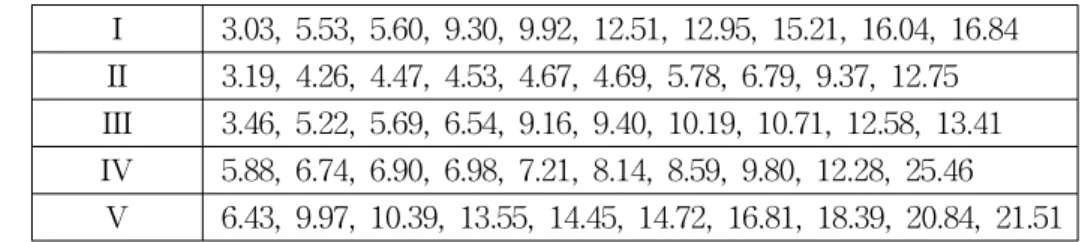
The data given in Table 1 is the results of an experiment designed to compare the performance of high-speed turbine bearings made out of five different compounds. In the experiment 10 bearings of each type were tested and the failure times in units of millions of cycles were recorded (McCool, 1979; Chhikara and Folks, 1989).

Let V i = ∑

n

i

j= 1 [ ( 1/X ij ) - ( 1/ X i )] and V =

k

i = 1 V i . Under H 11 = …= λ k , the

classical test statistic is given by

(8)

Λ = M C , where f i = n i -1, f =k

i = 1 (n i - 1), C = 1 + 1

3( k - 1) [ ∑ k

i = 1 (1/ f i )-( 1/ ∑ k

i = 1 f i )] and M =f log( V/f) -

k

i = 1 f i log( V i /f i ).The test statistic Λ is distributed approximately as χ 2 with ( k - 1) degrees of freedom.

Table 1. Failure Times of Bearing Specimens

I 3.03, 5.53, 5.60, 9.30, 9.92, 12.51, 12.95, 15.21, 16.04, 16.84 II 3.19, 4.26, 4.47, 4.53, 4.67, 4.69, 5.78, 6.79, 9.37, 12.75 III 3.46, 5.22, 5.69, 6.54, 9.16, 9.40, 10.19, 10.71, 12.58, 13.41 IV 5.88, 6.74, 6.90, 6.98, 7.21, 8.14, 8.59, 9.80, 12.28, 25.46

V 6.43, 9.97, 10.39, 13.55, 14.45, 14.72, 16.81, 18.39, 20.84, 21.51

The p-values based on the χ 2 statistics, the value of fractional Bayes factors of H 2 versus H 1 and the posterior probabilities for H 1 are given in Table 2.

We computed the posterior probabilities for model H 1 corresponding to values of Bayes factors when the prior probabilities are equal. From the results of Table 2, we may conclude that the homoscedastic model is clearly favoured.

Table 2. p-values, Bayes Factor Values and Posterior Probabilities

H 1 p-value B F 21 P( H 1 ∣ x )

λ 1 = λ 3 = λ 4 0.7446 0.1615 0.8610

λ 1 = λ 2 = λ 5 0.1953 0.5386 0.6499

λ 1 = λ 2 = λ 3 0.8621 0.1392 0.8778

Example 2 : Testing the equality of means

The three rows in Table 2 show that the equality of the scale parameters are accepted. In this situation it is desired to test whether the population means are all equal.

The p-values under the F statistics of the analysis of reciprocals, the value of fractional Bayes factors of H 2 versus H 1 and the posterior probabilities for H 1 are given in Table 3. We computed the posterior probabilities for model H 1

corresponding to values of Bayes factors when the prior probabilities are equal.

From the results of Table 3, for the model H 11 = μ 3 = μ 4 and the model

(9)

H 11 = μ 2 = μ 5 , the simpler model and the complex model are clearly favoured, respectively. The Bayes factors and the p-values give the same message. But for the model H 1 :μ 1 = μ 2 = μ 3 , the classical test favors the complex model and the Bayes factor favors simpler model.

In this paper, we developed a Bayesian model selection procedures for the analysis of reciprocals. Under the reference priors, the fractional Bayes factors of O'Hagan (1996) are computed. Through the examples, we can conclude that the Bayes factors and the classical tests perform reasonably.

Table 3. p-values, Bayes Factor Values and Posterior Probabilities

H 1 p-value B F 21 P( H 1 ∣ x )

μ 1 = μ 3 = μ 4 0.6389 0.0816 0.9246

μ 1 = μ 2 = μ 5 0.0017 25.4755 0.0378

μ 1 = μ 2 = μ 3 0.0480 0.9831 0.5043

REFERENCES

1. Berger, J.O. and Mortera, J. (1995). Discussion on Fractional Bayes Factors for Model Comparison (by O'Hagan, A.). Journal of Royal Statistical Society, B, 57, 130-131.

2. Berger, J.O. and Pericchi, L.R. (1996). The Intrinsic Bayes Factor for Model Selection and Prediction. Journal of the American Statistical Association, 91, 109-122.

3. Chhikara, R.S. and Folks, L. (1978). The Inverse Gaussian Distribution and Its Statistical Application-A Review. Journal of Royal Statistical Society, B, 40, 263-289.

4. Chhikara, R.S. and Folks, L. (1989). The Inverse Gaussian Distribution;

Theory, Methodology and Applications. Marcel Dekker, New York.

5. O' Hagan, A. (1995). Fractional Bayes Factors for Model Comparison (with discussion). Journal of Royal Statistical Society, B, 57, 99-118.

6. O' Hagan, A. (1997). Properties of Intrinsic and Fractional Bayes Factors. Test, 6, 101-118.

7. Kang, S.G. (2004). Noninformative Priors for the Common Scale

Parameter in the Inverse Gaussian Distributions. Journal of the Korean Data & Information Science Society, 15, 981-992.

8. McCool, J.I. (1979). Analysis of Single Classification Experiments based

on Censored Samples from Two-Parameter Weibull Distribution. Journal

of Statistical Planning and Inference, 3, 39-68.

(10)

9. Seshadri, V. (1999). The Inverse Gaussian Distribution: Statistical Theory and Applications. Springer, New York.

10. Spiegelhalter, D.J. and Smith, A.F.M. (1982). Bayes Factors for Linear and Log-Linear Models with Vague Prior Information. Journal of Royal Statistical Society, B, 44, 377-387.

11. Tweedie, M.C.K. (1957a). Statistical Properties of Inverse Gaussian Distributions I. The Annals of Mathematical Statistics, 28, 362-377.

12. Tweedie, M.C.K. (1957b). Statistical Properties of Inverse Gaussian Distributions II. The Annals of Mathematical Statistics, 28, 696-705.

[ received date : Oct 2005, accepted date : Nov. 2005 ]

수치

Table  2.  p-values,  Bayes  Factor  Values  and  Posterior  Probabilities
Table  3.  p-values,  Bayes  Factor  Values  and  Posterior  Probabilities

참조

관련 문서

The index is calculated with the latest 5-year auction data of 400 selected Classic, Modern, and Contemporary Chinese painting artists from major auction houses..

1 John Owen, Justification by Faith Alone, in The Works of John Owen, ed. John Bolt, trans. Scott Clark, "Do This and Live: Christ's Active Obedience as the

Also, for verifying the study hypothesis, unitary multi-variant analysis, correlation analysis and structural equation model analysis were carried out. The

전류와 자석의 상관관계에 의해 유도된 magnetic force로 보이스 코일이 앞뒤로 진동. 보이스 코일에 연결된 콘이 진동하여

Transformed –log 10 p of SNPs from the logistic regression model of association with dementia based on the additive model in male subjects.. P-value on the left Y-axis is

Recommendations on trajectory selection in flight planning based on weather uncertainty, Proceedings of the 2017 WMO Aeronautical Meteorology Scientific

Global structural analysis model of the 300K VLCC by using the developed method. (Shell element, 1-D

à For each subentity, create a table that includes the attributes of that entity set plus the primary key of the higher level