한약제제의 골성장 효과에 대한 국내외 실험 연구 고찰
김태정1,2⋅김동연3⋅양희원3⋅최동건3⋅권나연4⋅이동녕4⋅성현경5,*
1세명대학교 충주한방병원, 2동국대학교 한의과대학 소아과학교실, 3세명대학교 한의과대학,
4세명대학교 한의과대학 한방부인과교실, 5세명대학교 한의과대학 한방소아과교실
Received: May 14, 2021 ∙ Revised: August 20, 2021 ∙ Accepted: August 23, 2021
*Corresponding Author: Sung Hyun-Kyung
College of Korean Medicine, Semyung University, 65 Semyung-ro, Jecheon-si, Chungcheongbuk-do, 27136 Korea
Tel: +82-43-841-1739, Fax: +82-43-856-1731 E-mail: [email protected]
ⓒ The Association of Pediatrics of Korean Medicine. All rights reserved. This is an open-access article distributed under the tenus of the Creative Commons Attribution Non-Commercial License (http://creativecommons.org/licenses/by-nc/3.0/), which permits unrestricted non-commercial use, distribution, and reproduction in any medium, provided the original work is properly cited.
Abstract
A Literature Review of Experimental Study about Herbal Medicine for Bone Growth
Kim Tae-Jeong
1,2⋅Kim Dong-Yeon
3⋅Yang Hee-Won
3⋅Choi Dong-Gun
3⋅ Kwon Na-Yoen
4⋅Lee Dong-Nyung
4⋅Sung Hyun-Kyung
5,*1
Semyung University Chungju Korean Medicine Hospital
2
Dept. of Pediatrics, College of Korean Medicine, Dongguk University
3
College of Korean Medicine, Semyung University
4
Dept. of Pediatrics, College of Korean Medicine, Semyung University
5
Dept. of Korean Obstetrics and Gynecology, College of Korean Medicine, Semyung University
Objectives
The purpose of this study is to investigate the effect of herbal medicine on bone growth and growth factors by collecting and analyzing domestic and foreign experimental research papers to establish a platform for future research.
Methods
Experimental studies published before March 2021 were searched using 7 Korean databases and 2 foreign databases. Among the numbers of studies searched, 48 experimental studies met the criteria and were selected. The results of those 48 studies upon herbal medicine administration were analyzed by bone growth, growth plate, weight.
Results
23 studies mainly used monotherapy of either Astragali Radix and Cervi Parvum Cornu. 28 studies used combination of Poria Sclerotium, Dioscoreae Rhizoma, and Acanthopanacis Cortex. Among all studies selected, weight, bone growth, Insulin-like growth factor-1 (IGF-1) and Growth hormone (GH) were increased, but the increase was significant only in some of the studies.
Conclusions
The result of this study can be utilized as a background information for further studies and treatment in pediatric growth. Further randomized control studies are needed to underscore the finding.
Key words: Bone Growth, Pediatric Growth, Herbal Medicine Treatment, Experimental study
ISSN 2287-9463(Online), https://doi.org/10.7778/jpkm.2021.35.3.1
Ⅰ. Introduction
성장 (Growth)이란 소아 청소년의 키, 체중, 기관 등 이 양적으로 증가해 나가는 과정을 뜻하며, 신체 기능 의 발전을 뜻하는 발달 (Development)과도 밀접한 관련 이 있다. 소아의 성장 상태는 신체적, 사회적 건강 상태 를 반영하며 잠재된 건강 문제가 성장 지연으로 나타 나는 경우가 많다
1). 건강 상태 이외에도, 성장에 영향 을 주는 요인은 인종, 민족, 가계, 연령, 성별, 염색체 이상 등의 유전적 요인과 사회경제적 요인, 심리적 요 인 등의 외부적 요인, 운동 및 신체자극, 영양 및 질병 등과 같은 환경적 요인이 있다
2).
소아의 신장이 3 백분위수에서 97 백분위수 사이에 존재할 경우 정상 성장에 해당하며, 동일 연령, 동일 성별 소아의 표준 평균치에서 신장이 3 백분위수 이하 인 상태를 저신장으로 정의한다. 또한 일 년 간의 성장 속도가 역연령 및 사춘기에 따른 정상 성장 속도보다 더딜 경우에도 성장 장애를 의심할 수 있다
3).
성장장애의 원인은 크게 영양 결핍, 장관 질환 등 전신에 영향을 미치는 환경 요인, 갑상선 호르몬이나 성장 호르몬 (Growth hormone, 이하 GH)의 부족, 성호 르몬 과잉증 등의 호르몬 이상, 염색체 이상, 골격 등 성장을 담당하는 조직 자체의 이상으로 구분한다. 성 장 장애 아동을 진단하기 위하여 최우선적으로 병력 청취와 신체검사를 실시하며, 성장 곡선 (growth tra- jectory form) 분석, 소변검사, 혈액검사, 손과 손목의 X-ray 영상을 활용한다. 특정한 유전 질환이 의심되는 여아의 경우 염색체 검사를 실시한다
4).
한의학에서는 소아의 성장 장애에 대한 직접적인 언급은 없으나 解顱, 龜胸, 龜背, 五軟, 五遲, 疳證 등 의 병증이 서양의학의 성장 장애에 준하는 것으로 여 겨진다. 그 원인으로는 腎爲先天之本로 표현되는 선천 적인 원인과 脾爲後天之本로 불리는 후천적인 원인으 로 나눌 수 있다
5).
현재까지 성장에 대한 한의학적 연구는 주로 임상 증례를 토대로 이루어졌다. 한 등
6)은 한방 치료로 소아 성장을 개선시킨 증례를 토대로, 송
7)은 증례를 제외한 RCT, 환자 대조군 연구를 토대로 소아 성장 치료에 활 용된 중재 방법과 그 결과를 분석하였다. 그 밖에 한방 병원에 내원한 성장 지연 소아를 대상으로 한의학적 치료의 효과를 후향적으로 분석한 김 등
8), 이 등
9)의 연 구가 있으며, 정 등
10), 장 등
11), 정 등
12)은 문헌적 고찰
을 통하여 한의학적 성장 치료를 정리한 바 있다.
위와 같이 기존에 발표된 임상 연구들에 대한 분석 이 여러 방면에서 활발히 이루어지고 있는 것과 별개 로, 한약에 대한 세포 및 동물 실험 논문들에 대한 분석 은 미비한 실정이다. 그간 성장 지연 소아에게 한약을 투여한 임상 연구와 그에 대한 분석 연구는 다수 발표 되었으나, 침 치료 등의 보조 중재 수단을 병행하거나 환자의 증상에 따라 약재 구성을 가감하는 등 개별 한 약재와 처방의 효능을 비교하는 데에는 한계가 있었다.
따라서 단미제, 복합제를 투여한 세포 및 동물 실험을 포괄적으로 분석한다면 한약의 표준화, 규격화 및 한 의학 발전을 위한 기초 자료로 활용될 수 있을 것으로 보인다. 이에 저자는 한약제제가 골 성장 및 성장인자 에 미치는 효과에 관한 국내외 실험연구 논문을 수집 하고 실험 관련 지표를 조사, 분석하여 그 결과를 보고 하는 바이다.
Ⅱ. Materials and methods
1. 검색 데이터베이스 및 검색
국내 데이터베이스 검색사이트 ScienceON, Research
Information Service System (RISS), Oriental Medicine
Advanced Searching System (OASIS), Korean Studies
Information Service System (KISS), Korean Medical
Database (KMBASE), Korean Traditional Knowledge
Portal (KTKP), Korea Citation Index (KCI)에 2021년 3
월까지 게재된 논문들을 대상으로 2021년 4월 27일에
검색을 실시하였다. 국외 데이터베이스 검색은 상기
일자에 Medline (PubMed), China National Knowledge
Infrastructure (CNKI)을 통해 시행하였다. 검색 키워드
는 ScienceON과 RISS, KISS, KTKP에서 (골성장 OR 뼈
성장 OR 성장호르몬) AND (한의학 OR 한약 OR 생
약)으로, OASIS에서는 (성장 한약), KMBASE에서는
((([ALL=뼈성장] OR [ALL=골성장]) OR [ALL=성장호
르몬]) AND (([ALL=한의학] OR [ALL=한약]) OR
[ALL=생약])), KCI에서는 ((골성장 OR 뼈성장 OR 성
장호르몬) AND 한의학), (골성장 OR 뼈성장 OR 성장
호르몬) AND 한약), (골성장 OR 뼈성장 OR 성장호
르몬) AND 생약))으로 검색하였다. PubMed에서는
(("bone growth"[TI]) OR ("growth hormone"[TI])) AND
(("korean medicine"[TI]) OR ("chinese medicine"[TI]) OR
("herbal medicine"[TI])), CNKI에서는 (TI='bone growth' or TI='growth hormone') and (TI='korean medicine' or TI='Chinese medicine' or TI='herbal medicine')을 사용 하여 검색하였다.
2. 논문 선정 및 제외 기준
선정 기준은 골성장과 관련된 연구 중 단미제, 복합 제 한약을 이용하여 실험 동물의 신장, 체중, 골 길이 등의 구체적 지표를 평가한 문헌을 대상으로 하였다.
관련 연구 중 중재 도구로 한약을 이용하지 않았거나, 한약을 중재로 이용하였더라도 외용제나 외치법을 활 용한 경우는 제외하였다. 그 외에도 실험 연구가 아닌 경우, 중복된 논문, 주제가 뼈의 성장과 관련이 없는 경우는 제외하였다.
Ⅲ. Results
1. 논문 선정 결과
국내 7개 데이터베이스와 국외 2개 데이터베이스에 서 총 292편의 논문을 검색하였다. 그 중 중복된 논문 61편을 제거한 후, 231편의 제목과 초록을 검토하였다.
178편 중 한약 및 생약을 사용하지 않은 연구 1편, 연 구계획 2편, 실험연구가 아닌 연구 25편, 전문이 없는 연구 1편, 성장과 관련 없는 연구 149편을 제외하였다.
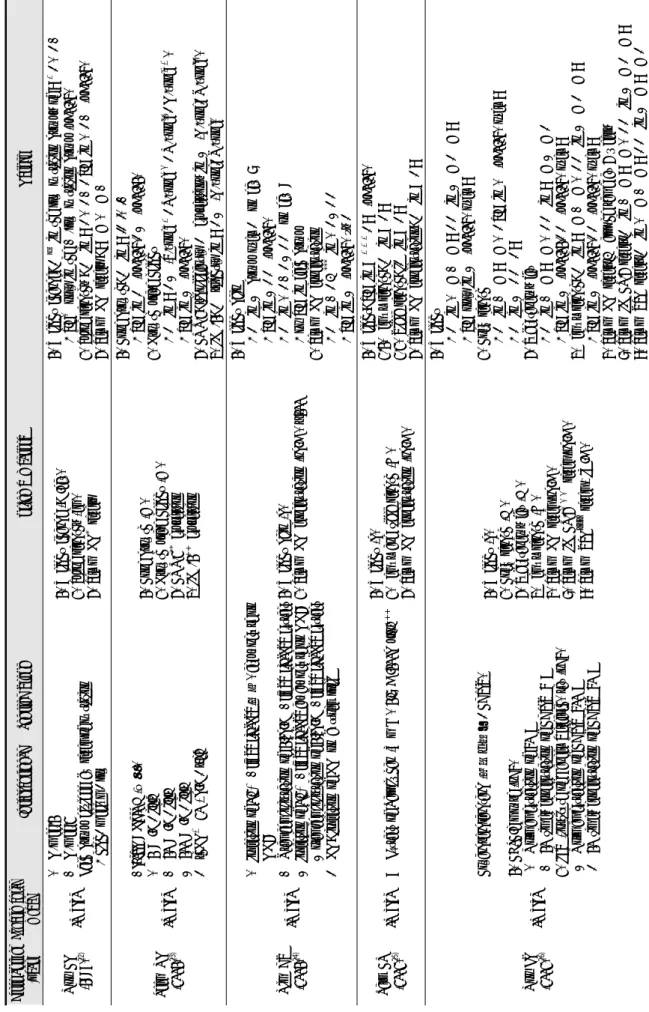
나머지 53편의 논문의 전문을 읽은 후 골다공증 관련 3편, 한약을 외용제로 사용한 2편을 제외한 총 48편을 본 연구대상에 포함하였다 (Figure 1). 최종적으로 선정 된 성장의 한약 치료와 관련된 실험연구 총 48편을 저 자, 연도, 연구 대상, 중재 약물, 평가 지표, 결과에 따 라 분석하였다 (Table 1).
2. 연구 경향 분석 1) 연도별 분류
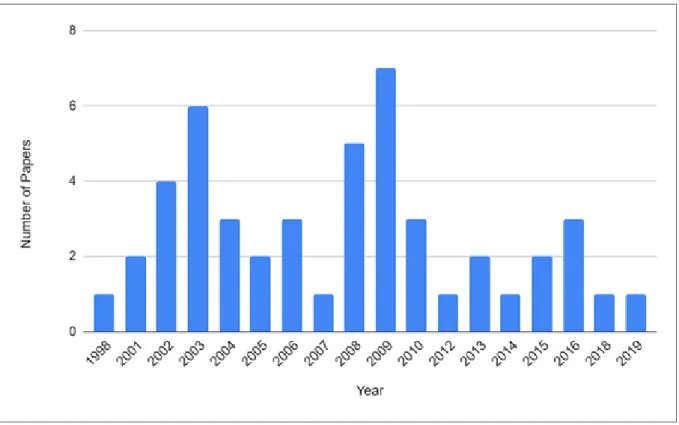
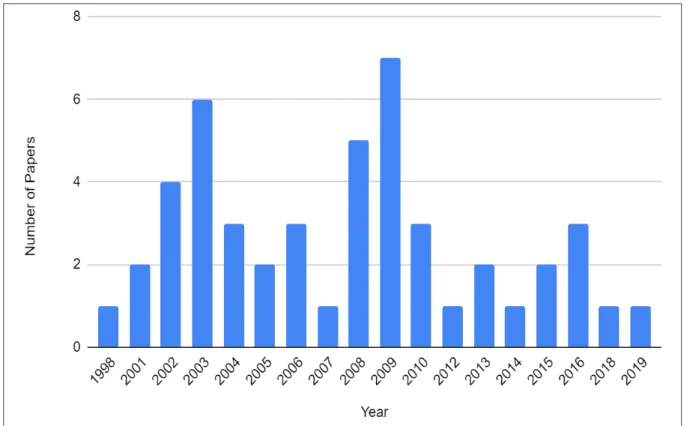
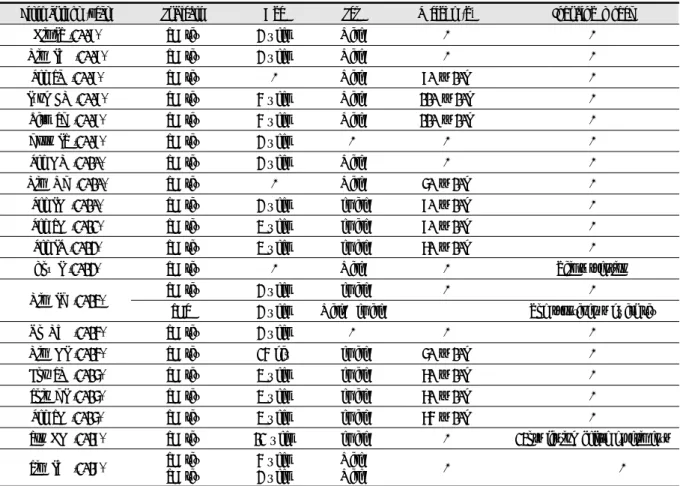
논문 48편을 연도별로 분류한 결과 1998년 1편 (2.08%), 2001년 2편 (4.16%), 2002년 3편 (6.25%), 2003년 6편 (12.5%), 2004년 3편 (6.25%), 2005년 3편 (6.25%), 2006년 3편 (6.25%), 2007년 1편 (2.08%), 2008년 5편 (10.42%), 2009년 7편 (14.58%), 2010년 3 편 (6.25%), 2012년 1편 (2.08%), 2013년 2편 (4.16%), 2014년 1편 (2.08%), 2015년 2편 (4.16%), 2016년 3편 (6.25%), 2018년 1편 (2.08%), 2019년 1편 (2.08%)으로 조사되었다. 2009년에 7편의 논문으로 가장 많은 논문 이 출판되었고, 2003년에 6편의 논문이 출판되었다 (Fig. 2).
Figure 1. A flowchart of the literature screening and selection process
First author (year)Experimental modelInterventional & control groupOutcome measureResult Koo BH (1998)22)In vivo
① H-med-1 ② H-med-2 Each group divided by level of nutrition - high, medium, low 1) Weight change (㎏/day) 2) Spine lengths (cm) 3) Serum GH* levels
1) Weight change: ↑+ in the low nutrition groups of Ⓒ† , ①, ② - S.D‡ only in the ②-low nutrition group (p<0.05) 2) Spine lengths : ↑ in Ⓒ, ①, ②, S.D in ①, ② (p<0.05) 3) Serum GH levels : Ⓒ > ① > ② Leem KH (2001)23)In vivo
Cibotii Rhizoma (狗脊) ① 1 ㎎/㎏, i.p.§ ② 10 ㎎/㎏, i.p. ③ 100 ㎎/㎏, i.p. ④ rhGH‖ 20μg/㎏, s.c.¶
1) Bone growth (㎛) 2) Growth plate height (㎛) 3) BMP-2** expression 4) IGF-1++ expression
1) Bone growth: ↑ in Ⓒ,④,①,② - S.D in ④ (p<0.05), ③ (p<0.01) 2) Growth plate height - ↑ in Ⓒ, ③ (R-zone††, P-zone‡‡, M-zone§§, H-zone‖‖) - S.D in ③ (p<0.05) 3) BMP-2: significantly ↑ expressions in ③ (H-zone, O-zone¶¶ ) 4) IGF-1: ↑ slightly in Ⓒ, ③ (H-zone, O-zone) Kim YT (2001)24)In vivo
① Injection of 0.2% Cervus elaphus (鹿茸) acupuncture on HG39 ② Oral administration of 1.5g/㎏ Cervus elaphus extract ③ Injection of 0.2% Cervus elaphus apuapuncture on HG39 + oral administration of 1.5g/㎏ Cervus elaphus extract ④ GH: injection of GH on buttock loci 1) Weight gain (g) 2) Serum GH concentration (ng/㎖) ×100
1) Weight gain - ↑ in ③ group over ④ on day 6 - S.D in ③, ④ (p<0.05) - ↑ in ①, ②, ③, ④ on day 9 - no S.D in each group 2) Serum GH concentration - ↑ in ②, ↓*** in ①, ③, ④ - S.D in ③ (p<0.05) vs ④ Park BM (2002)25)In vivoⒾ Extract of Palmiwhan (八味丸) 1.6 ㎖/100g p.o.+++1) Weight (g) 2) Femur and tibia length (㎜) 3) Serum GH concentration (ng/㎖)
1) Weight: S.D in Ⓘ††† , Ⓒ (p<0.05) 2-1) Femur length: ↑ in Ⓘ, Ⓒ 2-2) Tibia length: i↑ in Ⓘ, Ⓒ 3) Serum GH concentration: ↑ in Ⓘ, Ⓒ Koo EJ (2002)26)In vivo
Boyangsengjangtang (補陽成長湯, BYSJT) 1) BALB/c mouse (n=5) ① Normal extraction of 50 ㎕ ② 10 times concentration of BYSJT 5 ㎕ 2) ICR (Institute of Cancer Research) rat (n=5) ③ Normal extraction of BYSJT 500 ㎕ ④ 10 times concentration of BYSJT 50 ㎕ 1) Weight (g) 2) Body length (㎝) 3) Subcutaneous fat (㎝) 4) Femur length (㎜) 5) Serum GH level (ng/㎖) 6) Serum IGFBP-3‡‡‡ level (ng/㎖) 7) Serum TSH§§§ level (μIU/㎖)
1) Weight - ↑ in ① > ② > Ⓒ, ↑ in ③ > ④ > Ⓒ - S.D only in ③ (p<0.05) over Ⓒ 2) Body length - ↑ in ② > Ⓒ > ①, S.D in ① (p<0.05) over Ⓒ - ↑ in ③ , ④ , Ⓒ 3) Subcutaneous fat - ↑ in ② > Ⓒ > ①, ↑ in Ⓒ > ③ > ④ - S.D in ③ (p<0.01), ④ (p<0.05) over Ⓒ 4) Femur length: ↑ in Ⓒ > ② > ①, ↑ in ③ > ④ > Ⓒ - S.D in ③ (p<0.05), ④ (p<0.05) over Ⓒ 5) Serum GH level: ↓ all the same at 3 weeks 6) Serum IGFBP-3 level: ↑ in ② > Ⓒ > ①, ↑ in ③ > ④ > Ⓒ 7) Serum TSH level: ↑ in ① > ② > Ⓒ, ↑ in ③ > Ⓒ > ④
Table 1. Summary of the Included Experimental Studies
First author (year)Experimental modelInterventional & control groupOutcome measureResult Park SY (2002)27)In vivo Extracts of Acanthopanacis senticosi (刺五加) ① 1 ㎎/㎏, i.p. ② 10 ㎎/㎏, i.p. ③ 100 ㎎/㎏, i.p. ④ rhGH‖‖‖ 20 μg/㎏, s.c.
1) Bone growth (㎛/day) 2) Weight gain (g) 3) Growth plate height (㎛) 4) BMP-2 expression (%) 5) IGF-1 expression (%)
1) Bone growth: ↑ in ④> ③> ②> Ⓒ> ① - ③ group was 1.53 times higher than Ⓒ - S.D in ④ (p<0.05), ③ (p<0.01) over Ⓒ 2) Weight gain: ↑ in ④, Ⓒ, ③ 3) Growth plate height - significant ↑ ③ (p<0.05) over control (H-zone) 4) BMP-2 expression: similarly ↑ in ③, ④ 5) IGF-1 expression: similarly ↑ in ③, ④ Jung DY (2003)28)In vivoExtracts of Lonicerae Flos (金銀花) 70% MeOH¶¶¶ (1 ㎎ of herb /㎖)
1) rhGH concentration 2) Plasma rhGH concentration 3) Plasma rPRL**** , rLH++++ , rFSH†††† , rTSH‡‡‡‡ concentration
1) rhGH concentration: Ⓘ was 7.3 times over Ⓒ - no S.D in Ⓒ, Ⓘ 2) Plasma rPRL concentration: Ⓘ was 7.4 times over Ⓒ 3) Plasma rLH concentration: Ⓘ was 5.2 times higher over Ⓒ - S.D in Ⓘ over Ⓒ (p<0.01) 4) Plasma rFSH: Ⓘ was 0.89 times over Ⓒ 5) Plasma rTSH: Ⓘ was 1.6 times over Ⓒ, no S.D Park BM (2003)29)In vivoYukmiziwhangwhan (六味地黃丸) 1.6 ㎖/100 g
1) Body weight increase rate (%) 2) Femur and tibia length (㎜) 3) Serum GH concentration (ng/㎖) 4) Serum T3 concentration (ng/㎗) 5) Serum T4 concentration (㎍/㎗) 6) Serum insulin concentration (μIU/㎖)
1) Body weight increase rate: no S.D 2) Femur and tibia length: no S.D 3) Serum GH: ↑ in Ⓘ (p<0.05) over Ⓒ 4) Serum T3: ↑ in Ⓘ over Ⓒ, S.D in Ⓘ (p<0.05) over Ⓒ 5) Serum T4: ↑ in Ⓘ over Ⓒ 6) Serum Insulin: no S.D Kim CS (2003)30)In vivo
Astragali Radix (黃芪) ① 80% ethanol extract ② n-Hexane extract ③ Final water residue of fractionation ④ Traditional boling method extract ⑤ 1,2-benzendicarboxylic acid diisononylester, ⑥ β-sitosterol, ⑦ Formononetin, ⑧ 9Z,12Z-octadecadienoic acid, ⑨ 3-Ο-β-D-galactopyranosyl-β-sitosterol, ⑩ stigmast-4-en-6β-o1-3-one, ⑪ 1′-9, 12-octadecadienoic acid (Z,Z)-2′, 3′-dihydroxy-propylester, ⑫ 1′-hexadecanoic acid-2′,3′-dihydroxy-propylester 1) GH assay from Astragali Radix ① Concentration (㎎/㎖) ② GH Concentration 2) Measurement of GH activity in rat pituitary cell culture
1) GH assay - ① did not active in rat’s pituitary cell culture - ② facilitated the release of growth hormone - Concentration: ② > ③ > ① - GH concentration: ② was significantly higher (p<0.01) over Ⓒ 2) Measurement of GH activity in rat pituitary cell culture - ⑤, ⑥, ⑨ did not induce the release of GH. - ⑦, ⑧, ⑩, ⑪ stimulated the release of GH. - S.D in ⑦, ⑧, ⑩ (p<0.05). - ⑪, ⑫: The strongest growth hormone release derivative (p<0.01). Park SY (2003)31)In vivoA.senticousus (刺五加) extracts (100 ㎎/㎏, i.p.)Bone growth (㎛)Bone growth significantly ↑ in Ⓘ (p<0.01)
First author (year)Experimental modelInterventional & control groupOutcome measureResult Leem KH (2003)32)In vivo H-med for 6 days qd§§§§ ① 50 ㎎/㎏, p.o. ② 200 ㎎/㎏, p.o. ③ 500 ㎎/㎏, p.o. ④ 1000 ㎎/㎏, p.o.
1) Longitudinal bone growth (㎛) 2) Growth plate height (㎛)
1) Bone growth: no S.D in Ⓒ, Ⓘ - ↑ in ②>③>④>①>Ⓒ - S.D in ② (p<0.01 and p<0.05) vs Ⓒ, ① - ③ vs Ⓒ (p<0.05) 2) Total height of growth plate - ↑ in ② over Ⓒ (P-zone, H-zone) Leem KH (2003)33)In vivoJaoga-Yukmiwon (刺五加六味元) 100 ㎎/㎏, p.o. for 5 days
1) Proliferation ratio of Chondrocyte (%) 2) Bone growth of Longitudinal bone (㎛/day) 3) Growth plate height (㎛) 4) BMP-2 immunostaining in the growth plate 5) Plasma growth hormone
1) Proliferation ratio of Chondrocyte - ↑ in the Ⓘ over Ⓒ (p<0.05) 2) Longitudinal bone growth - significantly ↑ in the Ⓘ over Ⓒ (p<0.05) 3) Growth plate height - significantly ↑ in Ⓘ over Ⓒ (p<0.05) 4) BMP-2 expression (P-zone, H-zone, O-zone) - ↑ in the Ⓘ group over Ⓒ 5) Plasma growth hormone sampled at −20 min‖‖‖‖ , 0 min, 5min, 15 min, 30 min and 60 min after administration of Ⓘ, not ↑ Ra JC (2004)34)
In vivoFish: KiwoomiTM extract 2% of its weight for 4 W¶¶¶¶1) Height growth rate 2) Weight growth rate 3) Effect of KiwoomiTM extract on height and weight growth in Fish
1) Height growth rate (base on Ⓒ rate to 1): - Eleutherococcus senticosus (刺五加) 2.5 > Artemisia capillasis (茵蔯蒿) 2.1 > Etc. 2) Weight growth rate - Foeniculum vulgare(茴香) 1.3, Artemisia capillasis (茵蔯蒿) 1.3, Medicago sativa (Alfalfa) 1.3 > Etc. 3) Height and weight growth ↑ over Ⓒ In vivoPig: KiwoomiTM extract 0.2% + feed for 8 W
1) Effect of KiwoomiTM extract on height and weight growth in Pig 2) Serum GH (ng/㎖) 3) IGF-1 level (ng/㎖)
1) Ⓘ gained 7.06% weight over Ⓒ 2) Serum GH level ↑ in Ⓘ over Ⓒ 3) Serum IGF-1 level ↑ in Ⓘ over Ⓒ Human: KiwoomiTM extract for 3 MHeight of elementary school students (㎝/month)Height significantly ↑ in Ⓘ (p<0.05) over Ⓒ Jeon CI (2004)35)In vivoExtracts of velvet antler (鹿茸) to 3T3-L1 cell (concentration divided by 10, 50, 100, 200 ㎍/㎖)
1) 3T3-L1 differentiation 2) Cytotoxicity 3) Leptin expression 4) IGF-1 & IGF-1 receptor expression 5) Triglyceride expression
1) 3T3-L1 cells’ differentiation: No significant effect 2) Cytotoxicity: No effect at 200 ㎍/㎖ 3) Leptin expression: significantly ↓ as concentration ↑ 4) IGF-1 expression slightly ↑ in Ⓘ, and IGF-1 receptor tended to ↑ 5) The total amount of intracellular triglyceride showed a tendency to ↓ as the concentration of antler’s extract increase In vivo
① Control: 2% cholesterol diet for 7 W 2% cholesterol + extracts of antler ② 0.938 g/㎏/5㎖ ③ 1.875 g/㎏/5㎖ ④ 3.75 g/㎏/5㎖ for 7 W qd p.o.
1) Body weight (g) 2) Hematological analysis ① Leptin (㎍/㎖) ② Total cholesterol, Triglyceride, LDH***** , sGOT+++++, sGPT††††† (㎎/dl) ③ HDL‡‡‡‡‡ cholesterol (㎎/dl) 3. The average size of the epididymal fat cell (㎛²)1) Body weight: No S.D 2) Leptin level significantly ↓ in ②,③,④ (p<0.05) over Ⓒ - The HDL Cholesterol levels significantly ↑ in ②, ③ (p<0.05) over Ⓒ 3) The average size of the epididymal fat cell - Significantly ↓ as the concentration of antler’s extract increased between each groups (p<0.05)
First author (year)Experimental modelInterventional & control groupOutcome measureResult Kim HJ (2004)36)In vivoExtract of Rehmanniae Radix Preparat (熟地黃) for 8 W ① 0.05% concentration ② 0.1% concentration 1) Body weight (g) 2) Femoral bone length (㎜) 3) Serum GH level [(ng/㎖)×10²]
1) Body weight: ↓ in ①, ② over Ⓒ 2) Femoral bone length: no S.D in ①, ②, Ⓒ 3) Serum GH level: no S.D in ①, ②, Ⓒ Kim MK (2005)37)In vivo
① Daily administration of casein (100 ㎎/㎏, p.o.) ② Yolk (鷄子黃) proteins 100 ㎎/㎏, p.o. ③ Yolk water-soluble protein (YSP) 100 ㎎/㎏, p.o. ④ Yolk water-insoluble protein 100 ㎎/㎏, p.o for five consecutive days 1) Body weight change 2) Rate of the longitudinal bone growth (㎛) 3) Growth plate height (㎛) 4) BMP-2 expression
1) Body weight change: No S.D in each groups 2) Rate of the longitudinal bone growth - ① failed to promote bone growth - All groups promoted longitudinal bone growth - ③ significantly promoted bone growth compared to ②, ④ (p<0.01) 3) Growth plate height - ↑ in ③ over Ⓒ, S.D (p<0.05) over Ⓒ 4) BMP-2: ↑ in the ③ over Ⓒ ① Casein administration (100 ㎎/㎏) ② YSP-precipitated by salt (100 ㎎/㎏) ③ YSP-soluble in salt (100 ㎎/㎏)Longitudinal bone growth (㎛)③ significantly promoted bone growth. (p<0.05 over Ⓒ, ①) Seperated from YSP-soluble in salt ① higher than 50,000 molecular weight ② lower than 10,000 molecular weight ③ between 50,000 and 10,000 molecular weight (50 ㎎/㎏)Longitudinal bone growth (㎛)Bone growth ↑ in ③, ②, ① over Ⓒ - S.D in ③ over Ⓒ (p<0.01) Koo JS (2005)38)In vivo
① Saporin injection only ② Saporin injection with Yukmijiwhangtang-gamibang (六味地黃湯加味方) treatment for 3 W qd p.o.
1) Weight changes after behavioral test (g) 2) Length of internal margin of Femur (㎜)
1) Weight changes ↓ in sham, ①, ② group. - S.D in ② (p<0.05) over ① group 2) Bone growth ↑ in the ② over ①, Ⓒ - S.D in ② (p<0.05) over ① Min SY (2005)39)In vivo① Saporin injection only ② Saporin injection with Bojungikgitanggami (補中益氣湯加味) treatment (1.5 ㎖/100g) for 3 W qd p.o.1) Weight changes after behavioral test (g) 2) Length of internal margin of Femur (㎜)1) Weight changes ↓ in Ⓒ, ①, ② 2) No S.D among groups Kim MJ (2006)40)In vivo
- GR-HA: Gameegwuiryongtang (加味歸茸湯) herbal acupuncture - YM-HA: Yukmeejiwhangtang (六味地黃湯) herbal acupuncture ① Injected with saline at right ST36 ② Injected with saline at right GB39 ③ Injected with saline at right KI10 ④ Group treated with GR-HA at right ST36 ⑤ Group treated with GR-HA at right GB39 ⑥ Group treated with YM-HA at GB39 ⑦ Group treated with YM-HA at KI10 Each was performed 3 times a week for 18 days.
1) Weight, Height 2) IGF-1 level in serum
1) Weight, Height - ⑤, ④ promoted weight and height, but no S.D - ⑥, ⑦ promoted weight and height, but no S.D 2) IGF-1 level in serum - ⑤ significantly ↑ (compared to Saline at GB39, p<0.01). - ④ slightly ↑ but no S.D - ⑥, ⑦ significantly ↑ (compared to Saline at GB39 p<0.05, compared to Saline at KI10 p<0.001). - ⑦ significantly higher than ⑥ - ⑤ significantly higher than ⑥
First author (year)Experimental modelInterventional & control groupOutcome measureResult Jang SJ (2006)41)
In vivo① Deer antler (鹿茸) 25 g/㎏ diet ② Medicinal herbs 25 g/㎏ diet ③ ①+② 50 g/㎏ diet 1) Body weight (g/day) 2) Food intake (g/day) 3) Weight (g), length (㎜) of bone in femur 4) Weight, length of bone in tibia 5) Serum GH (ng/㎖), IGF-1 (nmol/L) level
1) Body weight : No S.D 2) Food intake: ↑ in ①,②,③ over Ⓒ, S.D in ①,② over Ⓒ(p<0.05) 3) Femur weight: ↑ in ①,②,③ over Ⓒ. S.D only in ① over Ⓒ (p<0.05), no S.D 4) Tibia weight: ↑ ①,②,③ over Ⓒ, S.D only in ① over Ⓒ (p<0.05), no S.D 5-1) Serum GH level: No S.D 5-2) IGF-1: ↑ in ①, ② over Ⓒ, S.D only in ① over Ⓒ (p<0.05) In vivo
① Control: 10% FBS-RPMI§§§§§ 1640 ② Deer antler 100 ㎍/㎖, cultivated by 48, 72, 96 hours ③ H-med 100 ㎍/㎖ ④ ②+③ 100 ㎍/㎖ ⑤ LPS‖‖‖‖‖ : 10% FBS-RPMI 1640+LPS ⑥ ConA¶¶¶¶¶ : 10% FBS-RPMI 1640+Con A
Proliferation rate of plenocyte
1) Proliferation rate of splenocyte - ↑ in ⑤, ②-48 hours, ②-72 hours - No increase in ⑥, ③, ④ - in ②-48 hours, ↑ 14% over Ⓒ - in ②-72 hours, ↑ 23% over Ⓒ Kim KT (2006)42)In vivo
Cervi Pantotrichum Cornu(鹿茸) ① 20 ㎎/㎏, qd p.o. ② 100 ㎎/㎏, qd p.o. Cervi Cornu(鹿角) ③ 20 ㎎/㎏, qd p.o. ④ 100 ㎎/㎏, qd p.o.
1) Longitudinal bone growth (㎛) 2) Growth plate height (㎛) 3) BMP-2 expression in growth plate
1) Longitudinal bone growth - ↑ in ①-④ over Ⓒ, S.D only in ①, ② over Ⓒ (p<0.05) 2) Growth plate height - ↑ in ①-④ over Ⓒ (p<0.05) 3) BMP-2 expression - ↑ in P-zone, M-zone of ①-④ over Ⓒ, ↑ in O-zone in ①-④ Park SS (2007)43)In vivoHM-10 ① 500 ㎎/㎏ qd p.o. ② 1000 ㎎/㎏ qd p.o.
1) Body weight (g/day) 2) Longitudinal bone growth (㎜) 3) Proximal epiphysis height (㎜) 4) Plasma IGF-1 level (ng/㎖) 5) Plasma GH level (ng/㎖)
1) Body weight: S.D in ①, ② over Ⓒ (p<0.05) 2) Bone growth - Tibia bone growths significantly ↑ in ①, ② - Femur bone growths significantly ↑ in ①, ② - No S.D in ①, ② for cumulative longitudinal bone growth 3) Growth plate height significantly ↑ in ①, ② 4) Plasma IGF-1 level significantly ↑ in ①, ② over Ⓒ (p<0.05) 5) Plasma GH level significantly ↑ in ①, ② over Ⓒ (p<0.05) Shin HS (2008)44)In vivo
HT032 ① 500 ㎎/㎏ bid****** p.o. ② 100 ㎎/㎏ bid p.o. ③ rhGH 20 μg/㎏ s.c.
1) Bone growth rate (%) 2) Body weight change (g) 3) Growth plate height (㎛) 4) BMP-2 expression rate in growth plate (%) 5) IGF-1 expression rate in growth plate (%) 1) Bone growth rate: ↑ in ① (p<0.05), ② (p<0.001) over Ⓒ 2) Body weight : no S.D in Ⓒ, Ⓘ 3) Total height of Growth plate - tended to ↑ overall in ③, In ③ length of H-zone ↑ (p<0.001) over Ⓒ - In ②, length of P-zone (p<0.05), H-zone (p<0.001) ↑ over Ⓒ 4) BMP-2 expression - R-zone: ↑ in ② over Ⓒ / P-zone : ↑ in ② over Ⓒ - H-zone : ↑ in ② over Ⓒ / O-zone : tend to ↑ in ③, ② over Ⓒ 5) IGF-1 expression: R-zone, P-zone, H-zone, O-zone: ↑ in ②, ③ over Ⓒ
First author (year)Experimental modelInterventional & control groupOutcome measureResult Han DH (2008)45)In vivo Gamijangsintang (加味長身湯) ① 1:10 ② 1:103 ③ 1:105
1) pH and cellular viability (%) 2) Phase-contrast microscopy 3) Scanning Electron Microscope (SEM) 4) Transmission Electron Microscope (TEM) 5) Effect on ALP++++++ activity (μmol/㎎) 6) Effect on calcified nodules 7) DEG (Differentially expressed gene) screening 8) Osteoclastogenesis assay (Differentiation osteoblasts) 9) OPG assay (Decreased phagocyte formation) (μg/㎖)
1) Effects of pH and the cellular viability of MG-63 cells - ①, ②, ③ was 14%, 85%, 124% respectively. 2) Phase-contrast microscopy - No difference between ③, Ⓒ - Morphologically unchanged, normal in shape, and numerically unchanged. - In ① : irregular in shape and significantly lower in numbers 3) SEM: ①-③ have substances that could not be seen by microscopy 4) TEM: No S.D in the appearance of the nucleus and organelles of the cell 5) ALP activity ↑ over Ⓒ on 3 day, 7 day, 14 day respectively. 6) ①-③ began calcification within 4 days, and was dyed black due to its phosphate deposition compared to Ⓒ. 7) DEG: no S.D 8) ①-③ had less TRAP†††††† staining than Ⓒ with RANKL and M-CSF. 9) OPG secretion: Ⓒ 1.8 μg/㎖, Ⓘ 1.24μg/㎖ Park YM (2008)46)In vivo
① HT042 100 ㎎/㎏ bid p.o. ② D. asper (川續斷) 100 ㎎/㎏ bid p.o. ③ A. membranaceus (黃芪) 100 ㎎/㎏ bid p.o. ④ A. senticosus (刺五加) 100 ㎎/㎏ bid p.o. ⑤ rhGH injections of 1 IU Eutropin injection qd s.c.
1) Longitudinal bone growth (㎛/day) 2) Height of growth plate thickness (㎛) 3) BMP-2 expression in growth plate (%) 4) IGF-1 expression in growth plate (%)
1) Longitudinal bone growth - ↑ in ⑤ (p<0.05), ① (p<0.01), ④ (p<0.05) over Ⓒ 2) Total height of growth plate: ↑ significantly in ⑤ (p<0.05) over Ⓒ - R-zone: no S.D in Ⓘ vs Ⓒ - P-zone: ↑ significantly in ⑤ (p<0.01) ① (p<0.05) over Ⓒ - H-zone : no S.D in Ⓘ vs Ⓒ 3) BMP-2 expression - H-zone: ↑ significantly in ⑤ (p<0.01) and ① (p<0.05) over Ⓒ - P-zone: ↑ significantly in ① (p<0.05) over Ⓒ 4) IGF-1 expression - each zone ↑ in ⑤ (p<0.05) over Ⓒ - H-zone: ↑ in ① (p<0.05) over Ⓒ Kong IP (2008)47)In vivo
① Basal diet ② Insufficient nutrition diet ③ 0.1% Yongohkogo (龍玉膏) diet ④ 0.2% Yongohkgo diet 1) Weight 2) Serum GH level (ng/㎖) 3) Serum IGF-1 level (ng/㎖)
1) Weight: ↑ significantly in ③, ④ over ② (p<0.05) 2) Serum GH level : tended to ↑ ③, ④ over ①, ② 3) Serum IGF-1 level: tended to ↑ ③, ④ over ①, ② Han SH (2008)48)In vivo
① Basal diet ② Insufficient nutrition diet ③ 0.1% Kyungohkgo (瓊玉膏) diet ④ 0.2% Kyungohkgo diet 1) Body weight change (g) 2) Serum GH level (ng/㎗) 3) Serum IGF-1 level (ng/㎗) 1) Body weight change: ↑ in ③, ④ over ②, S.D only in ④ group (p<0.05) over ② 2) Serum GH level: tended to ↑ in ③, ④ over ①, ② 3) Serum IGF-1 level: tended to ↑ in ③, ④ over ①, ②
First author (year)Experimental modelInterventional & control groupOutcome measureResult Gil JS (2009)49)In vivo Astragali radix (黃芪) ① 40 ㎎/㎏ p.o. ② 200 ㎎/㎏ p.o. ③ 1000 ㎎/㎏ p.o.
1) Body weight change (g/day) 2) Longitudinal bone growth (㎛) 3) Growth plate height (㎛) 4) BMP-2 expression in growth plate 5) IGF-1 expression in growth plate
1) Body weight change: no S.D in Ⓒ, Ⓘ 2) Longitudinal bone growth: ↑ in ①, ②, ③ (p<0.05) over Ⓒ 3) Total height of growth plate: ↑ in ①, ②, ③ (p<0.05) over Ⓒ 4) BMP-2 expression - ↑ in R-zone, P-zone, intensive in H-zone, O-zone in Ⓒ, Ⓘ 5) IGF-1 expression - ↑ in R-zone, P-zone, intensive in H-zone, O-zone in Ⓒ, Ⓘ Kim JW (2009)50)In vivo
① Lycii Fructus (枸杞子) 20 ㎎/㎏ p.o. ② Lycii Fructus 400 ㎎/㎏ p.o. ③ Herbal-acupuncture of Lycii Fructus (40 ㎎/㎏) injected at ST36, GB39 (left leg) ④ Herbal-acupuncture of Lycii Fructus (40 ㎎/㎏) injected at ST36, GB39 (right leg) ⑤ Normal saline injection (left leg) ⑥ Normal saline injection (right leg) 1) Weight gain (g) 2) Longitudinal bone growth (㎛) 3) Growth plate height (㎛) 4) BMP-2 expression in growth plate 5) IGF-1 expression in growth plate 6) Serum IGF-1 concentration (ng/㎖)
1) Weight gain: S.D 2) Longitudinal bone growth: ↓ in ①, ② (p<0.05) over Ⓒ - ↑ in ③ (p<0.05) over ⑤, ↑ in ④ (p<0.05) over ⑥ 3) Growth plate height - ↑ in ② (p<0.05) over Ⓒ, no S.D in ① over Ⓒ - ↑ in ③ (p<0.05) over ⑤ / ↑ in ④ (p<0.05) over ⑥ 4) BMP-2 expression : ↑ in R-zone, P-zone - intensive in H-zone, O-zone of ①, ② over Ⓒ 5) IGF-1 expression : ↑ in R-zone, P-zone - intensive in H-zone, O-zone of ①, ② over Ⓒ 6) Serum IGF-1 concentration: no S.D ①, ②, ③, ④ over Ⓒ Lee SN (2009)51)In vivo
① H-med ② Cervus elaphus (鹿茸) extract (fermented) ③ ①+② 1:1 combination Each group divided by concentration. - H: high concentration 200 ㎎/㎏ - L: low concentration 40 ㎎/㎏
1) Body weight change (g/day) 2) Longitudinal bone growth (㎛) 3) Growth plate height (㎛) 4) IGF-1 expression in growth plate 5) BMP-2 expression in growth plate 6) Serum IGF-1 level (ng/㎖)
1) Body weight change: No S.D in Ⓘ, Ⓒ 2) Longitudinal bone growth: ↑ in all Ⓘ - S.D in ① (p<0.001), ② (p<0.001) and ③ (p<0.05) over Ⓒ 3) Growth plate height: ↑ in all Ⓘ (p<0.001) except ② over Ⓒ 4) IGF-1 expression - R-zone, P-zone: mild on ③, Ⓒ - H-zone, O-zone: ↑ on ③ over Ⓒ 5) BMP-2 expression - R-zone, P-zone: mild on ③, Ⓒ - H-zone, O-zone: ↑ on ③ over Ⓒ 6) Serum IGF-1 level : no S.D in Ⓘ, Ⓒ Jung BK (2009)52)In vivo
Kyungocgo-gamibang (瓊玉膏加味方) ① 1,000 ㎎/㎏ qd p.o. ② 500 ㎎/㎏ qd p.o. ③ 250 ㎎/㎏ qd p.o.
1) Weight (g) 2) Changes in weight gain (g) 3) Femoral length change (㎜) 4) Serum GH level (ng/㎖) 5) Serum IGF-1 level (ng/㎖) 1) Weight: ↑ significantly in ①, ②, ③ (p<0.05) over Ⓒ 2) Weight gain ↑ significantly in ①, ②, ③ (p<0.05) over Ⓒ 3) Femoral length change: ↑ significantly in ①, ②, ③ (p<0.05) over Ⓒ 4) Serum GH level: ↑ significantly only in ① (p<0.05) over Ⓒ - no S.D ②, ③ over Ⓒ 5) Serum IGF-1 level: ↑ significantly in ①, ②, ③ (p<0.05) over Ⓒ
First author (year)Experimental modelInterventional & control groupOutcome measureResult Park SY (2009)53)In vivo Insamgobon-gamibang (人參固本加味方) ① 1,000 ㎎/㎏ qd p.o. ② 500 ㎎/㎏ qd p.o. ③ 250 ㎎/㎏ qd p.o.
1) Weight (g) 2) Body weight gain (g) 3) Femoral length change (㎜) 4) Serum GH level (ng/㎖) 5) Serum IGF-1 level (ng/㎖)
1) Weight: ↑ significantly in ①, ② (p<0.05) over Ⓒ, no S.D in ③, Ⓒ 2) Body weight gain: ↑ significantly in ①, ② (p<0.05) over Ⓒ, no S.D in ③, Ⓒ 3) Femoral length change: ↑ significantly in ①, ②, ③ (p<0.05) over Ⓒ 4) Serum GH level: ↑ only in ① (p<0.05) over Ⓒ, no S.D in Ⓒ, ②, ③ 5) Serum IGF-1 level: ↑ significantly in ①, ②, ③ (p<0.05) over Ⓒ Yoon JS (2009)54)In vivoⒾ Herbal-acupuncture solution of Eucommiae Cortex (杜沖) 100 μl
1) Body weight changes (g) 2) Weight gain (g) 3) Longitudinal bone growth (㎛) 4) Growth plate height (㎛) 5) BMP-2 in growth plate 6) IGF-1 in growth plate 7) Serum IGF-1 level (ng/㎖)
1) Body weight changes: no S.D in Ⓒ, Ⓘ 2) Weight gain: no S.D in Ⓒ, Ⓘ 3) Longitudinal bone growth: Average ↑ in Ⓘ (p<0.05) over Ⓒ - Both left / right leg: ↑ in Ⓘ (p<0.05) over Ⓒ 4) Growth plate height - Both left / right leg: ↑ in Ⓘ (p<0.05) over Ⓒ 5) BMP-2 expression - R-zone, P-zone: light / H-zone, O-zone: intensive over Ⓒ 6) IGF-1 in growth plate - R-zone, P-zone: light / H-zone, O-zone: intensive over Ⓒ 7) Serum IGF-1 level : no S.D in Ⓒ, Ⓘ Feng SH (2009)55)In vivo
① Puerariae Radix (葛根) ② Curculiginis Rhizoma (仙茅) ③ Polygonatum Rizoma(黃精) ④ Cibotii Rhizoma (狗脊) ⑤ Taxillus Ramulus (桑寄生) ⑥ Spatholobi Caulis(鷄血藤) Each group divided by concentration. - H: High concentration 6 ㎎/L, - M: Middle concentration 1.2 ㎎/L - L: low concentration 0.24 ㎎/L 1) Ulna growth (㎜) 2) Radius growth (㎜)
1) Ulna growth: - ↑ in ①-H (p<0.01), ①-M (p<0.01), ①-L (p<0.05) - ↑ in ②-H (p<0.01), ②-M (p<0.01), ②-L (p>0.05) - ↑ in ③-H (p>0.05), ③-M (p>0.05), ③-L (p>0.05) - ↑ in ④-H (p<0.01), ④-M (p<0.01), ④-L (p>0.05) - ↑ in ⑤-H (p<0.01), ⑤-M (p>0.05), ⑤-L (p>0.05) - ↑ in ⑥-H (p<0.01), ⑥-M (p<0.05), ⑥-L (p>0.05) 2) Radius growth: - ↑ in ①-H (p<0.01), ①-M (p<0.01), ①-L (p<0.05) - ↑ in ②-H (p<0.01), ②-M (p<0.01), ②-L (N.S§§§§§§) - ↑ in ③-H (p>0.05), ③-M (p>0.05), ③-L (p>0.05) - ↑ in ④-H (p<0.01), ④-M (p<0.05), ④-L (p>0.05) - ↑ in ⑤-H (p>0.05), ⑤-M (p>0.05), ⑤-L (p>0.05) - ↑ in ⑥-H (p<0.01), ⑥-M (p<0.05), ⑥-L (p>0.05) Lee HK (2010)56)In vivoHominis Placenta (紫何車) ① 5 ㎖/㎏ p.o. ② 1 ㎖/㎏ p.o.
1) Weight gain (g/day) 2) Longitudinal bone growth (㎛) 3) Height of growth plate (㎛) 4) Serum IGF-1 level (ng/㎖) 1) Weight gain: no S.D in Ⓒ, Ⓘ 2) Longitudinal bone growth : ↑ significantly only in ① (p<0.01) over Ⓒ - no S.D in ②, Ⓒ 3) Height of growth plate : ↑ significantly only in ① (p<0.01) over Ⓒ - no S.D in ②, Ⓒ 4) Serum IGF-1 level: no S.D in Ⓒ, Ⓘ
First author (year)Experimental modelInterventional & control groupOutcome measureResult Kim MY (2010)57)In vivo
① HT005 100 ㎎/㎏ qd p.o. ② HT005 10 ㎎/㎏ qd p.o. ③ rhGH 100 ㎍/㎏ qd i.p. ④ rhGH 10 ㎍/㎏ qd i.p.
1) Longitudinal bone growth rate (㎛/day) 2) Growth plate thickness (㎛) 3) Each zonal height in the growth plate (㎛) 4) IGF-1, BMP-2 expression in growth plate
1) Longitudinal bone growth rate - ↑ significantly in ① (p<0.001), ② (p<0.001), ③ (p<0.01), ④ (p<0.05) over Ⓒ, ↑ the most in ① 2) Growth plate thickness - ↑ significantly in ①, ②, ③ (p<0.001) over control, ↑ the most in ① 3) Growth plate height - R-zone : significant effect in ② (p<0.05), ③ (p<0.05), no S.D in Ⓒ and ①, ④ - P-zone : significant effect in ① (p<0.01), ④ (p<0.01), no S.D in Ⓒ and ②, ③ - H-zone: significant increase in ① (p<0.05), no S.D in ②,③,④ 4) IGF-1, BMP-2 expression in growth plate - markedly ↑ in H-zone on ①, ② Lee JH (2010)58)In vivoChunggyung-samultang (淸經四物湯) ① 200 ㎎/㎏ qd p.o. ② 40 ㎎/㎏ qd p.o.
1) Weight gain (g/day) 2) Longitudinal bone growth (㎛/day) 3) Growth plate height (㎛) 4) IGF-1 expression in growth plate 5) BMP-2 expression in growth plate
1) Weight gain : no S.D in Ⓒ, Ⓘ 2) Longitudinal bone growth : significantly ↑ in ①, ② (p<0.001) over Ⓒ 3) Growth plate height : significantly ↑ in ①, ② (p<0.001) over Ⓒ 4) IGF-1 expression: ↑ in ①, ② (P-zone, H-zone, O-zone) 5) BMP-2 expression: ↑ in ①, ② (P-zone, H-zone, O-zone) Lee SH (2012)59)In vivo① Amomum villosum (砂仁) 500 ㎎/㎏ bid p.o. ② rhGH 100 μg/㎏ qd s.c.
1) Weight gain for 5 days (g) 2) Longitudinal bone growth (㎛/day) 3) Growth plate width (㎛) 4) Chondrocyte proliferation (cells/㎜²) 5) BMP-2 expression in growth plate 6) IGF-1 expression in growth plate
1) Weight gain for 5 days - tend to ↑ in in ①, ② , no S.D in Ⓒ, ① 2) Longitudinal bone growth - significantly ↑ in ② (p<0.01), ① (p<0.001) over Ⓒ 3) Growth plate width - significantly ↑ in ② (p<0.001), ① (p<0.001) over Ⓒ 4) Chondrocyte proliferated significantly ↑ in ② (p<0.001), ① (p<0.05) over Ⓒ 5) BMP-2 expression in growth plate - ②: highly expressed in P-zone, H-zone, minimally in R-zone - ①: higher than Ⓒ, but lower than ② 6) IGF-1 expression in growth plate - ②: relatively higher expressed in P-zone, H-zone than R-zone - ①: higher than Ⓒ, but lower than ② Lee JI (2013)60)In vivoE. ulmoides (杜仲) ① 100 ㎎/㎏ ② 30 ㎎/㎏
1) Longitudinal bone growth (㎛/day) 2) Growth plate height (㎛) 3) BMP-2 expression in growth plate 4) IGF-1 expression in growth plate 1) Longitudinal bone growth - significantly ↑ in ① (p<0.01) over Ⓒ, no S.D in Ⓒ, ② 2) Growth plate height - ↑ significantly in ① (p<0.01) over group 3) BMP-2 expression: ↑ in ①, ② (P-zone, H-zone) 4) IGF-1 expression: ↑ in ①, ② (P-zone, H-zone)
First author (year)Experimental modelInterventional & control groupOutcome measureResult Jun Zhu (2013)61)In vivo With tail suspension, ① Poria cocos (茯笭), Barbary wolfberry (枸杞子) 100-110 g/㎏ qd ② Head-down tilted, hung in high place by tape
1) Body mass (g) 2) Femur length (㎜) 1) Body mass: no S.D in Ⓒ, ① 2) Femur length: no S.D in Ⓒ, ① Kim JY (2014)62)In vivo① HT042 100 ㎎/㎏, p.o. ② rhGH 20 μg/㎏, sc. ③ rhGH 500 μg/㎏, sc.
1) Changes in the growth parameters - Body weight gain (g) - Nose-anus length gain (%) - Nose-tail length gain (%) - Femur length gain (㎜) 2) Growth plate height (㎛) 3) Serum IGF-1 (ng/㎖) 4) Serum IGFBP-3 (ng/㎖) 5) Body weight (g) 6) Body weight gain (㎛/day) 7) Longitudinal bone growth 8) Bone length (㎜) - Femur - Tibia
1) Changes in the growth parameters after 3W - Body weight: ↑ in ② over ⓒ (N.S) - Nose-anus length gain: significantly higher in ① than ⓒ (p<0.01), higher in ② than ⓒ (N.S) - Nose-tail length gain: significantly higher in ② (p<0.05), ① (p<0.001) than ⓒ - Femur length gain: significantly higher in ① than ⓒ (p<0.05) 2) Growth plate height - Total: higher in ② (p<0.01), ① (p<0.001) - P zone : ↓ in ② (N.S), ① (N.S) / H zone : higher in ③ (p<0.05), ① (p<0.001) 3) Serum IGF-1: higher In the ② (N.S) than ⓒ - significantly higher in ① than ⓒ (p<0.001) 4) Serum IGFBP-3: ↑ in ①, ② (N.S) 5) Body weight - in ① (Male ↓; N.S, Female ↑; N.S) - in ③ (Male ↑; p<0.01, Female ↑; p<0.05) 6) Body weight gain - in ① (Male ↑; N.S, Female ↑; N.S) - in ③ (Male ↑; p>0.01, Female ↑; p<0.05) 7) Longitudinal bone growth - in ① (Male↑; N.S, Female↑; N.S) - in ③ (Male↑; p<0.001, Female↑; p<0.001) 8) Bone length (㎜) - Femur: in ① (Male ↓; N.S, Female ↑; N.S) / in ③ (Male ↑; p<0.05, Female ↑; p<0.01) - Tibia: in ① (Male ↓; N.S, Female ↓; N.S) / in ③ (Male ↑; p<0.05, Female ↑; p<0.01), Oh KW (2015)63)In vivo① Pinus densiflora (松節) 200 ㎎/㎏, p.o. ② rhGH 20 μg/㎏, s.c.
1) Body weight change (g) 2) Micro-CT analysis 3) Total tibial growth (㎜) 4) Growth plates height in P-zone, H-zone (㎜) 5) Chondrocyte proliferation in growth plate (cells/㎜²) 6) serum levels of rhGH and IGF-I 1) Body weight change: no S.D in Ⓒ, ① 2) Micro-CT analysis: no S.D in Ⓒ, ① 3) Total tibial growth: significantly ↑ in ②, ① (p<0.05) over Ⓒ 4) Growth plates height (P-zone, H-zone) - significantly ↑ in ② (p<0.05) - no S.D in Ⓒ, ① 5) Chondrocyte proliferation in growth plate - significantly ↑ in ② (p<0.05), ① (N.S) 6) Serum levels of rhGH and IGF-I: ①, ② similarly ↑ over Ⓒ
First author (year)Experimental modelInterventional & control groupOutcome measureResult Kim HJ (2015)64)In vivo Allium Macrostemon (薤白) ① 100 ㎎/㎏ bid p.o. ② 300 ㎎/㎏ bid p.o. ③ rhGH (20㎍/㎏ qd.sc.) 1) Body weight change (g/10days) 2) Longitudinal bone growth (㎛/day) 3) IGF-1 expression in growth plate 4) BMP-2 expression in growth plate
1) Body weight: ↑ in ① (N.S), ② inhibit Body weight gain (N.S) 2) Longitudinal bone growth ↑ significantly in ① (p<0.01), ③ (p<0.05) and ② (p<0.05) over Ⓒ 3) IGF-1 expression: relatively higher in P-zone, H-zone, R-zone - ①, ②: higher in P-zone, H-zone than Ⓒ 4) BMP-2 expression - ③: highly expressed in P-zone, H-zone, but minimally expressed in R-zone - ①, ②: higher in P-zone, H-zone than Ⓒ Cho SM (2016)65)In vivo
Yukmijihwangtang (六味地黃湯) ① 100 ㎎/㎏ p.o. ② 300 ㎎/㎏ p.o. ③ rhGH (20μg/㎏ s.c) 1) Longitudinal bone growth (㎛/day) 2) Numbers of BrdU-positive cells in growth plate (cells/㎜²) 3) BMP-2 expression 4) IGF-1 expression
1. Longitudinal bone growth significantly increased in the YM-300 (p<0.05) and rhGH groups (p<0.05) (523.8 ± 23.7 vs 536.3 ± 34.7 vs 498.0 ± 23.8) 1) Longitudinal bone growth - significantly ↑ in ② (p<0.05), ③ (p<0.05) over Ⓒ, no S.D in Ⓒ, ① 2) Number of BrdU-positive cells - significantly ↑ in ③ (p<0.05) over control, no S.D in Ⓒ, ② 3) BMP-2 expression - In ①, ②, ③, significantly ↑ in P-zone, H-zone. (Ⓒ < ② < ③) 4) IGF-1 expression - In ①, ②, ③, significantly ↑ in P-zone, H-zone. (Ⓒ < ② < ③) Shin YJ (2016)66)In vivo
Samultang (四物湯) ① 100 ㎎/㎏ bid p.o. ② 300 ㎎/㎏ bid p.o. ③ rhGH (20μg/㎏ qd s.c.) 1) Longitudinal bone length (㎛/day) 2. Numbers of BrdU-positive cells in growth plate (Chondrocyte proliferation) (cells/㎜²) 3. IGF-1 expression in growth plate 4. BMP-2 expression in growth plate
1) Longitudinal bone length - significantly ↑ in ③, ①, ② (p<0.05) over control 2) Number of BrdU-positive cells - significantly ↑ in the ③ (p<0.05) over control, no S.D in Ⓒ, ② 3) IGF-1 expression (P-zone, H-zone) - remarkably ↑ in ③, ② over control 4) BMP-2 expression (P-zone, H-zone) - remarkably ↑ in ③, ② over control Lee SH (2016)67)
In vivo
P. amurense (黃柏) ① 100 ㎎/㎏, p.o. ② 300 ㎎/㎏, p.o. ③ rhGH 20 μg/㎏, s.c. ④ Estradiol 1μg/㎏, s.c. ⑤ Triptorelin 100 μg, i.p.
1) Body weight change (g) 2) Food intake change (g) 3) Longitudinal bone growth rate (㎛/d) 4) Expression of IGF-I and BMP-2
1) Body weight change : no S.D in Ⓒ, Ⓘ except ⑤ (p<0.001) 2) Food intake change : no S.D in Ⓒ, Ⓘ except ⑤ (p<0.001) 3) Longitudinal bone growth rate - significantly higher in ① (p<0.05) ③ (p<0.01) ⑤ (p<0.01) than Ⓒ 4) Expression of IGF-I and BMP-2 - showed higher levels of expression in ①-⑤ than Ⓒ (in H-zone) - In ⑤ showed a slightly higher level of expression of BMP-2 and IGF-1 than Ⓒ (in P-zone) In vivo
① P. amurense (黃柏) ② A. asphodeloides (知母) ③ R. glutinosa (乾地黃) ④ P. vulgaris (夏枯草) ⑤ L. erythrorhizon (紫草) ⑥ H. vulgare (麥芽) Each group divided by concentration. - 30, 100, 300 ㎍/㎖
1) 24hr cytotoxicity 2) Expression of GnRH‖‖‖‖‖‖ mRNA in GH3 cells 3) Expression of GH mRNA in GH3 cells 1) Maximum viability - GT1-7 cells are viable up to in ①-100, ②-100, ③-300, ④-30, ⑤-300, ⑥-300 - GH3 cells are viable up to in ①-300, ②-300, ④-300, ⑥-300 2) Significantly inhibited GnRH mRNA expression ① 46% (p<0.001) ② 78% (p<0.05) ③ 90 % (N.S) ④ 58% (p<0.001) ⑤ 101% (N.S) ⑥ 70% (p<0.001) 3) Promoted GH mRNA expression ① 129% (p<0.05) ② 102% (N.S) ④ 80% (N.S) ⑥ 120% (N.S)
First author (year)Experimental modelInterventional & control groupOutcome measureResult Son GH (2018)68)
In vivo
① Snail extract 100 ㎎/㎏ ② Snail extract 200 ㎎/㎏ ③ Chondroitin sulfate 10 ㎎/㎏ Ⓒ Normal: Saline 0.9% divided by 4, 8, 12, 27 W 1) Femur weight 2) Femur length 3) IGFBP-3 concentration in serum 4) IGF-1 concentration in serum 5) X-ray Diffraction (XRD) observation 6) Thigh Mirco-CT scan 7) Thigh H&E Staining
1) Femur weight: Both Rt & Lt femur weights were ↑ in ①, ②, ③ 2) Femur length: no S.D ①, ②, ③ 3) IGFBP-3 concentration in serum: significant ↓ in ①, ②, ③, Ⓒ - ↑ dependently with the concentration of snail extracts for Ⓒ-8W in ②, significantly high (p<0.05) 4) IGF-1 concentration: highest in Ⓒ-12W, significantly high in ① (p<0.05) 5) X-ray Diffraction observation: N.S 6) Thigh Mirco-CT scan: most opened in Ⓒ-4W 7) Thigh H&E Staining: most wide in Ⓒ-4W, most thin in ③ In vivoⒾ Snail extracts divided by concentration. - 40, 100, 400 ㎍/㎖
1) Cell cytotoxicity assay 2)β-catenin, p-β-catenin protein expression 3)β-catenin immunofluorescent staining 4) p-GSK3β, IGF-1 protein expression 5) IGF-1 Immunofluorescent staining 6) p-p38MAPK, p38MAPK protein expression
1) Cell cytotoxicity: not toxic 2)β-catenin: tend to ↑ / p-β-catenin: tend to ↑ 3)β-catenin expression: most expressed in Ⓘ-400 4) p-GSK3β: tended to ↑ / IGF–1 : concentration-dependent ↑ - osteoblast cell activity ↑ 5) IGF-1 Immunofluorescent staining Most fluorescent in Ⓘ-400 6) p-p38, p38 MAPK protein expression: significantly ↑ Sim JW (2019)69)In vivo
① Basic diet ② Basic diet + Astragalus membranaceus (黃芪) 160 ㎎/㎏ ③ Gh-199 ④ Sh-188 1) Body weight gain (g) 2) Growth plate length 3) Femoral tibia length (㎜) 4) Bone mineral density (㎎ HA/ccm) 5) IGF-1 activity in serum (pg/㎖) 6) ALT, AST activity in serum (U/㎖)
1) Body weight gain: ↑ in ②, ③, ④ (p<0.05) over Ⓒ 2) Growth plate length: ↑ in ②, ③, ④ (p<0.05) over Ⓒ 3) Femoral tibia length: ④ was similar to ② - ③ was significantly longer than ② (p<0.05) 4) Bone mineral density: ↑ significantly in ③, ④ (p<0.05) over ② 5) IGF-1 activity in serum: ④ was similar to ② - significantly high in ③ (p<0.05) 6) ALT and AST activity in serum - ③, ④ lower ALT and AST levels than ① (p<0.05) * GH: Growth hormone,+↑: Increased, † Ⓒ: Control, ‡ S.D: Significantly different,§ i.p.: Intraperitoneal,‖ rhGH: Recombinant human growth hormone,¶ s.c.: Subcuetaneous,** BMP-2: Bone morphogenetic protein-2, ++ IGF-1: Insulin like growth factor 1,†† R-zone: Resting zone,‡‡ P-zone: Proliferative zone,§§ M-zone: Maturing zone,‖‖ H-zone: Hypertrophic zone, ¶¶ O-zone: Ossification zone,*** ↓: Decreased, +++ p.o.: Per oral (by mouth),††† Ⓘ: Intervention, ‡‡‡ IGFBP-3: Insulin-like growth factor-binding protein 3, §§§ TSH: Thyroid stimulating hormone,‖‖‖ rhGH: Recombinant human growth hormone,¶¶¶ MeOH: Methanol, **** rPRL: Rat prolactin,++++ rLH: Rat luteinizing hormone,†††† rFSH: Rat follicle-stimulating hormone,‡‡‡‡ rTSH: Rat thyroid stimulating hormone,§§§§ qd: Quaque die (daily),‖‖‖‖ min: minutes,¶¶¶¶ W: weeks,***** LDH: Lactate dehydrogenase, sGOT: Serum glutamic-oxaloacetic transaminase (aspartate aminotransferase), ††††† sGPT: Serum glutamic-pyruvic transaminase (alanine aminotransferase),‡‡‡‡‡ HDL: High-density lipoprotein,§§§§§ FBS-RPMI: Fetal bovine serum by Rosewell Park Menorial Institute, ‖‖‖‖‖ LPS: Lipopolysaccharide,¶¶¶¶¶ ConA: Concanavalin A, ****** bid: Bis in die (two times a day), ++++++ ALP: Alkaline phosphatase , †††††† TRAP: Tartrate Resistant acid phosphotase staining, §§§§§§ N.S: Not significant‖‖‖‖‖‖ GnRH: Gonadotropin-releasing hormone
2) 계열별 분류
선정된 논문 48편은 학술논문 19편, 학위논문 29편 으로, 그 중 19편의 학술논문은 13개의 학회지에서 출 판되었다. 학회지별로는 한의학 관련 학회지가 29편 중 9편으로 가장 많았으며, 약학 분야 4편, 식품영양학
분야 3편과 그 외 자연과학, 의학 분야의 논문이 3편이 었다. 검색된 논문 편수가 가장 많은 학회지는 대한본 초학회지로 총 4편이 게재되었다 (Table 2).
Paper Type Field Publishing Journal Number of Papers Total
Academic Papers
Korean medicine field
Journal of Korean Institute of Herbal Acupuncture 1 The Journal of Korean Oriental Pediatrics 2 9 The Korean Journal of Oriental Preventive Medicine 2
The Korea Journal of Herbology 4
Pharmacy field
Korean Journal of Pharmacognosy 2
4
Archives of Pharmacal Research 1
Phytotherapy Research 1
Food and Nutrition field
Journal of food hygiene and safety 1
3 Korean Society of Food Science and Technology 1
Journal of Nutrition and Health 1
Natural science field Journal of life science 1 1
Medical field Asian Pacific Journal of Tropical Medicine 1
Journal of Peking Union University 1 2
Thesis & Dissertation 29
Total 48
Table 2. Paper Type of Experimental Studys of Herbal Medicine for Growth Figure 2. Number of experimental studies per year
3. 실험 환경 및 연구대상 분석 1) 중재 및 대조군
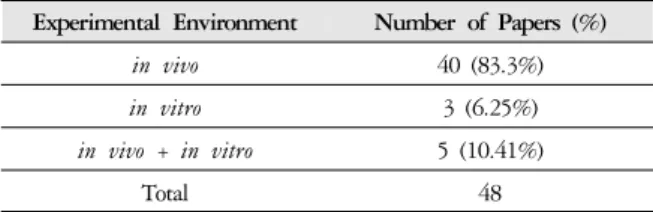
선정된 논문 48건 중 in vivo 단독 실험이 40편 (83.3%)으로 가장 많았고, in vitro 단독 실험이 3편 (6.25%), in vivo 와 in vitro를 함께 진행한 실험이 5편 (10.41%)이었다 (Table 3). 한 연구 안에서 여러 종류의 동물을 사용한 연구도 3편 있었다. 실험쥐를 사용한 in vivo 실험 중 SD rat를 사용한 실험은 41편, ICR mouse 를 사용한 실험은 3편, BALB/c mouse, Spontaneous dwarfism rat (SDR)를 사용한 실험이 각각 1편이었다.
그 외에 쥐가 아닌 동물을 사용한 in vivo 실험은 L×Y pig를 사용한 논문 1편, (D×Y)×L pig, gold fish를 사용 한 논문 1편이었다. 각 연구에 사용된 동물의 주령를
기재한 논문은 36편이었고, 최소 3주령부터 최대 12주 령까지의 SD rat이 사용되었다. 실험동물의 성별을 기 재한 논문은 29편이었으며 암컷 10편, 수컷 17편, 암수 모두를 사용한 논문은 2편이었다. 실험동물의 체중을 기재한 논문은 모두 30편이었으며 최소 21 ± 3 g부터 최대 280 ± 10 g의 실험쥐를 사용하였다 (Table 4).
Experimental Environment Number of Papers (%)
in vivo 40 (83.3%)
in vitro 3 (6.25%)
in vivo + in vitro 5 (10.41%)
Total 48
Table 3. Experimental Environment of Experimental Studies of Herbal Medicine for Growth
First author (year) Subjects Age Sex Weight (g) Inducing model
Koo BH (1998) L×Y pig 24 day - 7000~8000 3 Levels of nutrition
Leem KH (2001) SD rat 3 week - - -
Kim YT (2001) ICR mouse SD rat
4 week
5 week Male 21 ± 3
130 ± 10 -
Park BM (2002) SD rat 4 week - - -
Koo EJ (2002) BALB/c mouse ICR mouse
6 week
6 week Male 20~25
120~150 -
Park SY (2002) SD rat 3 week Male 80 ± 10 -
Jung DY (2003) SD rat 3~4 week - 250~300 -
Park BM (2003) SD rat 4 week - - -
Park SY (2003) SD rat 3 week Male 60 ± 10 -
Leem KH (2003) SD rat 3 week Male 80 ± 10 -
Leem KH (2003) SD rat 3 week Male - -
Ra JC (2004) gold fish
(D×Y)×L pig - - -
7214 -
Jeon CI (2004) SD rat 5 week Male 110 ± 10 -
Kim HJ (2004) SD rat - Male 120 -
Kim MK (2005) SD rat 3 week Male - -
Koo JS (2005) SD rat - Male 280 ± 10 Saporin
Min SY (2005) SD rat 12 week Male 280 ± 10 Saporin
Kim MJ (2006) ICR mouse 4~5 week male - -
Jang SJ (2006) SD rat 3 week Female 60g -
Kim KT (2006) SD rat - Male 80 ± 10g -
Park SS (2007) SD rat 3 week Male - -
Shin HS (2008) SD rat 4 week Male 50 ± 10 -
Park YM (2008) SD rat 3 week Female 60 ± 10 -
Kong IP (2008) SD rat after weaning Male 28.53 ± 4.11 -
Han SH (2008) SD rat after weaning Male 28.53 ± 4.11 Insufficient nutrition diet Table 4. Summary of Subjects used in in vivo Experimental Studies of Herbal Medicine for Growth
in vitro 실험에는 SD rat’s pituitary cell을 이용한 연구 가 2편, SD rat’s spleen cell을 이용한 연구가 1편이었고, MG-63 cell, RAW 264.7 cell을 사용한 논문 1편, 3T3-L1, Kunming mouse’s embryo rat를 사용한 논문이
각각 1편으로 연구마다 상이한 세포주를 사용하였다 (Table 5).
First author
(year) Subjects Age Sex Weight Inducing model
Jung DY
(2003)28) SD rat's pituitary cell 3~4 week - - DMEM (2.5% FBS, 10% horse serum) Kim CS
(2003)30) SD rat's pituitary cell Young
~ adult Male -
0.37% NaHCO₃, 10% horse serum, 2.5% fetal bovine serum, 1%
nonessential amino acids, 1% glutamine, 1% nystatin, 0.1%
gentamycin
Jeon CI
(2004)35) 3T3-L1 - - -
DMEM (10% FBS, 100 units/㎖ peniciline, 100 ㎍/㎖ streptomycin) inducing differentiation in DMEM (0.5 mM 1-methyl-3-isobutylxanthine, 0.25 μM dexamethasone, 10 μg/㎖
insulin) with 10-200 μg/㎖ sample Jang SJ
(2006)41) SD rat's spleen cell 3 - - -
Han DH (2008)45)
MG-63 cell - - - DMEM (10% FBS, antibiotics)
RAW 264.7 cell - - - DMEM (10% FBS, antibiotics)
Feng SH (2009)55)
Kunming mouse - Female 30 ± 2g 16 day embryo rat
Kunming mouse - Male 40 ± 2g 16 day embryo rat
Table 5. Summary of Subjects Used in in vitro Experimental Studies of Herbal Medicine for Growth
First author (year) Subjects Age Sex Weight (g) Inducing model
Gil JS (2009) SD rat 3 week Male - -
Kim JW (2009) SD rat 3 week Male - -
Lee SN (2009) SD rat - Male 80 ± 10g -
Jung BK (2009) SD rat 5 week Male 110 ± 10g -
Park SY (2009) SD rat 5 week Male 110 ± 10g -
Yoon JS (2009) SD rat 3 week - - -
Lee HK (2010) SD rat 3 week Male - -
Kim MY (2010) SD rat - Male 60 ± 10g -
Lee JH (2010) SD rat 3 week Female 80 ± 10g -
Lee SH (2012) SD rat 4 week Female 80 ± 10g -
Lee JL (2013) SD rat 4 week Female 70 ± 10g -
Zhu J (2013) SD rat - Male - Tail suspension
Kim JY (2014) SD rat 3 week Female - -
SDR 3 week Male, Female The spontaneous dwarf rat
Oh KW (2015) SD rat 3 week - - -
Kim HJ (2015) SD rat 25 day Female 60 ± 10g -
Cho SM (2016) SD rat 4 week Female 70 ± 10g -
Shin YJ (2016) SD rat 4 week Female 70 ± 10g -
Lee SH (2016) SD rat 4 week Female 75 ± 10g -
Son GH (2018) SD rat 12 week Female - 24hrs fasting before experiments
Sim JW (2019) SD rat
SD rat
5 week 3 week
Male
Male - -
4. 연구 중재 내용 분석
1) 단미제를 사용한 실험연구
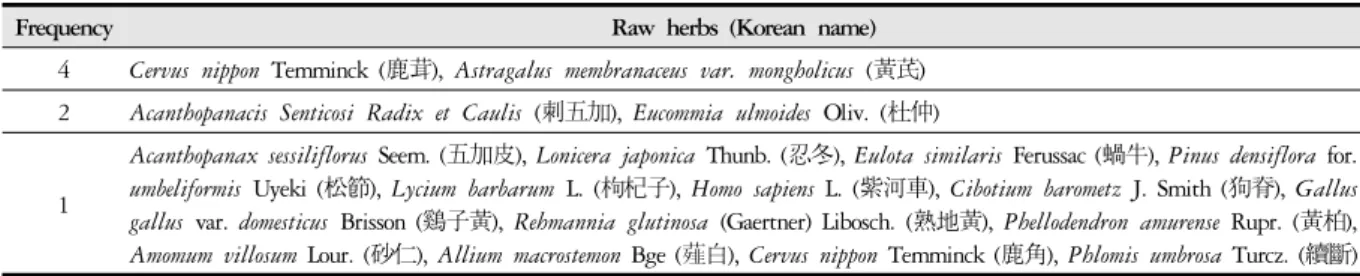
단미제를 사용한 실험연구 20편과 단미제, 복합제 를 함께 사용한 실험연구 3편에서 총 17종의 한약재가 단미제로 채택되었다 (Table 6). 단미제로 사용된 한약 재를 분석한 결과 황기 (黃芪)와 녹용 (鹿茸)이 4회로 가장 많이 사용되었고, 자오가 (刺五加), 두충 (杜沖) 2 회, 오가피 (五加皮), 인동 (忍冬), 와우 (蝸牛), 송절 (松 節), 구기자 (枸杞子), 자하거 (紫河車), 구척 (狗脊), 계 자황 (鷄子黃), 숙지황 (熟地黃), 황백 (黃柏), 사인 (砂 仁), 총백 (薤白), 녹각 (鹿角)이 각각 1회 사용되었다 (Table 7).
Intervention Number of Papers (%)
Single herb 20 (41.7%)
Combination herbs 25 (52.0%) Single + Combination 3 (6.25%)
Total 48
Table 6. Intervention of Experimental Studies of Herbal Medicine for Growth
2) 복합제를 사용한 실험연구
복합 한약물로써 사용된 한약재는 복합제만을 중재 로 채택한 실험연구 25편과 단미제, 복합제를 함께 사 용한 실험연구 3편에서 총 89종으로 나타났다 (Table 8). 이를 빈도별로 분류한 결과 복령 (茯笭)이 가장 많 은 17편의 논문에서 사용되었고, 산약 (山藥) 12편, 황 기 (黃芪) 10편, 당귀 (當歸), 숙지황 (熟地黃)이 각각 9편, 녹용 (鹿茸), 속단 (續斷), 산수유 (山茱萸)가 각각 8편, 감초 (甘草), 인삼 (人蔘)이 각각 7편, 진피 (陳皮), 구기자 (枸杞子), 오가피 (五加皮)가 각각 6편, 두충 (杜 沖), 녹각 (鹿角), 생지황 (生地黃), 목단피 (牧丹皮), 택 사 (澤瀉), 대조 (大棗), 자오가 (刺五加)는 5편에서 사 용되었다. 처방명에 따른 다빈도 처방은 육미지황탕 (六味地黃湯) 계열이 4편으로 가장 많았으며 (元方 2 편, 加減方 2편), 경옥고 (瓊玉膏) 계열 3편 (元方 1편, 加減方 2편), 사물탕 (四物湯) 계열 2편 (元方 1편, 加減 方 1편)이었다.
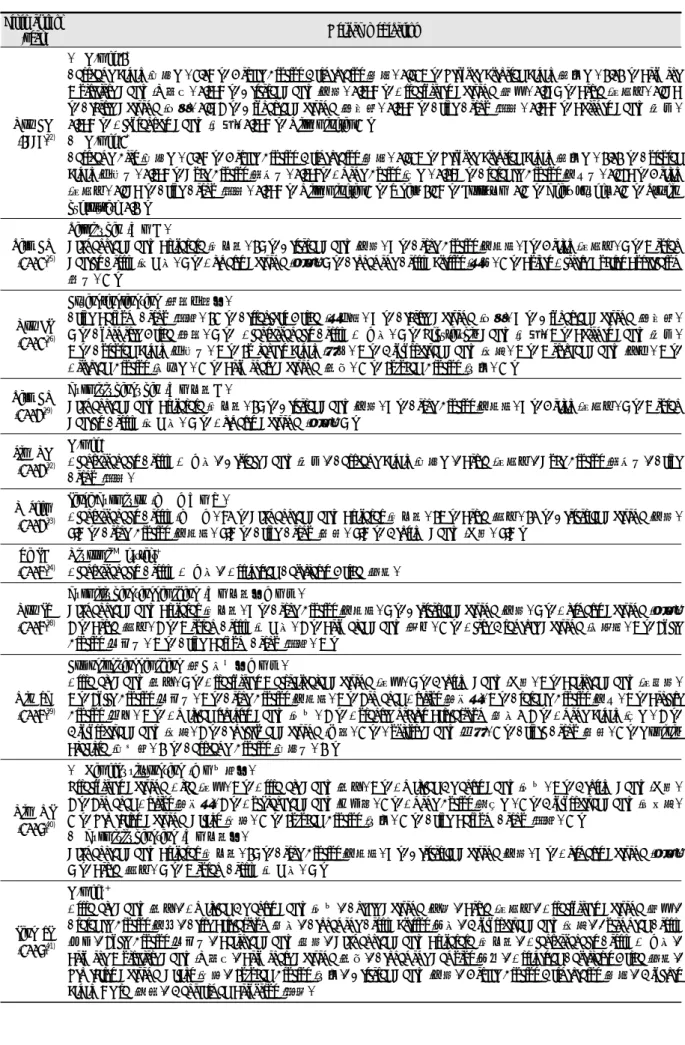
각 연구에 사용된 복합제의 처방 구성은 표 (Table 9)와 같다.
Frequency Raw herbs (Korean name)
4 Cervus nippon Temminck (鹿茸), Astragalus membranaceus var. mongholicus (黃芪) 2 Acanthopanacis Senticosi Radix et Caulis (刺五加), Eucommia ulmoides Oliv. (杜仲)
1
Acanthopanax sessiliflorus Seem. (五加皮), Lonicera japonica Thunb. (忍冬), Eulota similaris Ferussac (蝸牛), Pinus densiflora for.
umbeliformis Uyeki (松節), Lycium barbarum L. (枸杞子), Homo sapiens L. (紫河車), Cibotium barometz J. Smith (狗脊), Gallus gallus var. domesticus Brisson (鷄子黃), Rehmannia glutinosa (Gaertner) Libosch. (熟地黃), Phellodendron amurense Rupr. (黃柏), Amomum villosum Lour. (砂仁), Allium macrostemon Bge (薤白), Cervus nippon Temminck (鹿角), Phlomis umbrosa Turcz. (續斷) Table 7. Frequency of Used Raw Herbs for Growth Studies using Single Herb
Frequency Raw herbs (Korean name)
17 Hoelen (茯笭) 12 Discorae Radix (山藥) 10 Astragali Radix (黃芪)
9 Angelica gigas Nakai (當歸), Rehmanniae Radix Preparata (熟地黃) 8 Cervi Parvum Cornu (鹿茸), Phlomidis Radix (續斷), Corni Fructus (山茱萸) 7 Glycyrrhizae Radix (甘草), Gingseng Radix (人蔘)
6 Aurantii Nobilis Pericarpium (陳皮), Lycii Fructus (枸杞子), Acanthopanacis Cortex (五加皮)
5 Eucommiae Cortex (杜沖), Cervi Cornu (鹿角), Rehmanniae Radix (生地黃), Paeonia suffruticosa Andrews (牡丹皮), Alisma canaliculatum (澤瀉), Zizyphus jujuba Miller var. inermis Rehder (大棗), Acanthopanacis Senticosi Radix et Caulis (刺五加) 4 Atractylodes japonica Koidz. (白朮), Rubus coreanus Miq. (覆盆子), Dimocarpus longan Lour. (龍眼肉), Apis mellifera L. (白蜜),
Cibotium barometz J. Smith (狗脊)
Table 8. Frequency of Used Raw Herbs for Growth Studies using Complex Herbs (n≧4)
First author
(year) Herbal medication
Koo BH (1998)22)
① H-med-1*
Carthami Semen (紅花仁) 2.05 g, Hordei Fructus Germiniatus (麥芽) 0.624 g, Zizyphi Spinosae Semen (酸棗仁) 1.01 g, Polygoni Multiflori Radix (何首烏) 0.475 g, Discorae Radix (山藥) 0.475 g, Atractylodis Rhizoma (蒼朮) 0.386 g, Poria (白茯苓) 0.297 g, Cibotii Rhizoma (狗脊) 0.683 g, Drynariae Rhizoma (骨碎補) 0.475 g, Cervi Cornu (鹿角) 0.575 g, Phlomis Radix (續斷) 0.475 g, Achyranthis Radix (牛膝) 0.475 g, Milk mineral 2 g
② H-med-2*
Carthami Flos (紅花仁) 2.05 g, Hordei Fructus Germiniatus (麥芽) 0.624 g, Zizyphi Spinosae Semen (酸棗仁) 1.01 g, Cuscutae Semen (菟絲子) 0.475 g, Rubi Fructus (覆盆子) 0.475g, Amomi Fuctus (砂仁) 0.149 g, Crataegii Fructus (山楂子) 0.237 g, Hoelen (白茯苓) 0.297 g, Cervi Cornu (鹿角) 0.575 g, Milk mineral 2 g, Sugars 1.25 g, Colostrum 0.2 g, Yeast powder 0.2 g, Protein hydrolysate 0.1 g
Park BM (2002)25)
Palmi-whan (八味丸)
Rehmanniae Radix Preparata (熟地黃) 16 g, Discorae Radix (山藥) 8 g, Corni Fructus (山茱萸) 8g, Hoelen (白茯苓) 6 g, Moutan Radicis Cortex (牡丹皮) 6 g, Alimatis Rhizoma (澤瀉) 6 g, Cinnamomi Cortex Spissus (肉桂) 2 g, Pulvis Aconiti Tuberis Purificatum (附子) 2 g
Koo EJ (2002)26)
Boyangsengjangtang (補陽成長湯)
Cervi Parvum Cornu (鹿茸) 12 g, Cistanches Herba (肉蓯蓉) 8 g, Cibotii Rhizoma (狗脊) 8 g, Drynariae Rhizoma (骨碎補) 6 g, Cynomorii Herba (鎖陽) 6 g, Acanthopanacis Cortex (五加皮) 6 g, Achyranthis Radix (牛膝) 4 g, Phlomis Radix (續斷) 4 g, Cuscutae Semen (菟絲子) 4 g, Juglandis Semen (胡桃) 4 g, Glycyrrhizae Radix (甘草) 4 g, Morindae Radix (巴戟) 4 g, Alpiniae Fructus (益智仁) 2 g, Polygonati Rhizoma (黃精) 2 g, Jujubae Fructus (大棗) 2 g
Park BM (2003)29)
Yukmiziwhangwhan (六味地黃丸)
Rehmanniae Radix Preparata (熟地黃) 16 g, Discorae Radix (山藥) 8 g, Corni Fructus (山茱萸) 8 g, Hoelen (白茯苓) 6 g, Moutan Radicis Cortex (牡丹皮) 6 g, Alimatis Rhizoma (澤瀉) 6 g
Lim KH (2003)32)
H-med+
Acanthopanacis Cortex (五加皮), Dipsaci Radix (續斷), Carthami Semen (紅花仁), Poria (白茯苓), Rubi Fructus (覆盆子), Cervi Cornu (鹿角)
K Leem (2003)33)
Jaoga-Yukmiwon (刺五加六味元)
Acanthopanacis Cortex (刺五加) 50 g, Rehmanniae Radix Preparat (熟地黃) 14 g, Poria (茯苓) 10 g, Dioscoreae Rhizoma (山藥) 6.5 g, Corni Fructus (山茱萸) 6.5 g, Cervi Cornu (鹿角) 6.5 g, Ginseng Radix (人蔘) 6.5 g
Ra JC (2004)34)
KiwoomiTM extract+
Acanthopanacis Cortex (五加皮), Artemisiae Capillaris Herba (茵蔯)
Koo JS (2005)38)
Yukmijiwhangtanggamibang (六味地黃湯加味方)
Rehmanniae Radix Preparat (熟地黃) 8 g, Corni Fructus (山茱萸) 6 g, Dioscoreae Rhizoma (山藥) 6 g, Alismatis Rhizoma (澤瀉) 3 g, Poria (茯苓) 3 g, Moutan Cortex (牧丹皮) 3 g, Polygalae Radix (遠志) 2 g, Acori Graminei Rhizoma (石菖蒲) 4 g, Lycii Fructus (枸杞子) 4 g, Cervi Parvum Cornu (鹿茸) 4 g
Min SY (2005)39)
Bojungikgitanggamibang (補中益氣湯加味方)
Astragali Radix (黃芪) 6 g, Atractylodis Macrocephalae Rhizoma (白朮) 6 g, Ginseng Radix (人蔘) 4 g, Paeoniae Radix (白芍藥) 4 g, Lycci Fructus (枸杞子) 4 g, Corni Fructus (山茱萸) 4 g, Longanae Arillus (龍眼肉) 4 g, Crataegi Fructus (山楂) 4 g, Ponciri Fructus (枳實) 4 g, Angelicae sinensis Radix (當歸) 3 g, Aurantii nobilis Pericarpium (陳皮0 3 g, Amomi Semen (砂仁) 3 g, Glycyrrhizae Radix (甘草) 3 g, Cimicifugae Rhizoma (升麻) 2 g, Bupleuri Radix (柴胡) 2 g, Cervic Cornu (鹿角) 2 g, Hominis Placenta (紫河車) 1 g, Carthami Fructus (紅花子) 1 g
Kim MJ (2006)40)
① Gameegwuiryongtang (加味歸茸湯)
Atractylodis Rhizoma Alba (白朮) 4 g, Astragali Radix (黃芪) 4 g, Angelicae Gigantis Radix (當歸) 4 g, Ginseng Radix (人蔘) 3 g, Longanae Arillus (龍眼肉) 3 g, Aucklandiae Radix (唐木香) 2 g, Amomi Fuctus (貢砂仁) 2 g, Glycyrrhizae Radix (炙甘草) 2 g, Zingiberis Rhizoma Recens (生薑) 2 g, Jujubae Fructus (大棗) 2 g, Cervi Parvum Cornu (鹿茸) 2 g
② Yukmiziiwhangtang (六味地黃湯)
Rehmanniae Radix Preparat (熟地黃) 16 g, Corni Fructus (山茱萸) 8 g, Dioscoreae Rhizoma (山藥) 8 g, Alismatis Rhizoma (澤瀉) 6 g, Poria (茯苓) 6 g, Moutan Cortex (牧丹皮) 6 g
Jang SJ (2006)41)
H-med*,+
Astragali Radix (黃芪), Angelicae Gigantis Radix (當歸), Cnidii Rhizoma (川芎), Poria (白茯苓), Atractylodis Rhizoma (蒼朮), Crataegii Fructus (山査), Citri Pericarpium (陳皮), Cinnamomi Cortex Spissus (桂皮), Glycyrrhizae Radix (甘草), Eucommiae Cortex (杜冲), Lycii Fructus (枸杞子), Paeoniae Radix (芍藥), Rehmanniae Radix Preparata (熟地黃), Acanthopanacis Cortex (五加皮), Polygoni Multiflori Radix (何首烏), Polygonati Rhizoma (黃精), Cinnamomi Ramulus (桂枝), Artemisiae Capillaris Herba (茵蔯), Zingiberis Rhizoma Recens (生薑), Jujubae Fructus (大棗), Discorae Radix (山藥), Hordei Fructus Germiniatus (麥芽), Glycinis Semen Nigra (黑豆), Ganodermae Polyporus (靈芝)
Table 9. Herbal Composition of Complex Herbs Used in the Experiment