INTRODUCTION
Standard ecotoxicological study based on the official test guidelines has been one of the pri- mary approaches in order to assess the effects of toxic chemicals on aquatic organisms (fish, crus- tacean, and algae) and to classify these chemi- cals with respect to their potential hazard to the environment. According to the guidelines devel- oped by the Organization for Economic Coopera- tion and Development (OECD), for example, acute toxicity test on fish using juvenile or adult stage is to be carried out on only one of the eight recommended species. This would imply an equi- valent susceptibility of the difference species of fish to the chemicals, under the conditions de- scribed in the official guidelines (Vittozzi and De Angelis, 1991). However, Gallo et al. (1995) in- dicated that toxicity testing with only one fish
species may be inadequate to classify chemicals belonging to these classes for their environmen- tal impact. In addition, toxicity of chemicals to aquatic organisms has shown to be effected by age, size and health of the species, species, and the duration of exposure (Farah et al., 2004;
Köprücü et al., 2006). Therefore, the knowledge on the difference in susceptibility to various fish species may help to improve the determination of water quality criteria and the classification of chemicals, according to the regulations devoted to environmental protection.
The Chinese bleak, Aphyocypris chinensis, is a small cyprinid widely distributed in the small streams and ponds of Korea, and is also distri- buted in other East Asian countries such as Taiwan, China, and Japan (Kim, 1997). The im- portant characteristics of A. chinensis are short developmental time, transparent eggs, ease of culturing, and year-round reproduction (Park et
─
─ 419 ──
Acute Toxicity of Four Pesticides on the Chinese Bleak (Aphyocypris chisnensis) Indigenous to Korea
Yeom, Dong-Hyuk*and Sung Kyu Lee
(Ecotoxicology Research Team, Korea Institute of Toxicology, P.O. Box 123, Yuseong, Daejeon 304-343, Korea)
In this study, acute toxicity of four pesticides (diazinon, iprodione, fenproparthrin, and myclobutanil) to Chinese bleak, Aphyocypris chinensis, and to study their adverse effects were conducted in static systems. The 96-hr LC50 values were determined, as well as 95% confidence limits. The 96-hr LC50 values of these chemicals derived for Chinese bleak were rank ordered from the most toxic to the least toxic technicals as follows: Fenproparthrin (0.003 mg L--1)¤¤Myclobutanil (9.1 mg L-- 1)¤¤Diazinon (14.1 mg L-- 1)¤¤Iprodione (31.8 mg L-- 1). The data presented in this study indicate the acute toxicity tests carried out on only one fish species may lead to erroneous determination of water quality criteria and classification of test chemicals for environmental management and regulatory purpose. Therefore, more studies comparing the susceptibility of a variety of fish species to various toxicants are needed.
Key words : Chinese bleak, fish acute toxicity, pesticide, LC50
* Corresponding Author: Tel: 042) 860-7347, Fax: 042) 860-7399, E-mail: [email protected]
al., 1998; Yeom et al., 2001). With these attrac- tive features, A. chinensis can also be considered as a suitable test organism for ecotoxicological purpose, particularly for embryo-larval toxicity testing (Yeom et al., 2005). These days, however, the numbers of Chinese bleak are decreasing due to environmental changes such as destroying of natural waterways and ponds as oriental wea- therfish’s habitat, and increased use of agricul- tural chemicals in paddy fields. Despite this, there is little information on the effects of short- term exposure to agricultural pesticides.
The present study was performed to determine acute toxicity of four pesticides currently in use, such as diazinon, iprodione, fenpropathrin, and myclobutanil, to Chinese bleak, Aphyocypris chinensis. This species was selected for bioassays because it can easily be raised under laboratory conditions. It fulfills most of the requirements of a model species and is available throughout the year.
MATERIALS AND METHODS
Fishes used in this study were reared in this laboratory from eggs. After hatching, the larvae were fed daily with Baby Fish Food (Tetra, Germany) until reaching juvenile stage within 2 months. Juvenile fishes were fed daily with live brine shrimp until they were used in toxicity testing. The adult fishes, approximately four month old, were used for the toxicity test. Fishes were cultured with tap water dechlorinated through membrane and charcoal (residual chlor- ine, ⁄0.01 mg L
-1; hardness, 36-50 mg L
-1as CaCO
3; alkalinity, 19-39 mg L
-1as CaCO
3; pH 7.1-7.9). Fish were kept at kept at 24-26� C with a 16 : 8 hour light : dark photoperiod.
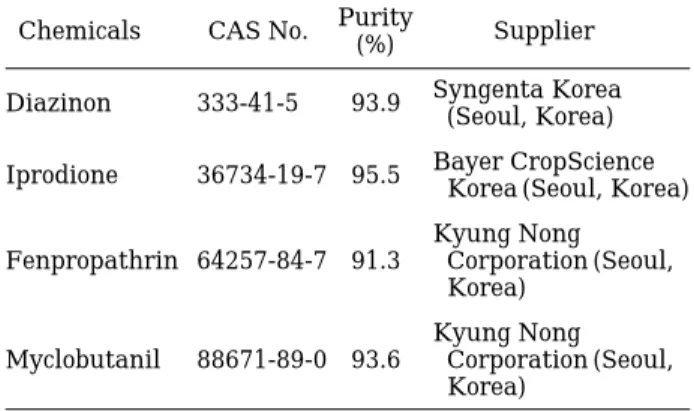
In this study, static acute toxicity tests were conducted according to standard methods (OECD, 1993). The concentration range of the agrochemicals was determined with a series of range finding tests. Thereafter, definitive acute toxicity tests were conducted by exposing fish to different concentrations of test chemicals. Each test consisted of exposing groups of 7 fish to a series of six or seven toxicant concentrations, one dilution water control, and one solvent control exposure. The four agrochemicals used in the present study had the specification listed in Table 1. Since all test substances have low solu-
bility, a stock solution of the test chemicals was prepared by dissolving desired amount in dime- thylsulphoxide (DMSO, Merck, Germany) and then added to the same water as that used for fish culture to give the desired exposure concen- trations. The concentration of DMSO was less than 100 mg L
-1. Tests were conducted in 5 L glass test vessels containing 4 L of test solution.
Mortality and abnormal behavior were moni- tored and recorded at 24-hour intervals during the tests, and dead fish were removed at those intervals. Cessation of opercular movement was the criteria for mortality. At the termination of each test, all control fish were weighed and total length was measured. The average wet weight and the average total length (±SD) of fish used in experiment were 0.28 (±0.09) g and 3.1 (±0.4) cm, respectively. Dissolved oxygen and pH were measured and recorded in the control, solvent control, low, medium, and high concentrations of each test with live fish present at 0, 48, and 96 hr of exposure. Dissolved oxygen was measured with a YSI Model 57 dissolved oxygen meter and probe with a standard membrane. pH was mea- sured with an Orion 720A pH meter with a Ross pH electrode and automatic temperature com- pensation electrode. A 16 : 8 hour light : dark pho- toperiod was provided throughout the test. The physiochemical characteristics of test water are
Table 1. Specification of the test chemicals.
Chemicals CAS No. Purity Supplier (%)
Diazinon 333-41-5 93.9 Syngenta Korea (Seoul, Korea) Iprodione 36734-19-7 95.5 Bayer CropScience
Korea (Seoul, Korea) Kyung Nong Fenpropathrin 64257-84-7 91.3 Corporation (Seoul,
Korea) Kyung Nong Myclobutanil 88671-89-0 93.6 Corporation (Seoul,
Korea)
Table 2. Physicochemical properties of the test water.
Parameter Value
Temperature (�C) 23.7±0.8
pH 6.48-8.02
Dissolved oxygen (mg L-1) 5.8-8.3 Total hardness (as CaCO3, mg L-1) 36-50
listed in Table 2.
The median lethal concentrations (LC
50values) with 95% confidence limits were calculated using either the Probit or Moving average angle me- thods as described by Stephan (1977). All LC
50values are expressed as nominal concentration of each test chemical.
RESULTS AND DISCUSSION
Temperature ranged from 22.0 to 24.8� C dur- ing the exposure period. The concentrations of dissolved oxygen in all tests were maintained at grater than 60% saturation, as recommended by OECD test guidelines (1992). There were no mor- talities and adverse effects observed in any of the fish exposed to control and solvent control during the experiments. The 96-hr LC
50values with 95% confidence limits determined with the four agrochemicals are presented in Table 3.
In the present study, the 96-hr LC
50value of diazinon, an organophosphate insecticide, to Chinese bleak was 14.1 mg L
-1(Table 3). The 96- hr LC
50values of diazinon were reported as 1.5 mg L
-1for common carp (Cyprinus carpio) larvae (Aydin and Köprücü, 2005), 3.9 mg L
-1for Japanese medaka (Oryzias latipes) (Oh et al., 1991), 0.1-0.5 mg L
-1for fry bluegill sunfish (Le- pomis macrochirus), 1.5 mg L
-1for sheepshead minnow (Cyprinodon variegates), 1.7 mg L
-1for fry rainbow trout (Oncorhynchus mykiss), and 7.8 mg L
-1for fathead minnow (Pimephales pro- melas) (Office of Pesticide Programs, 2000).
These results showed that Chinese bleak was approximately 2-141 times more tolerant than any other fish species reported above. These results suggest that diazinon has greater margin of safety to Chinese bleak in comparison to other fish. The symptoms of intoxication observed at all concentrations higher than 4.0 mg L
-1of dia-
zinon were loss of equilibrium, swimming at the water surface, and dark discoloration. In addi- tion to these, Chinese bleak exposed to 8.0 mg L
-1of diazinon showed vertebral deformity. McCann and Jasper (1972) observed haemorrhaging and fractures of the caudal vertebrae of bluegill fin- gerings exposed to organophosphorus and tria- zine formulations and they reported that most of this injury was due to a complex fracture of the caudal centrum and the haemal arch of a num- ber of the vertebrae. Kanazaw (1975) also found that up to 40% of an experimental population of motsugo (pseudorasbora pava) suffered vertebral damage after exposure to diazinon.
US EPA (1998) reported the 96-hr LC
50values of iprodione, a dicarboximide fungicide, on vari- ous fish species as follows: 3.7-7.8 mg L
-1for bluegill sunfish (L. macrochirus), 4.1-4.2 mg L
-1for rainbow trout (O. mykiss), 3.1 mg L
-1for channel catfish (Ictalurus punctatus). In terms of relative sensitivity, Chinese bleak appeared generally resistant and their 96-hr LC
50values were higher than those in bluegill sunfish, rain- bow trout, and channel catfish. For example, the corresponding 96-hr LC
50value for the present study was 31.8 mg L
-1(Table 3).
The fenpropathrin, a pyrethroid insecticide, appeared to be the most toxic to Chinese bleak with 96-hr LC
50value was 0.003 mg L
-1among the agrochemicals tested (Table 3). The results of the present study were similar to other report for fish exposed to fenpropathrin. For example, the 96-hr LC
50value was 0.002 mg L
-1for bluegill sunfish (L. macrochirus), 0.002 mg L
-1for rain- bow trout (O. mykiss), and 0.003 mg L
-1for sheepshead minnow (C. variegates) (http://www.
epa.gov/tri/chemical/hazard_enviro95.pdf). Pyre- throids have low toxicity in mammals, but they can be highly toxic to other animals, especially fish (Glickman and Lech, 1982). Yilmaz et al.
(2004) reported the hypersensitivity of fish to pyrethroid intoxication is partly due to species’
specific difference in pyrethroid metabolism, but principally to the increased sensitivity of the piscine nervous systems to these pesticides. Alth- ough under field conditions synthetic pyrethroids are considered to pose less risk due to its high adsorption to soil (Köprücü et al., 2006), these results indicate that fenpropathrin contamina- tion is very dangerous to fish. Therefore, this fact should be taken into consideration when pyre- throid insecticides including fenpropathrin are
Table 3. Calculated LC50 values (mg L-1) and 95% con- fidence intervals for diazinon, iprodione, fen- propathrin, and myclobutanil in Chinese bleak.
Pesticide Duration LC50
(hr) (95% confidence limits)
Diazinon 96 14.1 (10.9-17.4)
Iprodione 96 31.8 (27.2-38.8)
Fenpropathrin 96 0.003 (0.002-0.004) Myclobutanil 96 9.1 (7.4-11.7)
used in agriculture.
The British Crop Protection Council (2003) re- ported the acute toxicity of myclobutanil, a tria- zole fungicide, on bluegill sunfish and rainbow trout as 2.4 mg L
-1and 2.0 mg L
-1, respectively.
The 96-hr LC
50value (9.1 mg L
-1) reported in the present study for myclobutanil, however, were higher than those of British Crop Protection Council (Table 3). Since myclobutanil is rapidly excreted by animals, myclobutanil is classified as a moderately toxic compound (Athanasopoulos et al., 2003). The toxicity difference of myclobutanil among fish species may be related to host meta- bolism. Therefore, additional study is needed to confirm the contribution of metabolism, such as absorption, detoxification rate, and excretion, to toxicity difference in the Chinese bleak.
Acute toxicity studies are the very first step in determining the water quality requirements of fish. These studies obviously reveal the toxicant concentrations (LC
50) that cause fish mortality even at short exposure. The data presented in this study suggest that there are differences in the acute toxicity of pesticides for various fish species. The acute toxicity tests carried out on only one fish species may lead to erroneous de- termination of water quality criteria and classifi- cation of test chemicals for environmental mana- gement and regulatory purpose. Therefore, more studies comparing the susceptibility of a variety of fish species to various toxicants are needed in order to predict the potential risk of contami- nants.
LITERATURE CITED
Athanasopouls, P.E., C.J. Pappas and N.V. Kyriakidis.
2003. Decomposition of myclobutanil and triadi- mefon in grapes on the vines and during refri- gerated storage. Food Chemistry 82: 367-371.
Aydin, R. and K. Köprücü. 2005. Acute toxicity of diazinon on the common carp (Cyprinus carpio L.) embryos and larvae. Pesticide Biochemistry and Physiology 82: 220-225.
British Crop Protection Council. 2003. The Pesticide Manual, 13thed. British Crop Protection Council, Hampshire, UK.
Farah, M.A., B. Ateeq, M.N. Ali, R. Sabir and W.
Ahmad. 2004. Studies on lethal concentrations and toxicity stress of some xenobiotics on aquatic organisms. Chemosphere 55: 257-265.
Gallo, D., A. Merendino, J. Keiser and L. Vittozzi.
1995. Acute toxicity of two carbamates to the gup-
py (Poecilia reticulate) and the zebrafish (Bra- chydanio rerio). The Science of the Total Envi- ronment 171: 131-136.
Glickman, A.H. and J.J. Lech. 1982. Differential toxi- city of trans-permethrin in rainbow trout and mice. Toxicol. Appl. Pharmacol. 66: 162-171.
Kanazaw, J. 1975. Uptake and excretion of organo- phosphorus and carbamate insecticides by fresh- water fish, Motsugo Pseudoasbora parva. Bull.
Environ. Contam. Toxicol. 14: 346.
Kim, I.S. 1997. Encyclopedia of fauna and flora of Korea. Vol. 37. Freshwater fish. Ministry of Edu- cation, Seoul.
Köprücü, S.S., K. Koprucu and M.S. Ural. 2006. Acute toxicity of the synthetic pyrethroid deltamethrin to fingerling European catfish, Silurus glanis L.
Bull. Environ. Contam. Toxicol. 76: 59-65.
McCann, J.A. and R.L. Jasper. 1972. Vertebral da- mage to bluegills exposed to acutely toxic levels of pesticides. Trans. Am. Fish. Soc. 101: 317-322.
OECD. 1993. Fish, acute toxicity test. In: OECD Gui- delines for Testing of Chemicals No. 203, Paris.
Office of Pesticide Programs. 2000. Pesticide Ecotoxi- city Database (Formerly: Environmental Effects Database), Environmental Fate and Effects Divi- sion, U.S. EPA, Washington, DC, USA.
Oh, H.S., S.K. Lee, Y.H. Kim and J.K. Roh. 1991.
Mechanism of selective toxicity of diazinon to kil- lifish (Oryzias latipes) and loach (Misgurnus anguillicaudatus). Aquat. Toxicol. Risk. Assess.
14: 343-353.
Park, D.S., D.H. Yeom, S.K. Lee and S.S. Choi. 1998.
Development of eggs and larvae Aphyocypris chinensis GÜNTHER (Cyprinidae: Leuciscinae) reared in the laboratory. Koran Journal of Envi- ronmental Biology 16: 245-251.
Stephan, C.E. 1977. Methods for calculating an LC50. In: Mayer FL, Hamelink JL (eds.) Aquatic Toxi- cology and Hazard Evaluation, ASTM STP 634, American Society for Testing and Materials.
U.S. EPA. 1998. Reregisteration Eligibility Decision (RED), Iprodione. EPA738-R-98-019.
Vittozzi, L. and G. De Angelis. 1991. A critical review of comparative acute toxicity data on freshwater fish. Aquat. Toxicol. 19: 167-204.
Yeom, D.H., J. Seo and S.K. Lee. 2005. Use of Chinese bleak, Aphyocypris chinensis, in embryo and sac- fry stages toxicity test. J. Environ. Toxicol. 20:
359-363.
Yeom, D.H., S.K. Lee and S.S. Choi. 2001. Influence of water temperature on spawning of Chinese bleak, Aphyocypris chinensis. Korean. J. Limnol.
34: 337-341.
Yilmaz, M., A. Gül and K. . 2004. Acute toxi- city of alpha-cypermethrin to guppy (Poecilia rei- culata, Pallas, 1859). Chemosphere 56: 381-385.
(Manuscript received 5 June 2006, Revision accepted 21 August 2006)
⁄ ¤
국내 토착종인 왜몰개 (Aphyocypris chinensis) 에 대한 4 개 농약의 급성독성 생물검정
염 동 혁*∙이 성 규 (안전성평가연구소 생태독성연구팀)
본 연구에서는 국내 토착종인 왜몰개(Aphyocypris chinensis)을 사용하여 4가지 농약(diazinon, iprodione, fenpropathrin, myclobutanil)의 급성독성을 평가하기 위하여 지수식으로 독성실험을 실 시하여96-hr LC50값과 95% 신뢰한계를 구하였다. 각 실험농약의 96-hr LC50값을 비교하여 왜몰 개에 대한 급성독성이 높은 순서를 정리한 결과는 Fenproparthrin (0.003 mg L-1)¤Myclobutanil (9.1 mg L-1)¤Diazinon (14.1 mg L-1)¤Iprodione (31.8 mg L-1) 순으로 나타났다. 본 연구에서 사용 된 4가지 농약에 대한 왜몰개의 급성독성 값은 현재까지 보고된 다른 어종의 급성독성 값과 차이 가 있었다. 그러므로 환경관리 및 규제목적으로 어류에 대한 급성독성실험 결과를 수질기준 또는 물질분류에 이용하기 위해서는 다양한 어류에 대한 급성독성 평가를 통하여 종합적 판단이 필요하 다고 사료된다.