Jiyoung Rhee, Jaemin Jo
6
https://wcms.jejunu.ac.kr/medsci/The Journal of Medicine and Life Science https://wcms.jejunu.ac.kr/medsci/The Journal of Medicine and Life Science
INTRODUCTION
Colon cancer is one of the leading causes of death from cancer worldwide.1) In Korea, colorectal cancer ranks fourth among cancer deaths in men and second in wom- en.2) In stage III colon cancer, a combination chemother- apy of fluoropyrimidines and oxaliplatin after the resec- tion of the primary tumor is recommended to improve survival, with 5-fluorouracil, leucovorin, and oxaliplatin (FOLFOX) combination chemotherapy as the currently accepted standard adjuvant treatment regimen.3-5) How- ever, the appropriate period of FOLFOX chemotherapy
to minimize toxicity from chemotherapy while maxi- mizing the improvement of survival has not been deter- mined. Early clinical studies in the 1990’s on adjuvant treatment of colon cancer with 5-fluorouracil and leucov- orin showed there was no survival benefit from extending treatment from 6 months to 8 or 12 months.6,7) Based on the results from these studies, adjuvant chemotherapy for 6 months has been recommended for standard treatment in stage III colon cancer patients.
With FOLFOX chemotherapy, there is a concern for oxaliplatin-induced peripheral neuropathy(OIPN) from 12 cycles of treatment over 6 months.3) The results from a study of Western patients showed that >90% of pa- tients exhibited signs of OIPN during the chemotherapy, and 15% had residual signs even several years after the completion of chemotherapy.5) This chronic OIPN is as- sociated with the cumulative dose of oxaliplatin.8) There- fore, studies have recently been conducted to determine The Journal of Medicine and Life Science Vol. 16, No. 1, 6-9, April 2019
https://doi.org/10.22730/jmls.2019.16.1.6 eISSN: 2671-4922
Effects of 7~11 cycles adjuvant FOLFOX chemotherapy on the prognosis of patients with stage III colon cancer
By Jiyoung Rhee
1,, Jaemin Jo
11Division of Hematology-Oncology, Department Internal Medicine, Jeju National University Hospital, Jeju-do, Republic of Korea
Abstract Adjuvant fluorouracil, leucovorin, and oxaliplatin(FOLFOX) chemotherapy for 6 months is the standard treatment of stage III colon cancer to improve patient survival. Recent studies have shown that restricting the treatment to 3 months to reduce toxicity negatively affects the outcome. However, the effect of FOLFOX treatment for a duration of between 3 and 6 months(7~11 cycles) on survival is not known. The effect of a reduced duration of FOLFOX chemotherapy on the prognosis of stage III colon cancer was examined. The 5-year disease-free survival in patients receiving 7~11 cycles of FOLFOX was lower than those receiving 12 cycles(72.9% vs. 87%, respectively).
Patients receiving 7~11 cycles who had a bowel obstruction at diagnosis had a significantly higher recurrence rate (66.7% vs. 15.0%) and shorter median disease-free survival(24.7 months vs. not reached) than those receiving 12 cycles. Among patients receiving 12 cycles of FOLFOX, there was no difference in the outcome between those with and those without intestinal obstructions at diagnosis. These results suggest that the completion of 12 cycles FOLFOX chemotherapy is important to improve the patient’s prognosis, especially for with intestinal obstructions at diagnosis.
Key words: Colon cancer, Adjuvant chemotherapy, FOLFOX
Received: December 10, 2018; Revised: January 26, 2019; Accepted: January 28, 2019 Correspondence to : Jiyoung Rhee
Division of Hematology-Oncology, Department of Internal Medicine, Jeju National University Hospital, Aran 13-gil, 15, Jeju-si, Republic of Korea Tel: 82-64-717-1590, FAX: 82-64-717-1402
E-mail: [email protected]
Copyright The Journal of Medicine and Life Science
Original Article
Duration of FOLFOX in stage III colon cancer
7
https://wcms.jejunu.ac.kr/medsci/The Journal of Medicine and Life Science
whether shortening the treatment period reduces toxicity while maintaining efficacy. These studies reported that 3 months of FOLFOX chemotherapy did not show non-in- feriority of the survival outcome compared to that with 6 months of treatment.9,10) To date, no study has report- ed the effects of slightly longer durations, we sought to compare the clinical outcomes of stage III colon cancer patients receiving adjuvant FOLFOX chemotherapy for between 3 and 6 months(i.e., 7~11 cycles) with those who completed 6 months(12 cycles) of FOLFOX che- motherapy.
MATERIALS AND METHODS
Patients
The medical records of colon cancer patients who un- derwent curative surgery between March 2008 and May 2013 and received adjuvant FOLFOX chemotherapy were reviewed. Among these, the records of patients meeting
the following three criteria were selected for analyses: (i) diagnosis of stage III colon cancer according to the Ameri- can Joint Committee on Cancer cancer staging manual; (ii) more than 7 cycles of adjuvant FOLFOX were adminis- tered; (iii) no recurrence at the time of chemotherapy com- pletion. The patients’ clinicopathologic features and clin- ical outcomes were retrospectively evaluated. This study protocol was approved by the Institutional Review Board (IRB) of the Jeju National University Hospital(IRB proto- col number JEJUNUH 2018-05-008).
Statistical analysis
The comparisons of clinicopathologic variables, recur- rence of colon cancer, and patterns of relapse between patients receiving 12 cycles of FOLFOX(standard group) and those receiving 7~11 cycles of FOLFOX(short-course group) were made using Pearson’s χ2 or Fisher’s exact tests as appropriate. Two-sided P values of <0.05 were considered statistically significant. The associations be- tween clinicopathologic variables, including disease-free
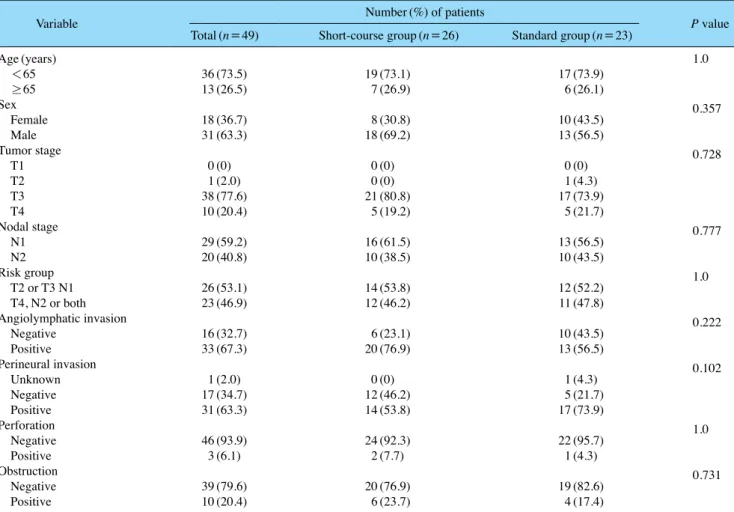
Table 1. Baseline characteristics
Variable Number(%) of patients
P value Total(n=49) Short-course group(n=26) Standard group(n=23)
Age(years) 1.0
<65 36(73.5) 19(73.1) 17(73.9)
≥65 13(26.5) 7(26.9) 6(26.1)
Sex 0.357
Female 18(36.7) 8(30.8) 10(43.5)
Male 31(63.3) 18(69.2) 13(56.5)
Tumor stage 0.728
T1 0(0) 0(0) 0(0)
T2 1(2.0) 0(0) 1(4.3)
T3 38(77.6) 21(80.8) 17(73.9)
T4 10(20.4) 5(19.2) 5(21.7)
Nodal stage 0.777
N1 29(59.2) 16(61.5) 13(56.5)
N2 20(40.8) 10(38.5) 10(43.5)
Risk group 1.0
T2 or T3 N1 26(53.1) 14(53.8) 12(52.2)
T4, N2 or both 23(46.9) 12(46.2) 11(47.8)
Angiolymphatic invasion 0.222
Negative 16(32.7) 6(23.1) 10(43.5)
Positive 33(67.3) 20(76.9) 13(56.5)
Perineural invasion 0.102
Unknown 1(2.0) 0(0) 1(4.3)
Negative 17(34.7) 12(46.2) 5(21.7)
Positive 31(63.3) 14(53.8) 17(73.9)
Perforation 1.0
Negative 46(93.9) 24(92.3) 22(95.7)
Positive 3(6.1) 2(7.7) 1(4.3)
Obstruction 0.731
Negative 39(79.6) 20(76.9) 19(82.6)
Positive 10(20.4) 6(23.7) 4(17.4)
Jiyoung Rhee, Jaemin Jo
8
https://wcms.jejunu.ac.kr/medsci/The Journal of Medicine and Life Science https://wcms.jejunu.ac.kr/medsci/The Journal of Medicine and Life Science
survival(DFS) of patients in both groups, were analyzed by Kaplan-Meier plots and log-rank tests. The DFS was defined as the time from the date of surgery to the first de- tection of disease recurrence. Multivariate analyses were carried out using the Cox regression model. A significance level of 0.05 was used to select variables for covariate analyses.
RESULTS
Patient characteristics
The medical records from 49 patients were included in this study. Of these, 23 patients were treated with 12 cycles FOLFOX chemotherapy(standard group), and 26 were treated with 7~11 cycles(short-course group). All patients in the short-course group received FOLFOX chemothera- py for more than 4 months: nine patients received 8 cycles, sixteen had 9 cycles, and one had 11 cycles of FOLFOX chemotherapy. The demographic and clinical characteris- tics of the patients are summarized in Table 1. The overall mean age(±standard deviation) of the patients was 57.4±
10.6 years; patients in the short-course group were a mean of 59.6±10.2 years, and those in the standard group were 55.0±10.8 years. The median duration of follow-up was 66.8 months(range, 17.9~121.4 months).
Clinical outcomes
During the follow-up period, 10(20.4%) patients ex- perienced recurrence; 7 of these were in the short-course group. The 5-year DFS in the short-course group was slightly lower than that in the standard group(72.9%
vs 87%, respectively; P =0.244)(Fig. 1). Among the patients in the short-course group, those with a bowel obstruction at diagnosis had a significantly higher re- currence rate(66.7% vs 15.0%, P=0.028) and shorter median DFS(24.7 months; 95% confidence interval, 0.0 to 61.8 [CI] vs not reached; 95% CI, not available, P=
0.017) than those with no obstructions(Fig. 2). There was no significant difference in outcomes between those with and those without an intestinal obstruction among patients in the standard group. None of the other factors, including age, lymph node stage, tumor stage, risk group(T2 or T3 N1 vs. T4, N2 or both), angiolymphatic invasion, perineu- ral invasion, and perforation, had a significant effect on recurrence and DFS.
DISCUSSION
A prospective study of Korean colorectal cancer patients treated with 12 cycles of adjuvant FOLFOX revealed that 94% showed signs of OIPN after the completion of treat- ment, and 14% of patients showed grade 3 OIPN.11) OIPN persisted in 64% of patients 1 year after the end of treat- ment, with 11% of patients showing grade 3 toxicity, and the frequency and severity of OIPN increased with repeat- ed cycles of chemotherapy.11) Because there is no specific
Disease-free survival
0 12 24 36 48 60 72 84 96 108 120
Time to event(months)
Standard group Short-course group 12 cycles-censored 7~11 cycles-censored 1.0
0.9 0.8 0.7 0.6 0.5 0.4 0.3 0.2 0.1 0.0
Figure 1. Disease-free survival for patients receiving standard or a short course of adjuvant FOLFOX chemotherapy.
Disease-free survival
0 12 24 36 48 60 72 84 96 108 120
Time to event(months)
Obstruction Negative Positive 1.0
0.9 0.8 0.7 0.6 0.5 0.4 0.3 0.2 0.1 0.0
Figure 2. Disease-free survival for patients with or without bowel obstructions receiving short-course FOLFOX chemotherapy.
Duration of FOLFOX in stage III colon cancer
9
https://wcms.jejunu.ac.kr/medsci/The Journal of Medicine and Life Science
method to prevent OIPN and treatment entails only con- servative management, there is continued concern about how to reduce the use of oxaliplatin.12) One way to reduce the frequency and severity of OIPN may be to reduce the number of chemotherapy cycles. And, treatment duration affected to patient’s compliance to chemotherapy.13)
The results of the present study reveal that the DFS of patients receiving fewer cycles of FOLFOX chemothera- py was lower, though this reduction was not statistically significant. However, patients with bowel obstructions as a risk factor had worse outcomes than those without, but only among patients receiving fewer cycles. This finding suggests that shortening the duration of adjuvant FOLF- OX has a negative effect on the clinical outcome of stage III colon cancer patients with bowel obstructions.
There are some limitations in this study. First, the small number of patients included in this study limited the sta- tistical comparisons. Second, the retrospective design limited the data to what was present in the medical re- cords; thus, we were unable to obtain some information, such as why chemotherapy was stopped early in some patients.
The results from this study indicate that patients with bowel obstructions at the diagnosis of colon cancer are at risk for a poorer outcome if a shorter course of FOLFOX chemotherapy is used. Thus, the full 12 cycles of treat- ment should be administered to these patients to improve the prognosis.
As shown in a recent study, for those with a lower risk for recurrence, a 3-month regimen of capecitabine with oxaliplatin may be as efficacious as a 6-month duration.9) Therefore, we also suggest that the choice of regimen should be personalized to the patient’s tumor condition and their risk of OPIN. And, further studies are needed to de- termine the exact mechanism of OIPN and its prevention and treatment.
REFERENCES
1. Jemal A, Bray F, Center MM, Ferlay J, Ward E, Forman D. Glo- bal cancer statistics. CA Cancer J Clin 2011;61:69-90.
2. Jung KW, Won YJ, Kong HJ, Lee ES. Cancer Statistics in Korea:
Incidence, Mortality, Survival, and Prevalence in 2015. Cancer Res Treat 2018;50:303-16.
3. Andre T, Boni C, Mounedji-Boudiaf L, Navarro M, Tabernero J, Hickish T, et al. Oxaliplatin, fluorouracil, and leucovorin as adju- vant treatment for colon cancer. N Engl J Med 2004;350:2343-51.
4. Haller DG, Tabernero J, Maroun J, de Braud F, Price T, Van Cutsem E, et al. Capecitabine plus oxaliplatin compared with flu- orouracil and folinic acid as adjuvant therapy for stage III colon cancer. J Clin Oncol 2011;29:1465-71.
5. Andre T, Boni C, Navarro M, Tabernero J, Hickish T, Topham C, et al. Improved overall survival with oxaliplatin, fluorouracil, and leucovorin as adjuvant treatment in stage II or III colon cancer in the MOSAIC trial. J Clin Oncol 2009;27:3109-16.
6. Andre T, Quinaux E, Louvet C, Colin P, Gamelin E, Bouche O, et al. Phase III study comparing a semimonthly with a monthly regimen of fluorouracil and leucovorin as adjuvant treatment for stage II and III colon cancer patients: final results of GERCOR C96.1. J Clin Oncol 2007;25:3732-8.
7. O̓Connell MJ, Laurie JA, Kahn M, Fitzgibbons RJ, Jr., Erli- chman C, Shepherd L, et al. Prospectively randomized trial of postoperative adjuvant chemotherapy in patients with high-risk colon cancer. J Clin Oncol 1998;16:295-300.
8. Cersosimo RJ. Oxaliplatin-associated neuropathy: a review. Ann Pharmacother 2005;39:128-35.
9. Grothey A, Sobrero AF, Shields AF, Yoshino T, Paul J, Taieb J, et al. Duration of Adjuvant Chemotherapy for Stage III Colon Can- cer. N Engl J Med 2018;378:1177-88.
10. Andre T, Vernerey D, Mineur L, Bennouna J, Desrame J, Faroux R, et al. Three versus 6 months of oxaliplatin-based adjuvant che- motherapy for patients with stage III colon cancer: disease-free sur- vival results from a randomized, open-label, international duration evaluation of adjuvant(IDEA) France, Phase III Trial. J Clin Oncol 2018;36:1469-77.
11. Kim SH, Kim W, Kim JH, Woo MK, Baek JY, Kim SY, et al. A Prospective study of chronic oxaliplatin-induced neuropathy in patients with colon cancer: long-term outcomes and predictors of severe oxaliplatin-induced neuropathy. J Clin Neurol 2018;14:81- 9.
12. Baek KK, Lee J, Park SH, Park JO, Park YS, Lim HY, et al. Ox- aliplatin-induced chronic peripheral neurotoxicity: a prospective analysis in patients with colorectal cancer. Cancer Res Treat 2010;42:185-90.
13. Lonardi S, Sobrero A, Rosati G, Di Bartolomeo M, Ronzoni M, Aprile G, et al. Phase III trial comparing 3~6 months of adjuvant FOLFOX4/XELOX in stage II~III colon cancer: safety and com- pliance in the TOSCA trial. Ann Oncol 2016;27:2074-81.