한국정보통신학회논문지(J. Korea Inst. Inf. Commun. Eng.) Vol. 20, No. 9 : 1666~1672 Sep. 2016
링크드오픈데이터 기반 스마트 라이브러리의 참조모델에 관한 연구
문희경 · 한성국*
A study of Reference Model of Smart Library based on Linked Open Data
Hee-kyung Moon · Sung-kook Han
*Department of Computer Engineering, Wonkwang University, Iksan 54538, Korea
요 약
최근 스마트 기술이 다양한 정보시스템 분야에 적용되고 있다. 특히, 기존 도서관 서비스 분야는 디지털도서관을 넘어 스마트 도서관으로 변화되었다. 이러한 변화의 환경에서 다양한 콘텐츠와 서비스 그리고 사용자와 스마트 디바 이스를 지원하는 도서관 서비스 소프트웨어 플랫폼이 요구된다. 기존 도서관 서비스는 서로 다른 이기종의 도서관 시스템간의 의미적 상호운용성이 저해되는 제한점을 갖고 있다. 본 논문은 다양한 콘텐츠 제공과 시스템간의 상호 작용 그리고 서비스의 통합에 중점을 두어 미래 도서관 시스템의 원형으로 링크드오픈데이터 기반의 스마트 라이 브러리 제안한다. 링크드 오픈데이터 기반 스마트 라이브러리는 첨단 정보기술이 모여진 혁신적인 시스템이다. 우 리는 링크드오픈데이터를 기반으로 스마트 라이브러리를 위한 다양한 요구사항에 따라 시스템 환경을 설계하였다.
이용자의 요구사항과 정보기술의 에코시스템을 고려하여 스마트 라이브러리 시스템의 기능적 요구사항에 대해 기 술한다. 또한 기능적 요구사항을 수용하고 다양한 스마트 디바이스를 통해 사용자에게 스마트 지식 서비스를 제공할 수 있는 참조 프레임워크를 보여준다.
ABSTRACT
In recent years, smart technology has been applied to various information system fields. Especially, traditional library service area is changing to Smart-Library from Digital-Library. In this environment are need to library service software platform for supporting variety content, library services, users and smart-devices. Due to this, existing library service has a limitation that inhibits semantic interoperability between different heterogeneous library systems. In this paper, we propose Linked-Open-Data based smart library as an archetype of future-library system that provide a variety content and system interaction and integration of services. It is an innovative system of the cutting-edge information intensive. Therefore, we designed system environments according to various integration requirements for smart library based on Linked-Open-Data. And, we describe the functional requirements of smart-library systems by considering the users' demands and the eco-systems of information technology. In addition, we show the reference framework, which can accommodate the functional requirements and provide smart knowledge service to user through a variety of smart-devices.
키워드 : 스마트 라이브러리, 링크드오픈데이터, 클라우드 컴퓨팅, 스마트 모바일 컴퓨팅.
Key word : Smart library, Linked Open Data (LOD), Cloud Computing, Smart Mobile Computing
Received 22 July 2016, Revised 28 July 2016, Accepted 15 August 2016
* Corresponding Author Sung-kook Han(E-mail:[email protected], Tel:+82-63-850-6749) Department of Computer Engineering, Wonkwang University, Iksan 54538, Korea
Open Access http://dx.doi.org/10.6109/jkiice.2016.20.9.1666 print ISSN: 2234-4772 online ISSN: 2288-4165
Library 2.0 inspired by Web 2.0 opens the new insight for library functions by means of openness, share, participation and collaboration through users networking. Digital Library (DL) has flourished the support of digitized resources through high-speed global networks to the diverse information appliances.
It is very common to access knowledge services provided by DL elsewhere with smart mobile devices.
Under this circumstance, semantic interoperability among knowledge services has become more important.
To resolve the bottleneck of the proliferation of DL, semantic library using the common metadata and ontology, sometimes called Library 3.0, has been studied [3, 4]. A formalized standard representation schema for heterogeneous knowledge resources is necessary to realize semantic interoperability in the global network environment. Linked Open Data (LOD) widely used in public domains is applied into the library systems [5-7].
For the future library systems, a new innovative library system considering the requirements of library services as well as the eco-systems of information technology is required for the seamless evolution of library systems. This paper describes the referential model of Smart Library as an archetype of future library systems.
based on the Internet and computer networks. This kind of the transition of library information systems is to accommodate new library resources due to the innovation of information technology, neither the users’
requirements nor the new service support. The purpose of e-Library or more generally digital library is to control electronically digitized information resources of various media and formats and provide service on open information access by establishing a large scale repository of electronic information resource. These systems still have used traditional management techniques such as MARC and metadata [7-10].
The Web technology accelerated open access of Web-based information resources and provided diverse services. Web 2.0 had proposed the ethos of Web technology that can be summarized into 4 important properties: openness, share, participation and collaboration through users networking. Library 2.0, the library information systems accommodating the ethos of Web 2.0, become the moment of the intrinsic transformation of library information systems. Library information systems are advanced towards user-oriented, service- oriented open systems.
Although library information services have been remarkably innovated, more intelligent information services are hindered by semantic interoperability among heterogeneous library systems.
For innovative service system and information
resources management, more fundamental approach is demanded. LOD originated from Semantic Web is applied to resolve these problems. Tripled-based description of knowledge resources in the library can be realized the global knowledge space by interweaved library information systems.
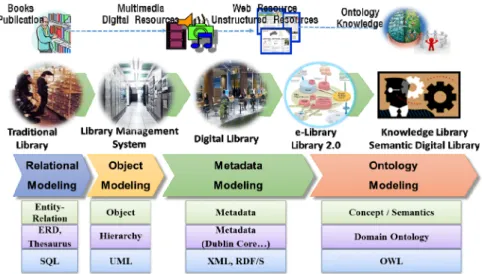
The evolution of library information systems shown in Fig. 1 have been was largely focused on providing various web-based services and interoperable description of knowledge resources. However, the seamless integration of related technologies are important and the innovated library information systems also consider the paradigm shift caused by smart mobile technology [7-10].
Ⅲ. A Reference Model of Smart Library Systems
Smart Library is an innovative system adopting recent information technology and an enhanced service system from the view point of a new library culture.
Consequently, it should offer the progressive functions that can accommodate a new technological, cultural transformation beyond the digital library. In this
section, the functional requirements of Smart Library Systems are derived from the eco-system of the current smart information environment. And the referential architecture of Smart Library Systems is presented.
3.1. Functional Requirements of Smart Library Systems Smart Library Systems are the convergence application of the forefront information technology from the point of view of the publication of smart services for knowledge resources in the library. Considering the users’ demands and the eco-systems of information technology, the functional requirements can be summarized as follows:
3.1.1. Semantic-based services
Smart Library as an evolutionary model of the future library system can support not only the usual library business and user services but also the new functions that can be realized by means of the innovate information technology. Recently, library systems widely adopt metadata, ontology and FRBR. These conceptual models aim to realize federated business processes and semantic services. Linked Open Data is a very appropriate model for semantic-based library services in the global information environment.
Fig. 1 The evolution of Library Management System
devices, library services have to be properly customized for devices.
3.1.4. Personalization
The library and information system should carry out a role as a personal information portal [8]. A personalized information portal should be realizable by utilizing service components including user profile, portlet or widget. Automatic subscription as RSS should be available. The library service cloud will be suitable for personalization and other user services.
3.1.5. Community support
Library community plays a key role for friendly interaction among library users, managers and developers.
Various community activities including participation of users in cataloging, metadata tagging using folksonomy, information sharing through blogs and collaboration by means of wiki should be provided. In other words, library should be a shared knowledge portal that harnesses knowledge of the community. The community support is also important for library marketing.
3.1.6. Digital asset management
The first goal of the library and information system is at effective management of library and information resources. In Smart Library, not only the digital library information resources but also the core management
management systems and library standards:
Knowledge resource network: Since the primary goal of the library is the management of the published knowledge resources, the efficient organization of knowledge resources are the basis of library systems.
According to the advancement of information technology, the diverse knowledge resources have been newly advent and traditional resources are transformed into digital forms. To represent bibliographic information, various methods have been used such as metadata, thesaurus, taxonomy and ontology. However, LOD is widely accepted as a powerful enabler to realize semantic interoperability of knowledge representation of the hyper-connected knowledge resources. LOD is a new vehicle to represent and deliver bibliographic infor- mation in the global knowledge space [11-13].
Library business network: The library is transformed into the community center for knowledge concert from the traditional repository of knowledge resources. The library becomes the knowledge hub of cultural, educational and entertainment activities. Besides, the active user participation in library business is opened and encouraged. The library system should play a role of social network hub to provide knowledge activities and business participation of users.
Smart service network: The quality and diversity of
information services as the product of the library should
prove the justification of the unique role of the library,
compared with services provided by the Internet portals.
The library systems should have the efficient information acquisition functions for their own business as well as offer ubiquitous smart services over smart devices. For the realization of smart library services, cloud computing is the essential infrastructure to develop sustainable services.
Technology network: Library information systems are indeed the convergence of information technologies.
Library information systems need service-oriented architecture to implement business functions, cloud computing technology such as SaaS for the diverse services, ontology and Linked Data to represent semantically interoperable information, mobile computing to deliver smart services and ubiquitous computing for the efficient management of information resources. In addition to these, advanced network technologies are used for the infrastructure of library information systems.
3.2. Reference Framework of Smart Library Systems The referential architecture of Smart Library Systems
consists of 4 layers: resource layer, core layer, service layer and delivery layer. This framework can be implemented with service-oriented architecture
3.2.1. Resource Layer
The resource layer is for the management of 3 major resources of library systems. Digital resources for the conventional library functions that usually manage digital library resources, triples of bibliographic LOD and library services components. The prominent properties of these resources are to supports semantic interoperability and reuse. The core layer consists of several components that can be classified into 3 categories. The most important thing in this layer is interoperability and reuse of bibliographic information.
3.2.2. Core Layer
The conventional library business functions are fully
supported for the sustainable innovation of library
systems in Smart Library. LOD management is to
endorse the new paradigm of library systems to realize
Fig. 2 Referential Architecture of Smart Library3.2.3. Service Layer
Library social network and service components are to support the diverse smart services for the users.
Knowledge services are provided in service layer in the form of private or public cloud. The interoperability and integration should be guaranteed among services.
3.2.4. Delivery layer
The rich user experience of knowledge services are delivered through the diverse devices including mobile phone and tablet to realize ubiquitous services.
Since the main business objects of the library are knowledge resources, library information systems should have to use the cutting-edge information technology.
Smart Library Systems are based on the innovative information technology such as cloud computing, ubiquitous computing, mobile computing, linked data and Big Data as shown in Fig. 2. Furthermore, since these technologies are at the level of practical applications, Smart Library Systems can be realized through the seamless integration in open system environment. The migration of the traditional bibliographic information into linked data, especially, has been accomplished in various ways [6, 7, 14, 15].
demands and the eco-systems of information technology.
The referential framework is proposed to accommodate functional requirements and provide smart knowledge services to the users in the global environment. Since Smart Library Systems are typical application of the technology convergence, it can be effectively imple- mented in open system environment.
ACKNOWLEDGMENTS
This paper was supported by wonkwang university in 2016
REFERENCES
[ 1 ] L. Candela, D. Castelli, N. Ferro, G. Koutrika, C. Meghini, P. Pagano, S. Ross, D. Soergel, M. Agosti, and M. Dobreva, The DELOS Digital Library Reference Model - Foundations for Digital Libraries, Pisa, Italy: ISTI-CNR at Gruppo ALI, 2007.
[ 2 ] L. Candela, D. Castelli, and P. Pagano, “Evolution and Impact of Digital Libraries,” in E-Publishing and Digital Libraries: Legal and Organizational Issues, Hershey, NY:
Information Science Reference (an imprint of IGI Global), ch. 1, pp.1-30, 2011.
[ 3 ] M. Lytras, M. A. Sicilia, J. Davies, and V. Kashyap,
"Digital libraries in the knowledge era: Knowledge
management and Semantic Web technologies," Library Management, vol. 26, no. 4/5, pp.170-175, May 2005.
[ 4 ] Y. Sure and R. Studer, "Semantic Web technologies for digital libraries," Library Management, vol. 26, no. 4/5, pp.190-195, May 2005.
[ 5 ] C. Bizer, T. Heath and T. Berners-Lee, “Linked Data - The Story So Far,” Special Issue on Linked Data, International Journal on Semantic Web and Information Systems (IJSWIS), vol. 5, no. 3, Sep. 2009.
[ 6 ] T. Heath and C. Bizer, “Linked Data: Evolving the Web into a Global Data Space (1st edition),” in Synthesis Lectures on the Semantic Web: Theory and Technology, San Rafael, CA:
Morgan & Claypool, 2011.
[ 7 ] E. T. Mitchella, “Linked Data Publishing for Libraries, Archives, and Museums: What Is the Next Step?,” Journal of Web Librarianship, vol. 7, no. 2, pp.231-236, Jun. 2013.
[ 8 ] N. Ferran, E. Mor and J. Minguillon, “Towards personalization in digital libraries through ontologies,”
Special issue on the Semantic Web. Library Management, vol. 26, no. 4/5, pp.206-217, May 2005.
[ 9 ] B. D. Rathje, M. McGrory, C. Pollitt and P. Voutilainen,
“Designing and Building Integrated Digital Library Systems - Guidelines,” International Federation of Library Associations
and Institutions, The Hague(Netherlands), IFLA Professional Reports, no. 90, 2005.
[10] C. Meghini and N. Spyratos, “Information Accdess in Digital Libraries: Steps Towards a Conceptual Schema,” in Proceeding 8th DELOS thematic workshop, Schloss Dagstuhl, Germany, pp.48-52, 2005.
[11] S. Bair, “Linked Data-The Right Time? Special Issue:
Linked Data, Semantic Web and Libraries,” Journal of Library Metadata, vol. 13, no. 2/3, pp75-79, Sep. 2013.
[12] Library Linked Data Incubator Group Final Report, [Interne t]. Available: https://www.w3.org/2005/Incubator/lld/XGR-l ld-20111025/.
[13] G. Byrne and L. Goddard, (2010, Nov.). The Strongest Lin k: Libraries and Linked Data. D-Lib Magazine [Online] 16 (11/12), Available: http://www.dlib.org/dlib/november10/by rne/11byrne.html.
[14] Y. Noh, “A Study on Library 3.0 Concept and its Service Model,” Journal of the Korean Society for Information Management, vol. 27, no. 4, pp.283-307, Dec. 2010.
[15] G. Hwang, S. J. Moon, D. S. Lee, C. P. Yoon, “The Multimedia Contents Search System based on Ontology,”
The Korea Institute of Information and Communication Engineering, vol. 17, no. 6, pp.1354-1359, Jun. 2013.
문희경(Hee-kyung Moon)
1993년 : 원광대학교 컴퓨터공학과 학사 1996년 : 원광대학교 컴퓨터공학과 석사
2014년 ~ 현재 : 원광대학교 컴퓨터공학과 박사과정
※관심분야 : 링크드오픈데이터, 시맨틱웹, 온톨로지, 그래프데이터베이스
한성국(Sung-kook Han)
1979년 : 인하대학교 전기공학과 학사 1983년 : 인하대학교 전기공학과 석사 1988년 : 인하대학교 전기공학과 박사 1984년 ~ 현재 : 원광대학교 컴퓨터공학과 교수 1990년 : University of Pennsyllvania 방문교수 2003년 : DERI 방문교수
2010년 : University of Innsbruck 방문교수
※관심분야 :인공지능, 자연어언처리, 링크드오픈데이터, 시맨틱웹, 온톨로지, 그래프데이터베이스, 지식기반시스템