Construction Of The Measurement Model Of User Satisfaction In Internet
Shopping Environment
-Based On The End-Use Computng Satisfaction Instrument -
김태환(Tae-Hwan Kim)
단국대 교수
목 차
. Introduction
Ⅰ
. Literature Review
Ⅱ
. Model Development
Ⅲ
. Research Methodology
Ⅳ
. Findings And Implications
Ⅴ
Abstract References Appendix
Abstract
To develop and validate an instrument to measure user satisfaction in Internet shopping environment, the EUCS instrument by Doll and Torkzadeh (1988) was used for this research. The results of the study shows how the main constructs of the model that will eventually interact for the user satisfaction in internet commerce environment.
This research will present significant progress towards keeping the End-User Computing Satisfaction instrument relevant and applicable under the Internet shopping environment.
Key Words user satisfaction, Internet shopping, EUCS:
Ⅰ Introduction .
Over the past several years, the subject of Internet shopping has received a great deal of attention among practitioners as well as academics. Few topics have received as much attention as Internet shopping in information technology application for business environment (Copee, 2000). The growing popularity of e-commerce and internet shopping has opened up exciting opportunities not only for the businesses finding new customers but also for the potential customers looking for best buy in the e-commerce environment.
Even though there are numerous researches in the field of e-commerce and Internet shopping, virtually all the studies have neglected or given cursory attention to the user satisfaction in the Internet shopping environment (Melon, 1984). However, user satisfaction has considered one of the most important measures of the successful application for information systems (Davis et al, 1989). User satisfaction is also important because of its potential effect on systems environment and extent of voluntary usage of systems (Olson, 1983).
To develop and validate an instrument to measure user satisfaction in the Internet shopping environment, the EUCS instrument by Doll and Torkzadeh (1988) was used as the starting point. Then, whether this existing instrument could be used for the Internet shopping environment has examined.
. Literature Review
Ⅱ
Measuring the user information satisfaction play increasingly important role in majoring the user satisfaction for computer-based information systems. Reliable measurement of user information satisfaction is important for providing evaluative information for both researchers and practitioners. The literature study found several studies relevant to measuring user satisfaction for information systems
Gatian (1986) represents an empirical study investigating the validity of user satisfaction as a measure ofsystem effectiveness by looking at the relationship between user satisfaction and user performance for a particular system. She suggested that user satisfaction is highly correlated with two measures of performance:
the system affected decision-making performance of users and system affected user efficiency. Overall, this research provides support for the construct validity of US-information quality as a measure of information system effectiveness. Following relationship was revealed:
(1) The statistically strong relationships were revealed between user information quality and decision performance.
(2) The statistically significant relationship between user information quality and system effectiveness.
(3) Investigation of the relationship between personal variables and user information quality reveals statistically significant results for only experience levels of direct users and satisfaction.
Galletta and Lederer (1989) suggest researchers for user information satisfaction should exercise caution when choosing instruments for measurements and in interpreting the results. In this study, authors described four potential difficulties in applying the measurement instrument in user information satisfaction study. By using 92 managers and executives as subjects, this study presented evidence challenging the reliability of a popular user information satisfaction instrument.
Bailey and Pearson (1983) established a list of factors via a review of 22 studies of the computer/user interface. From them, 36 distinct factors were identified. After the list was generated, the list of factors was empiricallycompared to interview responses from 32 middle manager users in eight different organizations.
The interviews were constructed to encourage reflection on past and present relations with computer products and services. This study offersseveral contributions to the research and practitioner communities. First, a definition of computer user satisfaction has been developed. The definitions consist of the weighted sum of a user’s positive or negative reaction to a set of 39 factors. A second contribution was the transition of the satisfaction into a valid measurement instrument. The measurement is based on the semantic differential of four adjective pairs that describes the factor. A variety of statistical test were presented to show the validity and reliability of the questionnaire. Thus, it is concluded that computer user satisfaction as defined can be measured.
Olson and Baroudi (1988) review four studies that measurethe user information satisfaction and selectone for replication and extension. In order to choose the most appropriate measure for further study, four criteria derivation, amount of empirical support, level of coverage, and number of indicators in the measure are –
reviewed. Pearson’s measure was chosen for further investigation for this study. Next, asurvey of production managers is used to provide additional support for the instrument. Each of the variables related to user information satisfaction was referred to as scales rather than factors. The primary significance of this work is the establishment of a generalized, standardized instrument for use across studies. In addition to that, the instrument could be significantly improved by further testing. The following are suggested:
(1) Establish test-retest reliability.
(2) Change the instrument format to eliminate biased responses and retest the interim reliability.
(3) Test the instrument in other samples besides production managers.
(4) Test the validity of the short form. The short form is based on the data from the original sample.
(5) Perform further construct validation
They adopted the instrument by Bailey and Pearson (1983) and examined causal relations of user involvement on system usage and information satisfaction. They concluded that user involvement in the development of information systems enhances both system usage and user’s satisfaction with the system.
Ives et al. (1983) developed a User Information Satisfaction (UIS) instrument to measure user’s general satisfaction with the information provided by the data processing group of the organization. The emphasis was on computing tasks that were carried out by the data processing group in an organization. The measuring scale was semantic differential rather than Likert-scale type scaling.
Doll and Torkzadeh (1988) developed and validated an End-User Computing Satisfaction (EUCS) instrument. It included five components: content, accuracy, format, ease of use, and timeliness. Their instrument was regarded as comprehensive, because they reviewed previous work on user satisfaction in their search for a comprehensive list of items. Their model included measurement of ease of use, which was not included in earlier research. Two global measures of perceived overall satisfaction and success were added to serve as a criterion.
. Model Development
Ⅲ
The model for this research is made based on the EUCS instrument by Doll and Torkzadeh (Fig. 1).
After the exploratory study was completed in 1988, two confirmatory studies with different samples were conducted respectively in 1994 and 1997, which suggested the instrument was valid (Doll et al. 1994; Doll and Xia 1997). A test-retest of reliability of the instrument was conducted in 1991, indicating the instrument was reliable over time (Torkzadeh and Doll 1991). The instrument is widely accepted and adopted in other researches. McHaney and Cronan (1998, 2000) adopted it to examining computer simulation success.
McHaney et al. (1999) adopted it in decision support systems research. Chen et al. (2000) applied it to measure user satisfaction with data warehouse.
User Satisfaction Contents
Source: End-U ser Com puting Satisfaction Model D oll et al., “A Confirm atory F ac tor Analys is of the End User Computing Satisfaction Ins trument,”
M IS Quarterly, (1994): 453-461
Format
Easy of Use
Accuracy
Timeliness
Fig.1. A Model for Measuring User Satisfaction for Internet Shopping
. Research Methodology
Ⅳ
First, the pretest was conducted with a sample of 20 graduate students at Mississippi State University. The construct validity was examined with correlations between total score and each item scores. In order to analyze the pretestdata, the item-total correlation and criterion-related correlation are accessed.
The Sample
The sample investigated in this study will be randomly taken from 290 university students in the college of business in Mississippi State University. Selecting sample out of university students were used since it is relatively convenient to collect sample in any classroom environment. Also, the statistics by GVU Center at Georgia Tech. University suggested that the most experienced Internet users were between 21 and 30 years old, which was the age range of most college students.
Subjects were all volunteers who were interested in Internet purchase and they were clearly told that their response to these questions would be kept strictly confidential
The reaction via survey will be related to the factors to the Internet shopping context such as Internet shopping content, Internet shopping accuracy, Internet shopping format, Ease of use in Internet shopping and Timeliness of Internet shopping.
Research Instrument
A five-point Likert scale will be employed, with "Strongly disagree" on one extreme and "Strongly agree"
on the other. The questionnaire will be composed of twelve questions as the original questions from Doll and Torkzadeh’s EUCS instrument. A list of questionnaire questions is provided in Appendix 1.
Data Analysis
The important criteria for evaluating a measurement tool are validity and reliability. Reliability is defined as the accuracy or precision of the research instrument. A pre-test will be performed to determine reliability and validity by sampling a number of responses from the targeted subject. After the pretest, the questionnaire will be edited if found to be necessary.
For this study, the methodology used by Doll and Torkzadeh (1988) is used to analyze the data. The construct validity, examined criterion-related validity, and reliability is analyzed. This was done with factor analysis and item-total correlation (Kerlinger 1978).
In conducting the factor analysis, the Principal Components Analysis (PCA) was used as the extraction technique and varimax was used as a method of rotation. Table 1 is the factor matrix of the 12-item instrument. The threshold value of 0.7 for factor loading criterion is taken for this analysis. As seen from the factor matrix, the primary loadings for the five factors are well above 0.7 while the factor loading for the question C2 and A2 is very close to 0.7. Therefore all the factors as they are in the instrument are kept.
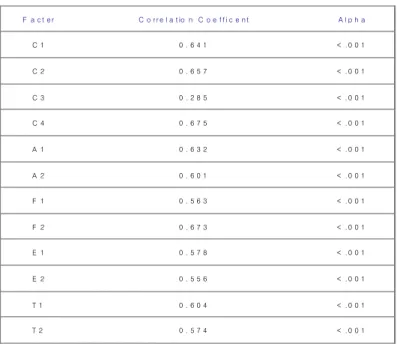
Next, item-total correlation analysis as well as criterion related correlation analysis is conducted.Following Doll and Torkzadeh’s procedure, the correlation of score of each item with the total score of all questions is examined. Table 2 lists the result of the correlation assessment. According to Doll and Torkzadeh, there is no accepted standard of cutoff threshold; therefore we took the same cutoff value of 0.5 as they did in their study.
<Table 1> Rotated Factor Matrix of the 12-Item Instrument
0.735 T2
0.836 T1
0.732 E2
0.736 E1
0.775 F2
0.836 F1
0.726 A2
0.853 A1
0.811 C4
0.744 C3
0.726 C2
0.874 C1
Timeliness Ease of Use
For mat Accura cy
Content Item
Forthe correlation coefficient, coefficients for all items are above the threshold of 0.5, except for the question C3 which is well below the threshold value. In conducting the criterion-related validity analysis, the correlation of each item are examined with the score of two global satisfaction criteria G1 and G2 in Appendix 1. As Doll and Torkzadeh, It was assumed that the two global measures of end-user satisfaction to be valid.
<Table 2> Item-Total Correlation
< .0 0 1 0 . 5 7 4
T 2
< .0 0 1 0 . 6 0 4
T 1
< .0 0 1 0 . 5 5 6
E 2
< .0 0 1 0 . 5 7 8
E 1
< .0 0 1 0 . 6 7 3
F 2
< .0 0 1 0 . 5 6 3
F 1
< .0 0 1 0 . 6 0 1
A 2
< .0 0 1 0 . 6 3 2
A 1
< .0 0 1 0 . 6 7 5
C 4
< .0 0 1 0 . 2 8 5
C 3
< .0 0 1 0 . 6 5 7
C 2
< .0 0 1 0 . 6 4 1
C 1
A l p h a C o r r e l a t io n C o e f f i c e n t
F a c t e r
Table 3 is the result of item-criterion correlation. The cutoff threshold is 0.4 as Doll and Torkzadeh did in their research.
<Table 3> Item-Criterion Correlation
< . 0 0 0 1 1
T 2
< . 0 0 0 1 0
T 1
< . 0 0 0 1 0
E 2
< . 0 0 0 1 1
E 1
< . 0 0 0 1 0
F 2
< . 0 0 0 1 1
F 1
< . 0 0 0 1 0
A 2
< . 0 0 0 1 1
A 1
< . 0 0 0 1 0
C 4
0 . 0 1 1 2 0
C 3
< . 0 0 0 1 1
C 2
< . 0 0 0 1 0
C 1
A lp h a C o r r e la t i o n C o e f f ic i e n t
It e m
. Findings And Implications
Ⅴ
As in the item-total correlation, all factors have correlation coefficients of greater than 0.4 threshold value except for the question C3has correlation coefficient well below the threshold. Therefore all questions other than question C3 are valid for this model. And, components of satisfaction as identified by Doll and Torkzadeh are still relevant for users of Internet shopping environment. Due to the results of data analysis, the question C3 is dropped.
The results of the study are expected to show how the main constructs of the model that will eventually interact for the user satisfaction in internet commerce environment. This research will also present significant progress towards keeping the End-User Computing Satisfaction instrument relevant and applicable under the Internet shopping environment.
These results obtained have two practical implications for individuals, in both the academic and practitioner community. From a practical perspective, this revised End-User Computing Satisfaction (EUCS) instrument can be applied to evaluate end user applications, especially Internet shopping environment. In addition to overall user satisfaction assessment with Internet shopping, it can also used to compare end-user satisfaction with different components of end-user computing task.
For the IS research community, the internet user satisfaction model poses several opportunities for further inquiry into the variables and the processes that impact internet user satisfaction. Alternative measurement approaches associated with each of the components of the model need to be investigated. This will also help all internet marketers to pay attention for developing better internet commerce platforms by understanding the consumer needs and expectations in internet commerce. From a theoretical perspective, by dividing the End-User Computing Satisfaction construct into separate components, this research provides a valuable theoretical framework to enable more precise research with the components. The contribution of this study will be to inform the internet users and firms any success factors in internet uses for commercial purpose and suggest possible improvement in deploying internet commerce for various users.
References
Asher, Herbert B., Causal Modeling, Beverly Hills, CA: Sage Publication, 1983.
Bagozzi.R.P., Causal Modeling in Marketing, Wiley & Sons, New York, NY: 1980
Bailey, J.E. and Pearson, S.W., "Development of a tool for measuring and analyzing computer user satisfaction,"
Management Science, 29(5), 1983, pp. 530-545
Baroudi, J. J., Olson, M. H. and Ives, B. An Empirical Study of the Impact of User Involvement on System Usage and Information Satisfaction, Communications of the ACM (29:3), March 1986, pp. 232-238.
Benson, D.H., A Field Study of End-User Computing: Findings and Issues,. MIS Quarterly (7:4), December 1983, pp. 35-45.
Blalock, H. M, Causal Models in the Social Sciences, Chicago, IL: Aldine Atherton, 1971.
Bollen, K.A. Structural Equations with Latent Variables, New York, NY: Wiley & Sons, 1989.
Chen, L., Soliman, K.S., Mao, E. and M.N. Frolick, .Measuring User Satisfaction with Data Warehouses: An Exploratory Study, Information & Management, 37, 2000, 103-110.
Coopee, T. .The Internet Today,. InfoWorld (22:39), September 2000, pp. 52.
Davis, F.D., Bagozzi, R.P, and Warshaw, P.R., "User acceptance of computer technology: a comparison of tow theoretical models," Management Science, 35(8), 1989, pp. 982-1003.
Delone, W. and McLean, E., "Information systems success: The quest for the dependant variables." Information Systems Research. 3(1), 1992, pp. 60-95
Doll, William J., Xia, Weidong, and Torkzadeh, Gholamreza, "A confirmatory factor analysis of the end user computing satisfaction instrument", MIS Quarterly, 18(4), 1994, pp. 453-461.
Doll, W. J. and Torkzadeh, G. .The Measurement of End-User Computing Satisfaction, MIS Quarterly (12:2), June 1988, pp. 259-274.
Galletta, D.F. and Lederer, A.L., "Some Cautions on the Measurement of User Information Satisfaction," Decision Sciences, Vol. 20 (1989): 419-438.
Hair, Joseph F. JR., Anderson, Ralph E., Tatham, Ronald L., and Black William C., Multivariate DataAnalysis, Englewood Cliffs, NJ: Prentice Hall, 1995.
Ives, B., Olson, M. H. and Baroudi, J. J. . The Measurement of User Information Satisfaction, Communications of the ACM (26:10), October 1983, pp. 785-793.
Kerlinger, F. N. Foundations of Behavioral Research, McGraw-Hill, New York, 1978.
Long, J. Scott, Confirmatory Factor Analysis: A Preface to LISREL, Beverly Hills, CA: Sago Publications, 1983.
Lucas, H. C. "Performance and the use of an information system," Management Science, 21(8), 1975, pp. 908-919 McHaney, R. and Cronan, T.P., Computer Simulation Success: On the Use of the End User Computing Satisfaction
Instrument: A Comment, Decision Sciences (29:2), Spring 1998, pp. 525-536.
McHaney, R. Hightower, R. and White D., EUCS test-retest reliability in representational model decision support systems, Information and Management (36), 1999, pp. 109-119.
Melon, Nancy Paule, "A theoretical assessment of the user satisfaction construct in information systems research,"
Management Science, 36(1), 1987, pp. 76-91.
Schewe, C.D., "The management information system user: an exploratory behavioral analysis," Academy of Management Journal, 19, 1976, pp.577-590.
Straub, D.W. "Validating instruments in MIS Research." MIS Quarterly, 13(2), 1989, pp. 147-169.
Torkzadeh, G. and Doll, W., Test-Retest Reliability of the End-User Computing Satisfaction Instrument., Decision Sciences (22:1), winter 1991, pp. 26-37.
Woodroof, J.B. and Kaspen, G.U., "A conceptual development of process and outcome user satisfaction,"
Information Resources Management Journal, 11(2), 1998, pp.37-43.
Appendix
(Questions based on Doll and Torkzadeh.s EUCS instrument)
G1. Is the Internet shopping system successful?
G2. Are you satisfied with the Internet shopping system?
C1. Does the Internet shopping system provide the precise information you need?
C2. Does the information content meet your needs?
C3. Does the Internet shopping system provide reports that seem to be just about exactly what you need?
C4. Does the Internet shopping system provide sufficient information?
A1. Is the Internet shopping system accurate?
A2. Are you satisfied with the accuracy of the Internet shopping system?
F1. Do you think the output for Internet shopping process is presented in a useful format?
F2. Is the information clear?
E1. Is the Internet shopping system user friendly?
E2. Is the Internet shopping system easy to use?
T1. Do you get the information you need in time?
T2. Does the Internet shopping system provide up-to-date information?