http://www.culinary.re.kr
INTRODUCTION
Recently, most of the universities in Korea are suffering from the level of low employment rate and are making efforts to help their students to become employed. For example, they provide them with resume writing, interview practice, recruitment related lecture, updated recruiting sources etc. Universities have been trying to increase MOU(Memorandum of Understanding) with real compa- nies and academic cooperation so as to have connections to real industries. Nonetheless, some students choose not to be em- ployed, while others look for career choices other than what the universities provide. The career development choices the univer- sities provide to their students and their desires towards career development seem to be unmatched. Students are unlikely to have a clear concept of their careers options and only have d gue plans for the future. Otherwise, they think they have higher qualification than those actually required by the employment conditions of real industries. Therefore, the university practitioners need to understand why these students are not interested in career exploration activities and need to help students decide their
careers based on their own interest.
Specifically, one of the most influential, comprehensive, and widely used career development theories is Super DE(1957)'s de- velopment theory. Defined as "encompassing those activities, directed toward enhancing knowledge of the self and the external environment, that an individual engages in to foster progress in career development"(Blustein DL, 1992, p175), career exploration is a main concern in Super DE(1957)'s theory, and is explained as significantly influencing one's career development. A high level of career exploration was found to influence greater process in career decision-making and a higher level of satisfaction with, and co- mmitment to, careers. Regardless of its theoretical contribution, the underlying factors that develop career exploration need to be further addressed.
Current career exploration research has focused on the ante- cedents of career exploration For example, they investigated in- dividual differences such as motivational processes(Blustein DL 1988), decision-making style(Blustein & Phillips SD, 1988) relational variables like family functioning(Ryan NE et al., 1996) and peer relationship(Felsman DE, Blustein DL, 1999) that influence career
Does Differentiation of Self Matter in University Students' Career Exploration?: Focused on Hospitality Majored Student
Jieun Kim1 and Youngju Kwon2.¶
1Dept. of Hotel Management, Catholic University of Daegu, Daegu 712-702, Korea
2Dept. of Hotel Management, Kyunghee University, Seoul 130-701, Korea
ABSTRACT: The employment rate has become the standard for university values. This raises the need to investigate the antecedents of university students' career exploration. Focused on the hospitality majored students, this study aims to investigate both individual and relational factors that influence their career exploration behaviors. Differentiation of self has been chosen as the individual and the relational antecedents based on Bowen's theory. It was investigated whether each dimension(I-position, emotional reactivity, fusion with others, and emotional cutoff) explains the amount of self-exploration and the amount of environmental exploration. The university students majoring in hospitality were surveyed and a total of 269 cases out of 300 cases were analyzed employing descriptive statistics and multi-variate analysis of variance, and structural equation modeling(SEM). The study found that I-position positively influenced self-exploration and environmental exploration. Emotional reactivity made an influence on environmental exploration, while it failed to explain self-exploration. Fusion with others and emotional cutoff also significantly influenced environmental exploration, however, it didn't make any significant influence on self-exploration. This study implies that the college of hospitality majors needs to understand that differentiation of self forms through family relationship and needs to provide the students the programs of how to understand themselves and what to do for their career exploration.
Keywords: Differentiation of Self, I-Position, Emotional Reactivity, Fusion with Others, Emotional Cutoff, Self-Exploration, Environ- mental Exploration
§ Corresponding Author: Youngju Kwon, Dept. of Hotel Management, Kyunghee University, 26, Kyungheedae-ro, Dongdaemun-gu, Seoul 130-701, Korea, Tel. +82- 2-961-0827, Fax. +82-2-961-0930, E-mail: yjkwon@ khu.ac.kr
Received: 3 August, 2014, Revised: 10 October, 2014, Accepted: 20 October, 2014.
exploration. Regardless of the various studies on the antecedents, these studies solely focused on either individual or relational factors. For instance, particular understanding of both relational and individual factors on career exploration need to be add- ressed(Whiston SC & Keller BK, 2004).
Bowen M(1976, 1978)'s theory of differentiation of self in family system encompasses both relational and individual factors. Based on the study needs and theoretical background , this study sought to answer the following questions: Within a sample of the uni- versity students majoring in hospitality related management, would each of Bowen M(1976, 1978)'s dimensions of differen- tiation of self in family systems make an impact on their career exploration behaviors? The study results would help us to un- derstand how career exploration is motivated and would suggest to university practitioners how to raise students' independence for career exploration.
LITERATUREREVIEW Differentiation of Self
The term ‘differentiation of self’ was originated from Bowen M's family system perspectives(1976, 1978). This theory provides a comprehensive understanding of individual differences function- ing in the family system(Nicols MP & Schwartz RC, 1998). According to Nichols MP, Schwartz RC(1998), Bowen's family system includes eight components: differentiation of self, triangulation, nuclear family emotional process, family projection process, multi-gene- rational transmission process, sibling position, emotional cutoff, and societal emotional process. Within this context, differrentiation of self plays a role as the fundamental factor explaining the other elements because differentiation of self allows one to interrelate all the elements that make a whole family system theory.
Differentiation of self refers to the intra-personal ability to di- fferentiate the thinking and emotional systems and the inter- personal capability to have autonomy within the deep intimate relationship with significant others(Bowen M, 1978). It describes the ability to keep balance between independence and intimacy with significant others. The ones who are able to differentiate themselves can look into the situation in balanced way and be clearly aware of their situations. In the long run, they can shift their emotional imbalance from specific circumstances to calm them- selves through logical reasoning. Kerr M & Bowen M(1988) su- ggested that more differentiated individuals have more capability in regulating their emotions with uncertainty, ambiguity, and staying calm with important others(Kerr M & Bowen M, 1988). That is, a level of differentiation influences one's capability to differ- rentiate thinking from feeling, thinking clearly under pressure, and regulating emotion.
In addition, there are some different levels of fusion between the emotional and intellectual systems in people. The greater the fusion, the more unconscious emotional forces control one's life.
This makes it hard for one to control his or her own life(Bowen M, 1978). Therefore, less differentiated individuals will respond more emotionally, stay with their strong ego in intimate relationships, and think unclearly under pressure(Kerr M & Bowen M, 1988). In other words, more differentiated people enable themselves to develop autonomy and stay comfortable in intimate relationships.
Differentiation of self, intra-personal abilities, and interpersonal ability consist of four components: emotional reactivity, emotional cutoff, fusion with others, and I-position. Emotional reactivity means to what degree individuals behave based on what "feels right" when one feels emotionally suppressed and cannot dis- tinguish between thought and feelings. Emotional cutoff captures to what degree one feels uncomfortable with intimate relation- ships, and thus have excessive desire to cut off the important others to defend themselves from feeling excessive vulnerability.
Fusion with others means to what degree one is excessively involved and overidentified with important others like parents. I- position means to what degree individuals stay with their own positions based on their own convictions regardless of outside pressure and under any intimate relationships. Therefore, highly differentiated persons are likely to have less emotional reactivity, emotional cutoff, and fusion with others, and more I-position in intimate relationships.
Based on Bowen M(1976, 1978)'s theory, differentiation of self is applied to the following elements : romantic relationships and marital satisfaction(Skowron EA, 2000; Skowron EA, Friedlander ML, 1998), adjustment to environment and happiness in early ado- lescence (Rosen KH et al., 2001).
In addition, differentiation of self seems to be related to psy- chological well-being in later adolescence and adulthood. For example, the existing studies suggest that the greater the levels of differentiation are, the less the levels of physical symptom and social anxiety exist (Peleg-Popko O, 2002). Further, the differen- tiated individuals suffer less from chronic anxiety (Maynard S, 1997), psychological distress(Skowron EA, 2004), and experience major depressive disorder(Elieson MV & Rubin LJ, 2001). Also, differentiated individuals of the higher/highest level experienced lower physical child abuse(Skowron EA & Platt LF, 2005), more ability of psychological adjustment(Skowron EA et al., 2004), and more psychological well-being(Skowron EA et al., 2003).
Review of Career Exploration Literature
It seems that career exploration theory stems from the career development theory presented by Super DE(1957). Super explains career development through vocational self-concept which means the set of self-perception related to work roles. The vocational self- concept starts from the parents' influence regarding vocational roles. Peers, role models, neighborhoods, and schools influence the individuals to develop vocational self-concept as well.
Career exploration theory has interested researchers since the early 1960s. It was understood as a concept of general exploratory behavior by Jordaan JP(1963), whose theory was influenced by Super DE(1957). Jordaan JP emphasized that career exploration occurred in any life stage and that exploration of his or her self and environment would refine one's vocational pursuits and give more satisfying career choices. Then Taveira MC(1997, 2001) organized four kinds of concepts of career exploration based on the existing literature. The concept had been developed for several decades and was suggested as follows.
First of all, Krumboltz JD(1979) defined career exploration as an information-seeking behavior to solve career related problems.
Secondly, career exploration referred to decision-making efforts regarding careers and this included the(delete) activities such as
identifying and evaluating options, and seeking information(Gelatt HB, 1962). A third concept explained career exploration as the efforts that occurred from age 14 to 24. This behavior was asso- ciated with general career development theories. According to Super DE(1957), career exploration behaviors included career development behaviors like collecting career information and experiencing occupational choices. The fourth concept described career exploration as a long term life span process and included activities like career training and other related development (Ta- veira MC, 1997).
In the context of the fourth concept, a complex psychological mechanism has been associated with career exploration. For ins- tance, based on the individuals' career goals, information seeking behaviors about self and environment are included. In order to search for future careers, people may need to be motivated to interpret and recreate both past and current experiences and these experiences include self and environment. Finally, the existing views of the construct suggest self- and environmental exploration as the sub-dimensions of career exploration.
Generally, the studies on career exploration investigated ante- cedents, outcomes, and suggested implementation. In the long run, the studies seem to be divided into two veins, one group emphasizing individual factors, the other relational factors as follows.
First, the individual differences make an impact on career de- velopment and outcomes. For example, work role salience, a belief in the usefulness of exploration, and preference towards the spe- cific careers were significantly related to career exploration (Stum- pf SA & Lockhart MC, 1987). The relationship between individual motivational process and career exploration was also investigated.
According to Blustein DL(1988), three distinctive motivational orien- tations were presented as influencing career exploration. These orientations include the autonomy orientation, which motivates an individual to work on his or her personal interest, the control orientation, which follows external cues or internalized social ex- pectations, and the impersonal orientation, which is aroused through the belief of one's inadequacy, task difficulty, etc. The autonomous orientation and the control orientation resulted as significant predictors of career exploration.
In addition, presented by Deci EL & Ryan RM(1985), self-deter- mination theory as an individual difference has also been utilized to explain the motivational factors to explain career exploration.
Here, they suggest that career may be explored though self- determination. Having delineated the elements involved in career exploration models, the motivational factors have been further addressed and these include perceived competence, internal locus of control, and self-esteem, which all move towards career ex- ploration intentions and/or behaviors(e.g. Betz NE & Voyten KK 1997; Bluestein DL, 1988, 1989; Solberg VS, 1998; Taylor KM &
Popma J, 1990).
Second, in regard to relational factors, the relationship with important others influence career exploration efficacy(e.g. Ryan NE et al., 1996; Ketterson TU & Blustein DL 1997). The important others include parents, peers, teachers, role models, etc. The secure attachment to them has been found to be related with quantity and quality of career exploration while dysfunctional attachment to them seemed to negatively influence the individuals' explo-
ration behaviors.
Further, the decision-making styles and the contextual factors were identified as the antecedents of career exploration(e.g. Blu- stein DL & Phillips SD, 1988; Greenhaus JH & Sklarew ND, 1981). For example, there are two different decision-making styles, utilization of self-initiated strategy and a feeling oriented strategy through impulsive and passive manner. On the other hand, the contextual factors include contextual anxiety regarding the career decision- making.
The Relationship with Differentiation of Self and Career Exploration According to Keller BD(2006)'s study, I-position of differentiation of self significantly influences career exploration. At the same time, his study shows more emotional reactivity is related to more career exploration behavior; less emotional reactivity explains more differentiation of self. Since then, regardless of the study needs of the extended studies, empirical studies have been rarely found.
However, the relationship between differentiation of self and career exploration can be assumed on the foundation of the exi- sting literature, which examined the interrelated psychological variables. For example, if individuals are able to separate emotional anxiety from intellectual processes under the career-related stress, and keep balance between intimacy and independence in close relationships, they could explore their careers efficiently(Keller BD, 2006).
At the same time, the positive relationship between differ- rentiation of self and psychological wellbeing was proved in support of Bowen M's theory(Peleg-Popko O, 2002; Tuason MT &
Friedlander ML, 2000). Also, the greater level of a persons' di- fferentiation predicts their greater level of psychological adjust- ment and problem-solving(Skowron EA, 2004). Career exploration involves problem-solving related to ones' career choices so that the more differentiated people may be committed to better career related problem solving. They are likely to explore self and environ- ment with their are rationales. Also, they make career-related decisions that would be congruent with their values and inte- rests(Zingaro JC, 1983). Further, if they follow or reject their sig- nificant values and interests, it would be after thoughtful con- sideration of value congruence is conducted.
Further, less differentiated individuals are unlikely to allocate enough time to self and environmental exploration on their own initiative since their high anxiety levels in intimate relationships lead them to either avoidance or too close attachment(Skowron &
Dendy, 2004). Such individuals may not have a chance to clearly understand their own values and interests and separate them from those of their parents/significant others. Even though they haven't understood their own values yet, they may just follow or avoid them without considering a personal fit. More differentiated individuals also take more effortful control over their works or tasks in the context of distress(Skowron EA & Dendy AK, 2004).
To this end, this study hypothesizes the significant impact of differentiation of self on career exploration behaviors using the Bowen M's theory(1976, 1978).
H1a : Hospitality students' I-position makes a significant impact on their environmental exploration.
H1b : Hospitality students' I-position makes a significant impact
on their self exploration.
H2a : Hospitality students' emotional reactivity makes a signifi- cant impact on their environmental exploration.
H2b : Hospitality students' emotional reactivity makes a signifi- cant impact on their self exploration.
H3a : Hospitality students' fusion with others makes a significant impact on their environmental exploration.
H3b : Hospitality students' fusion with others makes a significant impact on their self exploration.
H4a : Hospitality students' emotional cutoff makes a significant impact on their environmental exploration.
H4b : Hospitality students' self-esteem makes a significant im- pact on their self-exploration.
METHODOLOGY
Settlement of Proposed Model
Based on the propositions developed from the literature review, the conceptual model to explain the relations among the hos- pitality students' differentiation of self, environmental exploration, and self-exploration is illustrated in Fig. 1.
Construct Measurement Differentiation of self
This study defines differentiation of self as the interpersonal and intra-personal abilities to distinguish between thoughts and emo- tions under pressure and to keep both independence and intimacy within the relationship with important others based on Bowen M(1978)'s theory. Drake JR(2011)'s short form of differentiation of self inventory was used in this study. This measurement consist of 20 items based on Skowron EA & Schmitt TA (2003)'s 46 items.
Differentiation of self includes four dimensions, emotional reac- tivity(ER), I-position(IR), emotional cutoff(EC), and fusion with oth- ers(FO). The answers were put on a five-point Likert scale from "not at all characteristic of me" to "very characteristic of me".
Career exploration
Career exploration in this study means a long term process to develop careers through overall like and consists of self- and environmental exploration. Environmental Exploration (EE) and
Fig.1. A proposed model of differentiation of self and service- oriented OCBs.
Self Exploration(SE) scales were used to construct survey items based on Career Exploration Survey(CES; Stumpf et al., 1983). The hospitality students pinpointed how much they had self- and environmental career exploration behaviors over the past three months. The total of 11 items were asked to be surveyed to measure both environmental exploration and self exploration. The answers were put on a five-point Likert scale raging from “little“ to
"a tremendous amount. "
Data Collection and Sampling Frame
The targeted respondents in this study are the university stu- dents majoring in hospitality management. At first, English version of the survey items were translated into Korean and a random sample of 50 hospitality majored students were asked to be surveyed to identify whether this structural relationship was valid to be studied. In this preliminary survey, the several professors acquainted with id to searcher in hospitality related departments were asked to survey their students and to check for any ina- ppropriate survey items as well. id s preliminary survey was con- ducted from October 5th to 20th in 2013.
A convenience sample of the hospitality majored university students were selected to conduct a main survey; they included C, D, Y, and K universities in Daegu, and K university in Seoul. Further, a main survey was employed to carry out the survey after each department professor's approval had been given. To protect human subjects, consent form was issued to each participants. This included the purpose of the study, the questions to be asked, risks and benefits, and compensation such as a movie ticket. Most of all, taking part was voluntary. The main survey was conducted from November 6th to December 10th in 2013. A total of 282 responses were received out of the 300 cases. Cases with missing value were subsequently dropped from the analysis and 269 faithful cases have been analyzed.
Data Analysis
The collected data was analyzed employing the SPSS and AMOS 20 software program. Descriptive statistics, multi-variate analysis of variance, and structural equation modeling(SEM) were utilized.
Frequency analysis, reliability analysis after using Cronbach's alpha, and confirmatory factor analysis were operated. Further, the co- rrelation analysis was conducted to verify the reciprocal relation- ship among the variables. To verify the hypotheses and the structural model, confirmatory factor analysis was conducted to examine conformity of the causal relationship among each factor and covariance structure analysis was used to investigate a path coefficient.
EMPIRICALRESULTS Demographics
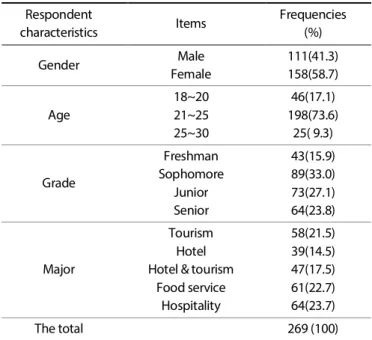
As presented in Table 1, 41.3 % of respondents were males, and 58.7% of them were females. It can be presumed that more females are majored in hospitality management. All the respon- dents are in their twenties. Moreover, freshmen consist of 43 people(15.9%); sophomores consist of 89 people(33.0%); juniors consist of 73 people(27.1%); seniors consist of 64 people (23.8%).
Finally, their current majors were as follows; tourism manage-
Table 1. Result of the demographic analysis of the respondents Respondent
characteristics Items Frequencies
(%)
Gender Male
Female
111(41.3) 158(58.7)
Age
18~20 21~25 25~30
46(17.1) 198(73.6)
25( 9.3)
Grade
Freshman Sophomore
Junior Senior
43(15.9) 89(33.0) 73(27.1) 64(23.8)
Major
Tourism Hotel Hotel & tourism
Food service Hospitality
58(21.5) 39(14.5) 47(17.5) 61(22.7) 64(23.7)
The total 269 (100)
ment(58 people;21.5%), hotel management(39 people;14.5%), ho- tel and tourism management(47 people; 17.5%), food service management(61 people;22.7%), and hospitality management(64 people;23.7%).
Analysis of Validity and Reliability Results of confirmatory factor analysis
The confirmatory measurement model was conducted to eva- luate the construct validity of the measurement. Confirmatory factor analysis(CFA) can confirm if psychometric properties are satisfactory scales beyond exploratory analytic technique(Noar, 2003).
CFA can also extend additional information about dimensiona- lity of scale by testing a variety of models against one another(Noar SM, 2003). In this study, the confirmatory factor analysis was completed with maximum likelihood estimation.
CFA was applied to all the items and chi-square of 401.967, degree of freedom of 272, and p-value of 0.000(p<0.001). Further, the value in chi-square/df is recommended to be less than 3.0 to secure overall goodness of fit(Kim GS, 2007). The value of chi- square/df shows 1.478 and overall goodness of fit is obtained.
In assessing model fit, the following indices were examined:
GFI(Goodness-of-fit index: desirable at ≧0.90), AGFI(Adjusted Good- ness of fit Index: desirable at ≧0.90), RMR(Root Mean Square Residual: desirable at ≦0.05), NFI(Normed fit index: desirable at
≧0.90), CFI(Comparative fit index: desirable at ≧0.90),χ2(chi- square: desirable at >0.05), TLI (Tucker-Lewis Index: desirable at
≧0.90), RMSEA(Root Mean Square Error of Approximation: de- sirable at <0.05). As presented in Table 2, NFI(0.877) and AGFI(0.872) indicate unfulfilled indices, however, GFI(0.901), NFI(0.877), CFI (0.956), TLI(0.956), and RMSEA(0.042) indicate the reasonable fits of the data. The relatively small sample sizes limit the possibility of reaching the 0.9 cutoff value and they can not be considered as "a stand alone index " (Hooper D et al., 2008, p54). Further, if a study is
strictly attached to the cutoff values, even an acceptable model can be improperly rejected(Marsh HW et al., 2004). Therefore, the suggested relationship among the latent variables seem to be reasonable fit of the data.
Further, Table 2 presents standard estimates for a measurement model. As illustrated, factor loading of all measures were mo- derate(ranging from 0.501 to 0.869). The factor loadings showed that relevant measurement items performed moderately well in reflecting the designated underlying construct.
Results of validity and reliability
As the survey items are adapted from different streams of studies, it is important to ensure construct reliability and validity.
Cronbach's coefficient alpha was calculated to determine reliability of the measurement. As indicated in Table 2, Cronbach's a of each construct in measurement model is ranged from 0.665 to 0.914, significantly a scale with high level of reliability; this value is adequate at Cronbach's a>0.60(Lee HY, 2006). If construct reliability reaches above 0.7, convergent validity or internal consistency is secured(Kim GS, 2007)). Also, convergent validity is procured as long as AVE reaches above 0.5(Kim GS, 2007). In terms of construct reliability, the values of six constructs are ranged from 0.750 to 0.900. At the same time, as illustrated in Table 3, factor loading of each variable is above 0.501, showing a moderate to high con- struct validity. Further, each average variance extracted(AVE) rea- ches between 0.510 to 0.677.
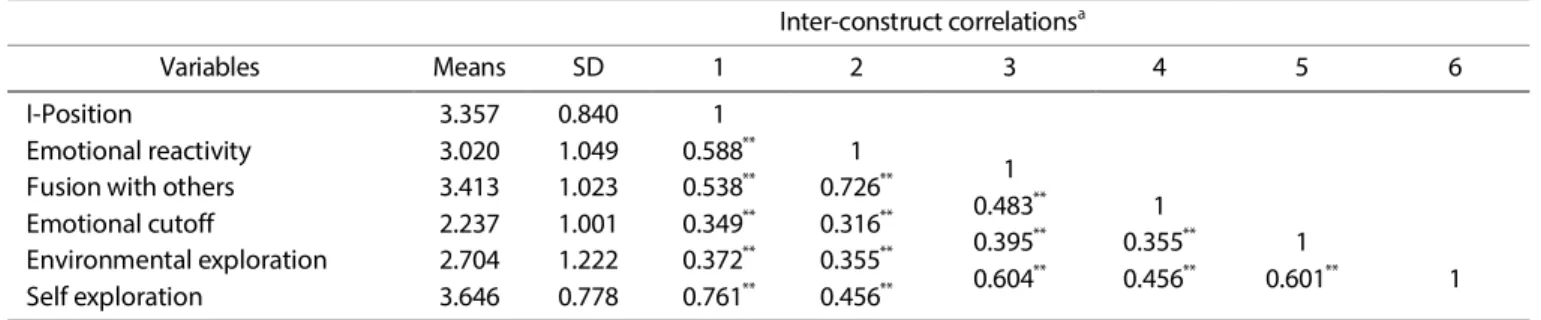
Discriminant validity was established using the procedures outlined by Fornell C & Larker DF (1981). Table 3 shows the correlations between the latent variables and the average variance extracted(AVE) of each construct. Fornell C & Larker DF(1981) prescribe that the squared correlation between constructs must be less than the AVE of each underlying construct in order for the constructs to have discriminant validity. As suggested in Table 3, the squared correlations between two constructs are ranged lower than each AVE. These outcomes established discriminant validity.
As a result, these values represent all six constructs and it is significant to analyze the relationship between those constructs.
Test of Hypotheses Testing
Preceding verification of theoretical model showed some fit indices were not fulfilled and therefore, covariance was conducted using modification indices(MI) so as to improve goodness of fit.
This is based on Hooper D & colleagues(2008)'s suggestion of
"Allowing modification indices to drive the process is a dangerous game, however, some modifications can be made locally that can substantially improve results"(p 56). Table 4 illustrated the strength of the relationships among the constructs, showing path co- efficient and overall goodness of model fit indices. Overall, the model was acceptable fit; (χ2: df=304)=488.117 (p=0.000), GFI=
0.888, AGFI=0.860, RMR=0.057, NFI=0.853, TLI=0.929, CFI= 0.938, RMSEA=0.048.
As shown in Table 4, the postulated hypotheses were examined through investigating the path coefficients of the constructs in the final model. Firstly, the results indicate that I-position significantly predict the hospitality students' environmental exploration(β=
0.410, p<0.05). I-position also predicts their self-exploration(β=
1.069, p<0.05). In other words, the hospitality students with higher
I-position tend to explore more on self and environment related to their careers. Therefore, hypotheses 1a and 1b were supported.
Secondly, the results suggest that the hospitality students' emotional reactivity makes a significant impact on environmental exploration(β=1.311, p<0.05), however, it doesn't make any signi-
ficant impact on self-exploration. It means the people with less emotional reactivity has more exploration on their environmental exploration. To this end, hypothesis 2a was partially supported and 2b was rejected.
Thirdly, it is indicated that hospitality students' fusion with Table 2. Confirmatory factor analysis and reliability analysis
Factor Items Estimate S.C. t-value p-value Cron-
bach's ⍺ CCR AVE
I-Position
No matter what happens in my life, I know that I'll never lose my sense of who I am.
There's no point getting upset about things I cannot change.
I'm fairly self-accepting.
I tend to feel pretty stable under stress.
1.000
0.874
0.880 0.756
0.738
0.559
0.671 0.501
7.152
9.115 6.992
***
***
***
0.665 0.79 0.573
Emotional reactivity
At times, I feel as if I'm riding an emotional roller- coaster(R).
I'm overly sensitive to criticism(R).
If I have had an argument with my close people (parents, friends), I tend to think about it all day(R).
If someone is upset with me, I can't seem to let it go easily(R).
I'm very sensitive to being hurt by others(R).
1.000
0.977 1.138
0.875
1.208
0.555
0.636 0.661
0.537
0.720 6.865 7.526
6.668
7.865
***
***
***
***
0.750 0.850 0.544
Fusion with others
I usually need a lot of encouragement from others when starting a big job or task(R).
When my close people criticize me, it bothers me for days(R).
I often feel unsure when others are not around to help me make a decision(R).
1.000
1.206
1.131
0.506
0.620
0.666 6.633
6.865
***
***
0.623 0.750 0.510
Emotional cutoff
I tend to distance myself when people get too close to me(R).
I'm often uncomfortable when people get too close to me(R).
When one of my relationships becomes very intense, I feel the urge to run away from it(R).
1.000
1.066
0.811
0.869
0.854
0.726 15.117
13.067
***
***
0.858 0.862 0.677
Environmental exploration
Investigated career possibilities
Went to various career orientation program Obtained information on specific jobs or companies Initiated conversation with knowledgable individuals in my career area
Obtained information on the labor market and ge- neral job opportunities in my career ares
Sought information on specific areas of career in- terest
1.000 0.800 1.095 0.976
1.235
1.096
0.819 0.626 0.831 0.764
0.897
0.853 10.894 15.747 14.026
15.559
16.318
***
***
***
***
***
0.914 0.900 0.601
Self exploration
Reflected on how my past integrates with my future career
Focused my thoughts on me as a person Contemplated my past
Been retrospective in thinking about my career Understand a new relevance of past behavior for my future career
1.000
0.785 0.814 0.799 1.211
0.705
0.540 0.602 0.651 0.759
7.588 10.117
9.150 9.372
***
***
***
***
0.792 0.830 0.500
Note: CCR=composite construct reliability; AVE= average variance extracted; χ2 (df :272)=401.967; p=0.000; CMIN/df=1.478; GFI= 0.901;
AGFI=0.872; RMR=0.058; NFI=0.877; CFI= 0.956; TLI= 0.956; RMSEA=0.042; ***: 0.000; (R):reversed scored.
Table 4. Parameter estimates in structural model
Hypothesis Path β S.E. t-value p-value Result
H1a I-Position → Environmental exploration 0.410 0.247 2.261 0.024* Supported
H1b I-Position → Self exploration 1.069 0.427 2.555 0.011* Supported
H2a Emotional reactivity → Environmental exploration 1.311 1.346 2.197 0.028* Supported
H2b Emotional reactivity → Self exploration 3.190 4.054 1.333 0.182 Rejected
H3a Fusionwith others → Environmental exploration 1.628 1.030 2.559 0.010* Supported
H3b Fusion with others → Self exploration 3.418 3.037 1.369 0.171 Rejected
H4a Emotional cutoff → Environmental exploration 0.371 0.222 1.992 0.046* Supported
H4b Emotional cutoff → Self exploration 0.723 0.555 1.167 0.243 Rejected
Overall goodness of
model fit indices
χ2 (df=304)= 488.117 (p=0.000), CMIN/df=1.606, GFI=0.888, AGFI=0.860 RMR=0.057, NFI=0.853,
TLI=0.929, CFI=0.938 RMSEA=0.048 *: Significant at <0.05.
others significantly influence their environmental exploration(β=
1.628, p<0.05) while it does not influence their self-exploration. In other words, the students with less fusion with others have more various and frequent investigation on environmental exploration.
Therefore, hypotheses 3a was supported and 3b was rejected.
Finally, the hospitality students' emotional cutoff makes a sig- nificant impact on environmental exploration(β=0.371, p<0.05), however, it fails to influence on self-exploration. That is, the stu- dents experiencing less emotional cutoff are more motivated to explore environment related to their careers. Therefore, hypothesis 4a was supported while hypothesis 4b was rejected.
Overall, all the variables under differentiation of self influence environmental career exploration. Specifically, fusion with others have the strongest impact on environmental exploration. The rest of the variables influence on environmental exploration in the order of emotional reactivity, I-position, and emotional cutoff.
Further, only I-position significantly influence on both environ- mental and self career exploration.
CONCLUSION Findings and Implications
This study proposed and investigated a structural relationship among I-position, emotional reactivity, fusion with others, emo- tional cutoff, self-exploration, and environmental exploration.
First, the results indicate the path coefficient of 0.410 for the impact of I-position on environmental exploration and 1.069 for the impact on self-exploration. In other words, the hospitality students' higher level of I-position led them to explore more on career-related self and environment. The current findings were consistent with previous research conducted by Keller who also found the I-position predicted high amount of career explora- tion(Keller BD, 2006). The current study results were also similar to Skowron EA & Dendy AK(2004)'s study which suggested I-position made people have more self-control over their efforts on their desirable behaviors.
Secondly, it has been found that emotional reactivity makes a significant influence on environmental exploration with the path coefficient of 1.311 while it fails to influence self-exploration. That is, the hospitality students who have less emotional reactivity make more amount of environmental exploration. Skowron EA &
Dendy AK(2004) suggested similar study results. For example, the decreased level of emotional reactivity explained more self-control over the individuals' desirable behaviors. However, the hospitality Table 3. Measurement model
Inter-construct correlationsa
Variables Means SD 1 2 3 4 5 6
I-Position
Emotional reactivity Fusion with others Emotional cutoff
Environmental exploration Self exploration
3.357 3.020 3.413 2.237 2.704 3.646
0.840 1.049 1.023 1.001 1.222 0.778
1 0.588**
0.538**
0.349**
0.372**
0.761**
1 0.726**
0.316**
0.355**
0.456**
1 0.483**
0.395**
0.604**
1 0.355**
0.456**
1
0.601** 1
Note: Higher scores on the emotional reactivity, I-Position, emotional cutoff, and fusion with others DSI subscales indicate less emotional reactivity, greater ability to take the I-position, less emotional cutoff, and less fusion with others, respectively, or greater differentiation of self.
** Significant at p<0.01; a two standard-error interval estimate of correlation does not include value 1.
students' emotional reactivity does not explain their amount of self-exploration. Emotional reactivity is associated with sensitive consideration in the relationship with close others so that it is more related to environment than self. This result is somewhat con- sistent with Nichols MP, Schwartz RC (1998)'s idea which su- ggested the individuals obsessed by strong emotions are too sophisticated to control over self. In relation to this idea, emotional reactivity seems not to explain the variance of self-exploration.
Thirdly, the results indicate that fusion with others significantly influence environmental exploration(the path coefficient of 1.628), however, it does not make any significant impact on self-ex- ploration. The ones with high fusion with others cannot undertake any works without important others' approval or encouragement.
Therefore, the hospitality students with higher fusion with others may have less amount of environmental exploration. This research results are also similar to Ryan NE et al. (1996), which proved that less family dysfunction such as excessive attachment to important others resulted in less career search self-efficacy. However, it seems that self-exploration is not explained by fusion with others since it also encompasses others or environment rather than self. Fusion with others couldn't explain the variance of career exploration in Keller BD(2006)'s study as well.
Finally, the results indicate the path coefficient of 0.371 for the impact of emotional cutoff on environmental exploration. On the other hand, self-exploration has been insignificantly influenced by emotional cutoff. In other words, the hospitality students in emo- tional cutoff experience less amount of environmental exploration.
This result consistent with Ryan NE et al.(1996) since it depicted that the individuals excessively disengaged with intimate rela- tionship didn't believe their career search were really effective.
However, it seems that self-exploration was not influenced by emotional cutoff since it didn't encompass self factors such as fusion with others. Keller BD(2006)'s study is consistent with this study result since it failed to explain the significant influence of emotional cutoff on career exploration.
Overall, I-position is the only dimension which influences both self-exploration and environmental exploration. Although environ- mental exploration is predicted by the other dimensions including emotional reactivity, fusion with others, and emotional cutoff, self- exploration is not. That is, I-position is likely to be the most critical dimension of career exploration among the dimensions of di- fferentiation of self.
This study provides some implications as follows. All universities are tasked to keep appropriate records of employment rate so that it is meaningful to investigate why university students show di- fferent levels in career exploration and developmental behaviors.
Based on the study results, university practitioners need to provide their students the opportunities to examine their growth back- grounds and measure their own levels of differentiation of self.
These opportunities can be systematized in the liberal arts courses and/or the education of humanism. Then they can be conscious of their behavioral motivations and may extend the variance of their cognitive extension on career exploration. Most of all, since career exploration is mostly conducted between 14 to(and) 24 years of age(Super DE, 1957), the hospitality related departments need to provide various career experience opportunities, counselling, and up to date information to their students.
Most of all, this study implies the following theoretical impli- cations. Although the effectiveness of differentiation of self on career exploration can be presumed based on the previous lite- rature extended from the family system theory, it is hard to find studies that clarify the procedural mechanism that influence career exploration behaviors. To this end, this study found differentiation of self as the mechanism to explain why students experience different levels of motivation about career exploration. At the same time, this study fulfills the study needs of the search for the antecedents of career exploration focused on both the relational and individual factors.
Limitations and Future Research
This study has limitations as follows. First, the sampling is focused on hospitality majored students at university level. To generalize the study, different majors and college level also need to be included. Second, people’s tendency to want to project themselves in a socially desirable way influence the study results (Podsakoff PM et al., 2003). In this study the students might res- pond to the survey items considering what is socially desirable as well. Finally, this study explained why there were differences among the university students’ career exploration amounts to some extent. However, how to help the students to have quality exploration is still left unanswered.
Future studies on this issue should be conducted to investigate the reports and interviews of processional counselors or university practitioners who can present the students' concerns and program recommendations. At the same time, the mediation mechanism between differentiation of self and career exploration behaviors can be further investigated.
REFERENCES
Betz, N. E., & Voyten, K. K. (1997). Efficacy and outcome expec- tations influence career exploration and decidedness. The Ca- reer Development Quarterly, 46(1), 179-189.
Blustein, D. L. (1988). The relationship between motivational processes and career exploration. J. Vocational Behavior, 32(1), 345-357.
Blustein, D. L. (1989). The role of goal instability and career self- efficacy in the career exploration process. J. Vocational Be- havior, 35(1),194-203.
Blustein, D. L., & Phillips, S. D. (1988). Individual and contextual factors in career exploration. J. Vocational Behavior, 33(1), 203- 216.
Bowen, M. (1976). Theory in the practice of psychotherapy. In Guerin PJ(Ed.), Family Therapy (pp. 42-90). New York: Gardner Press, Inc.
Bowen, M. (1978). Family Therapy in Clinical Practice. Jason Aron- son, 49-70, New York.
Deci, E. L., & Ryan, R. M. (1985). Intrinsic Motivation and Self- Determination in Human Behavior. Plenum, 59-67, Jason Aron- son.
Drake, J. R. (2011). Differentiation of self inventory-short form:
Creation and initial evidence of construct validity. PhD Thesis, The University of Missouri-Kansas City, 47-59, Kansas City, Missouri.
Elieson, M. V., & Rubin, L. J. (2001). Differentiation of self and major depressive disorders: A test of Bowen theory among clinical, traditional, and internet groups. Family Therapy, 28(1), 125-141.
Felsman, D. E., & Blustein, D. L. (1999). The role of peer related- ness in late adolescent career development. J. Vocational Behavior, 54(1), 279-295.
Fornell, C., & Larker, D. F. (1981). Evaluating structural equation models with unobservable variables and measurement error.
J. Marketing Research, 18(1), 39-50.
Gelatt, H. B. (1962). Decisional-making: A conceptual frame of reference for counseling. J. Counseling Psychology, 9(1), 240- 245.
Gelso, C. J., & Fretz, B. R. (1992). Counseling Psychology. Harcourt Brace Jovanovich, 78~91, Fort Worth, TX.
Greenhaus, J. H., & Sklarew, N. D. (1981). Some sources and consequences of career exploration. J. Vocational Behavior, 18(1), 1-12.
Hooper, D., Coughlan, J., & Mullen, M. (2008). Structural equation modeling: Guidelines for determining model fit. Electronic J.
Research Methods, 6(1), 53-60.
Jordaan, J. P. (1963). Exploratory behavior: The formation of self and occupational concepts. In DE Super (Ed.), Career Develop- ment: Self Concept Theory (pp. 42-78). New York: College Entrance Examination Board.
Keller, B. D. (2006). Beyond individual differences: The role of differentiation of self in predicting the career exploration of college students. PhD Thesis, The Pennsylvania State Univer- sity, 87-107, Pennsylvania.
Kerr, M., & Bowen, M. (1988). Family Evaluation. Norton, 29-61, New York.
Ketterson, T. U., & Blustein, D. L. (1997). Attachment relationships and the career exploration process. The Career Development Quarterly, 46(1), 167-178.
Kerr, M. E. (1992). Physical illness and the family emotional sys- tem: Psoriasis as a model. Behavioral Medicine, 18(1), 101-113.
Kim, G. S. (2007). AMOS 16.0: Analysis of Structural Equation Modeling. Hannarae, 346-437, Seoul.
Kosek, R. B. (1998). Self-differentiation within couples. Psycholo- gical Reports, 83(1), 275-279.
Krumboltz, J. D. (1979). A social learning theory of career decision malting. In AM Mitchel, G. B., Jones, J. L. Krumboltz (Eds.).
Social Learning Theory and Career-Decision Malting (chap. 2).
Evanston, RI: Carroll Press.
Larson, J. H. (1995). The use of family systems theory to explain and treat career decision problems in late adolescence: A review. American J. Family Therapy, 23(1), 328-337.
Lee, H. Y. (2006). Data Analysis Using SPSS. ChungRam, 25-52, Seoul.
Marsh, H. W., Haw, K. T., & Wen, Z. (2004). In search of golden rules: commitment on hypothesis-testing approaches to se- tting cutoff values for fit indexes and dangers in overge- neralizing Hu and Benterler's findings. Structural Equation Modeling,11(3), 320-341.
Maynard, S. (1997). Growing up in an alcoholic family system: The effect on anxiety and differentiation of self. J. Substance Abuse, 9(1), 161-170.
Nichols, M. P., & Schwartz, R. C. (1998). Family Therapy: Concepts and Methods. Allyn and Bacon, 52-84, Boston.
Noar, S. M. (2003). The role of structural equation modeling in scale development. Structural Equation Modeling, 10(4), 622- 647.
Peleg-Popko, O. (2002). Bowen theory: A study of differentiation of self, social anxiety, and physiological symptoms. Contem- porary Family Therapy, 24(1), 355-369.
Podsakoff, P. M., MacKenzie, S. B., Lee, J. Y., & Podsakoff, N. P.
(2003). Common method biases in behavioral research: A critical review of the literature and recommended remedies. J.
Applied Psychology, 88(5), 879-903.
Rosen, K. H., Bartle-Haring, S., & Stith, S. M. (2001). Using Bowen theory to enhance understanding of the inter-generational transmission of dating violence. J. Family Issues, 22(1), 124-142.
Ryan, N. E., Solberg, V. S., Brown, S. D. (1996). Family dysfunction, parental attachment, and career search self-efficacy among community college students. J. Counseling Psychology, 43(1), 84-89.
Skowron, E. A. (2000). The role of differentiation of self in marital adjustment. J. Counseling Psychology, 47(1), 229-237.
Skowron, E. A., & Dendy, A. K. (2004). Differentiation of self and attachment in adulthood: Relational correlates of effortful control. Contemporary Family Therapy, 26(3), 337-357.
Skowron, E. A. (2004). Differentiation of self, adjustment, problem solving, and ethnic belonging among persons of color. J.
Counseling and Development, 82(1), 447-556.
Skowron, E. A., & Friedlander, M. L. (1998). The differentiation of self inventory: Development and initial validation. J. Coun- seling Psychology, 45(1), 235-246.
Skowron, E. A., & Platt, L. F. (2005). Differentiation of self and child abuse potential in young adulthood. The Family J. Counseling and Therapy for Couples and Families, 13(1), 281-290.
Skowron, E. A., Holmes, S. E., & Sabatelli, R. M. (2003). Decon- structing differentiation: Self regulation, interdependent re- lating, and well-being in adulthood. Contemporary Family Therapy, 25(1), 111-129.
Skowron, E. A., & Schmitt, T. A. (2003). Assessing interpersonal fusion: Reliability and validity of a new DSI fusion with others sub-scale. J. Marital and Family Therapy, 29(1), 209-223.
Skowron, E. A., Wester, S. R., & Azen, R. (2004). Differentiation of self mediates college stress and adjustment. J. Counseling and Development, 82(1), 69-78.
Solberg, V. S. (1998). Assessing career search self-efficacy: Con- struct evidence and developmental antecedents. J. Assess- ment, 6(1), 181-193.
Statistical Date of Korea Culture and Tourism Institute (2013).
Retrieved from http://www.kcti.re.kr/
Stumpf, S. A., Colarelli, S. M., & Hartman, K. (1983). Development of the Career Exploration Survey (CES). J. Vocational Behavior, 22(1), 191-226.
Stumpf, S. A., & Lockhart, M. C. (1987). Career exploration: Work role salience, work preferences, beliefs, and behavior. J. Vo- cational Behavior, 30(1), 258-269.
Super, D. E. (1957). The Psychology of Careers. Harper & Row, 28-45, New York.
Taveira, M. C. (1997). Exploration and career development in ado-
lescence: Relation between exploration, identity, and inde- cision. PhD Thesis, University of Minho(in Portuguese), 52-81, Braga.
Taveira, M. C. (2001). Career exploration: theory, research, and practice. Psychologics, 26(1), 5-27 (in Portuguese).
Taylor, K. M., & Popma, J. (1990). An examination of the rela- tionships among career decision-making self-efficacy, career salience, locus of control, and vocational indecision. J. Vo- cational Behavior, 37(1), 17-31.
Tuason, M. T., & Friedlander, M. L. (2000). Do parents’ differ- rentiation levels predict those of their adult children? and
other tests of Bowen theory in a Philippine sample. J. Coun- seling Psychology, 47(1),27-35.
Tuason, M. T., & Friedlander, M. L. (2000). Do parents’' differen- tiation levels predict those of their adult children? And other tests of Bowen theory in a Philippine sample. J. Counseling Psychology, 47(1), 27-35.
Whiston, S. C., & Keller, B. K. (2004). The influences of the family of origin on career development: A review and analysis. The Counseling Psychologist, 32(4), 493-568.
Zingaro, J. C. (1983). A family systems approach for the career counselor. The Personnel and Guidance J. 62(1), 24-27.