Effect of Temperature Variables on Growth and Inorganic Nutrient Contents of Codonopsis lanceolata
Soo-Jeong Kwon 1 , Dong-Yeon Seo 2 , Gab-Yeon Cho 3 , Moon-Soon Lee 4 , Hee-Ock Boo 5 , Sun-Hee Woo 6 , and Hag-Hyun Kim 1,†
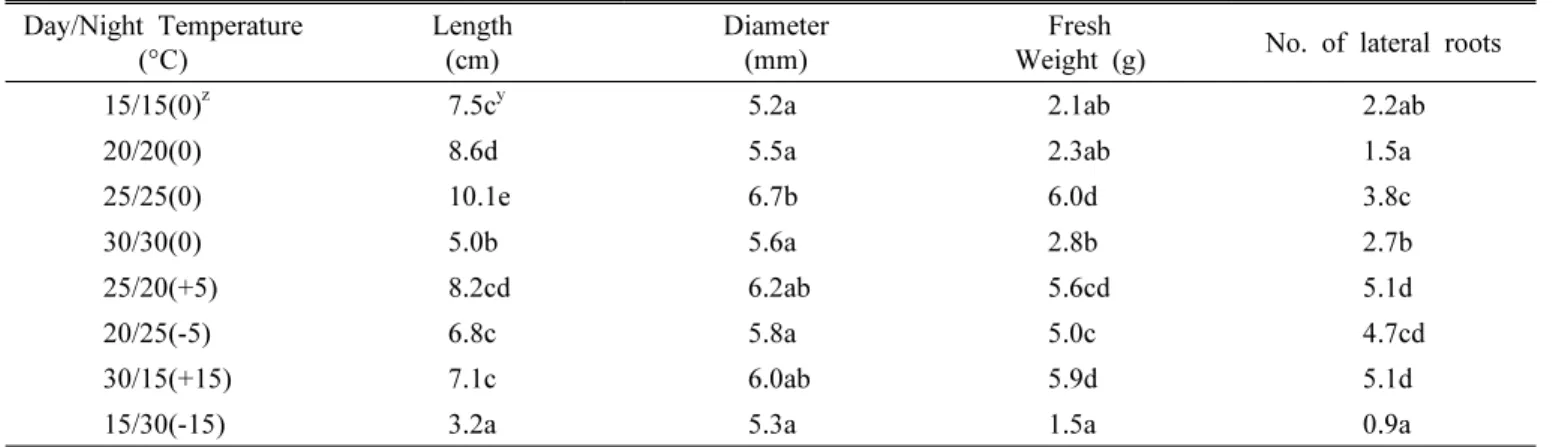
ABSTRACT This study was conducted to investigate the effects of temperature and shade, which are basic environmental conditions, on growth, yield, inorganic components, and general components of Codonopsis lanceolata, in order to obtain basic data for improving yield capacity. In natural light, in the 15, 20, and 25°C groups, the plant heights ranged between 218.9 cm and 223.9 cm, and there was no significant difference between groups. However, the leaf size was larger in shade, and the leaf area was significantly larger in the 15 and 30°C groups. In natural light, root length and diameter were shorter and thinner when the temperature was higher, and growth was highly suppressed at 30°C. With regards to macroelements, the contents of Na, Mg, and P increased as temperature increased, regardless of the plant part; however, no constant tendency was observed in K and Ca according to temperature. The contents of Mg and Ca (from highest to lowest) were in the order leaf>stem>root, whereas the contents of Na, P, and K were in the order stem>leaf>root. Contents of general components varied according to temperature, and were highest at 30°C. While the plant height was increased under the constant 25°C +DIF (Difference between day and night temperature) condition, growth was suppressed in the –DIF group, in which the night temperature was higher than the day temperature, which suggests that a change in night temperature is one of the factors that affects the growth of C. lanceolata. As in the growth of the above-ground parts, fresh weight of the root was high in the constant 25°C group and +DIF group. Notably, it was more than 2.5 times the fresh weights in the constant 15°C group, constant 20°C group, and –15 DIF group.
Keywords : Codonopsis lanceolata, DIF, mineral nutrients, proximate composition, shading
DOI : http://dx.doi.org/10.7740/kjcs.2016.61.2.131Original Research Article
ⓒ 본 학회지의 저작권은 한국작물학회지에 있으며, 이의 무단전재나 복제를 금합니다.
This is an Open-Access article distributed under the terms of the Creative Commons Attribution Non-Commercial License (http://creativecommons.org/licenses/by-nc/3.0) which permits unrestricted non-commercial use, distribution, and reproduction in any medium, provided the original work is properly cited.
1
Dept. of Food Nutrition and Cookery, Woosong College, Daejeon 34606, Korea
2
Dept. of Hotel and Restaurant Culinary Art, Kunjang University, Gunsan 54045, Korea
3
Dept. of Food Science and Biotechnology, Woosong University, Daejeon 34606, Korea
4
Dept. of Industrial Plant Science & Technology, Chungbuk National University, Cheong-ju 28644, Korea
5
WELLPHYTO Co. Ltd., BI Center, GIST, Gwangju 61005, Korea
6
Dept. of Crop Science, Chungbuk National University, Cheong-ju 28644, Korea
†
Corresponding author: Hag-Hyun Kim; (Phone) +82-42-629-6988; (E-mail) [email protected]
<Received 10 March, 2016; Revised 27 May, 2016; Accepted 8 June, 2016>
Codonopsis lanceolata is cultivated in different regions of South Korea and the total area of cultivation is increasing.
However, research on the cultivation of Codonopsis lanceolata is limited in comparison to that of other major crops and research on its yield according to temperature, light, and other growth conditions. Especially considering that Codonopsis lanceolata grows in cool and semi-shaded areas in mountains, problems are likely to occur when growing the crop in high temperature and under direct sunlight. Morphogenesis of plants is influenced by temperature, light, soil, and growth regulating substance among other factors, and temperature morphogenesis refers to shape of
a plant reacting to temperature (Erwin et al., 1989). In particular,
change between day temperature and night temperature has a
substantial effect on growth of plants (Tangeras, 1979), such as
interference with flower bud development (Grimstad and Frimanslund,
1993) and delay of flowering time (Grimstad, 1995). Response
of plant growth is reported in tomatoes to differentiate between
day temperature and night temperature (Moe and Heins, 1989),
cucumber (Challa and Brouwer, 1985), Euphorbia (Berghage and
Hein, 1991; Ueber and Hendriks, 1992), etc. It is reported that
plant growth is suppressed more when the night temperature is
higher than day temperature, and when the temperature is constant
or day temperature is higher than night temperature.
In the present study, the effects of temperature and shade on growth, yield, inorganic components, and general components of Codonopsis lanceolata, was investigated in order to obtain basic data for improving the yield.
MATERIALS & METHODS Temperature and Shading treatment
Seeds of Codonopsis lanceolata, were harvested in Muju in 2014, that were used as an experimental material. It was sown on March 2, 2015, and hastened to sprout in the glasshouse of Woosong Information College. After the leaf appeared, each unit was transplanted into a 15cm-diameter vinyl pot. On May 15, the plants were placed in the rooms of 15, 20, 25, and 30°C each in a biotron room, and grown in natural light and shade for which 90% of natural light was blocked by using cheese cloth.
Growth above ground part was invested gated on September 5, the same year, and then, on September 15, the plants were harvested to investigate the yield including root length, root diameter, and fresh weight. Also, inorganic components in the roots of Codonopsis lanceolata from each temperature group were analyzed.
Analysis of inorganic components
The sample was incinerated at 600°C for 12 hours and then decomposed by wet combustion method (Woo & Ryoo, 1983) and then made its quantity fixed with deionized distilled water to test the liquid. After adding 10 ml of thick nitric acid to 2 g of the roots of Codonopsis lanceolata for each region, the solution was heated with low temperature at first and then gradually increased the heating temperature to decompose it. Decomposed solute ion was chilled when the solution become white and transparent, and then added distilled water to the solution and made its quantity fixed to 100 ml, and then filtered it to make the remained liquid as the sample. The quantity of each mineral content was examined by ICP (Inductively Coupled Plasma, 3300DV, PerkinElmer Optima, USA). The condition of analysis was maintained in the following; plasma 15 l/min for the gas flow rate, 0.5 l/min for the auxiliary, 0.8 l/min for the nebulizer, 1,300 watts for the RF power, 1.0 ml/min for the flow rate, 18.48 rpm for the speed, 1.0 ml/min for the sample flow rate, 30sec for the sample flush time, 4.0 ml/min for the sample flush rate, and 30 sec for the delay time
(Jung et al., 2012).
Analysis of proximate compositions
The general components of the sample were analyzed by AOAC method (AOAC, 1990). Moisture was analyzed by ambient drying at 105°C and the ash contents were examined by dry ashing method. Crude protein contents were measured by Kjeltec protein analyzer (Tecator, Sweden) with using micro- Kjeltec method, and crude fat contents were analyzed by Soxhlet method.
DIF Treatment
The same testing materials as in test 1 was sown on March 10, 2015, and after the leaf appeared, each unit was transplanted into a 15 cm-diameter vinyl pot. On April 20, they were placed and grown in rooms with constant temperature (15, 20, 25 and 30°C) and alternating temperature (25°C /20°C, 20°C /25°C, 30°C /15°C and 15°C /30°C) in a biotron room. The temperature was maintained at a day temperature from 6 AM to 6 PM and changed to and maintained at night temperature from 6 PM to 6 AM. Growth above ground was invested gated on July 2, and, after harvesting, growth underground was investigated on July 8.
Statistical analysis
Using the SAS program (SAS, 9.2, Institute Inc, USA), comparisons between treatments were conducted by Duncan’s multiple range test (p=0.05).
RESULTS & DISCUSSION
Growth and yield of Codonopsis lanceolata in response to temperature and shading
In the present study, the growth of above-ground part of Codonopsis lanceolata is presented in Table 1. In natural light, in the 15, 20 and 25°C temperature, the plant heights ranged between 218.9 cm and 223.9 cm and there was no significant difference. However, the plant height (85.2 cm) was significantly shorter under 30°C than others temperature regimes. Contrary, in the shade at 15, 20 and 25°C temperature, the plant height was significantly shorter than the natural light, but there were no significant differences between different temperature groups.
However, the plant height exhibited higher in shade than in
natural light under 30°C. In natural light, the leaf size was
slightly smaller under 30°C temperature group, but there were
Table 1. Effects of air temperature and light intensity on the growth of Codonopsis lanceolate.
Temperature (°C) Light intensity
zPlant height (cm) Leaf width (cm) Leaf length (cm) No. of branches
15 H 229.4d
y4.2ab 4.6ab 17.3de
L 148.6c 5.3c 5.6c 12.2bc
20 H 218.9d 4.3ab 4.5ab 19.4e
L 159.5c 4.9bc 5.1bc 14.3cd
25 H 223.9d 4.5ab 4.7ab 17.1de
L 160.4c 4.6bc 4.9bc 12.9bc
30 H 85.2a 3.8a 4.0a 6.4a
L 129.7b 4.7bc 5.1bc 11.0b
z
H, high light intensity (=natural light); L, low intensity (=10% natural light)
y
Values followed by the same letters in the same column are not significantly different (P = 0.05, Duncan’s multiple range test).
Table 2. Effects of air temperature and light intensity on the root characteristics of Codonopsis lanceolata.
Temperature (°C) Light intensity
zLength (cm) Diameter (mm) Fresh weight (g) No. of lateral roots
15 H 9.7c
y9.3c 20.2d 12.2d
L 8.2bc 7.2bc 6.4c 7.7c
20 H 8.4bc 8.7bc 19.5d 12.5d
L 6.5b 6.3b 9.3c 5.1c
25 H 6.8b 8.0bc 6.0c 6.0c
L 6.4b 7.3bc 5.2bc 4.6bc
30 H 3.0a 3.7a 0.5a 0.5a
L 4.2a 6.1b 2.1ab 1.3ab
z
H, high light intensity (=natural light); L, low intensity (=10% natural light)
y
Values followed by the same letters in the same column are not significantly different (P = 0.05, Duncan’s multiple range test).
no significant differences between different temperature groups.
However, the leaf size was larger in the shade, and the leaf area was significantly larger both the 15 and 30°C temperature groups. Under natural light, the number of branches was also significantly smaller at 30°C temperature, but there were no significant differences among the 15, 20 and 25°C temperature groups. Under the shading treatment, the number of branches was significantly lower in the 15, 20 and 25°C temperature groups, but, it was interestingly higher in the 30°C temperature group (Table 1).
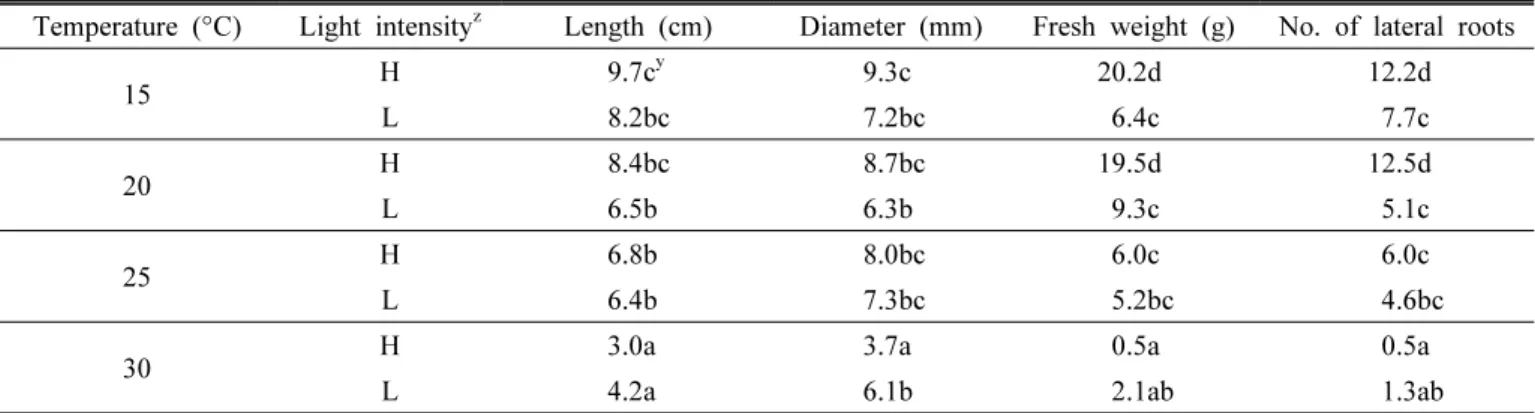
The changes of characteristics and yield of the underground part of Codonopsis lanceolata in response to temperature and shading treatment are presented in Table 2. Under the natural light, the root length and diameter were shorter and thinner when the plant was exposed to high temperature, and the growth was highly suppressed at 30°C temperature. Under the shading treatment,
there was no significant difference among the 5, 20 and 25°C temperature groups. At 30°C in shading treatment, as in natural light, the root length was significantly suppressed, but the root diameter was less suppressed and showed no significant difference from the root diameter under natural light. Under full sunlight condition, fresh weight of 15°C and 25°C temperature group showed a significant difference in each of 20.2 g and 6.0 g. This result was possibly occurred due to the difference in the number of lateral roots between the 15°C, 20°C, and the 25°C group. In all of the 15, 20 and 25°C temperature groups, there was significant decrease of fresh weight by shading treatment. At 30°C temperature, the fresh weight was higher under shading than the natural light condition, but the difference was not significant (Table 2).
The findings observed from the present investigation is
similar to the previously reported study, whereas the growth of
Table 3. Comparison of mineral nutrients contained in the parts of Codonopsis lanceolata were cultivated at different temperatures.
Plant part Temperature (°C)
Mineral nutrients (ppm)
P K Ca Mg Fe Mn Cu Zn Na Ni Pb Co
Leaf
15 748.2 512.8 6369 3062 1068.0 41.07 5.156 37.79 200.7 2.091 <0 <0 20 853.1 521.3 10955 4486 257.4 29.63 4.215 22.53 402.0 1.978 0.831 <0 25 1582.0 678.0 9673 2385 204.0 24.86 4.707 16.14 270.3 2.077 4.149 <0 30 1236.0 365.8 9047 3568 264.2 26.48 7.936 33.83 200.9 2.076 2.335 <0
Vine
15 796.9 753.5 4361 1408 66.0 8.99 1.933 6.33 66.6 1.054 2.057 <0 20 799.2 413.0 4336 583 52.2 11.87 2.262 9.24 90.1 2.147 3.544 <0 25 1375.0 442.6 3741 1793 75.0 7.29 2.842 16.69 284.9 1.747 1.438 <0 30 4229.0 818.1 5260 2874 69.5 13.88 14.620 24.91 641.7 1.514 1.660 <0
Root
15 959.6 437.5 1298 1040 114.6 10.89 3.182 15.89 71.1 0.937 <0 <0 20 767.6 357.3 8935 593 383.4 11.17 3.828 11.66 31.4 1.174 <0 <0 25 957.1 330.4 1756 1369 161.0 18.65 3.081 11.47 93.2 1.134 <0 <0 30 1316.0 274.7 2401 1524 159.9 19.77 5.633 15.78 304.7 2.018 <0 <0 Significance
Plant part (A) * ** * * ** ** NS NS * NS NS NS
Temperature (B) * * * * ** ** NS ** * NS NS NS
A×B NS NS ** ** NS NS NS NS NS NS NS NS
NS,*
Nonsignificant and significant at P = 0.05 and 0.01, respectively.
Codonopsis lanceolata decreases under high temperature and root growth is suppressed under shade condition (Lee et al., 1992). In this study, the above-ground growth of Codonopsis lanceolata was optimal in slightly low temperature, 20~25°C, while the yield of the underground part was higher under low temperature.
In the present study, results revealed that shading lowers the air and soil temperature in mid-summer. Although shading treatment is effective in actual cultivation, it simultaneously decreases the yield of the underground part. Therefore, during the temperature is lower than the optimum period, cultivation under natural light is believed to be ideal. In other words, when cultivating Codonopsis lanceolata, shading treatment at high temperature was applied to lower the air and soil temperature by avoiding direct sunlight rather than have direct effects on the physiology of the plants.
Taken together, the results obtained from the present study suggest that shading can be effective for reducing growth inhibition of the above-ground and underground parts caused by high temperature during mid-summer.
Analysis of inorganic and general components under different temperature variation
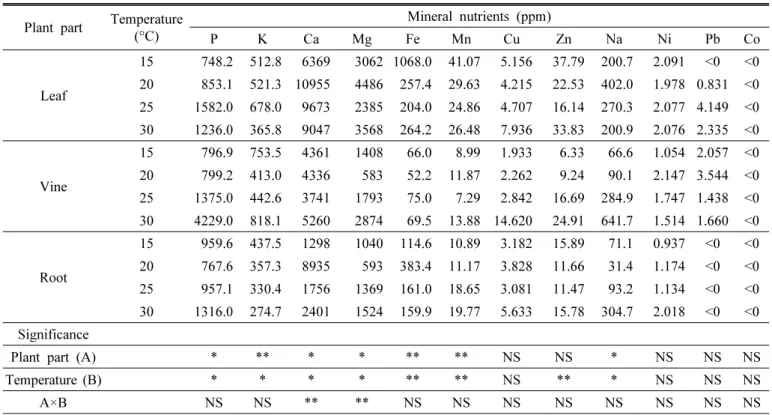
The inorganic components of different parts of Codonopsis
lanceolata are presented in Table 3 according to temperature
variation. In the case of macroelements, the contents of Na, Mg
and P increased as temperature increased, regardless of the part,
and no constant tendency was observed in K and Ca according to
temperature variation. The Mg and Ca contents showed highest
in the following pattern as leaf>stem>root, and Na, P and K
contents as stem>leaf>root order. This suggests that contents of
inorganic components of Codonopsis lanceolata are higher in
the stem and leaves than in the root. In the case of microelements,
in general, there was no constant tendency observed in contents
of inorganic components according to temperature variation,
and the contents were high in leaves. Co was not found in any
part regardless of the temperature, and Pb was found in the
leaves and stem in small quantities, but none in the root, which is
used for eating (Table 3). Lee et al., 1995 reported that the
contents of inorganic components vary according to regional
environment and contents of main inorganic components of
Codonopsis lanceolata varied in different plantations, and a
Table 4. Comparison of major constituents of proximate composition in Codonopsis lanceolata under different temperature conditions.
Temperature (°C)
General nutrients (%)
Moisture Crude protein Crude fat Crude fiber Crude ash Sugar
15 18.0b
z3.5b 1.3bc 5.1b 3.5b 39.0a
20 20.1b 3.3b 1.3bc 4.4ab 3.6b 37.5a
25 25.7c 2.3a 0.7a 3.7a 2.7a 37.4a
30 12.6a 6.1c 1.8c 10.7c 4.5c 35.8a
z
Values followed by the same letters in the same column are not significantly different (P = 0.05, Duncan’s multiple range test).
Table 5. Effects of DIF on the growth of Codonopsis lanceolata.
Day/Night Temperature (°C)
Plant height (cm)
Leaf width (cm)
Leaf length
(cm) No. of branches
15/15(0)
z13.8a
y2.8ab 1.6a 0.2a
20/20(0) 19.2ab 2.9ab 2.0ab 0.5a
25/25(0) 46.4d 2.5a 1.9ab 1.7b
30/30(0) 20.8ab 3.1b 2.4b 0.3a
25/20(+5) 36.5c 2.8ab 1.9ab 0.1a
20/25(-5) 30.3b 2.9ab 2.0ab 0.1a
30/15(+15) 37.7c 3.2b 2.0ab 0.6a
15/30(-15) 13.0a 2.6a 1.7a 0.3a
z
DIF value
y
Values followed by the same letters in the same column are not significantly different (P = 0.05, Duncan’s multiple range test).
similar result was also observed in ginseng (Ko et al., 1996).
Content of constituents varied according to temperature variation, and it was highest at 30°C. The moisture content at 25°C was 25.7%, slightly higher than in other temperature groups, and it was lowest at 30°C. Crude protein was lowest (2.3%) at 25°C, and highest (6.1%) at 30°C. Crude fat, crude fiber, and crude ash contents were also higher in the 30°C temperature group. Sugar contents were similar between different temperature groups, ranging between 35.8% and 39.0% (Table 4). Although a previous report suggested, in Codonopsis lanceolata, there was no characteristic difference in general components according to cultivation and environmental factors of the habitat (Lee, 1984). In this study, the contents of general components showed the highest under high temperature. Also, the general components of Codonopsis lanceolata roots were found to be high under high temperature.
This supports another report that has been reported earlier (Lee et al., 1992).
Growth and yield of Codonopsis lanceolata according to DIF treatment
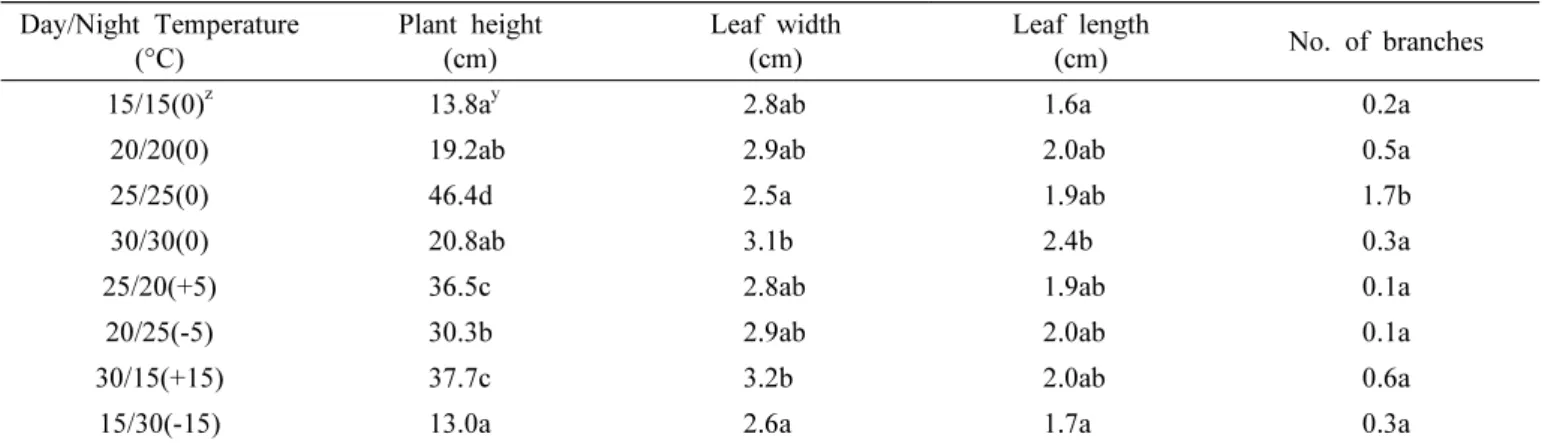
The changes of the growth of the above-ground part according to the difference between day and night temperature (DIF) is presented in Table 5.
While the plant height was high in the constant 25°C group +DIF treated group, plant height was suppressed in a -DIF group, in which the night temperature was higher than the day temperature, which suggests that change of night temperature is one of the factors that affects the growth of Codonopsis lanceolata.
There was no significant effect of temperature consistency on
the leaf length and width. The number of branches of the plants
grown at constant 25°C was 1.7, which was significantly higher
than other groups, but those of the rest of the groups were similar
to one another as 0.1 to 0.6 (Table 5). The low number of
ramifications could have been caused by inactive development
of ramification during the early growth stage. Growth of the
plant and height of the stem is further suppressed by -DIF
Table 6. Effect of DIF on the root characteristics of Codonopsis lanceolata.
Day/Night Temperature (°C)
Length (cm)
Diameter (mm)
Fresh
Weight (g) No. of lateral roots
15/15(0)
z7.5c
y5.2a 2.1ab 2.2ab
20/20(0) 8.6d 5.5a 2.3ab 1.5a
25/25(0) 10.1e 6.7b 6.0d 3.8c
30/30(0) 5.0b 5.6a 2.8b 2.7b
25/20(+5) 8.2cd 6.2ab 5.6cd 5.1d
20/25(-5) 6.8c 5.8a 5.0c 4.7cd
30/15(+15) 7.1c 6.0ab 5.9d 5.1d
15/30(-15) 3.2a 5.3a 1.5a 0.9a
z
DIF value
y