• 검색 결과가 없습니다.

Fully Immersive Virtual Reality Program Changes in the Autonomic Nervous System by Age According to Heart Rate Variability

N/A
N/A
Protected

Academic year: 2021

Share "Fully Immersive Virtual Reality Program Changes in the Autonomic Nervous System by Age According to Heart Rate Variability"

Copied!
10
0
0

로드 중.... (전체 텍스트 보기)

전체 글

(1)

| Abstract |

Purpose: This study aimed to investigate the fully immersive virtual reality (FIVR) program changes in the autonomic nervous system (ANS) by age according to heart rate variability (HRV).

Methods: A total of 44 subjects were classified into group 1(aged 20–30), group 2(aged 40–60), and group 3(aged 70 and above).

The study analyzed the HRV using a pulse wave analyzer and compared the ANS changes before and after applying the FIVR of the group. The LF, HF, RMSSD, and SDNN were measured. Fifteen minutes of virtual reality applications were applied to all subjects, and 1 min of rest was given in the middle of the session. A was used for anteroposterior comparisons of the ANS.

Results: The HF, LF, RMSSD, and SDNN values were not statistically significant in all groups, but they all increased. The RMSSD value was statistically significant because it increased in group 3 (p<0.05). Those of the other two groups were not statistically significant (p<0.05).

Conclusion: An FIVR program does not have a negative effect on the ANS response.

Key Words: Fully immersive virtual reality (FIVR), Heart rate variability (HRV), Autonomic nervous system (ANS)

†Corresponding Author : Min-Chull Park ([email protected])

Original Article Open Access

완전몰입형 가상현실(FIVR) 프로그램이 심박변이도에 의한 연령별 자율신경계의 변화

빈유민⋅박민철

1†1)

부산가톨릭 대학교 대학원 물리치료학과,

1

부산가톨릭 대학교 보건과학대학 물리치료학과

Fully Immersive Virtual Reality Program Changes in the Autonomic Nervous System by Age According to Heart Rate Variability

Yu-Min Been⋅Min-Chull Park

1†

Department of physical Therapy Graduate School, Catholic University of Pusan

1
Department of physical therapy, college of health science catholic university of Pusan

Received: April 4, 2018 / Revised: May 28, 2018 / Accepted: May 29, 2018

ⓒ 2018 Journal of Korea Proprioceptive Neuromuscular Facilitation Association

This is an Open Access article distributed under the terms of the Creative Commons Attribution Non-Commercial License

(http://creativecommons.org/licenses/by-nc/3.0) which permits unrestricted non-commercial use, distribution, and reproduction

in any medium, provided the original work is properly cited.

(2)

Ⅰ. 서 론

가상현실(virtual reality)기술의 급격한 발전으로 현 재 건축물 설계, 시뮬레이션, 운전 훈련, 게임 등에 사용되고 있으며, 이 외에도 통신이나 유통, 의료등 다양한 분야에 널리 이용되고 있다(Kim et al., 2013).

가상현실(virtual reality)은 일반적인 LED 모니터를 이 용한 비입체적 영상에서부터 헤드 장착디스플레이 (head mounted display)에 이르기까지 다양한 시각자극 을 제공할 수 있다(Adamovich et al., 2009; Emiliano et al., 2013). 또한 의학, 심리학, 스포츠 등 여러 분야에 서도 성공적인 융합을 이뤄내어 안전하고 다양한 환 경에서 사용자의 효과적인 움직임을 유도할 수 있다 (Cho, 2015; Kim, 2014; Riva et al., 1997).

이처럼 가상현실은 현실에서 이행하기 어려운 과 제를 실제상황과 같은 환경을 통해 실시간 피드백을 지속적으로 제공할 수 있다(Kim et al., 2013). 또한 개 인의 능력에 따라 난이도를 조절할 수 있으며 , 흥미로 운 요소로 인해 높은 동기부여를 일으킬 수 있다(You et al., 2005). 하지만 비용이 부담스러운 수준이고, 환자 의 치료에 접목하는데 있어서 아직 완벽한 기술이 아 니라 한계가 있으며, 어느 정도의 인지기능도 필요하 다 (Oujamaa et al., 2009). 또한 안구피로나 사이버 멀미 가 발생 할 수도 있다는 우려도 있다(Crosbie et al., 2007).

최근에는 첨단영상장비의 발달에 따라 가상현실 종류 중 완전몰입형(fully immersive virtual reality)이 많이 사용되는데, 완전몰입형은 1인칭 시점으로 머리 의 움직임에 따라 가상환경이 변화된다(Emiliano &

Heiko, 2013). 따라서 완전몰입형 가상현실은 360도 넓은 시야각을 이용해 시각자극을 더욱 극대화 시킬 수 있다는 장점이 있다(Pack et al., 2003).

하지만 Lee 등(2010)은 몰입도가 높은 콘텐츠가 더 큰 시각피로를 일으키며 , 뇌의 시각 정보처리 프로세 스를 과부화 시켜 자율신경계의 기능에 영향을 미칠 수 있다고 하였다(Lee et al., 2010). Pack 등(2011)도 3D TV 시청으로 인해서 유발된 시각피로가 자율신경

계에 미치는 영향에 대해 보고자 하였다 . 3D TV 시청 후 교감신경계가 항진되고 자율신경계의 균형이 감소 하는 결과를 나타내었으며, 이러한 결과가 자율신경 계의 부적절한 영향과 심혈관계에도 영향을 미칠 수 있는 가능성을 확인하였다.

자율신경계의 활동은 신체활동에 있어 매우 중요 한 요소이다 . 자율신경계의 역할은 신체 상태의 불균 형을 조절하여 신체가 일정하게 항상성을 유지 할 수 있도록 하는 역할을 한다(Yun et al., 2013).

자율신경계의 변화, 심박수의 변화, 스트레스를 모 니터 하는 방법에는 최근 심박변이도(heart rate variability, HRV)가 많이 사용되고 있다. 심박변이도는 비용이 저렴하고 , 인체에 통증을 가하지 않으며, 표준 측정과 분석에 관한 가이드라인이 발표되면서 자율신 경 모니터링을 위해 광범위하게 이용되고 있다(Tsuji et al., 1996).

기존 연구에서는 시각자극과 관련된 기본적인 영 상장비 사용이 자율신경계에 미치는 영향과 관련된 연구가 활발히 진행 되었으나, 현재 급속도로 발전해 대중화 되고 있는 완전몰입형 가상현실에 대한 연령 대별 연구는 거의 이루어지지 않고 있다.

따라서 본 연구자는 심박변이도를 이용하여 다양 한 분야에 적용되고 있는 완전몰입형 가상현실이 연 령별 자율신경계에 미치는 영향에 대해 알아보고자 하였다.

Ⅱ. 연구 방법

1. 연구 설계

본 연구는 완전몰입형 가상현실 프로그램이 자율

신경계에 어떠한 영향을 미치는지 알아보고자 시행되

었다 . 연령대별로 세 그룹으로 구성되었고, 완전몰입

형 가상현실 프로그램 적용 전후의 변화를 비교하고

자 하였다. 연구에 참여한 모든 실험군의 대상자들은

정상적인 기립자세에서 3D 헤드기어를 착용한 후 가

(3)

상환경을 조성하였다.

2. 연구 대상

본 연구의 연구 대상자는 부산에 거주한 20, 30대 그룹 15명, 40∼60대 그룹 14명, 70세 이상 그룹 15명이 모집되었다. 실험에 앞서 모든 참가자들에게 본 연구 의 목적을 설명하였고, 실험참여에 대한 동의를 얻었 다. 대상자의 공통특성 선정기준은 다음과 같다.

1) 백내장, 녹내장 등 안과질환이 없는 자 2) 독립적 보행이 가능한 자

3) 중추신경, 말초신경에 병변이 없는 자 4) 연구 참여에 대해 이해하며 자발적인 동의를 얻

은 자

5) 실험방법에 대해 충분히 이해가 가능한 자 3. 연구 방법

실험실의 환경은 온도 23도, 습도 65%로 밝고 쾌적 한 환경을 유지하고, 실험하는 동안 외부인의 출입이 나 소음을 차단하였다. 실험 측정 24시간 전부터 고강 도의 운동 및 카페인 , 알코올 섭취를 금지하였고, 흡연 은 2시간 전부터 금지시켰다.

4. 중재방법

사용기기는 완전몰입형 가상현실 프로그램에서 Galaxy7(SM-G930S, Samsung Inc., Korea)을 장착한 시 청각 3D 헤드기어(VR MAX, TENKYO, China)를 착용 하였다. 본 실험에 사용된 어플리케이션은 App Teeka 가 개발한 Rope Crossing Adventure VR (UAE, 2016)을 적용하였다.

자율신경계의 측정에 사용한 기기는 맥파계 (uBioClipV70, Biosense creative, Korea)이다.

5. 측정방법

대상자에게 5분간 의자에 앉아 안정을 취하게 한 후 , 테이블 위에 팔을 심장 높이로 올려두고 우측 손의 검지에 맥파계의 펄스옥시미터를 부착하여 심박변이 도를 측정하였다. 이후 대상자를 기립자세에서 헤드 기어를 착용시켜 7분간 완전몰입형 가상현실 프로그 램 적용하였고, 2분간 휴식을 취한 후 다시 7분간 완전 몰입형 가상현실 프로그램을 적용한 직후 다시 전과 동일한 자세로 맥파계를 이용해 심박변이도를 재측정 하였다.

1) LF (low frequency) : 저주파 부분으로 교감신경의 활동에 대한 지표로 활용된다.

2) HF (high frequency) : 부교감신경계의 활동에 대 한 지표로 활용된다.

3) RMSSD (root mean square successive difference) : 부교감신경계의 조절능력과 부교감신경계의 활동이 많다는 것을 의미한다.

4) SDNN (standrad deviation of N-N inteval) : 전체 R-R간격의 표준편차로 SDNN의 값이 작다는 것 은 심박변동신호가 단조롭다는 것을 의미하며 클수록 환경에 잘 대응한다는 것을 의미한다.

6. 자료 처리 통계 처리 방법

본 연구에서 얻어진 모든 데이터는 윈도우용 SPSS 22.0 통계프로그램을 사용하여 통계처리 하였다. 각 연 령별 그룹은 완전몰입형 가상현실 중재 전과 후 비교를 위해 Wilcoxon signed rank test를 실시하였다. 각 변수들 의 집단별 차이점을 알아보기 위해 Kruskal-wallis test를 실시하여 사후분석은 Mann-whitney 를 실시하였다.

유의수준(α)은 0.05로 설정하였다.

(4)

Ⅲ. 연구 결과

1. 연구 대상자의 특성

Group 1 (n=15)

Group 2 (n=14)

Group 3 (n=15) Age (years) 29.33±4.37 56.86±9.08 81.00±6.17 Height (㎝) 167.20±7.45 164.36±6.20 161.73±9.24 Weight (㎏) 66.07±11.29 66.21±8.69 58.27±12.51 Group 1: age 20s-39s

Group 2: age 41s-69s Group 3: age 70s above

Table 1. The general characteristics of the subject

2. 측정결과

1) LF

모든 연령그룹별로 증가하였지만, 통계학적으로 유의하지 않았다(p<0.05)(Table 2). 세 그룹 집단 간 차이에서는 중재 전후에서 Group 1과 Group 2, Group1 과 Group 3에서 집단 간에 유의한 차이를 보였다

(p<0.05)(Table 3).

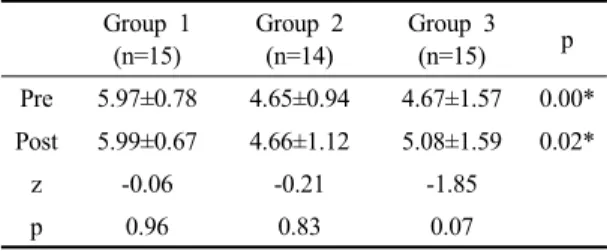
2) HF

모든 연령그룹별로 증가하였으며, 통계학적으로 유의하지 않았다(p<0.05)(Table 4). 세 그룹 집단 간 차이에서는 중재 전 Group 1과 Group 2, Group 1과 Group 3에서 집단 간에 유의한 차이를 보였고, 중재 후 Group 1과 Group 2에서 집단 간에 유의한 차이를 보였다(p<0.05)(Table 5).

Group 1 (n=15)

Group 2 (n=14)

Group 3 (n=15) p Pre 5.97±0.78 4.65±0.94 4.67±1.57 0.00*

Post 5.99±0.67 4.66±1.12 5.08±1.59 0.02*

z -0.06 -0.21 -1.85

p 0.96 0.83 0.07

*: significant difference (p<0.05)

Table 4. HF comparison pre and post intervention and comparison between groups

Group 1 Group 2

Group 2 pre 0.00* -

post 0.00* -

Group 3 pre 0.01* 0.51

post 0.13 0.65

*: significant difference (p<0.05)

Table 5. HF comparison between groups

3) RMSSD

Group 1, Group 2에서 통계학적으로 유의하지 않았 으며 , Group 3에서 통계학적으로 유의한 결과를 보였 다 (p<0.05)(Table 6). 세 그룹 집단 간 차이에서는 중재 전 Group 1과 Group 3에서 집단 간에 유의한 차이를 보였다(p<0.05)(Table 7).

Group 1 (n=15)

Group 2 (n=14)

Group 3 (n=15) p Pre 6.95±0.68 5.53±1.16 5.58±1.63 0.00*

Post 7.24±0.80 5.84±1.49 5.69±1.57 0.00*

z -1.03 -1.40 -0.28

p 0.31 0.16 0.78

*: significant difference (p<0.05)

Table 2. LF comparison pre and post intervention and comparison between groups

Group 1 Group 2

Group 2 pre 0.00* -

post 0.00* -

Group 3 pre 0.01* 0.51

post 0.00* 0.75

*: significant difference (p<0.05)

Table 3. LF comparison between groups

(5)

Group 1 (n=15)

Group 2 (n=14)

Group 3 (n=15) p Pre 40.53±18.94 30.57±17.76 24.23±12.31 0.03*

Post 36.92±17.68 30.18±17.00 30.87±18.67 0.46

z -1.76 -0.41 -2.16

p 0.08 0.69 0.03*

*: significant difference (p<0.05)

Table 6. RMSSD comparison pre and post intervention and comparison between groups

Group 1 Group 2

Group 2 pre 0.15 -

post 0.27 -

Group 3 pre 0.01* 0.31

post 0.33 0.88

*: significant difference (p<0.05)

Table 7. RMSSD comparison between groups

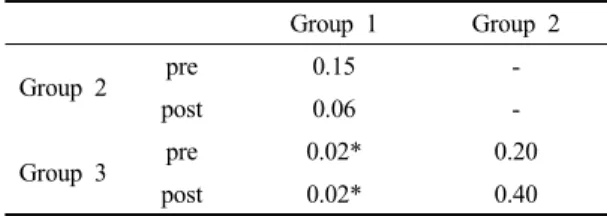
4) SDNN

모든 연령그룹별로 증가하였으며, 통계학적으로 유의하지 않았다(p<0.05)(Table 8). 세 그룹 집단 간 차이에서는 중재 전후에서 Group 1과 Group 3에서 집 단 간에 유의한 차이를 보였다(p<0.05)(Table 9).

Ⅳ. 고 찰

Pack 등(2011)은 3D TV시청이 자율신경계에 미치 는 영향에 시각피로로 인한 스트레스가 자율신경계의 균형을 감소시킨다고 하였다. 따라서 본 연구는 전 연령층을 대상으로 가상현실 프로그램 중 높은 몰입 도를 반영한 완전몰입형 가상현실 프로그램이 심박변 이도를 이용하여 자율신경계에 미치는 영향을 알아보 고자 하였다.

자율신경계(autonomic nervous system, ANS)는 복강 신경절이나 위, 아래 장간막 신경절등에서 신경접합 (synapses)을 일으키고 여기서 시작되는 신경절후 섬

유들은 말초장기, 혈관, 방광, 내장에 분포하게 된다 (Kim, 1992). 척수(spinal cord)나 뇌줄기(brainstem), 시 상하부(hypothalamus)에 구심성으로 자극된 감각정보 가 내장기관들에 반사반응을 유발시켜 자율적으로 기 능을 조절하게 된다(Arthur et al., 2000). 따라서 자율신 경계는 이러한 내장과 혈관에 분포되어 대뇌에 직접 적인 영향을 받지 않고 몸의 기능을 불수의적으로 조 절하여, 생명유지와 항상성에 관여하게 된다(Pack et al., 2010). 이러한 자율신경계는 크게 교감신경 (sympathetic nerve)과 부교감신경(parasympathetic nerve) 으로 나누어진다. 교감신경은 신체가 어떠한 자극에 대한 상황에 직면하였을 때 이에 대처하는 기능을 하 는데, 교감신경이 흥분하게 되면 호흡이 빨라지며, 각 기관에 세포가 작용하여 우리 몸을 활동적으로 만들 어 주는 반면 부교감신경은 잠을 잘 때나 휴식할 때와 같은 안정적인 상태일 때 활성이 되는데, 심장운동이 나 호흡을 진정시키고 소화가 잘 되도록 도와준다(Jo et al., 2011).

신체의 감소된 활동은 이러한 자율신경계의 기능 의 저하를 유발한다 (Bouchard & Rankinen, 2001).

Group 1 (n=15)

Group 2 (n=14)

Group 3 (n=15) p Pre 48.23±14.28 39.99±41.41 31.26±19.85 0.04*

Post 51.41±16.72 40.06±16.70 36.19±22.51 0.04*

z -1.05 -0.60 -1.59

p 0.29 0.55 0.11

*: significant difference (p<0.05)

Table 8. SDNN comparison pre and post intervention and comparison between groups

Group 1 Group 2

Group 2 pre 0.15 -

post 0.06 -

Group 3 pre 0.02* 0.20

post 0.02* 0.40

*: significant difference (p<0.05)

Table 9. SDNN comparison between groups

(6)

Pratley 등(1994)과 Raasead 등(2001)의 선행연구에 따 르면 근력운동 시 혈장의 노르에피네프린 농도를 상 승시켜 교감신경계의 활성화를 시킨다고 보고 하였 고, Heffernan 등(2006, 2008)에 따른 연구에 의해서도 근력운동 후 심박수의 변이도가 감소된다고 하였다.

반면에, Bloomfield 등(2000)과 Davy 등(1998)은 장기 간의 유산소 운동이 교감신경의 활성도를 감소시키 고, 부교감신경의 활성을 증가시킨다고 하였다. 이러 한 선행연구들은 외부자극의 종류와 강도에 따라 자 율신경계의 반응정도가 달라진다는 것을 보여주는 결 과이다.

본 연구에 사용된 맥파계의 LF값은 교감신경의 활 성도를 반영하고, HF값은 부교감 신경과 교감신경의 활성정도를 확인하기 위한 지표로 많이 사용된다(Kim et al., 2010; McCraty et al., 2009; Pagani et al., 1986;

Tran et al., 2009). 여러 기존 연구에서는 도수수동 운 동, 전기자극, 3D TV시청에 의한 시각자극 등의 외부 적인 자극에 의해 교감신경의 활성화를 나타내는 지 표인 LF가 증가되었다고 보고하였다(Kang, 2009;

Kim, 2015; Park, 2011). 본 연구에서도 교감신경을 나 타내는 LF값이 모든 그룹에서 평균적으로 증가한 것 을 볼 수 있는데, 이는 외부적인 자극에 대해 준비하기 위한 신체반응으로 볼 수 있다. 이러한 교감신경계의 활성화 자체가 위험요인은 아니지만, 계속된 교감신 경의 과활성은 심박수 , 심장의 일회 박출량, 말초저항 의 증가로 심장에 대한 부하를 증가시키게 되고, 심장 에 부담을 주어 혈액동역학적 스트레스를 일으킴으로 심혈관질환의 위험성 증가 시킬 수도 있다(Borchard, 2001; Curtis & O’Keefe, 2002). 반면에 부교감 신경의 활성화는 스트레스를 완화시켜주고 자극에 대해 신체 반응을 안정시키며 긴장감을 완화시켜준다(Kim, 2011). 이에 대해 본 연구에서는 교감신경을 나타내는 LF값 증가에 더해 부교감신경을 나타내는 HF값도 평 균적으로 증가한 것을 볼 수 있다. 이는 인체가 외부환 경에 대해 여러 가지 새로운 자극을 받게 되면 교감신 경과 부교감신경의 균형을 깨트린다는 기존 선행연구 와 다른 결과를 나타낸 것이다(Kim, 2001). 따라서 본

연구의 결과는 교감신경의 활성화로 인해 가해지는 스트레스와 긴장을 안정화시키기 위해 부교감신경이 활성화 하여 호흡과 심장운동을 진정시키고, 자율신 경계의 균형을 맞추기 위한 반응이라고 볼 수 있다.

이에 더해 , RMSSD값은 연속된 R-R 간격의 차이의 제곱평균을 제곱한 값으로, 심장의 부교감신경의 조 절능력을 나타내는 지표이다(Im et al., 2007). Hayer와 Land (2006)의 선행 연구에 따르면, 부교감 신경의 활 성이 감소되면 심인성 질환의 사망률을 높이지만, 이 와 반대로 Cerati와 Schwatz (1991)는 부교감 신경의 활성화는 불규칙한 심장의 변화를 방지시켜줄 수 있 다고 하였다. 결과적으로 심박변이도에서의 RMSSD 값의 변화는 임상적으로 중요한 의미를 둔다(Im et al., 2007). 이러한 RMSSD값의 감소는 나이가 많거나, 질병을 가지고 있거나, 자율신경계의 기능이상이 있 는 사람에게서 현저한 감소가 나타낸다고 알려져 있 다(Eur Heart J, 1996). Park등(2011)의 연구에서는 3D TV 시청 전후 시각자극이 RMSSD의 값이 감소시켜 자율신경계기능의 부적절한 영향을 주며 심혈관계 반 응까지 영향을 미친다고 하였다. 하지만 본 연구에서 는 완전몰입형 가상현실 프로그램 적용 후 RMSSD의 값의 변화가 20,30대 그룹과 40∼60대 그룹에서는 통 계학적으로 유의하지 않았지만, 70세 이상의 대상자 그룹에서 RMSSD값이 증가하여 부교감 신경계의 반 응이 증가하였다고 볼 수 있으며, 통계학적으로 유의 한 결과를 보였다. 이는 완전몰입형 가상현실프로그 램이라는 새로운 외부자극, 시작자극이 신체에 스트 레스를 야기 시킬 수 있는데, 이에 대해서 부교감신경 계가 더 활성화되어 몸의 항상성을 유지하기 위한 반 응으로 증가된 반응을 보였다고 볼 수 있다. Lee 등 (2005)의 연구에서도 긍정적인 시각자극에 대해서 RMSSD의 값이 증가하는 반응을 보였는데, 본 연구에 서도 완전몰입형 가상현실 프로그램을 통한 시각자극 이 70세 이상의 노인에게 있어 긍정적인 시각자극을 보임으로 RMSSD의 값이 증가된 반응을 나타내었다.

이를 통해 70세 이상의 노인에게 완전몰입형 가상현

실 프로그램 적용이 부교감 신경계의 활성을 유도하

(7)

여 높은 지각반응을 보이며 외부자극에 대한 스트레스 를 완화시켜 자율신경계의 위험요인 인자가 될 수 없으 며 긍정적인 시각자극을 보이는 반응을 나타내었다.

SDNN값은 연속 심장박동 사이의 간격, 즉 정상적 인 R-R사이의 간격의 표준편차를 나타낸다(Tak et al., 2009). 이는 교감신경과 부교감신경의 반응을 통합하 여 심혈관계의 반응을 나타내는 지표이다(Cevese et al., 2001; Cohen et al., 2001; Eur Heart, 1996). 따라서 SDNN 값의 감소는 심박의 변화가 불규칙하다는 것을 나타내고 좌심실의 기능장애, 심근경색으로 인한 위 험성을 나타내는 지표이며, 반대로 SDNN의 값은 클 수록 환경에 잘 대응한다는 것을 나타내며(Im et al., 2007), 결과적으로 SDNN값이 크고 복잡하게 나타나 는 것은 안정된 상태를 나타낸다 (Lee, 1999). 본 연구에 서 SDNN의 값이 모든 연령층에서 통계학적으로 유의 하지 않은 결과를 보였지만 , 모든 그룹에서 평균값이 증가한 값을 볼 때, 환경에 대해 잘 대응한다는 것을 나타내었다.

Loimaala 등(2000)은 유산소 운동을 하였는데, 5개 월간의 유산소 운동을 한 고강도 운동그룹에서만 자 율신경계에 대한 변화를 보였고, 저강도 운동그룹에 서는 의미 있는 변화가 없었다 . 이는 중재강도 및 중재 기간이 자율신경계 개선에 중요한 인자임을 제시하고 있는 것이다. 따라서 추후 연구에서는 가상현실 프로 그램을 이용한 더 많은 시간의 중재 , 시간별로 변화되 는 자율신경계의 변화나 다양한 난이도의 적용이 자 율신경계에 미치는 영향에 대해 연구해 볼 필요가 있 을 것이라고 사료된다. 또한 본 연구에서는 심박변이 도만을 이용하여 자율신경계를 검사하였다. 기존 선 행연구들에는 자율신경계를 검사하는 방법으로 교감 피부반응검사(sympathetic skinresponse, SSR), 발살바 메뉴버(valsalva maneuver), 기립시 심혈관계 반응 검사 (cardiovascular respnse to standing)를 사용하였는데, 이 러한 측정기계를 통해 자율신경계의 반응에 대해 더 정량적이고 수치화 한다면 임상적으로 더 의미 있는 결과를 나타낼 것이다(Claus et al., 1999; George et al., 1991; Epatein et al., 1986).

Ⅴ. 결 론

본 연구는 연령대별로 완전몰입형 가상현실 프로 그램의 적용이 심박변이도에 의해 자율신경계에 미치 는 영향에 대해 알아보고자 하였다. 모든 그룹에서 교감신경을 활성화 시켰으며 , 부교감신경도 활성화되 어 자율신경계의 균형을 이루었다. 특히, 70세 이상의 그룹에서 부교감신경의 반응을 증가시키는 유의한 결 과를 보여 외부자극으로부터 자율신경계의 안정화를 이루었으며, 긍정적인 시각반응을 나타내었다. 이는 완전몰입형 가상현실 프로그램이 다양한 연령층에서 의 적용에 있어 자율신경계에 부정적인 영향을 주지 않았음을 나타내었다. 따라서 최근 활발하게 진행되 고 있는 완전몰입형 가상현실 프로그램을 이용한 재 활치료의 중재에 있어 큰 의의를 둔다고 생각된다.

그러나 가상현실 프로그램의 난이도, 장시간 자극에 대한 자율신경계의 반응은 달라질 수 있다고 사료된 다 . 또한 환자를 대상으로 완전몰입형 가상현실 프로 그램을 적용하여 자율신경계의 변화에 대해 알아봄으 로 가상현실을 이용한 안전한 중재방법을 제시해야 할 것이다 .

References

Adamovich SV, August K, Merians A, et al. A virtual reality-based system integrated with fmri to study neural mechanisms of action observation-execution:

a proof of concept study. Restorative Neurology and Neuroscience. 2009;27(3):209-232.

Arthur C, Guyton MD, Hall JE. Textbook of medical physiology.

Philadelphia. Saunders company. 2000.

Bloomfield DM, Goldsmith RL, Rosenwinkel ET, et al. Exercise and autonomic function. Coronary Artery Disease.

2000;11(2):129-135.

Bouchard C, Rankinen T. Individual differences in response

to regular physical activity. Medicine and Science

(8)

in Sports Exercise. 2001;33(6):S446-453.

Borchard U. The role of the sympathetic nervous system in cardiovascular disease. Journal of Clinical and Basic Cardiology. 2001;4(3):175-177.

Cevese A, Gulli G, Polati E, et al. Baroreflex and oscillation of heart period at 0.1Hz studied by alpha-blockade and cross-spectral analysis in healthy humans. Journal Physiology. 2001;531(Pt1):235-44.

Cho HC, Kim SY, Kim YH, et al. Exercise physiology. Seoul.

21st century education. 2011.

Cho NJ. Effects of 12 week Yoga exercise on the autonomic nervous system and lung capacity. Andong National University. Dissertation of Master’s Degree. 2015.

Cohen H, Neumann L, Alhosshle A, et al. Abnormal sympathovagal balance in men with fibromyalgia.

The Journal of rheumatology. 2001;28(3):581-589.

Crosbie JH, Lennon S, Basford JR, et al. Virtual reality in stroke rehabilitation: still more virtual than real.

Disability and Rehabilitation. 2007;29(14):1139-1146.

Davy K, Desouza C, Jones P, et al. Elevated heart rate variability in physically activity young and older adult women.

Clinical Science (London, England: 1979).

1998;94(6):579-584.

D Claus, R Schondorf. Recommendations for the practice of clinical neurophysiology: guidelines of the international federation of clinical physiology.

Electroencephalography and Clinical Neurophysiology supplement. 1999;52(1):1-304.

Deutsch JE, Paserchia C, Vecchione C, et al. Improved gait and elevation speed of individuals post-stroke after lower extremity training in virtual environments.

Journal of neurologic physical therapy. 2004;28(4):

185-186.

Emiliano P, Heiko H. A Small-scale, low-budget semi-immersive virtual enviroment for scientific visualization and research. Procedia Computer Science. 2013;25(1):14-22.

Eur Heart J. Heart rate variability-standards of measurement, physiological interpretation, and clinical use, task force of the European society of cardiology and the north American society of pacing and electrophysiology. Journal of the American Heart Association. 1996;93(5):1043-1065.

Honos GN, Gaudreault G, Dumesnil JG, et al. Use of valsalva maneuver to unmask left ventricular diastolic function abnormalities by Doppler echocardiography in patients with coronary artery disease or systemic hypertension. The American Journal of Cardiology.

1991;68(5):515-519.

Heffernan KS, Kelly EE, Collier SR, et al. Cardiac autonomic modulation during recovery from endurance versus resistance exercise. European Journal of Cardiovascular Prevention and Rehabilitation.

2006;13(1):80-86.

Heffernan S, Kenin, Jae SY, Sosnoff JJ, et al. Acute resistance exercise reduces heart rate complexity and increases QTc inteval. International Journal of Sports Medicine.

2008;29(4):289-293.

Henderson A, Korner-Bitensky N, Levin M. Virtual reality in stroke rehabilitation: a systematic review if its effectiveness for upper limb motor recovery. Topic in Stroke Rehabilitation. 2007;14(2):52-61.

Im ST, Song BY, Yook TH, et al. The effects of distilled Astragali Radix herbal acupuncture on the heart rate variability (HRV). Woosuk University. Dissertation of Doctorate Degree. 2007.

Kang JH, Kim YN. The influence of transcutaneous electrical stimulation on autonomic function. Journal of the korean society of physical medicine. 2009;4(4):

241-247.

Kim C. The autonomic nervous system. The Korean journal of pain. 1992;5(2):206-212.

Kim CS, Kim SR, Hong SH, et al. The effects of foot reflexology

on sleep, depression and skin temperature of the famale

(9)

elderly at home. Journal Korean Acad Community Health Nurse. 2011;22(4):409-419.

Kim CY, Won KM. The effects of virtual reality-based physical therapy in stroke patients. Physical therapy rehabilitation science. 2013;2(1):7-11.

Kim CY, Kim IB, Shin HK, et al. The effects of manual passive exercise performed by physical therapists on autonomic nervous system. Journal of the korean society of physical medicine. 2015;10(1):9-14.

Kim DY, Ku J, Chang WH, et al. Assessment of post-stroke extrapersonal neglect using a three-dimensional immersive virtual street crossing program. Acta neurologica Scandinavica. 2010;121(3):171-177.

Kim DY, Park JB. Virtual reality based stroke rehabilitation.

Journal Korean Medical Association. 2013;56(1):

16-22.

Kim JH. Effects of Tai Chi exercise on cardiac autonomic activity and blood pressure in elderly women with hypertension. Official Journal of the Korean Society of Dance Science. 2014;31(1):158-160.

kim JH, Oh MH, Lee JS, et al. The effects of training using virtual reality games on stroke patients’ functional recovery. The Journal of Korean Society of Occupational Therapy. 2011;19(3):101-114.

Kim JY. Effect of scalp massage on autonomic nerve system in stress stage. Journal of Korean Dance Science.

2004;31(1):157-168.

Kim YJ, Kim CH. Cardiovascular and metabolic responses to the 14week exercise rehabilitation program in elderly acute coronary syndrome patient. The Korean Journal of Measurement and Evaluation in Physical Education and Sport Science. 2010;12(1):63-71.

Laver K, George S, Thomas S, et al. Cochrane review: virtual reality for stroke rehabilitation. European Journal of Physical and Rehabilitation Medicine. 2012;

48(1):523-530.

Lee CK, Jeong KS, Kim NH, et al. HRV analysis for aged

using visual stimulus protocol. The transactions of the korean institute of electrical engineers.

2005;54(5);330-337.

Lee EC, Heo H, Park KR. The comparative measurements of eyestrain caused by 2D and 3D displays. IEEE Transactions on Consumer Electronics. 2010;56(3):

1677-1683.

Lee JW. Design of heart rate variability signal time-frequency analysis system for the assessment of autonomic nervous system activities. Yonsei University.

Dissertation of doctorate Degree. 2000.

Loimaala A, Huikuri H, Oja P, et al. Controlled 5-mo aerovic training improves heart rate but not heart rate variability or baroreflex sensitivity. Journal of Applied Physiology. 2000;89(5):1825-1829.

Mazzeo RS, Marshall P. Influence of plasma catecholamins on the lactate threshold during graded exercise.

Journal of Applied Physiology. 1989;67(4):

1319-1322.

Oujamaa L, Relave I, Froger J, et al. Rehabilitation of arm function after stroke: literature review. Annals of Physical and Rehabilitation Medicine. 2009;52(3):

269-293.

Pagani M, Lombardi F, Guzzetti S, et al. Power spectral analysis of heart rate and arterial pressure variabilities as a marker of sympatho-vagal interaction in man and conscious dog. Circulation Research. 1986;59(2):

178-193.

Pack SH, Park MK, Kang HS. The effect of yoga training on the automatic cardiac nerve activity. Exercise science. 2010;19(3):331-338.

Park SI, Whang MC, Kim JW, et al. Autonomic nervous system response affected by 3D visual fatigue evoked during watching 3D TV. Korean Emotional Science Society.

2011;14(4):653-662.

Park SW, Kim MH. A prototype of operation room simulation

in CAVETM-like system. Ewha Womans university.

(10)

Dissertation of Master’s Degree. 2003.

Pratley R, Nicklas B, Rubin M, et al. Strengthtraining increases resting metabolic rate and norepinephrine levels in healthy 50- to 65-yr-old men. Jounrnal of Applied Physiology. 1994;76(1):133-137.

Epatein FH, Wei JY, Shannon RP, et al. The effect of age and sodium depletion on cardiovascular response to orthostasis. Journal Hypertension. 1986;8(5):438-443.

Raastad T, Glomsheller T, Bjoro T, et al. Changes in human skeletal muscle contractility and hormone status during 2weeks of heavy strength training. European Journal of Applied Physiology. 2001;84(1-2):54-63.

Riva G, Bolzoni M, Galimberti C, et al. Virtual reality environments for psycho-neuro physiological assessment and rehabilitation. Studies in Health Technology and Informatics. 1997;39(1):34-45.

Tak LM, Riese H, de Bock GH, et al. As good as it gets?

A meta-analysis and systematic review of methodological quality of heart rate variability studies

in functional somatic disorders. Biological Psychology. 2009;82(2):101-110.

Tsuji H, Larson MG, Venditti FJ, et al. Impact of reduced heart rate variability on risk for cardiac events. The Framingham Heart Study. 1996;94(11):2850-2855.

Walker ML, Ringleb SI, Maihafer GC, et al. Virtual reality-enhanced partial body weight-supported treadmill training poststroke : feasibility and effectiveness in 6 subjects. Archives of Physical Medicine and Rehabilitation. 2009;91(1):115-122.

You SH, Jang SH, Kim YH, et al. Virtual reality-induced cortical reorganization and associated locomotor recovery in chronic stroke: an experimenter-blind randomized study. Stroke. 2005:36(6):1166-1237.

Yun SJ, Pack SH. The effect of treadmill exercise and treadmill

exercise with sports massage on the change of serum

lipids and autonomic nerve system of the overweight

female college student. Journal Korean Society living

environ. 2013;20(5):587-596.

수치

Table 4. HF comparison pre and post intervention and  comparison between groups
Table 8. SDNN comparison pre and post intervention  and comparison between groups

참조

관련 문서

The purpose of this study is to investigate the effect of the employment education program implemented by the Gwangju Education Office Employment Support

Therefore, the aim of this study was to investigate the morphologic characteristics of the interalveolar foramen and to analyze according to sex and age using cone

Results: In this research, there were positive changes in sub-factors of body composition, cardiopulmonary endurance, and heart rate variability in obese

Age-related changes in the prevalence of osteoporosis according to gender and skeletal site: The Korea National Health and Nutrition Examination Survey 2008-2010..

By analyzing the parameters according to the regression formula according to the simulation of the LOADEST model, the trends according to flow rate, season, and time

In this paper, I have studied the development of the driving system using Virtual Reality Modelung Language for Virture GSIS, estimation for simulation design

This study is performed to investigate the catches, maturation and spawning, age and growth, and population ecological parameters, including survival

Heart rate and heart rate variability(RMSSD, SDNN, and LF/HF) for horses were measured to compare the stress of between beginner’s riding and expert’s riding