Effect of Kerfing and Incising Pretreatments on High-Temperature Drying Characteristics of Cedar and
Larch Boxed-Heart Timbers with Less than 150 mm in Cross Section Size 1KORAPP
Chang-Jin LEE
2,†ABSTRACT
1)This study was conducted to identify the effect of kerfing and incising pretreatments on high-temperature drying characteristics of cedar and larch boxed-heart timbers with a cross section of less than 150 mm. The result showed that the pretreatments have made a significant difference regarding surface check and shrinkage. Although the kerfing was suitable as a pretreatment to reduce the occurrence of surface check, the incising was not suitable as a pretreatment since the knives of timber joined together, causing the conversion to the surface checks. The shrinkage showed a significant result that the final moisture content was reduced in the order of incising, kerfing, and kerfing-incising after the drying process based on the pretreatment condition. Twist was more affected by the grain angle than the anisotropy of the juvenile wood, and there was no effect of pretreatments.
Keywords: small-diameter log, thinning-out tree, boxed-heart timber, longitudinal kerfing, knife incising, drying pretreatment, wood drying
1. INTRODUCTION
Since timbers that have a smaller diameter such as thinning logs have a poor yield as boards or square lumbers, boxed-heart timbers can be considered to use as an efficient method. However, since a boxed-heart timber includes juvenile wood that largely forms growth stress, there is a problem that drying defects such as checks, splits, and warps are easily produced.
In order to solve this issue, studies have been con- ducted to find a method of drying timbers after me-
chanically processing them such as longitudinal kerf- ing and incising.
The longitudinal kerfing was proposed to prevent drying defects which often occur when drying logs with pith, such as V-type cracks (Hsu and Tang, 1974). This is known to be effective in preventing the occurrence of surface check in the early stage of dry- ing process by inducing the concentration of stress in the groove formed in a cross section (Jung et al., 1997). In addition, although the longitudinal kerfing does not affect the drying rate much, it can influence
1
Date Received January 9, 2020, Date Accepted April 28, 2020
2
Department of Wood Science & Technology, Jeonbuk National University, Jeonju 54896, Republic of Korea
†
Corresponding author: Chang-Jin LEE (e-mail: [email protected], ORCID: 0000-0002-8208-9082)
Original Article
the distribution of the final moisture content after the drying process. It can also be treated with the incising (Lee et al., 2016a; Lee et al., 2017).
The incising treatment is a method to create an arti- ficial knife on timbers for the purpose of facilitating chemical injection to refractory wood species. It was reported that the treatment can be processed even prior to the drying process and help not only in the chemical injectability but also in reducing the duration of the drying process (Islam et al., 2009). Moreover, the knife processed on the wood surface could suppress the occurrence of the surface check by evenly dispers- ing the tensile stress of the surface layer at the initial phase of the drying process (Lee et al., 2017). However, the knife processed on the surface reduces several me- chanical characteristics of wood (Winandy and Morrel, 2007; Park et al., 2008). In particular, since the in- crease in the incising density leads to the decrease in the physical characteristics, the incising density should be low when it is used as a pretreatment for the drying process (Lee et al., 2016a; Suzuki et al., 1996).
The effects of these pretreatments on the drying de- fects in coniferous boxed-heart timber are varied de- pending on the factors such as tree species, size, etc., and the bigger the size of the cross section, the more the effect tends to increase. Although several studies (150 mm thick pine, 150 mm and 180 mm thick hem- lock and radiata pine) said that the longitudinal kerfing reduces the twist of the boxed-heart timber (Lee et al., 2016b; Lee et al., 2016c), other studies (200 mm thick pine, 210 mm and 220 mm thick nut pine) reported that it does not affect the reduction of the twist (Lee et al., 2013; Lee et al., 2014). In addition, it was de- scribed that the incising can make the knife of a boxed-heart timber of 200 mm thick pine evenly dis- perse the tensile stress of the surface layer (Lee et al., 2017), but it was said that the knives joined together resulting in the conversion to the surface check in a boxed-heart timber of 250 mm and 300 mm thick
douglas-fir (Lee et al., 2016a).
The drying defects are an important factor of proc- essing yield after the drying process, and the surface check deteriorates the quality of the dried woods.
Furthermore, the twist affects the processing yield greater than the surface check does. Thus, a study needs to be conducted on the effects of the kerfing and incising pretreatments on major drying defects which occur during the drying process of cedar and larch boxed-heart timbers. Accordingly, this study aims to identify the effects of the kerfing and incising pretreatments on the high-temperature drying charac- teristics of cedar and larch boxed-heart timbers proc- essed to a cross section of less than 150 mm.
2. MATERIALS and METHODS
2.1. Preparation of test materials
Cedar (Cryptomeria japonica, L.F. D.Don) and larch (Larix Kaempferi C.) were selected as published tree species. The trees were processed into square and round timbers with the length of 2,400 mm, thick- nesses and diameters of 90 (9), 120 (12), and 150 (15) mm. The species were prepared that contain each of the five square timbers and six round timbers, accord- ing to the tree species, sizes of cross section, and pre- treatment conditions.
2.2. Pretreatment processing
The test materials were classified into control (C), incising (I), kerfing (K), and combination of kerfing and incising (KI), based on pretreatment conditions.
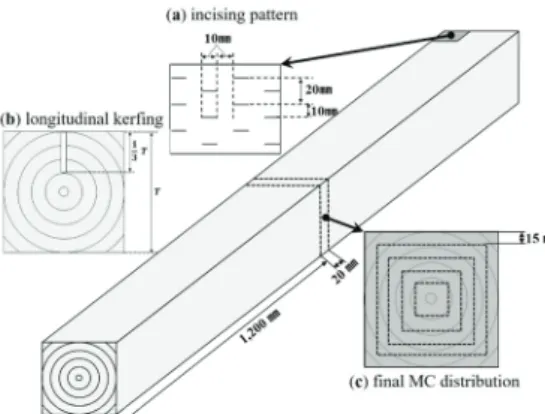
The incising pretreatment processed with a blade
thickness of 2 mm, depth of 10 mm, and incising den-
sity of approximately 2,400/m
2(Fig. 1(a)), and the
kerfing pretreatment processed to a width of 3 mm
and depth of 1/3 of the size of cross sectionusing a
circular saw (Fig. 1(b)).
Fig. 1. Processing diagram of the specimens ((a) in- cising, (b) longitudinal kerfing, (c) final MC distri- bution).
Stage Time
(Hours)
Dry-bulb (℃)
Wet-bulb (℃)
1 12 95 95
2 36 120 90
3 96 90 70
Cooling 24 25 -
Total time 168 Table 1. Drying schedule
2.3. Drying test
The drying test was performed between April and May by a 40 m
3commercial hot air drying machine.
The drying schedule was set as shown in Table 1, based on the results of studies by Lee et al. (2013), Lee et al. (2014), Lee et al. (2016b; 2016c), and Lee et al. (2017), as well as considering the sizes of the test speciesused in this study.
2.4. Moisture Content (MC) examination
The weights of all test materials were examined prior to the drying process. The heaviest one in each pretreatment condition was selected as a representa- tive test material and used for the moisture content examination after the drying process. The final MC was analyzed by collecting test pieces of 20 mm
thickness at the spot of 1,200 mm from the cross sec- tion and using an oven-drying method. The final moisture content distribution was investigated by di- viding the collected test pieces by 15 mm intervals from the surface (Fig. 1(c)). The initial MC was cal- culated from the changes in weight and the final moisture content of the test materials before and after the drying process.
2.5. Surface check examination
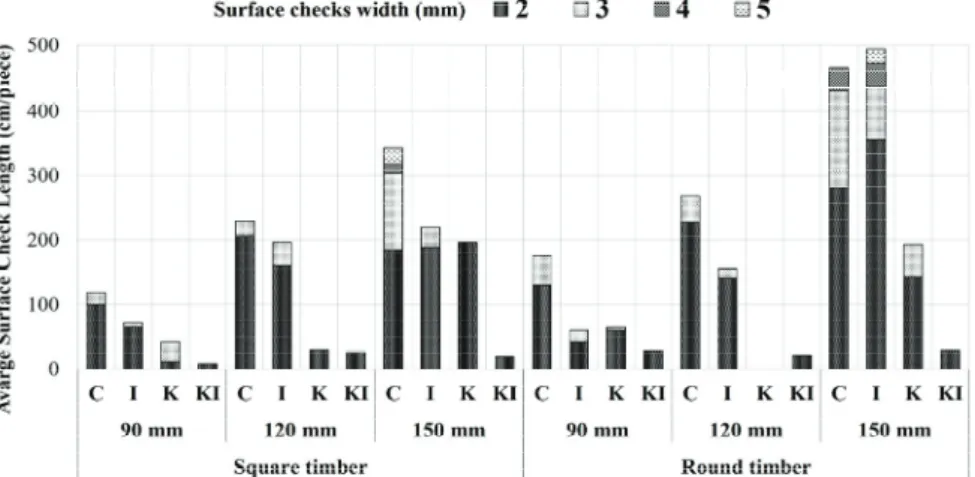
For the surface check, the width and length of the check that has the width of at least 2 mm were exam- ined in all test materials after the drying process. Since the maximum width of the investigated surface check was 5 mm, the average surface check length based on the pretreatment conditions was calculated by the fol- lowing equation:
(1)
where, lw length of each surface check with width 2-5 mm, N number of species.
2.6. Twist examination
The twist was tested only in the square timbers, and it was measured four times each in both cross sections per test material and eight times in total after the dry- ing process.
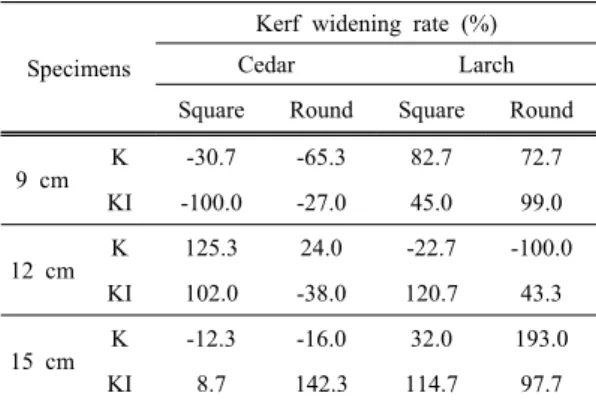
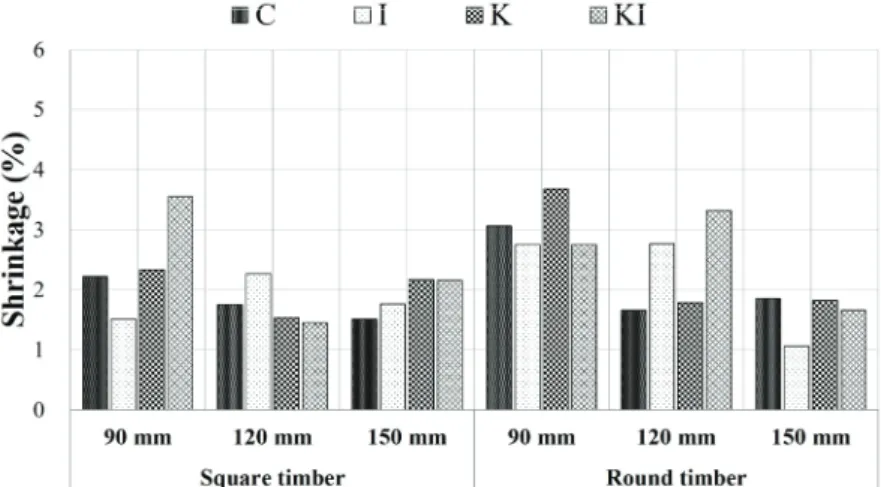
2.7. Shrinkage and kerf widening rate examination
The shrinkage and kerf widening rate were exam-
ined to find the width of the kerf and to measure the
changes in thickness and diameters at the spot of 1,200
mm from the cross section before and after the drying
process using a Vernier caliper.
(2) W
s: width of a circular saw,
W
k: width of the kerf after drying
3. RESULTS and DISCUSSION
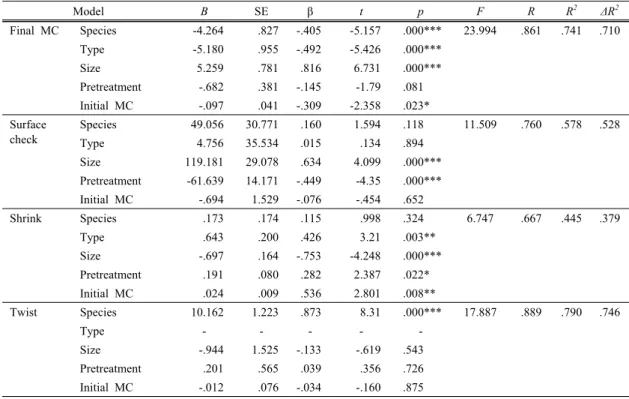
Table 2 shows the result of regression analysis be- tween various factors of woods and the drying charac- teristics of larch and cedar boxed-heart timbers. The analysis result indicated factors that have made sig- nificant differences as follows: 1) tree species, shapes, sizes of cross sections, and the initial moisture content in the final moisture content; 2) sizes of cross sections, and pretreatments in the surface check; 3) shapes, sizes of cross sections, pretreatments, and the initial
moisture content in the shrinkage; and 4) tree species in the twist.
The pretreatments had largely affected the surface check, and showed a significant difference in the shrinkage. In the surface check, the kerfing process was the major factor indicating a significant difference.
Regarding the shrinkage, it was determined that each pretreatment affected the final moisture content dis- tribution, which led to a significant difference.
3.1. Final moisture content and distribution
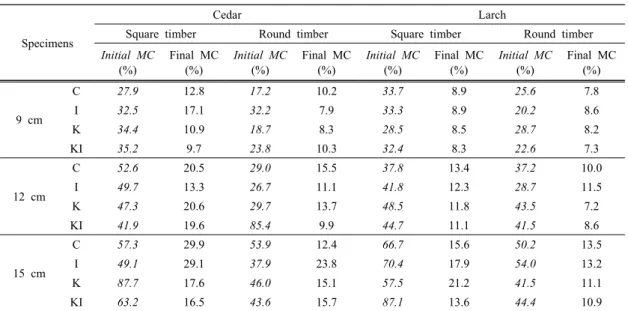
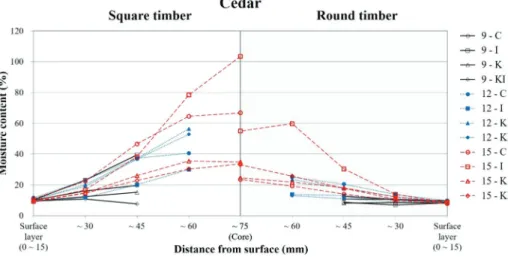
The final moisture content and distribution showed significant differences based on the tree species, sizes of cross sections, shapes, and the pretreatment con- ditions (Figs. 2~3, Table 3). The moisture content of
Model
BSE β
t p F R R2 ΔR2Final MC Species -4.264 .827 -.405 -5.157 .000*** 23.994 .861 .741 .710
Type -5.180 .955 -.492 -5.426 .000***
Size 5.259 .781 .816 6.731 .000***
Pretreatment -.682 .381 -.145 -1.79 .081
Initial MC -.097 .041 -.309 -2.358 .023*
Surface check
Species 49.056 30.771 .160 1.594 .118 11.509 .760 .578 .528
Type 4.756 35.534 .015 .134 .894
Size 119.181 29.078 .634 4.099 .000***
Pretreatment -61.639 14.171 -.449 -4.35 .000***
Initial MC -.694 1.529 -.076 -.454 .652
Shrink Species .173 .174 .115 .998 .324 6.747 .667 .445 .379
Type .643 .200 .426 3.21 .003**
Size -.697 .164 -.753 -4.248 .000***
Pretreatment .191 .080 .282 2.387 .022*
Initial MC .024 .009 .536 2.801 .008**
Twist Species 10.162 1.223 .873 8.31 .000*** 17.887 .889 .790 .746
Type - - - - -
Size -.944 1.525 -.133 -.619 .543
Pretreatment .201 .565 .039 .356 .726
Initial MC -.012 .076 -.034 -.160 .875
Table 2. Regression analysis result using SPSS
*** p < .001. ** p < .01. * p < .05.
B: regression coefficient, SE: standard error, β: standardized regression coefficient, t: t-value, p: p-value, F: F-value, R: correlation coefficient, R2
: coefficient of determination, ΔR
2: Adjusted-R
2.
Specimens
Cedar Larch
Square timber Round timber Square timber Round timber
Initial MC
(%)
Final MC (%)
Initial MC
(%)
Final MC (%)
Initial MC
(%)
Final MC (%)
Initial MC