뽕잎분말과 오디분말의 최적 혼합비율을 이용한 기능성 죽 제조
김유진1․김민주1․김현복2․임정대3․김애정1
1경기대학교 대체의학대학원
2농촌진흥청 국립농업과학원 농업생물부
3강원대학교 삼척캠퍼스 생약자원개발학과
Processing of Functional Porridge with Optimal Mixture Ratio of Mulberry Leaf Powder and Mulberry Fruit Powder
You-Jin Kim
1, Min-Ju Kim
1, Hyun-Bok Kim
2, Jung-Dae Lim
3, and Ae-Jung Kim
11
The Graduate School of Alternative Medicine, Kyonggi University
2
National Institute of Agricultural Sciences, RDA
3
Department of Herbal Medicine Resource, Kangwon National University
ABSTRACT The purpose of this study was to develop a functional porridge prepared with mulberry leaf and mulberry fruit powder, which can ameliorate hypertension. The experiment was designed according to the central composite design. For optimization of the mixture ratio of mulberry leaf powder (MLP) and mulberry fruit powder (MFP), the independent variables were defined as MLP (X1) and MFP (X2) and the dependent variables were defined as K (Y1), Na (Y2), γ-aminobutyric acid (GABA) (Y3), cyanidin-3-glycoside (C3G) (Y4), rutin (Y5), and flavonoid (Y6).
The optimal MLP to MFP mixture ratio according to the response surface method were 5.41 g of MLP and 2.65 g of MFP. The amounts of K, Na, GABA, C3G, rutin, and flavonoid in the optimal MLP and MFP mixture were 1,844.22 mg/100 g, 52.74 mg/100 g, 139.98 mg/100 g, 1,134.89 mg/100 g, 101.56 mg/100 g, and 201.28 mg/100 g, respectively. The amounts of Ca, K, Mg, and Na in the functional porridge at this optimal point were 27.66 mg/100 g, 131.32 mg/100 g, 19.57 mg/100 g, and 3.59 mg/100 g, respectively. Overall, this functional porridge can help reduce hypertension.
Key words: mulberry leaf powder, mulberry fruit powder, functional porridge, RSM
Received 26 May 2017; Accepted 4 September 2017
Corresponding author: Ae-Jung Kim, The Graduate School of Alternative Medicine, Kyonggi University, Seoul 03752, Korea.
E-mail: [email protected], Phone: +82-2-390-5044
서 론
생활수준의 향상, 식생활의 서구화 및 운동 부족은 현대 인의 질병 구조를 변화시켜 비만, 당뇨병, 동맥경화증, 고혈 압 등과 같은 만성질환을 증가시켜 왔다. 이들 만성질환은 경제, 사회적 부담을 가중할 뿐만 아니라 개인의 삶의 질을 떨어뜨리고 있다(1). 특히 60세 이상 노인의 51.4%가 고혈 압으로 진단받아 노인 2명 중 1명은 고혈압 환자라 할 만큼 고혈압은 유병률이 가장 높은 질환이다(2).
이처럼 우리나라는 식생활의 불균형 때문에 고혈압이 증 가하고 있고, 고혈압 환자들은 고혈압 개선을 위한 약재 복 용으로 여러 가지 부작용을 경험하고 있다. 이에 고혈압 개 선을 위해서는 무엇보다 균형 있는 식생활이 도움이 될 수 있는데(3), 미국에서는 오래전부터 칼륨(K), 칼슘(Ca) 및 마 그네슘(Mg) 함량이 높은 채소 위주의 dash diet가 고혈압
환자들에게 처방되었다(4). 그리고 국내에서는 칼륨을 다량 함유한 식품인 수리취, 연근, 함초(5-7) 등을 활용한 고혈압 개선 식품개발 연구가 보고되고 있다. 최근에는 뽕나무 부산 물인 뽕잎이나 오디와 같은 유기농 천연 소재를 이용한 고혈 압 개선을 위한 식품개발 연구가 활발히 진행 중이다(8-10).
뽕잎은 뽕나무(
Morus alba
)의 부산물로 열매인 오디와 함께 식・의약 소재로 주목받고 있다(11). 뽕잎에는 단백질, 비타민류, 미네랄, 식이섬유 등이 다양하게 함유되어 있다 (12). 또한, 뽕잎에 다량 함유된 대표적인 생리활성 물질로 flavonoid 성분인 rutin, astragalin, kaempferol, querce- tin 및 γ-aminobutyric acid(GABA) 등이 있다(13-15).Flavonoid 성분은 직접 활성산소종과 반응하여 이들을 제 거하는 free radical scavenger로서 항산화 작용(16), 총콜 레스테롤(TC)과 저밀도지질단백질(LDL)을 낮추고 고밀도 지질단백질(HDL)을 상승시키는 효과(9,17), 동맥경화증, 고지혈증(18), 당뇨(19), 비만(20), 고혈압(21) 등을 개선하 는 데 효과적인 것으로 보고되고 있다.
뽕나무 열매인 오디에는 천연색소인 안토시아닌(cyanidin- 3-glycoside; C3G)이 풍부하게 함유되어 있는데 오디에 함
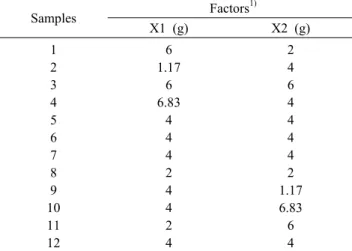
Table 1. The experimental design for different mixture ratio of
mulberry leaf powder and mulberry fruit powder by response surface design (RSM)Samples Factors1)
X1 (g) X2 (g)
1 2 3 4 5 6 7 8 9 10 11 12
6 1.17
6 6.83
4 4 4 2 4 4 2 4
2 4 6 4 4 4 4 2 1.17 6.83 6 4
1)X1: mulberry leaf powder, X2: mulberry fruit powder.
유된 안토시아닌은 항산화 작용, 항염증 효과(15,22,23)와 같은 생리활성이 우수하며, 천연색소 및 기능성 소재로서 주목받고 있다. 이처럼 뽕잎이나 오디 단일 소재를 이용한 고혈압 개선 연구는 진행됐으나 뽕잎과 오디를 혼합하여 고 혈압을 개선해보고자 하는 연구는 거의 없는 실정이다.
우리나라에서는 전통적으로 죽을 보양식의 형태로 섭취 해 왔고(24), 다양한 죽의 재료와 여러 조리방법에 대한 연 구들이 수행되어 왔다(25). 특히 녹두죽은 조선시대 승정원 일기에 170여 차례 활용 사례가 나오는데 소화기 문제가 있을 때, 위중한 질환을 앓았을 때, 스트레스가 심할 때 및 상처 회복 보조 수단으로 녹두죽이 활용되어 왔다(26). 죽의 특징은 간편하고, 소화도 잘되며 다양한 식재료를 첨가할 수 있어 영양적으로도 우수하다(27). 최근 이러한 죽의 편리 성 때문에 국내 죽 시장은 그 규모가 커지고 있고, 가공된 형태로 여러 곳에서 유통되고 있다(28). 이처럼 죽 시장이 활기를 띠고 있으나 식사 대용식으로의 기능(29)으로 한정 되어 있다.
본 연구는 반응표면분석법을 이용하여 뽕잎과 오디 혼합 비율의 최적화를 모니터링 하여 녹두죽에 첨가한 고혈압 개 선에 도움을 줄 수 있는 기능성 죽을 개발하고자 하였다.
재료 및 방법
실험재료
본 실험에 사용된 뽕잎분말과 오디분말은 국립농업과학 원(Jeonju, Korea)에서 재배한 뽕잎과 오디를 2016년 6월 에 채취하여 동결건조(FD5808, Ilsin Biobase, Gyeonggi, Korea) 후 분쇄하여 30 mesh 체에 내려 분말로 만들어 사 용하였다. 뽕잎분말과 오디분말의 최적 혼합비율을 이용한 죽 제조 시 사용된 쌀, 녹두는 서대문구의 농협(Seoul, Ko- rea)에서 구입하였으며, 글루코만난가루는 조은약초(Seoul, Korea)에서 구입하여 사용하였다.
실험디자인
본 연구에서는 최적 혼합비율의 뽕잎분말과 오디분말을 첨가한 기능성 죽을 제조하고자 반응표면 실험계획법(Res- ponse Surface Method; RSM)의 중심합성계획법(Central Composite Design; CCD)에 따라 실험을 설계하였다.
독립변수로는 뽕잎분말(X1)과 오디분말(X2)의 함량을 2 개의 요인으로 설정하였고, 독립변수 함량의 각 범위는 예비 실험을 바탕으로 각 요인의 최소 및 최대 범위를 뽕잎분말 (2~6 g), 오디분말(2~6 g)로 결정하였다. 설정된 범위를 입 력하여 factorial point(4개), axial point(4개) 및 central point(4개)와 같이 총 12개의 실험점을 설정하였다.
RSM을 이용하여 설계된 실험디자인의 재료 혼합비율은 Table 1과 같으며, 종속변수로는 칼륨(Y1), 나트륨(Y2), GABA(Y3), C3G(Y4), rutin(Y5), flavonoid(Y6)를 선정하 여 분석에 사용하였다.
무기질 분석
RSM에 의해 설계된 12개의 뽕잎과 오디 혼합분말들의 칼륨과 나트륨 함량 분석은 AOAC 방법(30)에 따라 습식분 해법으로 측정하였다. 습식분해 후 ICP(Inductively Cou- pled Plasma; Lactam 8440 Plasmalac, Horiba Scientific, Longjumeau Cedex, France)를 이용하여 측정하였다.
GABA 분석
RSM에 의해 설계된 12개의 뽕잎과 오디 혼합분말들의 GABA 분석을 위한 추출물 제조, 유도체화 및 HPLC 분석은 Tomita 등(31)의 방법을 변형하여 실시하였다. 즉 시료분말 약 1 g을 50 mL centrifuge tube에 담고 증류수 40 mL를 가하고 homogenizer(Polytron RT 2500E, Kinematica AG, Luzern, Switzerland)로 2분간 균질화시켰다. 균질화 한 시료는 4°C에서 10분간 원심분리(3,000 rpm) 한 후 상 등액을 분리하고 침전물에 다시 증류수 40 mL를 가하여 2분간 추가 추출을 하였다. 추출물을 원심분리 하여 얻은 상등액을 모아 증류수를 이용하여 50 mL로 정용하였다. 추 출물은 0.2 μm nylon syringe filter(Whatman, Clifton, NJ, USA)로 여과하고, Nexera X2 system(Shimadzu, Kyoto, Japan)으로 분석하였다. Column으로 MightysilTM RP-18 GP column(4.6×250 mm, 5 μm, Kanto Chemical, Tokyo, Japan)을 사용하였으며, 이동상 A는 HPLC water 2 L에 AccQ-Tag Eluent A concentrate 200 mL를 희석하였고 이동상 B는 AccQ-Tag Eluent B를 이용하였다. 용매조성 은 기울기 용리로 초기 A : B를 90:10으로 유지했으며, 15 분까지 80:20, 30분까지 50:50, 50분까지 0:100 및 60분까 지 90:10으로 분석하였다. 유속은 1.0 mL/min, 시료 주입량 은 10 μL, 검출기는 fluorescence detector를 사용하여 Ex.
250 nm, Em. 395 nm로 분석하였다.
Washing of 60 g mung bean and 25 g rice for 3 min
↓
Draining of washed 60 g mung bean and 25 g rice for 10 min
↓
Putting drained 60 g mung bean and 25 g rice in food making machine
↓
Adding of 800 g water in food making machine
↓
Boiling for 25 min
↓
Adding of 5 g glucomannan in food making machine
↓ Mixing
↓
1st product of mung bean rice porridge
Adding of mixture level of mulberry leaf powder and mulberry fruit power (Table 2)+
↓
Blending and boiling for 3 min
↓
2nd product of functional porridge
Fig. 1. The procedure of functional porridge prepared with optimal mixture ratio of mulberry leaf powder and mulberry fruit powder.
Table 2. Formulas for basic mung bean porridge
Ingredients Amounts (g) Mung beanRice Water Glucomannan
60 25 800
5
Cyanidin-3-glucoside 분석
RSM에 의해 설계된 12개의 뽕잎과 오디 혼합분말들의 C3G 분석을 위한 추출물 제조 및 HPLC 분석은 Ji 등(32)의 방법을 변형하여 실시하였다. 즉 시료분말을 50 mL cen- trifuge tube에 담고 20배의 추출용매(0.3% HCl을 함유한 80% 메탄올)를 가하여 30분간 초음파 추출하였다. 추출물 을 0°C에서 15분간 원심분리(3,000 rpm) 한 후 상등액을 분리하고 침전물에 다시 추출용매 20 mL를 가한 후 추출 및 원심분리 하여 얻은 상등액을 모아 추출용매를 이용하여 50 mL로 정용하였다. 추출물은 0.2 μm nylon syringe fil- ter(Whatman)로 여과하여 Nexera X2 system(Shimadzu) 으로 분석하였다. Column은 Luna OmegaTM Polar C18 column(2.1×150 mm, 1.6 μm, Phenomenex, Torrance, CA, USA)을 사용하였고, column oven의 온도는 30°C, 유 속은 0.3 mL/min, 시료 주입량은 2 μL, 검출기는 diode- array detector를 사용하여 520 nm로 분석하였다.
Rutin과 total flavonoid 분석
RSM에 의해 설계된 12개의 뽕잎과 오디 혼합분말들의 rutin과 flavonoid 분석을 위한 추출물 제조 및 HPLC 분석 은 Kim 등(33)의 방법을 변형하여 실시하였다. 즉 시료분말 을 50 mL centrifuge tube에 담고 20배의 추출용매(80%
메탄올)를 가하여 30분간 초음파 추출하였다. 추출물을 4°C 에서 10분간 원심분리(3,000 rpm) 한 후 상등액을 분리하고 침전물에 다시 추출용매 20 mL를 가한 다음 추출 및 원심분 리 하여 얻은 상등액을 모아 추출용매를 이용하여 50 mL로 정용하였다. 추출물은 농축기를 이용하여 용매를 완전히 제 거한 후 추출용매 1 mL와 증류수 9 mL를 넣어 재용해하였
다. 추출물을 정제하기 위하여 hexane 10 mL를 가하여 지 방 및 색소 성분을 제거한 후 물층에 에틸아세테이트 10 mL 를 가하여 2회 분획하였다. 에틸아세테이트 분획물은 농축 하여 용매를 완전히 제거한 후 메탄올로 재용해시켰다. 추출 물은 0.2 μm nylon syringe filter(Whatman)로 여과하여 Nexera X2 system(Shimadzu)으로 분석하였다. Column 으로 KinetexTM C18 column(2.1×150 mm, 1.7 μm, Phe- nomenex)을 사용하였고, column oven의 온도는 40°C, 유 속은 0.3 mL/min, 시료 주입량은 2 μL, 검출기는 diode- array detector를 사용하여 345 nm로 분석하였다.
최적 혼합비율의 뽕잎분말과 오디분말을 첨가한 기능성 죽 제조
기본 녹두죽은 Table 2의 레시피로 Fig. 1과 같은 방법으 로 제조하였다. 녹두와 멥쌀을 계량 후 각각 씻어서 10분 정도 물기를 빼준 다음 죽 제조기(HFM-1000, HAAN Corp., Seoul, Korea)에 녹두, 멥쌀, 물을 넣어 뚜껑을 덮고 고운죽 모드로 맞추어 기본 녹두죽(34)을 제조하였다. 제조된 기본 녹두죽에 글루코만난 분말을 넣어 잘 혼합하였고, 완성된 기본 녹두죽에 최적 혼합비율의 뽕잎분말과 오디분말을 첨 가하여 고혈압 개선에 도움을 줄 수 있는 기능성 죽을 제조
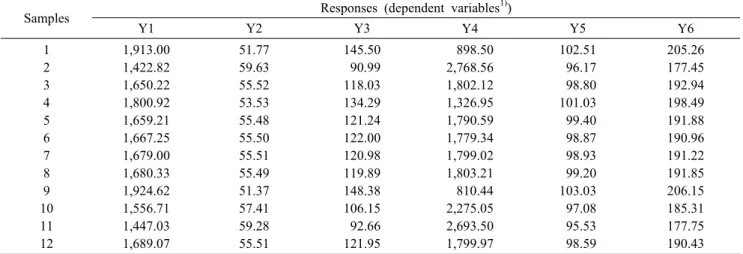
Table 3. Chemical properties of different mixture ratio of mulberry leaf powder and mulberry fruit powder by response surface
design (mg/100 g)Samples Responses (dependent variables1))
Y1 Y2 Y3 Y4 Y5 Y6
1 2 3 4 5 6 7 8 9 10 11 12
1,913.00 1,422.82 1,650.22 1,800.92 1,659.21 1,667.25 1,679.00 1,680.33 1,924.62 1,556.71 1,447.03 1,689.07
51.77 59.63 55.52 53.53 55.48 55.50 55.51 55.49 51.37 57.41 59.28 55.51
145.50 90.99 118.03 134.29 121.24 122.00 120.98 119.89 148.38 106.15 92.66 121.95
898.50 2,768.56 1,802.12 1,326.95 1,790.59 1,779.34 1,799.02 1,803.21 810.44 2,275.05 2,693.50 1,799.97
102.51 96.17 98.80 101.03 99.40 98.87 98.93 99.20 103.03 97.08 95.53 98.59
205.26 177.45 192.94 198.49 191.88 190.96 191.22 191.85 206.15 185.31 177.75 190.43
1)Y1: K, Y2: Na, Y3: GABA, Y4: C3G, Y5: rutin, Y6: flavonoid.
Table 4. Analysis of predicted model equation for chemical properties of different mixture ratio of mulberry leaf powder and mulberry
fruit powderResponses Model Mean±SD
(mg/100 g) R2 1) F-value
P-value
Polynomial equation2) Y13)Y2 Y3 Y4 Y5 Y6
quadratic quadratic quadratic quadratic quadratic quadratic
1,674.18±17.10 55.50±0.20
120.17±1.64 1,795.60±49.56 99.09±0.31
191.64±0.68
0.9923 0.9958 0.9946 0.9957 0.9878 0.9963
225.38 419.39 321.10 120.27 141.97 474.82
<0.0001
<0.0001
<0.0001
<0.0001
<0.0001
<0.0001
1673.63+121.29A−127.01B−31.75A2+32.58B2 55.50−2.01A+2.01B+0.55A2−0.55B2
121.54+14.02A−14.30B−4.68A2+2.63B2 1792.23−479.23A+483.02B+128.64A2−123.58B2 98.95+1.68A−1.97B−0.25A2+0.47B2
191.12+7.29A−6.98B−1.55A2+2.33B2
1)0≤R2≤1, close to 1indicates regression line fix the model.
2)A: mulberry leaf powder, B: mulberry fruit powder.
3)Y1: K, Y2: Na, Y3: GABA, Y4: C3G, Y5: rutin, Y6: flavonoid.
하였다.
일반성분 및 무기질 함량 분석
최적 혼합비율의 뽕잎분말과 오디분말을 첨가한 기능성 죽의 일반성분은 AOAC 방법(30)에 따라 정량하였다. 즉 수분은 105°C 상압가열건조법, 조단백질은 semi-micro Kjeldahl법, 조지방은 majonnier법, 조회분은 550°C 직접 회화법으로 측정하였다. 탄수화물 함량은 시료의 무게를 100%로 하여 수분, 조단백질, 조지방, 조회분 함량 %를 감 한 것으로 산출하였다. 무기질 함량 분석은 AOAC 방법(30) 에 따라 습식분해법으로 측정하였다. 습식분해 후 ICP(In- ductively Coupled Plasma; Lactam 8440 Plasmalac, Horiba Scientific)를 이용하여 측정하였다.
통계처리
본 연구의 모든 자료는 3회 반복 측정한 값을 이용하였으 며, 실험 자료의 분석 및 최적화는 Design Expert10(Stat Easy Co., Minneapolis, MN, USA) Program의 ANOVA test 및 회귀분석을 이용하였고, 모델의 적합성은
F
-test로 유의성 검증을 하였다.결과 및 고찰
뽕잎분말과 오디 혼합분말의 칼륨과 나트륨 함량
RSM에 의해 설계된 12개의 뽕잎과 오디 혼합분말의 칼 륨과 나트륨 함량 분석 결과는 Table 3에 제시된 바와 같고, 설정된 반응별로 modeling 한 후 유의성 검증을 한 결과와 반응표면 회귀 분석을 통해 얻은 결과는 Table 4에 제시된 바와 같다.우리나라의 경우 나트륨의 과잉 섭취가 고혈압 발병의 주 된 원인이 되고 있다. 나트륨을 과다 섭취할 경우 나트륨 이온이 체내에 과잉 축적되게 되어 세포외액량의 증가를 가 져오며, 세동맥 벽의 저항과 흥분성을 높이게 되어 혈압을 상승시키기 때문이다(35). 반면 칼륨은 Na/K 펌프의 활성 화를 돕고 혈관 확장을 유도하여 신장을 통해 나트륨의 배출 을 돕기 때문에 고혈압 개선 인자로 잘 알려져 있다(36).
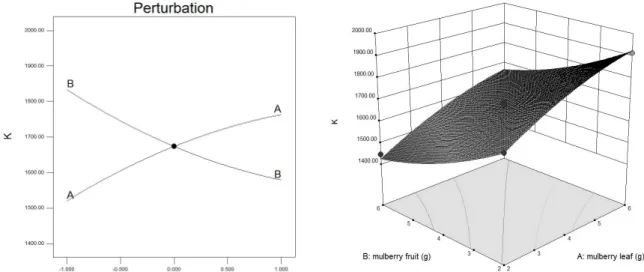
RSM에 의해 설계된 12개의 뽕잎과 오디 혼합분말의 칼 륨 함량은 1,422.82~1,924.62 mg/100 g의 범위로 나타났 고(Table 3) 독립변수 간에 상호작용하는 quadratic model 이 채택되었으며,
P
-value가 0.0001 미만으로 유의적인 차 이를 보였다. 뽕잎과 오디 혼합분말의 칼륨 함량의 경우 뽕
Fig. 2. Perturbation plot and response surface plot for the effect of mulberry leaf powder (A) and mulberry fruit powder (B) on
K of different mixture ratio of mulberry leaf powder and mulberry fruit powder.
Fig. 3. Perturbation plot and response surface plot for the effect of mulberry leaf powder (A) and mulberry fruit powder (B) on
Na of different mixture ratio of mulberry leaf powder and mulberry fruit powder.잎분말 혼합비율이 증가할수록, 오디분말의 혼합비율이 감 소할수록 높게 나타났다(Fig. 2). 이러한 결과는 뽕잎분말 (2,245 mg/100 g)에는 오디분말(1,171 mg/100 g)에 비해 칼륨이 많이 포함되어 있기 때문이다(Table 7).
RSM에 의해 설계된 12개의 뽕잎과 오디 혼합분말의 나 트륨 함량은 51.37~59.63 mg/100 g 범위로 나타났고 (Table 3) 독립변수 간에 상호작용하는 quadratic model이 채택되었으며,
P
-value가 0.0001 미만으로 유의적인 차이 를 보였다(Table 4). 뽕잎과 오디 혼합분말의 나트륨 함량의 경우 칼륨 함량과는 반대로 뽕잎분말 혼합비율이 감소할수 록, 오디분말의 혼합비율이 증가할수록 높게 나타났다(Fig.3). 이러한 결과는 뽕잎분말(47.98 mg/100 g)에는 오디분 말(63.01 mg/100 g)에 비해 나트륨이 많이 포함되어 있기 때문이다(Table 7).
뽕잎분말과 오디 혼합분말의 고혈압 저감화 관련 물질(GABA, C3G, rutin 및 flavonoid) 함량
RSM에 의해 설계된 12개의 뽕잎과 오디 혼합분말들의 GABA, C3G, rutin 및 total flavonoid 분석 결과는 Table 3에 제시된 바와 같고, 설정된 반응별로 modeling 한 후 유의성 검증을 한 결과와 반응표면 회귀 분석을 통해 얻은 결과는 Table 4에 제시된 바와 같다.
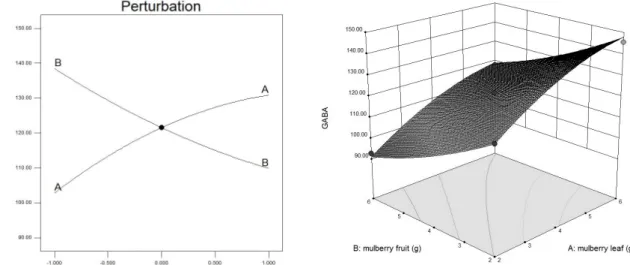
GABA는 혈압을 증가시키는 뉴런의 활성을 억제하여 혈 압을 감소시키는 인자로 잘 알려져 있다(37). RSM에 의해 설계된 12개의 뽕잎과 오디 혼합분말들의 GABA 함량은 90.99~148.38 mg/100 g 범위로 나타났고(Table 3) 독립 변수 간에 상호작용하는 quadratic model이 채택되었으며,
P
-value가 0.0001 미만으로 유의적인 차이를 보였다(Table 4). 뽕잎분말의 혼합비율이 증가할수록, 오디분말의 혼합비 율이 감소할수록 GABA의 함량이 높아지는 경향을 보였다
Fig. 4. Perturbation plot and response surface plot for the effect of mulberry leaf powder (A) and mulberry fruit powder (B) on
GABA of different mixture ratio of mulberry leaf powder and mulberry fruit powder.
Fig. 5. Perturbation plot and response surface plot for the effect of mulberry leaf powder (A) and mulberry fruit powder (B) on
C3G of different mixture ratio of mulberry leaf powder and mulberry fruit powder.(Fig. 4).
C3G는 오디가 함유한 안토시아닌 색소 중 하나로 항산화 력이 뛰어나며, 노화 억제 효과가 토코페롤보다 7배나 높아 혈행 개선에 도움이 된다고 알려져 있다(38,39).
RSM에 의해 설계된 12개의 뽕잎과 오디 혼합분말들의 C3G 함량은 810.44~2,768.56 mg/100 g 범위로 나타났고 (Table 3) 독립변수 간에 상호작용하는 quadratic model이 채택되었으며,
P
-value가 0.0001 미만으로 유의적인 차이 를 보였다(Table 4). 뽕잎분말의 혼합비율이 감소할수록, 오디분말의 혼합비율이 증가할수록 C3G의 함량이 높게 나 타났다(Fig. 5).뽕잎은 모세혈관 강화・수축작용을 나타내고 순환계질환 치료제로 사용되는 rutin을 다량 함유하고 있어 혈중 콜레스 테롤 저하, 항당뇨, 항고혈압, 동맥경화예방, 중풍예방 등의 다양한 기능을 한다(21,40).
RSM에 의해 설계된 12개의 뽕잎과 오디 혼합분말들의
rutin 함량은 95.53~103.03 mg/100 g 범위로 나타났고 (Table 3) 독립변수 간에 상호작용하는 quadratic model이 채택되었으며,
P
-value가 0.0001 미만으로 유의적인 차이 를 보였다(Table 4). 뽕잎분말의 혼합비율이 증가할수록, 오디분말의 혼합비율이 감소할수록 rutin의 함량이 높아지 는 경향을 보였다(Fig. 6).뽕잎과 오디에 포함된 isoquercitrin, quercitrin, quer- cetin과 같은 flavonoid는 항고혈압, 항산화 및 항노화 기능 을 가진 생리활성 물질이다(41,42).
RSM에 의해 설계된 12개의 뽕잎과 오디 혼합분말들의 flavonoid 함량은 177.45~206.15 mg/100 g 범위로 나타 났고(Table 3) 독립변수 간에 상호작용하는 quadratic mod- el이 채택되었으며,
P
-value가 0.0001 미만으로 유의적인 차이를 보였다(Table 4). 뽕잎분말의 혼합비율이 증가할수 록, 오디분말의 혼합비율이 감소할수록 flavonoid의 함량이 높아지는 경향을 보였다(Fig. 7).
Fig. 6. Perturbation plot and response surface plot for the effect of mulberry leaf powder (A) and mulberry fruit powder (B) on
Rutin of different mixture ratio of mulberry leaf powder and mulberry fruit powder.
Fig. 7. Perturbation plot and response surface plot for the effect of mulberry leaf powder (A) and mulberry fruit powder (B) on
flavonoid of different mixture ratio of mulberry leaf powder and mulberry fruit powder.Table 5. Optimum constraint values using two numerical methods in the object goal
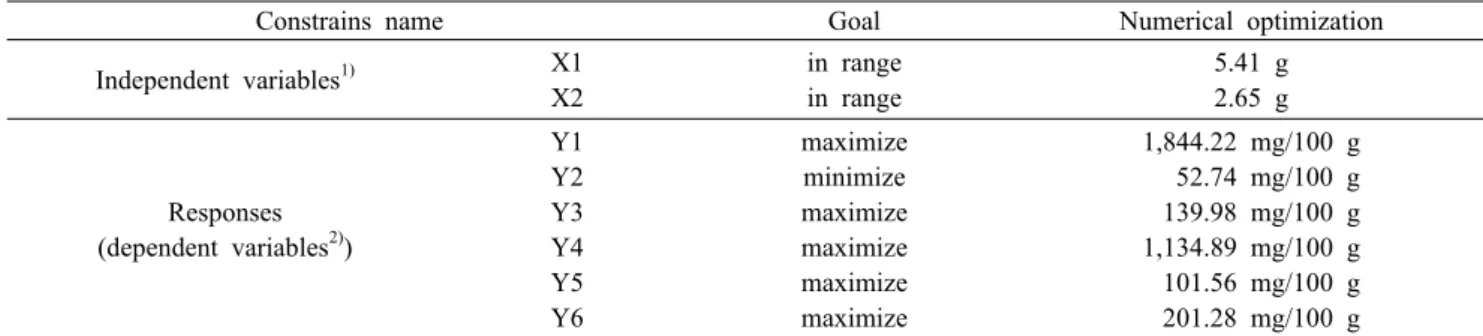
Constrains name Goal Numerical optimization
Independent variables1) X1 X2
in range in range
5.41 g 2.65 g
Responses (dependent variables2))
Y1 Y2 Y3 Y4 Y5 Y6
maximize minimize maximize maximize maximize maximize
1,844.22 mg/100 g 52.74 mg/100 g 139.98 mg/100 g 1,134.89 mg/100 g 101.56 mg/100 g 201.28 mg/100 g
1)X1: mulberry leaf powder, X2: mulberry fruit powder. 2)Y1: K, Y2: Na, Y3: GABA, Y4: C3G, Y5: rutin, Y6: flavonoid.
뽕잎과 오디 혼합분말 비율의 최적화
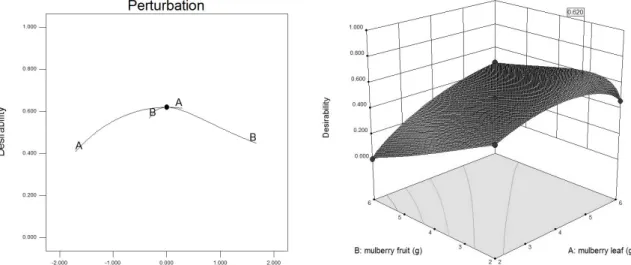
뽕잎과 오디분말 혼합비율 최적화는 Design Expert 10 프로그램을 이용하여 Table 5와 같이 설정한 후 canonical 모형의 수치 최적화를 통해서 하였다. 독립변수인 뽕잎과 오디분말은 실험 범위 내(뽕잎 2~6 g, 오디 2~6 g)로 설정
하였다. 종속변수인 칼륨, GABA, C3G, rutin 및 flavonoid 의 goal area를 최대(maximum)로, 나트륨은 최소(minim- um)로 설정하였고, 수치 최적화를 통해 제시된 최적점 중 가장 높은 desirability를 나타내는 최적점을 선택하였다 (Fig. 8).
Fig. 8. Perturbation plot and response surface plot for the effect of mulberry leaf powder (A) and mulberry fruit powder (B) on
K, Na, GABA, C3G, rutin, and flavonoid.Table 6. Proximate composition of control sample and mung bean porridge prepared with optimized mixture ratio of mulberry
leaf powder and mulberry fruit powder (g)Variables Moisture Carbohydrate Crude protein Crude fat Crude ash Control1)
Optimal2)
89.41±0.10***3) 88.54±0.10
8.19±0.10***
8.77±0.05
2.09±0.05* 2.24±0.05
ND**4) 0.04±0.01
0.31±0.05* 0.41±0.00
1)Control: basic mung bean porridge.
2)Optimal: functional porridge prepared with optimized mixture ratio of mulberry leaf powder and mulberry fruit powder.
3)Mean±SD (n=3).
4)ND: not detected.
*
P<0.05,
**P<0.01,
***P<0.001 expressed significant differences between control and optimal by Student’s t-test.
Overlay Plot
A: mulberry leaf (g)
Fig. 9. Overlay plot of optimized of mulberry leaf powder (A)
and mulberry fruit powder (B).종속변수들의 반응에 따른 최적화는 독립변수(X1)인 뽕 잎분말이 5.41 g과 독립변수(X2)인 오디분말이 2.65 g으로 혼합된 경우로 나타났다. 이때 종속변수들의 함량은 칼륨은 1,844.22 mg/100 g, 나트륨은 52.74 mg/100 g, GABA는
139.98 mg/100 g, C3G는 1,134.89 mg/100 g, rutin은 101.56 mg/100 g 및 flavonoid는 201.28 mg/100 g으로 예측되었다(Fig. 9).
최적 혼합비율의 뽕잎분말과 오디분말을 첨가한 기능성 죽 제조
뽕잎분말과 오디분말의 최적 혼합비율은 뽕잎분말 5.41 g과 오디분말 2.65 g이 혼합되었을 때이며, 이 비율을 기본 녹두죽에 첨가한 후 일반성분과 무기질 함량을 분석하여 Table 6과 7에 각각 제시하였다.
기본 녹두죽(control)의 일반성분의 경우, 수분 함량은 89.41 g, 탄수화물 함량은 8.19 g, 단백질 함량은 2.09 g, 조회분 함량은 0.31 g으로 분석되었다. 최적 혼합비율의 뽕 잎분말과 오디분말이 첨가된 기능성 죽의 수분 함량은 88.54 g, 탄수화물 함량은 8.77 g, 단백질 함량은 2.24 g, 지방 함량은 0.04 g, 조회분 함량은 0.41 g으로 측정되어 기본 녹두죽에 비해 수분 함량을 제외하고는 모든 일반성분 함량 이 증가하였다.
기본 녹두죽(control)의 무기질 함량의 경우, 칼슘 함량은 10.21 mg/100 g, 칼륨 함량은 114.50 mg/100 g, 마그네슘 함량은 16.32 mg/100 g, 나트륨 함량은 3.11 mg/100 g으 로 측정되었다. 최적 혼합비율의 뽕잎분말과 오디분말이 첨 가된 기능성 죽의 칼슘 함량은 27.66 mg/100 g, 칼륨 함량
Table 7. Mineral contents of control sample, mung bean porridge prepared with optimized mixture ratio of mulberry leaf powder
and mulberry fruit powder, mulberry leaf powder and mulberry fruit powder (mg/100 g)Variables Ca K Mg Na
Control1) Optimal2) MLP3) MFP4)
10.21±0.02***5) 27.66±0.27 2,496.32±72.53 210.65±2.37
114.50±1.21***
131.32±0.66 2,245.47±42.30 1,171.05±33.17
16.32±0.24***
19.57±0.18 476.11±13.82 90.65±1.61
3.11±0.04***
3.59±0.03 47.98±1.44 63.01±3.45
1)Control: basic mung bean porridge.
2)Optimal: functional porridge prepared with optimized mixture ratio of mulberry leaf powder and mulberry fruit powder.
3)MLP: dried mulberry leaf powder.
4)MFP: dried mulberry fruit powder.
5)Mean±SD (n=3).
***
P<0.001 expressed a significant difference between control and optimal by Student’s t-test.
은 131.32 mg/100 g, 마그네슘 함량은 19.57 mg/100 g, 나트륨 함량은 3.59 mg/100 g으로 나타나 기본 녹두죽보다 모든 무기질 함량이 증가하였다. 이러한 결과는 뽕잎과 오디 분말에 각각 칼륨 2,245 mg/100 g과 1,171 mg/100 g, 칼 슘 2,496 mg/100 g과 210 mg/100 g, 마그네슘 476 mg/
100 g과 90 mg/100 g 등 고혈압 조절 관련 무기질이 풍부 하게 포함되어 있기 때문이다(43,44).
요 약
본 연구의 목적은 반응표면분석법을 통해 최적화한 뽕잎과 오디 혼합비율을 기본 녹두죽에 첨가하여 고혈압 개선에 도 움을 줄 수 있는 기능성 죽을 개발하는 것이다. 뽕잎분말과 오디분말을 독립변수로 하였고, 칼륨, 나트륨, GABA, C3G, rutin 및 flavonoid를 종속변수로 하여 뽕잎분말과 오디분말 의 최적 혼합비율을 모니터링 하고자 하였다. 반응표면분석 법을 이용하여 산출된 뽕잎분말과 오디분말의 최적 혼합비 율 함량은 뽕잎분말 함량 5.41 g, 오디분말 함량 2.65 g이었 다. 이때 종속변수들의 최적 함량은 칼륨 함량이 1,844.22 mg/100 g, 나트륨 함량이 52.74 mg/100 g, GABA 함량은 139.98 mg/100 g, C3G 함량은 1,134.89 mg/100 g, rutin 함량은 101.56 mg/100 g 및 flavonoid 함량은 201.28 mg/100 g으로 나타났다. 최적 혼합비율의 뽕잎분말(5.41 g)과 오디분말(2.65 g)을 첨가한 기능성 죽을 제조하여 일반 성분과 무기질 함량 분석을 한 결과 수분 함량은 88.54 g, 탄수화물 함량은 8.77 g, 단백질 함량은 2.24 g, 지방 함량 은 0.04 g, 조회분 함량은 0.41 g으로, 최적 혼합비율의 뽕 잎분말과 오디분말을 첨가한 녹두죽의 탄수화물, 단백질, 지 방, 조회분 및 무기질 함량이 뽕잎과 오디의 혼합분말이 첨 가되지 않은 기본 녹두죽보다 모두 높았다. 결론적으로 최적 혼합비율의 뽕잎분말과 오디분말이 첨가된 기능성 죽은 고 혈압 개선에 도움을 줄 수 있는 칼륨, 나트륨, GABA, C3G, rutin 및 flavonoid와 같은 기능성 성분이 우수하여 고혈압 환자의 혈압개선에 도움을 줄 수 있을 것이다.
감사의 글
본 연구는 농촌진흥청 연구사업(세부과제번호: PJ0118092 032017)의 지원에 의해 이루어진 것이며, 이에 감사드립니 다.
REFERENCES
1. Choi IS, Kim KA, Yim JE, Kim YS. 2011. Calorie re- striction and obesity under the regulation of SIRT1. Korean
J Obes 20: 170-176.
2. KNSO 2015 Population Census. Korea National Statistical Office 2015. Available from: http://kosis.kr/statisticsList/sta- tisticsList_01List.jsp?vwcd=MT_ZTITL#SubCont (accessed Apr 2017).
3. Kim HR. 2013. Nutrition transition and shifting diet linked non-communicable diseases and policy issues. Health Welf
Policy Forum 198(4): 27-37.
4. Appel LJ, Moore TJ, Obarzanek E, Vollmer WM, Svetkey LP, Sacks FM, Bray GA, Vogt TM, Cutler JA, Windhauser MM, Lin PH, Karanja N, Simons-Morton D, McCullough M, Swain J, Steele P, Evans MA, Miller ER, Harsha DW.
1997. A clinical trial of the effects of dietary patterns on blood pressure. N Engl J Med 336: 1117-1124.
5. Park MH, Choi BG, Lim SH, Kim KH, Heo NK, Yu SH, Kim JD, Lee KJ. 2011. Analysis of general components, mineral contents, and dietary fiber contents of Synurus del-
toides. J Korean Soc Food Sci Nutr 40: 1631-1634.
6. Park BH, Choi SH, Cho HS, Kim SD, Jeon ER. 2010. Quality changes in Baik-Kimchi (pickled cabbage) added lotus root juice during fermentation. Korean J Food Preserv 17: 320- 327.
7. Kim SM. 2013. Quality characteristics of low-salt kimchi with salt replaced by Salicornia herbacea L. powder. J Ko-
rean Soc Food Cult 28: 674-683.
8. Lee JA. 2012. Quality characteristics of salad dressing add- ed with mulberry fruit juice from different breeds. Korean
J Culinary Res 18: 216-227.
9. Ju MJ, Kwon JH, Kim HK. 2009. Physiological activities of mulberry leaf and fruit extracts with different extraction conditions. Korean J Food Preserv 16: 442-448.
10. Jeon SY, Kim AJ, Rho JO. 2015. A study on the phys- icochemical activities of Dangmyon (starch vermicelli) add- ed with mulberry leaves powder. Korean J Hum Ecol 24:
713-723.
11. Ye EJ, Bae MJ. 2010. Comparison of components between
mulberry leaf tea and fermented mulberry leaf tea. J Korean
Soc Food Sci Nutr 39: 421-427.
12. Kondo Y. 1957. Trace constituent of mulberry leaves. Nippon
Sanshigaku Zasshi 26: 349-351.
13. Choi JW. 2016. Studies on antioxidant, blood flow improve- ment and anti-diabetic effect of mulberry leaves (Morus al-
ba L.). PhD Dissertation. Chonbuk National University,
Jeonbuk, Korea.14. Sun L, Meng L, Chen J, Ma J, Hu R, Jia DZ. 2001. Determi- nation of rutin and quercetin in mulberry leaves by high performance capillary electrophoresis. Chin J Chromatogr 19: 395-397.
15. Choi SK, Moon HS. 2016. The role of resveratrol in lipid metabolism: a systematic review of current basic and trans- lational evidence. J Food Hyg Saf 31: 67-73.
16. Ozkur MK, Bozkurt MS, Balabanli B, Aricioglu A, Ilter N, Gurer MA, Inalöz HS. 2002. The effects of EGb 761 on lipid peroxide levels and superoxide dismutase activity in sunburn. Photodermatol Photoimmunol Photomed 18: 117- 120.
17. Shim JU, Lim KT. 2008. Glycoprotein isolated from Morus
indica Linne enhances detoxicant enzyme activities and
lowers plasma cholesterol in ICR mice. Korean J Food SciTechnol 40: 691-695.
18. Kim SY, Lee WC, Kim HB, Kim AJ, Kim SK. 1998. Anti- hyperlipidemic effects of methanol extracts from mulberry leaves in cholesterol-induced hyperlipidemia rats. J Korean
Soc Food Sci Nutr 27: 1217-1222.
19. Jang MJ, Rhee SJ. 2004. Hypoglycemic effects of pills made of mulberry leaves and silkworm powder in streptozo- tocin-induced diabetic rats. J Korean Soc Food Sci Nutr 33: 1611-1617.
20. Kim EJ, Kim GY, Kim YM, Choi KH, Jang SJ. 2009. Anti- obesity effect of mulberry leaves extraction in obese rats high-fat diet. Kor J Orient Physiol Pathol 23: 831-836.
21. Lee WC, Kim AJ, Kim SY. 2003. The study on the func- tional materials and effects of mulberry leaf. Food Science
and Industry 36(3): 2-14.
22. Kim HB, Kim JB, Kim SL. 2005. Varietal analysis and quantification of resveratrol in mulberry fruits. Korean J
Seric Entomol Sci 47: 51-55.
23. Lee SG, Nam JO. 2016. Induction of p53-dependent apopto- sis by resveratrol in human cancer cells, A549 and SKOV3.
Microbiol Biotechnol Lett 44: 194-200.
24. Eom D, Kim Y, Song J. 2017. A research on porridge that king Yeongjo had been served -based on the daily record of royal secretariat of Joseon dynasty during king Yeongjo period-. J Korean Med Class 30: 017-029.
25. Shin ES, Lee KA, Lee HK, Kim KBWR, Kim MJ, Byun MW, Lee JW, Kim JH, Ahn DH, Lyu ES. 2008. Effect of grain size and added water on quality characteristics of abalone porridge. J Korean Soc Food Sci Nutr 37: 245-250.
26. Park JY, Lee HY, Lee JC, Ahn SW. 2016. Study on use of mung bean porridge reported in daily records of royal secretariat of Joseon dynasty. J Korean Soc Food Cult 31:
541-553.
27. Park JL, Kim JM, Kim JG. 2003. A study on the optimum ratio of the ingredients in preparation of black sesame gruels. Korean J Soc Food Cook Sci 19: 685-693.
28. Kwak HS, Oh YJ, Kang HB, Kim TH. 2013. Descriptive
profile and liking/disliking factors for aseptic-packaged rice porridge. J Korean Soc Food Sci Nutr 42: 1878-1885.
29. Zhang X, Lee FZ, Kum JS, Eun JB. 2002. The effect of processing condition on physicochemical characteristics on pine nut gruel. Korean J Food Sci Technol 34: 225-231.
30. AOAC. 2005. Official method of analysis. 18th ed. Associa- tion of Official Analytical Chemists, Washington, DC, USA.
Chap 45, p 114-118.
31. Tomita R, Todoroki K, Machida K, Nishida S, Maruoka H, Yoshida H, Fujioka T, Nakashima M, Yamaguchi M, Nohta H. 2014. Assessment of the efficacy of anticancer drugs by amino acid metabolomics using fluorescence derivatiza- tion-HPLC. Anal Sci 30: 751-758.
32. Ji YM, Kim MY, Lee SH, Jang GY, Yoon N, Kim EH, Kim KM, Lee J, Jeong HS. 2016. Storage stability of anthocyanin extracted from black bean (Glycine max Merrill.) with co- pigments treatment. J Korean Soc Food Sci Nutr 45: 996- 1000.
33. Kim HB, Kim SL, Seok YS, Lee SH, Jo YY, Kweon HY, Lee KG. 2014. Quantitative analysis of rutin with mulberry leaves (Ⅰ). J Seric Entomol Sci 52: 52-58.
34. Chu MS. 2014. Quality characteristics of Nokdujuk contain- ing various of amount mungbean. MS Thesis. Kyung Hee University, Seoul, Korea.
35. Muntzel M, Drüeke T. 1992. A comprehensive review of the salt and blood pressure relationship. Am J Hypertens 5: 1S- 42S.
36. Campese VM, Romoff MS, Levitan D, Saglikes Y, Friedler RM, Massry SG. 1982. Abnormal relationship between so- dium intake and sympathetic nervous system activity in salt- sensitive patients with essential hypertension. Kidney Int 21:
371-378.
37. Hagiwara Y, Kubo T. 2007. γ-Aminobutyric acid in the lat- eral septal area is involved in mediation of the inhibition of hypothalamic angiotensin Ⅱ-sensitive neurons induced by blood pressure increases in rats. Neurosci Lett 419: 242- 246.
38. Kim HB, Kim SL. 2003. Identification of C3G (cyanidin-3- glucoside) from mulberry fruits and quantification with dif- ferent varieties. Korean J Seric Sci 45: 90-95.
39. Kim HB, Kim JB, Seok YS, Seo SD, Kim SL, Sung GB.
2012. The effect of citric acid and enzyme inactivation treat- ment on C3G stability and antioxidant capacity of mulberry fruit jam. J Seric Entomol Sci 50: 82-86.
40. Markham KR. 1989. Flavones, flavonols and their glyco- sides. Methods Plant Biochem 1: 197-235.
41. Lee HW, Shin DH, Lee WC. 1998. Morphological and chemical characteristics of mulberry (Morus) fruit with vari- eties. Korean J Seric Sci 40: 1-7.
42. Lee JY, Moon SO, Kwon YJ, Rlee SJ, Park HR, Choi SW.
2004. Identification and quantification of anthocyanins and flavonoids in mulberry (Morus sp.) cultivars. Food Sci Bio-
technol 13: 176-184.
43. Kim AJ, Yuh CS, Bang IS, Woo KJ. 2006. Study on prepa- ration and quality of jelly using mulberry leaf powder. Kore-
an J Food Cook Sci 22: 56-61.
44. Kim AJ, Yuh CS, Bang IS, Park HY, Lee GS. 2007. An investigation the preparation and physicochemical proper- ties of Oddi jelly using mulberry fruit powder. Korean J