Article Info
Received July 5, 2021 Revised July 13, 2021 Accepted July 13, 2021 Corresponding Author Chung-hwi Yi
E-mail: [email protected]
https://orcid.org/0000-0003-2554-8083
Key Words Ankle joint Dynamic tape Joint instability Kinesio tape Postural control
Background: Postural control deficit is a major characteristic in patients with chronic ankle instability (CAI). Elastic ankle tapings are commonly used to facilitate postural control in pa- tients with CAI as well as prevent relapse of a lateral ankle sprain. However, equivocal evidence exists concerning the effect of elastic ankle taping on postural control.
Objects: This study aimed to evaluate the effects of elastic ankle tapings using kinesio tap- ing (KT) and dynamic taping (DT) on static and dynamic postural control in patients with CAI.
Methods: Fifteen subjects with CAI were participated in this study. The participants per- formed tests under three conditions (barefoot, KT, and DT). Static postural control was evalu- ated using the one-leg standing test (OLST) and dynamic postural control using the modified Star Excursion Balance Test (mSEBT). One-way repeated-measures analysis of variance was used to compare center of pressure (CoP) data and normalized mSEBT reach distances among the three conditions (with α = 0.05).
Results: The CoP parameters (path length, ellipse area, and mean velocity) of the OLST signifi- cantly decreased on applying KT and DT compared with those when barefoot. The normalized reach distances in the anteromedial (AM), medial (M), and posteromedial (PM) directions of the mSEBT significantly increased with DT compared to that in the control condition. Further, the higher reach distances with KT compared with those in the control condition were ob- tained in the M and PM directions of the mSEBT. No significant differences were identified in any of the OLST and SEBT parameters between the two different taping applications.
Conclusion: KT and DT improved static postural control during the OLST compared with the control condition. Moreover, these tapes improved dynamic postural control during the mSEBT compared to the control. Therefore, elastic ankle tapings are useful prophylactic de- vices for the prevention and treatment of ankle sprain in people with CAI.
INTRODUCTION
Lateral ankle sprain (LAS) is a major musculoskeletal injury that occurs both in the general and athletic population [1].
LAS potentially leads to structural damages to the ligaments, nerves, and musculotendinous structures around the ankle joint [2]. They can impede both activities of daily living and athletic participation. These damages increase the possibility of relapse by up to 80% and cause chronic ankle instability (CAI) [3]. CAI is a complicated syndrome that is characterized by various insufficiencies, including laxity of the lateral ligament, muscle weakness, diminished joint proprioception, impaired neuromuscular control, and frequent episodes of giving way [4].
A major characteristic of CAI is postural control deficit [5].
Sensory and motor responses can affect postural control [6].
Moreover, these factors potentially affect the range of motion, muscle strength, and coordination [6]. Due to the importance of postural control in activities of daily living, some studies have investigated various treatment strategies in order to im- prove postural control, such as taping, bracing, orthotics [7-10].
Kinesio taping (KT) is a commonly used elastic tape in sports and rehabilitation [11]. KT reportedly serves as a prophylactic treatment against rapid hypersupination of ankle joints while providing more ease than athletic tapes because of its skin- mimicking property [12,13]. Dynamic taping (DT), another type of elastic tape, is a biomechanical tape. DT has certain
Copyright ⓒ Korean Research Society of Physical Therapy
This is an Open Access article distributed under the terms of the Creative Commons Attribution Non-Commercial License (http://creativecommons.org/licenses/by-nc/4.0) which permits unrestricted non-commercial use, distribution, and reproduction in any medium, provided the original work is properly cited.
Physical Therapy Korea
PTK https://doi.org/10.12674/ptk.2021.28.3.200 pISSN: 1225-8962 eISSN: 2287-982X Phys Ther Korea. 2021;28(3):200-207
Original Article
The Effects of Elastic Ankle Taping on Static and Dynamic Postural Control in Individuals With Chronic Ankle Instability
Jin-seok Lim
1, PT, BPT, Seo-hyun Kim
1, PT, BPT, Il-young Moon
1, PT, MSc, Chung-hwi Yi
2, PT, PhD
1
Department of Physical Therapy, The Graduate School, Yonsei University,
2Department of Physical Therapy, College of Software and Digital
Healthcare Convergence, Yonsei University, Wonju, Korea
properties that include deceleration, load absorption, and as- sistance with movement as its primary mode of action. This is due to DT’s elasticity of >200% of the elongation capacity and multidirectional nature, in which elongation occurs in all di- rections [14].
Equivocal evidence has been yielded by several studies that have examined the effects of KT on ankle joint stability in CAI patients [10,12,15-18]. Some studies have found that KT potentially decreases postural sway, thus providing reinforce- ment of ankle stability during functional tasks, such as the Star Excursion Balance Test (SEBT) and Y balance test [10,19,20].
Moreover, other studies evaluating postural control using the single legged-balance test and quiet standing have demon- strated that KT noticeably enhances postural control in indi- viduals with CAI [21-23]. However, some studies have found no improvement in performance during the SEBT with KT [24-27].
Shields et al. [21] found that the elastic tape could not improve the sway of the center of pressure (CoP) during the single legged-balance test.
To the best of our knowledge, research regarding the effect of DT application in patients with CAI is lacking. Moreover, studies simultaneously investigating and comparing the effects of KT and DT on postural control in individuals with CAI are limited. Thus, this study aimed to evaluate the effects of ankle tapings, namely, KT and DT, on static and dynamic postural control in patients with CAI. The one-leg standing test (OLST) and modified SEBT (mSEBT) were used to measure static and dynamic postural control, respectively. We hypothesized that both the KT and DT applications improve postural stability compared with the control condition (barefoot).
MATERIALS AND METHODS
1. Participants
At least 7 participants were required in this study after con- sidering a power of 0.80, level of 0.05 in repeated measures analysis of variance (ANOVA), and effect size of 0.58 obtained in a preliminary study. Fifteen patients with unilateral CAI be- tween the ages of 21 and 26 years participated in this study.
We determined the inclusion and exclusion criteria for patients with CAI using the International Ankle Consortium guidelines [28]. The inclusion criteria were as follows: (1) a history of at least one specific ankle sprain that occurred more than 12 months before this study, (2) having perceived the feeling of
instability and/or ankle giving way at least twice within the last 6 months, (3) a Cumberland Ankle Instability Tool score <24, and (4) an Activities of Daily Living Subscale score <90% and Sport Subscale of the Foot and Ankle Ability Measure score
<80%. Table 1 shows the characteristics of the participants in this study. Individuals who had undergone any lower-extremity surgery and those who experienced any nervous and vestibular system problem or tape allergy were excluded from the study.
The experiment was conducted after all participants had read and signed an informed consent form. This study was ap- proved by the Institutional Review Board of Yonsei University (IRB number: 1041849-202104-BM-055-01).
2. Instrumentation
Twenty-second OLST measurement was performed using a 2,122 × 605 × 21-mm (length × width × height) Zebris pressure measurement plate (FDM- 2 system; Zebris Medical GmbH, Isny, Germany) [29]. CoP data were sampled at 100 Hz.
The CoP path length (LENGTH, mm), mean sway area of the 95% confidence ellipse area (AREA, mm
2), and mean velocity of the CoP displacements (VEL, mm/s) were measured during the OLST [29]. Data were processed using MyoResearch software (MyoResearch 3.16; Noraxon, Scottsdale, AZ, USA).
3. Taping Types and Techniques
In this study, we used two types of tapes: (1) a 5-cm wide KT (Towatek Korea, Guri, Korea) and (2) a 5-cm wide DT (Dynamic Tape, Port Vila, Vanuatu). The same investigator applied the taping techniques to all participants.
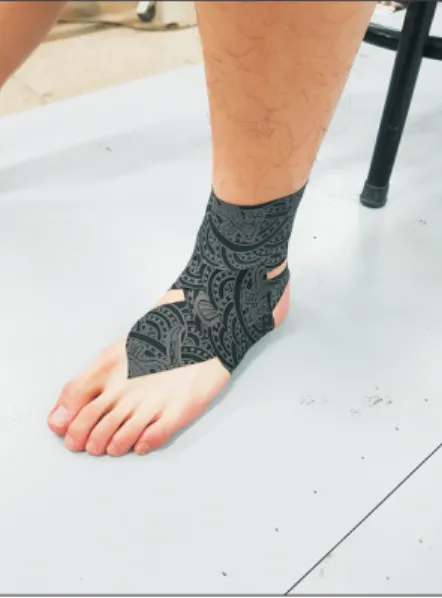
In the KT ankle-taping technique, three strips of KT, one I- stripped tape, and two Y stripped tapes were used in that or- der (Figure 1). First, the I-stripped tape was attached from the
Table 1.
Table 1. Participant demographics (N = 15)
Characteristics Values
Age (y) 23.5 ± 1.7
Sex (male:female) 9:6
Height (cm) 178.1 ± 7.6
Weight (kg) 84.9 ± 13.6
No. of previous ankle sprains 6.5 ± 2.6
CAIT score 13.3 ± 4.3
FAAM, ADL (%) 76.0 ± 5.7
FAAM, Sport (%) 62.1 ± 3.1
Values are presented as number only or mean ± standard deviation. CAIT, cumberland ankle instability scale; FAAM, foot and ankle ability measure;
ADL, activities of daily living.
lateral to the medial malleolus. Thereafter, the long Y stripped tape was attached to the lateral side of the ankle joint and placed in such a way that the tails stretched along the leg. The origin of the short Y stripped tape was placed on the back of the heel and stretched towards the hallux [11].
In the DT ankle taping technique, single strips with differ- ent lengths were used according to the participants’ anthro- pometrical characteristics (Figure 2). First, the participants’
starting position was plantar flexion and eversion. The DT was attached and anchored at the head of the first metatarsal joint and proceeded down to the top of the calcaneus posteriorly.
Subsequently, the DT was swept around the inside of the heel and attached from the lateral side of the foot. The anchor was attached at one-third of the medial part of the tibia [14].
4. Procedures
The participants attended one test session, and static postur- al control was evaluated using the 20-second OLST on a force plate. Subsequently, dynamic postural control was assessed using the mSEBT. The order of the 3 experimental conditions (bare foot, KT, and DT) was randomized using the random number generator in Excel software (Microsoft corp., Remond, WA, USA).
The first task was the OLST, and the participants were in- structed to look forward and place their hands on their hips and hold their contralateral leg at approximately 30° hip flex- ion and 90° knee flexion. Five practice trials were conducted to prevent the “learning effect.” The subjects maintained this
position for 20 seconds. If the contralateral leg touched the floor, the trials were repeated. The participants rested for 30 seconds between trials to minimize the effect of fatigue. Three successful trials were used in the statistical analysis (Figure 3).
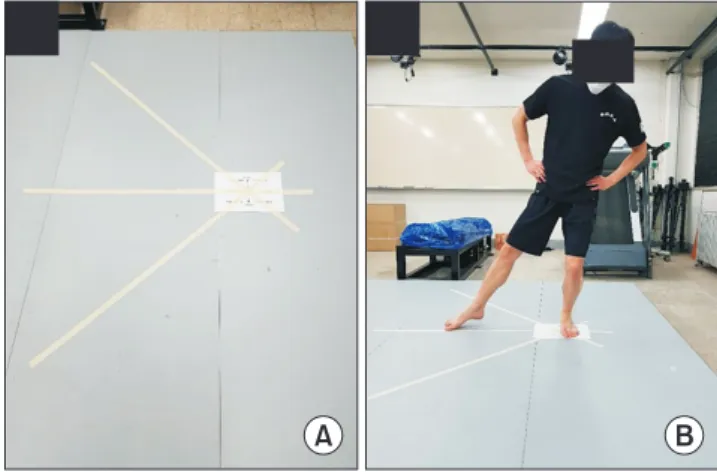
After the first task was completed, the participants took a 5-minute rest and subsequently proceeded with the second task, namely, the mSEBT. The SEBT has been recommended as a reliable test for determining postural control deficit in patients with CAI [30]. The modified version, mSEBT, was con- ducted in 3 directions at 45° to each other from the center, and the participants placed the test foot of their stance leg in the middle of the testing grid. They were instructed to stretch Figure 1.
Figure 1. Kinesio ankle taping technique.
Figure 2.
Figure 2. Dynamic ankle taping technique.Figure 3.
Figure 3. One-leg standing test position on the plate form.
out the opposite leg maximally in the anteromedial (AM), me- dial (M), and posteromedial (PM) directions (Figure 4) [31].
As their hands remained on their hips, the most distal part of their reaching foot contacted the ground and returned to a double-leg stance position. If the foot of the tested leg did not remain in contact with the ground, the trial was repeated.
In order to prevent the “learning effect,” 5 practice trials were conducted in each direction prior to the test session [32].
Reach distances were recorded by measuring the distance from the center to the mark point using a tape measure (cm). There- after, 3 successful trials in 3 directions were used in the statis- tical analysis. Rest periods of 30 seconds and 2 minutes were applied between each direction and between trials to minimize the effect of fatigue, respectively [33].
5. Data Processing and Statistical Analysis
All the parameters recorded during the OLSTs and SEBTs were calculated for each condition. The mean value of the 3 successful trials in each condition was assessed in the statisti-
cal analysis. The mean of the 3 successful reach distances were normalized to each participant’s leg length [34].
The Shapiro –Wilk statistical test was used to confirm the normality of the data distribution. One-way ANOVA was used to compare CoP data and normalized mSEBT reach distances among the three conditions (barefoot, KT, and DT). The α level of significance was set at 0.05. Post-hoc pairwise comparisons (Bonferroni procedure) were used to determine where the dif- ferences existed (with α = 0.05/3 = 0.017). All statistical analy- ses were performed using IBM SPSS software (version 25; IBM Corp., Armonk, NY, USA).
RESULTS
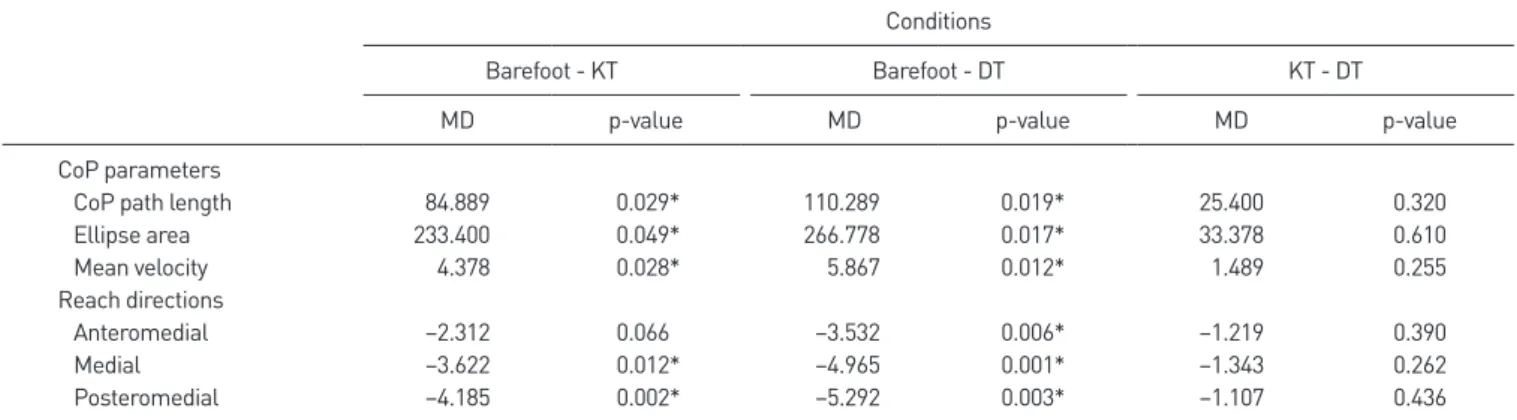
Table 2 displays the means and standard deviations of all CoP parameters as well as the normalized reach distances in 3 directions for the 3 conditions. Table 3 shows the mean differ- ences and p-values of the post-hoc pairwise comparisons of the 3 conditions.
On the OLST, participants exhibited different static postural control among the 3 conditions. On comparing CoP parame- ters among the 3 conditions, the mean values decreased in the following order: barefoot, KT, and DT. LENGTHs, AREAs, and VELs significantly differed between KT application and bare- foot (p < 0.05). Moreover, all CoP parameters were significantly different between KT and barefoot (p < 0.05). Nevertheless, no significant differences between KT and DT were observed (p >
0.05).
As regards normalized reach distances, significant differenc- es were identified among the 3 conditions in all directions. The post-hoc analysis revealed that the normalized reach distances in the M and PM directions, but not in the AM direction, were significantly different between barefoot and KT (p > 0.05). On
Table 2.
Table 2. Means and standard deviations of CoP parameters and the normalized reach distances in 3 conditions
Conditions
Barefoot Kinesio taping Dynamic taping
CoP parameters
CoP path length (mm) 907.8 ± 256.9 822.9 ± 216.1 797.5 ± 204.2
Ellipse area (mm
2) 1,251.0 ± 516.1 1,017.6 ± 386.1 984.2 ± 300.8
Mean velocity (mm/s) 45.5 ± 12.7 41.1 ± 10.9 39.6 ± 9.7
Reach directions (cm)
Anteromedial 77.7 ± 9.0 80.0 ± 8.8 81.2 ± 9.0
Medial 76.3 ± 6.3 80.0 ± 7.9 81.2 ± 7.9
Posteromedial 79.1 ± 7.9 83.3 ± 8.5 84.4 ± 8.3
CoP, center of pressure.
A B
Figure 4.
Figure 4. Modified Star Excursion Balance Test. (A) Three directions. (B)
Performance in the medial direction.
the other hand, DT application yielded longer reach distances than the other 2 conditions. In addition, all reach distances in the 3 directions were significantly different between barefoot and DT (p > 0.05). No significant differences in normalized reach distances and CoP parameters between KT and DT were observed (p > 0.05).
DISCUSSION
This study investigated the effects of KT and DT on static and dynamic postural control in subjects with CAI. First, OLST results demonstrated that all CoP parameters (LENGTH, AREA, and VEL) were significantly lower in the KT and DT conditions than in the barefoot condition. However, no differences be- tween KT and DT were observed. Second, the results revealed that KT and DT have a more positive effect on balance perfor- mance in the mSEBT than the barefoot condition. Likewise, no differences between KT and DT were noted. Notably, KT and DT application potentially improves both static and dynamic postural control compared with the control group.
The CoP trajectory is the general biomechanical parameter that has been used to determine static postural control per- formance [35]. The shorter the LENGTH, AREA, and VEL, the better the postural control performance [11]. Generally, a key characteristic of CAI is decreased balance control. Ankle taping has proven to improve static balance performance in patients with CAI [11,16,36]. We found significant improvement in static postural control with KT and DT application but not in the control condition. These results were consistent with those of previous studies [11,16,36]. Balance improvement was rep- resented by a decrease in the speed of postural control move- ments and an increase in the level of tissue stiffness around
the ankle [37]. In this study, we hypothesized that ankle taping may have a positive effect on the subjects’ balance regulation.
Lee and Lee [36] found a positive effect of KT on providing more ankle stability to subjects while testing different static postural tasks on different surfaces and measuring the ankle’
s range of motion before and after tape application. They as- serted that KT’s elastic property might have assisted balance regulation by facilitating proprioception around the ankle joint [36]. Likewise, lateral support was provided by ankle tapes with elasticity, supporting the lateral ankle structures. Resultantly, the application of ankle tapes culminated in significantly lower postural sway compared with the control [11].
The three-directional reach distance scores during the mSEBT using DT were significantly higher than those in the control group, and those using KT significantly increased com- pared with those in the control group, except AM-direction scores. A systematic review by Wang et al. [18] suggested that DT and KT had advantages over other taping methods (sham taping or tension-free taping) with respect to the maximum reach distance. The foregoing outcomes may be explained by the possibility of tension application enhancing the joint posi- tion sense at the ankle joint by improving proprioception with approximately 35% elasticity. These mechanisms potentially result in increased stimulation of the cutaneous mechanore- ceptors, thereby increasing the reach distance [36]. However, regarding AM-direction outcomes, only DT but not KT scores were significantly different from those in the barefoot condi- tion. First, the KT and DT ankle-taping techniques differed.
Although both tapes are elastic, we concluded that each tape should be uniquely applied to suit each property due to its distinct nature. Second, the application position differed be- tween KT and DT. To maximize KT’s tissue lifting, KT was Table 3.
Table 3. Post-hoc pairwise comparisons of CoP parameters and the normalized reach distances in 3 conditions