• 검색 결과가 없습니다.

Study of the Wireless Ad-hoc Networks with Robust Route Maintenance Scheme

N/A
N/A
Protected

Academic year: 2021

Share "Study of the Wireless Ad-hoc Networks with Robust Route Maintenance Scheme"

Copied!
4
0
0

로드 중.... (전체 텍스트 보기)

전체 글

(1)

46 한국정보전자통신기술학회논문지 제3권 제2호

Study of the Wireless Ad-hoc Networks with Robust Route Maintenance Scheme

Geun-Bin Hong*, Ji-Hun Yun**, Kwan-Woong Kim***

ABSTRACT

This paper has proposedfor wireless Ad-hoc networks with robust route maintenance schemes.

The device feature Bluetooth and/or IEEE 802.11 network interfaces and communicate in a decentralized manner. The nodes have the responsibility of self-organizing so that the network is robust to the variations in network topology due to node mobility as well as the fluctuations of the signal quality in the wireless environment.

keywords : Wireless communication, Ad-hoc Networks, Robust route, AODV, routing protocol

* 원광대학교 정보통신공학과 광통신시스템 연구실 ([email protected])

** 교신저자 원광대학교 정보통신공학과 광통신시스템 연구실 ([email protected])

*** 한국원자력연구원 ([email protected])

접수일자:2010년 5월 14일, 수정일자 : 2010년 5월 28일, 심사완료일자:2010년 6월 11일

Ⅰ. Introduction

Wireless Ad-hoc network [1-3] is a self-organ ized, dynamically changing multi-hop network. All mobile nodes in an ad-hoc network are capable of communicating with each other without the aid of any established infrastructure or centralized contr oller. Ad-hoc network is useful in many applications because they do not need any infrastructure support and has capability of self configuration. Sensor networks, disaster recovery, rescue and automated battlefields are examples of application environments. This implies that the routing protocol should propagate topology changes and compute updated routes to the destination.

Since wireless ad-hoc networks usually have limited bandwidth and battery power, their routing protocols should have low control overhead.

Reactive or on-demand routing protocols have been developed for this reason. In an on-demand routing protocol, a node only maintains routes for

in-use destinations and does not pro-actively advertise routes. Rather, it queries for needed routes and offers routes in response to queries.[4]

In this paper, we proposed a novel route maintenance scheme and we present about related works and background. The nodes have the responsibility of self-organizing so that the network is robust to the variations in network topology due to node mobility as well as the fluctuations of the signal quality in the wireless environment.

Ⅱ. Proposed Route Maintenance Scheme

Route maintenance in routing protocols plays a role of maintaining route connectivity and link breakage detection. The local route repair algorithm can be used for fast route recovery [5].

But most of existing routing algorithms have

lack of ability route recover before link breakage

(2)

Study of the Wireless Ad-hoc Networks with Robust Route Maintenance Scheme 47

occurred. Our work is focus on routing maintenance to prevent route-failure which caused by node mobility and improve efficiency of routing protocol during forwarding packets. Our approach is quite different with other mobility support routing protocols. To achieve this goal, Routing protocol should have ability of local route change from moving node to alternative node. The basic idea of the proposed scheme is based on our previous work [6]. In the scheme, we use receiving signal variation function for detecting node movements as follows.

V = RxP(t

1

) - RxP(t

0

) (1)

If function V is negative value, it indicatestwo adjacent nodes becoming far, else if V is equal to zero, two nodes doesn’t move or move same direction with the same speed. When value V is positive, two adjacent nodes move closer.

If RxP is under RxTh and V(A) is over than 0 (movement detected), then node triggers local rout e change process to find alternative node among it s neighbors. Looking for alternative nodes, node br oadcasts HELP message to its one-hop neighbors.

Where RxTh is receiving power threshold for RE D ZONE and defined as follows.

RxTh = K × RxP

min

(2)

Fig. 1. The example of the proposed scheme:Broadcasts HELP message to its one-hop neighbor

Pseudo code of the proposed scheme procedures is shown bellows. To avoid unnecessary broadcasting HELP, node set the flag of precursor of route entry to 1. It indicates HELP sent already for the flow. Precursor list is a set of nodes that share the same route to reach final destination [7].

The flag of precursor initialized when route is updated.

Ⅲ. Performance Evaluation

In this section, a performance of the proposed routing protocol is evaluated using extensive simulations and comparedits performance with AODV. NS2 simulator was used for experiments and the proposed scheme is implemented as part of AODV in NS2 [8]. The network model used for simulations consists of 100 mobile nodes in 1.0 km

× 1.0 km area. The initial position of nodes is randomly chosen. Node pairs are randomly selected to generate CBR/UDP traffic. Channel bandwidth is 2 Mbps.

Each node uses IEEE 802.11 MAC protocol and the used Channel model is Wireless channel/Wir eless Physical propagation model. In all cases, the proposed scheme improves the number of received packets and reduces packet loss. The main reason of performance improvement is that the proposed scheme can change route to alternative node before the next-hop node move out of transmission range. It could reduce packet loss and route failure more efficiently in high mobility environments.

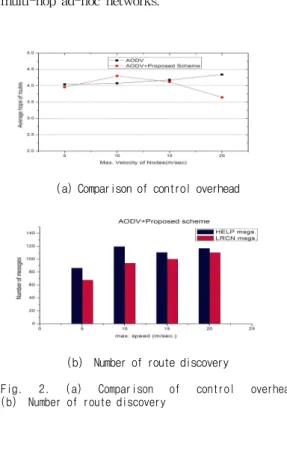
Performance comparison in control overhead and number of route discovery is shown in figure 2.

In the most cases, AODV with proposed scheme

reduces control message overhead and number of

route discovery compared to AODV. It is obvious

that local route change after route establishments

can reduce probability of re-route discovery and

control overhead efficiently.

(3)

48 한국정보전자통신기술학회논문지 제3권 제2호

Figure 2 (a) depicts average hops of routes and number of transmitted new messages shown in figure 2(b). In the proposed scheme, previous hop node launches local route repair process when it failed to receive LRCN messages. Therefore hop counts of route can be increase in some cases. As maximum speed of node increase, the more HELP and LRCN message generated as shown in figure 2 (b). In general, the results are quite positive in the sense that the proposed scheme outperformed than AODV in terms of routing overhead and throughput. Using our technique, the proposed scheme may reduce re-route discovery as well as overall end-to-end throughput improvement s over multi-hop ad-hoc networks.

(a) Comparison of control overhead

(b) Number of route discovery

Fig. 2. (a) Comparison of control overhead (b) Number of route discovery

Ⅴ. Conclusion

This paper has studied for wireless Ad-hoc networks with robust route maintenance schemes.

The device feature Bluetooth and/or IEEE 802.11

network interfaces and communicate in a decentralized manner. We also worked a new route maintenance scheme for AODV using receiving signal variation. The novel route maintenance scheme and related works and background were depicted. The nodes have the responsibility of self-organizing.

Reference

[1] C. E. Perkins. "Ad Hoc Networking".

Addison-Wesley, Upper Saddle River, NJ, USA, Jan 2003.

[2] http://www.ietf.org/, IETF MANET Working Group.

[3] C. E. Perkins, E. M. Royer and S. R. Das,

"Ad-hoc on demand distance vector rout- ing," IETF RFC3561, http://www.ietf.or g/rfc/rfc 3561.txt, 2005.

[4] Y.-H. Wang, C.-C. Chuang, C.-P. Hsu and C.M. Chung, "Ad hoc on demand routing protocol setup with backup routes", Proceedings of ITRE 2003. International Conference on Information Technology Research and Education, 2003, August 2003, pp. 137–141.

[5] Ki-Hyung KIM, Hyun-Gon SEO, "The Effects of Local Repair Schemes in AODV-Based Ad Hoc Networks," IEICE TRANSACTIONS on Communications, Vol. E87-B No. 9 pp.

2458-2466, Oct. 2004.

[6] M. Brahma , K. W. Kim, A. Abouaissa and P. Lorenz, "A Load-Balancing and Push-Out Scheme for Supporting QoS in MANETs", Telecommunication Systems Journal, Vol. 30, No.1-3, pp. 161-175, Dec. 2006.

[7] WaveLAN/PCMCIA Card User’s Guide–Lu cent Technologies

[8] Network Simulator: NS2.29 available via

web site http://www.isi.edu/nsnam.ns/

(4)

Study of the Wireless Ad-hoc Networks with Robust Route Maintenance Scheme 49

저자약력

홍 근 빈(Geun-bin Hong) 정회원

2010년 2월:원광대학교 정보통 신공학과 졸업

2010년 3월~현재:원광대학교 정보통신공학과 석사과정

<관심분야> 가시광통신, 광통신시스템, 적외선통신

윤 지 훈(Ji-Hun Kim) 정회원

2009년 2월:원광대학교 정보통신공학과 졸업 2009년 3월~현재:원광대학교

정보통신공학과 석사과정

<관심분야> 전력선통신, 가시광통신, LED 응용

김 관 웅(kwan-woong Kim) 정회원

1998년 2월:전북대학교 전자공 학과 석사

2002년 8월:전북대학교 전자공 학과 박사

2009년 3월~현재:한국원자력 연구소 연구원

<관심분야> 정보통신시스템기술, 광통신시스템, 가

시광통신, 스피커

수치

Fig. 1. The example of the proposed scheme:Broadcasts  HELP message to its one-hop neighbor
Figure 2 (a) depicts average hops of routes and number of transmitted new messages shown in figure 2(b)

참조

관련 문서