Korean J Gastroenterol Vol. 60 No. 3, 182-185 http://dx.doi.org/10.4166/kjg.2012.60.3.182
CASE REPORT
Korean J Gastroenterol, Vol. 60 No. 3, September 2012 www.kjg.or.kr
특발성 간경변증 환자에서 발생한 남성 유방암
신수린, 이명석, 박상훈, 최종수, 이경민, 김진배, 김형수, 김정원1
한림대학교 강남성심병원 내과, 병리과1
A Case of Breast Cancer in a Male Patient with Cryptogenic Cirrhosis
Su Rin Shin, Myung Seok Lee, Sang Hoon Park, Jong Soo Choi, Kyung Min Lee, Jin Bae Kim, Hyeong Su Kim and Jeong Won Kim1 Departments of Internal Medicine and Pathology1, Hallym University Kangnam Sacred Heart Hospital, Seoul, Korea
Breast cancer is a rare disease in men. We report a case of 53-year-old obese male, with known cryptogenic cirrhosis and hepatocellular carcinoma, presenting a tender mass on left breast. He was diagnosed with invasive intraductal carcinoma, which was consistent with a sporadic lesion. On the basis of previous literatures, obesity can be regarded as a cause for breast cancer even in men. However, there has been inconsistent data about link between liver cirrhosis and male breast cancer, which can be due to heterogenity in the etiology of cirrhosis. Through this case, it can be postulated that the risk for male breast cancer may vary according to the etiology of cirrhosis. (Korean J Gastroenterol 2012;60:182-185) Key Words: Breast cancer; Cirrhosis; Non-alcoholic fatty liver disease; Hepatocellular carcinoma
Received July 14, 2011. Revised August 18, 2011. Accepted August 19, 2011.
CC This is an open access article distributed under the terms of the Creative Commons Attribution Non-Commercial License (http://creativecommons.org/licenses/
by-nc/3.0) which permits unrestricted non-commercial use, distribution, and reproduction in any medium, provided the original work is properly cited.
교신저자: 이명석, 150-950, 서울시 영등포구 신길로 1, 한림대학교 강남성심병원 내과
Correspondence to: Myung Seok Lee, Department of Internal Medicine, Hallym University Kangnam Sacred Heart Hospital, 1 Singil-ro, Yeongdeungpo-gu, Seoul 150-950, Korea. Tel: +82-2-829-5114, Fax: +82-2-826-4669, E-mail: [email protected]
Financial support: None. Conflict of interest: None.
INTRODUCTION
Male breast cancer (BC) is a rare disease, which make up less than 1% of all breast malignancies in United States.1 The incidence in Korea has been reported at about 0.2 per year/100,000 and its prevalence accounts for 0.6% of all BC in Korea (Korean Statistical Information Service, http://ko- sis.kr).
Because of the rarity, relatively little is known regarding the etiology of male BC and mostly depends on case-control studies. To date, several conditions to predispose BC in men were identified, which included family history of first-degree relative with BC, Klinefelter syndrome, mutations on breast cancer susceptibility gene (BRCA) 1 and 2, and obesity.2-5 Relationships with other conditions in male BC, including low physical activity, alcohol ingestion, gynecomastia, history of
bone fracture, liver cirrhosis, and diabetes were indicated in several studies, but not significant in other studies.
Obesity is well known for the cause of non-alcoholic fatty liver disease (NAFLD), represented by the more aggressive non-alcoholic steatohepatitis (NASH). NASH can progress to cirrhosis and its related complications including hep- atocellular carcinoma (HCC). NASH accounts for a large pro- portion of cryptogenic cirrhosis, even though most of the his- tologic hallmarks of NASH are not present in cryptogenic cirrhosis.6
Here we report a case with BC in obese man after having cryptogenic cirrhosis with HCC. We believe this case is worthy of being discussed to speculate the effect of cirrhosis on male BC.
Shin SR, et al. A Case of Breast Cancer in a Male Patient with Cryptogenic Cirrhosis 183
Vol. 60 No. 3, September 2012
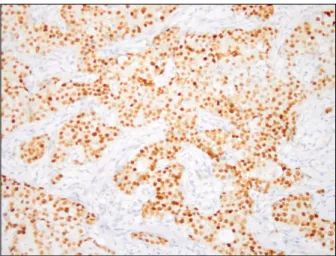
Fig. 3. Representative immunohistochemical staining (×200). The tumor cells stained with brown color represented strong and diffuse positivity for estrogen receptor.
Fig. 2. Microscpic image of H&E (×100). Invasive ductal carcinoma with prominent desmoplastic response and comedo necrosis was present (arrow). There was a lack of glandular differentiation.
Fig. 1. Radiologic findings of the patient. (A) Computed tomography showed low attenuated lesion with spiculated margin in the left breast (white circle). (B) Ultrasonographic scanning shows lobular hypoechoic mass of 3.2 cm in size including calcification on the left subareolar area (white arrow).
CASE REPORT
A 53-year-old man, with known cryptogenic cirrhosis of the liver, presented a painful mass on left breast developed 3 months ago. He had undergone wedge resection of liver due to HCC 3 years ago. The following year, HCC recurred, and a total of 3 sessions of transarterial chemoembolization (TACE) were done over next 2 years. He has been treated with insulin for 3 years due to diabetes. Current medications included proton pump inhibitor with itopride for reflux symptom and ur- sodeoxycolic acid but not diuretics. He was a self-employed man and never drank or smoked. There was no family history of malignancy. The patient’s height was 167 cm, body weight 81 kg, and body mass index 29.4 kg/m2, and he weighted
more than 100 kg during last 10 years. Physical examination revealed gynecomastia in both breasts and a tender mass on left one. He had Child-Pugh class A cirrhosis (score 5). On computed tomography, a mass of 3 cm in size showing spec- ulation of the margin at left subareolar area was scanned (Fig. 1A). Breast ultrasonography depicted a hypoechoic mass containing uneven calcifications and a lymph node en- largement of 2 cm in size on left axilla (Fig. 1B). Since the le- sion was highly suspicious of malignancy according to afore- mentioned findings, the modified radical mastectomy with axillary lymph node dissection including level I and II was performed. The final pathology showed invasive intraductal carcinoma of 3.5×3.0×2.0 cm invading skin and nipple (Fig.
2). Eight of 29 lymph nodes were confirmed as metastatsis,
184 신수린 등. 특발성 간경변증 환자에서 발생한 남성 유방암
The Korean Journal of Gastroenterology
and the final stage was pT2N2M0, stage IIIA. Immunohisto- chemical staining showed positivity for c-erbB2, and strong positivity for estrogen and progesteron receptors (Fig. 3).
Serum estrogen level was 237 pg/mL, which was more than 2 times of upper normal limit in men. He received radio- therapy following adjuvant chemotherapy. Since then, ta- moxifen combined with herceptin has been administered till now, 14 months after the operation. In addition, 4 sessions of TACE were done for HCC concomitantly with the BC treatment. At present, there is no evidence of recurrence of either HCC or BC.
DISCUSSION
Similarly to female, predisposing factors for male BC are divided into genetic and hormonal factors. The former is re- lated with hereditary BC and identified risks include germline BRCA1 and BRCA2 mutations, and Klinefelter syndrome. The latter is called sporadic BC, caused by acquired condition with high circulating estrogen level.7 As results, the sporadic BCs tend to be positive for estrogen receptor. Albeit poorly de- veloped ducts without lobule formation, male breast is also influenced by estrogen. Estrogen exposure can increase the number of potential target cells by stimulating breast growth and drive cycles of proliferation that promote DNA damage.
Once premalignant or malignant cells are present, hormones can stimulate their growth as well as the growth of normal epi- thelial and stromal cells that may aid tumor development. In addition, estrogen may also play a more direct role in carcino- genesis through its metabolites.8 Abnormal circumstances of hyperestrogenism was maintained for a long time without any genetic risk factor related BC in our case. Increased se- rum estrogen level was ascertained and estrogen receptor was positive in histology as like other male BC. These findings strongly suggest that BC in this patient is most likely sporadic disease.
Among his characteristics, obesity appears to play major etiologic role because body mass index of the patient had been approximately 36 kg/m2 during more than 10 years.
Obesity has been relatively well-documented as an im- plication in male BC. Though variable definitions of obesity were used, risk for BC in obese men is reported about 1.6-2.6 times compared to non-obese men.2-5 In obese men, plasma testosterone and sex hormone-binding globulin levels are de-
creased but estrogen production, metabolism, and bioavail- ability are enhanced by peripheral conversion of testoster- one to estradiol and androstenedione to estrone. Obesity is also associated with an increased risk and poor prognosis of postmenopausal female BC, presumably through peripheral conversion of androgens to estrogens.
Cirrhosis has been proposed as a possible risk factor for male BC.9-11 The hypothesis is based on the hormonal im- balance occurs in cirrhotic patients. A combined testicular and pituitary abnormality in cirrhosis leads to decreased tes- tosterone production and impaired hepatic extraction of adrenal androstenedione induces the extraglandular con- version to estrone and estradiol, which partially suppresses luteinizing hormone and results in hyperestrogenism. How- ever, in spite of high plausibility, the cases of male BC in cir- rhotic patients have been rarely documented, and only few case-control studies revealed significant association (Table 1). Although authors postulate the link of cirrhosis with male BC suggest that the reason for the lack of association is that cirrhotic patients do not live long enough to develop BC, it has been only hypothesis yet.12
Given that the patient had been overweighed during more than 10 years and had late-onset diabetes, cryptogenic cir- rhosis is supposed to be induced by NASH.6 As mentioned above, despite cirrhosis can lead hyperestrogenic condition, there is insufficient evidence that cirrhosis predisposes male BC. Through our case, authors suggest that the inconsistent results of previous studies about relation between liver cir- rhosis and male BC may be due to different etiologies of cir- rhosis, because patients with NASH-associated cirrhosis in- evitably have increased risk for male BC compared to cir- rhosis from other causes. Unfortunately, most case-control studies about cirrhosis and male BC did not determine the etiology of cirrhosis. There is an unique report to classify liver disease, in which the type of liver disease did not affect the incidence of male BC.13 However, they included patients with non-cirrhotic liver disease, did not distinguish cirrhosis from other liver disease, and the etiologies of liver disease was poorly categorized except alcohol. Even in case reports de- scribed the details of subjects, the physical measurements were mostly omitted and cryptogenic cirrhosis was verified in only one case report.14 Lack of understanding about NASH than now may contribute the insufficient etiologic evaluation of cirrhosis in previous studies.
Shin SR, et al. A Case of Breast Cancer in a Male Patient with Cryptogenic Cirrhosis 185
Vol. 60 No. 3, September 2012
Table 1. Summary of Reports Assessing the Link between Liver Cirrhosis and Male Breast Cancer Author Country Type of
publication
Material and
method Etiology Association
with LC Other risk factors Remark Yoneda
et al.14
Japan Letter 55 yr Undetermined - - Multiple HCCs
Mohan et al.12
India Letter 65 yr Alcohol - - -
Misra et al.15
India Case report 47 yr Viral hepatitis - -
Rubino et al.16
Italia Case report 61 yr Alcohol & chronic hepatitis B
- - Bilateral BC
HCC Lenfant-Pejovic
et al.9
France- Switzerland
Case-control study
91 male BC vs. 255 male cancer control
No comment No Bachelor
Family history Digitalis/isoniazid Hyperthyroidism Tuberculosis
LC was more prevalent but not statistically significant.
Sørensen et al.11
Denmark Prospective follow-up study
11,642 men with LC
2: alcoholic 1: non-alcoholic
Yes 3 occurred vs. 0.75
expected Liukkonen
et al.10
Finland Descriptive study
58 male BC No comment Probable Obesity Family history High alcohol drink
Prevalence of LC: 7%
Brinton et al.13
United States
Case-control study
642 male BC among 26 million discharge records
No Kleinfelter syndrome Gynecomastia Obesity
Orchitis/epididymitis
Poorly categorized
LC, liver cirrhosis; HCC, hepatocellular carcinoma; BC, breast cancer.
This is a first case report of BC developed in obese man with cirrhosis and HCC. On the basis of reviewing previous lit- eratures, the causative role of cirrhosis is not clear and it can be postulated that the risk for male BC varies according to the etiology of cirrhosis. This presumption must be noticeable with a growing concern about obesity and NAFLD these days.
REFERENCES
1. Jemal A, Siegel R, Xu J, Ward E. Cancer statistics, 2010. CA Cancer J Clin 2010;60:277-300.
2. D’Avanzo B, La Vecchia C. Risk factors for male breast cancer.
Br J Cancer 1995;71:1359-1362.
3. Giordano SH, Buzdar AU, Hortobagyi GN. Breast cancer in men.
Ann Intern Med 2002;137:678-687.
4. Johnson KC, Pan S, Mao Y; Canadian Cancer Registries Epidemiology Research Group. Risk factors for male breast cancer in Canada, 1994-1998. Eur J Cancer Prev 200;11:
253-263.
5. Weiss JR, Moysich KB, Swede H. Epidemiology of male breast cancer. Cancer Epidemiol Biomarkers Prev 2005;14:20-26.
6. Starley BQ, Calcagno CJ, Harrison SA. Nonalcoholic fatty liver disease and hepatocellular carcinoma: a weighty connection.
Hepatology 2010;51:1820-1832.
7. Kenemans P, Verstraeten RA, Verheijen RH. Oncogenic path- ways in hereditary and sporadic breast cancer. Maturitas
2008;61:141-150.
8. Yager JD, Davidson NE. Estrogen carcinogenesis in breast cancer. N Engl J Med 2006;354:270-282.
9. Lenfant-Pejovic MH, Mlika-Cabanne N, Bouchardy C, Auquier A. Risk factors for male breast cancer: a Franco-Swiss case-control study. Int J Cancer 1990;45:661-665.
10. Liukkonen S, Saarto T, Mäenpää H, Sjöström-Mattson J. Male breast cancer: a survey at the Helsinki University Central Hospital during 1981-2006. Acta Oncol 2010;49:322-327.
11. Sørensen HT, Friis S, Olsen JH, et al. Risk of breast cancer in men with liver cirrhosis. Am J Gastroenterol 1998;93:231-233.
12. Mohan P, Ramakrishnan MK, Jayanthi V. Is liver cirrhosis a risk factor for breast cancer in men? J Gastrointestin Liver Dis 2008;17:483-484.
13. Brinton LA, Carreon JD, Gierach GL, McGlynn KA, Gridley G.
Etiologic factors for male breast cancer in the U.S. Veterans Affairs medical care system database. Breast Cancer Res Treat 2010;119:185-192.
14. Yoneda S, Yoshikawa M, Yamane Y, et al. Breast cancer devel- oped in a male patient with liver cirrhosis bearing hep- atocellular carcinoma. Am J Gastroenterol 2000;95:556-557.
15. Misra SP, Misra V, Dwivedi M. Cancer of the breast in a male cirrhotic: is there an association between the two? Am J Gastroenterol 1996;91:380-382.
16. Rubino A, Fissi S, Secreto G. Bilateral breast cancer in a male patient with hepatocellular carcinoma. A case report. Ann Ital Chir 2008;79:117-119.