D I A B E T E S & M E T A B O L I S M J O U R N A L
This is an Open Access article distributed under the terms of the Creative Commons At- tribution Non-Commercial License (http://creativecommons.org/licenses/by-nc/3.0/) which permits unrestricted non-commercial use, distribution, and reproduction in any medium, provided the original work is properly cited.
A Randomized Controlled Trial of an Internet-Based Mentoring Program for Type 1 Diabetes Patients with Inadequate Glycemic Control
Sunghwan Suh1, Cheol Jean2, Mihyun Koo3, Sun Young Lee4, Min Ja Cho4, Kang-Hee Sim4, Sang-Man Jin4, Ji Cheol Bae4, Jae Hyeon Kim4
1Division of Endocrinology and Metabolism, Department of Internal Medicine, Dong-A University Medical Center, Busan,
2Manager of JahkEunSon (Small Hands) Type 1 Diabetes Cafe,
3Department of Medical Social Work, Samsung Medical Center, Seoul,
4Division of Endocrinology and Metabolism, Department of Medicine, Samsung Medical Center, Sungkyunkwan University School of Medicine, Seoul, Korea
Background: To determine whether an internet-based mentoring program can improve glycemic control in subjects with type 1 diabetes mellitus (T1DM).
Methods: Subjects with T1DM on intensive insulin therapy and with hemoglobin A1c (HbA1c) ≥8.0% were randomized to mentored (glucometer transmission with feedback from mentors) or control (glucometer transmission without feedback) groups and were examined for 12 weeks. Five mentors were interviewed and selected, of which two were T1DM patients themselves and three were parents with at least one child diagnosed with T1DM since more than 5 years ago.
Results: A total of 57 T1DM adult subjects with a mean duration after being diagnosed with diabetes of 7.4 years were recruited from Samsung Medical Center. Unfortunately, the mentored group failed to show significant improvements in HbA1c levels or other outcomes, including the quality of life, after completion of the study. However, the mentored group monitored their blood glucose (1.41 vs. 0.30) and logged into our website (http://ubisens.co.kr/) more frequently (20.59 times vs. 5.07 times) than the control group.
Conclusion: A 12-week internet-based mentoring program for T1DM patients with inadequate glycemic control did not prove to be superior to the usual follow-up. However, the noted increase in the subjects’ frequency of blood glucose monitoring may lead to clinical benefits.
Keywords: Diabetes mellitus, type 1; Internet; Mentors
Corresponding author: Jae Hyeon Kim
Division of Endocrinology and Metabolism, Department of Medicine, Samsung Medical Center, Sungkyunkwan University School of Medicine, 81 Irwon-ro, Gangnam-gu, Seoul 135-710, Korea
INTRODUCTION
Type 1 diabetes mellitus (T1DM) is known to be associated with the increased risk of mortality compared with the general population [1]. Intensive glycemic control in T1DM was found to reduce the risk of cardiovascular disease in a follow-up of subjects in the Diabetes Control and Complications Trial (DCCT) [2], whereas poor glycemic control has been found to be associated with cardiovascular disease in observational
studies of T1DM [3,4]. Tight glycemic control and intensive support have also been shown to improve control and reduce the risk of retinopathy, neuropathy, and nephropathy by up to 75% [5]. As shown above, control of diabetes has been shown to decrease mortality and prevent long-term complications, and thus it is critical that healthcare systems develop innova- tive ways to improve diabetes management and provide timely care to patients.
Close monitoring of blood glucose at home is a key compo- http://dx.doi.org/10.4093/dmj.2014.38.2.134
pISSN 2233-6079 · eISSN 2233-6087
nent of diabetes management, but without timely provider feedback, it somewhat has lesser value. For those patients liv- ing in rural areas, it is potentially invaluable to have access to diabetes care providers from the comfort of their homes, thus sparing them the time and cost of traveling. The internet has proven itself to be a fast, efficient, and reliable source of com- munication. Its widespread availability makes it an attractive communication tool among patients and providers, and it has shown efficacy in patients with different ages and illness expe- riences, and can help to improve various symptoms and health behaviors [6,7]. However, the clinical benefits of telemedical support on diabetes care remains inconclusive [8].
Parent mentoring is a proven strategy to provide social sup- port to the parents of children who are newly diagnosed with T1DM, especially in day-to-day management areas for which health care professionals may not be available [9]. However, although considerable diabetes research data has been pub- lished, there are little data regarding the results of mentoring in the contemporary literature.
For these reasons, we decided to analyze the benefits of con- tact between parents and patient mentors through an online- based program to intensify the follow-up for T1DM adult sub- jects. We hypothesized that this intervention would be benefi- cial to subjects’ glycemic control and welfare. Therefore, we conducted a randomized, controlled clinical trial in adult T1DM subjects employing an internet-based telemedicine system with real-time data transfer of blood glucose results, where we compared one group which received intensive feed- back against the other group which was given no feedback.
METHODS
The study was performed in accordance with the Declaration of Helsinki and the guidelines for Good Pharmacoepidemiol- ogy Practices. The protocol was reviewed and approved by The Institutional Review Board at Samsung Medical Center (2010- 05-065) and all the participants gave written informed consent before any trial-related activity. This study was registered at ClinicalTrial.gov (trial number, NCT01157611).
Participants
Subjects were eligible to participate in this study if they had 1) documented T1DM (with C-peptide ≤0.6 ng/mL) of >6 months’
duration; 2) inadequate glycemic control (hemoglobin A1c [HbA1c] ≥8.0%) even after using multiple daily insulin injec-
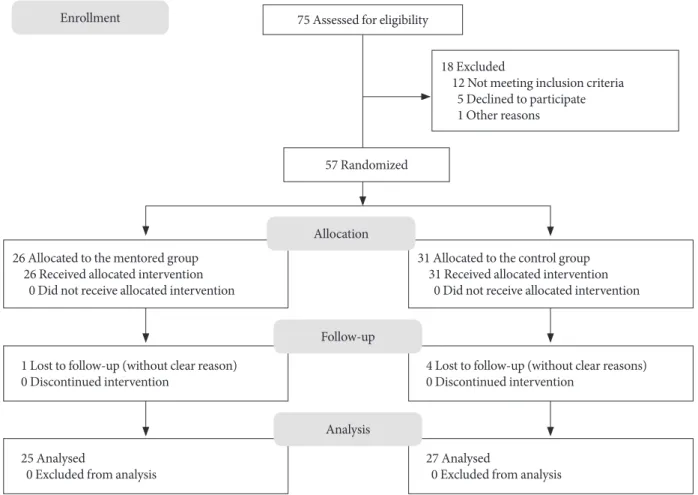
tions or insulin pumps for ≥3 months; and 3) ≥4 weeks of self- blood glucose monitoring data. The subjects were patients re- ceiving typical diabetes care in Samsung Medical Center in Seoul, Republic of Korea (Fig. 1). Subjects were excluded if they were 1) under the age of 18; 2) pregnant or planning pregnan- cy; or 3) did not have access to the internet. After confirming eligibility and obtaining written informed consent, the study coordinator allocated the subjects to different groups using a computerized random number table to minimize the differ- ences between groups.
Interventions
We trained all the subjects enrolled in the study to connect to the internet website (http://ubisens.co.kr/) and transmit glu- cometer data. We trained the subjects to install data transmis- sion software and cables on their own computer to upload their glucometer data. The personnel of the website were available to handle calls to assist in the installation and usage of the pro- gram. The glucose analysis software on this website assisted the mentors with the interpretation. Each subject underwent counseling with a medical social worker at their first visit to Samsung Medical Center. This helped the mentors to better understand the subjects and to provide appropriate advice and feedback. We asked all subjects to monitor their blood glucose 4 times per day, 7 days per week, and to transmit the recorded glucometer data at least every 2 weeks. The subjects allocated to the mentored group received individual feedback on their results: mentor-initiated support about insulin dosing, physi- cal activity, and food intake within 48 hours of transmission.
Text messages were sent to notify the allocated mentors when their mentees uploaded their data. Their advices on glycemic goals (HbA1c ≤6.5%), food intake, and physical activity fol- lowed the recommendations by the Korean Diabetes Associa- tion [10]. Mentors were given the contact numbers of their mentees so no face-to-face meetings between the mentors and their mentees were required, and the calls were not monitored.
Mentors were contacted once per month to provide training reinforcement and to answer questions about the interactions with their mentees. Meetings with the investigators were held five times during the study to report progress and discuss any problems during the study. On the other hand, subjects allo- cated to the control group did not receive any feedback, but they could review and interpret their own data from the web- site as often as necessary. All subjects received face-to-face dia- betes care with physicians at clinic visits every 6 weeks.
Mentors
Five mentors (three male and two female) were interviewed and carefully selected based on their background of giving ad- vice to other Korean T1DM patients in an internet community (JahkEunSon [Small Hands] Type 1 Diabetes Cafe; http://cafe.
naver.com/dmtype1.cafe) for at least 2 years. This community is the largest and most active online T1DM society in the Re- public of Korea. The community began in January 2006 and now comprises over 4,300 T1DM patients or their parents (as of December 2012). They run camps for T1DM children and have also created four informational publications for patients.
Two of the mentors were T1DM patients themselves, and three were parents of at least one child diagnosed with T1DM more than 5 years ago. All of the mentors were currently in good glucose control states (defined as HbA1c level <7.0% within 3 months of enrollment). They were all university graduates, with the exception of one who had 2 years of college education. As a group, they were highly empathetic and devoted to helping
other patients or parents through the postdiagnosis crisis. They all agreed to participate in this study purely as an altruistic un- dertaking without any kind of financial compensation except for blood screening test cost and transportation expenses re- imbursement for meeting with investigators. No mentors re- ported that they had been assigned to patients they knew.
Outcome measures
The primary outcome measure was the HbA1c levels 12 weeks after randomization. Secondary outcome measures included the fructosamine levels after the 12-week study, the number of hypoglycemic episodes (serum glucose ≤70 mg/dL), and num- ber of self-monitoring of blood glucose (SMBG) readings. To assess the impact of the intervention on the self-management of diabetes, the subjects completed the Audit of Diabetes De- pendent Quality of Life (ADDQoL) questionnaire [11] and the Diabetes Treatment Satisfaction Questionnaire (DTSQ) [12] at baseline and after completing the study. Both question-
Enrollment 75 Assessed for eligibility
57 Randomized
18 Excluded
12 Not meeting inclusion criteria 5 Declined to participate 1 Other reasons
31 Allocated to the control group 31 Received allocated intervention 0 Did not receive allocated intervention
4 Lost to follow-up (without clear reasons) 0 Discontinued intervention
27 Analysed
0 Excluded from analysis 26 Allocated to the mentored group
26 Received allocated intervention 0 Did not receive allocated intervention
1 Lost to follow-up (without clear reason) 0 Discontinued intervention
25 Analysed
0 Excluded from analysis
Allocation
Follow-up
Analysis
Fig. 1. Flow diagram of the study.
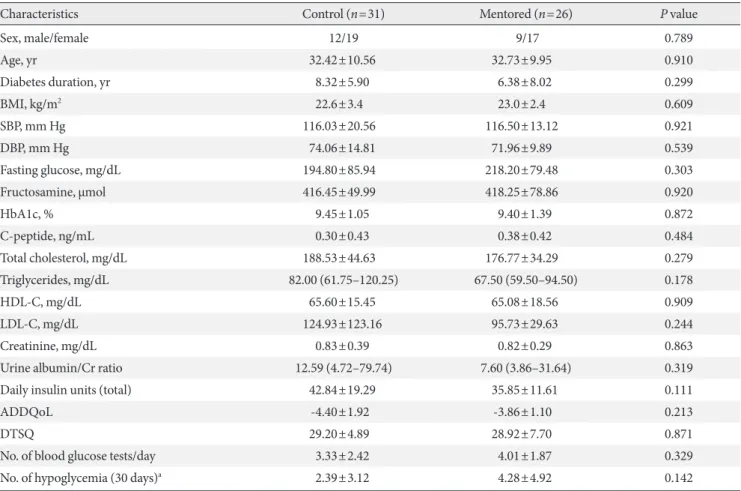
Table 1. Subjects’ characteristics after randomization (n=57)
Characteristics Control (n=31) Mentored (n=26) P value
Sex, male/female 12/19 9/17 0.789
Age, yr 32.42±10.56 32.73±9.95 0.910
Diabetes duration, yr 8.32±5.90 6.38±8.02 0.299
BMI, kg/m2 22.6±3.4 23.0±2.4 0.609
SBP, mm Hg 116.03±20.56 116.50±13.12 0.921
DBP, mm Hg 74.06±14.81 71.96±9.89 0.539
Fasting glucose, mg/dL 194.80±85.94 218.20±79.48 0.303
Fructosamine, µmol 416.45±49.99 418.25±78.86 0.920
HbA1c, % 9.45±1.05 9.40±1.39 0.872
C-peptide, ng/mL 0.30±0.43 0.38±0.42 0.484
Total cholesterol, mg/dL 188.53±44.63 176.77±34.29 0.279
Triglycerides, mg/dL 82.00 (61.75–120.25) 67.50 (59.50–94.50) 0.178
HDL-C, mg/dL 65.60±15.45 65.08±18.56 0.909
LDL-C, mg/dL 124.93±123.16 95.73±29.63 0.244
Creatinine, mg/dL 0.83±0.39 0.82±0.29 0.863
Urine albumin/Cr ratio 12.59 (4.72–79.74) 7.60 (3.86–31.64) 0.319
Daily insulin units (total) 42.84±19.29 35.85±11.61 0.111
ADDQoL -4.40±1.92 -3.86±1.10 0.213
DTSQ 29.20±4.89 28.92±7.70 0.871
No. of blood glucose tests/day 3.33±2.42 4.01±1.87 0.329
No. of hypoglycemia (30 days)a 2.39±3.12 4.28±4.92 0.142
Values are presented as mean±standard deviation, median (interquartile range), or numbers as appropriate.
BMI, body mass index; SBP, systolic blood pressure; DBP, diastolic blood pressure; HbA1c, hemoglobin A1c; HDL-C, high density lipoprotein cholesterol; LDL-C, low density lipoprotein cholesterol; ADDQoL, Audit of Diabetes Dependent Quality of Life; DTSQ, Diabetes Treatment Satisfaction Questionnaire.
aHypoglycemia is defined as serum glucose ≤70 mg/dL.
naires were translated into Korean (KR-ADDQol-19; Korean for South Korea 17.12.09 from Standard UK English revision 1.3.06 and KR-DTSQ; Korean 8.3.06 from standard UK Eng- lish revision 7/94). Average glucose, standard deviation (SD), average daily risk range (ADRR), and the percentage coeffi- cient of variation (CV) were calculated and analyzed from each subject’s transmitted glucometer data.
Statistical analysis
Using a two-sided test at a 5% level of statistical significance, the trial was designed to have an 80% statistical power to de- tect intergroup differences of 1.0% in the mean change in HbA1c from baseline to the completion of the trial. We aimed to re- cruit 80 patients, allowing for a 10% drop-out rate. Data were
analyzed using PASW Statistics version 20.0 for Windows (SPSS Inc., Chicago, IL, USA). Values are presented as mean±standard deviation or numbers (%). For all statistical analyses a P value of less than 0.05 (two-sided) was considered to be statistically significant. Statistical significance was tested using the unpaired Student t-test to evaluate group differences. Changes in vari- ables following the study were compared with baseline values by using the repeated measures analysis of variance (ANOVA) for each group. One-way ANOVA with Bonferroni correction was applied to evaluate the main effects and interactions of all of the dependent variables in each of the two groups by time (prior to and after the 12-week program).
RESULTS
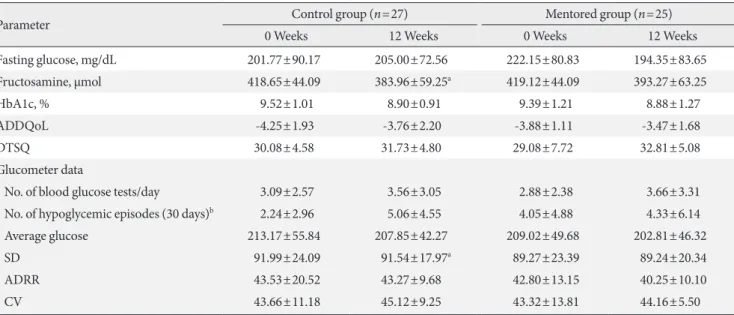
The descriptive characteristics of all of the groups are given in Table 1. The two groups did not differ significantly at baseline with respect to any of the anthropometric or metabolic vari- ables, suggesting successful randomization of the study partic- ipants. Unfortunately, five subjects were dropped out through- out the study for failing to turn up to a follow-up without giv- ing any clear reason (four from the control group and one from the mentored group). A comparison between the parameters of each group after the completion of the study is described in Table 2. In the control group, the fructosamine and average glucose values from the subject’s glucometer were significantly different from baseline value. Only fructosamine and average glucose improved from baseline, while other outcome measures, including HbA1c, number of hypoglycemic episodes, and number of SMBG, ADDQoL, DTSQ, and other glucometer data, did not (Table 2). In the mentored group, the number of SMBG per day increased during the study. However, none of the values changed significantly from the baseline value (Table 2). A comparison between parameters at completion of the study is depicted in Table 3. The mentored group visited the website more often (20.59 times vs. 5.07 times), and an increase in the number of SMBG per day was also observed (1.41 vs.
0.30). Nevertheless, the primary and secondary outcome mea-
Table 2. Comparison of parameters at baseline and after study completion in each group (n=52)
Parameter Control group (n=27) Mentored group (n=25)
0 Weeks 12 Weeks 0 Weeks 12 Weeks
Fasting glucose, mg/dL 201.77±90.17 205.00±72.56 222.15±80.83 194.35±83.65
Fructosamine, µmol 418.65±44.09 383.96±59.25a 419.12±44.09 393.27±63.25
HbA1c, % 9.52±1.01 8.90±0.91 9.39±1.21 8.88±1.27
ADDQoL -4.25±1.93 -3.76±2.20 -3.88±1.11 -3.47±1.68
DTSQ 30.08±4.58 31.73±4.80 29.08±7.72 32.81±5.08
Glucometer data
No. of blood glucose tests/day 3.09±2.57 3.56±3.05 2.88±2.38 3.66±3.31
No. of hypoglycemic episodes (30 days)b 2.24±2.96 5.06±4.55 4.05±4.88 4.33±6.14
Average glucose 213.17±55.84 207.85±42.27 209.02±49.68 202.81±46.32
SD 91.99±24.09 91.54±17.97a 89.27±23.39 89.24±20.34
ADRR 43.53±20.52 43.27±9.68 42.80±13.15 40.25±10.10
CV 43.66±11.18 45.12±9.25 43.32±13.81 44.16±5.50
HbA1c, hemoglobin A1c; ADDQoL, Audit of Diabetes Dependent Quality of Life; DTSQ, Diabetes Treatment Satisfaction Questionnaire; SD, standard deviation; ADRR, average daily risk range; CV, coefficient of variation.
aSignificantly different from baseline value (P<0.05), bHypoglycemia is defined as serum glucose ≤70 mg/dL.
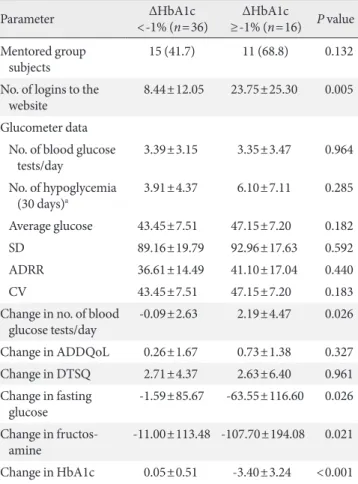
sures, namely HbA1c and fructosamine levels, number of hy- poglycemic episodes, and number of SMBG, and ADDQoL and DTSQ score, did not differ between the two groups. None of the changes of other outcome measures from the baseline values were statistically significant. Further analysis compar- ing groups with or without a reduction of HbA1c of 1% showed that the number of logins to the website and the increment in the number of SMBG per day were significantly different be- tween the two groups (Table 4), along with the changes of fast- ing glucose, fructosamine, and HbA1c levels themselves. The proportion of subjects in the mentoring group who improved their HbA1c levels by more than 1% was higher than in the control group; however, this difference (68.8% vs. 41.7%) did not reach statistical significance.
DISCUSSION
The primary finding of this 12-week study is that an internet- based mentoring program can increase the frequency of SMBG.
However, we failed to show any improvement in the number of hypoglycemic episodes, or ADDQoL, and DTSQ scores.
Although the primary and secondary outcome measures did not improve significantly in the mentored group compared with the control group, the improvement in the number of blood glucose monitoring events in the mentored group sug-
gests that the program is effective in altering important out- come mediators. A subgroup analysis the questions in the ADDQoL questionnaire also failed to show any significant difference between the two groups (data not shown). Attempts to identify the specific subgroups most likely to benefit from mentoring also failed due to the small number of subjects.
Previous telemedicine studies have also failed to show clear improvements in HbA1c levels or other outcomes [8,13-15], which we suspect to be due to the generally small subject groups (<50 subjects) and the limited durations of follow-ups (3 to 6 months) in most studies. Some patient mentoring studies [16,17] have shown benefit in diabetes management, although all of these programs evaluated patients with type 2 diabetes
mellitus in a Veterans Affairs Medical Center setting. Both of the studies lasted for 6 months and more than 90% of the sub- jects were male. A recent study by Long et al. [17] in which all 118 subjects in the study were African American provided mentors with financial incentive. Our negative results also sug- gest a Hawthorne effect, whereby the mere fact of being en- rolled in a study improves outcomes without any added impact of the mentoring program. The control group in this study showed improvements in fructosamine levels compared with baseline values. Moreover, we deliberately excluded patients with good control and recruited the remaining population; de- livering effective intervention to subjects with poor control is likely to be difficult. Dropout rates in both groups were similar Table 3. Comparison between parameters at study completion
(n=52)
Parameter Control
(n=27) Mentored
(n=25) P value No. of logins to the website 5.07±8.23 20.59±21.75 0.001 Fasting glucose, mg/dL 205.00±72.56 194.35±83.65 0.626 Fructosamine, µmol 383.96±59.25 393.27±63.25 0.586
HbA1c, % 8.90±0.91 8.88±1.27 0.929
ADDQoL -3.76±2.20 -3.47±1.68 0.592
DTSQ 31.73±4.80 32.81±5.08 0.436
No. of drop outs 4 (13.3) 1 (3.7) 0.356
Glucometer data No. of blood glucose
tests/day 3.56±3.05 3.66±3.31 0.598
No. of hypoglycemic
episodes (30 days)a 5.06±4.55 4.33±6.14 0.695 Average glucose 207.85±42.27 202.81±46.32 0.742
SD 91.54±17.97 89.24±20.34 0.729
ADRR 43.27±9.68 40.25±10.10 0.403
CV 45.12±9.25 44.16±5.50 0.716
Change in no. of blood
glucose tests/day 0.30±2.09 1.41±4.11 0.049 Change in ADDQoL 0.63±1.36 0.19±1.78 0.331 Change in DTSQ 2.76±4.85 2.60±5.94 0.917 Change in fasting glucose -25.30±98.31 -21.15±105.95 0.879 Change in fructosamine -69.77±146.63 -17.33±156.65 0.197 Values are presented as mean±standard deviation or number (%).
HbA1c, hemoglobin A1c; ADDQoL, Audit of Diabetes Dependent Quality of Life; DTSQ, Diabetes Treatment Satisfaction Question- naire; SD, standard deviation; ADRR, average daily risk range; CV, coefficient of variation.
aHypoglycemia is defined as serum glucose ≤70 mg/dL.
Table 4. Comparison between parameters according to glyce- mic control (n=52)
Parameter ΔHbA1c
<-1% (n=36) ΔHbA1c
≥-1% (n=16) P value Mentored group
subjects 15 (41.7) 11 (68.8) 0.132
No. of logins to the
website 8.44±12.05 23.75±25.30 0.005
Glucometer data No. of blood glucose
tests/day 3.39±3.15 3.35±3.47 0.964
No. of hypoglycemia
(30 days)a 3.91±4.37 6.10±7.11 0.285
Average glucose 43.45±7.51 47.15±7.20 0.182
SD 89.16±19.79 92.96±17.63 0.592
ADRR 36.61±14.49 41.10±17.04 0.440
CV 43.45±7.51 47.15±7.20 0.183
Change in no. of blood
glucose tests/day -0.09±2.63 2.19±4.47 0.026 Change in ADDQoL 0.26±1.67 0.73±1.38 0.327 Change in DTSQ 2.71±4.37 2.63±6.40 0.961 Change in fasting
glucose -1.59±85.67 -63.55±116.60 0.026 Change in fructos-
amine -11.00±113.48 -107.70±194.08 0.021 Change in HbA1c 0.05±0.51 -3.40±3.24 <0.001 Values are presented as mean±standard deviation or number (%) as appropriate.
HbA1c, hemoglobin A1c; SD, standard deviation; ADRR, average daily risk range; CV, coefficient of variation; ADDQoL, Audit of Dia- betes Dependent Quality of Life; DTSQ, Diabetes Treatment Satisfac- tion Questionnaire.
aHypoglycemia is defined as serum glucose ≤70 mg/dL.
to other studies [8,18].
Subjects in the mentored group logged into the website more often, and thus received more feedback from mentors. This in- teraction provided additional opportunities for the subjects to request health information and use the system as a portal to gain access to accurate and up-to-date information about their illness, treatment, nutrition, and exercise. In addition, the mentored group had a higher number of SMBG per day. Not only did these subjects monitor their blood glucose levels more frequently, but they were also able to show their blood glucose readings to their mentors in a more timely fashion. A higher frequency of SMBG measurements is related to better metabolic control, especially in T1DM [19,20]. This may ex- plain why subjects with a greater reduction in HbA1c level showed a higher number of logins and an increased frequency of blood glucose monitoring; the percentage of these subjects was higher in the mentored group, although the difference was not statistically significant. Consequently, an internet-based mentoring program that can encourage monitoring is poten- tially a tremendous health asset. The internet-based program provides patients with a convenient vehicle for transferring their blood glucose readings to their doctors or mentors, thus providing an opportunity to be more involved in their own health care; this kind of communication plays a critical role in an illness that can change as quickly as diabetes [21]. In addi- tion to the abovementioned benefits, experienced mentors could advise with their own personal experiences. They were able to discuss issues with and provide support to the patients in ways that health care professionals cannot. Moreover, as is the case with other forms of peer support, patient mentoring may help not only the patient, but also the mentor. A growing body of research shows that patients who help others receive benefits themselves in return [22].
Telemedicine can be a useful tool for the provision of diabe- tes care, and represents a potential solution for the poor access to healthcare and provider shortages. It cannot replace patient visits and direct interaction with providers, but it can supple- ment between-visit care and reduce the time to the attainment of adequate metabolic control by patients. Telemedicine can also potentially save time and travel expenses for patients [23].
Patient mentors may be especially effective in helping patients develop strategies to incorporate complex treatment regimens into their everyday routines. Volunteer patient mentors also are frequently available beyond normal clinic hours, which are times when patients do not typically have access to health care
staff. In addition, perhaps the most obvious attraction of this type of patient mentoring is that providing one-on-one peer support through mentors could potentially provide similar benefits as direct health-care staff interactions at a lower cost (virtually free). This almost certainly enhances its cost-effec- tiveness relative to more expensive interventions, such as nurse care management, telemedicine, and group medical appoint- ments [17,24,25]. Another major advantage to electronic glu- cose tracking is accuracy. Compared with paper data capture by patients, electronic tracking is likely to be significantly more accurate and preclude back-filling, forward-filling, and data manipulation [26]; practitioners therefore have an accurate sense of glucose levels and monitoring frequency with richer data. Combining the scientific knowledge of doctors and the personal experience of mentors with the assistance of the in- ternet will open a new era of diabetes management. However, choosing mentors who have a good grasp of day-to-day diabe- tes management and are knowledgeable and flexible is key to the success of an internet-based mentoring program. Never- theless, certified criteria for mentor in diabetes management are lacking and variable across other studies [16,17].
This study has some limitations. This study was conducted in a single center, although some of the participants were re- cruited from the internet website, hence our study subjects may not represent the larger population of T1DM. We were unable to fulfill the planned 80 patients, making this study an underpowered analysis. In addition, only short-term outcomes are reported in this article. It is possible that, given the mediat- ing effects on blood glucose monitoring, a longer period of follow-up is needed to observe the changes in outcomes. Last- ly, subjects who did not have internet access or did not know how to use the internet were excluded, allowing us to presume the existence of a selection bias. Developing computer skills in older, computer-naive patients is a major barrier in telemedi- cine. Moreover, the development of universal software that can easily download data from all glucometers and easily transmit the results is still needed.
In conclusion, a 12-week internet-based mentoring program for T1DM patients with inadequate glycemic control did not prove superior to conventional follow-ups. However, the in- crease in the frequency of blood glucose monitoring may lead to other clinical benefits.
CONFLICTS OF INTEREST
No potential conflict of interest relevant to this article was re- ported.
ACKNOWLEDGMENTS
We are grateful to the five mentors, Cheol Jean, Kyoung Yae Kim, Kwang Min An, Jeong Seok Oh, and Ja-Eun Yi for their dedication in this study. This study was supported by a grant from i-SENS Inc. (Seoul, Korea). The funding source had no role in the oversight or design of the study, in the analysis or in- terpretation of the data, or in the decision to submit the manu- script for publication.
REFERENCES
1. Secrest AM, Becker DJ, Kelsey SF, LaPorte RE, Orchard TJ.
All-cause mortality trends in a large population-based cohort with long-standing childhood-onset type 1 diabetes: the Al- legheny County type 1 diabetes registry. Diabetes Care 2010;
33:2573-9.
2. Nathan DM, Cleary PA, Backlund JY, Genuth SM, Lachin JM, Orchard TJ, Raskin P, Zinman B; Diabetes Control and Com- plications Trial/Epidemiology of Diabetes Interventions and Complications (DCCT/EDIC) Study Research Group. Inten- sive diabetes treatment and cardiovascular disease in patients with type 1 diabetes. N Engl J Med 2005;353:2643-53.
3. Eeg-Olofsson K, Cederholm J, Nilsson PM, Zethelius B, Svens- son AM, Gudbjornsdottir S, Eliasson B. Glycemic control and cardiovascular disease in 7,454 patients with type 1 diabetes:
an observational study from the Swedish National Diabetes Register (NDR). Diabetes Care 2010;33:1640-6.
4. Soedamah-Muthu SS, Chaturvedi N, Toeller M, Ferriss B, Re- boldi P, Michel G, Manes C, Fuller JH; EURODIAB Prospec- tive Complications Study Group. Risk factors for coronary heart disease in type 1 diabetic patients in Europe: the EURODIAB Prospective Complications Study. Diabetes Care 2004;27:530-7.
5. Effect of intensive diabetes treatment on the development and progression of long-term complications in adolescents with insulin-dependent diabetes mellitus: Diabetes Control and Complications Trial. Diabetes Control and Complications Tri- al Research Group. J Pediatr 1994;125:177-88.
6. Williamson DA, Martin PD, White MA, Newton R, Walden H, York-Crowe E, Alfonso A, Gordon S, Ryan D. Efficacy of an
internet-based behavioral weight loss program for overweight adolescent African-American girls. Eat Weight Disord 2005;
10:193-203.
7. Nguyen B, Kornman KP, Baur LA. A review of electronic in- terventions for prevention and treatment of overweight and obesity in young people. Obes Rev 2011;12:e298-314.
8. Azar M, Gabbay R. Web-based management of diabetes through glucose uploads: has the time come for telemedicine?
Diabetes Res Clin Pract 2009;83:9-17.
9. Sullivan-Bolyai S, Lee MM. Parent mentor perspectives on providing social support to empower parents. Diabetes Educ 2011;37:35-43.
10. Korean Diabetes Association. Treatment guideline for diabe tes.
J Korean Diabetes 2011;12 Suppl 1:S1-244.
11. Bradley C, Todd C, Gorton T, Symonds E, Martin A, Plowright R. The development of an individualized questionnaire mea- sure of perceived impact of diabetes on quality of life: the AD- DQoL. Qual Life Res 1999;8:79-91.
12. Lewis KS, Bradley C, Knight G, Boulton AJ, Ward JD. A mea- sure of treatment satisfaction designed specifically for people with insulin-dependent diabetes. Diabet Med 1988;5:235-42.
13. Whittemore R, Jaser SS, Jeon S, Liberti L, Delamater A, Mur- phy K, Faulkner MS, Grey M. An internet coping skills train- ing program for youth with type 1 diabetes: six-month outcomes.
Nurs Res 2012;61:395-404.
14. Farmer AJ, Gibson OJ, Dudley C, Bryden K, Hayton PM, Tarassenko L, Neil A. A randomized controlled trial of the ef- fect of real-time telemedicine support on glycemic control in young adults with type 1 diabetes (ISRCTN 46889446). Diabe- tes Care 2005;28:2697-702.
15. Gay CL, Chapuis F, Bendelac N, Tixier F, Treppoz S, Nicolino M. Reinforced follow-up for children and adolescents with type 1 diabetes and inadequate glycaemic control: a random- ized controlled trial intervention via the local pharmacist and telecare. Diabetes Metab 2006;32:159-65.
16. Heisler M, Vijan S, Makki F, Piette JD. Diabetes control with reciprocal peer support versus nurse care management: a ran- domized trial. Ann Intern Med 2010;153:507-15.
17. Long JA, Jahnle EC, Richardson DM, Loewenstein G, Volpp KG. Peer mentoring and financial incentives to improve glu- cose control in African American veterans: a randomized trial.
Ann Intern Med 2012;156:416-24.
18. Montori VM, Helgemoe PK, Guyatt GH, Dean DS, Leung TW, Smith SA, Kudva YC. Telecare for patients with type 1 diabetes and inadequate glycemic control: a randomized controlled tri-
al and meta-analysis. Diabetes Care 2004;27:1088-94.
19. Ziegler R, Heidtmann B, Hilgard D, Hofer S, Rosenbauer J, Holl R; DPV-Wiss-Initiative. Frequency of SMBG correlates with HbA1c and acute complications in children and adolescents with type 1 diabetes. Pediatr Diabetes 2011;12:11-7.
20. Miller KM, Beck RW, Bergenstal RM, Goland RS, Haller MJ, McGill JB, Rodriguez H, Simmons JH, Hirsch IB; T1D Exchange Clinic Network. Evidence of a strong association between fre- quency of self-monitoring of blood glucose and hemoglobin A1c levels in T1D exchange clinic registry participants. Diabe- tes Care 2013;36:2009-14.
21. Levine BA, Turner JW, Robinson JD, Angelus P, Hu TM. Com- munication plays a critical role in web-based monitoring. J Di- abetes Sci Technol 2009;3:461-7.
22. Heisler M. Different models to mobilize peer support to improve diabetes self-management and clinical outcomes: evidence, logis- tics, evaluation considerations and needs for future research. Fam
Pract 2010;27 Suppl 1:i23-32.
23. Biermann E, Dietrich W, Standl E. Telecare of diabetic patients with intensified insulin therapy: a randomized clinical trial.
Stud Health Technol Inform 2000;77:327-32.
24. Kirsh S, Watts S, Pascuzzi K, O’Day ME, Davidson D, Strauss G, Kern EO, Aron DC. Shared medical appointments based on the chronic care model: a quality improvement project to ad- dress the challenges of patients with diabetes with high cardio- vascular risk. Qual Saf Health Care 2007;16:349-53.
25. Trento M, Passera P, Bajardi M, Tomalino M, Grassi G, Borgo E, Donnola C, Cavallo F, Bondonio P, Porta M. Lifestyle inter- vention by group care prevents deterioration of type II diabe- tes: a 4-year randomized controlled clinical trial. Diabetologia 2002;45:1231-9.
26. Klonoff DC. Diabetes and telemedicine: is the technology sound, effective, cost-effective, and practical? Diabetes Care 2003;26:
1626-8.