Ellis-van Creveld (EVC) syndrome is a rare congenital genetic disorder having autosomal recessive inheritance.
Credit goes to Richard W.B. Ellis and Simon van Creveld for describing the syndrome in detail in 1940, and they called it as chondroectodermal dysplasia. It is a syndrome affecting the Amish population of Pennsylvania in USA with the prevalence rate of 1/5,000 live birth. In non-Amish population, the birth prevalence is 7/1,000,000.1It is caus- ed by mutation in the EVC gene as well as by a mutation in a nonhomologous gene, EVC2, located close to EVC gene in a head-to-head configuration.2 The syndrome is characterized by bilateral postaxial polydactyly of the hands, chondrodysplasia of long bones resulting in acrome- somelic dwarfism, ectodermal dysplasia affecting nails as well as teeth and congenital heart malformation.3,4This re- port demonstrates a typical EVC syndrome in a 12-year- old Indian girl.
Case Report
A 12-year-old female patient visited the Department of Oral Medicine and Radiology, Yenepoya Dental College, with a complaint of missing anterior teeth since three years ago. She had a history of exfoliation of decidious teeth due to mobility three years ago and there was no eruption of the permanent teeth. There was a history of presence of two mandibular natal teeth which were exfoliated two weeks after birth. Her parents had no consanguineous mar- riage, however her elder sibling died of similar medical problem. Her medical history revealed that she had visited genetic clinic and they have diagnosed her with Ellis-van Creveld syndrome. She also had dyspnoea because of con- genital lobar emphysema for which she had undergone left upper lobectomy when she was one and half year old.
Her general physical examination showed bilateral pos- taxial polydactyly of hands (Fig. 1A). She could not make a tight fist. She had hypoplastic finger and toe nails (Figs.
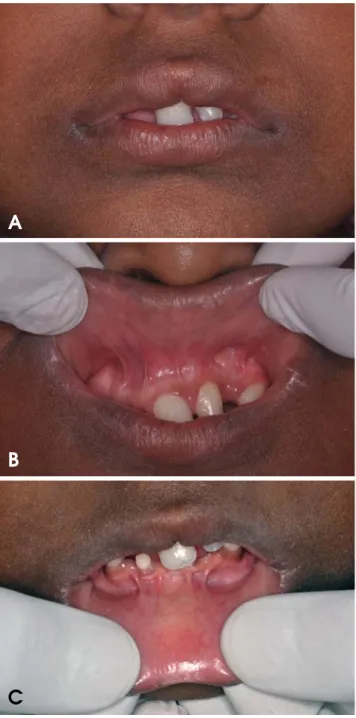
1B and C). There was wide gap between the big toe and other toes (Fig. 1C). Intraoral examination showed V-shap- ed notching of the upper lip at the mid line (Fig. 2A),
─ 167 ─
Ellis-van Creveld syndrome in an Indian child: a case report
K.M. Veena, H. Jagadishchandra*, Prasanna Kumar Rao, Laxmikanth Chatra
Department of Oral Medicine and Radiology, Yenepoya Dental College, Yenepoya University, Mangalore, India
*Department of Oral Surgery, Yenepoya Dental College, Yenepoya University, Mangalore, India.
ABSTRACT
Ellis-van Creveld syndrome is a rare congenital genetic disorder having autosomal recessive inheritance. It is a syn- drome affecting the Amish population of Pennsylvania in USA with prevalence rate of 1/5,000 live at birth. In non- Amish population, the birth prevalence is 7/1,000,000. The syndrome is characterized by bilateral postaxial poly- dactyly of the hands, chondrodysplasia of long bones resulting in acromesomelic dwarfism, ectodermal dysplasia affecting nails as well as teeth and congenital heart malformation. There were very rare reports of this syndrome in dentistry. The present case focuses on the striking and constant oral findings of these patients, which are the main diagnostic features of this syndrome. Since the oral manifestations affect the esthetic, speech, and jaw growth of the child, the dentists have an important role to play in proper management of such case. (Imaging Sci Dent 2011; 41 : 167-70)
KEY WORDS : Ellis-Van Creveld Syndrome; Genu Valgum; Postaxial Polydactyly
Received June 29, 2011; Revised September 20, 2011; Accepted October 25, 2011 Correspondence to: Prof. K.M. Veena
Department of Oral Medicine and Radiology, Yenepoya Dental College, Yenepoya University, Deralakatte, Mangalore, Karnataka 575018, India
Tel) 91-9845010856, Fax) 91-824-2204663, E-mail) [email protected]
Imaging Science in Dentistry 2011; 41 : 167-70 http://dx.doi.org/10.5624/isd.2011.41.4.167
Copyright ⓒ 2011 by Korean Academy of Oral and Maxillofacial Radiology
This is an Open Access article distributed under the terms of the Creative Commons Attribution Non-Commercial License (http://creativecommons.org/licenses/by-nc/3.0) which permits unrestricted non-commercial use, distribution, and reproduction in any medium, provided the original work is properly cited.
Imaging Science in Dentistry∙pISSN 2233-7822 eISSN 2233-7830
absence of mucobuccal fold in maxillary and mandibular anterior region (Figs. 2B and C), conical shaped teeth, missing mandibular permanent anterior and retained decid- uous mandibular canines, and right lateral incisor teeth (Fig. 2C).
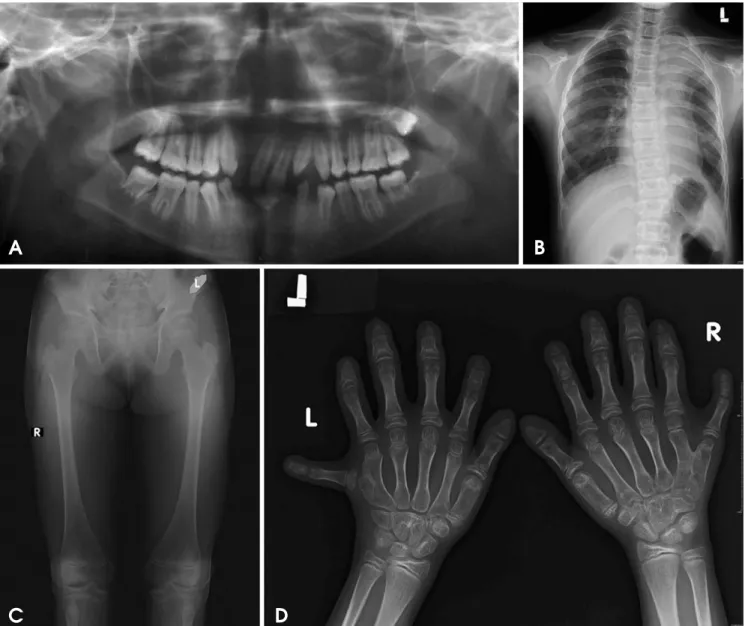
Panoramic radiograph revealed many missing teeth with no impacted tooth (Fig. 3A). Chest radiograph showed homogenous opacity in the left upper zone associated with elevation of hilum and left dome of diaphragm suggestive
of left upper lobectomy (Fig. 3B). Antero-posterior view of the legs showed Genu valgum, hypoplasia of lateral end of tibia associated with medial tibial diaphysial outgrowth called exostosis, and mild shortening of fibula (Fig. 3C).
Hand-wrist radiograph showed carpal fusion, postaxial polydactyly, and shortening of metacarpal and phalangeal bone with cone shaped epiphysis. There was fusion of cap- itate and hamate on the right hand and hamate and triqua- dral on the left hand (Fig. 3D).
─ 168 ─ Ellis-van Creveld syndrome in an Indian child: a case report
Fig. 1.A. The patient has bilateral post axial polydactyly of both hands. B. The patient cannot make tight fist. C. Hypoplastic toe nails and wide gap between the big toe and other toes.
A
B
C
Fig. 2.A. V-shaped notching of the upper lip at the mid line. B and C. Absence of mucobuccal fold in maxillary and mandibular anterior region.
A
B
C
A team work of pedodontist, oral and maxillofacial sur- geon, and prosthodontist was required to correct the cran- iofacial and dental defects in this patient. Therefore, the patient was referred to these specialists for further treat- ment. Conical teeth were built up by composites in Depart- ment of Pedodontics. Since the patient was in growing phase, the prosthodontist decided to give acrylic partial dentures for the missing teeth. Oral and maxillofacial sur- geon performed frenectomy for the high labial frenum as it was hindering the placement of the partial denture. Patient was on regular follow up.
Discussion
Ellis-van Creveld syndrome (EVC) otherwise known as chondroectodermal dysplasia has autosomal recessive inheritance. It is a syndrome found in Amish population of Pennsylvania in USA, affecting male and female equally.2 Familial history may include parental consanguinity or affected siblings or family members. Our patient was the second child of non-consanguineous and normally devel- oped parents, however her elder sibling had died of similar medical problem.
─ 169 ─
K.M. Veena et al
Fig. 3.A. Panoramic radiograph shows conical shaped teeth, missing mandibular permanent anterior, retained deciduous mandibular canine and right lateral incisor. B. Chest radiograph shows homogenous opacity in the left upper zone. C. Antero-posterior view of legs shows Genu valgum. D. Hand-wrist radiograph shows carpal fusion, postaxial polydactyly, shortening of metacarpal and phalangeal bone with cone shaped epiphysis and fusion of capitate and hamate on right hand and hamate and triquadral on left hand.
A B
C D
About 60% of the cases have congenital heart defect.
These patients die due to either cardiac problem or respira- tory distress.2Our case did not have any cardiac problem, however there was congenital lobar emphysema because of her dyspnoea. She had undergone left upper lobectomy for the same reason when she was one and half year old child.
The syndrome affects mainly the bones such as the lower limb with genu valgum, which requires surgical correction.
The upper limbs show the characteristic bilateral postaxial polydactyly.3,4Our case had all these limb anomalies.
Other ectodermal features in this syndrome are the abs- ence or hypoplastic features of finger and toe nails, natal teeth, conical shaped or missing teeth, and absence of labi- al vestibule because of fusion of upper lip to the gingival margin, leading to the notching of upper lip. This could be due to the continuation of the normal serrated condition of the gingiva from the third to seventh month in the uter- ine life of the fetus. It is considered as the characteristic and diagnostic feature of this syndrome.5-7 All of these features were also present in this case.
This condition can be diagnosed on intrauterine ultra- sonographic image. Genetic testing is also useful in diag- nosis. There are about 40 independent EVC/EVC2 muta- tions.8Ruiz-Perez and Goodship mentioned that the abnor- malities in EVC syndrome resulted from the tissue specific disruption of the response to Hh ligands.9
Weyer’s syndrome, asphyxiating thoracic dystrophy, and orofacial digital syndrome should be considered in the dif- ferential diagnosis of this syndrome. EVC syndrome and Weyer’s acrodental dysastosis are allelic conditions caused by loss of function mutation in EVC and EVC2. These are separated by 2-6 kb of genomeric sequence on chromosome 4p16.10All the features are similar in both conditions ex- cept for the fact that there is delay in fusion of mandibular symphysis in acrodental dysastosis.6
Patients with EVC syndrome and asphyxiating thoracic dystrophy will have identical features in hand, pelvis, and long bones. Therefore, it is not possible to differentiate these two conditions radiographically. Presence of cardiac anomalies, nail hypoplasia, fusion of upper lip to gingiva and neonatal teeth in EVC syndrome, and renal failure with hypertension in asphyxiating thoracic dystrophy will help in distinguishing these two disorders from each other.6,11
Presence of multiple gingivolabial frenula is similar to EVC in orofacial digital syndrome. However, it has domi- nant sex linked inheritance. It is commonly found in wo- men. Hypoplastic nasal cartilage, moderate mental retar- dation, fissured tongue, and ankyloglossia helps to differ-
entiate this from EVC syndrome.11
In conclusion, the effective management of this syndrome will require a team which includes pedodontist, oral and maxillofacial surgeon, prosthodontist, clinical geneticist, cardiologist, pulmonologist, orthopaedician, urologist, psychologist, pediatrician, and pediatric neurologist. Since the oral manifestation is one of the characteristic diagnostic features, and it affects the esthetic problem, speech, jaw growth of the child, the dentists have an important role to play in proper management of such cases.
Acknowledgement
The authors would like to acknowledge Dr. Shaul Hameed, Postgraduate Student, for clinical support.
References
1. Kurian K, Shanmugam S, Harsh Vardah T, Gupta S. Chondro- ectodermal dysplasia (Ellis van Creveld syndrome): a report of three cases with review of literature. Indian J Dent Res 2007;
18 : 31-4.
2. Ghanekar J, Sangrampurkar S, Hulinaykar R, Ahmer T. Ellis van Creveld syndrome. J Assoc Physicians India 2009; 57 : 532 -4.
3. Phatak SV, Kolwadkar PK, Phatak MS. Ellis van creveld syn- drome: report of two cases. Indian J Radiol Imaging 2003; 13 : 393-4.
4. McAlister WH, Herman TE. Osteochondrodysplasias, dysos- toses, chromosomal aberrations, mucopolysaccharidoses, and mucolipidoses. In: Resnick D, Kransdorf MJ. Bone and joint imaging. 3rd ed. Philadelphia: Elsevier; 2005. p. 1303.
5. Shilpy S, Nikhil M, Samir D. Ellis Van Creveld syndrome. J Indian Soc Pedod Prev Dent 2007; 25 Suppl : S5-7.
6. Gorlin RJ, Cohen MM Jr, Hennekam RC. Syndromes of the head and neck. 4th ed. New York: Oxford University Press;
2001. p. 239-42.
7. Cahuana A, Palma C, Gonzales W, Gean E. Oral manifestations in Ellis-van Creveld syndrome: report of five cases. Pediatr Dent 2004; 26 : 277-82.
8. Valencia M, Lapunzina P, Lim D, Zannolli R, Bartholdi D, Wollnik B, et al. Widening the mutation spectrum of EVC and EVC2: ectopic expression of Weyer variants in NIH 3T3 fibrob- lasts disrupts Hedgehog signaling. Hum Mutat 2009; 30 : 1667-75.
9. Ruiz-Perez VL, Goodship JA. Ellis-van Creveld syndrome and Weyers acrodental dysostosis are caused by cilia-mediated diminished response to hedgehog ligands. Am J Med Genet C Semin Med Genet 2009; 151C : 341-51.
10. Umm-E-Kalsoom, Wasif N, Tariq M, Ahmad W. A novel mis- sense mutation in the EVC gene underlies Ellis-van Creveld syndrome in a Pakistani family. Pediatr Int 2010; 52 : 240-6.
11. Alves-Pereira D, Berini-Aytés L, Gay-Escoda C. Ellis-van Creveld syndrome. Case report and literature review. Med Oral Patol Oral Cir Bucal 2009; 14 : E340-3.
─ 170 ─ Ellis-van Creveld syndrome in an Indian child: a case report