Eletromyographic Activities of Trunk and Lower Extremity Muscles During Bridging Exercise in Whole Body Vibration and Swiss Ball Condition
in Elderly Women
Tack-hoon Kim, Ph.D., P.T.
Dept. of Physical Therapy, Hanseo University Kang-seong Lee, M.Sc., P.T., C.P.O.
Dept. of Prosthetics and Orthotics, Hanseo University
Abstract
1)The purpose of this study was to compare the trunk and lower extremity muscle activity induced by six different conditions floor, intensity 0, 1, 3, 5 of whole body vibration (WBV), and Swiss ball during bridging exercise. Surface electromyography (EMG) was used to measure trunk and lower extremity muscles activity. Ten elderly women were recruited from Hong-sung Senior Citizen Welfare Center. The collected EMG data were normalized using reference contraction (during floor bridging) and expressed as a percentage of reference voluntary contraction (%RVC). To analyze the differences in EMG data, the re- peated one-way analysis of variance was used. A Bonferroni’s correction was used for multiple comparisons. The study showed that EMG activity of the rectus abdominis, external oblique, internal ob- lique, erector spinae and rectus abdominis muscles were not significantly different between six different conditions of during bridging exercise (p>.05). However, there were significantly increased EMG activity of the rectus femoris (p=.034) in the WBV intensity 0, 1, 3, and 5 conditions compared with the floor bridging condition. EMG activity of the medial gastrocnemius were significantly increased in the WBV intensity 0, 1, 3, 5 and Swiss ball conditions compared with the floor bridging condition. Future studies are required the dynamic instability condition such as one leg lifting in bridging.
Key Words: Bridging exercise; Elderly; Electromyography; Swiss ball; Whole body vibration.
Introduction
Spinal stability can be enhanced by facilitating a co-contraction of the muscle surrounding the lumbar spine (Richardson et al, 1990). The stabilization ex- ercises have been designed enhance to neuro- muscular control system and correct the dysfunction (Noris, 2000; Richardson et al, 1999).
Klein-Vogelbach (1990) began using balls for postural training and exercise to increase mobility and stability of the spine and extremities. The term ‘Swiss ball’ probably originated from American physiotherapist who had learned about Klein-Vogelbach’s teaching of ball exercises when working or studying in Europe (Carrière, 1999).
Swiss balls are inflatable vinyl balls of various size and are commonly employed in physical ther- apy and athletic conditioning setting core stability.
However, empirical data to support the claims made by clinicians, trainers and users of Swiss balls are lacking. Data from Swiss ball studies conducted thus far indicate greater activation of the abdominal musculature, when compared to other forms of abdominal training.
Lehman et al (2005) suggested that modifying trunk muscle activity could be important in the safety and efficacy of rehabilitation exercises when a low level of trunk muscle activity is desired. He was performing bridging exercise on a Swiss ball rather than the ground resulted in increases in trunk muscle activity.
Corresponding author: Tack-hoon [email protected]
Several studies (Bosco et al, 1999; Cardinale and Lim, 2003; Roelants et al, 2006) have shown that the application of vibration increased muscle electromyo- graphic activity to a much greater degree than the same activity without vibration. Controlled whole body vibration is a type of physical therapy thought to ac- tivate muscle via reflexes (Rittweger et al, 2000).
Clinical studies suggest that controlled mechanical WBV may improve muscular performance (Bosco et al, 2000; Issurin and Tenenbaum, 1999; Torvinen et al, 2002a) and body balance in young healthy adults (Torvinen et al, 2002b). The subject performed ex- ercises on a platform that generates vertical sinusoidal vibrations. The mechanical stimuli are transmitted to the body where they stimulate the primary endings of the muscle spindles which in turn activate alpha-mo- tor neuron resulting in muscle contraction (Burke and Schiller, 1976; Hagbarth and Eklund, 1966).
Importantly, the acute physiologic reponses to WBV have been investigated in the young but no adult. One might speculate that the responses to WBV are miti- gated in older people (Cochrane et al, 2008).
Advancing age is associated with impaired postur- al stability due to deficits in sensory function, central processing, and neural pathways for motor control and musculoskeletal integrity (Horak et al, 1989).
Research suggested that aging and disuse attenuates motorneuron excitability and causes structural changes to the muscle spindle (Scaglioni et al, 2002;
Józsa et al, 1988). Therefore, the muscle spindle more in older individuals may be less sensitive to the vibration because of fiber composition and reflex deterioration that occurs with natural aging (Lexell, 1997; Liu et al, 2005). But, the elderly are possible beneficiaries of WBV because they have poor mus- cular performance and low bone quality (Hung et al, 2005; Leung et al, 2004; Qin, 2002). Bruyere et al ( 2005) reported that short training sessions using con- trolled WBV 3 times a week for 6 weeks improved gait, body balance, motor capacity in elderly nursing home residents. Rees et al (2008) shown that 8 weeks of WBV training produced a significant improvement
in plantar-flexor strength and power for a group of older adults who a healthy. Despite the benefit on muscular performance, the efficacy of WBV on balanc- ing ability is still uncertain, which may be dependent of age, physical conditions (Cheung et al, 2007).
The mechanism responsible for WBV benefit is not conclusive (Cardinale and Rittweger, 2006;
Cardinale and Wakeling, 2005). Madau and Cronin (2008) reviewed that neurologic patients and the eld- erly, WBV seems to have positive effects. Based on this review, WBV has proven to have more benefi- cial effects on balance, stability, gait, muscle strength, physical and physiological properties as compared with conventional treatment (resistance training and physiotherapy). Exposure to WBV re- ported that to have negative effects on the human body (Chen et al, 2005; Jordan et al, 2005; Sherwin et al, 2004a; 2004b). Harazin and Grezesik (1998) found that the vibration magnitudes being trans- mitted by the hip, shoulder and head decreased with an increase in frequency above 16~20 ㎐. Crewther et al (2004) investigated gravitational forces and WBV. Gravitational force associated with semi-squat (2.34 g) was significantly greater than the standing postures. Significant damping was observed as the vibratory stimulation was transmitted to the proximal segment. Kim and Choi (2009) compared that the trunk and lower extremity muscle activity induced by three different WBV intensity during bridging exercise. This study showed that EMG activity of the trunk muscles between three different intensity conditions of WBV during bridging exercise.
However, lower extremity muscles were significantly increased EMG activity high intensity condition. This result can be interpreted that vibration was absorbed through the distal muscles, plantar flexor and knee flexor.
There are many studies on trunk stability exercises on unstable surfaces using a Swill ball, and studies using a WBV was undertaken in the standing or the squat position. Studies using a WBV and Swiss ball during bridging with elderly was not found in the
Subjects Age (yrs) Height (㎝) Weight (㎏) BMI (㎏/㎡) Ten Females 71.2±3.9a
(63∼76)b
153.5±4.6 (146.5∼161)
56.1±3.4 (50∼60)
23.8±1.2 (21.49∼25.16)
aMean±SD, bRange.
Table 1. General characteristics of subjects (N=10)
literature as well as proper vibration intensity was not studied during bridging exercise. Therefore the effect of bridging exercise and vibration intensity us- ing a WBV on trunk and lower extremity muscle ac- tivity during bridging on Swiss ball and WBV in elderly women was investigated in this study.
Methods Subjects
Ten healthy elderly subjects (10 females) were re- cruited from Hong-sung Senior Citizen Welfare Center. Exclusion criteria were disease or medication known to affect bone metabolism or muscle strength.
People suffering from diabetics, serious heart con- ditions were also excluded from the study. The sub- ject had a mean age of 71.2±3.9 (range 63~76) years, a mean height of 153.5±4.6 ㎝, a mean weight of 56.1±3.4 ㎏, and a mean body mass index of 23.8±1.2
㎏/㎡. Before the study, the principal investigator ex- plained all the procedures to the subjects in detail.
Surface Electromyographic Recording2)
We collected and amplified electromyographic data using a Biopac MPWSW1). EMG signals of the dom- inant leg were collected. Electrode skin area were shaved and cleaned before electrode placement, con- ductive paste was used. Surface electrode pairs were placed in a bipolar configuration over the seven muscle sites, and distance between two electrodes were 2 ㎝. The seven sites were as follows: 1) the rectus abdominis (RA) muscle, 2 ㎝ lateral to the umbilicus, 2) the external oblique (EO) muscle, half- way between the anterior superior iliac spine (ASIS)
and the inferior border of the ribcage at a slightly oblique angle running parallel with the underlying muscle fibers, 3) the internal oblique abdominal (IO) muscle, approximately 2 ㎝ medial and inferior to the right anterior superior iliac spine, 4) the erector spi- nae (ES) muscles placed half the distance between the greater trochanter and the sacral vertebrae in the middle of the muscle on an oblique angle at the level of the trochanter or slightly above, 5) the rectus femoris (RA) placed the anterior aspect of the thigh, midway between the superior border of the patella and the anterior superior iliac spine, 6) the medial hamstring muscle (MH), the midway on a line be- tween the medial epicondyle of the femur and the ischial tuberosity, and 7) the medial gastrocnemius (MG) muscle, one hand breadth below the popliteal crease on the medial mass of the calf (Cram et al, 1998; Perotto, 1996). The bandpass filter of 80~250
㎐ was used and converted to digital data at a sam- pling rate of 1000 ㎐. The EMG data was processed into the root mean square (RMS) using a windows of 300 ㎳ data points. For a normalization, reference contraction (lying supine bridging on the floor) was used and EMG data were expressed as a percentage of reference voluntary contraction (%RVC).
Whole Body Vibration
Intensity for WBV was controlled from stage 15 (1,200 vibrations per minute). The maximal amplitude was 15.4 ㎜. In this study, stage 0, 1, 3, and 5 was chosen for the experiment.
Swiss Ball3)
The tools described are inflated rubber balls origi- nally fabricated in Italy under the name of Pezzi
1) MPWSW, Biopac System Inc., Goleta, CA, U.S.A.
Figure 1. Supine bridging exercise on the WBV platform condition.
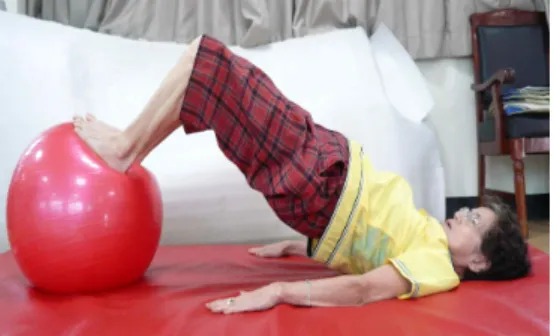
Figure 2. Supine bridging exercise on ball condition.
BALL2), now available through various companies in different qualities and sizes and even different shapes. The most commonly used sizes 45, 55, and 65 ㎝ diameter. Most of the balls can take a weight of 400 lb or more (Oetterli and Larsen, 1996). Since the balls roll very easily, therapists have to consider the safety of patients at all times, adjust and modify the exercises accordingly and observe common pre- cautions (Carrière, 1999). We used a size of 45 ㎝ diameter for Swiss ball exercise. All subjects were familiarized with the device and the proper position.
Procedures
Subjects began by lying supine on the floor with their feet on the WBV platform3)and Swiss ball, knees bent 90 degrees, toes facing forward and hands on the floor by their sides, palms facing down, pushing through the heels. Subjects lifted their pelvis off the ground to assume a bridging posture (Figure 1) (Figure 2). Feedback from instructor was given in or- der to achieve a consistent trunk and lower limb pos- ture during each 6 conditions (floor, 0, 1, 3, 5 intensity on WBV, and Swiss ball). Subjects were aimed to keep their spines neutral position with their leg parallel to their trunk during bridging. EMG data were col- lected for 5 seconds during the isometric portion of each different condition during bridging posture with their feet on the floor, WBV platform and Swiss ball.
Three trials of each of these exercise were recorded.
Statistical Analysis
All data were expressed as the mean and standard deviation. To analyze the differences in EMG data, the repeated one-way analysis of variance was used.
A Bonferroni's correction was used for multiple comparisons. The analysis of data was performed using SPSS version 12.0 program and significant level was set at α=.05.
Results
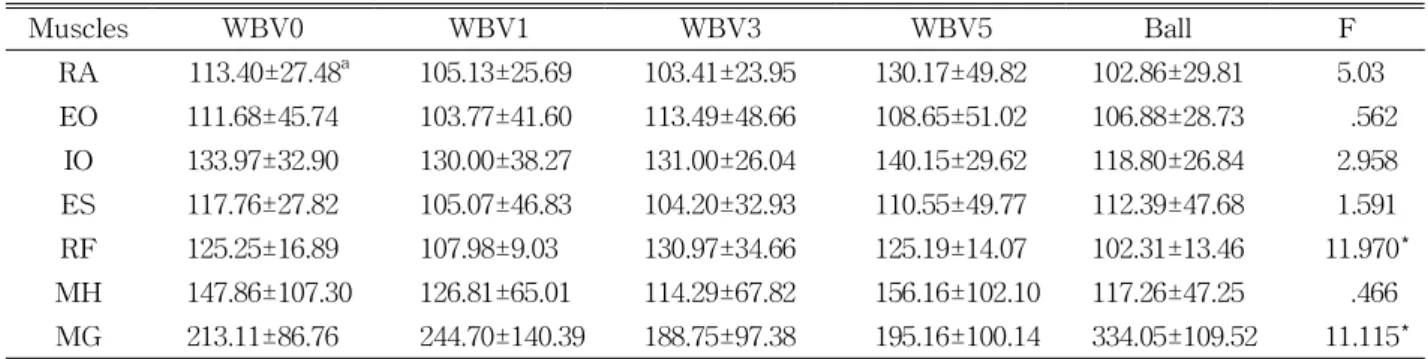
The study showed that EMG activity of the trunk muscles (RA, EO, IO, and ES) and MH muscles were not significantly different among 6 different conditions during bridging exercise (p>.05). However, there were sig- nificantly increased EMG activity of the RF (p=.034) in the WBV intensity 0, 1, 3, and 5 conditions compared with the floor bridging condition (Table 2) (Figure 3). EMG ac- tivity of the MG were significantly increased in the WBV intensity 0, 1, 3, 5 and Swiss ball conditions compared with the floor bridging condition (Table 2) (Figure 4).
Discussion
This study compared EMG activity of trunk and lower extremity muscles according to 6 different conditions (floor, 0, 1, 3, 5 intensity of WBV and
2) Swiss ball, LEDRAGOMMA, Osoppo, Italy.
3) BBSliner, SECO Inc., Bucheon, Korea.
Muscles WBV0 WBV1 WBV3 WBV5 Ball F RA 113.40±27.48a 105.13±25.69 103.41±23.95 130.17±49.82 102.86±29.81 5.03 EO 111.68±45.74 103.77±41.60 113.49±48.66 108.65±51.02 106.88±28.73 .562
IO 133.97±32.90 130.00±38.27 131.00±26.04 140.15±29.62 118.80±26.84 2.958 ES 117.76±27.82 105.07±46.83 104.20±32.93 110.55±49.77 112.39±47.68 1.591 RF 125.25±16.89 107.98±9.03 130.97±34.66 125.19±14.07 102.31±13.46 11.970*
MH 147.86±107.30 126.81±65.01 114.29±67.82 156.16±102.10 117.26±47.25 .466 MG 213.11±86.76 244.70±140.39 188.75±97.38 195.16±100.14 334.05±109.52 11.115*
aMean±SD, *p<.05.
RA: rectus abdominis, EO: external oblique, IO: internal oblique, ES: erector spinae, RF: rectus femoris, MH: medial hamstring, MG: medial gastricnemius.
Table 2. Comparison of the %RVC of the muscles intensity induced on WBV and Swiss ball during bridging exercise
Figure 3. The %RVC data of the rectus femoris muscle among different 6 conditions of WBV and Swiss ball during bridging posture (*p<.05).
Figure 4. The %RVC data of the medial gastrocnemius muscle among different 6 conditions of WBV and Swiss ball during bridging posture (*p<.05).
Swiss ball during bridging). The study showed that EMG activity of the trunk muscles (RA, EO, IO, and ES) were not significantly different among 6 differ- ent conditions during bridging exercise (p>.05).
Lehman et al (2005) showed that EMG activity of the RA, EO, IO, and ES muscles were not sig- nificantly different during bridging between on the floor and on the ball. Duncan (2009) reported that muscle activity was greater when exercises were performed on a Swiss ball in comparison to a stable surface and lower rectus abdominis muscle activity was maximized during the Swiss ball. Kim and Kim (2009) studied that the effect of bridging using
Swiss ball, whole body vibration (WBV), and mat on trunk and lower extremity muscle activity. And they found EMG activity of internal oblique increased sig- nificantly in WBV condition compared with mat con- dition (p<.05). However, Kim (2009) also reported that the IO, EO, and ES with feet on ball bridging and calf on ball bridging exercise showed sig- nificantly higher muscle activity than the floor bridg- ing exercise. A significantly higher level of ele- tromyographic activity appears in muscles during WBV treatment with respect to a rest condition whereas at the same time specific WBV frequencies also seem to produce a higher EMG-RMS signal
than others (Cardinale and Lim, 2003). Trunk rotation is controlled by internal oblique, external oblique, and transverse abdominals that runs obliquely or trans- versely than rectus abdominals that runs longitudi- nally (Hall and Brody, 1999; Neumann, 2002). This study utilized left-right vibration by WBV and Swiss ball during bridging with both feet fixed. Therefore trunk rotation was less than one leg lifting so that no difference in trunk muscle activity was observed.
This study found significantly increased EMG activity of the RF (p=.034) in the WBV intensity 0, 1, 3, and 5 conditions compared with the floor bridging condition.
EMG activity of the MG was significantly increased in the WBV intensity 0, 1, 3, 5 and Swiss ball conditions compared with the floor bridging condition.
Kim and Kim (2009) reported that EMG activity of rectus femoris and medial gastrocnemius in- creased significantly in Swiss ball condition and WBV condition compared with mat condition (p<.05). The muscle activity of medial hamstrings increased significantly in Swiss ball condition com- pared with mat condition (p<.05).
Rees et al (2008) suggested that average strength gains following eight weeks of WBV training were larger for ankle plantar flexors than for knee and hip flexors and extensors. WBV induced larger gains in ankle plantar flexor strength than in more proximal leg musculature. This result is in accordance with research findings of Blottner et al (2006) demonstrat- ing that vibration applied at the foot predominantly recruits the calf musculature to dampen the stimulus.
Especially, the EMG activity of MG on the Swiss ball condition was the highest compared to other WBV conditions. This result showed that Swiss ball condition was due to the distal instability.
This study showed that EMG activity of low ex- tremity was not significantly different among four intensity (0, 1, 3, 5) conditions of WBV during bridg- ing exercise (p>.05). However, Kim and Choi (2009) showed that EMG activity of the trunk muscles was not significantly different among three intensity con- ditions (1, 3, 5) of WBV during bridging exercise
(p>.05). However, there were significantly increased EMG activity of the medial hamstring muscle (p=.001) and medial gatrocnemius muscle (p=.027) in the in- tensity 3 condition compared with the intensity. These two different results of similar studies seems that participants were heathy young men and elderly women. Scaglioni et al (2002) suggested that aging and disuse attenuates motorneuron excitability and causes structural changes to the muscle spindle.
Therefore, the muscle spindle most older individuals may be less sensitive to the vibration because of fiber composition and reflex deterioration that occurs with natural aging (Lexell, 1997; Liu et al, 2005). Bogaerts et al (2007) reported that there were no changes in response strength in any WBV condition, suggesting that training has no effect on central processing, in- cluding encoding direction and amplitude of the trans- lation and initiating the appropriate response.
In this study, the effect of stability exercise was investigated by inducing trunk instability with WBV and Swiss ball during bridging in elderly women.
There were no significant trunk muscle activity dif- ferences with six different exercise conditions. EMG activity of the RF in the WBV intensity 0, 1, 3 and 5 conditions compared with floor bridging condition.
EMG activity of the MG was significantly increased in the WBV intensity 0, 1, 3, 5 and Swiss ball con- ditions compared with the floor bridging condition.
This results can be interpreted that the effect of stability by inducing instability with WBV and Swiss ball was lager for distal muscle than more proximal and trunk muscle. This results can be in- terpreted that the effect of stability by inducing in- stability with WBV and Swiss ball was larger for distal muscle than proximal and trunk muscle.
Future studies are required using various vibration intensity including trunk instability such as one leg lifting in bridging during WBV and Swiss ball.
Because muscle activity was measured only in domi- nant lower extremity, the change of muscle activity in non-dominant lower extremity was not determined. Consistency of EMG activity varied in
elderly women. These limitation should be considered in future studies.
Conclusion
This study compared EMG activity of trunk and lower extremity muscles according to 6 different con- ditions (floor, 0, 1, 3, 5 intensity of WBV and Swiss ball during bridging). The study showed that EMG activity of the trunk muscles (RA, EO, IO, and ES) and MH muscles were not significantly different be- tween 6 different conditions during bridging exercise (p>.05). However, there were significantly increased EMG activity of the RF in the WBV intensity 0, 1, 3, and 5 conditions compared with the floor bridging condition (p=.034). EMG activity of the MG were sig- nificantly increased in the WBV intensity 0, 1, 3, 5 and Swiss ball conditions compared with the floor bridging condition. This study indicates that distal muscle rather than proximal and trunk muscle was affected greatly by inducing instability with WBV and Swiss ball. Further studies are required the dynamic instability condition such as one leg lifting in bridging. It is suggested that long term functional outcome rather than EMG muscle activity of trunk and low extremity should be considered in the future study.
References
Blottner D, Salanova M, Püttmann B, et al. Human skeletal muscle structure and function preserved by vibration muscle exercise following 55 days of bed rest. Eur J Appl Physiol.
2006;97(3):261-271.
Bogaerts A, Verschueren S, Delecluse C, et al.
Effects of whole body vibration training on pos- tural control in older individuals: A 1 year randomized controlled trial. Gait Posture.
2007;26(2):309-316.
Bosco C, Cardinale M, Tsarpela O. Influence of vi- bration on mechanical power and electromyo- gram activity in human arm flexor muscles. Eur
J Appl Physiol Occup Physiol.
1999;79(4):306-311.
Bosco C, Iacovelli M, Tsarpela O, et al. Hormonal responses to whole-body vibration in men. Eur J Appl Physiol. 2000;81(6):449-454.
Bruyere O, Wuidart MA, Di Palma E, et al.
Controlled whole body vibration to decrease fall risk and improve health-related quality of life of nursing home residents. Arch Phys Med Rehabil.
2005;86(2):303-307.
Burke D, Schiller HH, Discharge pattern of single motor units in the tonic vibration reflex of hu- man triceps surae. J Neurol Neurosurg Psychiatry. 1976;39(8):729-741.
Cardinale M, Lim J. Electromyography activity of vastus lateralis muscle during whole-body vi- brations of different frequencies. J Strength Cond Res. 2003;17(3):621-624.
Cardinale M, Rittweger J. Vibration exercise makes your muscles and bones stronger: Fact or fic- tion? J Br Menopause Soc. 2006;12(1):12-18.
Cardinale M, Wakeling J. Whole body vibration ex- ercise: Are vibrations good for you? Br J Sports Med. 2005;39(9):585-589.
Carrière B. The swissball: An effective physiotherapy tool for patients, families and physiotherapist.
Physiotherapy. 1999;85(10):552-561.
Chen JC, Chang WR, Chang W, et al. Occupational fac- tors associated with low back pain in urban taxi drivers. Occup Med (Lond). 2005;55(7):535-540.
Cheung WH, Mok HW, Qin L, et al. High-frequency whole-body vibration improves balancing ability in elderly women. Arch Phys Med Rehabil.
2007;88(7):852-857.
Cochrane DJ, Sartor F, Winwood K, et al. A com- parison of the physiologic effects of acute whole-body vibration exercise in young and older people. Arch Phys Med Rehabil.
2008;89(5):815-821.
Cram JR, Kasman GS, Holtz J. Introduction to Surface Electromyography. Gaithersburg, Aspen Pub, 1998.
Crewther B, Cronin J, Keogh J. Gravitional forces and whole body vibration: Implications for pre- scription of vibratory stimulation. Physical Therapy in sports 2004;5:37-43.
Duncan M. Muscle activity of the upper and lower rectus abdominis during exercises performed on and off a Swiss ball. J Bodyw Mov Ther.
2009;13(4):364-7.
Hagbarth KE, Eklund G. Tonic vibration reflexes (TVR) in spasticity. Brain Res. 1966;2:201-203.
Hall CM, Brody LT. Therapeutic Exercise: Moving toward Function. 1st ed. Philadelphia, Lippincott Williams and Wilkins, 1999.
Harazin B, Grzesik J. The transmition of vertical whole-body vibration to the body segments of standing subjects. Journal of Sound and Vibration. 1998;215(4):775-787.
Horak FB, Shupert CL, Mirka A. Components of postural dyscontrol in the elderly: A review.
Neurobiol Aging. 1989;10:727-738.
Hung LK, Wu HT, Leung PC, et al. Low BMD is a risk factor for low-energy Colles' fractures in women before and after menopause. Clin Orthop Relat Res. 2005;435:219-225.
Issurin VB, Tenenbaum G. Acute and residual effects of vibratory stimulation on explosive strength in elite and amateur athletes. J Sports Sci.
1999;17(3):177-182.
Jordan MJ, Norris SR, Smith DJ, et al. Vibration training: An overview of the area, training con- sequences, and future considerations. J Strength Cond Res. 2005;19(2):459-466.
Józsa L, Kvist M, Kannus P, et al. The effect of te- notomy and immobilization on muscle spindles and tendon organs of the rat calf muscles. A histochemical and morphometrical study. Acta Neuropathol. 1988;76(5):465-470.
Kim MJ. Effect of bridging stabilization exercise on trunk muscle activity on off a Swiss ball.
Physical Therapy Korea. 2009;16(1):18-24.
Kim TH, Choi HS. EMG activities of trunk and lower extremity muscles induced by different intensity of whole body vibration during bridging exercise.
Physical Therapy Koera. 2009;16(4):16-22.
Kim TH, Kim EO. Effect of bridging exercise using Swiss ball and whole body vibration on tunk muscle activity and postural stability. J Korean Contents. 2009;9(12):348-356.
Klein-Vogelbach S. Ballgymnastik zur Funktionellen Bewegungslehre. Berlin, Springer Verlag, 1990.
Lehman GJ, Hoda W, Oliver S. Trunk muscle activ- ity during bridging exercises on and off a Swiss ball. Chiropr Osteopat. 2005;13:14.
Leung KS, Lee KM, Cheung WH, et al.
Characteristics of long bone DXA reference data in Hong Kong Chinese. J Clin Densitom.
2004;7(2):192-200.
Lexell. Evidence for nnervous system degeneration with advancing age. J Nutr 1997;127(5 Supp):1011-1013.
Liu JX, Eriksson PO, Thornell LE, et al. Fiber con- tent and myosin heavy chain composition of muscle spindles in aged human biceps brachii. J Histochem Cytochem. 2005;53(4):445-454.
Madau KH, Cronin JB. The effects of whole body vibration on physical and physiological capability in special populations. Hong Kong Physiother.
2008;26:24-38.
Neumann DA. Kinesiology of the Musculoskeletal System. 1st ed. St. Louis, Mosby, 2002.
Noris CM. Back stability. Champaign, Human ki- netics, 2000.
Oetterli S, Larsen C. Bewegungkoordination auf derm Ball. J Swiss Federation of Physiotherapis.
1996;6:23-35.
Perotto AE. Anatomical Guide for the Electromyographer: The Limbs and trunk. 3rd ed. Illinois, Thomas Books, 1996.
Qin L, Au SK, Leung PC, et al. Baseline BMD and bone loss at distal radius measured by periph- eral quantitative computed tomography in peri- and postmenopausal Hong Kong Chinese women.
This article was received October 10, 2010, and was accepted November 8, 20010
Osteoporos Int. 2002;13(12):962-970.
Rees SS, Murphy AJ, Watsford ML. Effects of whole-body vibration exercise on low- er-extremity muscle strength and power in an older population: A randomized clinical trial.
Phys Ther. 2008;88(4):462-470.
Richardson C, Toppeburg R, Jull G. An initial evalu- ation of eight abdominal exercises for their abil- ity to provide stabilization for the lumbar spine.
Aus J Physiother. 1990;36:6-11.
Richardson C, Jull G, Hodges P, et al. Therapeutic exercise spinal segment stabilization in low back pain. Edinburgh, Churchill Livingstone, 1999.
Rittweger J, Beller G, Felsenberg D. Acute physio- logic effects of exhaustive whole body vibration exercise in man. Clin Physiol. 2000;20(2):134-142.
Roelants M, Verschueren SM, Delecluse C, et al.
Whole-body-vibration-induced increase in leg muscle activity during different squat exercises.
J Strength Cond Res. 2006;20(1):124-129.
Scaglioni G, Ferri A, Minetti AE, et al. Plantar flex- or activation capacity and H reflex in older adults: Adaptations to strength training. J Appl Physiol. 2002;92(6):2292-2302.
Sherwin LM, Owende PM, Kanali CL, et al.
Influence of forest machine function on operator exposure to whole-body vibration in a cut-to-length timber harvester. Ergonomics.
2004a;15;47(11):1145-1159.
Sherwin LM, Owende PM, Kanali CL, et al.
Influence of tyre inflation pressure on whole-body vibrations transmitted to the oper- ator in a cut-to-length timber harvester. Appl Ergon. 2004b;35(3):253-261.
Torvinen S, Kannu P, Sievänen H Effect of a vi- bration exposure on muscular performance and body balance. Randomized cross-over study.
Clin Physiol Funct Imaging. 2002a;22(2):145-152.
Torvinen S, Kannus P, Sievänen H, et al. Effect of four-month vertical whole body vibration on performance and balance. Med Sci Sports Exerc.
2002b;34(9):1523-1528.