†Corresponding Author: Department of Computer Engineering, College of Engineering, Kongju National University, 1223-24 Cheonan-Daero, Seobuk-Gu, Cheonan, Chungnam 331-717, Korea, E-mail: [email protected] Tel:
041-521-9233
1 Department of Information and Communication Engineering, College of Engineering, Hannam University, 133 Ojeong-dong, Dedeok-Gu, Daejeon 306-791, Korea, E-mail: [email protected], Tel: 042-629-7928
A hand-off mechanism of mobile nodes in a location positioning system based on ZigBee tags
Seong Bae Eun
1· Yi Geun Chae
†(Received January 21, 2014; Revised February 10, 2014;Accepted February 17, 2014)
Abstract: Location awareness is one of the key functions to build an U-city. Recently, many of works for the lo- cation-aware systems are emerging to be applied to on-going large-scale apartment complex. For example, when dwellers or cars with active tags are move in the apartment complex, the active tags broadcast their own identi- fiers periodically and receivers such that routers use this information to calculate the location of the active tags.
Since the active tags can actually move between routers and coordinators, it requires a hand-off mechanism. In this paper, we investigate the hand-off problem occurred in location awareness system based on ZigBee active tags. We propose and analyze a new approach for handling the hand-off problem. Through a mathematical analy- sis, we show that our approach diminishes the quantity of packet transfer than ZigBee's approach.
Keywords: ZigBee Tag, Location Awareness, RSSI, Vehicle Location Awareness, Resident Location Awareness
1. Introduction
ZigBee [1] is one of the key technologies to realize U-city. The main characteristics of ZigBee can be counted low cost and low power consumption. We can use for more than several months or a couple of years with small sized battery such as AA type alkaline battery. And the cost of it is very cheap by three or four dollars now.
Because of these advantages, ZigBee is applied to various communication applications especially to change existing wired sensor network to be wireless and is getting into the spotlight in new radio applications. ZigBee is also studied into location posi- tioning system of resident or vehicles recently and it is near step at commercial application.
Research on location awareness began to get atten-
tion with entrance on the stage of radio communica- tion and many research results have been achieved in various field. The cellular phone with GPS is used for a long time [2][3]. The location awareness techniques based on RSSI (Received Signal Strength Indication) is generally used because it can recognize location only by strength of RF's power without any other special devices [4]-[8].
To recognize the location of residents or vehicles in
apartment complex for realizing U-city, the system sat-
isfies the following requirements. First, it must be able
to use in indoor environment such as underground
parking lot as well as outside environment. Next, a tag
has to be wearable or attachable. So it should be light
and simple. Finally, It can be in error by less than
several meters but power consumption is very im-
portant so that can be used for more than several months by small sized battery.
To satisfy these requirements, we propose a RSSI-based location awareness techniques using ZigBee tag. The proposed system is simple, satisfied with required low power consumption, and proper to required error range because it uses RF only. However, as ZigBee tag across routers or coordinators this caus- es a hand-off problem that happens to be stopped in communicating between them.
To solve this hand-off problem, ZigBee standard [9]
suggests reunion or path-search technique. But, they make another problem to leave dregs on address table in router or to spread path search packets over the network.
In this paper, we propose a new algorithm to solve the hand-off problem that is happened by a location awareness system based on ZigBee tag and RSSI. The proposed algorithm does not use the existing reunion method or path search technique. And we show that the technique pares down more greatly packet trans- mission burden than existing methods.
In Chapter 2, we describe related researches and de- fine hand-off problem in moving terminal nodes and propose a solution in Chapter 3. Implementation and analysis of location awareness system is explained in Chapter 4. Finally, we describe conclusions and further research directions in Chapter 5.
2. Related Works
2.1 Location awareness technique based on RSSI
Location awareness becomes a fundamental function in the mobile communication area. It is to position tar- get objects outdoor and/or indoor. GPS satellites are used for outdoor objects for a long time. And location awareness methods on mobile communication network is widely used which utilize response time interval be- tween mobile phone terminal and surrounding base sta-
tion transceiver system.
Location awareness techniques based on RSSI is al- so studied a lot because they can recognize the loca- tion of the target object by power level of RF without special device addition. In case of RADAR [4] system, it measures location with the radio strength of the known beacon nodes and its error range is in several meters. For the mobile network without beacon nodes, there are also a lot of researches. Moving object sends a signal and fixed receiving apparatus recognize the signal strength and then compute the location of send- er [5][6][8].
These methods are based on signal strength, but the algorithm which calculates location is different from each other. Elnahrawy presented experimental result that location awareness system based on RSSI has fun- damentally considerable amount of error range [6].
2.2 Signal Transmission Methods for Location Awareness
The location awareness based on RSSI is classified into two types according to who transmits signal. First, the router whose location is fixed and well known to all moving tags sends beacon signals, the moving nodes re- ceive and then analyze the signals for computing the their own positions. RADAR [4] used this method. The CC2431 chip [12] developed by Texas Instrument had a location awareness engine supporting for this method.
Second, the moving node broadcasts beacon signal, and the fixed routers receive it and central computer decides the location of the node[5][6].
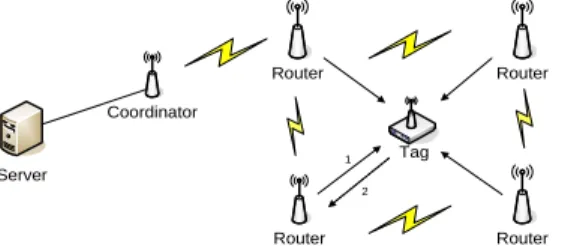
Figure 1 shows the former method that recognizes the location of target tag node with signal strengths transmitted by routers. Routers transmit beacon signals periodically and a target node may receive these signals. And then the tag node calculates its own loca- tion and sends it to router, finally server receives tag's location. To recognize correctly, tag node needs m sig- nal packets from routers and there must be packets re- ceived from more than three routers.
Figure 2 shows the latter method that tags transmit
Coordinator
Server
Router
Router
Router
Router
2
1 Tag
Figure 1: The method which routers send beacon sig- nals
the signal packets to recognize the location. The mov- ing tags broadcast signal and routers which receive the signal transmit the RSSI to server. As well as former method, tags broadcast m signal packets for reducing error range.
Coordinator
Server
Router
Router
Router
Router
1
Tag
Figure 2: The method which tags send beacon signals
Sun-Sup So and Seongbae Eun [10] show these ap- proaches recognize successfully the location of tags in the apartment complex and the efficiency of them is different depending on the density of tags. When the density of tags is high, the former method to recognize with signals transmitted by routers is more efficient. In the case of low density of tags, the former method to recognize with signals transmitted by tags is more efficient.
2.3 Hand-off Processing Technique in ZigBee The current ZigBee standard does not provide any algorithm to solve the hand-off problem caused in a inter-router or inter coordinator [9]. To solve the prob- lem in ZigBee standard, the re-connection method or path search method is used.
Router Area 1 Router Area 2 E1
E2 R1
C1
R2
E3
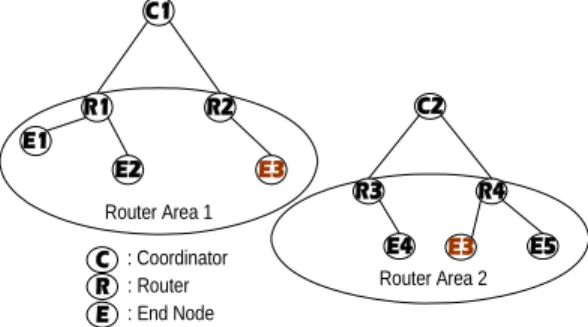
C : Coordinator : Router : End Node R E Figure 3: An example of inter-router hand-off
As shown in Figure 3, 'R1' and 'R2' routers exist in 'C1' coordinator area and end tag node 'E2' is currently connected to router 'R1'. If tag node 'E2' moves into router ‘R2’ area, then 'E2' requires hand-off to the router 'R2'.
ZigBee Standard’s re-connection method can be used for this example and the algorithm is as follows:
① 'E2' moves router ‘R2’ area physically.
② End-node 'E2' transmits data to 'R1' continuously, but 'E2' does not receive any ACK from ‘R1’ and ‘E2’
become aware of disconnecting from network.
③ 'E2' broadcasts 'Orphan Request' packet to con- firm which router has its own record in ZigBee’s Network Address Table.
④ If 'E2' receives no reply to 'Orphan Request', then 'E2' broadcasts 'Beacon Request' to the whole network.
⑤ Receiving replies to 'Beacon Request' from all surrounding routers, 'E2' selects the nearest router and transmits 'Association Request' to the router. It may be
‘R2’.
⑥ When 'R2' receives 'Association Request' from 'E2', 'R2' adds the address of 'E2' in its own Address Table and then sends 'Association Response' to 'E2'.
When the step ⑥ is finished, a network re-connect
is completed. This re-connection method based on
ZigBee standard has a severe shortcoming. This meth-
od requires robust address management technique be-
Router Area 1
E1
E2 R1
C1
R2 E3
Router Area 2
E3 E4 R3
C2
R4 C
: CoordinatorE5
: End Node : Router