A case report on the use of processed Glycyrrhiza uralensis extract and Korean medical treatment for a
patient with Amyotrophic Lateral Sclerosis(ALS)
※Eun Hye Cha
1,2, Seong Jin Lee
1,2, Ji In Lee
1,2, In Ja Song
3and Sung Chul Kim
1,2,*1Department of Acupuncture & Moxibustion Medicine, Wonkwang University Gwangju Korean Medical Hospital
2Nervous & Muscular System Disease Clinical Research Center of Wonkwang University Gwangju Korean Medical Hospital
3Department of Nursing, Gwang-Ju Womens University
[Abstract]
Objectives : The serum creatine kinase(CK) level of Amyotrophic Lateral Sclerosis(ALS) patients suggests that it may be an independent prognostic factor for the survival of ALS. We report the changes of serum CK level of ALS patients treated by administering processed Glycyrrhiza uralensis extracts and Korean medical treatments.
Methods : We provided an ALS patient with processed Glycyrrhiza uralensis extracts and Korean medical treatments including acupuncture, pharmacopuncture and herbal medicine. The serum CK level was checked every month. The changes of ALSFRS-R and MRC grade were checked every month for additional result.
Results : The serum CK level as the prognostic factor for the survival of ALS gradually decreased for three months. However, ALSFRS-R decreased by two points at the second trial. MRC rate had no change for three months.
Conclusion : Combined administration of processed Glycyrrhiza uralensis extracts and Korean medical treatment could be meaningful possibilities in the treatment of ALS. We should conduct further studies to solve the limitations of this case study.
※ This study was supported by the Traditional Korean Medicine R&D Program funded by the Ministry of Health & Welfare through the Korea Health Industry Development Institute(KHIDI) (HI11C2142).
✱ Corresponding author : Department of Acupuncture & Moxibustion Medicine, Wonkwang Gwangju Oriental Medical Hospital, 543-8, Juwol-Dong, Nam-gu. Gwangju, Republic of Korea Tel : +82-62-670-6441 E-mail : [email protected]
Key words : Amyotrophic lateral
sclerosis;
Glycyrrhiza uralensis;
Creatine kinase;
Korean medical
treatment
Received : 2016. 05. 11.
Revised : 2016. 05. 29.
Accepted : 2016. 06. 03.
On-line : 2016. 06. 20.
This is an Open-Access article distributed under the terms of the Creative Commons Attribution Non-Commercial License (http://creativecommons.org/licenses/by- nc/3.0) which permits unrestricted non-commercial use, distribution, and reproduction in any medium, provided the original work is properly cited.
The Acupuncture is the Journal of Korean Acupuncture & Moxibustion Medicine Society. (http://www.TheAcupuncture.org) Copyright 2016 KAMMS. Korean Acupuncture & Moxibustion Medicine Society. All rights reserved.
Ⅰ. Introduction
Amyotrophic lateral sclerosis(ALS) is a neurolog- ical disease of unknown origin characterized by se- lective degeneration and death of upper and lower motor neurons. It almost invariably progresses to paralysis and death over a 1~5 year time course. At present, there is no therapy that can reverse loss of functions1).
Until now, Riluzole remains the only medication with demonstrated efficacy and regulatory approval for the treatment of ALS. Although it is not a cure, research has shown that it can prolong survival for 2~3 months2). In addition, riluzole has no effects on rates of changes in functional capacity, muscle strength, respiratory function, or quality of life3). Thus, the development of novel drugs to treat ALS will be required.
Glycyrrhiza uralensis is a perennial legume con- taining 6~14 % glycyrrhizin components with a sweet flavor. It has been mostly used as a con- stituent of oriental medicine, so the safety of its use has already been proven. The key component ofGlycyrrhiza uralensis contains glycyrrhizin, gly- cyrrhetinic acid, liquilitin, and isoliquilitin, and it is used for medicinal effects such as of relieving pain, suppressing spasm, preventing cough, and loosening phlegm. It is widely known that Gly- cyrrhiza uralensis has pharmacological action such as anti-inflammatory action, a acting anal- gesic and anti-bacterial effect, etc4).
The diagnosis of ALS is mostly taken with clinical methods, so there is no diagnostic test or biomarker for this condition. The CK levels of some ALS patients may be elevated moderately. It is reported that 23~75 % of ALS patients experi- enced CK elevation5).
Therefore, we provided a hospitalized ALS patient with processedGlycyrrhiza uralensis ex- tract and Korean medical treatments such as acupuncture, pharmacopuncture and herbal medi- cine. The serum CK level was checked for a key in- dicator. The changes of ALSFRS-R and MRC grade
were also checked every month for additional in- dices. We reported the changes that appeared to ALS patient during hospitalized period.
Ⅱ. Case study
1. Patient
Im ○○, Man, 43 years
(Height : 174 cm, Weight : 73 kg)
2. Symptoms
Limb weakness, dysarthria, and fasciculation
3. Onset 2013.
4. Past medical history N/S
5. Family history N/S
6. Present medication
Individual antihypertensive drug. 1 T # 1
7. Present history
1) 2013. Lt. hand weakness onset
2) 2013. Winter Rt. leg weakness developed
3) 2014. 11. Lt. legtremordeveloped. C-spineMRI, EMG etc. ‘Motor neuron disease’ diagnosed.
4) 2015.3 Visiting Gwang-Ju Oriental Medical Hospital, Wonkwang University and had taken acupuncture treatment several times.
5) 2016. 1.4~2016.4.4
Gwang-ju Oriental Medical Hospital of Wonkwang University, received admission treatment
8. Examination views
1) ECG : Minimally abnormal or normal variation ECG
2) Neurological examination Mental sate : Alert pupil reflex : 2+/2+
Biceps reflex : → → Babinski sign : --
Dysarthria grade : 1
9. Korean medical diagnosis Wei symptom(痿證)
10. Treatment method
1) Processed Glycyrrhiza uralensis extract
ProcessedGlycyrrhiza uralensis extract (Gamcho extract powder Hanpoong) 4.32 g manufactured by
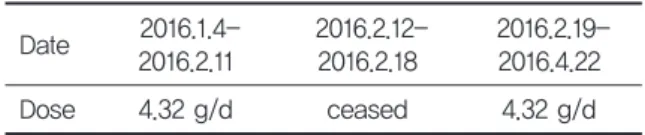
Hanpoong Co., Ltd. was applied from 2016.1.4 to 2016.4.22. (Notappliedduring2016.2.12.-2016.2.18.) Processed Glycyrrhiza uralensis extract was ad- ministered to the patient 30 minutes after lunch (Table 1).
2) Acupuncture & Pharmacopuncture (1) Acupuncture
Hua-Tuo-Jia-Ji-Xue acupuncture treatment was conducted by single-use 0.3 × 40 mm needles (DongBang acupuncture Inc, Korea) for 15 minutes.
Bulbarpalsytreatmentwasconductedbystimulat- ing the soft palate and applying acupuncture in GeumjinOkaekacupointsbysingle-use0.4 × 0.75 mm needles (DongBang acupuncture Inc, Korea).
(2) Pharmacopuncture
After checking for allergic reactions to a skin test, 0.1 cc of bee-venom pharmacopuncture (Jaseng pharmacopuncture institute, BV2) was ad- ministered equally on the acupoints of Hapgok (LI04)·Gokji(LI11)·Joksamni(ST36)·Taechung(L R03).
0.1 cc of Hominis placenta pharmacoacupunc- ture(Jaseng pharmacopuncture institute, C1-JH) was administered on the acupoints of Jungwan (CV04)·Gwanwon(CV12)
Table 1. Processed Glycyrrhiza uralensis extract ad- ministration
Date 2016.1.4-
2016.2.11 2016.2.12-
2016.2.18 2016.2.19- 2016.4.22
Dose 4.32 g/d ceased 4.32 g/d
Table 2. Herbal Medicine Treatment
Date Herbal medicine
2016.1.4~2.10
Curcuma longa 6 g, Salvia miltiorrhiza 6 g, Gastrodia elata 8 g, Chaenomeles sinensis 6 g, Polygala tenuifolia 6 g, Paeonia japonica 6 g, Atractylodes japonicam 6 g and processed Aconitum
carmichaeli(manufactured by Hanpoong Co., Ltd. Aconibal Tab.) 2016.2.17.~3.1
Panax ginseng 10 g, Astragalus membranaceus 10 g, Salvia miltiorrhiza 15 g, Chaenomeles sinensis 4 g, Crataegus pinnatifida 4 g, Amomum cadamomum Linne′4 g, Amomum villosum 4 g, Atracty- lodes japonica 8 g
2016.3.4~4.22
Curcuma longa 6 g, Salvia miltiorrhiza 6 g, Gastrodia elata 8 g, Chaenomeles sinensis 6 g, Polygala tenuifolia 6 g, Paeonia japonica 6 g, Atractylodes japonicam 6 g and processed Aconitum
carmichaeli(manufactured by Hanpoong Co., Ltd. Aconibal Tab.)
3) Herbal medicine
2016.1.4~2016.2.10 Prescription named‘加味芍藥 甘草附子湯’ was administered three times a day 30 minutes after each meal.
2016.2.17~2016.3.1 Another prescription was ad- ministered three times a day 30 minutes after each meal due to general weakness.
2016.3.4~2016.4.22 Prescription named‘加味芍 藥甘草附子湯’ was administered three times a day 30 minutes after each meal.
11. Assessment & Result
It was the changes of serum Creatine Kinase level that was a primary result.
Serum creatine kinase level was checked every month (Table 3). The serum CK level was gradually decreased for three months.
Secondary result was changes of ALSFRS-R.
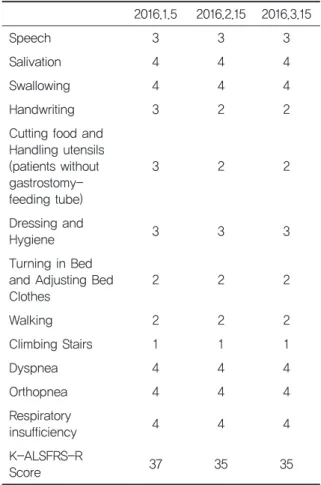
ALSFRS-R score was also checked every month (Table 4, 5). In this case, ALSFRS-R was two points
decreased in the second time period. The score measured in the second time was the same as the one in the third time.
Additional result was changes of MRC grade (Table 5). The score of MRC rate was no change.
Table 5. Changes of MRC grade
2016.1.4 2016.2.15 2016.3.15
right left right left right left
shoulder 4+ 4+ 4+ 4+ 4+ 4+
elbow 4+ 4+ 4+ 4+ 4+ 4+
wrist 4 4 4 4 4 4
finger 4+ 4+ 4+ 4+ 4+ 4+
hip 4+ 4+ 4+ 4+ 4+ 4+
knee 4+ 4+ 4+ 4+ 4+ 4+
ankle 4+ 4+ 4+ 4+ 4+ 4+
1sttoe 4+ 4+ 4+ 4+ 4+ 4+
Table 3. Changes of serum creatine kinase level
Date Creatine Kinase level
(reference value : 24-195)
2016.1.4 250.0H
2016.2.13 242.0H
2016.3.14 212.0H
Table 4. Changes of ALSFRS-R score
2016.1.5 2016.2.15 2016.3.15
Speech 3 3 3
Salivation 4 4 4
Swallowing 4 4 4
Handwriting 3 2 2
Cutting food and Handling utensils (patients without gastrostomy- feeding tube)
3 2 2
Dressing and
Hygiene 3 3 3
Turning in Bed and Adjusting Bed
Clothes 2 2 2
Walking 2 2 2
Climbing Stairs 1 1 1
Dyspnea 4 4 4
Orthopnea 4 4 4
Respiratory
insufficiency 4 4 4
K-ALSFRS-R
Score 37 35 35
Ⅲ. Discussion
Amyotrophic lateral sclerosis(ALS) is a neurode- generative disease characterized by dominant in- volvement of upper and lower motor neurons, leading to progressive weakness of bulbar, limb, thoracic and abdominal muscles. Within 2-4 years, it causes progressive and severe muscle weakness, eventually causing death due to respiratory muscle palsy6,7). No curative treatment is available ; there- fore, the mainstay of management is primarily supportive and symptomatic8).
It has been demonstrated that Glycyrrhiza uralensis has antiviral, antimicrobial, anti-in- flammatory, hepatoprotective, and blood pressure- increasing effectsin vitro and in vivo. Additionally, Glycyrrhiza uralensis may be effective in treating hyperlipidaemia and inflammation-induced skin hyperpigmentation. The antiulcer, laxative, an- tidiabetic, anti-inflammatory, immunomodulatory, antitumour and expectorant properties of Gly- cyrrhiza uralensis have been investigated. Also, Glycyrrhiza uralensis may also be useful in pre- venting neurodegenerative disorders9). So, it could be a possible substance for treating neural disease such as ALS. Glycyrrhizic acid is the major and bioactive substance ofGlycyrrhiza uralensis. Gly- cyrrhizic acid is neuroprotective in the post-is- chemic brain mainly through anti-excitotoxic and anti-oxidative effects. Recently, it was reported that Glycyrrhizic acid protects DPC12 cells against glutamate-induced neurotoxicity mainly through ERK and mitochondria-related pathways10). It is considered to be very important because the pathology of ALS is related to glutamate. Gluta- mate-induced excitotoxicity has lain at the core of theories behind the pathological mechanism of neurodegenerative disease, including mitochondrial dysfunction, oxidative stress, and protein aggre- gation, that lead to neurodegenerative cell death.
Riluzole, which possesses anti-glutamatergic properties, is approved as neuroprotective for ALS11). However, high intake ofGlycyrrhizauralensis
can cause hypermineralocorticoidism with sodium retention and potassium loss, edema, muscle weakness, increased blood pressure and depression of renin-angiotensin-aldosterone system12). The severity of symptoms depends on the dose and du- ration of licorice intake, as well as the individual susceptibility13). So, on this study, we checked a blood test every month to prevent the side-effects mentioned above.
Hua-Tuo-Jia-Ji-Xue(華佗夾脊穴) is located in about 0.5 Cun(寸) at both side of spinous process of each cervical, thoracic, lumbar and sacral vertebra.
It has a therapeutic effect for musculoskeletal dis- eases, and nervous system diseases14). Based on this, Hua-Tuo-Jia-Ji-Xue was selected to treat the above ALS patient.
Bee-venom, and hominis placenta pharmacop- uncture were used for relieving pain caused by joint contracture, treating muscle weakness, and strengthening the immune system. Lee et al. re- ported that pretreatment of neuronal and microglial cells with bee-venom significantly in- hibited glutamate-mediated toxicity. Therefore, bee-venom treatment could be useful for neurode- generative diseases such as ALS or motor neuron disease15). Also, it is reported thathominis placenta could be a potential treatment strategy in neuro- degenerative diseases. Hominis placenta signifi- cantly prevented cell loss and protected neurites against MPP+ toxicity16).
Gami-Jakyak Gamcho buja Decoction(加味芍藥 甘草附子湯) was administered above patient. Gami- Jakyak Gamcho buja Decoction was developed for treating amyotrophic lateral sclerosis patients with pain, joint contracture and muscular weak- ness. Jakyak-gamcho decoction has been used in traditional medicine to relieve pain, muscle spasms and cold syndrome due to blood deficiency17).
An elevated serum CK is considered as a marker of muscle damage. An obvious explanation of raised CK in ALS is muscle atrophy resulting from degeneration of motor neurons. The CK levels may then reflect severity of the underlying disease processandextentofmuscledenervation, inwhich
case a higher level may be associated with a worse prognosis18).
The Amyotrophic Lateral Sclerosis Functional Rating Scale(ALSFRS) and the revised version that includes respiratory function(ALSFRS-R) is the most widely used instrument to measure function in ALS clinical trials19).
When clinical progress of neuron motor disease is evaluated, it’s quite important to precisely measure muscular strength. The Manual Muscle Test of Medical Research Council (MRC) is tradi- tionally and widely used to evaluate muscular strength because of strong points of its simplicity and credibility20).
In this case study, the CK level of the ALS patient was measured every month, three times in total (for 3 months) and was gradually decreased.
Even though it didn’t reach normal figure and there is a limit that the CK level may not be an index that directly shows a progression of disease, the result of gradual decrease of CK level was shown. This means that muscle damage rate was gradually decreased for three months.
ALSFRS-R was used as additional indices (the total number of points is 48). When the score was measured in the second time, two points decreased.
The score measured in the second time was the same as the one in the third time. This means that the patient’scondition was aggravated 2016.1.5 to 2016.2.15. However, through the periods of 2016.2.15 to 2016.3.16, the patient’s condition was preserved. It seems that due to disorder of liver function, the patient’s condition was worsening temporarily. MRC scale was also used as another used as additional indices. Each score measured three times had no change. This means that mus- cular strength of this patient was maintained stable for three months.
During hospitalization periods, the patient had general weakness and liver somatic index slightly increased on February 13, 2016, so all the medica- tion had ceased for the periods of 2016.2.11~
2016.2.16 while only acupuncture treatment and pharmacopuncture were applied. When the pa-
tient's condition improved and liver somatic index didn’tincrease, the medication began again from February 17, 2016.
As mentioned before, high intake ofGlycyrrhiza uralensis and long-term administration can cause side effects such as hypocalemia and increased blood pressure. In this case study, potassium level and blood pressure remained stable. But liver so- matic index temporarily increased. When liver so- matic index was measured after administration of Glycyrrhiza uralensis, liver somatic index no longer increased(Table 6). Therefore, it appears that the increase of liver somatic index is irrelevant to administration ofGlycyrrhiza uralensis.
In this study, although ALSFRS-R was decreased two points, the serum CK level as the key indicator was gradually decreased. Furthermore, the MRC rate was retained stable. Therefore, we suspect that our findings could open up new clinical guide- line possibilities.
However, this study has its limitations on one case and setting control group as well as many kinds of oriental medication were applied at the same time, so it’s not clear which treatment is more effective among them. Moreover, even though CK level, ALSFRS-R, and MRC scale were set as a key indicator to catch up with progress, it has its limitation that they would not be figures which can objectively apprehend the progress.
As ALS is a rare incurable disease, a supportive and symptomatic treatment has been normally carried out until now. Because this study has an example with one patient, it’s hard to discuss sig- nificance about the effect of combined administra- tion of Glycyrrhiza uralensis and Korean medication treatment at the same time. However, as long as we steadily continue to conduct more Table 6. Changes of liver function test
AST(12-33) ALT(5-35) ALP(96-254)
2016.1.4 22.0 25.0 153.0
2016.2.13 27.0 46.0 136.0
2016.3.14 20.0 32.0 119.0
studies to yield concrete evidence, it is surely be- lieved that these researches help improvement of symptoms and life-extension for patients.
Ⅳ. References
1. C.Carlesi, L. pasquali, S. piazza et al.
Strategies for clinical approach of neurodegen- eartioninamyotrophiclateralsclerosis. Archives itallenes de bilologie. 2011 ; 149(1) : 151.
2. Richard W. Orell. Motor neuron disease : sys- tematic reviews of treatment for ALS and SMA.
British Medical Bulletin. 2010 ; 93(1) : 145-6.
3. Lacomblex L, Bensimon G, Leigh PN et al.
Dose-ranging study of riluzole in amyotrophic lateral sclerosis. Amyotrophic Lateral Sclero- sis/Riluzole Study group Ⅱ. Lancet. 1996 ; 347(9013) : 1425-31.
4. Yoon MY, Jun KI, Son ES et al. Induction of Glutathione S-transferase Activity by the Ex- tracts ofGlycyrrhiza uralensis Fischer. Appl Biol Chem J. 2008 ; 51(3) : 228-9.
5. Gibson SB, Kasarskis EJ, Hu N et al. Relation- ship of creatine kinase to body composition, disease state, and logevity in ALS. Amyotroph Lateral Scler Frontotemporal Degener. 2015 ; 16(7-8) : 473-7.
6. Ince PG, Lowe J, Shaw PJ. Amyotrophic lateral sclerosis : Current issues in classification, pathogenesis and molecular pathology. Neu- ropathol Appl Neurobiol. 1998 ; 24(2) : 104-17.
7. Andersen PM, Abrahams S, Borasio GD et al.
EFNSguidelinesontheclinicalmanagementof amyotrophic lateral sclerosis (MALS)-revised report of an EFNS task force. Eur J Neurol.
2012 ; 19(3) : 360.
8. Bae JS, Hong YH, Baek W et al. Current status of the diagnosis and management of amy- otrophic lateral sclerosis in Korea : A multi- center cross-sectional study. J Clinical Neurol.
2012 ; 8(4) : 293-300.
9. Data of Electronic Media Morse SS. Wikipedia.
Liquorice. Available from : URL : https://en.
wikipedia.org/wiki/Liquorice.
10. D. Wang, T.Q. Guo, Z.Y. Wang et al. ERKs and mitochondria-related pathways are essential for glycyrrhizic acid-mediated neuroprotection against glutamate-induced toxicity in differ- entiated PC12 cells. Braz J Med Biol Res. 2014 ; 47(9) : 777-8.
11. Blasco H, Mavel S, Corcia P, Gordon PH. The glutamate hypothesis in ALS : pathophysiology and drug development. Curr Med Chem. 2014 ; 21(31) : 3551.
12. Jo SG, Im BG, Jo HG et al. Licorice induced hy- pokalemia. Kidney research and clinical prac- tice. 2001 ; 20(6) : 1021-5.
13. Park KA, Seok SJ, Kim SJ et al. A Case of licorice-Induced hypokalemic rhabdomyolysis in a patient using a diuretic drug. Korean J Med. 2011 ; 80(2) : 258.
14. Ahn SG, Lee SR, Yang YS. The treatise research on Hua-Tuo-Jia-Ji-Xue. The Acupuncture. 2000 ; 17(4) : 139.
15. Lee SM, Yang EJ, Choi SM et al. Effects of Bee Venom on Glutamate-Induced Toxicity in Neuronal and Glial Cells. Evid Based Comple- ment Alternat Med. 2012 ; 2012 : 368196.
16. Jeon HJ, Nam SS, Kim YS. Neuroprotection of Dopaminergic Neurons by Hominis placenta Herbal Acupuncture in in vitro and in vivo Models of Parkinson’s Disease Induced by MPP+/MPTP Toxicity. The Acupuncture.
2015 ; 32(1) : 23-36.
17. Guo L, Cho SY, Kang SS et al. Orthogonal array design for optimizing extraction effi- ciency of active constituents from jakyak- gamcho decoction, the complex formula of herbal medicines, paeoniae radix and gly- cyrrhizae radix. J Ethnopharmacol. 2007 ; 113(2) : 306-11.
18. M. K. Rafiq, E. Lee, M. Bradburnb. et al. Crea- tine kinase enzyme level correlates positively with serum creatinine and lean body mass, and is a prognostic factor for survival in amy-
otrophic lateral sclerosis. Eur J Neurol. 2016 ; 23(6) : 1071-8.
19. Cedarbaum JM, Stambler N, Malta E et al. The ALSFRS-R : a revised ALS functional rating scale that incorporates assessments of respira- tory function. BDNF ALS Study Group (Phase
III). J Neurol Sci. 1999 ; 169(1-2) : 13-21.
20. Kim SC, Na WM, Lim NR et al. A pilot clinical study on the Traditional Korean Medicine treatment of Amyotrophic lateral sclerosis. J pharmacopuncture. 2009 ; 12(1) : 59.
Appendix.
1. Speech
4) Normal speech processes.
3) Detectable speech disturbances.
2) Intelligible with reepeating.
1) Speech combined with nonvocal communications.
0) Loss of useful pseech.
2. Salivation 4) Normal.
3) Slight but definite excess of saliva in mouth ; may have nighttime drooling.
2) Moderately excessive saliva ; may have minimal drooling 1) Marked excess of saliva with some drooling.
0) Marked drooling ; requires constant tissue or handkerchief.
3. Swallowing
4) Nromal eating habits.
3) Early eating problems ; occasional choking.
2) Dietary consistency changes.
1) Needs supplemental tube feeding.
0) Nothing by mouth(NPO) ; exclusively parenteral or enteral feeding.
4. Handwriting 4) Normal.
3) Slow or sloppy ; all words are legible.
2) Not all words are legible.
1) Able to grip pen but unable to write.
0) Unable to grip pen.
5. Cutting Food and Handling Utensils(patients without gastrostomy-feeding tube) 4) Normal.
3) Somewhat slow and clumsy, but no help needed.
2) Can cut most foods, altough clumsy and slow ; some help needed.
1) Food must be cut by someone, but can still feed slowly.
0) Needs to be fed.
6. Dressing and Hygiene 4) Normal
3) Independent and complete self-care with effort of decreased efficiency.
2) Intermittent assistance or substitute methods.
1) Needs attendant for self-care.
0) Total dependence.
7. Turning in Bed and Adjusting Bed Clothes 4) Normal
3) Somewhat slow and clumsy, but no help needed.
2) Can turn alone or adjust sheets, but with great difficulty 1) Can initiate, but not turn or adjust sheets alone 0) Helpless.
8. Walking 4) Normal
3) Early ambulation difficulties.
2) Walks with assistance.
1) Non ambulatory functional movement only.
0) No purposeful leg movement.
1. ALSFRS-R
9. Climbing Stairs 4) Normal 3) Slow
2) Mild unsteadiness or fatigue.
1) Needs assistance.
0) Cannot do.
10. Dyspnea 4) Normal
3) Shortness of breath with minimal exertion(e.g. walking, talking) 2) Shortness of breath at rest.
1) Intermittent(e.g. nocturnal) ventilatory assistance required.
0) Ventilator dependent.
11. Orthopnea 4) Normal
3) Some difficulty sleeping at night due to shortness of breath. Does not routinely use more than two pillows.
2) Needs extra pillow in order to sleep.
1) Can only sleep sitting up.
0) Unable to sleep 12. Respiratory insufficiency 4) Normal
3) Intermittent use of BiPAP.
2) Continuous use of BiPAP.
1) Continuous use of BiPAP during the night and day.
0) Invasive mechanical ventilation by intubation or tracheostomy.
2. Modified MRC Grade
Modified MRC Grade Degree of Strength
5 Normal power
5- Equivocal, barely detectable weakness
4+ Definite but slight weakness
4 Able to move the joint against combination of gravity and some resistance
4- Capable of minimal resistance
3+ Capable of transient resistance but collapses abruptly
3 Active movement against gravity
3- Able to move against gravity but not through full range
2 Able to move with gravity eliminated
1 Trace contraction
0 No contraction