• 검색 결과가 없습니다.

Arterial Switch Operation in Patients with Intramural Coronary Artery: Early and Mid-term Results

N/A
N/A
Protected

Academic year: 2021

Share "Arterial Switch Operation in Patients with Intramural Coronary Artery: Early and Mid-term Results"

Copied!
8
0
0

로드 중.... (전체 텍스트 보기)

전체 글

(1)

*Department of Thoracic and Cardiovascular Surgery, Ajou University Hospital

**Department of Thoracic and Cardiovascular Surgery, School of Medicine, Pusan National University

***Department of Thoracic and Cardiovascular Surgery, St. Mary's Hospital, The Catholic University of Korea, School of Medicine

****Department of Pediatrics, School of Medicine, Pusan National University

†This work was supported for two years by Pusan National University Research Grant.

Received: September 25, 2010, Revised: November 11, 2010, Accepted: November 12, 2010

Corresponding author: Si Chan Sung, Department of Thoracic and Cardiovascular Surgery, School of Medicine, Pusan National University, Beomeo-ri, Mulgeum-eup, Yangsan 626-770, Korea

(Tel) 82-55-360-2560 (Fax) 82-55-360-2157 (E-mail) [email protected]

C

The Korean Society for Thoracic and Cardiovascular Surgery. 2011. All right reserved.

CC
This is an open access article distributed under the terms of the Creative Commons Attribution Non-Commercial License (http://creative- commons.org/licenses/by-nc/3.0) which permits unrestricted non-commercial use, distribution, and reproduction in any medium, provided the original work is properly cited.

Arterial Switch Operation in Patients with Intramural Coronary Artery: Early and Mid-term Results

Hyungtae Kim, M.D.*, Si Chan Sung, M.D.**, Si-Ho Kim, M.D.**, Yun Hee Chang, M.D.***, Hyo Yeong Ahn, M.D.**, Hyoung Doo Lee, M.D.****

Background: The intramural coronary artery has been known as a risk factor for early death after an arterial

switch operation (ASO). We reviewed the morphological characteristics and evaluated the early and mid-term results

of ASO for patients with an intramural coronary artery. Materials and Methods: From March 1994 to September

15th 2010, 158 patients underwent ASO at Dong-A and Pusan National University Hospitals for repair of trans-

position of the great arteries and double outlet right ventricle. Among these patients, 14 patients (8.9%) had an in-

tramural coronary artery. Mean age at operation was 13.4±10.2 days (4 to 39 days) and mean body weight was

3.48±0.33 kg (2.88 to 3.88 kg). All patients except one were male. Eight patients had TGA/IVS and 4 patients

had an aortic arch anomaly. Two patients (14.3%) had side-by-side great artery relation, of whom one had an in-

tramural right coronary artery and the other had an intramural left anterior descending coronary artery. Twelve pa-

tients had anterior-posterior relation, all of whom had an intramural left coronary artery (LCA). The aortocoronary

flap technique was used in coronary transfer in 8 patients, of whom one patient required a switch to the individual

coronary button technique 2 days after operation because of myocardial ischemia. An individual coronary button im-

plantation technique was adopted in 6, of whom 2 patients required left subclavian artery free graft to LCA during

the same operation due to LCA injury during coronary button mobilization and LCA torsion. Results: There was 1

operative death (7.1%), which occurred in the first patient in our series. This patient underwent an aortocoronary

flap procedure for coronary transfer combining aortic arch repair. Overall operative mortality for 144 patients without

an intramural coronary artery was 13.2% (19/144). There was no statistical difference in operative mortality between

the patients with and without an intramural coronary artery (p>0.1). There was no late death. The mean follow-up

duration was 52.1±43.0 months (0.5 to 132 months). One patient who had a subclavian artery free graft required

LCA stenting 6.5 years after surgery for LCA anastomotic site stenosis. No other surviving patient needed any in-

tervention for coronary problems. All patients had normal ventricular function at latest echocardiography and were in

NYHA class 1. Conclusion: The arterial switch operation in Transposition of Great Arteries or Double Outlet Right

Ventricle patients with intramural coronary can be performed with low mortality; however, there is a high incidence

of intraoperative or postoperative coronary problems, which can be managed with conversion to the individual coro-

nary button technique and a bypass procedure using a left subclavian free graft. Both aortocoronary flap and in-

dividual coronary button implantation techniques for coronary transfer have excellent mid-term results.

(2)

Key words: 1. Congenital heart disease

2. Transposition of the great arteries 3. Arterial switch operation

4. Coronary artery

5. Coronary artery anatomy

INTRODUCTION

An arterial switch operation (ASO) is becoming a standard treatment for transposition of the great arteries (TGA) and some cases of a double outlet right ventricle (DORV) due to good long term results and a low mortality rate. The most important element for successful ASO is accurate coronary artery implantations. However, the origin or course of an un- usual coronary artery can make it difficult to perform ASO and can produce poor surgical results in some cases. Among the unusual coronary arteries, the intramural coronary artery is well known for being difficult to transplant and a risk fac- tor for postoperative coronary artery complications [1-4]. In this study, we analyzed the incidence of the intramural coro- nary artery, its morphological characteristics, operative techni- ques, and postoperative early and mid-term results.

MATERIALS AND METHODS

Among the 158 patients who had undergone ASO at our- hospital between March of 1994 and September 15, 2010, we retrospectively reviewed the medical records of the 14 pa- tients (8.9%) with intramural coronary artery. The mean age was 13.4±10.2 days (4 to 39 days), and the mean body weight was 3.48±0.33 kg (2.88 to 3.88 kg). All patients but one were male. Eight patients (57.1%) had TGA with an in- tact ventricular septum, three patients (21.4%) had TGA with ventricular septal defect (VSD), and three patients had a Taussig-Bing anomaly. Among the latter patients, 4 patients (28.6%) had aortic arch anomaly simultaneously. Preoperative mechanical ventilation was performed in 4 patients (28.6%), Prostaglandin E1 was infused in 12 patients (85.7%), and bal- loon atrioseptostomy was performed in 6 patients (42.9%) (Table 1). 12 patients (85.7%) had an anterior-posterior great

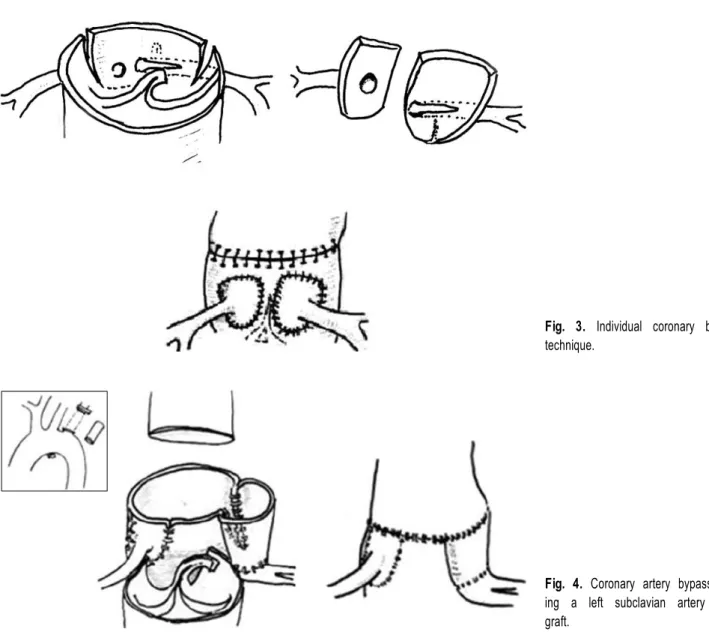
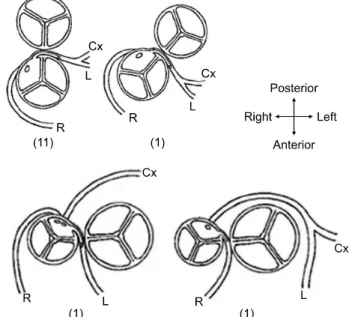
arterial relation, and all of them had interamural left coronary arteries. Two patients (14.3%) showed a side-by-side arterial relation. One of them had an intramural right coronary artery and the other, an intramural left anterior descending coronary artery (Fig. 1). There was no case of definite diagnosis of in- tramural coronary artery preoperatively, the diagnosis was confirmed in an operating room. The aortocoronary flap tech- nique was applied to 8 patients and the individual coronary button technique to 6 patients. There were no special in- dications for the aortocoronary flap technique or individual coronary button technique. The aortocoronary flap technique tended to be applied more frequently in the earlier cases of ASO, while the individual coronary button technique was used more often in the recent ASO procedures. In all cases, we performed the aortocoronary flap technique or individual coronary button technique after detaching the facing aortic commissure from the posterior aortic wall and two or three coronary arteries as one button from the aorta. In the cases of the aortocoronary flap technique, we anastomosed the coro- nary artery flap to the main pulmonary artery at the same level as the coronary artery flap after removing a rectangular portion of the incised main pulmonary artery adjacent to the coronary artery flap as wide as the coronary artery flap. After that, we fully covered the coronary artery flap with autolo- gous pericardium and attached the coronary artery flap to the distal aorta, which allowed blood to run from the aorta to the coronary artery flap (Fig. 2).

In order to cover the coronary artery flap, we used fresh

autologous pericardium in 5 cases, autologous pericardium

fixed with Glutaldehyde in 2 cases, and bovine pericardium

in the one earliest case. In the cases of the aortocoronary flap

technique, we did not unroof the anterior wall of the intra-

mural coronary artery at all. In the cases of the individual

coronary artery button technique, after dissecting some of the

(3)

Age (days) 13.4±10.2 (4∼39)

Sex (M : F) 13 : 1

Weight (kg) 3.48±0.33 (2.88∼3.88) Diagnosis

TGA with IVS 8 (57%)

TGA with VSD 3 (21%)

Taussig-Bing anomaly 3 (21%) Aortic arch anomaly 4 (29%) Preoperative ventilator 4 (29%) Preoperative PGE1 infusion 12 (86%) Preoperative atrial septostomy 6 (43%)

TGA=Transposition of the great arteries; IVS=Intact ventricular septum; VSD=Ventricular septal defect; PGE1=Prostaglandin E1.

Fig. 1. Great artery relation and coronary artery patterns. ( )=

Number of patients.

Fig. 2. Aortocoronary flap technique.

facing commissure from the aortic wall, we fully unroofed the anterior wall of the intramural coronary arteries and then divided them into one button from the aorta. After that, we divided this button into two and performed the reconstruction of a neoaorta following the Lecompte maneuver. Relieving an aortic clamp could inflate the neoaorta. Therefore, we could identify and mark the site for the two coronary buttons and transfer them (Fig. 3).

Postoperative management was done in the same way as normal ASO, and we performed delayed sternal closures in 11 of 13 patients who had survived after their operations.

The mean cardiopulmonary bypass time was 256.9±45.0 mi- nutes (157 to 319 minutes) and aortic cross clamp time was 154.4±39.7 minutes (82 to 209 minutes). Mean postoperative mechanical ventilation time was 162.7±120.5 hours (40 to 408 hours), and mean postoperative hospitalization time was 18.7±7.6 days (12 to 34 days). All mean values are presented as mean±SD and the difference of frequency was analyzed with the Chi-square test using MedCalc version 7.0 (MedCalc Software bvba, Belgium) program. We regarded a p-value less than 0.05 as statistically significant.

RESULTS

There was one operative death (7.1%). The case was the first patient in this series who had undergone the aortocoro- nary flap technique with the correction of the aortic arch anomaly. The operative mortality of the 144 patients who did not have an intramural coronary artery was 13.2% (19 of

144), and there was no significant statistical difference (p>

0.1). One of 8 patients who had undergone the operation with

the aortocoronary flap technique had a coronary artery re-

implantation using the individual coronary button technique

due to myocardial ischemia on postoperative day 2. There

were 2 failures of the left coronary artery transfer among the

6 patients undergoing the individual coronary button

technique. There was one intramural left coronary artery in-

jury while dividing the coronary artery button from the aorta,

so a coronary bypass graft was done by using a left sub-

clavian artery free graft to the left main coronary artery. The

other patient suffered from left ventricular ischemia after the

individual coronary button technique, so a coronary bypass

(4)

Fig. 3. Individual coronary button technique.

Fig. 4. Coronary artery bypass us- ing a left subclavian artery free graft.

graft was performed using a left subclavian artery free graft to the left main coronary artery (Fig. 4). For these reasons, there were three failures of planned coronary artery transfer among the total of 14 patients, and other surgical techniques were needed. The mean follow-up period was 52.1±43.0 months (0.5 to 132 months), and there was no long term death during the period. The patient who had undergone cor- onary artery bypass grafting using a left subclavian artery free graft had a stent graft insertion in the left coronary ar- tery due to the stenosis of the anastomotic site 6.5 years lat- er; now the patient is maintaining good ventricular function without any problems. There was no invasive treatment or re- operation by complications of the coronary artery in the re-

maining survivors. All the surviving patients showed normal

ventricular function in their last echocardiography, and they

are now in the state of NYHA class 1. Four patients had

postoperative cardiac catheterizations, in one case by the aor-

tocoronary flap technique at postoperative 18 months, in 2

cases by a left subclavian artery free graft at postoperative 21

months and 78 months, and in one case by the individual

coronary button implantation technique at postoperative 22

months. In one case in which a left subclavian artery free

graft was performed, left main coronary artery stenosis was

identified, so a stent graft insertion was performed. The re-

maining three patients had no stenosis of the coronary artery

(Fig. 5). Recently, multislice CT scans (SOMATOM defi-

(5)

Fig. 5. Postoperative coronary an- giography. (A) 18 months after an aortocoronary flap, (B) 21 months after a left subclavian free graft by- pass, (C) 22 months after the dou- ble button technique.

Fig. 6. Postoperative multislice CT scan. (A) 10.4 years after the aor- tocoronary flap procedure, (B) 11.4 years after a left suclavian artery free graft bypass and 4.9 years af- ter left coronary artery stenting.

nition flash, Siemens) were performed in the 4 patients. One patient who had undergone a coronary artery bypass graft us- ing the left subclavian artery free graft and a stent insertion 6.5 years later underwent a CT scan at postoperative 11.4 years and the remaining three patients who had undergone the aortocoronary flap technique had scans at postoperative 10.4 years, 5.6 years, and 2.6 years. None of the CT scans showed any stenosis of the coronary artery (Fig. 6).

Therefore, we could observe the postoperative state of the coronary arteries in 7 of the 14 patients by cardiac catheter- izations or multislice CT scans, and there was no coronary artery stenosis except in one patient who had undergone a coronary artery bypass graft using the left subclavian artery free graft.

DISCUSSION

An intramural coronary artery is a case in which some of the coronary artery is inside the aortic wall, that is, a form of the coronary artery in which its media is attached to the aorta

without separation from the adventitia. An intramural coro- nary artery is very rare in a normal ventricular – great vessel relation;, however, a frequency of 3 to 7% in TGA has been reported [2,4-6]. In our series, 14 intramural coronary arteries were identified among 158 TGA patients (8.9%), which showed a little higher incidence. Metton et al. [2] reported that 46 of 919 patients who had undergone ASOs (5%) had an intramural coronary artery, and the ratio of males to fe- males was 35 to 11, which demonstrated predilection of TGA toward males. On the other hand, in our series, the ratio of male to female among all cases of ASO was 23 to 8, or about 75% male; all but one patient were male; that is, there was a strong predilection of intramural coronary artery toward males.

Intramural coronary artery can appear in the right coronary

artery or the left coronary artery, but it usually appears in the

left main coronary artery or the left anterior descending coro-

nary artery. Among our cases, the majority of cases were in

the left main coronary artery and each case was detected in

the left anterior descending coronary artery and the right cor-

(6)

onary artery respectively. In terms of the great arteries’ rela- tion and the morphology of the intramural coronary artery, most intramural coronary arteries can be detected between the great arteries. In our series, 12 patients of 14 who had an in- tramural coronary artery had an anterior-posterior great arte- rial relation and the left coronary artery came from sinus 2 and ran between the great arteries in all of them. The remain- ing 2 patients had a side-by-side great arterial relation. In one of them, the right coronary artery came from sinus 2 and ran between the great arteries, while the left anterior descending artery came from sinus 2 and ran between the great arteries in the other case. Moreover, all the cases had a right and left coronary artery ostia which came from the coronary sinus 2 (Fig. 1) Asou et al. [5] reported 5 types of intramural coro- nary artery in 12 cases, which were more varied than ours.

They reported as many as 5 forms of the left main coronary artery from sinus 2 and 4 forms of the left anterior descend- ing coronary artery from sinus 2. Six of 9 patients had steno- sis in the left main coronary artery or the left main coronary artery. Two other patients had intramural coronary arteries originating not from the wrong aortic sinus but from the nor- mal aortic sinus, but they originated from a site a bit higher than usual and ran intramurally. The remaining patient had intramural left and right coronary arteries with only one os- tium in the facing comissure superiorly. However, in our ser- ies, all of the intramural coronary arteries originated from the wrong aortic sinus and had a separate coronary ostium.

Metton et al. [2] reported that among 46 cases, there were in- tramural main coronary arteries in 61%, intramural left ante- rior descending arteries in 26%, intramural right coronary ar- teries in 6.5% and intramural left and right coronary arteries in 6.5%.

In cases in which the intramural left main coronary artery or intramural left anterior descending coronary artery origi- nated from between the great arteries, during the dissection of the coronary artery from the aorta, inexperienced surgeons can damage the left main or anterior descending coronary ar- tery, which looks like a normal coronary artery from sinus l.

For that reason, Metton et al. [2] noted that in case of trans- verse aortotomy, a safe region should first be incised partially and the rest of aortotomy should then be performed after the identification of the coronary arteries. Asou et al. [5] strongly

suspected the existence of an intramural coronary artery in cases where there was no outward typical ostial bulging. The authors believe that if the left coronary artery does not origi- nate from the aortic sinus bulging outwardly, there is a possi- bility of an intramural coronary artery. Furthermore, if after a transverse aortomy, there isn’t a left coronary artery ostium in sinus 1, we strongly suspect an intramural left coronary ar- tery, and we also consider the possibility of a small hiding left coronary artery ostium immediately right to the facing commissure. These are important factors that unexperienced surgeons must keep in mind. In fact, the authors experienced many difficulties with the coronary artery transfer of intra- mural coronary arteries during the earlier cases of ASO. In the first case of our series, we caused damage to the left cor- onary artery during division of the coronary artery from the aortic wall, and thus repaired the damage and performed a coronary artery bypass graft using an aortocoronary flap technique. Nonetheless, the patient died. In the other one case, we caused an injury to the left main coronary artery, but overcame the difficult situation by performing a coronary artery bypass graft using a left subclavian artery free graft.

We found we could not safely detach a coronary artery from the aortic sinus without removal of some portion of the facing commissure because intramural coronary arteries usu- ally originate from the wrong aortic sinus and they are lo- cated very close to the facing commissure. Furthermore, the originating part is very closely located to the other coronary artery (the right coronary artery), not to the intramural coro- nary artery, dividing these two originating sites is not an easy task, and the possibility of stenosis or torsion after anasto- mosis to the neoaorta is higher because an undue division without unroofing the aortic wall of the intramural coronary artery can result in a lack of sufficient tissue for anastomosis.

Owing to these anatomical characteristics, a coronary artery

transfer can be difficult, and its postoperative course can be

poor. In order to overcome these problems, several coronary

artery implantation methods have been introduced. First, the

aortocoronary flap technique is a method of dividing the left

and right coronary arteries as one button from the aortic wall,

to anastomose the upper edge of the button to the incised

main pulmonary artery, and to keep the coronary blood flow

from going through a neoaorta by covering this flap with au-

(7)

Sometimes, the reconstruction of a neoaorta can be performed first and then, the transverse neo-aortomy at the same level as the upper border of the coronary artery flap and some tis- sue removal of the neoaorta can be performed before anasto- mosing the upper edge of the flap to the neoaorta and cover- ing the flap with autologous pericardial tissues [7]. The aorto- coronary flap technique is easy to perform and to minimize the torsion of the coronary artery due to the minimum geo- metric changes of the left and right coronary arteries.

However, the coronary artery ostium can be compressed by a neopulmonary artery and in the long term, there is the possi- bility of coronary arterial stenosis when the covering tissues do not grow or shrink. Actually, Asou et al. [5] used this method in the beginning of the intramural coronary artery transfer process and Metton et al. [2] reported that they used this method when the left and right coronary arteries were lo- cated too closely to divide them; however, this method caused coronary events more often than the individual coro- nary button technique. In our experiences, the aortocoronary flap technique has been used since ASO was first introduced without big problems; however, we have drastically used the individual coronary button technique since the one case of conversion to the individual coronary button technique due to myocardial ischemia on the second postoperative day after aortocoronary flap technique (since January, 2009). When the two coronary arteries originate from the same sinus, dividing the coronary arteries with too short an intramural course or something other than an actual intramural coronary artery into an individual coronary button can be dangerous, so we usu- ally use the aortocoronary flap technique. The second method for intramural coronary transfer is the individual coronary button technique. We divide two individual coronary arteries each into button and detach them, then transfer the coronary arteries using the technique of usual ASO. We would like to emphasize the two important surgical techniques in this method. One is that at the time of division of the two coro- nary arteries from the aortic sinus, we must obtain enough si- nus 1 tissue near the left commissure and sufficiently unroof the aortic wall of the intramural coronary artery after partial detachment of the facing commissure from the aortic wall.

This is in order to obtain enough of the aortic cuff of both

two coronary buttons. Furthermore, it is also important to identify the extent of unroofing the aortic wall by inserting a coronary probe into the intramural portion of a coronary artery. The other important technique in this method is that for coronary transfer to a neoaorta, at first, the reconstruction of a neoaorta has to be performed, then, inflating the neoarta by declamping the aorta and choosing the right location and direction for the left and right coronary transfer should be carried out. This method is for coronary button transfer to an adequate location. The authors were able to overcome a my- ocardial ischemia, which had occurred after using the in- dividual coronary button technique early in our experience, by performing a bypass between the aorta and the left main coronary artery using a left subclavian artery free graft.

Besides, the technique of keeping perfusion from a neoaorta to the coronary arteries using the aortic wall or other grafts without coronary transfer has been reported [8,9]; however, this is not usually done.

The surgical results of TGA with an intramural coronary

artery are very different among institutions. According to a

paper which was presented from Royal Children’s Hospital in

Australia in 1994 by Asou et al. [5], 12 of 259 patients who

underwent ASO had an intramural coronary artery and there

was no operative or long term postoperative death. According

to the report which Blume et al. from the Boston Children

Hospital in 1999 [10], there were 4 intramural coronary ar-

teries of a total of 223 patients, and one of them died. There

were 12 intramural coronary arteries of 168 patients and no

death, according to the relatively recent results of ASO re-

ported by Qamar et al. from C.S. Mott Children’s Hospital in

2007. On the other hand, the results of ASO which per-

formed at Green Lane Hospital in New Zealand until 1999

noted 11 intramural coronary arteries of 244 patients and 4

postoperative deaths [4]. According to the results presented

by Metton et al. [2] from Hospital for Sick Children of the

University of Paris Descartes, there were 46 patients with in-

tramural coronary arteries of 919 who underwent ASO, and

13 patients died, which corresponded to a 28% of mortality

rate. This mortality rate was very high, when compared with

that (3.9%) of the patients without intramural coronary artery

in the same period. They reported that there had been no

(8)

change in the mortality rate, even in recent years.

There are few published long term results of ASO in pa- tients with intramural coronary arteries. According to the long term results of ASO from Green Lane Hospital, there was no late mortality after ASO in patients with intramural coronary arteries [4]. However, Metton et al. reported that two patients died at postoperative day 51 and day 105, and 8 patients of 33 survivors had intramural coronary arteries, and fur- thermore, 5 of them had reoperations due to an intramural coronary artery. They reported that the actuarial freedom from a coronary event of these patients for ten years would be 46%. Sachweh et al. [11] reported that they found an intra- mural coronary artery in 5 patients (1.4%) of 351 who under- went ASO, and they transferred the intramural coronary ar- tery as one button without unroofing the aortic wall. They al- so reported that, though there were neither operative mortality nor myocardiac ischemia, intramural coronary artery ob- structions were identified by coronary angiograms that were performed at postoperative 5, 16, and 53 months later, and 2 of the patients had operations for a coronary artery bypass graft using an internal mammary artery.

In this series, the mortality rate of ASO in patients with an intramural coronary artery was lower than that of the other patients undergoing ASO, but the difference was statistically insignificant. There was no late mortality. We observed the postoperative coronary state with a coronary angiography or CT scan in 7 of the 14 total patients, and one patient needed an invasive coronary artery intervention. Even the patients without symptoms could have a coronary abnormality, so we think close follow-up is needed for these patients.

CONCLUSION

In TGA with an intramural coronary artery, ASO could be performed with a low mortality rate. However, myocardial is- chemia related to the coronary artery transfer occurred during the operative or postoperative period with a high incidence.

This problem could be managed by the conversion to the in- dividual coronary button implantation technique and a coro- nary artery bypass graft using a subclavian artery free graft.

Both an aortocoronary flap and the individual coronary button implantation technique for coronary transfer have excellent mid-term results.

REFERENCES

1. Day RW, Laks H, Drinkwater DC. The influence of coro- nary anatomy on the arterial switch operation in neonates. J Thorac Cardiovasc Surg 1992;104:706-12.

2. Metton O, Calvaruso D, Gaudin R, et al. Intramural coro- nary arteries and outcome of neonatal arterial switch operation. Eur J Cardiothorac Surg 2010;37:1246-53.

3. Pretre R, Tamisier D, Bonhoeffer P, et al. Results of the ar- terial switch operation in neonates with transposed great arteries. Lancet 2001;357:1826-30.

4. Wong SH, Finucane K, Kerr AR, O'Donnell C, West T, Gentles TL. Cardiac outcome up to 15 years after the arte- rial switch operation. Heart Lung Circ 2008;17:48-53.

5. Asou T, Karl TR, Pawade A, Mee RB. Arterial switch:

translocation of the intramural coronary artery. Ann Thorac Surg 1994;57:461-5.

6. Qamar ZA, Goldberg CS, Devaney EJ, Bove EL, Ohye RG.

Current risk factors and outcomes for the arterial switch operation. Ann Thorac Surg 2007;84:871-8; discussion 8-9.

7. Cetin G, Tireli E, Ozkara A, et al. Arterial switch operations for single coronary artery ostium or intramural coronary artery. Circ J 2004;68:1179-83.

8. Moat NE, Pawade A, Lamb RK. Complex coronary arterial anatomy in transposition of the great arteries. Arterial switch procedure without coronary relocation. J Thorac Cardiovasc Surg 1992;103:872-6.

9. Murthy KS, Cherian KM. A new technique of arterial switch operation with in situ coronary reallocation for transposition of great arteries. J Thorac Cardiovasc Surg 1996;112:27-32.

10. Blume ED, Altmann K, Mayer JE, Colan SD, Gauvreau K, Geva T. Evolution of risk factors influencing early mortality of the arterial switch operation. J Am Coll Cardiol 1999;33:1702-9.

11. Sachweh JS, Tiete AR, Jockenhoevel S, et al. Fate of intra- mural coronary arteries after arterial switch operation.

Thorac Cardiovasc Surg 2002;50:40-4.

수치

Fig. 1. Great artery relation and coronary artery patterns. ( )=
Fig. 3. Individual coronary button  technique.
Fig. 5. Postoperative coronary an- an-giography. (A) 18 months after an  aortocoronary flap, (B) 21 months  after a left subclavian free graft  by-pass, (C) 22 months after the  dou-ble button technique

참조

관련 문서

Combined percutaneous transluminal coronary angioplasty and minimally invasive coronary arterial bypass grafting (Hybrid CABG).. artery bypass with complete avoidance

Aortic translocation and biventricular outflow tract reconstruction: a new surgical repair for transposition of the great arteries associated with ventricular

Background: This study aimed to review the long-term clinical outcomes and graft patency of coronary artery bypass grafting (CABG) using arterial grafts in patients with Kawasaki

Patient demographic data, early (≤30 days) and late (>30 days) complications and outcomes including hematoma, cranial nerve injury, hyperperfusion syndrome, intra- cranial