서 론
활성산소종(reactive oxygen species; ROS)은 superoxide
anion (O2-.), hydrogen peroxide (H2O2), 및 hydroxyl radical (.OH-)등으로 구성되는데 이 중 superoxide anion은 다른 활성산소종의 근원물질로서 NADPH oxidase에 의해 생 성되며 hydrogen peroxide및 hydroxyl radical로 변형된다.1,2)
Nicotine에 의한 인체세포 활성산소 발생 억제작용
한양대학교 의과대학 생화학분자생물학교실
임 수 진·김 용 석
Suppressed Synthesis of Reactive Oxygen Species from HL60 Cell by Nicotine
Su-Jin Lim and Yong-Seok Kim
Department of Biochemistry and Molecular Biology, College of Medicine, Hanyang University, Seoul 133-791, Korea Reactive oxygen species (ROS) include superoxide anion radical (O2-.), singlet oxygen (1O2), hydrogen peroxide (H2O2), and the highly reactive hydroxyl radical (.OH) which are byproducts of the metabolism of oxygen. Nicotinamide adenine dinucleotide phosphate (NADPH) oxidase-a cytochrome- b-558-containing, plasma-membrane-bound enzyme complex-synthesizes superoxide anion which is quickly transformed into hydrogen peroxide and hydroxyl radical. ROS normally exist in all aerobic cells in balance with cellular antioxidants. Excess ROS or antioxidants depletion can evoke oxidative stress because of disruption of the balance. ROS can cause tissue damage by reacting with membrane lipids, DNA, and proteins. Oxidative stress is implicated in various diseases such as atherosclerosis, chronic inflammation, diabetes, ischemia-reperfusion injury, and malignant diseases. Nicotine, in tobacco smoking concentrations, is a powerful psychoactive drug. A wide variety of stimulant and depressant effects is observed in animals and humans that involves the central and peripheral nervous, cardiovascular, endocrine, gastrointestinal, and skeletal motor systems. In spite of these heterogenous effects, nicotine was confirmed to decrease superoxide anion from HL60 cell. Even when HL60 was treated with nicotine and other smoking components such as benzopyrene and cotinine together, the generation of superoxide anion was completely suppressed by nicotine. This phenomenon was compared to the decreased superoxide anion from HL60 by toluene diisocyanates (TDI). TDI is supposed to remove superoxide anion from HL60 because nitric oxide induced by TDI can react with superoxide anion to form peroxynitrite anion (ONOO-). However, superoxide anion generation was initially and completely blocked by nicotine in comparison with the gradual decrease of superoxide anion by TDI. So, nicotine was regarded to be a particular suppressant of superoxide anion and could be used in conjunction with antioxidants in the prevention or therapy of diseases which have free radical reactions as an underlying mechanism of injury. (Cancer Prev Res 12, 35-40, 2007)
Key Words: Reactive oxygen species, Nicotine, HL60 cell, Antioxidants, Toluene diisocyanates
책임저자:김용석, 133-791, 서울시 성동구 행당 1동 한양대학교 의과대학 생화학분자생물학교실 Tel: 02-2220-0624, Fax: 02-2294-6270 E-mail: [email protected]
접수일:2007년 1월 9일, 게재승인일:2007년 3월 7일
Correspondence to:Yong-Seok Kim
Department of Biochemistry and Molecular Biology, College of Medicine, Hanyang University, 17, Haengdang-dong, Seongdong-gu, Seoul 133- 791, Korea
Tel: +82-2-2220-0624, Fax: +82-2-2294-6270 E-mail: [email protected]
35
활성산소종은 정상세포내에서 항산화인자와 균형을 이 루면서 존재하지만, 활성산소종의 과다 또는 항산화인 자의 결핍은 그 균형상태로부터 세포내 산화력이 증가 된 상태를 초래한다.2)따라서 세포막지질, DNA, 단백질 등이 산화되어 비정상적인 구조나 기능을 갖게되고 이 에 따라 조직손상이 초래되어 동맥경화, 만성염증, 당뇨 병, 심장의 허혈 재관류 손상 및 악성 종양에 이르는 다 양한 질환이 발생한다.2,3)
Nicotine은 흡연물질 중 하나로서 강력한 습관성을 초 래한다.4,5)Nicotine은 수용성 및 지용성 물질로서 호흡기 조직, 피부, 위장관 조직에서 신속히 흡수되며 교감신경 계를 자극하여 혈압상승과 빈맥을 초래하며, 드물게는 과량 섭취시 호흡기능 저하, 심부정맥 및 경련까지 야기 할 수 있다.4,6)상기한 바와 같은 nicotine의 작용에 추가하 여 인체에 미치는 새롭고 다양한 작용이 보고되어 왔으
며7∼10) 본 연구에서는 HL60세포의 superoxide anion 생성
이 nicotine에 의해 억제됨을 확인하였다. 특히 HL60세포 를 nicotine과 함께 흡연물질인 benzopyrene과 cotinine에 의 해 처리하였을 때에도 활성산소종의 생성은 니코틴에 의해 완전히 억제되었다. 이 현상은 NO생성을 촉진함으 로써 superoxide anion을 peroxynitrite anion (ONOO-)로 변 형시키는 toluene diisocyanate (TDI)에 의한 superoxide anion 농도저하현상과 대조적이었다. 즉, TDI에 의한 super- oxide anion감소는 점진적으로 발생하였으나 니코틴에 의 한 superoxide anion의 감소는 즉각적이었고 완전히 억제 되는 특징을 나타내었다. 따라서, 니코틴은 습관성 초래 물질임에도 불구하고, 강력한 superoxide anon발생 억제제 로서 활성산소종에 의한 조직손상기전을 갖는 질환의 예방 또는 치료물질로서 다른 항산화제와 병용시 시너 지효과를 기대할 수 있을 것으로 판단되었다.
재료 및 방법 1. HL60세포배양 및 약제처리
인체 promyelocytic leukemia세포주인 HL60을 배양액 RPMI1640 10%FBS, 5% PCN/SM에 가하여 37oC의 CO2배 양기에서 24시간 배양한 후 1,600 rpm으로 2분간 원심 분리하였고 Costar 3912 Opaque 96 well-white, flat bottom plate의 각 well당 HL60세포 5.0×10⁵개를 100 ul의 Lumi- MaxⓇ Superoxide Anion Detection Kit (Stratagene Catalog
#204525)의 SOA assay medium에 가하였다. 이후, 100 ul 의 SOA assay medium-reagent mixture에 혼합된 phorbol my- ristate acetate (Strategene), nicotine (Sigma N-3876), cotinine (Sigma C-5923), benzo(a)pyrene (Sigma B-1760), tolylene 2,4-
diisocyanate (TDI, Sigma T39853), TDIHSA (TDI cross-linked human serum albumin (HSA)), dexamethasone (Sigma D-8893) 또는 DMSO (Fluka 41639) 등을 추가하였다. 각 약제의 사 용농도는 최종희석농도를 기준으로 100 pg/ul phorbol myristate acetate, 10 mM Nicotine, 10 mM Cotinine, 150 nM benzo(a)pyrene, 50 ug/ml TDI, 50 ug/ml TDIHSA 또는 50 ug/ml dexamethasone이 되도록 하였고 dexamethasone과 병 합투여하는 TDI의 경우 dexamethasone을 처리하고 10분 후 TDI를 처리하였다.
2. HL60세포 유리 활성산소종의 측정
HL60세포로부터 유리된 활성산소종은 LumiMaxⓇ Su- peroxide Anion Detection Kit (Stratagene Catalog #204525)을 사용하여 microplate luminometer ORION (Berthold, Ger- many)에서 상기한 96well microplate의 약제처리된 HL60 세포로부터 LumiMax Superoxide kit(Stratagene catalog
#204525)의 사용메뉴얼에 따라 측정되었다. Microplate luminometer ORION의 측정모드는 slow kinetics로서 20시 간의 total duration (Duration of INTERVAL x No of data points), 200회의 repeat plate measurement (Number of data points), 6분의 interval (total duration of experiment/No of repeat plate measurement) 및 1초의 measurement duration 조 건으로 설정하였다. 활성산소종의 양은 HL60세포로부 터 유리된 superoxide anion과 luminol의 반응결과로서 발 생한 chemiluminescent signal을 microplate luminometer에서 탐지한 빛의 양(light intensity)으로서 기록되었다.
결 과
1. Phorbol myristate acetate로 처리된 HL60세포 로부터 유리된 활성산소종 측정결과
HL60세포에서 활성산소종 superoxide anion의 발생량은 NADPH oxidase 활성화인자인 phorbol myristate acetate (PMA)로 처리된 경우, 경과시간 54분에서 최대치(light intensity=180,707), PMA처리를 하지 않은 대조군의 경우, 경과시간 5시간에서 최대치(light intensity=25,068)을, DMSO로 분화를 유도한 경우, 경과시간 8시간에서 최대 치(light intensity=16,788)를 나타내었다(Fig. 1). PMA로 처 리된 HL60세포의 superoxide anion 최대발생량은 대조군 의 7배 및 DMSO처리한 경우의 11배에 이르렀고 super- oxide anion 발생속도도 대조군에 비해 4시간만큼 앞섰고, DMSO 처리한 경우에 비해 7시간만큼 앞서는 정도로 신 속하였다.
2. Nicotine으로 처리된 HL60세포로부터 유리된 활 성산소종 측정결과
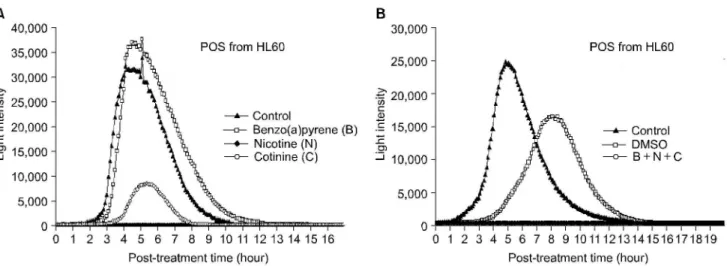
HL60세포에서 활성산소종 superoxide anion의 발생량은 nicotine으로 처리된 경우, 경과시간 17시간에 이르기까 지 바닥수준(light intensity=14)에 머물렀고, 대조군의 경 우 경과시간 4시간에 최대치(light intensity=32,429)에, benzo(a)pyrene 처리한 경우, 경과시간 5시간에 최대치 (light intensity=37,848)에, Cotinine 처리한 경우, 경과시간 5시간 24분에 최대치(light intensity=8,271)에 이르렀다 (Fig. 2A). Nicotine을 benzo(a)pyrene및 cotinine과 함께 혼합 하여 처리시 HL60세포의 superoxide anion 발생량은 ni- cotinin 단독처리한 경우와 마찬가지로 바닥수준(light intensity=11)에 머물렀으며 대조군의 경우 경과시간 5시 간에서 최대치(light intensity=25,068)를, DMSO로 분화를 유도한 경우, 경과시간 8시간에서 최대치(light intensity=
16,788)를 나타내었다(Fig. 2B).
3. TDI로 처리된 HL60세포로부터 유리된 활성산소종 측정결과
HL60세포에서 활성산소종 superoxide anion의 발생량은 TDI로 처리된 경우, 경과시간 2시간 30분에서 최대치 (light intensity=1,451)에, dexamethasone처리한 경우, 경과 시간 5시간 42분에서 최대치(light intensity=24,907)에,
Fig. 2. Reactive oxygen species from nicotine- treated HL60 cell. Superoxide anion released from nicotine treated HL60 was measured by LumiMaxⓇSuperoxide Anion Detection Kit (Stratagene) and microplate luminometer ORION (Berthold). 5.0×10⁵HL60 cells in 100 ul SOA assay medium was mixed with 100μl of the SOA assay medium- reagent mixture and the light emission was recorded at regular intervals in the luminometer for 20 hours. The light intensity was quantitatively in direct proportion to the concentration of superoxide anion in HL60 cultures. (A) Comparison between the results from no treatment (negative control) and treatment with nicotine or benzo(a)pyrene or cotinine. (B) Comparison between the results from no treatment (negative control) and treatment with DMSO or mixture of nicotine, benzo(a)pyrene and cotinine.
Fig. 1. Reactive oxygen species from PMA- treated HL60 cell Superoxide anion released from phorbol myristate acetate (PMA) treated HL60 was measured by LumiMaxⓇ Superoxide Anion Detection Kit (Stratagene) and microplate luminometer ORION (Berthold). 5.0×10⁵ HL60 cells in 100ul SOA assay medium was mixed with 100μl of the SOA assay medium- reagent mixture and the light emission was recorded at regular intervals in the luminometer for 20 hours. The light intensity was quantitatively in direct proportion to the concentration of superoxide anion in HL60 cultures. The measured amount of superoxide anion was compared with that of HL60 with no treatment as a negative control and also compared with that of dimethylsulfoxide differentiated HL60.
dexamethasone 전처치 후 TDI처리를 한 경우, 경과시간 5시간 36분에 최대치(light intensity=26,034)에, TDIHSA 처리한 경우, 경과시간 5시간 12분에 최대치(light inten- sity=20,235)에 이르렀다(Fig. 3).
고 찰
활성산소종의 발생과정은 세포내 NADPH oxidase 작 용에 의해 superoxide anion(O2-.
)이 생성되고 superoxide anion으로부터 미토콘드리아 기질이나 세포질에서 과 산화수소(H2O2)가 생성되며 과산화수소로부터 수산기 (OH-)기가 발생하는 경로로 구성된다.1,2)이러한 활성산 소종의 발생과정에 관여하는 인자들로서 superoxide dis- mutases, catalase 및 glutathione peroxidase등의 항산화효소 들이 존재한다.2,11) 세포내 활성산소종은 상기한 항산화 인자들과 균형을 이루고 있으나 활성산소종의 과다한 발생이나 항산화인자의 감소로 인한 불균형시 세포내 농도가 비정상적으로 증가되어 단백질, 탄수화물, 지질 및 DNA 등의 생체물질을 산화시킴으로써 조직손상을 초래한다.2,11∼13) 비정상적으로 증가된 활성산소종은 생
체물질의 직접적인 산화반응을 초래할 뿐 아니라 cal- cium channel을 억제하여 세포내 calcium농도를 증가시킴 으로써 산화반응 관련 병리기전에 기여한다.1)Superoxide anion은 과산화수소와 수산기를 발생시키는 한편, NO와 반응하여 peroxynitrite anion (ONOO-)을 발생시키므로 세 포내 NADPH oxidase의 활성화결과로서 발생하는 활성 산소종을 대표하는 물질로 볼 수 있다.13) 활성산소종의 증가로 인한 결과로서 세포의 apoptosis 촉진, 혈관내피세 포의 기능부전, 동맥경화, 고혈압, 신부전, 조직 섬유화, 종양형성 등이 보고되어 있다.2,3,13,14)
세포내 활성산소종의 농도를 측정하는 방법은 활성산 소종 자체의 농도를 직접 측정하는 방법15)과 활성산소종 으로 인해 발생하는 관련인자의 변화(예, 항산화효소 농 도)를 측정하는 간접 측정법16)이 있다. 본 연구에서는 대 표적인 활성산소종인 superoxide anion을 luminol과 반응시 키는 chemiluminescence방법17)을 사용하였으며 이 방법의 장점은 세포의 NADPH oxidase활성화 정도를 직접적으 로 확인할 수 있다는 것이다.18)특히 본 연구에서 활성산 소종을 측정한 HL60은 undifferentiated human promyelo- cytic leukemia 세포주로서 NADPH oxidase 활성화에 의한 superoxide anion 생성 자체가 탐식세포(phagocytes)에서와 마찬가지로 세포 생존에 필요하기 때문에18)활성산소종 의 발생조절을 정밀하게 측정하고자 하는 본 연구목적 에 부합되었다. HL60 세포로부터의 superoxide anion 발생 여부는 NADPH oxidase 촉진제로 알려진 phorbol myristate acetate (PMA)12)처리시 superoxide anion 발생량이 신속하 게 급증되었던 본 연구결과(Fig. 1)에서 검증되었다.
Nicotine은 흡연시 tar와 함께 인체내로 흡수되어 건강 을 해치는 물질인 동시에 흡연의 습관성을 초래하는 원 인물질로 알려져 있다.4∼6) 최근에는 nicotine의 면역 및 염증 억제효과를 나타냄과 대뇌혈류증진에 따른 인지능 개선효과 및 nicotine의 특정농도(10-12to 10-8mol/L)에서 는 혈관내피모세포(endothelial progenitor cell)의 수, 증식 도 및 이동성의 증가에 따른 신생혈관생성촉진 현상이 보고되었다.7∼10) 본 연구에서는 nicotine이 HL60 세포에 서 superoxide anion 발생을 근원적으로 차단함이 확인되 었다(Fig. 2). Nicotine의 인체내 대사산물인 cotinine을 처 리한 HL60에서도 흡연물질인 benzo(a)pyrene이나 HL60의 분화촉진제인 DMSO를 처리한 경우와 비교하였을 때 superoxide anion의 발생량은 상대적으로 크게 감소된 결 과로 판단되었다(Fig. 2).
인체세포 내 NO의 발생을 촉진하는 물질로 알려진 toluene diisocyanate (TDI)19)의 경우, 생성된 NO와 super- oxide anion의 반응결과로서 superoxide anion을 peroxynitrite Fig. 3. Reactive oxygen species from TDI- treated HL60 cell
Superoxide anion released from tolylene 2,4- diisocyanate (TDI*) treated HL60 was measured by LumiMaxⓇ Superoxide Anion Detection Kit (Stratagene) and microplate luminometer ORION (Berthold). 5.0×10⁵ HL60 cells in 100 ul SOA assay medium was mixed with 100μl of the SOA assay medium- reagent mixture and the light emission was recorded at regular intervals in the luminometer for 20 hours. The light intensity was quan- titatively in direct proportion to the concentration of superoxide anion in HL60 cultures. The measured amount of superoxide anions was compared between the results from treatment with TDI or TDIHSA or dexamethasone or TDI with pretreatment of dexamethasone.
*TDIHSA: TDI cross- linked human serum albumin (HSA).
anion (ONOO-)로 변형시킴에 따라 본 연구결과에서는 superoxide anion의 농도가 크게 감소되었다(Fig. 3). 그러 나 nicotine에 의한 superoxide anion의 발생억제는 nicotine 처리 직후부터 완전하게 나타남으로써(Fig. 2, 3) TDI에 의한 superoxide anion의 점진적인 농도감소와는 전혀 별 개의 기전에 의하는 것으로 추정되었다. 본 연구에서 관 찰된 nicotine의 superoxide anion 발생억제현상은 nicotine 에 의한 신경계손상방지효과에 대한 기존보고20)와 일치 하였다. 이 보고에 의하면 nicotine은 rat brain mitochondria 에서 전자전달계의 complex I을 억제함으로써 활성산소종 의 발생을 차단하였다.20)또한 nicotine뿐 아니라, nicotine 의 인체내 대사산물인 cotinine도 superoxide anion의 발생 량을 크게 감소시키는 본 연구 결과(Fig. 2)에 근거하여 판단할 때 superoxide anion의 발생은 nicotine에 의해 근원 적으로 억제되는 것으로 추정되었다. 본 연구결과와는 상반되게 nicotine이 활성산소종의 발생을 증가시킨다는
보고21,22)는 본 연구의 실험방법과 몇가지 차이점을 갖고
있었다. 첫째 차이점으로서 이들 보고에서 연구대상으 로 한 세포는 human gingival fibroblasts,21)human mesangial cells22)등으로 본 연구의 HL60 세포와 틀리며, 둘째 차이 점으로서 이들 보고에서 사용한 활성산소종 측정방법은 세포내 peroxide농도를 측정하는 fluorescent probe로서 2,7- dichlorofluorescein diacetate (DCF)를 검출하는 방법을 사용 하였고,15)본 연구에서는 superoxide anion과 luminol의 반 응에 의한 chemiluminescence 방법17)을 사용하였다. 사용 한 세포종류와 활성산소종의 측정방법 및 측정된 활성 산소종의 차이점에도 불구하고 nicotine에 의한 활성산소 종발생 조절이 상반되게 나타나는 점은 설명하기 어렵 다. Nicotine 처리 및 활성산소종 측정과정을 세부적으로 비교해보면, 본 연구에서는 HL60세포에 10 mM의 nicotine 을 처리함과 동시에 luminol 반응액을 가하여 microplate luminometer에서 20시간동안 superoxide anion의 발생량의 변화를 6분 간격으로 측정하였으나 DCF를 이용하여 활 성산소종의 농도를 측정하는 방법에서는 1 uM의 nicotine 을 대상세포에 가하여 24시간 배양한 뒤 fluorescent probe 인 2,7-dichlorofluorescein diacetate (DCF)와 1시간 반응하여 DCF fluorescence의 강도를 측정하였다. 따라서 본 연구결 과와 상반되는 연구과정에서는 nicotine의 사용량이 본 연구에서 사용한 10 mM의 10,000배로 희석된 농도인 1 uM이었음과 활성산소종의 측정시간이 본 연구에서는 20시간이었으나 본 연구와 상반된 결과를 제시한 연구 에서는 1시간이었음이 현저한 차이점이었다. 또한, 연구 대상세포에 있어 본 연구는 NADPH oxidase 활성이 세포 생존에 필수적이며 외부자극에 대하여 NADPH oxidase
활성이 매우 민감하게 조절되는 HL60세포를 사용하였 고 PMA 처리에 의해 NADPH 활성도 자체를 검증하였으 나(Fig. 1), 본 연구와 상반된 결과를 제시한 연구에서는 NADPH 활성도 자체가 검증되지 않은 고형조직의 체세 포를 사용하였다. 따라서, nicotine의 처리농도, 활성산소 종의 측정방법, 측정한 활성산소종의 종류, 사용한 세포 종류등의 차이점을 염두에 두었을 때, 각각의 세포에서 동일한 실험조건으로 얻어진 결과라야 비교가 가능하다 는 결론이다. 또한, HL60 세포의 경우 본 연구에서 사용 된 nicotine, cotinine및 benzopyrene 농도로 처리 후 LDH 검 출에 의한 cytotoxicity assay 분석결과(data not shown)에서 세포의 사멸 및 세포수의 감소현상은 없었으므로 ni- cotine에 의한 superoxide anion 발생의 억제현상은 분명하 였다. 더욱이 NO생산을 촉진하고 peroxynitrite anion (ONOO-)의 생성반응을 통하여 superoxide anion의 농도 를 감소시키는 것으로 추정되는 TDI에 의한 superoxide anion 농도의 점진적인 감소현상과 비교하였을 때 nicotine 에 의한 superoxide anion의 발생억제 현상은 즉각적이고 완전한 양상을 나타냄으로써 nicotine이 본 연구결과와 일치하는 보고20)에서와 같이 NAD(P)H oxidase를 억제하 여 superoxide anion의 발생을 근원적으로 억제할 가능성 이 매우 높다고 사료되었다.
결 론
HL60세포내 NADPH oxidase작용에 의해 생성되는 활 성산소종인 superoxide anion (O2-.
)의 생성을 NADPH oxidase 촉진제인 PMA 처리에 의해 입증하였으며 동시에 HL60 세포의 superoxide anion 발생이 nicotine에 의해 억제 됨을 확인하였다. 이러한 superoxide anion (O2-.
) 발생 억 제현상은 peroxynitrite anion (ONOO-)의 생성반응을 통한 superoxide anion 농도를 감소시킬 것으로 추정되는 TDI에 의한 superoxide anion 농도의 점진적인 감소현상과는 전 혀 다르게 nicotine 처리 직후부터 superoxide anion의 발생 이 근원적으로 억제되는 양상을 나타내었다.
따라서 습관성 물질로서의 부작용을 최소화할 수 있 는 적절한 생체농도의 nicotine을 다른 항산화제와 병용 한다면 산화현상에 의한 병리기전을 예방 또는 치료하 는데 기여할 수 있을 것으로 사료되었다.
감사의 글
이 연구는 과학기술부 기초연구지원(특정기초)사업(과 제번호 R01-2004-000-10670-0)과 보건복지부 보건의료바
이오기술개발사업(과제번호 01-PJ10-PG6-01GN14-0007;
A010383)에 의해 이루어졌습니다.
참 고 문 헌
1) Camello-Almaraz C, Gomerz-Pinilla PJ, Pozo MJ, Camello PJ.
Mitochondrial reactive oxygen species and Ca2+signaling. Am J Physiol Cell Physiol 291, C1082-C1088, 2006.
2) Waris G and Ahsan H. Reactive oxygen species: role in the development of cancer and various chronic conditions. J Carcinogenesis 5, doi:10.1186/1477-3163-5-14, 2006.
3) Touyz RM. Reactive oxygen species, vascular oxidative stress, and redox signaling in hypertension: what is the clinical significance? Hypertension 44, 248-252, 2004.
4) 1988 Surgeon General Report: The health consequences of smoking-nicotine addiction. Atlanta, GA 30333, U.S.A., Centers for Disease Control and Prevention National Center for Chronic Disease Prevention and Health Promotion Office on Smoking and Health. 1988; pp1-619
5) Rose JE, Behm FM, Westman EC, Mathew RJ, London ED, Hawk TC, Turkington TG, Coleman RE. PET studies of the influences of nicotine on neural systems in cigarette smokers.
Am J Psychiatry 160, 323-333, 2003.
6) Benowitz NL, Hansson A, Jacob P. Cardiovascular effects of nasal and transdermal nicotine and cigarette smoking. Hyper- tension 39, 1107-1112, 2002.
7) Kalra R, Singh SP, Pena-Philippides JC, Langley RJ, Razani- Boroujerdi S, Sopori ML. Immunosuppressive and anti-inflam- matory effects of nicotine administered by patch in an animal model. Clin Diagn Lab Immunol 11, 563-568, 2004.
8) Blanchet MR, Israel-Assayag E, Cormier Y. Inhibitory effect of nicotine on experimental hypersensitivity pneumonitis in vivo and in vitro. Am J Respir Crit Care Med 169, 903-909, 2004.
9) Wang XX, Zhu J, Chen JZ, and Shang YP. Effects of nicotine on the number and activity of circulating endothelial progenitor cells. J Clin Pharmacol 44, 881-889, 2004.
10) Ernst M, Matochik JA, Heishman SJ, Van Horn JD, Jons PH, Henningfield JE, London ED. Effect of nicotine on brain activation during performance of a working memory task.
PNAS 98, 4728-4733, 2001
11) Kinnula VL. Focus on antioxidant enzymes and antioxidant strategies in smoking related airway diseases. Thorax 60, 693-
700, 2005.
12) Takeuchi T, Nakajima M, Morimoto K. Relationship between the intracellular reactive oxygen species and the induction of oxidative DNA damage in human neutrophil-like cells. Car- cinogenesis 17, 1543-1548, 1996.
13) Li JM, Shah AM. ROS generation by nonphagocytic NADPH oxidase: potential relevance in diabetic nephropathy. J Am Soc Nephrol 14, S221-S226, 2003.
14) Cathcart MK. Regulation of superoxide anion production by NADPH oxidase in monocytes/macrophages: contributions to atherosclerosis. Arterioscler Thromb Vasc Biol 24, 23-28, 2004.
15) Probes for Reactive Oxygen Species, Including Nitric Oxide.
In: ed by Invitrogen the handbook - a guide to fluorescent probes and labeling technologies, 10th web edition (http://
probes.invitrogen.com/handbook/). Invitrogen Corporation, 2006.
16) Tozzi G, Nuccetelli M, Lo Bello M, Bernardini S, Bellincampi L, Ballerini S, Gaeta LM, Casali C, Pastore A, Federici G, Bertini E, Piemonte F. Antioxidant enzymes in blood of patients with Friedreich’s ataxia. Arch Dis Child 86, 376-380, 2002.
17) Irani K, Xia Y, Zweier JL, Sollott SJ, Der CJ, Fearon ER, Sundaresan M, Finkel T, Goldschmidt-Clermont PJ. Mito- genic signaling mediated by oxidants in ras-transformed fibroblasts. Science 275, 1649-1652, 1997.
18) Dong JM, Zhao SG, Huang GY, Liu Q. NADPH Oxidase- mediated generation of reactive oxygen species is critically required for survival of undifferentiated human promyelocytic leukemia cell line HL-60. Free Radical Research 38, 629-637, 2004.
19) Huffman LJ, Judy DJ, Frazer D, Shapiro RE, Castranova V, Billie M, Dedhia HV. Inhalation of toluene diisocyanate is associated with increased production of nitric oxide by rat bronchoalveolar lavage cells. Toxicol Appl Pharmacol 145, 61- 67, 1997.
20) Cormier A, Morin C, Zini R, Tillement JP, Lagrue G. Nico- tine protects rat brain mitochondria against experimental injuries. Neuropharmacology 44, 642-652, 2003.
21) Argentin G, Cicchetti R. Genotoxic and antiapoptotic effect of nicotineon human gingival fibroblasts. Toxicological Sciences 79, 75-81, 2004.
22) Jaimes E, Tian RX, Raij L. Nicotine: the link between cigarette smoking and the progression of renal injury? Am J Physiol Heart Circ Physiol 2006; [Epub ahead of print].