Journal of Information Science Theory and Practice
Study of Machine-Learning Classifier and Feature Set
Selection for Intent Classification of Korean Tweets about
Food Safety
Ha-Neul Yeom
Korea University of Science and Technology (UST) Korea Institute of Science and Technology Information (KISTI), Republic of Korea
[email protected], [email protected]
Mi-Nyeong Hwang *
Korea Institute of Science and Technology Information (KISTI), Republic of Korea
Myunggwon Hwang
Korea Institute of Science and Technology Information (KISTI), Republic of Korea
[email protected], [email protected]
Hanmin Jung
Korea University of Science and Technology (UST) Korea Institute of Science and Technology Information (KISTI), Republic of Korea
Open Access
Accepted date: September 7, 2014 Received date: June 8, 2014
*Corresponding Author: Mi-Nyeong Hwang
Senior Researcher
Korea Institute of Science and Technology Information (KISTI) Republic of Korea
All JISTaP content is Open Access, meaning it is accessible online to everyone, without fee and authors’ permission. All JISTaP content is published and distributed under the terms of the Creative Commons Attribution License (http:/ creativecommons. org/licenses/by/3.0/). Under this license, authors reserve the copyright for their content; however, they permit anyone to unrestrictedly use, distribute, and reproduce the content in any medium as far as the original authors and source are cited. For any reuse, redistribution, or reproduction of a work, users must clarify the license terms under which the work was produced.
http://dx.doi.org/10.1633/JISTaP.2014.2.3.3
ABSTRACT
In recent years, several studies have proposed making use of the Twitter micro-blogging service to track various trends in online media and discussion. In this study, we specifically examine the use of Twitter to track discussions of food safety in the Korean language. Given the irregularity of keyword use in most tweets, we focus on optimistic machine-learning and feature set selection to classify collected tweets. We build the classifier model using Naive Bayes & Naive Bayes Multinomial, Support Vector Machine, and Decision Tree Algorithms, all of which show good performance. To select an optimum feature set, we construct a basic feature set as a standard for performance comparison, so that further test feature sets can be evaluated. Experiments show that precision and F-measure performance are best when using a Naive Bayes Multinomial classifier model with a test feature set defined by ex-tracting Substantive, Predicate, Modifier, and Interjection parts of speech.
1. INTRODUCTION
Within the Twitter micro-blogging service, a ‘Tweet’ is considered to be the basic unit of composed text and is limited to 140 words, including blanks and symbols, regardless of language. Twitter users can connect to one another as ‘followers’ and exchange tweets freely. The recent emergence of smartphone clients has en-couraged a vast array of users to express their opinions via tweets.1
In recent years, several studies have suggested anal-ysis of Twitter feeds to track various realtime trends, including journalistic influence, political attitudes, the vectors of certain illnesses, and the analysis of symp-toms and treatments in public health crises (Choi et al., 2014; Tumasjan et al., 2010; Lampos et al., 2010; Paul & Dredze, 2011).
Similarly, in this study, we have concentrated on us-ing Twitter to track trends involvus-ing food safety, such as those reflecting outbreaks of food poisoning, satis-faction with school food services, etc. For this work, we collected tweets using keywords for food safety topics and analyzed their contents. Unfortunately, the keywords used to collect tweets do not typically carry over to the collected content, and a large number of irrelevant tweets must be filtered out.
To this end, we propose use of a machine-learning classifier model and feature set for classifying collect-ed tweets. Among machine-learning algorithms, the Naive Bayes & Naive Bayes Multinomial (McCallum & Nigam, 1998; Androutsopoulos et al., 2000; Youn & McLeod, 2007), Support Vector Machine (Drucker et al., 1999; Youn & McLeod, 2007) and Decision Tree (Youn & McLeod, 2007) algorithms have shown the best performance for classifying texts. We compare these algorithms to find the best classifier model. To select an optimum feature set, we construct a basic feature set as a standard for comparison, and then test other feature sets against this basic set.
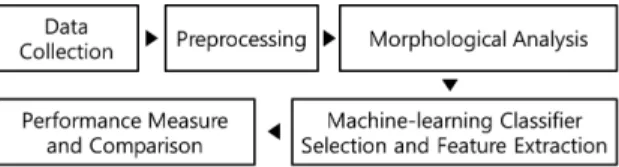
We perform preprocessing to remove slang words and symbols from collected tweets and to analyze text morphology prior to building the machine-learning classifier models and the basic and test feature sets. We
then measure the performance of the classifier models by applying the basic and test feature sets. Figure 1 shows the overall experimental process.
The rest of the paper is organized as follows: Sec-tion 2 presents related works; SecSec-tion 3 describes our experimental process in detail; Section 4 provides an analysis of experimental results; and Section 5 contains concluding remarks.
2. RELATED WORKS
2.1. Machine Learning Algorithms for Text Classification
Text classification or document classification is just such a domain with a large number of attributes. The attributes of the examples to be classified are words, and the number of different words can be quite large indeed (McCallum & Nigam, 1998). In this section, we describe representative algorithms briefly.
2.1.1. Support Vector Machine (SVM)
Support Vector Machines (SVM) are a relatively new learning method used for binary classification. The ba-sic strategy behind SVM is to find a hyperplane which separates the d-dimensional data perfectly into two classes (Dustin, 2002).
SVM generally exhibits slow training times but high accuracy, owing to its capacity to model complex non-linear decision boundaries (margin maximization). It has been used both for classification and prediction and has been applied to handwritten digit recognition, visual object recognition, speaker identification, and benchmarking time-series prediction tests (Chen, 2010).
1 Twitter (https://about.twitter.com/what-is-twitter/).
2.1.2. Naive Bayes and Naive Bayes Multinomial
All attributes of the examples are independent of each other given the context of the class. This is the so-called “Naive Bayes assumption.” The Naive Bayes classifier is the simplest probabilistic classifier based on applying Naive Bayes assumption. While this assumption is clearly false in most real-world tasks, Naive Bayes often performs classification very well. Naive Bayes has been successfully applied to text clas-sification in many research efforts.
The assumptions on distributions of features are called the event model of the Naive Bayes classifier. The Naive Bayes Multinomial classifier specifies that a document is represented by the set of word occur-rences from the document. This approach has also been used for text classification by numerous people (McCallum & Nigam, 1998).
2.1.3. Decision Tree
A decision tree is a classifier expressed as a recursive partition of the instance space. Each internal node splits the instance space into two or more sub-spaces according to a certain discrete function of the input attributes values.
There are several advantages of the decision tree as a classification tool. First, decision trees are self–ex-planatory and when compacted they are also easy to follow. Second, decision trees can handle both nomi-nal and numeric input attributes. Third, decision tree representation is rich enough to represent any discrete value classifier. Fourth, decision trees are capable of handling datasets that may have errors (Rokach & Maimon, 2005).
2.2. Korean Morphological Analyzer
The Korean morphological analyzer is a piece of software that analyzes the morphology of entered Ko-rean text and outputs results as tagged parts of speech (POS). This tagged data plays a major role in Korean natural language processing (KAIST Semantic Web Research Center, 2011).
Hannanum is the most significant Korean morpho-logical analyzer (Lee et al., 1999). In this paper, we
use the Hannanum morphological analyzer to process the morphology of tweets and to tag each word by its POS.
The following two sections describe relevant por-tions of Korean grammar and provide details on the Hannanum morphological analyzer.
2.2.1. Korean Grammar2
Nine POS are distinguished in Korean: noun, pro-noun, numeric, verb, adjective, determiner, adverb, interjection, and postposition. These are further grouped into five categories: Substantive, predicate, modifier, interjection, and postposition.
(1) Substantive: Includes nouns, pronouns, and numerics, and grouped into independent noun and dependent noun classes. A dependent noun can be used with an adnominal phrase. The dependent noun can be used independently in a sentence with the help of a postposition, or to predicate and modify other POS. A substantive takes a case marker and can modify a determin-er. In this paper, we call this category ‘Substan-tive’ to distinguish it from nouns proper. (2) Predicate: Includes verbs and adjectives. A
pred-icate is used to predpred-icate the action or property of a subject, and is inflected by a suffix. In this paper, we call this category ‘Predicate.’
(3) Modifier: Includes determiners and adverbs. A modifier is only used to modify a substantive or predicate, and does not take a case marker or suffix.
(4) Interjection: Used independently in the pres-ence of a sentpres-ence. It is not predicated, and does not predicate other POS. Of the nine POS men-tioned above, only interjections belong to this category, so we call it simply ‘Interjection.’ (5) Postposition: Used to present grammatical
re-lations between words. Of the nine POS men-tioned above, only postpositions belong to this category, so we call it simply ‘Postposition.’
2.2.2. Hannanum Morphological Analyzer
The Hannanum Morphological Analyzer is
veloped by KAIST Semantic Web Research Center.3
Hannanum users can control the morphological anal-ysis process by selecting plug-ins and constructing a workflow. Workflow is composed of three phases: The preprocessing phase, the morphological analysis phase, and the POS tagging phase. The plug-ins performing each of these phases are classified into two groups: Ma-jor plug-ins and supplemental plug-ins. MaMa-jor plug-ins perform primary functions like morphological analysis and POS tagging, whereas supplemental plug-ins per-form functions like recognizing sentences, converting morphology tags, extracting nouns, etc. (KAIST Seman-tic Web Research Center, 2011).
3. METHOD FOR SELECTING FEATURE SETS
BY MACHINE-LEARNING ALGORITHM
3.1. Data Collection and PreprocessingWe begin by collecting tweets based on keywords tar-geting food safety from twitter feeds covering the period from January 2014 until some recent date. As of April 30 of this year, the raw tweets collected by this process numbered around 15 million. From this collected set, we narrow our test dataset to tweets that include ‘Geupsig’ (food service). This test dataset includes tweets with a wide range of attitudes toward free school meals, such as those including abusive language (e.g., ‘Geupsigsaeggi’).
We classify the test data into a positive set and a neg-ative set. The subjects of tweets classified in the positive set concern the evaluation of food services. Once this set is classified, the remainder of the tweets is classified as the negative set. Table 1 below shows the size of the positive, negative, and total sets used in our experiment.
Among the collected tweets are a large number of
‘retweets’ (i.e. duplicate tweets) and news links unre-lated to our analysis. Once these are removed, slang words that use symbols to reflect users’ attitudes are removed too. Note that these words generally mark a tweet for classification in the negative set.
3.2. Morphological Analysis (Lee et al., 1999)
We use the Hidden Markov Model (HMM) POS Tagger Workflow included in the Hannanum morpho-logical analyzer to analyze the tweets in the test dataset. The HMM POS Tagger Workflow is composed of the SentenceSegmentor, InformalSentenceFilter, ChartMor-phAnalyzer, UnknownProcessor, and HMMTagger.
A description of the analysis process and the char-acteristics of each plug-in are as follows.
① SentenceSegmentor: Segments sentences based on delimiters like periods, question marks, and exclamation marks.
② InformalSentenceFilter: Filters noise based on patterns. The patterns are learned from a data-set of over 90,000 replies.
③ ChartMorphAnalyzer: Uses lattice storage to analyze morphology.
④ UnknownProcessor: Handles words that are
not found in the dictionary.
⑤ HMMTagger: Tags POS based on a Hidden
Markov Model. Tagging reflects dependencies between separate words and morphology.
3.3. Machine-learning Classifier Selection and Feature Extraction
Our goal is to find an optimistic machine-learning classifier model and a feature set for classifying the intents of collected tweets. For this, we use the Naive Bayes & Naive Bayes Multinomial, Support Vector Machine, and Decision Tree methods, and compare their performance.
To find an optimistic feature set, we construct a ba-sic feature set as a standard for comparison and then a number of test feature sets. The basic feature set is the result of simple preprocessing. Test feature sets are created by extracting words corresponding to a particular POS from the basic feature set.
3 KAIST Semantic Web Research Center (http://semanticweb.kaist.ac.kr/home/index.php/HanNanum).
Table 1. Size of Positive, Negative and Total Sets used in
Experiment
Positive Negative Total
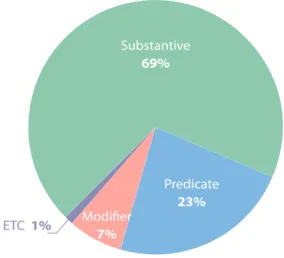
We calculate the component ratio of POS in each test set. Figure 2 shows the component ratios for the extracted POS in our test sets (Substantive: 69%;
Predicate: 23%; Modifier: 7%; Other POS: 1%). Thus we create a test feature set by extracting Substan-tive, Predicate, and Substantive-Predicate that have higher percentages than the others (feature B, D, F). Feature C, E, G are created by adding modifier and interjection to feature B, D, F because modifiers and interjections account for a small percentage. Table 2 describes the basic feature set (A), test feature set (B~H), and examples of each feature set.
We propose use of a machine-learning classifier model and feature set for classifying collected tweets. So we track precision, recall, and F-measure. Preci-sion measures how accurate a machine-learning clas-sifier model is, and recall measures how many tweets can be classified by a machine-learning classifier model. F-measure measures reliability of precision and recall. Lastly, to increase reliability of measuring classifier model performance, we measure the perfor-mance of the classifier models using Weka4 with
ten-fold cross validation. Fig. 2 Component ratios for extracted POS in test sets
4 Weka is a collection of machine-learning algorithms for data mining tasks. The algorithms can either be applied directly to a dataset or called from the user’s own Java code. Weka contains tools for data pre-processing, classification, regression, clustering, association rules, and visualization. It is also well suited for developing new machine-learning schemes (Hall et al., 2009).
Table 2. Basic Feature Set (A), Test Feature Set (B~H), and Examples of Each Feature Set
Feature Set Example of Feature Extraction
A Preprocessing gieogeul, doesaegyeobomyeon, geupsigiraneun, mulgeoneun, geunyang, baereul, chaeugi, wihae, meogneungeoji, masisseurago, mandeun, mulgeoneun, anida, eoddeoghaeya, giseongmandureul, maseobsge, mandeulsuga, isseulgga
B Substantive gieog, geupsig, mulgeon, bae, meogneungeoji, mulgeon, giseong, mandu, su C Substantive, Modifier, Interjection gieog, geupsig, mulgeon, geunyang, bae, meogneungeoji, mulgeon, giseong, su D Predicate doesaegi, chaeu, wiha, masiss, mandeul, ani, eoddeogha, maseob, mandeul, iss
E Predicate, Modifier, Interjection doesaegi, geunyang, chaeugi, wiha, masiss, mandeul, ani, eoddeogha, maseob, mandeul, iss
F Substantive, Predicate gieok, doesaegi, geupsik, mulgeon, bae, chaeu, wiha, meokneungeoji, masiss, mandeul, mulgeon, ani, eoddeogha, giseong, mateob, mandeul, iss
G Substantive, Predicate, Modifier, Interjection gieok, doesaegi, geupsik, mulgeon, geunyang, bae, chaeu, wiha, meokneungeoji, masiss, mandeul, mulgeon, ani, eoddeogha, giseong, maseob, mandeul, iss H Modifier, Interjection geunyang
4. EXPERIMENTAL RESULTS
The figures and tables below show the precision, recall, and f-measure of each classifier model and each feature set.
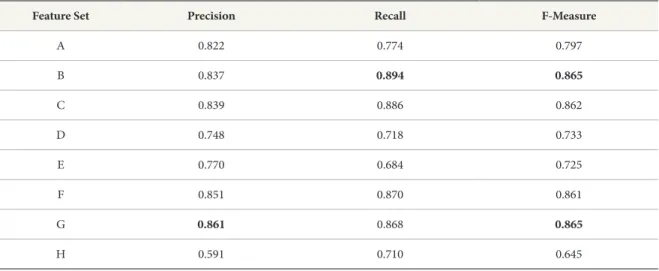
When applying the Naive Bayes classifier model to
feature sets for Substantive, Substantive-Modifier-Inter-jection, Substantive-Predicate, and Substantive-Pred-icate-Modifier-Interjection categories (B, C, F, G), F-measure is 6.4~6.8% higher than for the basic feature set. Table 3 and Figure 3 show the performance of the Naive Bayes classifier, respectively.
Table 3. Performance of Naive Bayes Classifier Model
Feature Set Precision Recall F-Measure
A 0.822 0.774 0.797 B 0.837 0.894 0.865 C 0.839 0.886 0.862 D 0.748 0.718 0.733 E 0.770 0.684 0.725 F 0.851 0.870 0.861 G 0.861 0.868 0.865 H 0.591 0.710 0.645
Fig. 3 Graph of performance of Naive-Bayes classifier model
Naive-Bayes 1.000 0.800 0.600 0.400 A B C D E F G H
Similarly, when applying the Naive Bayes Multi-nomial classifier model to feature sets for Substan-tive-Modifier-Interjection, Substantive-Predicate, and Substantive-Predicate-Modifier-Interjection categories (C, F, G), the performance is higher than that of the basic feature set. When applied to the test feature set for Substantive, precision is 5.7% lower than for the basic feature set, but F-measure and recall for feature
set B are 16.3% and 35.4% higher than for the basic feature set. Precision for the test feature sets, including Substantive-Predicate and Substantive-Predicate-Mod-ifier-Interjection (F, G) is about 90%. This is the best overall precision result for the Naive Bayes Multino-mial classifier model. Table 4 and Figure 4 show the performance of the Naive Bayes Multinomial classifier, respectively.
Table 4. Performance of Naive-Bayes Multinomial Classifier Model
Feature Set Precision Recall F-Measure
A 0.874 0.622 0.727 B 0.817 0.976 0.890 C 0.887 0.924 0.905 D 0.716 0.634 0.672 E 0.718 0.668 0.692 F 0.901 0.928 0.914 G 0.906 0.930 0.918 H 0.479 0.322 0.385
Fig. 4 Graph of performance of Naive-Bayes Multinomial classifier model
0.900
0.700
0.500
0.300
A B C D E F G H
Precision Recall F-Measure
When using the Support Vector Machine and Deci-sion Tree classifier models, preciDeci-sion for the basic fea-ture set is higher than for all other feafea-ture sets, whereas recall rates for all test feature sets were higher than the recall for the basic feature set. In particular, F-measure and recall rates for test feature sets for Substantive,
Substantive-Modifier-Interjection, Substantive-Predi-cate, and Substantive-Predicate-Modifier-Interjection categories are up to 11.3% and 27% higher than for the basic feature set. Table 5 and 6 and Figure 5 and 6, re-spectively, show the performance of the Support Vector Machine and the Decision Tree classifier.
Table 5. Performance of Support Vector Machine Classifier Model
Feature Set Precision Recall F-Measure
A 0.889 0.740 0.808 B 0.819 0.962 0.885 C 0.874 0.860 0.867 D 0.698 0.840 0.762 E 0.698 0.814 0.752 F 0.883 0.892 0.888 G 0.884 0.900 0.892 H 0.584 0.790 0.672
Table 6. Performance of Decision Tree Classifier Model
Feature Set Precision Recall F-Measure
Fig. 5 Graph of performance of Support Vector Machine
Fig. 6 Graph of performance of Decision Tree classifier model
Support Vector Machine 1.000
0.800
0.600
0.400
A B C D E F G H
Precision Recall F-Measure
Decision Tree 1.000 0.800 0.600 0.400 A B C D E F G H
Overall, we conclude that the Naive Bayes Multino-mial classifier model outperforms other models.
Normally, it is assumed that the mor e words in a feature set, the better the precision will be. Our exper-iments yield a different result: The F-measure and pre-cision rates for test feature sets for Substantive or Sub-stantive-Predicate categories (B, C, F, G) are higher than for the basic feature set. Furthermore, recall rates for test feature sets for Substantive-Modifier-Interjection, Substantive-Predicate, and Substantive-Predicate-Mod-ifier-Interjection categories are up to 35% higher than the recall for the basic feature set.
5. CONCLUSIONS
We proposed the use of a machine-learning classifier model and feature set for classifying collected tweets.
In experiments, F-measure and precision rates for test feature sets of Substantive or Substantive-Predicate categories (B, C, F, G) are higher than that for the basic feature set. This result shows that using many words does not guarantee more accurate classification.
Recall rates for the test feature sets are far higher than that for the basic feature set. Particularly, when using the Naive Bayes Multinomial classifier model, recall rates for test feature sets including Substantive-modi-fier-interjection, Substantive-predicate, and Substan-tive-predicate-modifier-interjection categories are about 30% higher than that for the basic feature set. The recall for test feature set B using only Substantive is the best in each classifier model except for Decision Tree. The reason is that Substantive and Predicate categories deal with different words depends on suffixes (endings of words). So recall for the test feature set is far higher than that for the basic feature set.
When using the Naive Bayes Multinomial classifier model and applying test feature set G (Substantive, Predicate, Modifier, Interjection), the precision is the best (90.6%). Furthermore, when using the same clas-sifier, the recall for test feature set B (Substantive) is the best (97.6%). But the precision for the same test fea-ture set is 6% lower than recall for the basic feafea-ture set (81.7%). F-measure for Naive Bayes Multinomial classi-fier model and test feature set G (Substantive, Predicate, Modifier, Interjection) is the best (91.8%, Precision 90.6%, Recall 93%).
In our final analysis, the Naive Bayes Multinomial classifier and test feature set G (Substantive-Predi-cate-Modifier-Interjection) proved to be the best pair-ing for classification of Korean tweets about food safety. In the future, to increase reliability of measuring clas-sifier model performance, we will use more test data sets and analyze morphology more accurately. And we will use classifier models to classify intent values of the rest of the collected tweets.
ACKNOWLEDGEMENTS
This work was supported by the IT R&D program of MSIP/KEIT [2014-044-024-002, Developing On-Line Open Platforms to Provide Local-Business Strategy Analysis and User-Targeting Visual Advertisement Ma-terials for Micro-Enterprise Managers].
REFERENCES
Androutsopoulos, I., Koutsias, J., Chandrinos, K. V., Paliouras, G., & Spyropoulos, C. D. (2000). An evaluation of Naive Bayesian anti-spam filtering. Proceedings of the Workshop on Machine Learn-ing in the New Information Age, 11th European Conference on Machine Learning, 9-17.
Chen, B. (2010). Chapter 6. Classification and predic-tion. Lecture Note Distributed in Data Mining CSCI 4370/5370 at Georgia State University, Re-trieved June 2, 2014, from http://storm.cis.ford-ham.edu/~yli/documents/CISC4631Spring12/ Chapter6_Class1.ppt.
Choi, D., Hwang, M., Kim, J., Ko, B., & Kim, P. (2014). Tracing trending topics by analyzing the sentiment status of Tweets. Computer Science and Information
Systems, 11(1), 157-169.
Drucker, H., Wu, D., & Vapnik, V. N. (1999). Support vector machines for spam categorization. IEEE
Transactions on Neural Networks, 10(5), 1048-1054.
edu%2F~boswell%2FIntroToSVM.pdf&ei=4f- 6SU9P2A4K48gW6noHIBw&usg=AFQjCNGlfz- DO-ZpOtj219pI81FgjP2yyEA&sig2=SdwK6M-V4e2EVzFaZuZhLEw
Hall, M., Frank, E., Holmes, G., Pfahringer, B., Reute-mann, P., & Witten, I. H. (2009). The WEKA data mining software: An update. ACM SIGKDD
Ex-plorations Newsletter, 11(1), 10-18.
KAIST Semantic Web Research Center, (2011). Hanna-num Korean Morphological Analyzer User Manu-al.
Lampos, V., Bie, T. D., & Cristianini, N. (2010). Flu detector-tracking epidemics on Twitter. Machine
Learning and Knowledge Discovery in Databases, 6323, 599-602.
Lee, W., Kim, S., Kim, G., & Choi, K. (1999). Imple-mentation of modularized morphological analyzer. Proceedings of Korean Institute of Information Scientists and Engineers: Special Interest Group on Human Language Technology, 123-136.
McCallum, A., & Nigam, K. (1998). A comparison of event models for Naive Bayes text classification. AAAI-98 Workshop on Learning for Text Catego-rization, 752, 41-48.
Paul, M. J., & Dredze, M. (2011). You are what you Tweet: Analyzing Twitter for public health. Pro-ceedings of the Fifth International AAAI Confer-ence on Weblogs and Social Media.
Rokach, L., & Maimon, O. (2005). Decision trees. Data
mining and knowledge discovery handbook.
Spring-er, US, 165–192.
Tumasjan, A., Sprenger, T. O., Sandner, P. G., & Welpe, I. M. (2010). Predicting elections with Twitter: What 140 characters reveal about political sentiment. Proceedings of the Fourth International AAAI Conference on Weblogs and Social Media, 178-185.