Vol. 18, No. 2 pp. 261-267, 2017
The Effect of Soybean Oil and Waste Chicken Oil Mixing Ratio on Biodiesel Characteristics
Jong Won Kwack, Tae Han Kim
*Dept. of Bio-indusrtial Machinery Engineering, Kyungpook National University
대두유와 폐계유의 혼합비가 바이오디젤 특성에 미치는 영향
곽종원, 김태한*
경북대학교 생물산업기계공학과
Abstract The interest in biodiesel is increasing rapidly. As a result, the price of vegetable oil that is used as a raw material for biodiesel is skyrocketing. Studies of biodiesel using animal waste as a means of solving these problems are underway. Biodiesel produced from animal fat contains considerably more saturated fatty acids than that produced from vegetable oil. In addition, it has a high cetane number and a high heating value. On the other hand, the fluidity decreases at lower temperatures because of the large amount of saturated fatty acids. For the biodiesel production, waste chicken oil and soybean oil were first purified. The raw materials were mixed at various ratios from 1:9 to 9:1. The methanol / oil molar ratio was also changed from 7 mol to 15 mol. The entire reaction time was one hour.
The results showed that the optimal mixing ratio of soybean oil to waste chicken oil was 3:7, and the optimal methanol / oil molar ratio was 13. Moreover, the BD yield was 90.2%, the FAME content was 96.6%, and the LAME content was 4.1%. This result satisfied the Korea Industrial Standard (KSM2413).
요 약 바이오디젤에 대한 관심이 급증하면서 식물성유지의 가격이 급등하고 있다. 이러한 문제점을 해결하기 위한 방안으 로 동물성 폐기물을 이용한 연구가 진행되고 있으며, 이러한 연구는 환경오염을 줄이고 원료가격을 절감시키는 장점이 있다.
또한 동물성 유지는 식물성 유지에 비해 포화지방산이 다량 함유되어 있어 세탄가가 높고 발열량이 큰 연료특성을 갖고 있 다. 그러나 다량 함유된 포화지방산으로 인해 저온유동성이 좋지 않은 문제점이 있다. 이러한 문제점을 보완하기 위해 대두유 와 폐계유를 혼합하여 바이오디젤을 제조하였다. 원료는 정제된 대두유와 폐계유를 사용하였으며, 실험은 대두유와 폐계유 혼합비를 1:9에서 9:1까지, 메탄올/유지 몰비를 7∼15로 변화시키면서 수행 하였다. 실험조건으로 촉매는 KOH 1wt%, 반응온 도 55℃, 반응시간 1시간으로 하여 바이오디젤을 제조하였다. 그 결과 대두유와 폐계유의 최적혼합비율은 3:7이었으며, 메탄 올/유지 몰비는 13으로 나타났다. 또한 제조된 바이오디젤의 성능을 평가한 결과 바이오디젤 수율(BD수율)은 90.2%, FAME 함량은 96.6%, LAME 함량은 4.1%로 나타났으며, 이 결과는 한국공업규격(KSM2413)을 만족하는 것으로 나타났다.
Keywords : Biodiesel yield, FAME content, Mixed oil of chicken and soybean, Soybean oil, Waste chicken oil.
This work was supported by Kyungpook National University.
*Corresponding author : Tae Han Kim (Kyungpook National University) Tel : +82-53-950-5793 E-mail : [email protected]
Received October 31, 2016 Accepted February 3, 2017
Revised (1st January 5, 2017, 2nd January 19, 2017) Published February 28, 2017
1. Introduction
Most of the energy consumed worldwide is produced from fossil fuels such as petroleum, coal, and natural gas. However, due to the recent increase of the
oil price as well as the severe environmental pollution caused by the combustion of fossil fuels, securing a clean alternative fuel is necessary [1].
Biodiesel refers to monoalkyl esters of long-chain fatty acids prepared from renewable biological
resources, such as vegetable and animal fats, to use as a fuel for heat engines. Biodiesel is a fuel oil to replace the conventional diesel and may be used in various applications and easily combusted in comparison with other alternative fuels [2].
Biodiesel is manufactured through a chemical process such as esterification using vegetable oils (i.e.
rapeseed oil, soybean oil, palm oil, and waste cooking oil) or animal oil (i.e. beef tallow and fish oil).
Representative raw materials of vegetable biodiesel include rapeseed oil, soybean oil, palm oil, and sunflower seed oil. Vegetable oil has good properties as a raw material for biodiesel and may be mas produced, but it is expensive to produce and competes with food resources [3].
To resolve these problems, biodiesel studies have thus focused on using animal waste, which unlike vegetable raw materials does not compete with food resources, enables the prevention of environmental pollution by recycling waste, and greatly reduces biodiesel production cost [4]. Representative animal wastes include lard, beef tallow, and waste chicken oil produced at butcheries. These animal wastes are the remains produced at butcheries, and some of them are combusted or sold off, causing environmental pollution and a waste of raw materials [5].
The chicken abdominal fat, which may be used as a raw material for biodiesel, accounts for 2.71% of the total weight of a chicken on average. The average number of chickens slaughtered in Korea was 787,958 in 2012 and 2013. The average weight of a slaughtered chicken is about 1.5 kg, and the chicken abdominal fat production in Korea is about 32,030,493 ㎏ [6]. Using the waste fat from butcheries as the raw material for biodiesel may reduce environmental pollution and the raw material cost. However, biodiesel produced from animal fat contains a higher ratio of saturated fatty acids than biodiesel produced from vegetable oils and has good fuel properties, such as a higher cetane number and higher calorie, but its poor low-temperature fluidity is a weakness. Therefore,
100% biodiesel (BD100) may not be used in the inter without mixing with diesel [7].
However, for instruments for heat and electricity production such as heaters, either BD100 from animal fat or biodiesel mixed with diesel may be used [8].
With regard to preparing biodiesel by mixing animal and vegetable fats, a study was conducted to prepare biodiesel by mixing beef tallow and Jatropha, [5]and another study was conducted to prepare biodiesel by mixing waste chicken oil and canola oil. In the present study, biodiesel was prepared by mixing waste chicken oil, which is an animal fat, and soybean oil, which is a vegetable fat. The characteristics of the prepared biodiesel were analyzed.
2. Materials and Methods
2.1 Samples and Apparatus
In the present study, purified soybean oil was used as vegetable oil and waste chicken oil as animal fat.
The waste chicken oil was provided by a butchery located in Daegu. The waste chicken oil was extracted using the irradiation heating extraction method with a microwave oven. The amount of phosphoric acid (H3PO4) added for degumming of the waste chicken oil was 0.1 to 0.3 wt% of the oil weight. The degumming temperature was 60℃, and the degumming duration was 60 minutes at which the conversion rate was not increased any more. The stirring rate was 300 rpm. A deacidification process following the degumming process was performed using an alkaline deacidification method in which the reactants were neutralized by 0.5N potassium hydroxide (KOH) at 85℃ to pH 7 and the free fatty acids eliminated by stirring the reactants at a stirring rate of 320 rpm for 10 minutes. The heating was performed by using a heating mantle in a 100 ml three-neck flask with a stirrer and a thermometer. The alkaline catalyst used for the ester interchange reaction was KOH, and the alcohol used was anhydrous methanol. The reaction temperature was
55℃. To investigate the fatty acid methyl ester (FAME) conversion rate depending on the fat mixing ratios, the ratio of soybean oil to waste chicken oil was varied from 1:9 to 9:1. The FAME conversion rate experiment depending on the methanol/oil molar ratios was performed by varying the amount of methanol input according to the methanol/oil molar ratios. The methanol input was varied in a range from 7 to 15 moles with reference to the amount of fat. The ratio of catalyst was KOH 1 wt% with reference to the amount of oil. The reaction was carried out at 55℃ for 60 minutes to observe a reversible reaction. The stirring rate was 300 rpm. After producing biodiesel, the glycerol layer was separated by using a separatory funnel.
The alkaline catalyst and unreacted components in the biodiesel layer were washed away by using deionized water, and then the characteristics were analyzed. The performance of biodiesel after the reaction was analyzed by gas chromatography (GC) (YL6500 GC, Younglin, Korea) in terms of biodiesel yield, FAME content, and linolenic acid methyl ester (LAME) content. The experiment was repeated five times to verify the reproducibility.
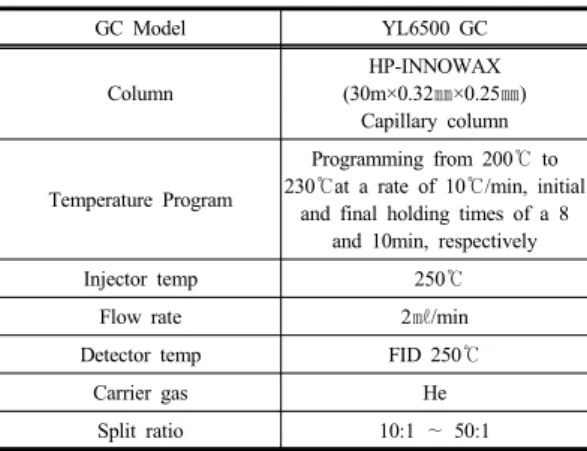
2.2 Analysis of Fatty Acid Composition After the esterification, the FAME was analyzed by GC (YL6500 GC, Younglin, Korea). Table 1 shows the
GC Model YL6500 GC
Column
HP-INNOWAX (30m×0.32㎜×0.25㎜)
Capillary column Temperature Program
Programming from 200℃ to 230℃at a rate of 10℃/min, initial
and final holding times of a 8 and 10min, respectively
Injector temp 250℃
Flow rate 2㎖/min
Detector temp FID 250℃
Carrier gas He
Split ratio 10:1 ∼ 50:1
Table 1. Experimental conditions for GC analysis of fatty acids.
GC analysis conditions. The GS column was HP-INNOWAX, and the sample flow rate was 2 ㎖ /min. The oven temperature was kept at 200℃ for the first eight minutes, then increased by 10℃ per minute to 230℃ at which the temperature was maintained for 10 minutes.
An FID type detector was used at 250℃.
2.3 Biodiesel Performance Evaluation
To evaluate the performance of the biodiesel prepared by using soybean oil and waste chicken oil, the biodiesel yield and the FAME and LAME content of KS H ISO 5508 were analyzed according to the following Eqs. (1) to (3):
× (1)
×
×
× (2)
× (3)
According to KSM2413, BD100 should have a FAME content of 96.5% or higher and a LAME content of 12% or lower.
2.4 Data Analysis and Verification
To find out the optimal molar ratio by varying the soybean oil and waste chicken oil mixing ratio, one-way ANOVA was performed to analyze the average biodiesel yield and the FAME content as well as the significance probability. Tukey B test was performed as a post hoc test of the analysis.
3. Results and Discussion.
3.1 Evaluation of Biodiesel Characteristics Depending on Oil Mixing Ratio and Methanol/Oil Molar Ratio
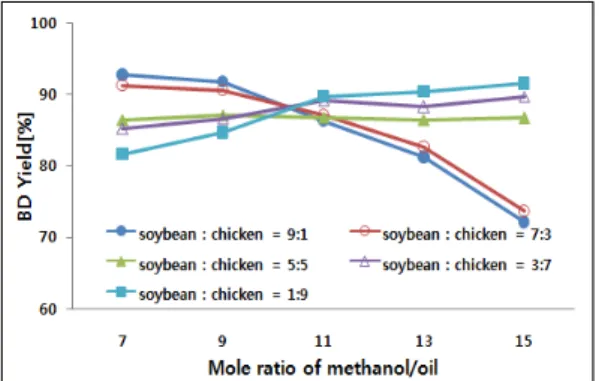
Fig. 1 shows the biodiesel yield depending on the soybean oil and waste chicken oil mixing ratio and the methanol/oil molar ratio. As shown in Fig. 1, the biodiesel
Fig. 1. Effect of soybean and chicken oil mixing ratio on the BD yield.
Table 2. Descriptive statistics of BD yield by the change of soybean and chicken oil mixing ratio based on the ANOVA analysis.
yield was increased as the molar ratio was decreased at a high soybean oil mixing ratio, while the biodiesel yield was increased as the molar ratio was increased as the waste chicken oil mixing ratio was increased. The highest biodiesel yield was found at 7 mol of soybean oil mixing ratio when the soybean oil mixing ratio was high, while it was found at 15 mol of waste chicken oil when the waste chicken oil mixing ratio was high.
The findings indicated that the optimal molar ratio of soybean oil was 7 and that of waste chicken oil was 15. The content of free fatty acid is evaluated to be lower as BD yield become higher as soybean oil content in mixed raw material is higher since soybean oil is higher than waste chicken oil.
Table 2 shows the average biodiesel content and the significance probability analyzed by one-way ANOVA.
As shown in Table 2, the average values among the groups are not identical at a significance probability.
The Tukey B value in the post hoc test was 13 mol and 15 mol in Group A and 7 mol, 9 mol, 11 mol, and 13 mol in Group B. Therefore, the optimal molar ratio of BD yield was highest from 9 to with an average value of 88.1%.
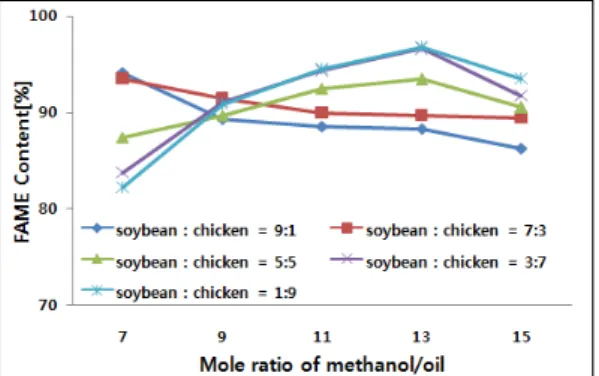
Fig. 2 shows the FAME content depending on the soybean oil and waste chicken oil mixing ratio and the methanol/oil molar ratio. As shown in Fig. 2, the FAME content increased as the molar ratio decreased when the soybean oil mixing ratio was high, while the FAME content increased as the molar ratio increased when the waste chicken oil mixing ratio was high. The optimal methanol/oil molar ratio when only soybean oil was used was 7, and the optimal methanol/oil molar ratio when only waste chicken oil was used was 15.
Therefore, the FAME content decreased as the methanol/oil molar ratio increased at a soybean oil mixing ratio exceeding 5. At a waste chicken oil ratio exceeding 5, the FAME content increased as the methanol/oil molar ratio increased. However, the FAME content slightly decreased at a methanol/oil molar ratio exceeding 13. This FAME content decrease at a high methanol/oil molar ratio may be because the transesterification is a reversible reaction in which the FAME content is increased at an optimal methanol/oil molar ratio depending on the characteristics of oil, but the FAME content is decreased at a methanol/oil molar ratio higher than the optimal ratio as a reverse reaction takes place. The content of free fatty acid is evaluated to be lower as FAME content become higher as soybean oil content in mixed raw material is higher since soybean oil is higher than waste chicken oil.
Table 3 shows the average FAME content and the significance probability found by one-way ANOVA. As shown in Table 3, the average values among the groups are not equal at a significance probability. The Tukey B values in the post hoc test were 7 mol, 9 mol, and 15 mol in Group A and 9 mol, 11 mol, 13 mol, and 15 mol in Group B. Therefore, the optimal molar ratio with respect to the biodiesel yield was 13 mol, at which the average biodiesel yield was 93.02%.
Fig. 2. Effect of soybean and chicken oil mixing ratio on the FAME content.
Table 3. Descriptive statistics of FAME content by the change of soybean and chicken oil mixing ratio based on the ANOVA analysis.
3.2 Evaluation of Biodiesel Characteristics Depending on Oil Mixing Ratio at Optimal Methanol/Oil Molar Ratio
Figs. 3 and 4 show the biodiesel yield, the FAME content, and the LAME content of the biodiesel prepared at fixed methanol/oil molar ratios of 9 and 13 depending on the oil mixing ratios. At a methanol/oil molar ratio of 9, the FAME content was the highest at 91.4% when the soybean oil and waste chicken oil mixing ratio was 7:3, indicating that the optimal soybean oil and waste chicken oil mixing ratio was 7:3. At a methanol/oil molar ratio of 13, the FAME content was the highest at 96.6% when the soybean oil and waste chicken oil mixing ratio was 3:7, indicating that the optimal soybean oil and waste chicken oil mixing ratio was 3:7. When the waste chicken oil mixing ratio was 3:7 or higher, the FAME content was
almost constant, but the biodiesel yield slightly increased. As the mixing ratio of waste chicken oil, which is an animal oil, increased, the LAME content decreased, because the LAME content is lower in vegetable oils than in animal oils. At a methanol/oil molar ratio of 9, the soybean oil and waste chicken oil mixing ratio of 7:3 did not satisfy the KSM2413 standards (FAME content: 96.5% or higher, LAME content: 12% or lower). However, at a methanol/oil molar ratio of 13, the soybean oil and waste chicken oil mixing ratio of 3:7 satisfied the KSM2413 standards because the FAME content was 96.6% and the LAME content was 4.1%.
Fig. 3. Effect of soybean and chicken oil mixing ratio on the biodiesel performance (methanol/oil mole ratio = 9 mole).
Fig. 4. Effect of soybean and chicken oil mixing ratio on the biodiesel performance (methanol/oil mole ratio = 13mole).
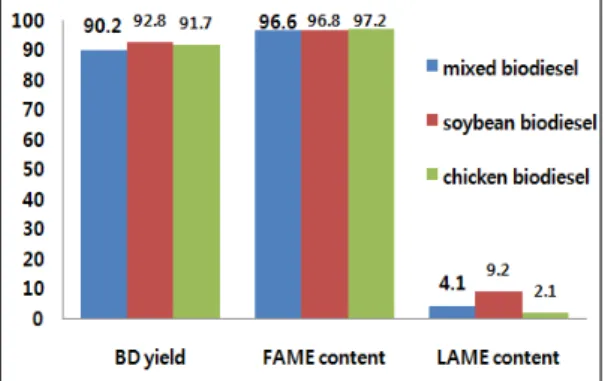
3.3 Comparison of Biodiesel Characteristics Fig. 5 shows the respective FAME content, the LAME content, and the biodiesel yield of the biodiesel prepared with waste chicken oil only, soybean oil only, and by the esterification (methanol/oil molar ratio of 13) of soybean oil and waste chicken oil (mixing ratio of 3:7). The soybean-based biodiesel had a biodiesel yield of 92.8%, a FAME content of 96.8%, and a LAME content of 9.2%, showing the best characteristics. The biodiesel based on the mixture of the animal oil and the vegetable oil had biodiesel yield of 90.2%, a FAME content of 96.6%, and a LAME content of 4.1%, satisfying the KSM2413 standards.
Fig. 5. Performances of soybean, chicken and mixed biodiesels.
4. Conclusions
Although biodiesel has recently drawn increasing attention, most biodiesel products, produced from vegetable oil, have to compete with food resources. To resolve this problem, studies have been conducted to produce biodiesel from animal oils. However, biodiesel produced from animal oils contains a high ratio of saturated fatty acids and thus its low-temperature fluidity is poor. To solve the problem of animal oil-based biodiesel, biodiesel was prepared in the present study by using a mixture of animal oil and vegetable oil, and the characteristics of the prepared biodiesel were analyzed. The following conclusions
were made from the present study.
1. The biodiesel yield and the FAME content analysis showed that the optimal methanol/oil molar ratio was 9 or 13.
2. The biodiesel performance was measured at a fixed methanol/oil molar ratio of 9 by varying the soybean oil and waste chicken oil mixing ratio, and the result showed that the optimal mixing ratio was 7:3 (soybean oil to waste chicken oil ratio of 7:3), the biodiesel yield 90.5%, the FAME content 91.4%, and the LAME content 6%.
3. The biodiesel performance was measured at a fixed methanol/oil molar ratio of 13 by varying the soybean oil and waste chicken oil mixing ratio, and the result showed that the optimal mixing ratio was 3:7 (soybean oil to waste chicken oil ratio of 3:7), the biodiesel yield 90.2%, the FAME content 96.6%, and the LAME content 4.1%.
4. The optimal methanol/oil molar ratio for the esterification of the soybean oil and waste chicken oil mixture was 13, and the optimal soybean oil and waste chicken oil mixing ratio was 3:7 (soybean oil to waste chicken oil ratio of 3:7).
The biodiesel produced under these conditions satisfied the KSM2413 standards of the FAME content of 96.5% or higher and the LAME content of 12% or lower.
References
[1] K. H. Chung, B. G. Park, “Biodiesel production from Vegetable Oils by Transesterification Using Ultrasonic Irradiation”, Applied Chemistry for Engineering, vol. 21, no. 4 pp. 385-390, 2010.
[2] L. K. Chao, K. F. Hua, H. Y. Hus, S. S. Cheng, J. Y.
Liu, S. T. Chang, “Study on the anti-inflammatory activity of essential oil from leaves of Cinnamomum osmophloeum”, Journal of Agricultural and Food Chemistry, vol. 53, no. 18, pp. 7274-7278, 2005.
DOI: https://doi.org/10.1021/jf051151u
[3] Y. K. Lim, S. C. Shin, E. S. Yim, H. O. Song, “The
Effective Product Method of Biodiesel”, Journal of the Korean Industrial and Engineering Chemistry, vol. 19, no. 2 pp. 137-144, 2008
[4] Dennis Y. C. Leung, X. Wu, M. K. H. Leung, “A review on biodiesel production using catalyzed transesterification”, Applied Energy, vol. 87, no. 4 pp.
1083-1095, 2009.
[5] Y. J. Hyun, “Conversion of Mixed Fat into Biodiesel in Plug Flow Reactor Using Alkali and Mixed Catalysts”, Journal of the Korean Chemical Society, vol. 27, no. 2 pp. 123-128, 2010.
[6] Korea broiler council, Slaughter current state in korea, 2010, http://www.chicken.or.kr/statistics/statUser.html?
Ncode=st4.
[7] D. K. Kim, J. D. Choi, J. Y. Park, J. S. Lee, S. B. Park, S. C. Park, “Optimization of Pre-treatment of Tropical Crop Oil by Sulfuric Acid and biodiesel Production”, pp.
215-215, Korean Chemistry Engineering Research, 2009.
[8] L. Canoira, M. Rodrigues-Gamero, E. Querol, R.
Alcantara, M. Lapuerta, F. Oliva, “Biodiesel from low-grade animal fat: production process assessment and biodiesel properties characterization” Industrial and Engineering Chemistry Research, vol. 47, no. 21 pp.
7997-8004, 2008.
DOI: https://doi.org/10.1021/ie8002045
[9] S. B. Lee, Y. S. Park, J. D. Lee, “Mixing Effect of Waste Chicken Oil and Canola Oil in Biodiesel Production Process”, Journal of the Korea society of waste management, vol. 28, no. 2 pp. 159-164, 2011.
Jong-Won Kwack [Regular member]
•Feb. 2012 : Kyungpook Univ., Bio-indusrtial Machinery Engineering, MS
•Jan. 2017 : Kyungpook Univ., Bio-indusrtial Machinery Engineering, PhD
<Research Interests>
Biodiesel, Bioenergy, Technology for Biodiesel Production
Tae-Han Kim [Regular member]
•Feb. 1982 : Kyungpook National Univ. Agricultural Engineering. MS
•Mar. 1989 : The University of Tokyo, PhD
•May. 1983 ~ current : Kyungpook National Univ. Dept. of Bio-Industrial Machinery Engineering, Professor
<Research Interests>
-Technology for Biodiesel Production
-Effective Utilization of Biogas in Cogeneration of Power -Technology for Biomass Conversion into Energy -Effective Utilization of Natural Energy in Agriculture