Investigation on Mechanical Property and Adhesion of Oxide Films Formed on Ni and Ni-Co Alloy in Room and
High Temperature Environments
Yoshinori I. Oka† and Hisanobu Watanabe
Departiment of Chemical Engineering, Hiroshima University 1-4-1 Kagamiyama, Higashi-Hiroshima 739-8527 Japan
Material degradation such as high temperature oxidation of metallic material is a severe problem in energy generation systems or manufacturing industries. The metallic materials are oxidized to form oxide films in high temperature environments. The oxide films act as diffusion barriers of oxygen and metal ions and thereafter decrease oxidation rates of metals. The metal oxidation is, however, accelerated by mechanical fracture and spalling of the oxide films caused by thermal stresses by repetition of temperature change, vibration and by the impact of solid particles. It is therefore very important to investigate mechanical properties and adhesion of oxide films in high temperature environments, as well as the properties in a room temperature environment. The oxidation tests were conducted for Ni and Ni-Co alloy under high temperature corrosive environments. The hardness distributions against the indentation depth from the top surface were examined at room temperature. Dynamic indentation tests were performed on Ni oxide films formed on Ni surfaces at room and high temperature to observe fractures or cracks generated around impact craters. As a result, it was found that the mechanical property as hardness of the oxide films were different between Ni and Ni-Co alloy, and between room and high temperatures, and that the adhesion of Ni oxide films was relatively stronger than that of Co oxide films.
Keywords : high temperature oxidation, oxide film, Ni, Ni-Co alloy, mechanical properties, adhesion, hardness, particle impact method
†Corresponding author: [email protected]
1. Introduction
Nickel and cobalt metals possess high resistance to high temperature corrosion/oxidation, and are very important el- ements of alloy compositions. It is well known that their oxide films are good diffusion barriers to protect metals and alloys from high temperature oxidation.1)-3) However, component materials used in practically high temperature environments of energy generation systems, manufacturing and refining sometimes suffer mechanical degradation by wear, abrasive wear and solid particle erosion. It is there- fore needed to know mechanical properties and adhesion of oxide films formed on metal surfaces at high tempera- tures.
It is very difficult to obtain mechanical properties, espe- cially adhesion of oxide films formed on metal surfaces at high temperatures so that research papers associated with mechanical evaluation of oxide films are a few.4),5) We reported examinations of mechanical properties and
adhesion of various oxide films formed on carbon steel and titanium and its alloy surfaces in high temperature corrosive environments, using a particle impact method.6)-8) The behaviour of fracture and spalling around impact cra- ters caused by impact of a glass ball, and the mechanical property as dynamic fracture stress and adhesion of the oxide films were roughly obtained with environmental conditions. These characteristic properties changed with the corrosive environments and were dependent on the type of oxide films.
The aim of this paper is to obtain corrosion character- istics of Ni metal and Ni-Co alloy and mechanical property as hardness and adhesion of the respective oxide films formed on the metal and alloy. The corrosion/oxidation tests were conducted under high temperature corrosive environments. XRD analyses were carried out to confirm compositions of oxide films. The hardness distributions against the indentation depth from the top surface were examined at room temperature. Dynamic indentation tests were performed on oxide films formed on Ni surfaces at room and high temperature to observe fractures or cracks
Heater Ceramic Tube
Flask
Specimen
Refractory
(a) (b)
N2 Gas Gas Gun
Fig. 1. Schematic diagram of testing rigs. (a) furnace arrangement for oxidation tests and (b) a gas gun unit for and impact tests at a high temperature.
generated around impact craters, using a particle impact method.
2. Experimental
The materials tested were a commercially pure nickel and a 10 Ni-90 Co alloy. The high temperature corrosion /oxidation test apparatus with a simple furnace and a gas feeder is schematically shown in Fig. 1(a). The furnace is composed of a ceramic tube, hot coils, refractory and a hatch. A few types of corrosive gases (air, water vapor, 20 wt%HCl water vapor and 2 wt%HF water vapor) were supplied into the ceramic tube through a gas feeder from a flask. The temperatures of the furnace were 873 and 973 K. Four specimens (20x30x1 mm3) were put in the middle of the furnace at a given high temperature, taken out one by one for the four times of measurements and cooled. The specimens were not put back in the furnace.
The mass gain of the specimen was measured after cooling. X-ray diffraction (XRD) analyses were performed on the oxidized Ni specimens and on oxide films collected after oxidation tests of the Ni-Co alloy. Measurements of Vickers hardness on the oxidized specimen surfaces were conducted to obtain hardness distributions of oxide films and the metal at room temperature. A pyramidal indenter was suppressed on oxide film surfaces at different loads.
Impact tests of a round particle on a Ni block specimen (65φ x 25 mm3) in a high temperature (973 K) air environ- ment were conducted with a compact gas gun schemati- cally shown in Fig. 1(b). A glass ball with 2 mm in diame- ter was impacted on the oxide films formed on a Ni speci- men in the furnace at 973 K, and on the same oxide films at room temperature after cooling the specimen, at an im- pact velocity of 50 ms-1. The crater surfaces were observed by scanning electron microscopy (SEM).
3. Results
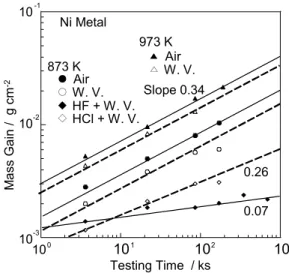
Fig. 2 shows mass gain of Ni versus testing time curves in various corrosive environments at temperatures of 873 and 973 K. Relations between testing time and mass gain were linear on a logarithmic scale. The mass gain was larger at a high temperature of 973 K than at 873 K . The slope of the linear curves was about 0.34 for Ni in the environments of air and water vapor (W.V.), irre- spective of temperature. The slope was lower in the corro- sive environments including halogen. Fig. 3 shows mass gain of Ni-Co alloy versus testing time curves at two tem- peratures in various corrosive environments at 873 and 973 K. The similar behaviour of the mass gain was ob- served for Ni metal and Ni-Co alloy. But the slope of the linear curves for Ni-Co alloy in environments of air and W.V. was about 0.37 slightly higher than that for Ni.
Testing Time / ks
Mass Gain / g cm-2
10-3 10-2 10-1
100 101 102 103
973 K
▲
△
Air W. V.
873 K
●
○
W. V.Air
◆ HF + W. V.
◇ HCl + W. V.
Ni Metal
Slope 0.34
0.26
0.07
Fig. 2. Mass gain vs. testing time curves for Ni metal in various corrosive environments.
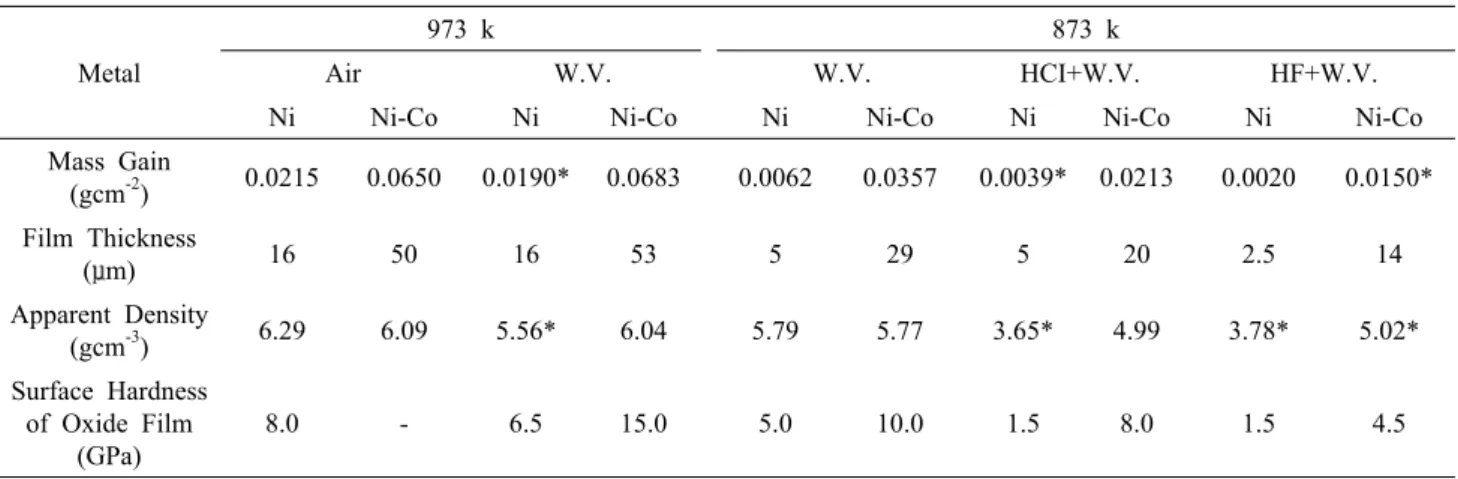
Table 1. Oxidation test results, apparent density and surface hardness of oxide films at a testing time of 172.8 ks.
Metal
973 k 873 k
Air W.V. W.V. HCI+W.V. HF+W.V.
Ni Ni-Co Ni Ni-Co Ni Ni-Co Ni Ni-Co Ni Ni-Co
Mass Gain
(gcm-2) 0.0215 0.0650 0.0190* 0.0683 0.0062 0.0357 0.0039* 0.0213 0.0020 0.0150*
Film Thickness
(μm) 16 50 16 53 5 29 5 20 2.5 14
Apparent Density
(gcm-3) 6.29 6.09 5.56* 6.04 5.79 5.77 3.65* 4.99 3.78* 5.02*
Surface Hardness of Oxide Film
(GPa)
8.0 - 6.5 15.0 5.0 10.0 1.5 8.0 1.5 4.5
*Estimated from mass gain vs. testing time curves.
Testing Time / ks
Mass Gain / g cm-2
10-3 10-2 10-1
100 101 102 10
Ni-Co Alloy 973 K
▲
△
W. V.Air
873 K
●
○
W. V.Air
◆HF + W. V.
◇HCl + W. V.
Slope 0.37
0.24
Fig. 3. Mass gain vs. testing time curves for Ni-Co alloy in various corrosive environments.
The mass gain basically means the mass of absorbed oxygen. The mass gain for Ni-Co alloy was larger than that for Ni. Film thicknesses of oxide films formed for 172.8 ks in various corrosive environments were observed and measured by SEM and listed in Table 1.
Fig. 4 shows appearances of oxidized specimens after a testing time of 86.4 ks in environments of W.V.at tem- peratures of 873 and 973 K, and HF+W.V. at 873 K for Ni and Ni-Co alloy. The oxide films formed on Ni speci- mens were not spalled after taking them from the furnace, but the oxide films formed on Ni-Co alloy specimens were partially spalled (light area) in an environment of W.V..
The spalling of oxide films was easily observed in the corrosive environment, but partially located and thin.
Fig. 5 shows XRD patterns of Ni substrate and with oxide films formed in high temperature environments of
(a) (b)
(c) (d)
(e) (f)
Fig. 4. Appearances of oxidized specimens after 86.4 ks (a) Ni in W.V. at 873 K, (b) Ni in W.V. at 973 K, (c) Ni-Co alloy in W.V. at 873 K and (d) Ni-Co alloy in W.V. at 973 K, (e) Ni in HF+W.V. at 873 K and (f) Ni-Co in HF+W.V. at 873 K.
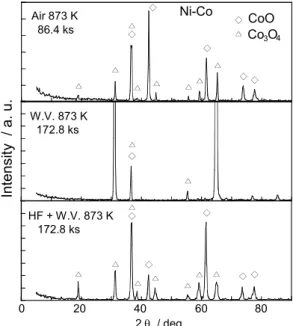
air, water vapor and water vapor including hydrogen chlor- ide and fluoride. Ni oxide (NiO) was detected in any corro- sive environments. The metal Ni was also detected because of a thin oxide film. Fig. 6 shows XRD patterns of Ni-Co alloy and collected oxide films formed in high temperature environments of air, water vapor and water vapor includ- ing hydrogen fluoride. The films were all composed of cobalt oxides of CoO and Co3O4, even if in the corrosive environment of hydrogen fluoride. No chloride was de- tected in all corrosive environments.
Air 973 K 172.8 ks
W.V. 973 K 86.4 ks Ni Substrate
HF+W.V. 873 K 172.8 ks
0 20 40 60 80
HCl+W.V. 873 K 172.8 ks
2θ / deg.
□ □
□ □ □
○
○
□ □
□
○ □ □
○
□
□
□
□ □
○
○
□
○
○
○
□
□
□
□
○
○
○
○
□
NiONi
Intensity / a. u.
Ni Substrate
Air 973 K 172.8 ks
W.V. 873 K 86.4 ks
HF+W.V. 873 K 172.8 ks
HCl+W.V. 873 K 172.8 ks
0 20 40 60 80 2θ / deg.
Fig. 5. XRD patterns of Ni oxide film formed on Ni metal in various corrosive environments, as compared with Ni substrate.
Ni-Co Air 873 K
86.4 ks
W.V. 873 K 172.8 ks
0 20 40 60 80
2 θ / deg.
Intensity / a. u.
△
◇CoO Co O3 4
◇
◇ ◇
◇
◇
◇
△ △
△
△
△
△
△
△
△
△ △
△
△
◇
△ ◇ ◇
△
◇
◇
△
△
△
HF + W.V. 873 K 172.8 ks
Fig. 6. XRD patterns of Co oxide film formed in various corrosive environments.
Figs. 7 and 8 show hardness distributions against tip depth of the indenter calculated from an indentation diame- ter, for oxide films formed on Ni and Ni-Co alloy in vari- ous corrosive environments. Thickness values of oxide films were nearly the same in Table 1. The hardness values were very high on the surfaces of oxide films and gradu-
0 2 4 6 8 10
0 5 10 15 20 25
Vickers Hardness / GPa
Indentation Depth / μm Ni Metal
△
○
◇
◆
W. V. 973 K W. V. 873 K HF + W.V. 873 K HCl + W.V. 873 K
▲ Air 973 K
Hv of Ni Bulk 0.8 GPa
Fig. 7. Hardness distributions against indentation depth for oxide films formed on Ni metal in various corrosive environments for 172.8 ks.
0 2 4 6 8 10 12 14 16
0 2 4 6 8 10 12
Vickers Hardness / GPa
Indentation Depth / μm Ni-Co Alloy
△
○
◇
◆
W.V. 973 K W.V. 873 K HF + W.V. 873 K HCl + W.V. 873 K
Hv of Ni-Co 3.3 GPa
Fig. 8. Hardness distributions against indentation depth for oxide films formed on Ni-Co alloy in various corrosive environments for 172.8 ks.
ally decreased with indentation depth, and reached hard- ness values of the bulk metal and alloy. The values of surfce hardness approximately estimated by Figs. 7 and 8 were listed in Table 1. The hardness values were also higher in the environments of air and/or water vapor (W.V.) and lower in the corrosive environments. The hard- ness of Ni-Co alloy oxide films was larger than that of Ni oxide films.
Fig. 9 shows observations of impact craters on the Ni oxide films impacted in an air environment at 973 K (a) and impacted at room temperature after cooling the speci- men (b). The crater size was slightly different between the two temperatures of test conditions. The film thickness was about 16 μm. It can be seen that circumferential cracks in the inside area near the crater rim were observed and radial cracks both inside and around the impact crater ex- tended to a wide area far from the indentation. These
0.5 mm (a)
(b)
Fig. 9. SEM photographs of craters formed in impact of a glass ball (2 mm) at a velocity of 50 ms-1, (a) in the air at 973 K and (b) at room temperature.
cracks were remarkably observed in the impact crater at 973 K but a few at room temperature. The distance of terminated radial cracks was longer at the impact at 973 K than that at room temperature.
4. Discussion
4.1 Oxidation of Ni and Ni-Co alloy
The slopes of linear curves, 0.34 and 0.37 in a loga- rithmic scale from Figs. 2 and 3 were lower than 0.5 of a parabolic law of oxidation1) and implied that protective films formed on the surface both of Ni metal and of Ni-Co alloy. The mass gain was slightly affected by the environ- ment of water vapor for Ni. The oxidation of Ni-Co alloy was basically independent of the existence of water vapor.
However, a decrease in slope of the linear curve was found in the environment of water vapor including hydrogen flu- oride, and the mass gain was actually low. The more pro- tective film with a diffusion barrier were suggested to be formed in the corrosive environments, and to be associated with thickness and apparent density of oxide films as men- tioned later.
The analyses of the oxide films by XRD (Figs. 5 and 6) suggested that the films formed in any corrosive envi- ronments were metal oxides of NiO for Ni metal and CoO and Co3O4 for Ni-Co alloy and that any chloride was not accumulated in the films. It is well known that volatile chlorides have low melting points and easily turns to metal
oxide even if the chlorides generate. Apparent densities of the oxide films can be calculated from the mass gain by absorbed oxygen, the composition and thickness of ox- ide films. The apparent densities of oxide films calculated as NiO and CoO formed on the respective metal and alloy for 172.8 ks at 973 K were listed in Table 1. It was found that the apparent densities of oxide films formed under the corrosive environments including halogen were lower than those under air or water vapor environments. The generation of chlorides leads to low apparent density of the oxide films but thicker films formed with the low appa- rent density turn to protect metals from oxidation. These results were quite different from the oxidation of mild steel which was accelerated by hydrogen chloride accompanied by the oxychlorination reaction.9) The mass gains of Ni-Co alloy were larger than those of Ni at the same high temper- atures and at the same testing time. The cobalt oxides are easily formed but not regarded as very good diffusion bar- riers, but the oxidation of Ni-Co alloy was one half of that of mild steel reported in the previous paper.7) 4.2 Adhesion of oxide films
The appearances in Fig. 4 show a possibility of spalling of oxide films from the metal surface. Oxide films suffer thermal stresses caused by the difference in thermal ex- pansions of an oxide film and metal. The thermal ex- pansion coefficients of the oxides are unknown so that the values of thermal stress cannot be estimated. The Ni oxide was not spalled from a Ni metal surface, but the Ni-Co oxide was spalled slightly in the case of a temper- ature of 873 K and largely in the case of 973 K. The thermal stress is probably higher at a higher temperature difference during cooling from 973 K and on thicker oxide films at 973 K than at 873 K. The adhesion of Ni oxide films probably decreases with an increase in corrosiveness of the environment, because of the existence of slight ex- foliation of a thin oxide film appeared on tightly stacked oxide films (see Fig. 4).
The resistance to exfoliation of Ni oxide films from a Ni surface is supposed to be higher than that for Co oxide films. Highly thermal or vibrational stresses accompanied by dynamic circumstances possibly cause wide areas of exfoliation in the Co oxide films formed on the Ni-Co alloy and promote a large acceleration of oxidation. The corrosiveness of a high temperature environment accel- erates the possibility of the exfoliation and the oxidation both of Ni and Ni-Co alloy.
4.3 Mechanical property of oxide film estimated from hardness distributions
The mechanical property as hardness of oxide films at
room temperature can be estimated from hardness dis- tributions which were obtained from indentation tests on oxide film surfaces. The indentation depth in Figs. 7 and 8 is the distance of the indenter tip from a top surface of oxide films, which is geometrically determined by the indentation diameter. Hardness values decreased with the increase in the indentation depth and reached the hardness of the metal and alloy. The hardness value at a depth of about 3 or 5 μm was a half of surface hardness in spite of thicker oxide films than the indentation depth. This is attributed to effects of the softer metal and alloy than the oxide films. It can be seen that the hardness of the cobalt oxide films is generally harder than that of the Ni oxide films, although the distributions seem to be affected by the thickness of the oxide films followed by the metal and alloy.
A corrosive environment leads to a decrease in apparent density of oxide films, and to a decrease in hardness of the oxide films. It is well known that oxide films protect metal surfaces by forming diffusion barriers of oxygen.
The oxide films observed in this report are also regarded to be protective in all high temperature environments, as shown in Figs. 2 and 3. However, an acceleration of oxida- tion is possibly anticipated by the mechanical destruction of oxide films formed in corrosive environments. This con- sideration from the hardness distributions is experimen- tally limited to room/low temperature.
4.4 Dynamic indentation on Ni oxide films
The particle impact method is very useful for estimating mechanical property or exfoliation of oxide films in a high temperature environment. The average dynamic hardness can be obtained from the size of indentation, but can hardly reflect a mechanical resistance of the oxide films because the oxide films are thin as compared with the indentation depth. The indentation diameters in Fig. 9 were about 0.79 and 0.83 mm respectively at an impact velocity of 50 ms-1. The indentation depth of 80-90 μm was geometrically esti- mated from the diameter. The oxide film thickness was about 16 μm. Dynamic hardness is calculated according to the definition of impact energy, mass of a glass ball m and indentation volume V (P=(mv2/2)/V)10) and within low accuracy of impact velocity v. The dynamic hardness was calculated as 0.54 and 0.67 GPa respectively of Fig.
9 (a) and (b), as compared with 0.8 GPa of the Ni metal at the same impact condition. The dynamic hardness was probably lower at a temperature of 973 K than that at room temperature because of softening of Ni metal at the high temperature, and the dynamic hardness on the Ni sur- face with the oxide films was hardly affected by the harder oxide films.
A lot of circumferential cracks near the inner crater rim and radial cracks around the crater on a Ni specimen with oxide films of about 16 μm were remarkably observed after the impact test at a high temperature of 973 K, but were not observed in the impact test at room temperature.
Tensile forces seemed to generate on the Ni oxide films and metal during the impact of a glass ball. This result suggested that the mechanical strength of Ni oxide films at 973 K is lower than that at room temperature, or com- pressive strength caused by cooling the specimen possibly moderate the tensile strength during the impact. The adhe- sion of Ni oxide films on Ni metal was perfect also in the case of the impact of a glass ball, as any spalling of the Ni oxide was not observed.
5. Conclusions
The oxidation tests for Ni and Ni-Co alloy were per- formed in the high temperature corrosive environments.
The behaviours of mass gain on testing time and XRD analyses of oxide films were investigated and charac- terized with properties of the films. Measurements of Vickers hardness and observations of impact craters were conducted on the oxide films formed on Ni metal and Ni-Co alloy. The conclusions are:
1) The exponent numbers in mass gain and testing time curves on a logarithmic scale were 0.34 for Ni metal and 0.37 for Ni-Co alloy respectively in air and water vapor environments at 873 and 973 K. The oxide films formed on these metals behaved diffusion barriers of oxygen. The films formed on the metal surface in high temperature cor- rosive environments were composed not of chlorides but only nickel or cobalt oxides. From the measurements of oxide film thickness, it was found that the apparent density of the oxide films decreased with corrosive environments.
2) The hardness values of the oxide films formed on metal surfaces were larger than those of metal and alloy.
The Co oxide films were harder than Ni oxide films and the mechanical property as hardness for Ni and Co oxide films decreased with the corrosive environments.
3) Spalling of the oxide films was observed for Co oxide formed on Ni-Co alloy caused by cooling the specimen or probably thermal stresses. Any spalling of Ni oxide films was not observed both in cooling specimens after oxidation tests and in these after impact tests of a glass ball at a temperature of 973 K. These results suggested that the adhesion of Ni oxide films was perfect and the adhesion of Co oxide films was weaker than that of Ni ones.
4) The circumferential and radial cracks were observed inside and outside of the crater caused in the impact tests
of a glass ball at a temperature of 973 K. The mechanical property of Ni oxide films at a temperature of 973 K was anticipated to be lower than that at room temperature.
References
1. J. M. West, Basic corrosion and oxidation, second edition, p. 179, Ellis Horwood Ltd. (1986).
2. S. N. Basu and V. K. Sarin, Materials Science and Engineering, A209, 206 (1996).
3. A. M. Huntz, M. Andrieux, and R. Molins, Materials Science and Engineering, A415, 21 (2006).
4. O. Bernard, G. Amiri, C.Haut, B. Feltz, A. M. Huntz, and M. Andrieux, Materials Science and Engineering,
A335, 32 (2002).
5. A. M. Huntz, M. Andrieux, and R. Molins, Materials Science and Engineering, A417, 8 (2006).
6. S. Thavendra, T. Oe, and Y. I. Oka, Proc. of the 2nd Int. Conf. on Environment Sensitive Cracking and Corrosion Damage, p. 148, Hiroshima (2001).
7. Y. I. Oka, Y. Mukai, and T. Tsumura, Wear, 258, 92 (2005).
8. Y. Isomoto Oka, T. Yamabe, and T. Tsumura, Materials Science Forum, 522-523, 417 (2006).
9. JSCE, High Temperature Oxidation and Hot Corrosion of Metals (Jpn.), p. 190, Maruzen (1984).
10. Y. I. Oka, M. Nishimura, K. Nagahashi, M. Matsumura, Wear, 250, 736 (2001).