Nematicidal Effect of Root-Knot Nematode (Meloidogyne incognita) by Amino Acids Biochemical Agent Extracted from Chicken Feather
Se-Jong Kim · Kyung-Sook Whang*
닭 우모로부터 추출한 아미노산 생화학제의 고구마뿌리혹선충 증식억제 효과
김세종 · 황경숙*
Received: 27 August 2012 / Accepted: 13 September 2012 / Published Online: 31 December 2012
© The Korean Society for Applied Biological Chemistry 2012
Abstract This study examined the control effects of amino acid biochemical agent extracted from chicken feathers on Meloidogyne incognita for the purpose of developing an environmentally friendly nematicidal agent that can replace chemical control of root-knot nematodes (RKN). We investigated the lethal effects of J2 juveniles for 19 types of commercial amino acids. As a result, five kinds of amino acids (
L-asparagine,
L-aspartic acid,
L- methionine,
L-tyrosine,
L-cysteine) showed mortality rate of more than 50% at a concentration of 50 mM.
L-asparagine showed the highest mortality rate at 94%. We also investigated the lethal effect of J2 juveniles and suppressive effects of egg hatching by feather amino acids (FAA) biochemical agent. It showed that the mortality rate of J2 juveniles was more than 80% and suppression rate of egg hatching was 74% at 1/50 concentrations of FAA. As a result of conducting a tomato pot culture experiment for 60 days after treating 1/50 concentrations of FAA biochemical agent in rhizosphere soil, it showed that the control effects were 63% of juveniles density in the soil, 59% of egg mass and 61% of root gall index, respectively. Based on the above results, it is considered that the FAA biochemical agent extracted from chicken feathers can be used as an environmentally friendly nematicidal agent of
RKN.
Keywords amino acid · biochemical nematicide · chicken feather
· Meloidogyne incognita
서 론
뿌리혹선충(Root-knot nematodes)은 1887년 Goeldi에 의해 Meloidogyne 속이 처음으로 밝혀진(Taylor와 Sasser, 1978)이래 90종 이상 분리되었으며(Perry 등, 2009), 현재 NCBI GenBank database (http://www.ncbi.nlm.nih.gov)에 45종이 등록되어 있다.
뿌리혹선충은 식물기생성선충으로 기주작물의 근권에 주로 서 식하며 식물체 뿌리의 내부에 기생하여 영양분을 흡수하고 뿌 리혹을 형성한다. 뿌리혹이 형성된 식물은 토양으로부터 수분과 양분의 흡수가 저하되어 황화현상이 나타나고 지상부가 점차 고 사되며 각종 토양 병해와의 상호작용으로 2차적인 피해를 일으 키는 것으로 알려져 있다(Shurtleff와 Averre, 2000). 또한, 뿌리 혹선충은 노지나 시설재배지의 수박, 참외, 오이, 토마토, 멜론 등의 과채류와 당귀, 더덕, 인삼, 천궁과 같은 약용식물 등 넓 은 범위의 경제작물에 큰 피해를 일으키고 있다(Choo 등, 1987;
Lim 등, 2005).
뿌리혹선충 방제에는 물리적 방제, 경종적 방제, 생물학적 방 제, 화학적 방제 등 다양한 방법이 사용되고 있으나, 국내의 경 우 뿌리혹선충의 방제를 위하여 물리적 방제와 화학적 방제를 주로 선호하고 있다. 물리적 방제는 매 작기 마다 방제를 해야 하는 고가의 비용, 많은 인력과 시간이 요구되는 등 많은 어려 움이 있다(Lim 등, 2006). 화학물질을 인공적으로 합성한 살선 충제의 사용은 약효보다는 약해의 부작용뿐만 아니라 토양 및 수계환경을 오염시키는 문제점이 있다(Kim과 Choi, 2001;
S.-J. Kim
Department of Microbial & Nano Materials, Mokwon University, Daejeon, 302-729, Republic of Korea
K.-S. Whang
Department of Microbial & Nano Materials, Mokwon University, Daejeon, 302-729, Republic of Korea
Institute of Microbial Ecology and Resources, Mokwon University, Daejeon, 302-729, Republic of Korea
*Corresponding author (K.-S. Whang: [email protected])
ORIGINAL ARTICLE
Atkins 등, 2003; Karpouzas 등, 2004). 작물을 연작하고 있는 시설재배지의 경우 선충탄 처리 후 선충 서식부위가 깊어져 선 충 밀도회복이 급격히 빨라지고 선충탄 반복사용으로 인한 저 항성 증가 등 살선충제의 효과가 제대로 미치지 못하는 것으로 보고되었다(Thomas, 1978). 이러한 살선충제를 이용한 화학적 방제를 대체할 생물학적 방제에 관한 다양한 연구가 진행되어 왔다. 뿌리혹선충 포식곰팡이(Cho 등, 2007; Braga 등, 2010;
Zhang 등, 2010)와 기생성 세균(Uriostegui와 DelaParra, 2002;
Zhu 등, 2005; Mendoza 등, 2008; Oliveira 등, 2009)을 이용 한 방제는 대량배양이 어려울뿐만 아니라 유통과정 중 생균력 저하, 토양 내 정착과 효과발현까지 장시간이 소요되어 시설재 배지에서 효과가 미흡하다. 식물 또는 약용식물 유래 추출물을 이용한(Lim 등, 2006; Hong 등, 2010; Lee 등, 2011) 살선충 효과의 우수성이 많이 보고되었으나 식물체 원료의 수급이 어 려워 실용화에 많은 어려움이 있다. 따라서 친환경적이면서 효 과가 우수한 뿌리혹선충 방제법 개발이 절실한 실정이다.
최근, 국외에서는 L-arginine, L-cysteine, L-glutamic acid,
DL-methionine, L-proline, DL-aminobutyric acid와 같은 아미노 산이 뿌리혹선충 유충의 치사력뿐만 아니라 알 부화를 억제시 키며(Oka 등, 1999; Talavera와 Mizukubo, 2005; Oliveira 등, 2009), L-3,4-dihydroxyphenylalanine (L-DOPA)은 고구마뿌리혹 선충(Meloidogyne incognita)과 콩시스트선충(Heterodera glycines) 에도 살선충 효과가 있는 것으로 보고된 바 있다(Barbosa 등, 1999). 또한, 세균과 곰팡이가 생산하는 대사산물에 함유된 아 미노산이 뿌리혹선충에 살선충 효과가 있어 뿌리혹선충의 방제 제로 활용하기 위한 연구가 다양하게 진행되고 있다(Kwon 등, 2007; Oliveira 등, 2009). 국내의 경우, 아미노산은 친환경 농 업에서 토양개량과 작물생육용 비료로 개발되어 실용화되고 있 으나, 뿌리혹선충의 방제제 개발에 관한 연구는 아직까지 보고 된 바 없다.
본 연구는 다양한 종류의 아미노산을 사용하여 뿌리혹선충의 치사효과를 현미경을 통하여 관찰하고, 아미노산 생화학제의 뿌 리혹선충 친환경 방제제로의 활용 가능성에 대해 검토하기 위 해 케라틴 단백질로 구성된 닭 우모분으로부터 추출한 아미노 산 생화학제를 이용하여 뿌리혹선충의 증식억제 효과를 검토하 고 토마토 작물재배를 통해 뿌리혹선충의 방제가를 조사하였다.
재료 및 방법
시험작물 및 사용균주. 실험에 사용한 고구마뿌리혹선충(M.
incognita)은 농촌진흥청 국립농업과학원 농산물안전성부 작물보 호과로부터 분양 받아 토마토 뿌리에 형성된 난낭에서 분리하 여 화분 내에서 증식시켜 사용하였다. 시험 작물로는 고구마뿌 리혹선충의 감수성 토마토(Lycopersicon esculentum Mill. cv.
Rutgers)를 사용하였다. 실험균주는 저자들이 선행연구에서 분리 한 닭 우모 분해 우수세균 Chryseobacterium sp. FBF-7 (KACC 91463P) 균주를 사용하였다(Kim 등, 2010).
아미노산 생화학제의 추출 및 분석. 닭 우모분으로부터 아미노 산의 추출은 실험균주인 Chryseobacterium sp. FBF-7을 NB broth [1.0% (w/v) peptone, 0.5% (w/v) NaCl, 1.0% (w/v) beef extract, pH 7.5]에 접종한 후 28oC에서 24시간 전배양하여 사 용하였다. 닭 우모분으로부터 아미노산을 추출하기 위하여 무기 염기초배지[0.05% (w/v) NH4Cl, 0.05% (w/v) NaCl, 0.03%
(w/v) K2HPO4, 0.03% (w/v) KH2PO4, 0.01% (w/v) MgCl2· 6H2O, 0.01% (w/v) yeast extract, pH 7.5]에 닭 우모분(chicken feather meal)을 2% (w/v) 첨가하여 제조한 후 실험균주 전배양액을 1% 농도로 접종하고 25oC, 150 rpm으로 3일간 회전진탕 배양 하였다. 배양액을 여과지(Whatman filter paper No.2, 185 mm Ø)에 걸러 잔존 우모분을 제거한 후 4oC, 7,920×g (Supra 22K, Hanil, Korea)로 20분간 원심 분리하여 분해산물인 아미 노산액을 추출하고 4oC에 냉장보관하며 실험에 사용하였다.
닭 우모분으로부터 추출된 아미노산의 정량 · 정성 분석은 아 미노산액 1 mL에 1 mL의 6 N HCl을 가하고 N2 gas로 2분간 치환시킨 후 110oC에서 12시간 처리한 뒤 감압하여 HCl를 제거 하였다. 0.2 N HCl (pH 2.0–3.0) 2 mL을 첨가하여 용해시킨 후 여과지(Whatman filter paper No. 2, 90 mm Ø)로 여과하여 분 석시료로 사용하였다. 아미노산의 정량 · 정성 분석은 아미노산 분석기(Hitachi L-8900, Hitachi, Ltd., Japan)를 이용하였다.
고구마뿌리혹선충의 2령 유충과 알. 고구마뿌리혹선충은 Rutgers 토마토를 기주작물로 온실에서 증식하여 시험에 사용하였다.
Hussey와 Barker(1973)의 방법에 준하여 토마토 뿌리에 형성된 난낭으로부터 알과 유충을 분리하였다. 먼저, 고구마뿌리혹선충 에 의하여 뿌리혹이 형성된 토마토 뿌리의 흙을 흐르는 물로 3 회 세척한 후 해부현미경(Leica EZ4, Germany)하에서 난낭을 추출하였다. Sodium hypochlorite (NaOCl) 0.5% 용액이 담겨 있는 바이알병에 추출한 난낭을 넣고 2분간 흔든 후 200 mesh 와 500 mesh 체를 이용하여 분리된 알을 걸른 다음 멸균수로 3회 세척하여 수집한 다음 알 부화 실험에 사용하였다. 고구마 뿌리혹선충의 2령 유충은 난낭으로부터 Baermann funnel을 이 용하여 3일간 알을 부화시켜 2령 유충을 분리하고 4oC에 보관 한 다음 3일 이내에 분리된 유충을 치사 효과 검정을 위한 기 내 실험과 포트시험에 사용하였다.
고구마뿌리혹선충 2령 유충 치사 및 알 부화억제효과 검정. 고 구마뿌리혹선충 2령 유충의 치사 효과와 알 부화억제효과는 순 수 아미노산과 아미노산 생화학제를 이용하여 24-well culture plate 생물검정법으로 조사하였다. 순수 아미노산 19종류(L- alanine, L-arginine, L-aspartic acid, L-asparagine, L-cysteine,
L-glutamic acid, L-glycine, L-histidine, L-isoleucine, L-leucine,
L-lysine, L-methionine, L-phenylalanine, L-proline, L-serine, L- threonine, L-tyrosine, L-tryptophan, L-valine)를 각각 10−100 mM 농도로 조절하고 닭 우모분으로부터 추출한 아미노산 생화 학제는 1/50−1/1000 농도로 희석하여 실험에 사용하였다. 고구 마뿌리혹선충 유충의 치사 효과 검정에는 각 농도별로 well plate에 950 µL씩 접종하고 4oC의 냉장고에 보관 중이던 고구 마뿌리혹선충의 2령 유충을 50 µL 당 300마리 밀도로 계수하 여 각각 50 µL씩 접종한 후 암조건의 배양기(25±1oC)에 보관하 면서 24시간 간격으로 3일 동안 도립현미경(Leica DMIL, Germany)하에서 살아있는 유충의 수를 조사하였다. 유충의 치 사 유무는 well plate를 흔들어 몸 전체가 일자로 뻗은 상태로 운동성이 없는 것을 확인하여 판정하였다. 고구마뿌리혹선충의 알 부화억제효과 검정에는 각 농도별로 well plate에 950 µL씩 접종하고 고구마뿌리혹선충의 난낭으로부터 수집한 알을 50 µL 당 300개 밀도로 계수하여 각각 50 µL씩 접종한 후 암조건의 배양기(25±1oC)에 보관하면서 6일 간격으로 24일 동안 도립현 미경(Leica DMIL)하에서 부화된 유충의 수를 조사하였다. 무처 리구는 멸균수를 이용하였고 대조약제로는 살선충제인 선충탄 (Fosthiazate 액제, 30%)을 사용적량(0.025%)으로 조절하여 사용
하였으며, 실험은 5반복으로 수행하였다.
고구마뿌리혹선충의 방제 효과 검정. 고구마뿌리혹선충에 대한 아미노산 생화학제(feather amino acids, FAA)의 방제 효과를 검정하기 위해 발아 후 4주된 Rutgers 토마토 유묘를 포트(15 cm × 15 cm)에 심은 후 약 3000마리의 2령 유충과 2500여개의 알을 각각의 토마토 근권부위에 접종하였다. FAA 생화학제 처 리구는 유충과 알을 접종한 후 0, 15, 30, 45일째에 1/50 희석 액을 포트 당 250 mL씩 처리하였다. 무처리구는 동량의 물을 처리하였고, 대조약제로는 시중에 판매되는 선충탄을 약량 (0.025%)으로 희석하여 시험 당일에 포트 당 동량으로 1회만 처리하였다. 실험은 각 처리별로 9반복 수행하였고, 처리 60일 후 각 처리구별로 각 포트 토양 내 선충밀도, 토마토 뿌리에 형 성된 난낭수와 뿌리혹지수를 측정하였다. 선충밀도는 각 시험구 포트로부터 토양시료를 채취하여 음건한 후 2 mm 표준체로 걸 렀다. 체를 통과한 각 토양시료 300 g을 Sive & Baermann funnel 기법을 이용하여 선충을 분리하였다(Southey, 1986). 분 리된 선충은 24-well culture plate에 옮겨 도립현미경(Leica DMIL)하에서 고구마뿌리혹선충 밀도를 조사하였다. 난낭수 조 사는 토마토 뿌리를 흐르는 물에 조심스럽게 흙을 씻어내고 0.15% Phloxin B (Sigma, USA) 용액에 담가 20분간 충분히 염색한 후 해부현미경(Leica EZ4)하에서 난낭수를 조사하였다.
뿌리혹지수는 0–5단계(0, 0%; 1, 1–20%; 2, 21–40%, 3, 41–
60%, 4, 61–80%, 5, 81–100%)를 적용하여 조사하였다 (Garabedian과 Van Gundy, 1984).
통계분석. 본 연구의 생물검정 실험에서 유충 치사, 알 부화억 제, 증식 억제(선충밀도, 난낭수, 뿌리혹지수) 결과는 Duncan 다 중검정(SAS Institute, 1988)으로 5% 수준에서 처리간 유의성을 검정하였다.
결과 및 고찰
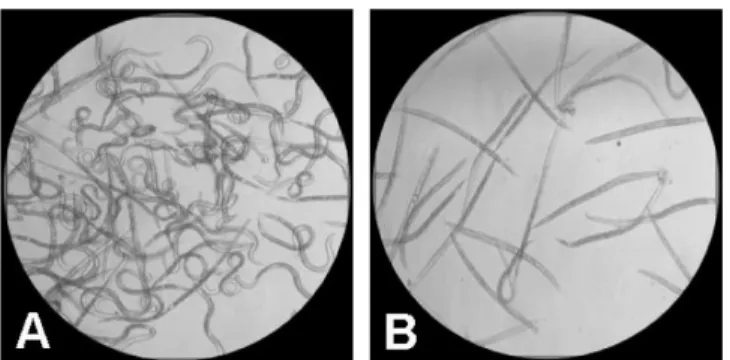
순수 아미노산의 고구마뿌리혹선충 치사효과 검정. 아미노산의 고구마뿌리혹선충 치사효과를 검정하기 위하여 순수 아미노산 19종류를 2령(J2) 유충에 처리하여 치사율을 검토하였다. 각 아 미노산을 10–100 mM로 조정한 후 고구마뿌리혹선충의 유충에 처리하고 72시간 후 도립현미경(40–100x)하에서 운동성을 관찰 하여 유충의 치사 유무를 판정하였다(Fig. 1). 아미노산의 종류 와 처리농도에 따라 고구마뿌리혹선충의 유충 치사효과가 다양 하게 나타났는데, 아미노산 19종류 중 5종류(L-asparagine, L- aspartic acid, L-methionine, L-tyrosine, L-cysteine)의 아미노산 이 50 mM 농도에서 50% 이상의 치사율을 나타낸 반면 L-valine,
L-isoleucine, L-phenylalanine, L-glycine, L-lysine 은 치사효과가 없는 것으로 나타났다. L-asparagine은 50 mM에서 치사율이 94%로 가장 높았으며, L-aspartic acid가 68%의 치사율을 나타 내었다. 특히, L-asparagine은 25 mM의 낮은 농도에서도 78%의 높은 치사율을 보여 다른 아미노산들에 비해 고구마뿌리혹선충 의 유충 치사 효과가 가장 효과적이었다(Fig. 2). 아미노산을 이 용한 뿌리혹선충의 살선충 효과에 관한 연구는 국외에서 일부 수행된 바 있는데 DL-methionine을 25 g/L−1 처리 시 고구마뿌 리혹선충 유충은 16% 이상 치사되고 알 부화율이 76% 억제되 는 것으로 알려져 있다(Talavera과 Mizukubo, 2005). Ascorbic acid, L-arginine, L-glutamic acid는 4000 ppm 농도에서 고구마 뿌리혹선충의 치사와 알 부화억제가 높게 나타났으며(AlSayed
와 Thomason, 1988), 2000 ppm 농도에서는 7일 후 자바뿌리혹 선충의 유충을 100% 치사시키는 것으로 알려져 있다(Osman, 1993). 또한, 상업적으로 판매되고 있는 22종류의 아미노산 중
L-cysteine은 10 mg/mL 농도에서 Meloidogyne exigua를 100%
치사시키는 것으로 알려져 있고(Oliveira 등, 2009), L-3,4- dihydroxyphenylalanine은 고구마뿌리혹선충과 콩시스트선충(H.
glycines)에 살선충 효과가 있는 것으로 보고된 바 있다(Barbosa 등, 1999).
닭 우모로부터 추출한 아미노산 생화학제의 유충 치사효과. 저 자들은 선행연구에서 양계장 내 부산물 시료로부터 분리한 닭 우모 분해세균 Chryseobacterium sp. FBF-7을 이용하여 닭 우 모분으로부터 아미노산을 추출하고 그 특성을 보고하였다(Kim 등, 2010). 케라틴 단백질 분해세균 Chryseobacterium sp.
FBF-7 균주가 닭 우모분으로부터 생산하는 아미노산 생화학제 (FAA)의 총 함량은 210 mg/mL이며, 17종류의 아미노산 중 valine, aspartic acid, glutamic acid, glycine, proline, serine은 주 요 아미노산으로 함유되었다. 특히 고구마뿌리혹선충의 높은 치 사 효과를 나타낸 aspartic acid가 23.4 mg/mL로 총 아미노산의 약 11%를 차지하는 것으로 나타났다.
본 연구에서는 Chryseobacterium sp. FBF-7을 이용하여 닭 우모분으로부터 추출한 FAA 생화학제의 고구마뿌리혹선충 2령 Fig. 1 Observation of second-stage juveniles activity (Meloidogyne incognita) by inverted microscope. Symbols: A; Live juveniles (before treatment with amino acid), B; Dead juveniles (juvenile mortality was observed at 25oC for 3 days after treatment with 50 mM of L-asparagine).
Fig. 2 Lethal effect of free amino acids on second-stage juveniles activity of Meloidogyne incognita. Juvenile mortality was observed at 25oC for 3 days after treatment with amino acids. Values are means ± standard deviations of five replicates.
유충에 대한 치사 효과를 생물검정법으로 조사하였다. FAA 생 화학제를 1/50−1/1000로 희석하여 고구마뿌리혹선충의 2령 유 충에 처리하고 3일 동안 운동성을 관찰하였다(Fig. 3). 대조약 제로 사용된 선충탄의 경우 3일 후 100%의 운동성 억제효과를 보였다. FAA 생화학제는 1/50 농도에서 81%의 높은 운동성 억 제효과를 보였으며, 1/100 농도에서도 67%의 억제효과를 나타 내어 고구마뿌리혹선충 유충에 대한 치사효과가 있음을 확인할 수 있었다.
FAA 생화학제의 알 부화억제 효과 검정. FAA 생화학제의 처 리농도에 따른 고구마뿌리혹선충의 알 부화억제 효과를 24-well culture plate를 이용한 생물검정법으로 조사하였다. FAA 생화 학제를 1/50−1/1000로 희석하여 고구마뿌리혹선충의 알에 처리 하고 6일 간격으로 24일 동안 알 부화율을 검정한 결과를 Fig.
4에 나타내었다. 대조약제로 선충탄을 처리한 경우 24일째에 95%의 부화 억제율이 확인되었다. FAA 생화학제를 1/50 농도 로 처리한 경우 74%, 1/100 농도에서 61%의 부화 억제율을 나타내었다. 상기의 유충 치사효과와 알 부화억제효과 검정 결 과로부터 닭 우모분으로부터 추출한 FAA 생화학제 1/50 희석 농도가 고구마뿌리혹선충의 증식억제 적정농도임이 확인되었다.
FAA 생화학제 처리에 의한 고구마뿌리혹선충의 방제효과 검정.
FAA 생화학제의 고구마뿌리혹선충 방제효과를 알아보기 위해 토마토 포트재배 실험을 수행하였다. 토마토 유묘를 포트에 정 식하고 고구마뿌리혹선충 증식억제 적정농도인 FAA 생화학제 1/50 희석액을 처리하여 60일간 재배한 후 토양 내 유충밀도, 난낭수, 뿌리혹지수를 조사한 결과를 Table 1에 나타내었다. 토 마토 토양 내 고구마뿌리혹선충의 유충밀도를 조사한 결과, 토
양 300 g 당 무처리구에서는 1245±127마리였으며, FAA 생화 학제 처리구가 454±67마리, 살선충제인 선충탄 처리구의 경우 179±27마리로 나타났다. 무처리구의 유충밀도에 따른 방제가는 선충탄의 85.7%에 비하여 낮았으나, FAA 생화학제 처리에서 63.5%의 방제가를 보였다.
토마토 뿌리에 형성된 난낭수를 조사한 결과, 무처리구에서 는 430±56개, FAA 생화학제 처리구가 174±33개, 선충탄 처리 구의 경우 39±4개로 나타났다. 무처리구의 난낭수에 따른 방제 가는 선충탄 처리구가 91.2%로 확인되었고, FAA 생화학제 처 리구의 경우 59.5%의 방제가를 나타내었다. 뿌리혹지수에 따른 감염정도를 조사한 결과, 무처리구는 뿌리의 70% 이상 뿌리혹 이 형성된 반면 FAA 생화학제는 30% 미만으로 형성되었다. 무 처리구의 뿌리혹지수와 비교하여 방제가를 산출한 결과, FAA 생화학제 처리 시 뿌리혹이 61.6% 방제되는 것으로 나타났다.
이상의 결과로부터 FAA 생화학제는 농촌진흥청 고시-농약 및 원제의 등록기준(제2012-37호)에 제시된 살충제의 방제가 기준 과 비교하여 뿌리혹선충의 방제를 위한 살충제뿐만 아니라 친 환경농자재(병해충 방제제)로도 크게 이용될 수 있을 것으로 판 단된다.
최근, 단백질분해효소를 생산하는 Paenibacillus macerans 균 주를 이용하여 배지로부터 획득한 대사산물 중 alanine, glutamic acid, glycine, histidine, threonine, valine이 M. exigua에 살선 충 효과가 있는 것으로 보고된 바 있으며(Oliveira 등, 2009), Fusarium oxysporum 곰팡이가 생산하는 fusaric acid는 높은 살 선충 효과가 있는 것으로 알려져 있다(Kwon 등, 2007). Osman과 Viglierchio (1981)의 보고에 의하면 L-cysteine, L-phenylalanine, Fig. 3 Lethal effect of feather amino acids (FAA) on second-stage
juveniles activity of Meloidogyne incognita. Juvenile mortality was observed at 25oC for 3 days after treatment with FAA. Values are means
± standard deviations of five replicates. Different letters above the bars are significantly different at the 5% level (Duncan’s Multiple Range Test).
Fig. 4 Inhibitory effect of feather amino acids (FAA) on egg hatching of Meloidogyne incognita. Egg hatching was observed at 25oC for 24 days after treatment with FAA. Values are means ± standard deviations of five replicates. Different letters above the bars are significantly different at the 5% level (Duncan’s Multiple Range Test).
Table 1 Suppressive effects of feather amino acids (FAA) on infection of tomato plants by Meloidogyne incognita
Treatment
Nematode reproduction* Index of control (%)
No. of juveniles (300 g soil/pot)
No. of egg mass /root
Root gall index
/root Juveniles Egg sacs Root galling
FAA 454±67 b 174±33 b 2.8±0.4 b 63.5 59.5 61.6
Nematicide (Fosthiazate) 179±27 c 39±4 c 1.1±0.3 c 85.7 91.2 84.9
Control 1245±127 a 430±56 a 4.1±0.6 a - - -
*Nematode reproduction was assayed 2 months after planting. Data are means ± standard deviations of 9 replicates. Means followed by different letters within the column are significantly different at the 5% level (Duncan’s Multiple Range Test).
L-valine을 해바라기에 연속처리 시 단일처리보다 고구마뿌리혹 선충의 난낭수와 뿌리혹 억제효과가 높은 것으로 알려져 있다.
식물 뿌리의 아미노산 구성은 근권토양 내 다양한 병원체로부 터 저항 또는 방어 기작으로 세포벽 대사와 관련된 것으로 고 구마뿌리혹선충의 감염에 따른 목화 뿌리 조직 내 아미노산의 구성에 관한 보고에 의하면 저항성품종보다 감수성품종의 뿌리 내 아미노산의 함량 변화가 큰 것으로 보고되었다(Lewis와 McClure, 1975). 이와 같이 미생물에 의해 생산되는 아미노산 을 이용하여 실용화가 가능하다면 뿌리혹선충뿐만 아니라 식물 기생성선충과 인축에 유해한 선충방제제 개발에 활용될 수 있 을 것으로 생각된다.
초 록
본 연구는 뿌리혹선충의 화학적 방제를 대체할 수 있는 친환경 선충방제제 개발을 목적으로 닭 우모분으로부터 추출한 아미노 산 생화학제(feather amino acid; FAA)의 고구마뿌리혹선충에 대한 방제효과를 검정하였다. 다양한 종류의 아미노산을 대상으 로 고구마뿌리혹선충 유충 치사효과를 조사한 결과, 5종류(L- asparagine, L-aspartic acid, L-methionine, L-tyrosine, L-cysteine) 의 아미노산이 50 mM 농도에서 50% 이상의 치사율을 나타내 었고, L-asparagine 50 mM에서 치사율이 94%로 가장 높았다.
닭 우모분으로부터 추출한 FAA 생화학제의 고구마뿌리혹선충 2령 유충의 치사력과 알 부화억제 효과를 조사한 결과, 1/50 농 도에서 80% 이상의 유충 치사력과 74%의 알 부화 억제율을 보였다. 토마토 근권토양에 FAA 생화학제를 처리하고 60일간 재배시험을 통하여 관찰한 결과, 토양 내 유충밀도는 63%, 난 낭수는 59%, 뿌리혹 형성 61%의 방제효과를 나타내었다. 이상 의 결과로부터 닭 우모분으로부터 추출한 FAA 생화학제는 뿌 리혹선충의 친환경 선충방제제로 활용될 수 있을 것으로 사료 된다.
Keywords amino acid · biochemical nematicide · chicken feather
· Meloidogyne incognita
감사의 글 본 연구는 교육과학기술부와 한국연구재단의 지역혁신인력양성 사업 (M-02-20080704171810)으로 수행된 연구결과로 이에 감사드립니다.
참고문헌
AlSayed AA and Thomason IJ (1988) Meloidogyne incognita and tomato response to thiamine, ascorbic acid, L-arginine, and L-glutamic acid. J Nematol 20, 451–6.
Atkins SD, Hidalgo-Diaz L, Kalisz H, Mauchline TH, Hirsch PR, and Kerry BR (2003) Development of a new management strategy for the control of root-knot nematodes (Meloidogyne spp.) in organic vegetable production. Pest Manag Sci 59, 183–9.
Barbosa LCA, Barcelos FF, Demuner AJ, and Santos MA (1999) Chemical constituents from Mucuna aterrima with activity against Meloidogyne incognita and Heterodera glycines. Nematropica 29, 81–8.
Braga FR, Silva AR, Carvalho RO, Araújo JV, Guimarães PHG, Fujiwara RT et al. (2010) In vitro predatory activity of the fungi Duddingtonia flagrans, Monacrosporium thaumasium, Monacrosporium sinense and Arthrobotrys robusta on Ancylostoma ceylanicum third-stage larvae. Vet Microbiol 146, 183–6.
Cho CW, Kang DS, Jeon HK, Son HS, and Whang KS (2007) Morphological
and phylogenetic characteristics of nematophagous fungi. J Korean Soc Appl Biol Chem 50, 101–6.
Choo HY, Kim HK, Park JC, Lee SM, and Lee JI (1987) Studies on the patterns of plastic film house, their growing conditions, and diseases and pests occurrence on horticultural crops in southern part of Korea. Insects and nematodes associated with horticultural crops and effect of nursery soil conditions on the infection of root-knot nematode. Korean J Plant Prot 26, 195–201.
Garabedian S and Van Gundy SD (1984) Use of avermectins for the control of Meloidogyne incognita on tomato. J Nematol 15, 503–10.
Hong TK, Lee JK, Heo JW, Kim SI, Choi DR, and Ahn YJ (2010) Toxicity of Kaempferia galanga rhizome-derived extract and steam distillate to Meloidogyne incognita juveniles and eggs, and their effects on Lycopersicon esculentum germination and growth. Nematology 12, 775–
82.
Hussey RS and Barker KR (1973) A comparison of methods of collecting inocula of Meloidogyne spp. Including a new technique. Plant Dis Rep 57, 1025–8.
Karpouzas DG, Hatziapostolou P, Papadopoulou-Mourkidou E, Giannakou IO, and Georgiadou A (2004) The enhanced biodegradation of fenamiphos in soils from previously treated sites and the effect of soil fumigants. Environ Toxicol Chem 23, 2099–107.
Kim DJ and Choi KJ (2001) Effects of incorporation method of nematicides on reproduction of Meloidogyne arenaria. Korean J Appl Entomol 40, 89–95.
Kim SJ, Cho CH, and Whang KS (2010) Isolation and characterization of keratinolytic protein chicken feather-degrading bacteria. Korean J Microbiol 46, 86–92.
Kwon HR, Son SW, Han HR, Choi GJ, Jang SJ, Choi YH et al. (2007) Nematicidal activity of bikaverin and fusaric acid isolated from Fusarium oxysporum against pine wood nematode, Bursaphelenchus xylophilus. J Plant Path 23, 318–21.
Lee JS, Choo HY, and Lee DW (2011) Nematicidal efficacy of herbal extracts against Meloidogyne hapla. Korean J Appl Entomol 50, 315–24.
Lewis SA and McClure MA (1975) Free amino acids in roots of infected cotton seedlings resistant and susceptible to Meloidogyne incognita. J Nematol 7, 10–5.
Lim JR, Hwang CY, Kim JY, Park CB, Kim DH, Choi JS et al. (2005) Occurrence of plant parasitic nematodes in Codonopsis lanceolata field and its damaged by Meloidogyne hapla. Korean J Appl Entomol 44, 317–23.
Lim JR, Hwang CY, Ryu J, and Choi YG (2006) Some medicinal plants suppressed reproduction of Meloidogyne hapla on Codonopsis lanceolata Trautv. Korean J Appl Entomol 45, 347–55.
Mendoza AR, Kiewnick S, and Sikora RA (2008) In vitro activity of Bacillus firmus against the burrowing nematodes Radopholus similis, the root knot nematode Meloidogyne incognita and the stem nematode Ditylenchus dipsaci. Biocontrol Sci Technol 18, 377–89.
Oka Y, Cohen Y, and Spiegel Y (1999) Local and systemic induced resistance to the root-knot nematode Meloidogyne javanica in tomato by DL-- amino-n-butyric acid. Phytopathology 89, 1138–43.
Oliveira DF, Carvalho HWP, Nunes AS, Silva GH, Campos VP, Junior SMS et al. (2009) The activity of amino acids produced by Paenibacillus macerans and from commercial sources against the root-knot nematode Meloidogyne exigua. Eur J Plant Pathol 124, 57–63.
Osman AA and Viglierchio DR (1981) Foliar spray effects of selected amino acids on sunflower infected with Meloidogyne incognita. J Nematol 13, 417–9.
Osman GY (1993) Effect of amino-acids and ascorbic acid on Meloidogyne javanica Chitw. (Tylenchidae, Nematoda). Anzeiger fur Schädlingskunde Pflanzenschutz Umweltschutz 6, 140–2.
Perry RN, Moeus M, and Starr JC (2009) Root-knot nematodes. pp. 488.
CAB International, Wallingford, London, UK.
Shurtleff MC and Averre CW (2000) Diagnosing plant diseases caused by nematodes. pp. 187. APS Press, St. Paul, Minnesota, USA.
Southey JF (1986) Laboratory methods for work with plant and soil nematodes. Ministry of Agriculture, Fisheries and Food, Technical Bulletin, No. 2. (6th ed.), pp. 220. Her Majesty’s Stationery Office,
London, UK.
Talavera M and Mizukubo T (2005) Effects of DL-methionine on hatching and activity of Meloidogyne incognita eggs and juveniles. Pest Manag Sci 61, 413–6.
Taylor AL and Sasser JN (1978) Identification and control of root-knot nematodes (Meloidogyne spp). Biology, p. 111. North Carolina State University Graphics, Raleigh, USA.
Thomas SH (1978) Population densities of nematodes under seven tillage regimes. J Nematol 10, 24–7.
Uriostegui PV and De-la-Parra AB (2002) In vitro lethal activity of Bacillus thuringiensis toxins against Haemonchus contortus eggs and infective larvae. Int J Nematol 12, 66–72.
Zhang Y, Qiao M, Weber E, Baral HO, Hagedorn G, Zhang K et al. (2010) Arthrobotrys scaphoides from China and Europe with a phylogenetic analysis including the type strain. Mycotaxon 111, 291–300.
Zhu YZ, Park DS, Cho MR, Hur JH, and Lim CK (2005) Suppression of Meloidogyne arenariaby different treatments of Pasteuria penetrans.
Korean J Pest Sci 9, 437–41.