Purification and Properties of Intracellular Invertase from Alkalophilic and Thermophilic
Bacillus cereusTA-11
Min-Ho Yoon2, Woo-Young Choi2, Su-Jin Kwon1, Sung-Hun Yi3, Dae-Hyung Lee1 and Jong-Soo Lee1,*
1Department of Life Science and Genetic Engineering, Paichai University, Daejeon 302-735, Korea
2Department of BioEnvironmental Chemistry, College of Agriculture and Life, Chungnam National University, 220 Gung-dong, Yuseong-gu, Daejeon 305-764, Korea
3Korea Food Research Institute, Seongnam 463-746, Korea Received July 11, 2007; Accepted November 1, 2007
An intracellular invertase was purified to homogeneity from the cell extract of an alkalophilic and thermophilic Bacillus sp. TA-11, which was classified as a new species belonging to Bacillus cereus
based on chemotaxanomic and phylogenetic analyses. The purified enzyme with a recovery of 26.6% was determined to be a monomeric protein with a molecular weight of 23 kDa by SDS- PAGE and 26 kDa by gel filtration. The maximum enzyme activity was observed at pH 7.0 and 50oC, and the purified enzyme was stable at the pH range of 5.0 to 8.0 and below 60oC. Km and Vmax
values of the enzyme for sucrose were 370 mM and 3.0µM per min, respectively. The enzyme activity was significantly inhibited by bivalent metal ions (Hg2+, Cd2+ and Cu2+) and sugars (glucose and fructose).
Key words: alkalophilic, Bacillus cereus, intracellular invertase, thermophilic
Invertase (β-fructofuranosidase: β-D-fructofuranoside fructohydrolase: EC 3.2.1.26) hydrolyzes sucrose into glucose and fructose and also catalyzes the trans- fructosylation reaction using sucrose as a substrate, resulting in the formation of various isomers of the ketose-type trisaccharides (fructosyl sucrose). It is widely used in food and medical industries for the productions of fructose syrup as well as fructooligosaccharide, which is a low-calorie sweetener, bifidus growth factor, and anti- caries effector [Fitzgerald et al., 1968].
Although invertase has been found in various plants and microorganisms, studies on production and the characterization of the enzyme have been carried out extensively in yeast [Abrams et al., 1994; Ottolenghi, 1971] and some plants [Obenland et al., 1993; Porntaveewat et al., 1994,]. It has been known that two forms of invertase exist in Saccharomyces sp.: one being a large, secreted mannoprotein of 270 kDa molecular weight respectively containing 50 and 3% mannose and
glucosamine by weight, and the other an intracellular glycan enzyme with a molecular weight of 135 kDa [Abrams et al., 1994]. Besides yeast, the microbial invertases with various molecular weights were also isolated from Zymomonas mobilis. [Yanase et al., 1991], Streptococcusmutants [Abrams et al., 1994], Arthrobacter sp. K-1[Fujita et al., 1990], and Aspergillus niger [L’Hocine et al., 2000].
The enzymatic and molecular biological studies on the intracellular invertase of the genus Bacillus are scarce. In particular, only one single gene encoding both intracellular and extracellular invertase and sucrase genes from B.
subtilis has been cloned and sequenced [Fouet et al., 1986, Martin et al., 1987]. In addition, three structural genes in B. subtilis were induced by sucrose; sac A and sac B, which code for sucrase and levansucrase, respectively, and sac P, which codes for a membrane component of the PEP-dependent phosphotransferase system of the sucrose transport.
In the previous paper, we reported on the expression and enzyme production of E. coli tansformant (pYC17), which was encoded with an intracellular invertase from Bacillus sp. TA-11 [Yi et al., 2006a]. This paper describes the identification of alkalophilic and thermophilic Bacillus sp. TA-11 and the characterization of an
The NCBI GenBank accession number for the 16S rRNA gene sequence of Bacillus cerus TA-11 is AB284820.
*Corresponding author
Phone: +82-42-520-5388; Fax: +82-42-520-5388 E-mail: [email protected]
intracellular invertase purified from the strain TA-11 for the development of a new alkalo-thermo-tolerant invertase.
Materials and Methods
Bacterial strain and culture condition. Alkalophilic and thermophilic Bacillus sp. TA-11 (KCTC 13123), initially isolated from the soil, was used as a source for the purification of invertase [Choi et al., 1995]. The strain was cultivated in a fermenter (KFM-7, Korea fermentor Co.) at 50oC for 36 h in an SY broth containing 1% (w/v) sucrose, 0.6% (w/v) yeast extracts, and 0.1% (w/v) each of KH2PO4 and K2HPO4 with 0.5 vvm (aeration volume/
medium volume/minute) aeration and 100 rpm agitation.
pH was maintained at 9.5 by adding 1.0 M Na2CO3 [Yi et
al., 2006].
Identification of Bacillus sp. TA-11. The phenotypic and biochemical characteristics of the strain TA-11 were tested using API 20 NE, API ID 32 GN, and API ZYM test kits (bioMérieux, Marcy l’Etoile, France). For the 16S rRNA gene sequencing and phylogenetic analysis, the DNA was extracted using a commercial genomic DNA extraction kit (Solgent Co., Korea), followed by PCR-mediated amplification of the 16S rRNA gene and sequencing of the purified PCR product. The full sequences of 16S rRNA gene were compiled using the SeqMan software (DNASTAR, Madison, WI). The 16S rRNA gene sequences of the related taxa were obtained from the GenBank database, The multiple alignments were performed using the Clustal_X program, and the gaps edited using the BioEdit program. The evolutionary distances were calculated using the Kimura two- parameter model [Kimura, 1983], and the phylogenetic trees were constructed using the neighbor-joining method [Saito et al., 1987] and maximum-parsimony method using the MEGA3 Program with the bootstrap values based on 1,000 replications.
Purification of the invertase. The cell pellet of B.
cereus TA-11 was harvested by centrifugation at 12,000
× g for 30 min after cultivation for 4 days, and suspended in 100 mM phosphate buffer (pH 7.5). The cell-free extract was prepared by disintegration of the cells using the ultrasonic disintegrator (Sonifier 450, Branson Ultrasonic Co., Danbury, CT, USA) for 3 min with 30 s interval of cooling. The crude extract was then separated from the cell debris by centrifugation at 14,000 × g for 10 min. The cell-free extract of Bacillus sp. TA-11 was saturated to 40~85% with (NH4)2SO4. The pellet was then resuspended in 10 mL phosphate buffer (pH 7.5) and dialyzed overnight against the same buffer. An aliquot of the dialyzed solution was loaded onto a DEAE-Sephadex A-50 column (2.5 × 40 cm; bed volume, 140 mL) equilibrated with a 0.1 M
phosphate buffer, pH 7.5, and the elution was performed at a linear gradient of NaCl from 0 to 0.5 M in the 0.1 M phosphate buffer (pH 7.5) at a flow rate of 0.2 mL/min, collecting 2-mL fractions. The active fractions containing the invertase were pooled and concentrated using the Centricon-30 membrane (AMICON, Inc., Beverly, MA, USA). The concentrated sample was applied to a Sephadex G-75 column (2.0 × 80 cm), which was pre-equilibrated using the same phosphate buffer. The elution was performed at a flow rate of 0.1 mL/min, and 1-mL fractions were collected.
Assay of invertase activity. The invertase activity was assayed by measuring the amount of the reducing sugar released from the sucrose as the substrate (Choi et al., 1995). The assay mixture contained 0.1 M sucrose, 0.1 M phosphate buffer (pH 6.5), and 0.2 mL of an enzyme solution at a total volume of 1 mL. After incubation for 2 h at 37oC, the amount of the reducing sugar released was determined using the dinitrosalicylic acid (DNS) method [Miller, 1959] with glucose as the standard. One unit of the enzyme activity was defined as the amount of enzyme that liberated 1µmol of glucose per min under the assay conditions.
Determination of protein and reducing sugar. The protein concentration was determined either using the method of Bradford [1976] with bovine serum albumin as a standard or by extinction at 280 nm.
Polyacrylamide gel electrophoresis of enzyme protein.
Electrophoresis on the polyacrylamide gel to determine of the molecular weight of the enzyme subunit was carried out on 10% SDS-PAGE slab gels using 25 mM Tris-glycine buffer (pH 8.3). E. coliβ-galactosidase (116 kDa), rabbit phosphorylase (97 kDa), bovine serum albumin (66 kDa), porcine fumarase (48.5 kDa), and bovine carbonic anhydrase (29 kDa) were used as the molecular weight standards. Electrophoresis for homogeneity of the purified enzyme and glycoprotein staining (PAS staining) were performed on an 8% native PAGE.
Determination of molecular weight. The molecular weight of the purified invertase was determined by SDS- PAGE, which was carried out as mentioned above. A Sephadex G-200 column was equilibrated with the phosphate buffer (pH 7.5), and the elute was also used to determine the molecular weight of the native invertase by gel-filtration chromatography. Two individual runs of a mixture of the molecular weight standards were performed to create a standard curve. The molecular markers were albumine, bovine dimer (132 kDa), bovine serum albumin (66kDa), ovalbumin, chicken egg (45kDa), bovine carbonic anhydrase (29 kDa), and α-lactoalbumin (14.2 kDa). The elution volume of the invertase was determined by measuring the elution of its peak activity.
Effect of pH and temperature. The optimum pH and the pH stability of the purified enzymes were investigated at the pH range of 4.0 to 11.0 using various buffers, and the pH stability was tested by measuring the residual activity after standing the enzyme solution at different pH values for 1 h at 4oC. The optimal temperature and the thermal stability were examined over the range of 30 to 70oC, and the effect of the enzyme on the thermal stability was determined by measuring the residual enzyme activity after incubation for 1 h at different temperatures.
Effect of metal ions and sugars. The purified enzyme was pre-incubated in various cations and EDTA with a final concentration of 1 to 25 mM in 0.1 M phosphate buffer (pH 6.5) for 1 h at 40oC, and the residual activity was measured using 0.1 M sucrose. Various sugars at 30 mM were added into the substrate solution of 0.1 M sucrose, and the residual enzyme activity was determined.
Results and Discussion
Identification of Bacillus sp. TA-11. Comparative 16S rRNA gene sequence analyses of the strain TA-11 (1,430 bp, NCBI/EMBL/DDBJ; accession number: AB284820)
showed that this strain exhibited high sequence similarity (>99.9%) to B. cereus NCDO1771T. The phylogenetic tree (Fig. 1) based on the neighbor-joining algorithm showed that the strain Bacillus sp. TA-11 (KCTC 13123) is a novel species belonging to B. cereus.
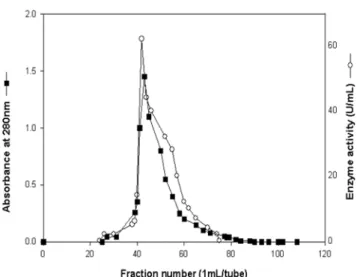
Purification of invertase. An invertase from the alkalophilic and thermophilic B. cereus TA-11 was purified successively through the ammonium sulfate precipitation (40~85% saturation), ion exchange chromato- graphy on DEAE-Sephadex A-50, and gel filtration on Sephadex G-75. The chromatogram of the ion-exchange showed three protein peaks, and one major activity peak was eluted using 0.3 M NaCl (data not shown). The active fraction was concentrated by ultrafiltration and further purified on a Sephadex G-75 column chromato- graph (Fig. 2). Only one protein peak exhibiting the invertase activity was obtained. The invertase eluted from the column was homogeneous, showing a single hand in the native-PAGE and SDS-PAGE (Data not shown). The results obtained from the purification steps are given in Table 1. The specific activity of the purified invertase was estimated to be 207.5 U/mg, which is about 15-fold higher than that of the crude enzyme preparation. The final activity recovery was 26.6% of the crude enzyme.
Even though its specific activity was lower than those of the invertases of yeast [Babczinski, 1980], Aspergillus niger [Hirayama et al., 1989], Arthrobacter sp. K-1 [Fujita et al., 1990], barley [Obenland et al., 1993], and grape [Porntaveewat et al., 1994], the activity recovery was similar or higher than those of these microorganisms and plants.
Molecular weight. The molecular weight of the enzyme Fig. 1. Neighbor-joining tree showing the phylogenetic
positions of TA-11 and other related taxa based on the 16S rRNA gene sequences. This tree was constructed using the neighbor-joining method [Saitou and Nei, 1987]
with a Kimura [1983] two-parameter distance matrix and pairwise deletion. Dots indicate the generic branches recovered using the maximum-parsimony algorithms. The bootstrap values (expressed as percentages of 1,000 repli- cation) greater than 70% are shown at the branch points.
Bar, 0.01 substitutions per nucleotide position.
Fig. 2. The profile of gel filtration chromatography of the invertase on a Sephadex G-75 column. Protein was eluted with 0.1 M phosphate buffer (pH 7.5); flow rate, 6 mL/h.
was estimated to be about 23 kDa by SDS-PAGE (Data not shown) and 26 kDa from gel filtration with Sephadex G-200 (data not shown). This molecular weight was smaller than those of the invertases from Z. mobilis (58 kDa) [Yanase et al., 1991], Saccharomyces sp. (270 kDa) [Babczinski P et al., 1980], A. niger (340 kDa) [Hirayama et al., 1989], S. mutans (48 kDa) [Tanzer et al., 1973], Arthrobacter sp. K-1 (52 kDa) [Fujita et al., 1990], carrot (68 kDa) [Unger et al., 1992], and barley (64, 116, and 155 kDa) [Obenland et al., 1993].
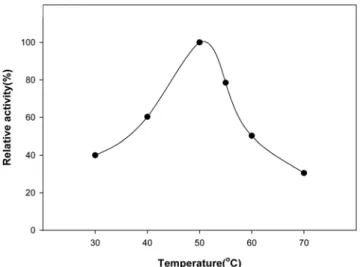
Optimal temperature and pH. The optimum temperature for the enzyme activity was 50oC (Fig. 3), and about 50%
of the enzyme activity was retained at 60oC and 15% at 70oC during 20 min incubation (Fig. 4). Except for the grape invertase (80oC) [Porntaveewat et al., 1994], this optimal temperature was similar to those of the other invertases from yeast (50oC) [Neumann et al., 1967], bacteria (50~60oC) [Yanase, 1991; Fujita, 1990], and ginseng (50oC) [Kim, 1980].
When the effects of pH on the enzyme activity were examined at the pH range of 4.0~11.0, the optimum pH was shown to be 7.0, and the enzyme was stable at the pH
range of 6.0~8.0 (Fig. 5). This enzyme was neutral or alkaline invertase, having pH optimum around 7.0, showing about 60% of the maximum activity at pH 8.0, Table 1. Summary of the purification of invertase of Bacillus cereus TA-11
Purification step Total protein
(mg) Total activity
(units) Specific activity
(unit/mg) Activity recovery
Cell-free extract 479.2 6481.0 013.5 100.00(%)
40~80%(NH4)2SO4 227.8 3780.8 016.6 58.3
DEAE A-50 022.6 1833.3 081.1 28.3
Sephadex G-75 008.3 1724.3 207.5 26.6
*One unit of the invertase is defined as the amount of enzyme required to release the reducing sugar equivalent to 1µM glucose per min under the specific conditions. Specific activity is defined as units/mg of protein.
Fig. 3. Effect of temperature on the activity of the B.
cereus TA-11 invertase. The enzyme was incubated at 30 to 70oC for 10 min, and the relative activity was measured.
Fig. 4. Thermal stability of the purified invertase of B.
cereus TA-11. -□-: 40oC, -▲-: 50oC, -▽-: 60oC, -■-:
70oC. The enzyme was incubated for 1 h at different tem- peratures, and the relative activities were determined.
Fig. 5. Optimal pH (□) and pH stability (●) of the purified invertase of B. cereus TA-11. The assay solu- tion contained 0.1 M citrate buffer (pH 3~6), 0.1 M phos- phate buffer (pH 6~8), 0.1 M Tris-Cl (pH 8~9), and 0.1 M borate buffer (pH 9~11). The enzyme was incubated for 1 h at different pH values, and the relative activity was determined at pH 7.5.
and less than 20% at pH 5.0. Some invertases with acid and alkaline pH optima have been reported, including the acidic invertases of Z. mobilis (pH 5.5), S. mutans (pH 5.5~6.0) [Tanzer et al., 1973], grape (pH 3.5), barely leaves and carrot (pH 5.0), potato (pH 4.7) [Pressey R, 1966], ginseng (pH 5.0), and the alkaline invertase (pH 8.0~9.0) from the soybean sprout [Chen et al., 1992]. The purified enzyme could be useful in the food and medicinal industries due to its enzymatic properties as a slightly thermo-tolerant and neutral or alkaline invertase.
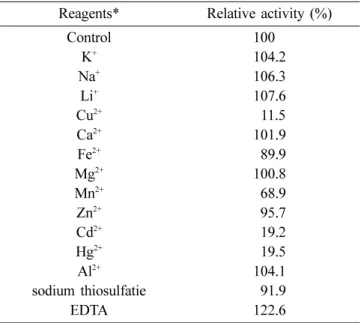
Effects of metal ions and sugars. The effect of metal ions on the invertase was investigated. The enzyme was markedly inhibited by Hg2+, Cd2+, and Cu2+, whereas Ca2+, Mg2+, Li2+, and EDTA did not show any inhibitory effects at the final concentration of 1.0 mM (Table 2). This result coincided with those reported on Z. mobilis [Yanase et al., 1991] and barley leaves [Obenland et al., 1993]. Fujita et al. [1990] also reported that the activity of β-fructo- furanosidase from Arthrobacter sp. K-1 was inactivated almost completely by 1 mM Hg2+, Cu2+, Ag3+, and SDS, whereas slightly by 1 mM Zn2+, Sn2+, and Pb2+.
The effect of sugars on the invertase activity was investigated. Lactose did not affect the activity of the purified enzyme, whereas glucose and fructose were found to inhibit the enzyme activity up to 30 and 24%, respectively (data not shown). This result suggested that glucose or fructose acts as a competitive inhibitor at the
active site of the enzyme such as the recombinant E. coli pYC 17 of B. cereus TA-11 invertase [Yi et al., 2006b].
Enzyme Kinetics.Km and Vmax values of the purified enzyme for sucrose were estimated to be 370 mM and 3.07 mM/min, respectively (Fig. 6). This Km value was similar to that of Z. mobilis (290 mM), but was higher than those of S.mutans (35 mM) and Arthrobacter sp. L- 1 (9.1 mM), barley leaves (I; 8.1 mM, IIa; 1.0 mM, IIb;
1.7 mM), carrot (7.5 mM), and grape (4.4 mM), suggesting that the affinity of the enzyme on sucrose is very low.
References
Abrams BB, Hckel R, Mizunaga T, and Lampen JO (1978) Relationship of large and small invertase in Saccharomy- ces; Mutant selectively deficient in small invertase. J Bacteriol135, 809-817.
Babczinski P (1980) Partial purification, characterization and localization of the membrane-associated invertase of yeast. Biochim Biophys Acta614, 121-133.
Bradford MM (1976) A rapid and sensitive method for the quantitation of microgram quantities of protein utilizing the principle of protein-dye binding. Anal Biochem 72, 248-254.
Chen JQ and Black CC (1992) Biochemical and immuno- logical properties of alkaline invertase from sprouting hypocotyls. Arch Biochem Biophys295, 61-69.
Choi YJ and Lee JS (1995) Production if β-fructofuransosi- dase from alkalophilic, thermophilic Bacillus sp. TA-11.
Kor J Appl Microbiol Biotech23, 197-202.
Fitzgerald RJ, Spinell DM, and Stoudt TH (1968) Enzy- matic removal of artificial plague. Arch Oral Biol 13, 125-128.
Fouet A, Klier A, and Rapoport G (1986) Nucleotide sequence of the sucrose gene of Bacillus subtilis. Gene
45, 221-225.
Table 2. Effects of metal ions and EDTA on the activ- ity of invertase purified from B. cereus TA-11
Reagents* Relative activity (%)
Control 100.0
K+ 104.2
Na+ 106.3
Li+ 107.6
Cu2+ 011.5
Ca2+ 101.9
Fe2+ 089.9
Mg2+ 100.8
Mn2+ 068.9
Zn2+ 095.7
Cd2+ 019.2
Hg2+ 019.5
Al2+ 104.1
sodium thiosulfatie 091.9
EDTA 122.6
* All of the cations were added as chlorides, except Cu2+, Fe2+, and Al3+, which were added as sulfates. The enzyme solutions containing 25 mM metal ions and EDTA, except K+ and Na+ (1 mM) were separately preincubated at 40oC for 1 h, and the relative activity was measured.
Fig. 6. Lineweaver-Burk plot for the determination of the Michaelis constant of activity towards sucrose.
Fujita K, Hara K, hashimoto H, and Kithata S (1990) Purifi- cation and some properties of β-furctofuranosidase I from Arhrobacter sp. K-1. Agric Biol Chem54, 913-919.
Hirayama M, Sumi N, and Hidaka H (1989) Purification and properties of a fructooligosaccharides-producing β- fructofuranosidase from Aspergillus niger ATCC 20611.
Agric Biol Chem53, 667-673.
Kim BM (1980) Studies on invertase from Kroean ginseng, Panax ginseng C. A. Meyer. Kor J Food Sci Technol12, 1-5.
Kimura M (1983) The Neutral Theory of Molecular Evolu- tion. Cambridge University Press, Cambridge.
L’hocine L, Whang Z, Jiang B, and Xu S (2000) Purifica- tion and partial characterization of fructosyltransferase and invetase from Aspergillus niger AS0023. J Biotech
81, 73-84.
Martin I, Debarbopie M, Ferrari E, Llier A, and Rapoport G (1987) Characterizatiom of the levanase gene of Bacil- lus subtilis which shows homology to teast invertase.
Mol Gen Genet208, 177-184.
Miller GL (1959) Uses of dinitrosalicylic acid reagent for determination of reducing sugar. Anal Chem 31, 426- 428.
Nakagawa H, Kawasaki Y, Ogura N, and Takehata H (1971) Purification and properties two types of β-fructofuranosi- dase from tomato fruit. Agric Biol Chem36, 18-26.
Neumann N and Lampen JO (1967) Purification and proper- ties of yeast invertase. Biochemistry 6, 468-475.
Obenland D, Simmen U, Boller T, and Wiemken A (1993) Purification and characterization of three soluble inver- tase from barley leaves. Plant Physiol101, 1331-1339.
Ottolenghi P (1971) A comparison of five genetically dis-
tinct invertase from Saccharomyces. Eur J Biochem 18, 554-552.
Pressey R (1966) Separation and properties of potato inver- tase and invertase inhibitor. Arch Biochem Biophys 113, 667-674.
Porntaveewat W, Takayanagi T, and Yokotsuka K (1994) Purification and properties of invertase from Muscat Bailey A grapes. J Ferment Bioeng78, 288-292.
Saitou N and Nei M (1987) The neighbor-joining method: a new method for reconstructing phylogenetic trees. Mol Biol Evol4, 406-425.
Srtaathof A, Kieboom APG, and Bekkum H (1986) Inver- tase catalyzed fructosyl transfer in concentrated solu- tions of sucrose. Carbohydr Res146, 154-159.
Tanzer JM, Brown AT, and Mclnerney MF (1973) Identifi- cation, preliminary characterization, and evidence for regulation of invertase in Streptococcus mutants. J Bacte- riol116, 192-202.
Unger C, Hofsteenge J, and Sturm A (1992) Purification and characterization of a soluble β-fructofuranosidase from Daucus carota. Eur J Biochem204, 915-921.
Yanase H, Fukushi H, Ueda N, Maeda Y, Toyoda A, and Toromura K (1991) Cloning, Sequencing and character- ization of the intracelluar invertase gene from Zymomo- nas mobilis. Agric Biol Chem55, 1383-1390.
Yi SH, Lee DH, No JD, Lee JW, Lee DH, and Lee JS (2006a) Production of Intracellular invertase from alkalo- philic and thermophilc Bacillus sp. TA-11 in the recom- binant E. coli. Kor J Microbiol Biotechnol34, 318-322.
Yi SH, No JD, Lee DH, and Lee JS (2006b) Biosynthetic regulation of invertase from recombinant E. coli pYC 17. J Nat Sci. Paichai Univ17, 103-111.