ORIGINAL ARTICLE
INTRODUCTION
Postmenopausal osteoporosis is the most common bone disease and can be managed using a variety of pharmacological agents. Menopausal hormone therapy (MHT) is effective in reducing postmenopausal bone loss and the risk of fracture and has been mainstay for the management of postmenopausal osteoporosis [1,2].
However, some postmenopausal women on MHT (between 5% and 15%, depending on compliance) con-
tinue to lose bone and even experience fractures [3].
Therefore, the combination of MHT with other treat- ments may be beneficial in postmenopausal women with insufficient response to MHT.
Bisphosphonates are stable pyrophosphate analogs that bind to hydroxyapatite in bone and inhibit bone resorption by decreasing the number and activity of osteoclasts. Etidronate was initially used, followed by alendronate and then risedronate [4]. Most of these bisphosphonates have been approved for use in treating
Received: February 28, 2019 Revised: August 2, 2019 Accepted: October 13, 2019
Address for Correspondence: Byung-Koo Yoon, Department of Obstetrics, Gynecology and Women’s Health, Samsung Medical Center, Sungkyunkwan University School of Medicine, 81 Irwon-ro, Gangnam-gu, Seoul 06351, Korea
Tel: 82-2-3410-3519, E-mail: [email protected], ORCID: https://orcid.org/0000-0002-1326-6102 Young-Ah Koo and Kyung-A Son contributed equally to this study.
Young-Ah Koo’s current affiliation is Seoul Samsung Women’s Clinic, Seoul 05510, Korea.
Effects of Adding Intravenous Pamidronate to Ongoing Menopausal Hormone Therapy in Postmenopausal Korean Women with Low Bone Mineral Density
Young-Ah Koo, Kyung-A Son, Suk-Joo Choi, Byung-Koo Yoon
Department of Obstetrics, Gynecology and Women’s Health, Samsung Medical Center, Sungkyunkwan University School of Medicine, Seoul, Korea
Objectives: We evaluated the effects of adding intravenous pamidronate to ongoing menopausal hormone therapy (MHT) on bone mineral density (BMD) in postmenopausal Korean women with low BMD.
Methods: This retrospective cohort study included 74 postmenopausal women who received MHT for at least 1 year and had a BMD T-score of less than −2.0. Maintaining the same MHT regimen, these women were divided into two groups: oral placebo group (n = 44) and a pamidronate group of patients with gastrointestinal discomfort (n = 30) who received 15–30 mg pamidronate intravenously every 3–12 months. BMD was reviewed at 12-month follow-up. Bone resorption markers in both groups, urinary deoxypyridinoline levels in the placebo group, and serum N-telopeptide of type I collagen in the pamidronate group were assessed at 6 and 12 months.
Results: At baseline, the body mass index (BMI), duration of previous MHT, and femur neck (FN) BMD differed between the groups.
Within-group analysis revealed that BMD of the lumbar spine (LS) and total hip (TH) significantly increased in the placebo group, whereas those of the LS, FN, and TH increased in the pamidronate group. The increase in BMD of LS was significantly greater in the pamidronate group, after adjusting for BMI and duration of previous MHT (mean change: 3.7% vs. 6.2%; P < 0.001). There were no changes in bone resorption markers in either group.
Conclusions: Adding intravenous pamidronate to ongoing MHT for 12 months might increase LS BMD in postmenopausal Korean women with low BMD.
Key Words: Bone density, Hormone replacement therapy, Osteoporosis, Pamidronate, Postmenopause
osteoporosis in many countries and have been shown to increase bone mass and reduce fracture rates at the spine [5,6], hip, and other sites up to 40% in postmeno- pausal women [7,8]. Several studies from Caucasian countries have reported that the combined use of MHT with oral bisphosphonate has been reported to increase bone mineral density (BMD) better than individual drug therapy [9]. Our group, however, reported that 12 months of alendronate added to ongoing MHT did not prompt a significant BMD increase in postmenopausal Korean women [10].
Oral bisphosphonates may cause gastrointestinal (GI) disturbance in about 20% of women [11]. Moreover, for patients who have preexisting GI disease such as esophagitis and gastritis, these approaches are accom- panied by poor compliance that necessitates the use of another administration route [12]. There have been no studies conducted to date that focus on the efficacy of the combination of pamidronate infusion and MHT in postmenopausal women.
Thus, the purpose of the present study was to evaluate the effects of adding intravenous pamidronate to ongo- ing MHT in postmenopausal Korean women with low BMD and GI disturbance.
MATERIALS AND METHODS
Subjects and treatments
This retrospective cohort study included 74 post- menopausal women who had received MHT for at least one year between January 2000 and December 2007 at Samsung Medical Center in Seoul, Korea. MHT was administered in an individualized manner and consisted of estrogen at a dose approximately equiva- lent to 0.625 mg/day of conjugated equine estrogen.
Additionally, all patients with intact uteri were also prescribed progestogen in either a cyclic or continuous regimen. Women were considered postmenopausal if their amenorrhea duration was more than 12 months or if their serum follicle-stimulating hormone level was higher than 40 IU/L. Eligible patients were those who had low BMD (T-score < −2.0) in the lumbar spine, femur neck, or total hip. Patients were excluded if they had a history of certain diseases including hyperthy- roidism or hyperparathyroidism or were taking medi- cations such as glucocorticoids or anticonvulsants that could affect bone mineral metabolism. Patients were also excluded if they had received any bisphosphonate or fluoride within the last year. The study protocol was
approved by the Institutional Review Board of Samsung Medical Center (no. 2019-07-106).
The study participants continued to follow their same prescribed MHT regimen. The pamidronate group who could not tolerate oral bisphosphonate due to GI disturbance (n = 30) received 15 to 30 mg of pamidro- nate (Hanlim Pharmaceuticals Inc., Seoul, Korea) in 250 mL normal saline intravenously infused over two hours every three months for 12 months. Nonsteroidal anti-inflammatory drugs were used as needed. The un- paralleled control group (n = 44) received oral placebo for 12 months. We employed data that satisfied the in- clusion criteria from another randomized placebo-con- trolled trial that was designed to evaluate the efficacy of oral bisphosphonate [10]. All women also received oral calcium supplementation if tolerable.
Bone mineral density
BMD was measured at the second to fourth vertebrae of the lumbar spine and at the hip by dual energy X- ray absorptiometry (DXA; Hologic, Inc., Marlborough, MA, USA) with fan-beam technology. Bone densitom- etry was performed at baseline and after 12 months of therapy. Percent changes from baseline BMD were cal- culated.
Biochemical markers of bone resorption
Urinary deoxypyridinoline was assessed in the pla- cebo group via enzyme immunoassay by the manufac- turer’s manual and corrected for creatinine level. Serum N-telopeptide of type I collagen was measured in the pamidronate group via enzyme-linked immunosorbent assay using Osteomark® (Ostex International, Seattle, WA, USA). Bone markers were measured at baseline and after 6 and 12 months of therapy, respectively.
New fracture
The occurrence of new fracture was ascertained by history taking at each visit. Asymptomatic spine defor- mity was also checked by X-ray at baseline and the end of the study.
Statistical analysis
Baseline characteristics and BMDs are summarized in the form of mean ± standard deviation and num- ber with percent for continuous and categorical vari- ables, respectively. Comparisons between the placebo- and pamidronate-treated groups were conducted for continuous variables by Student’s t tests or Wilcoxon
rank-sum test after checking normality via Shapiro- Wilks test. Comparisons for categorical variables were performed using Chi-squared test or Fisher’s exact test, as appropriate. Changes in BMD and bone resorption markers within each group and between groups were compared using paired and Student’s t tests, respec- tively. Multivariable linear regression was further used to investigate group difference in BMD changes with adjustment of baseline characteristics that showed sig- nificant difference between the two groups. Examples include body mass index (BMI), duration of previous MHT, and baseline BMD of femur neck. A two-tailed value of P < 0.05 was considered to be statistically sig- nificant. Statistical analysis was completed using the Statistical Analysis System software version 9.4 (SAS Institute Inc., Cary, NC, USA).
RESULTS
Clinical characteristics of the study subjects
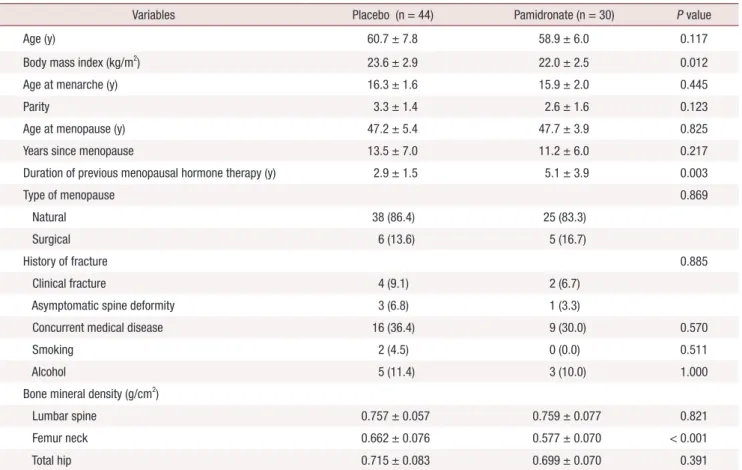
The baseline characteristics of each group are pre-
sented in Table 1. There were no statistically significant differences between the two groups except regarding BMI, duration of previous MHT, and BMD of the fe- mur neck.
Bone mineral density
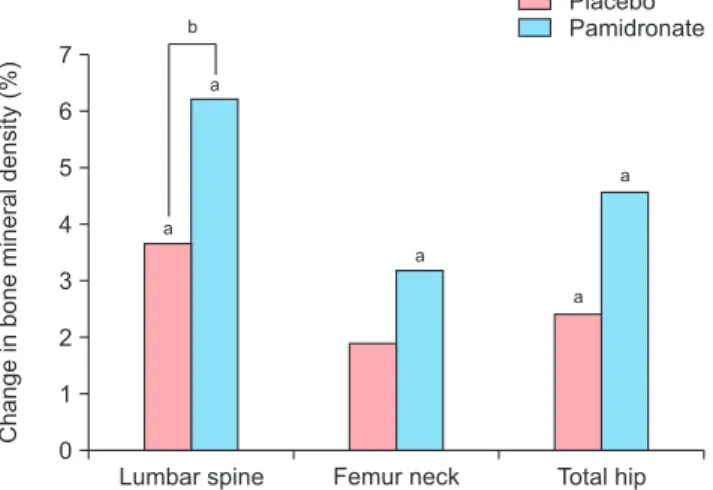
Figure 1 displays the mean percent changes in BMD after 12 months of treatment. In the placebo group, sig- nificant increase was observed in BMD values of lum- bar spine (P < 0.001) and total hip (P = 0.003), but not of femur neck (P = 0.062). In the pamidronate group, BMD values of the lumbar spine, femur neck, and total hip were all increased significantly (P < 0.001 for all).
BMD increase of the lumbar spine was significantly higher in the pamidronate group compared to the pla- cebo group (mean change: 3.7% vs. 6.2%; P = 0.021).
This group difference remained significant after adjust- ing baseline BMI and duration of previous MHT (P <
0.001). BMD increase of the total hip seems higher in the pamidronate group compared to the placebo group (mean change: 2.4% vs. 4.6%) with marginal signifi-
Table 1. Baseline characteristics of study patients
Variables Placebo (n = 44) Pamidronate (n = 30) P value
Age (y) 60.7 ± 7.8 58.9 ± 6.0 0.117
Body mass index (kg/m2) 23.6 ± 2.9 22.0 ± 2.5 0.012
Age at menarche (y) 16.3 ± 1.6 15.9 ± 2.0 0.445
Parity 3.3 ± 1.4 2.6 ± 1.6 0.123
Age at menopause (y) 47.2 ± 5.4 47.7 ± 3.9 0.825
Years since menopause 13.5 ± 7.0 11.2 ± 6.0 0.217
Duration of previous menopausal hormone therapy (y) 2.9 ± 1.5 5.1 ± 3.9 0.003
Type of menopause 0.869
Natural 38 (86.4) 25 (83.3)
Surgical 6 (13.6) 5 (16.7)
History of fracture 0.885
Clinical fracture 4 (9.1) 2 (6.7)
Asymptomatic spine deformity 3 (6.8) 1 (3.3)
Concurrent medical disease 16 (36.4) 9 (30.0) 0.570
Smoking 2 (4.5) 0 (0.0) 0.511
Alcohol 5 (11.4) 3 (10.0) 1.000
Bone mineral density (g/cm2)
Lumbar spine 0.757 ± 0.057 0.759 ± 0.077 0.821
Femur neck 0.662 ± 0.076 0.577 ± 0.070 < 0.001
Total hip 0.715 ± 0.083 0.699 ± 0.070 0.391
Data are presented as mean ± standard deviation or number (%). P values were calculated using Student’s t tests, Wilcoxon rank-sum test, Chi-squared test, or Fisher’s exact test, as appropriate.
cance before and after adjustment of baseline BMI and duration of previous MHT (P = 0.097 and P = 0.062, respectively). The increase in BMD of the femur neck showed no significant difference between two groups before and after adjustment of baseline BMI, baseline BMD of the femur neck and duration of previous MHT (P = 0.321 and P = 0.369, respectively). Conversely, the number of patients with BMD decrease after 12 months of treatment is shown in Table 2. The percent- age of BMD at the lumbar spine was significantly lower in the pamidronate group than in the placebo group (27.3% vs. 6.7%; P = 0.035). The BMD percentages at the femur neck and total hip in the pamidronate group tended to be lower than the placebo group.
Biochemical markers of bone resorption
There was no significant change in bone resorption markers during the 12 months of therapy within either group (Table 3). Percent changes in the two different markers considered were also comparable between the two groups (data not shown).
Adverse effects
There were no significant differences in the adverse
effects experienced by the study patients in the two groups (Table 4). Four cases (9.1%) of joint pain oc- curred only in the placebo group, whereas four cases (13.3%) of flu-like symptoms were reported only in the pamidronate group. Regarding new fractures, one case (3.3%) occurred in the pamidronate group and three cases (6.8%) occurred in the placebo group.
DISCUSSION
This study shows that the addition of intravenous pamidronate every three months for 12 months to ongoing MHT increased BMD of the lumbar spine in postmenopausal Korean women with low BMD and GI problems.
In the present study, BMD percentages were increased significantly in the lumbar spine and total hip in the placebo group. This BMD increase in the control group could be attributed to improved compliance with MHT.
Pamidronate is a nitrogen-containing bisphosphonate that improves BMD in both the spine and hip [13] and prevents spinal fracture [14]. Pamidronate adminis- tered intravenously is reported to have similar effects to those of alendronate on BMD of the lumbar spine and total hip in patients with osteoporosis [15]. Pamidro- nate injection is licensed in Korea for the treatment of osteoporosis. To our knowledge, this is the first study to report a beneficial effect of intravenous pamidronate
Femur neck 7
6 5 4 3 2 1
Changeinbonemineraldensity(%)
0
Placebo Pamidronate
a
a a
a a b
Lumbar spine Total hip
Fig. 1. Mean percent changes in bone mineral density after 12 months of therapy. aP < 0.01 vs baseline; bP < 0.05 vs placebo.
Table 2. Number of patients with decrease in bone mineral density after 12 months of treatment
Site Placebo
(n = 44) Pamidronate
(n = 30) P value
Lumbar spine 12 (27.3) 2 (6.7) 0.035
Femur neck 16 (36.4) 8 (26.7) 0.454
Total hip 14 (31.8) 7 (23.3) 0.600
Patients with any decrease 26 (59.1) 13 (43.3) 0.183 Data are presented as number (%). P values were calculated by Fisher’s exact test.
Table 3. Changes in bone resorption markers during the follow-up
Group Bone resorption marker Baseline 6 months 12 months
Placebo Urine DPD (nM, DPD/mM, Cr) 4.96 ± 2.07 4.87 ± 0.25 4.98 ± 2.42
Pamidronate Serum NTx (nm, BCE) 14.28 ± 5.99 14.25 ± 4.32 15.60 ± 6.93
Data are presented as mean ± standard deviation. There were no statistical significances within each group by paired t tests.
DPD, deoxypyridinoline; Cr, creatinine; NTx, N-telopeptide of type I collagen; BCE, bone collagen equivalents.
on BMD in combination with MHT.
Importantly, oral daily alendronate added to ongo- ing MHT did not yield any significant BMD change in postmenopausal Korean women [10]. In this study, however, pamidronate infusion increased spine BMD compared to oral placebo. Pamidronate has a 5-to-10- times lower antiresorptive potency than alendronate [16]. The reason for the difference between the two bisphosphonates is not clear, but possible explana- tions are as follows: first, the GI absorption rate of oral bisphosphonate is extremely low (1%–5%) [16] and the intravenous administration of pamidronate provides high bioavailability (100%) by way of direct access to the systemic circulation. Further, higher adherence resulted in a better response to pamidronate. Oral alendronate was given daily, whereas the between-dose interval of pamidronate was three months. In addition, oral bisphosphonate requires inconvenient dosing rec- ommendation to promote bioavailability and minimize upper GI disturbance, including long fasting, taking the medicine with a large amount of water, and main- taining an upright position for two hours after intake.
Participant acceptability was likely enhanced with an intravenous route of administration. Indeed, a change from oral administration of bisphosphonate to an intra- venous infusion may be considered in patients showing insufficient response [17].
Congruent with our BMD findings, the nonresponder rate for the lumbar spine was significantly lower in the pamidronate group. Hip BMD values were also increased with pamidronate for 12 months but did not reach statistical significance compared with the con-
trol group. A difference in bone composition might be attributed to the different responses to pamidronate observed by site. The lumbar spine contains a greater amount of trabecular bone, which is metabolically more active than cortical bone.
In this study, there was no change in the bone resorp- tion marker reviewed in the placebo group. Of note, no change was also observed in the pamidronate group upon considering a different marker. Oral bisphos- phonate in combination with MHT usually decreases bone resorption markers further and raises concerns about severely suppressed bone turnover [10]. If this is the case, the safety concerns regarding the use of in- travenous pamidronate combined with MHT might be less than those for oral bisphosphonate. These findings require further confirmation because the biological mechanisms underlying this result are uncertain.
Patients with GI disturbance were selected for inclu- sion in the pamidronate group. Using intravenous preparation, no participants reported further GI trouble with pamidronate. Acute phase reaction resulting from mild transient systemic inflammatory reactions such as febrile sense, nausea, myalgia, and anorexia occurred in 10% to 30% of patients receiving their first bisphos- phonate infusion [18]. In this study, flu-like symptoms were experienced in 13.3% of the pamidronate group but did not recur at subsequent infusions. Even though this study is not powered to check the difference, the number of new fractures was lower in the pamidronate group.
Our study has some limitations. This study is retro- spective in design and employed an unmatched control group. In addition, the study duration was short, and the sample size was not large enough. Further random- ized clinical trials are warranted using newer genera- tions of bisphosphonate infusion with matched placebo controls to validate the clinical efficacy of combination therapy with MHT and intravenously administered bisphosphonate.
In conclusion, adding intravenous pamidronate to ongoing MHT for 12 months might increase the BMD of the lumbar spine in postmenopausal Korean women with low BMD. Pamidronate infusion is an appropriate alternative in patients with intolerance to oral bisphos- phonate.
ACKNOWLEDGMENTS
This work was supported in part by the Samsung Table 4. Adverse effects experienced by study patients
Adverse effect Placebo
(n = 44) Pamidronate (n = 30)
Joint pain 4 (9.1) 0 (0.0)
Skin reaction 1 (2.3) 1 (3.3)
Gastrointestinal trouble 1 (2.3) 0 (0.0)
Flu-like symptom 0 (0.0) 4 (13.3)
New fractures 3 (6.8) 1 (3.3)
Spine 2 0
Wrist 1 0
Ankle 0 1
Others 2 (4.5) 1 (3.3)
Patients with any adverse effect 10 (22.7) 7 (23.3) Data are presented as number (%).
Medical Center Research Fund (PH01095291 and PHO1133361) and the IN-SUNG Foundation for Med- ical Research (C-A5-811-1).
CONFLICT OF INTEREST
No potential conflict of interest relevant to this article was reported.
REFERENCES
1. Effects of hormone therapy on bone mineral density: results from the postmenopausal estrogen/progestin interventions (PEPI) trial.
The Writing Group for the PEPI. JAMA 1996; 276: 1389-96.
2. Nelson HD, Rizzo J, Harris E, Cauley J, Ensrud K, Bauer DC, et al. Osteoporosis and fractures in postmenopausal women using estrogen. Arch Intern Med 2002; 162: 2278-84.
3. Hillard TC, Whitcroft SJ, Marsh MS, Ellerington MC, Lees B, Whitehead MI, et al. Long-term effects of transdermal and oral hormone replacement therapy on postmenopausal bone loss. Os- teoporos Int 1994; 4: 341-8.
4. Fleisch H. Bisphosphonates: mechanisms of action. Endocr Rev 1998; 19: 80-100.
5. Black DM, Cummings SR, Karpf DB, Cauley JA, Thompson DE, Nevitt MC, et al. Randomised trial of effect of alendronate on risk of fracture in women with existing vertebral fractures. Fracture Intervention Trial Research Group. Lancet 1996; 348: 1535-41.
6. Liberman UA, Weiss SR, Bröll J, Minne HW, Quan H, Bell NH, et al. Effect of oral alendronate on bone mineral density and the incidence of fractures in postmenopausal osteoporosis. The Alen- dronate Phase III Osteoporosis Treatment Study Group. N Engl J Med 1995; 333: 1437-43.
7. McClung MR, Geusens P, Miller PD, Zippel H, Bensen WG, Roux C, et al. Effect of risedronate on the risk of hip fracture in elderly women. Hip Intervention Program Study Group. N Engl J Med 2001; 344: 333-40.
8. Boonen S, Laan RF, Barton IP, Watts NB. Effect of osteoporosis treatments on risk of non-vertebral fractures: review and meta- analysis of intention-to-treat studies. Osteoporos Int 2005; 16:
1291-8.
9. Harris ST, Eriksen EF, Davidson M, Ettinger MP, Moffett AH Jr, Baylink DJ, et al. Effect of combined risedronate and hormone re- placement therapies on bone mineral density in postmenopausal women. J Clin Endocrinol Metab 2001; 86: 1890-7.
10. Min YK, Lee DY, Choi SJ, Kim JH, Choi D, Yoon BK. Effects of adding alendronate to ongoing hormone therapy on bone mineral density in postmenopausal Korean women: a randomized, double- blind, placebo-controlled clinical trial. Menopause 2013; 20: 761- 6.
11. Aki S, Eskiyurt N, Akarirmak U, Tüzün F, Eryavuz M, Alper S, et al. Gastrointestinal side effect profile due to the use of alendronate in the treatment of osteoporosis. Yonsei Med J 2003; 44: 961-7.
12. Anckaert E, Öktem M, Thies A, Cohen-Bacrie M, Daan NM, Schiettecatte J, et al. Multicenter analytical performance evaluation of a fully automated anti-Müllerian hormone assay and reference interval determination. Clin Biochem 2016; 49: 260-7.
13. Reid IR, Wattie DJ, Evans MC, Gamble GD, Stapleton JP, Cornish J.
Continuous therapy with pamidronate, a potent bisphosphonate, in postmenopausal osteoporosis. J Clin Endocrinol Metab 1994;
79: 1595-9.
14. Brumsen C, Papapoulos SE, Lips P, Geelhoed-Duijvestijn PH, Hamdy NA, Landman JO, et al. Daily oral pamidronate in women and men with osteoporosis: a 3-year randomized placebo-con- trolled clinical trial with a 2-year open extension. J Bone Miner Res 2002; 17: 1057-64.
15. Vis M, Bultink IE, Dijkmans BA, Lems WF. The effect of intrave- nous pamidronate versus oral alendronate on bone mineral den- sity in patients with osteoporosis. Osteoporos Int 2005; 16: 1432-5.
16. Kang M. Bisphosphonate. In: The Korean Society for Bone Min- eral Research, editor. Textbook of osteoporosis. 5th ed. Seoul:
Koonja; 2016. pp. 253-65.
17. Bae SJ, Kim BJ, Lim KH, Lee SH, Kim HK, Kim GS, et al. Efficacy of intravenously administered ibandronate in postmenopausal Korean women with insufficient response to orally administered bisphosphonates. J Bone Miner Metab 2012; 30: 588-95.
18. Drake MT, Clarke BL, Khosla S. Bisphosphonates: mechanism of action and role in clinical practice. Mayo Clin Proc 2008; 83: 1032- 45.