대기 중 온도 및 CO
2농도 조절에 따른 건조 스트레스와 질소 시비가 소나무의 생장 및 생리적 특성에 미치는 영향
송우경1⋅이보라1⋅조낭현2⋅정성철1*⋅김은숙1⋅임종환11)
1국립산림과학원 기후변화생태연구과, 2강원대학교 환경학과 (2020년 4월 23일 접수; 2020년 6월 17일 수정; 2020년 6월 26일 수락)
Effects of Drought Stress and Nitrogen Fertilization on Growth and Physiological Characteristics of Pinus densiflora Seedlings Under Elevated Tem perature and CO
2Concentration
Wookyung Song1, Bora Lee1, Nanghyun Cho2, Sungcheol Jung1*, Eun-Sook Kim1, Jong-Hwan Lim1
1Division of Forest Ecology and Climate Change, National Institute of Forest Science, Seoul 02455, Korea
2Department of Environmental Science, Kangwon National University, Chuncheon 24341, Korea (Received April 23, 2020; Revised June 17, 2020; Accepted June 26, 2020)
ABSTRACT
Pinus densiflora is the most widely distributed tree species in South Korea. Its ecological and socio-cultural attributes makes it one of the most important tree species in S. Korea. In recent times however, the distribution of P. densiflora has been affected by dieback. This phenomenon has largely been attributed to climate change. This study was conducted to investigate the responses of growth and physiology of P. densiflora to drought and nitrogen fertiliz ation according to the RCP 8.5 scenario. A Temperature Gradient Chamber (TGC) and CO2⋅Temperature Gradient Chamber (CTGC) were used to simulate climate change conditions. The treatments were established with temperature (control versus +3 and +5℃;
aCeT) and CO2 (control: aCaT versus x1.6 and x2.2; eCeT), watering(control versus drought), fertilization(control versus fertilized). Net photosynthesis (Pn), stomatal conductance (gs), biomass and relative soil volumetric water content (VWC) were measured to examine physiological responses and growth. Relative soil VWC in aCeT significantly decreased after the onset of drought. Pn and gs in both aCeT and eCeT with fertiliz ation were high before drought but decreased rapidly after 7 days under drought because nitrogen fertilization effect did not last long. The fastest mortality was 46 days in aCeT and the longest survival was 56 days in eCeT after the onset of drought. Total and partial biomass (leaf, stem and root) in both aCeT and eCeT with fertiliz ation were significantly high, but significantly low in aCeT. The results of the study are helpful in addressing P. densiflora vulnerability to climate change by highlighting physiological responses related to carbon allocation under differing simulated environmental stressors.
Key words: Climate Change, Drought, Physiology, Net photosynthetic rate, Nitrogen Fertilization
* Corresponding Author : Sungcheol Jung ([email protected])
ⓒ Author(s) 2020. CC Attribution 3.0 License.
I. 서 론
전 지구적으로 기후변화에 따라 강수의 유형 변화, 이상고온 현상 등 극한 기상 현상의 빈도가 높아지고 있고 지금의 기후변화 추세라면 향후 더 빠른 기상환 경변화가 예상 된다(IPCC, 2018), 특히 대기 중 CO2
농도가 지금의 증가 추세로 21C 말 1,000ppm에 도달 한다면 평균기온은 2∼4℃ 이상, 극지방은 6℃ 이상의 기온상승이 예측 된다(Solomon et al., 2007). 우리나 라의 경우 평균 기온과 대기 중 CO2 농도의 증가 추세 가 다른 국가보다 빠르게 나타났다. 최근 100년간 (1920년∼2019년) 지구 평균기온은 0.99℃도 상승한 것과 비교하면 우리나라는 1.56℃로 급격한 증가 폭을 보였다(NOAA, 2020). 지난 10년간(2009년∼2018년) 한반도의 대기 중 CO2 농도 평균 절대증가 속도는 2.4ppm / yr로 전 지구 연간 증가 값(2.3ppm / yr)과 비슷하나 2018년 평균 대기 중 CO2 농도 407.4 ppm 보다 약 6.7 ppm 높은 414.1ppm였다(Korea Meteoro- logical Administration, 2019).
이러한 기온상승, 이상고온 등 기후변화에 대한 수 목의 반응은 다양하게 나타나고 있다. 수목은 생리적 으로 대기 중 CO2 농도 증가에 따라 광합성 속도를 높여 식물체 생장이 촉진(Kim and Lee, 2001; Stirling et al., 1998) 혹은 감소하기도 한다(Kohen et al., 1993; Woodward, 2002). 또한, CO2 시비효과로 인한 생물량 증가는 식물의 양분, 수분, 온도 등 생리적 요 인과 미기상 조건에 복잡하고 민감하게 반응하기 때문 에(Huang et al., 2007; Oren et al., 2001) 수종별 생리 반응을 파악하는 것은 기후변화에 대응하기 위한 산림 수종 관리에 있어 매우 중요하다. 건조 스트레스로 인 한 토양수분 감소는 수목의 생존을 위협하며 다양한 형태적, 생리적 변화를 유도한다(Hopkins, 1999). 건 조 스트레스 초기에는 팽압에 영향을 받는 요소들이 감소하여 잎의 탈리, 기공 폐쇄 등 수분보존과 수분이 용효율을 높이는 기작을 보이지만 건조가 심해짐에 따 라 광합성 속도의 급격한 감소, 삼투조절기능(osmore- gulation) 상실 등 세포 내 주요대사에 영구적인 손상 을 끼치게 된다(Hopkins and Huner, 2008; Taiz and Zeiger, 2006). 또한 식물체 내 건조 스트레스에 대응 하기 위한 식물호르몬과 관련된 여러 반응이 일어나게 된다(Taiz and Zeiger, 2006). 이러한 대응 전략이나 능력은 수종 마다 차이가 있기 때문에 수종별 적응 기작을 구명하는 것은 수목의 건전한 생육을 위해 필
수적이다.
최근 고온과 가뭄으로 인한 건조 스트레스로 인해 온대 침엽수림 수목의 고사가 증가하고 있고 국내에서 도 소나무(Pinus densiflora) 고사가 보고되고 있다 (Allen et al., 2010; Lim et al., 2017; Lim and Shin, 2005). 일반적으로 P. densiflora는 등수성(isohydric) 수종으로 알려져 있으며(Matyssek et al., 2014), 등수 성 수종의 특징은 토양수분 변화에 따라 기공 개폐를 조절하는데(Collatz et al., 1991; Tardieu and Simonneau, 1998), P. densiflora의 순광합성율, 기공전도도, 증산 의 감소는 기공 폐쇄에 영향을 받게 된다(Farquhar and Sharkey, 1982). 따라서 지속적으로 건조한 환경에 노 출되면 기공 폐쇄에 따른 탄소 기아(Carbon Starvation) 의 위험이 증가된다(Allen et al., 2010). 탄소 기아란 수목이 수분감소를 줄이기 위해 기공을 폐쇄하여 발생 하는 생산량(탄소흡수)과 소비량(호흡량)의 불균형을 의미하며, 이러한 현상이 지속되면 수목의 스트레스를 가중 시킬 수 있다(McDowell et al., 2008).
이러한 가뭄 스트레스에서 적절한 양분 공급은 수 분이용효율을 증가시키고 부정적인 영향을 최소화하 여 가뭄 후 수목이 빠르게 회복하는데 도움을 준다 (Gessler et al., 2017; Tarvainen and Näsholm, 2017).
특히 질소(N)는 대사물질 생산에 중요한 역할을 하고 (Nunes-Nesi et al., 2010), 수분손실을 줄이고 물질생 물량을 증가시켜 수분이용효율을 높이는 등 긍정적인 영향을 끼친다(Zhang et al., 2019). 또한 질소는 건조 스트레스가 광합성에 미치는 억제 효과를 감소시켜 탄 소고갈 현상을 피할 수 있게 도움을 준다(Gessler et al., 2017; Tarvainen and Näsholm, 2017). 이렇듯 양 분유효도가 가뭄 스트레스를 완화시키는 근본적인 메 커니즘을 구명하는 것은 수목의 생장과 산림 생산성에 매우 중요하다(Gessler et al., 2017). 그러나 가뭄에 대한 수목의 스트레스는 대부분 수분과 탄소 기작에 많은 연구가 이루어지고 있으나, 식물의 양분유효도와 건조 스트레스 사이의 상호작용에 대한 연구는 미흡한 실정이다.
따라서 본 연구는 최근 기후변화로 인해 많은 피해 가 발생하고 있는 소나무의 건조 스트레스 고사 메커 니즘을 이해하기 위한 연구로 수행되었다. 소나무 묘 목(2년생)을 대상으로 고온 및 고농도 CO2 농도 환경 에서 인위적인 건조 스트레스와 질소 시비에 따른 처 리별 토양함수율 변화를 통해, 1) 수목의 순광합성율 (Pn)과 기공전도도(gs) 반응을 살펴보고, 2) 이를 통해
변색율과 고사시기 변화와 3) 생물량 변화 특성을 조 사하여 건조 스트레스에 대한 소나무의 반응을 구명하 고자 수행되었다.
II. 재료 및 방법
2.1. 실험재료 및 건조 처리
본 연구에 사용된 실험재료 2년생 소나무(Pinus densiflora) 묘목을 사용하였다. 2019년 4월 크기가 일 정한 2년생 묘목을 선정하여 각각의 화분에 처리별로 5본씩 식재 후 완전임의배치법으로 배치하였다. 관수 는 2019년 4월 3일부터 2019년 7월 14일까지 강한 햇빛과 고온에 의한 피해를 줄이기 위해 오전 6시, 오 후 8시, 오전 12시 사이에 토양이 적윤 상태가 되도록 30분간 관수하였으며, 관수량은 묘목 1본 당 2.5L/day 로 처리되었다. 무관수 처리는 7월 15일부터 인위적인 단수처리를 통하여 건조 스트레스를 유발하였다.
2.2. 대기 중 온도와 CO2 농도와 질소시비 처리 국립산림과학원 산림기술경영연구소(경기도 포천 시 소홀읍 직동리 51) 구내에 있는 환경변화시뮬레이 션시스템(온도⋅CO2 처리 시스템 온실)을 이용하였다.
온실은 2개의 온도 조절 온실(Temperature Gradient Chamber, TGC)과 2개의 온도 및 CO2 농도 조절 온실 (CO2⋅Temperature Gradient Chamber, CTGC)로 구 성되어 있으며, 규격은 높이 3.5m X 폭3.0m X 길이 30.0m 이다. 대기 중 온도와 습도, CO2 농도는 자체 제작한 환경제어프로그램(Data logger control system) 을 통해 조절되었다. TGC 와 CTGC 온실은 대기 온도 및 CO2 농도의 일변화, 계절변화, 광조건 등을 직접적 으로 반영하는 미래 기후변화 환경 조성이 가능한 시 설이다. 온실 입구 반대쪽에 환풍기를 가동하여 입구 로부터 출구까지 인위적인 공기 흐름을 발생함으로써, 온실 내 온도와 CO2 농도가 RCP 8.5 시나리오 21세기 후반(2071년∼2100년)에 도래할 것으로 예상되는 값 (IPCC, 2013) 으로 처리 되었다. 본 연구에서는 거리 사이(5m∼25m)에 따라 처리된 온도 및 CO2는 다음과 같다: 대조구인 aCaT (ambient CO2 and ambient temperature, 400ppm + 27℃), 현재 수준의 대기 CO2
농도에서 현재보다 온도가 상승된 aCeT (ambient CO2
and elevated temperature, 400ppm + 30℃, 400ppm + 32℃) 조건과 현재 대기 중의 온도와 CO2 농도가
증가된 환경인 eCeT (elevated CO2 and elevated temperature, 560ppm + 30℃, 720ppm + 32℃) 조건으 로 수행되었다. 온도와 CO2 농도 처리는 2019년 4월 2일부터 2019년 11월 19일까지 실시하였다. 질소 시 비는 수용성 비료인 MultiFeed (N:P:K = 30:10:10, Haifa Chemicals, Israel)를 이용하여 처리별로 시비처 리 하였다. 시비기준은 산림청 시설양묘 사업기준 일 람표(Korea Forest Service, 2006)에 따라 최적 시비 량(생육기 주 1회, 20g/ 20L/ m2)을 실험에 사용된 화분 넓이에 맞춰 재계산하여 시비하였으며, 2019년 5월 3일부터 2019년 7월 10일까지, 총 11회 실시하 였다.
2.3. 생리 반응 조사
질소시비와 온도 및 CO2 처리에 따른 생리 반응 특성 조사는 건조 처리 후 7일 간격으로 총 5주간 6회(7 월 16일∼8월 21일) 실시하였다. 처리에 따른 순광합 성속도(Pn), 기공전도도(stomatal conductance; gs) 조 사는 휴대용 광합성 측정장치(Li-6400 xt, Li-Cor Inc., Lincoln, NE, USA)를 이용하였다. 측정 시 상대습도는 55%∼60%, 유입되는 공기유량은 500 umol m-2 s-1, PPFD (Photosynthetic Photon Flux Density)는 1000 μmol m-2 s-1로 유지하였다. 본 연구에서 처리된 온도 및 CO2농도에서 측정된 데이터는 통계적인 차이를 보 이지 않아 처리를 통합하여 사용하였다. 처리 별 측정 시 설정된 기온과 CO2 농도는 다음과 같다: 대조구 (aCaT; 27℃, 400ppm), 고온처리 (aCeT; 30℃, 400ppm;
32℃, 400ppm), 복합처리(eCeT; 30℃, 560ppm; 32℃, 800ppm). 광합성 측정은 모든 설정을 안정화 후 오전 9시부터 오후 3시까지 처리마다 3 반복으로 측정하 였다.
2.4. 토양함수율 및 변색율, 고사 조사
처리 별 평균 토양함수율(Soil VWC, m3m-3, %;
Soil Volumetric Water Content) 측정은 Time Domain Reflectometer (Field Scout TDR 100, Spectrum Technologies, Inc., Plainfield, IL, the USA)을 사용하 여 주기적으로 총 13회 모니터링 하였다. 고사의 경우, 실험목의 모든 잎이 갈색으로 변색되고 부서지기 쉽고 괴사하는 상태일때 고사로 판단하였는데 시각적으로 100% 갈변된 잎은 나무의 사망을 나타내는 신뢰적인 지표로 사용되고 있다(Anderegg et al., 2013; Mitchell
et al., 2013). 변색율은 시각적으로 수목의 전체 잎 중에서 변색된 부분을 비율로 나타냈으며, 주기적으로 전수조사하였다.
2.5. 생물량 측정
질소시비와 환경처리에 따른 생장 변화를 알아보기 위해 모든 측정이 끝난 후 건조 스트레스로 인해 고사 한 실험목을 잎, 줄기, 뿌리로 구분하고 채집하였다.
채집한 시료는 건조기에서 60℃, 72시간 이상 건조시 킨 후 건중량(g) 측정을 통해 총 물질 생물량과 부위별 생물량을 분석하였다.
2.6. 통계분석
각 처리에 따른 측정 결과를 비교, 분석하기 위해 평균 차이 유의성 분석은 R 통계 프로그램(ver. 3.3.2, R Core Team, 2016)을 이용하여 분석하였다. 일원분 산분석(ANOVA)을 실시하였으며, 유의성이 나타날 경우(P < 0.05), Tukey HSD 검정을 수행하였다.
III. 결과 및 고찰
3.1. 토양함수율 변화
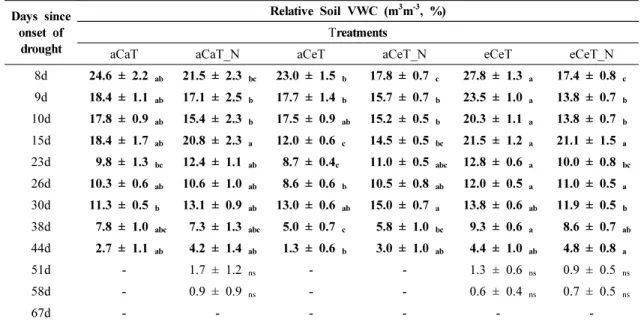
무관수 처리에 의한 처리구별 토양함수율 변화는 Table. 1과 같다. 무관수 이후 처리간 효과를 비교하기 위해 시기별 토양함수율 변화는 상대적 토양함수율로 나타냈다. 무관수 처리에 따른 처리별 토양함수율은 전반적으로 eCeT에서 높은 경향을 보였다. 또한, 처리 에 따른 토양함수율의 차이는 무관수 후 44일까지 지 속되었으나, 그 이후에는 통계적인 차이가 없었다. 토 양함수율은 무관수 초반인 8일째(P < 0.001) 질소가 시비되지 않은 eCeT에서 평균 27.8%로 가장 높은 수 준을 유지하였으며, 질소가 시비된 aCeT_N, eCeT_N 에서 최대 토양함수율 대비 각각 약 36.0%, 37.4% 감 소하였다. 토양함수율은 eCeT에서 가장 높았는데 이 는 대기 중 고농도 CO2가 gs를 낮추어 토양수분을 증 가시키는 특징으로 보이며(Girardin et al., 2016), 가 장 낮은 처리는 약 44.2% 감소한 aCeT였다(Table 1).
무관수 67일째, 모든 처리에서 토양함수율은 평균 0%
수준으로 감소하였다. 그러나 aCeT와 aCeT_N에서 무관수 44일∼51일 사이 가장 먼저 0% 수준으로 토양
Days since onset of
drought
Relative Soil VWC (m3m-3, %) Treatments
aCaT aCaT_N aCeT aCeT_N eCeT eCeT_N
8d 24 .6 ± 2.2 ab 21.5 ± 2.3 bc 23.0 ± 1.5 b 17.8 ± 0.7 c 27.8 ± 1.3 a 17.4 ± 0.8 c
9d 18.4 ± 1.1 ab 17.1 ± 2.5 b 17.7 ± 1.4 b 15.7 ± 0.7 b 23.5 ± 1.0 a 13.8 ± 0.7 b
10d 17.8 ± 0.9 ab 15.4 ± 2.3 b 17.5 ± 0.9 ab 15.2 ± 0.5 b 20.3 ± 1.1 a 13.8 ± 0.7 b
15d 18.4 ± 1.7 ab 20.8 ± 2.3 a 12.0 ± 0.6 c 14 .5 ± 0.5 bc 21.5 ± 1.2 a 21.1 ± 1.5 a
23d 9.8 ± 1.3 bc 12.4 ± 1.1 ab 8.7 ± 0.4c 11.0 ± 0.5 abc 12.8 ± 0.6 a 10.0 ± 0.8 bc
26d 10.3 ± 0.6 ab 10.6 ± 1.0 ab 8.6 ± 0.6 b 10.5 ± 0.8 ab 12.0 ± 0.5 a 11.0 ± 0.5 a
30d 11.3 ± 0.5 b 13.1 ± 0.9 ab 13.0 ± 0.6 ab 15.0 ± 0.7 a 13.8 ± 0.6 ab 11.9 ± 0.5 b
38d 7.8 ± 1.0 abc 7.3 ± 1.3 abc 5.0 ± 0.7 c 5.8 ± 1.0 bc 9.3 ± 0.6 a 8.6 ± 0.7 ab
44d 2.7 ± 1.1 ab 4 .2 ± 1.4 ab 1.3 ± 0.6 b 3.0 ± 1.0 ab 4 .4 ± 1.0 ab 4 .8 ± 0.8 a
51d - 1.7 ± 1.2 ns - - 1.3 ± 0.6 ns 0.9 ± 0.5 ns
58d - 0.9 ± 0.9 ns - - 0.6 ± 0.4 ns 0.7 ± 0.5 ns
67 d - - - -
aCaT; ambient CO2 and ambient temperature, aCeT; ambient CO2 and elevated temperature, eCeT; elevated CO2 and elevated temperature with control nitrogen and nitrogen fertilization on each treatment was represented as aCaT_N, aCeT_N and eCeT_N, respectively. Values are means ± SE (aCaT, aCaT_N; n = 10, aCeT, aCeT_N, eCeT, eCeT_N; n = 25). Different letters indicate significant differences between treatments (P
< 0.05) based on multiple comparisons (Tukey’s HSD test) in ANOVA, ns: not significant.
Table 1. Relative Soil VWC (m3m-3, %) subjected to drought under different treatments
함수율이 감소하였다. Duan et al. (2015)에서도 고온 처리에 의한 토양함수율 감소가 복합처리보다 더 빠르 게 감소한 결과를 보여 본 연구와 비슷한 경향이었다.
단수 이후 상대적 토양함수율은 모든 처리에서 비슷한 추세로 감소하여 수목에게 건조 스트레스를 제공하였 을 것으로 판단된다. 또한 질소 시비에 따른 토양함수 율 변동에 뚜렷한 차이는 나타나지 않았다.
3.2. 생리적 변화
무관수로 인한 건조 스트레스 증가와 질소시비에 따른 처리별 순광합성율(Pn) 및 기공전도도(gs) 변화는 Fig. 1와 같다. 본 실험에서는 선행연구들(Chang et al., 2019; Han et al., 2018)과 마찬가지로 고온처리에 의해 Pn 과 gs 모두 감소하는 현상이 나타났다. 일반적 으로 수목이 가뭄을 회피하는 전략은 잎의 기공을 조 절하여 증산을 줄이고 수분이용효율을 높이는 것을 의 미한다(Cao et al., 2014). 무관수 처리 1일차, Pn은 질소가 시비된 eCeT_N에서 약 19.2 umol CO2 m-2 s-1로 가장 높았으며, aCeT에서 약 41.0% 감소한 11.3 umol CO2 m-2 s-1로 가장 낮았다(P = 0.026, Fig. 1a).
무관수 처리 초기에는 질소가 시비된 모든 처리에서 무시비 처리 보다 Pn이 높은 경향을 보였다. 이는 높은 양분유효도가 지상부의 생물량을 우선적으로 분배시 켜 초기 가뭄 환경에서 탄소 고갈 현상을 피하는 등의 역할을 하기 때문이다(Gessler et al., 2017). 무관수 7일차 이후, 전반적으로 Pn이 감소하는 경향이 나타났 다. 가장 높은 Pn은 eCeT에서 약 10.1 umol CO2 m-2
s-1이었으나, 고온이 처리되는 aCeT, aCeT_N에서 최 대 Pn 대비 각각 약 57.7%, 90.6% 낮아졌다(P = 0.001). 무관수 13일차에도 비슷한 경향이 유지되었으 나 통계적인 차이는 없었다. 무관수 21일차, eCeT_N 에서 가장 높은 Pn을 유지하였고 aCeT_N, aCaT_N에 서는 최대 Pn 대비 각각 각각 약 83.7%, 85.6% 낮아졌 다(P = 0.04). 토양수분함량으로 인한 광합성의 전반 적인 감소 추세가 보였으며 이는 토양수분함량이 줄어 들면서 발생한 것으로 판단된다(Reich et al., 2018).
무관수 1일∼7일 사이 건조 스트레스에 따른 광합성 감소율에 질소 시비 효과가 나타나지 않았고, 무관수 7일∼13일 사이 질소가 광합성에 대한 가뭄의 억제 효과를 완화시키는 경향을 나타냈지만(eCeT 감소율 83.9%, eCeT_N 감소율 77.5%), 본 연구에서 질소 시 비에 따른 뚜렷한 완화 효과는 나타나지 않았다. 그러 나 잎 내 질소는 대부분이 광합성에 직접적으로 관여 하여 광합성에 대한 가뭄 스트레스를 완화시켜 탄소고갈 을 피할 수 있게 도와주고, 광합성 능력에도 영향을 주므 로 질소 시비 처리에서 서서히 감소하도록 도움을 준다 고 보고되었다(Evans, 1989; Gessler et al., 2017;
Tarvainen and Näsholm, 2017). 이후 무관수 후 28일, 36일에도 측정하였으나 Pn이 유의미한 차이를 보이지 않아 고사에 이른 것으로 판단되었다.
기공증산속도와 기공의 개폐를 측정하는 gs는 (Hopkins, 1999), 측정 시기(무관수 1일, 7일)와 처리 에 따라 유의한 차이를 보였다(Fig. 1b). 또한 무관수 초반에는 Pn과 유사하게 질소 시비 처리에서 높은 경
Fig. 1. (a) Net photosynthesis at saturating light (Pn), (b) stomatal conductance (gs) of P. densiflora seedlings under different treatment. The bars indicate means ± SE (n = 3). Different letters indicate significant differences between treatments (P < 0.05) based on multiple comparisons (Tukey’s HSD test) in ANOVA, ns: not significant.
향을 보였는데, 이는 질소 시비가 gs 조절 호르몬인 식물생장호르몬 ABA (leaf abscisic acid)을 증가시켜 기공을 조절해 수분이용효율 증가에도 영향을 끼친다 고 한다(Song et al., 2019).
무관수와 처리에 따른 기간 별 gs 경우 무관수 처리 1일차, gs는 aCeT_N에서 약 0.3 mol m-2 s-1로 가장 높았으나 eCeT에서 약 51.7% 유의하게 낮아졌다(P
= 0.004, Fig. 1b). 그러나 무관수 7일차부터 eCeT에서 0.06 mol m-2 s-1로 가장 높았지만 aCeT_N에서 약 76.4% 유의하게 낮아졌다(P = 0.001). 토양함수율과 gs는 서로 높은 상관관계가 있으며(Tim, 1996), 이러 한 현상은 토양함수율이 감소하면서 기공을 빨리 닫아 잎의 수분포텐셜을 유지하여 hydraulic failure를 피하 려는 Pinus 수종의 특징으로 판단된다(Tardieu and Simonneau, 1998). 이후 무관수 후 13일, 28일, 36일 에도 측정하였으나 Pn과 유사한 경향을 보이고, 유의 미한 차이를 보이지 않아 고사에 이른 것으로 판단되 었다(Fig. 1). 질소가 충분한 경우 수분이용효율이 촉 진되지만, 토양수분함량에 따라 기공을 조절하는 능력 이 손상될 수 있을 것으로 판단되며(Gessler et al., 2017; Yang et al., 2012), 질소 시비는 gs를 감소 시켜 물관부 색전증(embolism)에 대한 취약성을 줄일 수 있 다(Goldstein et al., 2013).
3.3. 변색율 및 고사 변화
변색율은 수목의 조직 고사와 시기를 결정하는데 있어 완벽하게 일치하지 않지만 가뭄으로 인한 고사의 유용한 추정 지표로 사용되고 있다(Leuzinger et al., 2009). 무관수 26일부터 모든 처리에서 정기적인 모니 터링을 수행하였다. 온도⋅CO2 처리와 질소 시비 및 무관수 처리에 따른 소나무의 변색율 차이는 시기에 따라 뚜렷한 차이가 나타났다(Table 2). 무관수 26일 에 aCeT와 aCeT에서 각각 약 23.5%, 21.6%로 빠르게 변색되었으나 eCeT와 eCeT_N에서 약 4.3%, 3.2%로 유의하게 낮았다(P < 0.001, Table. 2). 무관수 30일에 도 26일과 같은 경향을 보였다. aCeT_N와 aCeT에서 각각 약 53.1%, 52.3%로 높은 변색율을 보였고, eCeT 와 eCeT_N에서 각각 13.6%, 8.4%로 낮은 변색율을 보였다(P < 0.001). 무관수 38일에 aCeT에서 약 79.2%로 가장 높고, eCeT_N에서 약 61.0% 감소하였 으며 가장 느리게 변색되었다(P < 0.001, Table 2).
이후 무관수 후 44일, 51일, 58일, 67일, 73일까지 지 속적으로 측정한 결과, 복합처리에서는 고온처리에 비
해 상대적으로 느린 변색율을 보였으나 유의미한 차이 는 나타나지 않았다. 또한 무관수 88일에 모든 처리에 서 100% 변색하여 고사하였다. 무관수 처리 초반에는 환경 변화 처리에 따라 반응이 다르게 나타났지만 기 간이 길어짐에 따라 온도와 CO2에 따른 유의한 차이 는 나타나지 않았다.
고사는 변색율 100%을 기준으로 판단하였으며 건 조 스트레스 증가와 질소시비에 따른 처리별 고사 기 간 변화는 Fig. 2에 나타냈다(P = 0.049). 가장 빨리 고사한 처리는 aCeT였으며 평균적으로 무관수 후 46 일이였다. 고온처리는 건조 스트레스로 기공을 빨리 닫고 증발과 호흡을 증가시켜 빠르게 고사가 진행된다 고 한다(Adams et al., 2009; Will et al., 2013). 그러나 본 실험과 유사하게 온실에서 묘목으로 진행한 연구도 고온 환경에서 고사율이 증가하였으나 실제 산림 환경 에서 성목은 화분 안 묘목보다 뿌리가 발달해 토양의 수분 보유능이 증가 될 수 있기 때문에 고사 비교 예측 에는 다양한 요인 고려가 필요하며(Duan et al., 2015, McDowell et al., 2008), 실제 환경에서 장시간 가뭄처 리에 따른 성목의 반응에 대한 연구가 요구된다. eCeT 에서는 무관수 후 평균적으로 56일로 가장 오래 생존 하였으며, aCeT와 비교해 볼 때 약 21.5% 오래 생존하 였다. 이는 고농도 CO2가 고온처리와는 다르게 gs를 감소시킨 점을 고려해 볼 때, 가뭄 스트레스에서 수분 이용에 유리하게 작용하여 수목 생존에 기여를 한 것 Fig. 2. Mean time (days) to mortality in P. densiflora seedlings subjected to drought under different treatments with control nitrogen (Control_ N) and nitrogen fertilization (Fertilized_N). The bars indicate means ± SE (aCaT, aCaT_N; n = 10, aCeT, aCeT_N, eCeT, eCeT_N; n = 25). Different letters on the bars indicate significant differences (P < 0.05) based on multiple comparisons (Tukey’s HSD test) in ANOVA.
Days since onset of
drought
Leaf browning (%) Treatments
aCaT aCaT_N aCeT aCeT_N eCeT eCeT_N
26d 11.2 ± 2.6 ab 6.9 ± 2.4 ab 23.5 ± 5.6 a 21.6 ± 4 .4 a 4 .3 ± 0.8 b 3.2 ± 0.8 b
30d 26.0 ± 4 .9 ab 26.8 ± 9.2 ab 52.3 ± 7.1 a 53.1 ± 7.8 a 13.6 ± 2.1 b 8.4 ± 1.9 b
38d 66.0 ± 6.4 abc 57.2 ± 12.4 abc 79.2 ± 6.2 a 67.4 ± 8.4 ab 42.0 ± 6.5 bc 30.8 ± 6.1 c
44d 82.0 ± 3.7 ns 81.0 ± 9.4 ns 86.8 ± 6.0 ns 76.2 ± 7.4 ns 68.3 ± 7.0 ns 73.0 ± 6.5 ns
51d - 93.2 ± 5.0 ns 91.8 ± 4.7 ns 89.6 ± 5.2 ns 88.0 ± 4.7 ns 88.4 ± 5.8 ns
58d - 93.2 ± 5.0 ns 97 .1 ± 2.0 ns 89.6 ± 5.2 ns 92.8 ± 3.4 ns 88.4 ± 5.8 ns
67d - 99.5 ± 0.5 ns 99.2 ± 0.6 ns 99.7 ± 0.2 ns 95.9 ± 2.0 ns 95.4 ± 2.8 ns
7 3d - - - 99.7 ± 0.2 ns 99.5 ± 0.3 ns 98.3 ± 1.1 ns
aCaT; ambient CO2 and ambient temperature, aCeT; ambient CO2 and elevated temperature, eCeT; elevated CO2 and elevated temperature with control nitrogen and nitrogen fertilization on each treatment was represented as aCaT_N, aCeT_N and eCeT_N, respectively. Values are means ± SE (aCaT, aCaT_N; n = 10, aCeT, aCeT_N, eCeT, eCeT_N; n = 25). Different letters indicate significant differences between treatments (P
< 0.05) based on multiple comparisons (Tukey’s HSD test) in ANOVA, ns: not significant.
Table 2. Leaf browning (%) subjected to drought under different treatments
Fig. 3. P. densiflora seedlings biomass of (a) Leaf, (b) Stem. (c) Root, (d) Total subjected to drought under different treatments with control nitrogen (Control_N) and nitrogen fertilization (Fertilized_N). The bars indicate means ± SE (aCaT, aCaT_N; n = 10, aCeT, aCeT_N, eCeT, eCeT_N; n = 25). Different letters on the bars indicate significant differences (P < 0.05) based on multiple comparisons (Tukey’s HSD test) in ANOVA.
으로 판단된다(Warren et al., 2011).
3.4. 생물량 변화
온도와 CO2 처리가 종료된 후 잎, 줄기, 뿌리 부위 별 생물량과 총 생물량은 질소 시비 처리 따라 뚜렷한 차이를 보였다(Fig. 3). 질소가 시비된 처리구에서 생 물량이 높아 우수한 생장을 확인할 수 있었지만, 고온 과 복합처리 효과에 의한 차이는 나타나지 않았다. 고 온에서 생물량 감소 원인 중 하나로 유지호흡 소비 증가로 언급되었지만(Prior and Bowman, 2014), 수종 별 적응 반응은 다양하기 때문에 복합적인 환경요인 영향을 설명할 필요가 있다(King et al., 2005). 본 연 구에서는 고온 및 복합처리가 단기간 이루어졌기 때문 에 통계적으로 의미있는 차이가 나타나지 않은 것으로 생각되며 장기간 지속적인 연구가 필요하다고 판단된 다. 잎과 줄기의 경우, aCeT_N에서 각각 약 9.4g, 2.7g 으로 가장 높은 물질생산량을 보였다(P <0.001, respectively). 반면 잎에서는 aCaT 생물량이 약 46.4%, 줄기에서는 aCeT가 약 32.1% 감소하였다. 뿌 리의 경우 aCeT에서 약 3.2g으로 유의하게 낮았으며, 가장 높은 eCeT_N에서는 약 53.1% 증가하였다(P <
0.001). 일반적으로 뿌리는 가뭄처리에서 생산성에 밀 접한 연관이 있으며(Comas et al., 2013; Zheng et al., 2017), 양분이 시비 될 경우 뿌리 생장 및 수분이용효 율을 높여 건조 스트레스로 인한 부정적 효과를 완화 시킬 수 있다(Luo et al., 2013; Tran et al., 2014).
또한 CO2 시비효과에 의한 광합성 촉진은 식물의 생 장에 직접적인 영향을 미쳐 생물량이 증가한 것으로 판단된다(Ainsworth and Rogers, 2007). 본 연구에서 도 질소가 시비된 처리에서 높은 뿌리 생물량을 보여 변색율과 고사율에 영향을 주었을 것으로 판단된다.
가뭄 스트레스에서도 질소 시비는 뿌리의 생장이 증가 되는데, 이는 대부분 생장과 물질 생물량 유지에 이용 된다(Tran et al., 2014). 본 연구에서 총 건중량의 경우 질소 시비가 없는 고온처리에서 약 10.4g으로 가장 낮 았으나, 질소가 시비된 고온처리에서는 약 17.7g으로 시비에 의해 약 69.8% 증가하였다(P < 0.001, Fig. 3).
고온처리에 의한 광합성은 평균적으로 약 30%, 총 생 물량은 약 50% 감소하는 것으로 알려져 있다 (Kumarathunge et al., 2019). 질소 시비가 뿌리 생장 에서 무관수로 인한 건조 스트레스가 주는 억제효과를 완화시켜 소나무의 물질 생물량을 증가시킨 것으로 판 단된다.
적 요
본 연구는 최근 기후변화로 인해 피해가 증가하고 있는 소나무를 대상으로 고온 및 고농도 CO2 환경에 인위적으로 건조 스트레스를 주어 질소 시비에 따른 생리적 반응과 생물량 변화 특성을 구명하고자 수행되 었다. 토양수분은 고온처리에서 가장 빨리 감소하여 수목의 건조 스트레스를 제공하는 것으로 나타났다.
결과적으로 토양수분이 가장 빨리 감소한 고온처리에 서 순광합성율과 기공전도도 모두 감소하였다. 생리적 반응의 경우, 무관수 초기에는 질소가 시비되는 모든 처리구에서 대조구 보다 높은 경향을 보였으나 건조 스트레스 기간이 길어짐에 따라 질소 시비 효과는 나 타나지 않았다. 고사율은 고온처리에서 빠르게 진행되 었으며 고농도 CO2 농도 환경에서는 평균적으로 21.5% 오래 생존하였다. 생물량의 경우 질소 시비와 CO2 시비효과가 뿌리에서 무관수로 인한 건조 스트레 스가 주는 억제 효과를 완화시켜 부위별⋅총 생물량 증가에 영향을 준 것으로 판단된다. 본 연구결과를 통 해 기후변화가 산림생태계에 끼칠 수 있는 영향을 정 량적으로 구명함으로서 기후변화에 대응하여 산림을 효율적으로 관리하는데 필수적인 자료를 활용하고, 향 후 미기상 조건에 다른 산림생태 예측모델 활용에 중 요한 역할을 할 것으로 기대된다.
REFERENCES
Adams, H. D., M. Guardiola-Claramonte, G. A.
Barron-Gafford, J. C. Villegas, D. D. Breshears, C. B. Zou, P. A. Troch, and T. E. Huxman, 2009: Temperature sensitivity of drought-induced tree mortality portends increased regional die-off under global-change-type drought. Proceedings of the National Academy of Sciences 106(17), 7063-7066.
Ainsworth, E. A., and A. Rogers, 2007: The response of photosynthesis and stomatal conductance to rising [CO2]: mechanisms and environmental interactions. Plant, Cell Environment 30(3), 258- 270.
Allen, C. D., A. K. Macalady, H. Chenchouni, D.
Bachelet, N. McDowell, M. Vennetier, T.
Kitzberger, A. Rigling, D. D. Breshears, and E. T.
Hogg, 2010: A global overview of drought and heat-induced tree mortality reveals emerging
climate change risks for forests. Forest Ecology Management 259(4), 660-684.
Anderegg, W. R., J. M. Kane, and L. D. Anderegg, 2013: Consequences of widespread tree mortality triggered by drought and temperature stress.
Nature Climate Change 3(1), 30-36.
Cao, X., J. Jia, C. Zhang, H. Li, T. Liu, X. Jiang, A. Polle, C. Peng, and Z. B. Luo, 2014:
Anatomical, physiological and transcriptional responses of two contrasting poplar genotypes to drought and re‐watering. Physiologia Plantarum 151(4), 480-494.
Chang, H., S. H. Han, J. An, M. J. Park, and Y.
Son, 2019: Relationship between Soil Water and Physiological and Growth Responses of Pinus densiflora Seedlings under Open-field Experimental Warming and Precipitation Manipulation. Journal of Climate Change Research 10(2), 145-152. (in Korean with English abstract)
Collatz, G. J., J. T. Ball, C. Grivet, and J. A. Berry, 1991: Physiological and environmental regulation of stomatal conductance, photosynthesis and transpiration: a model that includes a laminar boundary layer. Agricultural Forest Meteorology 54(2-4), 107-136.
Comas, L., S. Becker, V. M. V. Cruz, P. F. Byrne, and D. A. Dierig, 2013: Root traits contributing to plant productivity under drought. Frontiers in Plant Science 4, 442pp.
Duan, H., A. P. O’Grady, R. A. Duursma, B. Choat, G. Huang, R. A. Smith, Y. Jiang, and D. T.
Tissue, 2015: Drought responses of two gymnosperm species with contrasting stomatal regulation strategies under elevated [CO2] and temperature. Tree Physiology 35(7), 756-770.
Farquhar, G. D., and T. D. Sharkey, 1982: Stomatal conductance and photosynthesis. Annual Review of Plant Physiology 33(1), 317-345.
Gessler, A., M. Schaub, and N. G. McDowell, 2017:
The role of nutrients in drought‐induced tree mortality and recovery. New Phytologist 214(2), 513-520.
Girardin, M. P., O. Bouriaud, E. H. Hogg, W. Kurz, N. E. Zimmermann, J. M. Metsaranta, R. de Jong, D. C. Frank, J. Esper, and U. Büntgen, 2016: No growth stimulation of Canada’s boreal forest under half-century of combined warming and CO2
fertilization. Proceedings of the National Academy of Sciences 113(52), E8406-E8414.
Goldstein, G., Bucci, SJ., Scholz. FG., 2013: Why do trees adjust water relations and hydraulic
architecture in response to nutrient availability?
Tree Physiology 33(3), 238-240.
Han, S. H., H. Chang, and Y. Son, 2018: Short-term Effects of Warming and Precipitation Manipulation on Seasonal Changes in Fine Root Production and Mortality for Pinus densiflora Seedlings. Journal of Korean Society of Forest Science 107(1), 43-49.
Hopkins, W., and N. Huner, 2008: Introduction to Plant Physiology (4 ed.). The University of Western Ontario, London.
Hopkins, W. G., 1999: Introduction to Plant Physiology . John Wiley and Sons.
Huang, J.-G., Y. Bergeron, B. Denneler, F.
Berninger, and J. Tardif, 2007: Response of forest trees to increased atmospheric CO2. Critical Reviews in Plant Sciences 26(5-6), 265-283.
IPCC, 2013: Climate change 2013: The physical science basis, 25, Cambridge University Press, Cambridge.
IPCC, 2018: Global warming of 1.5℃ An IPCC Special Report on the impacts of global warming of 1.5℃ above pre-industrial levels and related global greenhouse gas emission pathways, in the context of strengthening the global response to the threat of climate change, sustainable development, and efforts to eradicate poverty, Cambridge University Press, Cambridge.
King, J. S., M. E. Kubiske, K. S. Pregitzer, G. R.
Hendrey, E. P. McDonald, C. P. Giardina, V. S.
Quinn, and D. F. Karnosky, 2005: Tropospheric O3 compromises net primary production in young stands of trembling aspen, paper birch and sugar maple in response to elevated atmospheric CO2. New Phytologist (168), 623-636.
Kim, P. G., and E. J. Lee, 2001: Ecophysiology of Photosynthesis 1: Effects of Light Intensity and Intercellular CO2 Pressure on Photosynthesis.
Korean Journal of Agricultural and Forest Meteorology 3(2), 126-133. (in Korean with English abstract)
El Kohen, A., L. Venet, and M. Mousseau, 1993:
Growth and Photosynthesis of two deciduous forest species at elevated carbon dioxide.
Functional Ecology 7(4), 480-488.
Korea Forest Service, 2006: Forest Resources Creation and Management Act, Korea Forest Service.
Korea Meteorological Administration, 2019: Annual Climatological Report, Korea Meteorological Administration.
Kumarathunge, D. P., J. E. Drake, M. G. Tjoelker,
R. López, S. Pfautsch, A. Vårhammar, and B. E.
Medlyn, 2019: The temperature optima for tree seedling photosynthesis and growth depend on water inputs. Global Change Biology.
Leuzinger, S., C. Bigler, A. Wolf, and C. Körner, 2009: Poor methodology for predicting large-scale tree die-off. Proceedings of the National Academy of Sciences 106(38), E106-E106.
Lim, J.-H., E. Kim, B. Lee, S. Kim, and K. Jang, 2017: An analysis of the hail damages to Korean forests in 2017 by meteorology, species and topography. Korean Journal of Agricultural Forest Meteorology 19(4), 280-292. (in Korean with English abstract)
Lim, J.-H., and J. H. Shin, 2005: Forest vegetation shift and plant phenological changes according to global warming. Nature Conservation 120, 8-17.
(in Korean with English abstract)
Luo, J., H. Li, T. Liu, A. Polle, C. Peng, and Z.-B.
Luo, 2013: Nitrogen metabolism of two contrasting poplar species during acclimation to limiting nitrogen availability. Journal of Experimental Botany 64(14), 4207-4224.
Matyssek, R., A. R. Kozovits, J.-P. Schnitzler, H.
Pretzsch, J. Dieler, and G. Wieser, 2014: Forest trees under air pollution as a factor of climate change. Trees in a Changing Environment, 117-163.
McDowell, N., W. T. Pockman, C. D. Allen, D. D.
Breshears, N. Cobb, T. Kolb, J. Plaut, J. Sperry, A. West, and D. G. Williams, 2008: Mechanisms of plant survival and mortality during drought:
Why do some plants survive while others succumb to drought? New Phytologist 178(4), 719-739.
Mitchell, P. J., A. P. O’Grady, D. T. Tissue, D. A.
White, M. L. Ottenschlaeger, and E. A. Pinkard, 2013: Drought response strategies define the relative contributions of hydraulic dysfunction and carbohydrate depletion during tree mortality. New Phytologist 197(3), 862-872.
NOAA, 2020: Climate at a Glance: Global Mapping https://www.ncdc.noaa.gov/cag/. National Centers for Environmental information.
Nunes-Nesi, A., A. R. Fernie, and M. Stitt, 2010:
Metabolic and signaling aspects underpinning the regulation of plant carbon nitrogen interactions.
Molecular Plant 3(6), 973-996.
Oren, R., D. S. Ellsworth, K. H. Johnsen, N.
Phillips, B. E. Ewers, C. Maier, K. V. Schäfer, H. McCarthy, G. Hendrey, and S. G. McNulty, 2001: Soil fertility limits carbon sequestration by
forest ecosystems in a CO2-enriched atmosphere.
Nature New Biology 411(6836), 469pp.
Prior, L. D., and D. M. Bowman, 2014: Big eucalypts grow more slowly in a warm climate:
Evidence of an interaction between tree size and temperature. Global Change Biology 20, 2793-2799.
Reich, P. B., K. M. Sendall, A. Stefanski, R. L.
Rich, S. E. Hobbie, and R. A. Montgomery, 2018:
Effects of climate warming on photosynthesis in boreal tree species depend on soil moisture.
Nature 562(7726), 263-267.
Solomon, S., M. Manning, M. Marquis, and D. Qin, 2007: Climate change 2007-the physical science basis: Working group I contribution to the fourth assessment report of the IPCC (4 ed.). Cambridge University Press.
Song, J., Y. Wang, Y. Pan, J. Pang, X. Zhang, J.
Fan, and Y. Zhang, 2019: The influence of nitrogen availability on anatomical and physiological responses of Populus alba× P. glandulosa to drought stress. BMC Plant Biology 19(1), 63pp.
Stirling, C., M. Heddell-Cowie, M. Jones, T.
Ashenden, and T. Sparks, 1998: Effects of elevated CO2 and temperature on growth and allometry of five native fast-growing annual species. New Phytologist 140(2), 343-354.
Taiz, L., and E. Zeiger, 2006: Plant Physiology.
Sinauer Associates Inc., Sunderland, MA.
Tardieu, F., and T. Simonneau, 1998: Variability among species of stomatal control under fluctuating soil water status and evaporative demand:
modelling isohydric and anisohydric behaviours.
Journal of Experimental Botany, 419-432.
Tarvainen, L., and T. Näsholm, 2017: Can adjustments in foliar nitrogen-use efficiency reduce drought stress impacts on boreal trees? Tree Physiology 37(4), 415-417.
Brodribb, T., 1996: Dynamics of Changing Intercellular CO2 Concentration (ci) during Drought and Determination of Minimum Functional ci. Plant Physiology 111, 179-185.
Tran, T. T., M. Kano-Nakata, M. Takeda, D. Menge, S. Mitsuya, Y. Inukai, and A. Yamauchi, 2014:
Nitrogen application enhanced the expression of developmental plasticity of root systems triggered by mild drought stress in rice. Plant and Soil 378(1-2), 139-152.
Warren, J. M., R. J. Norby, and S. D. Wullschleger, 2011: Elevated CO2 enhances leaf senescence during extreme drought in a temperate forest. Tree
Physiology 31(2), 117-130.
Will, R. E., S. M. Wilson, C. B. Zou, and T. C.
Hennessey, 2013: Increased vapor pressure deficit due to higher temperature leads to greater transpiration and faster mortality during drought for tree seedlings common to the forest–grassland ecotone. New Phytologist 200(2), 366-374.
Woodward, F. I., 2002: Potential impacts of global elevated CO2 concentrations on plants. Current Opinion in Plant Biology 5(3), 207-211.
Yang, Y., J. Guo, G. Wang, L. Yang, and Y. Yang, 2012: Effects of drought and nitrogen addition on photosynthetic characteristics and resource allocation of Abies fabri seedlings in eastern Tibetan
Plateau. New Forests 43(4), 505-518.
Zhang, H., Y. Gao, B. Y. Tasisa, J. M. Baskin, C.
C. Baskin, X.-T. Lü, and D. Zhou, 2019:
Divergent responses to water and nitrogen addition of three perennial bunchgrass species from variously degraded typical steppe in Inner Mongolia. Science of The Total Environment 647, 1344-1350.
Zheng, H., X. Zhang, W. Ma, J. Song, S. U.
Rahman, J. Wang, and Y. Zhang, 2017:
Morphological and physiological responses to cyclic drought in two contrasting genotypes of Catalpa bungei. Environmental Experimental Botany 138, 77-87.