. Introduction
Ⅰ
Customer needs for the beauty and attractiveness of appearance have diversified and increased for reasons of a lot of informations about the advanced beauty service and the improvement of living standard. The
+
Corresponding author: Eun-Jeong Ryou, Tel. +82-55-213-3495, Fax. +82-55-213-3490 E-mail: [email protected]
This research is financially supported by Changwon National University in 2013~2014.
volume of beauty service industry is expanding because of the change of customers desires.
The beauty service industry was segmented and specialized into the fields of hair care, make up, skin care and nail care after the 2000s. Among them, the hair care industry occupies presently the largest area so that the sales scale is KRW
The Effects of Service Recovery and Perceived Justice on Customer Relationship in the Beauty Service Industry
Eun-Jeong Ryou
+Dept. of Clothing & Textiles, Changwon National University
Abstract
The purposes of this study are to explore how the service recovery of the beauty shops and customers’perceived justice affect the customer relationship. A survey based questionnaire method was employed for this study. Data were collected by a convenient sampling of 232 female customers of hair beauty shops in Seoul and Busan. The data were analysed by using SPSS 21.0, including a frequency analysis, reliability analysis, factor analysis and multiple of regression analyses. The first result showed that all dimensions of service recovery had a significantly positive effect on the perceived justice.
Especially, behavioral recovery of beauty shops was the major significant factor affecting perceived justice. Second, distributive justice and interactive justice had a significant effect on satisfaction. However, procedural justice did not have any significant effect on satisfaction. Finally, satisfaction was significantly and strongly associated with both trust and commitment. These results provide empirical proposition that the recovery strategies for complaint handling of the beauty service shop are related closely to relationship marketing.
Key words : beauty service industry, service recovery, perceived justice, customer
relationship
4,500 billion and the number of the hair beauty shop is 90,000 nationally(“Hair salon leading beauty market”, 2012). The beauty service industry experienced a qualitative change with a quantitative growth of beauty service market, the expansion of the well-known franchise store, the extensive size of beauty shop and the high educational level of beauty professional staffs.
However, the business of beauty service shop is becoming more difficult due to the economic recession and excess competition. Therefore, for overcoming the problems like the above, the marketing for management innovation and service development is needed (Choi, 2008; Kim,
& Kim, 2006).
The beauty service is defined by all kinds of activity offering consistently customers the beauty care technique with personal and physical service products (Kim, 2012). The important elements of beauty service are not only technical skills but also general services like comfort environment, hospitality attitude of staffs and reservation receipt. The beauty service industry has distinctively the production process of service that staffs and customers engage with simultaneously. Therefore, the differentiated attributes of beauty service are concurrency and non separability with producing and consuming, extinction and non standardization caused by various production process(Hwang & Hwang, 2001).
The beauty service industry has more concern for increasing the loyalty of existing customers than securing new customers. Therefore, the efforts for building a consistent customer relationship are important in order to achieve the business goal of beauty industry. However, the strategy of beauty service quality can fail for satisfying suitably the customer desires. If any service trouble arise, customers will respond aggressively(Choi, 2008). Service failure causes
customer dissatisfaction with the service provider, and due to that customers may exit silently, spread a negative word-of-mouth, voice their complaints to the operator, or continue to patronage the same service provider despite their dissatisfaction (Kim, T., Kim, W. G., & Kim, H. B.., 2009). An effective recovery process can then repair the service failure and, consequently, turn dissatisfied customers into satisfied ones, improving customer relationships and preventing defection(Fornell & Wemerfelt, 1987). Complaint handling or recovery of service failure is important to minimize a breakaway from existing customer relationship and to lead a return visit and customer loyalty. Therefore, service recovery is critical for satisfying its customers as well as strengthening its relationships with them (Blodgett, Hill, & Tax, 1997; Kim, Chae, &
Hwang, 2014; Smith & Bolton, 2002).
Besides, the success of service recovery depends on the perceived justice of customers.
Whether customers perceived the fair and justified experience in service recovery encounters is important in success with complaint handling. In order to more fundamentally comprehend effective service recovery, researchers have utilized justice theory as the main framework for examining service recovery procedures (McColl-Kennedy & Sparks, 2003).
Despite a importance of service failure
handling in building customer relationship,
research findings are very insufficient in the
beauty service industry(Kim, 2012). Little
study(Choi, 2008; Hwang, 2005; Kim 2012) has
been made to investigate the perceived justice
regarding service recovery and customer
relationship after recovery. In this regard, the
purposes of this study are to explore how the
service recovery of beauty shop and
customers’perceived justice affect the customer
relationship.
. Literature Review
Ⅱ
1. Service Recovery and Perceived Justice
Service recovery refers to the action taken by a service provider to address a customer complaint regarding a perceived service failure (Gr nroos, 1988). The ultimate goal of service ӧ recovery is to pacify dissatisfied customers through appropriate actions in order to reduce potential damage to customer relationships caused by service failures (Ha & Hang, 2009;
Zemke, 1993). Some researchers suggest that a firm’s recovery effort can either reinforce customer relationships or compound the failure (Hoffman, Kelly, & Rotalsky, 1995; Smith, Bolton,
& Wagner, 1998). According to Miller, Craighead, and Karwan (2000), service recovery efforts are defined as “those actions designed to resolve problems, to alter negative attitudes or dissatisfied customers and to ultimately retain these customers”.
In a service marketing situation, customer inputs could be the costs associated with a service failure such as economic, time, energy, and psychic costs(Hoffman & Kelley, 2000). The outcomes could include recovery tactic used such as cash refund, apology, replacement, and so on. These specific recovery strategy can be classified by three dimensional complaint handling of behavioral recovery, psychological recovery, and monetary recovery (Kelly, Hoffman,
& Davis, 1993; Kim, 2012).
The outcomes of service recovery must be perceived to be fair or just by the customers. In order to more fundamentally comprehend effective service recovery, researchers have
utilized justice theory as the main framework for examining service recovery procedures (McColl-Kennedy & Sparks, 2003). Perceived justice is a multi-dimensional concept comprising three dimensions: distributive, procedural, and interactional justice.
Distributive justice refers to the assignment of tangible resources by the firm to rectify and compensate for a service failure (del Rio-Lanza, 2009). In context of service failure/ recovery, it refers to the perceived fairness of specific reimbursement like a repair, refund, discounts, exchange and free upgrades(Ahn, 2011).
Procedural justice refers to the methods the firm uses to deal with the problems arising during service delivery in aspects such as accessibility, timing/speed, process control, delay and flexibility to adapt to the consumer's recovery needs (del Rio-Lanza, 2009).
Procedural justice also includes policies, procedures, and tools that companies use to support communication with customers and specifically, the time taken to process complaints and to arrive at a decision.
Procedural justice focuses on the way that the outcome is reached(Davoud, Ishak, Malliga, &
Mohammad, 2010)
Interactional justice focuses on interpersonal interactions during the process of service delivery. It means the evaluation of the degree to which the customers have experienced justice in human interactions from the employees of service organization during the recovery process (Sparks & McColl-Kennedy, 2001).
Despite a widespread adoption of the justice framework, research findings vary considerably.
There is variability in the relative strength of the effects of each justice dimension on satisfaction with complaint handling (Ostringer, Valentini, &
De Angelis, 2010).
2. Customer Relationship
Complaint handling strategies are important particularly in managing continuous customer relationships in service business. Effective resolution of customer problems and relationship marketing are linked closely in terms of their mutual interest in customer satisfaction, trust, and commitment (Tax, Brown, &
Chandrashekaran, 1998).
Satisfaction with complaint handling can enhance the evaluation of service experiences.
Bitner, Brooms, and Tetreault(1990) find that customers were likely to have positive reactions to encounters in which initial service failures were followed by effective recoveries, such as being upgraded to a better room, compensated with a free meal or drink, provided with an explanation as to why the service was unavailable, or assisted in solving the problem.
Satisfaction reinforces the customer's decision to participate in the service process, leading over time to commitment (Fornell 1992). The attitudinal and behavioral consequences of customer satisfaction play a central role in driving long-term customer relationships.
Commitment can be defined as one's enduring desire to maintain a valued relationship (Moorman, Zaltman, & Deshpande., 1992).
Definitions of commitment focus on the enduring desire of parties to maintain a relationship (Morgan & Hunt 1994). The need for customer participation in the delivery process makes the concept of commitment especially relevant to services. Customer relationship commitment is directly related with satisfaction of service recovery (Kelley & Davis 1994). The resultant commitment of the social credit is a key factor to avoid the uncertainty of the relationship (Dwyer, Shurr, & Oh, 1987). Therefore,
commitment is a typical dimensions that constitute the relationship and can be called a critical variable for the maintenance of customer relationships and loyalty.
Trust is an important factor in the development of marketing relationships and exists when one party has confidence in an exchange partner's reliability and integrity (Morgan & Hunt, 1994). Holmes and Rempel(1989) observe that trust is strengthened if partners are responsive in ways that acknowledge an individual's particular needs and affirm their sense of worth. Trust is an indicator of a growing relationship that tends to foster higher levels of commitment and cooperation (Morgan & Hunt, 1994). Especially in the beauty service industry, trust to the other may reduce the uncertainty and perceived risk. Therefore, trust can be regarded as an important indicator of long term relationships with customers.
To summarize the above, satisfaction with service recovery is significantly and strongly associated with both trust and commitment, which provides the empirical proposition that complaint handling is tied closely to relationship marketing.
. Methods
Ⅲ
1. Research Issues
The first objective is to investigate the behavioral Characteristics related purchasing the beauty Service.
Next objective is to examine the effects of service recovery on perceived justice.
The final objective is to examine the effects of
perceived justice on customer relationship.
2. Measurement
A survey based questionnaire method was employed for this study. The questionnaire consisted of the measurement items related with purchasing behavior of beauty service, service recovery, perceived justice, customer relationship and demographic characteristics. The validated multiple scales from previous literature were employed and the most of scales were measured on a 5 point Likert-scale.
Service recovery was measured with 12 statements adopted from Kelly et al.(1993), Smith et al.(1999) and Kim(2012). Perceived Justice was measured with 12 statements adopted from DeWitt, Nguyen, & Marshall(2008), Tax et al.(1998) and Ahn(2011). Customer relationship was measured with 9 statements adopted from Crosby, Kenneth, and Deborah(1990) and Ryou and Park(2013). To identify samples’characteristics, demographics related with age, income, marital status and occupation were measured by the nominal scale items.
3. Sample and Data Analysis
Data were collected by a convenient sampling of 232 adult female customers in Seoul and Busan. A screening question was asked to see if respondents encountered any service failure with hair beauty service over the last few years.
Respondents in their 20s comprised 55.7% of the total samples. Other respondents were 30s(10.7%), 40s(17.2%) and 50s(16.4%). Among all respondents, 48.7% were university students, the highest proportion, followed by employee workers(25.9%) and housewives (25.4%). Married of the total respondents accounted for 40.9%.
The monthly household income ranges of the
sample were less than KRW 2 million(27.2%), KRW 2 million ~ less than 4 million (33.2%), KRW 4 million ~ less than 6 million(20.3%) and more than KRW 6 million(19.4%).
The data were analysed by using SPSS 21.0, including a frequency analysis, reliability analysis, factor analysis and multiple of regression analyses.
. Results
Ⅳ
1. Behavioral Characteristics for Beauty Service
The behavioral characteristics for the beauty service are presented in Table 1. In the visiting frequency of beauty shop, one in two months(29.7) was the most common, followed by once in three months(24.1%) and once a month(16.4%). The service frequently used was found to be hair cut(42.6%), followed by Dyeing or coating(26.2%) and permanent(25.0%).
The ranges of KRW 50,000 ~ 100,000(25.6%) and KRW 100,000 ~ 150,000(26.3%) were the most common in maximum expenditure for beauty service. The loyal customers(59%) of visiting mainly one shop were much more frequent than the customers of visiting several beauty shops. The criteria for selecting the beauty shop appeared in the following order of an expertise of staff(33.9%), reasonable price(25.5%), location and convenient access(12.5%) and acquaintances recommendation(10.5%).
If the customers are unsatisfied with beauty
service, the most customers answered that they
expressed the complaints as a non verbal
action(41.8%) followed by a immediate
protest(19.0%) and a request of appropriate
explanation(10.3%).
Behavior Characteristics Frequency(%)
Visiting frequency
Once a month Once in two months Once in three months
Once in four months Once in five months
twice a year
38(16.4) 69(29.7) 56(24.1) 19( 8.2) 12( 5.2) 38(16.4)
Total 232(100.0)
Frequently used services
Permanent Cut Dyeing or Coating Temporary setting
Clinic etc.
58(25.0) 99(42.6) 61(26.2) 2( 0.9) 2( 0.9) 10( 4.4)
Total 232(100.0)
Maximum expenditure (unit; KRW)
less than 50,000 50,000 ~ less than 100,000 100,000 ~ less than 150,000 150,000 ~
less than 200,000 200,000 ~ less than 250,000 250,000 ~ less than 300,000
more than 300,000
21( 9.1) 61(25.6) 62(26.3) 36(15.5) 22( 9.5) 12( 5.2) 18( 7.8)
Total 232(100.0)
Switching behavior of beauty shop
Mainly one shop Two or Three shops
Multiple shops
137(59.0) 48(20.7) 47(20.3)
Total 232(100.0)
Selection criteria
*Recommendation of acquaintances Reasonable price
Brand reputation Acquaintance with staffs
Expertise of staffs Store environments Discount or Promotion policy Location & Convenient access
etc.
54(10.5) 131(25.5)
12( 2.3) 39( 7.6) 174(33.9)
18( 3.5) 16( 3.2) 64(12.5) 5( 1.0)
Total 513
Complaining behavior
Immediate protest Non verbal expression Revisit or Call for protest Claim by e-mail or home page
Request of explanation Specific compensation claims
.etc
44(19.0) 97(41.8) 16( 6.9) 3( 1.3) 24(10.3) 8( 3.4) 40(17.3)
Total 232(100.0)
* multiple response item
Table 1. Respondents’ Behavioral Characteristics for the Beauty Shop
2. Measurement Assessment
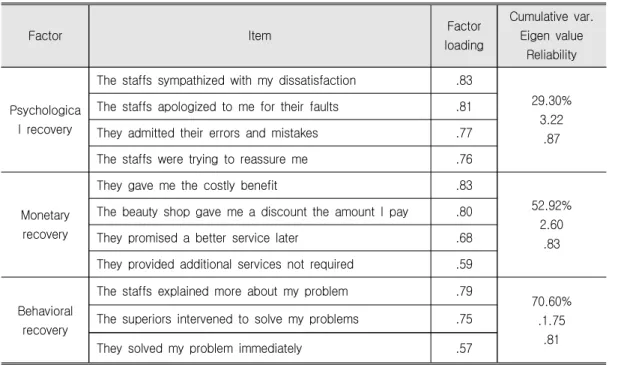
To assess of service recovery, an exploratory factor analysis was conducted through SPSS 21.0. It generated three dimensions for service recovery: psychological recovery, monetary recovery, and behavioral recovery. This is consistent with the results of the study by Kelly et al.(1993) and Kim(2012). The three factors accounted for 70.6% of the total variance(see table 2). Factor loadings ranged from 0.57 to 0.83, and Cronbach’s alpha of factors were 0.81 or 0.87.
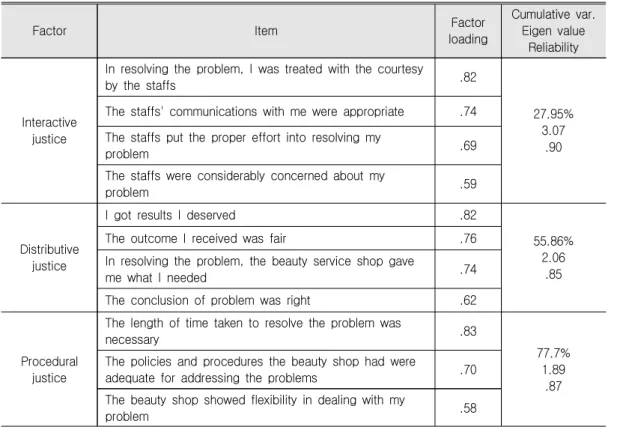
To assess of perceived justice, an exploratory factor analysis was conducted through SPSS 21.0. The three factors, interactive, distributive, and procedural dimensions of perceived justice accounted for 77.7% of the total variance(see table 3). All factors show a value above the
Factor Item Factor
loading
Cumulative var.
Eigen value Reliability
Psychologica l recovery
The staffs sympathized with my dissatisfaction .83
29.30%
3.22 .87 The staffs apologized to me for their faults .81
They admitted their errors and mistakes .77 The staffs were trying to reassure me .76
Monetary recovery
They gave me the costly benefit .83
52.92%
2.60 .83 The beauty shop gave me a discount the amount I pay .80
They promised a better service later .68
They provided additional services not required .59
Behavioral recovery
The staffs explained more about my problem .79
70.60%
.1.75 .81 The superiors intervened to solve my problems .75
They solved my problem immediately .57
Table 2. Factors of Service Recovery
threshold .80 for Cronbach’s alpha. This is consistent with the results of the study by Ahn(2011) and Tax et al.(1998).
To assess of customer relationship quality, an exploratory factor analysis was conducted through SPSS 21.0. The three factors (commitment, trust and satisfaction) of relationship quality accounted for 76.8% of the total variance(see table 4). This is consistent with the results of the study by Ryou and Park(2012) and Crosby et al.(199)). All factors show a value above the threshold .80 for Cronbach’s alpha.
3. Effects of Service Recovery on Perceived Justice
A multiple regression analysis was conducted
in order to determine the effect of that service
Factor Item Factor loading
Cumulative var.
Eigen value Reliability
Interactive justice
In resolving the problem, I was treated with the courtesy
by the staffs .82
27.95%
3.07 .90 The staffs' communications with me were appropriate .74
The staffs put the proper effort into resolving my
problem .69
The staffs were considerably concerned about my
problem .59
Distributive justice
I got results I deserved .82
55.86%
2.06 .85
The outcome I received was fair .76
In resolving the problem, the beauty service shop gave
me what I needed .74
The conclusion of problem was right .62
Procedural justice
The length of time taken to resolve the problem was
necessary .83
77.7%
1.89 .87 The policies and procedures the beauty shop had were
adequate for addressing the problems .70
The beauty shop showed flexibility in dealing with my
problem .58
Table 3. Factors of Perceived Justice
Factor Item Factor
loading
Cumulative var.
Eigen value Reliability
Commitment
I feel attachment to relations with the beauty shop .82
31.07%
3.42 .86 I will continue the relationship with the beauty shop .79
I will continue to be a loyal customer of this beauty shop .71
Trust
I can trust the procedures and provisions of beauty shop .79 55.21%
2.66 .85 The efforts of the beauty shop give me confidence .75
Services provided by the beauty shop is reliable. .72
Satisfaction
I am satisfied with the handling of the beauty shop for
my problem .85
76.87%
2.34 .84 I am satisfied with the overall experience in the beauty
shop .82
As a whole, I am satisfied with the beauty shop .75
Table 4. Factors of Customer Relationship
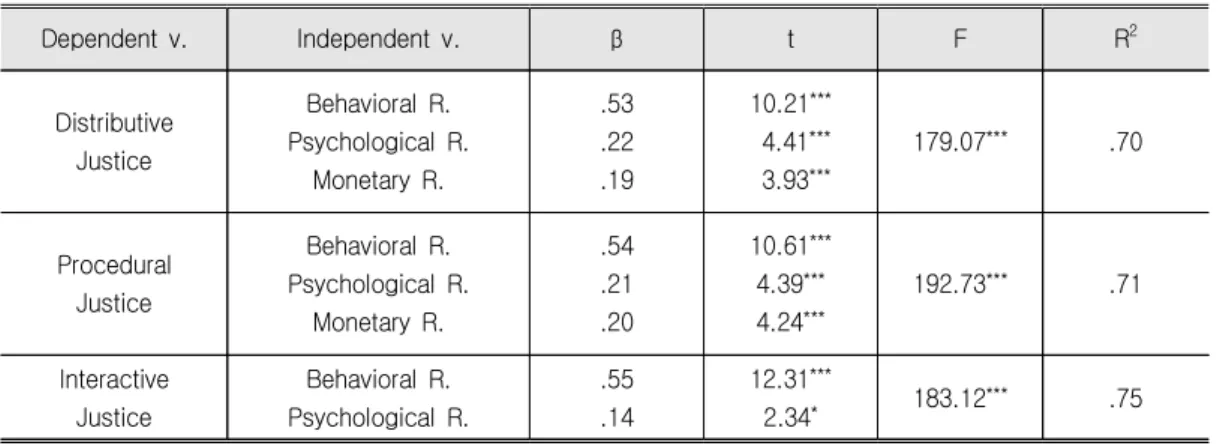
recovery activities of beauty shop would have on the justice perception of unsatisfied customers(see table 5).
First, the three factors of service recovery were defined as the independent variables and distributive justice was defined as the dependent variable. The results showed that behavioral recovery( =.53), psychological recovery( =.22) β β and monetary recovery( =.19) had a significant β effect on distributive justice.
Next, the three factors of service recovery were defined as the independent variables and procedural justice was defined as the dependent variable. The results showed that behavioral recovery( =.54), β psychological recovery( =.2) β and monetary recovery( =.20) had a significant β effect on procedural justice.
Finally, the three factors of service recovery were defined as the independent variable and interactive justice was defined as the dependent variable. The results showed that behavioral recovery( =.55), psychological recovery( =.14) β β had a significant effect on interactive justice.
However, monetary recovery did not have any significant effect on interactive justice.
Dependent v. Independent v. β t F R
2Distributive Justice
Behavioral R.
Psychological R.
Monetary R.
.53 .22 .19
10.21
***4.41
***3.93
***179.07
***.70
Procedural Justice
Behavioral R.
Psychological R.
Monetary R.
.54 .21 .20
10.61
***4.39
***4.24
***192.73
***.71
Interactive Justice
Behavioral R.
Psychological R.
.55 .14
12.31
***2.34
*183.12
***.75
***
p<.001
Table 5. Effects of Service recovery on Perceived Justice
The results showed that all variables of service recovery had a significantly positive effect on the justice perception. Especially, behavioral recovery of beauty shop is the major significant factor affecting all type of perceived justice.
4. Effects of Perceived Justice on Customer Relationship
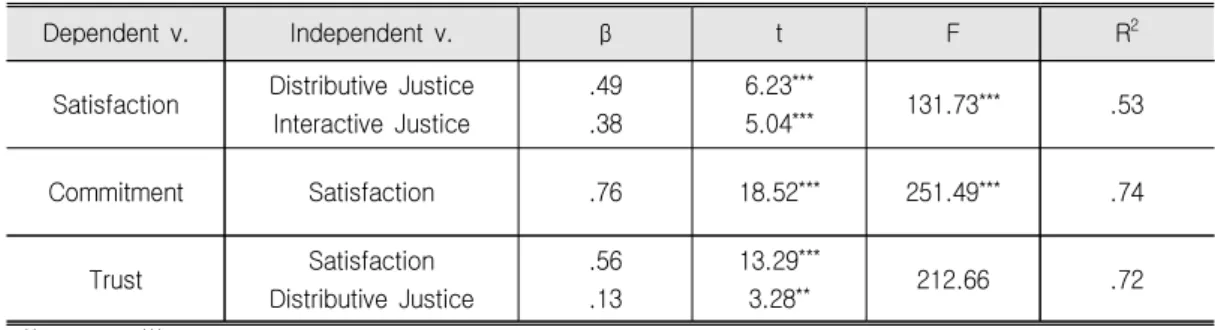
A multiple regression analysis was conducted in order to determine the effect of that perceived justice of customers would have on each of the relationship dimensions(see table 6).
First, the three factors of perceived justice
were defined as the independent variables and
satisfaction was defined as the dependent
variable. The results showed that distributive
justice( =.49) and interactive justice( =.38) had β β
significant effects on satisfaction. However,
procedural justice did not have any significant
effect on satisfaction. These are consistent with
the results of the study by Ahn(2011) and
Lee(2010). Chebat and Slusarczyk (2005)
observed that the specific effects of the three
justice dimensions on customer loyalty are quite
different from each other. The procedural justice had a very little effect on customer relationship because customers recognized a quick and accurate recovery procedures as a natural requirement (Chebat & Slusarczyk, 2005). The very significant influence of distributive justice was consistent with most exiting researches(Ahn, 2012; Ostringer et al., 2010; Smith et al., 1999).
Next, the three factors of perceived justice and satisfaction were defined as the independent variables and commitment was defined as the dependent variable. The results showed that only satisfaction( =.76) had a β significant effect on commitment.
Finally, the three factors of perceived justice and satisfaction were defined as the independent variables and trust was defined as the dependent variable. The results also showed that satisfaction( =.56) and distributive justice( β β
=13) had a significant effect on trust.
Commitment and trust of customer relationship were indirectly influenced by perceived justice in terms of satisfaction. Satisfaction is significantly and strongly associated with both trust and commitment, which provides the empirical proposition that complaint handling is tied closely to relationship marketing(Tax et al., 1998).
Dependent v. Independent v. β t F R
2Satisfaction Distributive Justice Interactive Justice
.49 .38
6.23
***5.04
***131.73
***.53
Commitment Satisfaction .76 18.52
***251.49
***.74
Trust Satisfaction
Distributive Justice
.56 .13
13.29
***3.28
**212.66 .72
**