• 검색 결과가 없습니다.

Imbalance in Cardiovascular Surgery Medical Service Use Between Regions

N/A
N/A
Protected

Academic year: 2021

Share "Imbalance in Cardiovascular Surgery Medical Service Use Between Regions"

Copied!
6
0
0

로드 중.... (전체 텍스트 보기)

전체 글

(1)

ISSN: 2233-601X (Print) ISSN: 2093-6516 (Online)

Received: October 5, 2016, Revised: October 23, 2016, Accepted: October 24, 2016, Published online: December 5, 2016

Corresponding author: Choon Seon Park, Health Insurance Review and Assessment Research Institute, Health Insurance Review and Assessment Service, 60 Hyeoksin-ro, Wonju 26465, Korea

(Tel) 82-33-739-0916 (Fax) 82-33-811-7442 (E-mail) [email protected]

© The Korean Society for Thoracic and Cardiovascular Surgery. 2016. All right reserved.

This is an open access article distributed under the terms of the Creative Commons Attribution Non-Commercial License (http://creativecommons.org/

licenses/by-nc/4.0) which permits unrestricted non-commercial use, distribution, and reproduction in any medium, provided the original work is properly cited.

Imbalance in Cardiovascular Surgery Medical Service Use Between Regions

Myunghwa Kim, M.P.H. 1 , Seok-Jun Yoon, M.D., Ph.D. 1 , Ji Suk Choi, Ph.D. 1 , Myo Jeong Kim, M.S. 1 , Sung Bo Sim, M.D., Ph.D. 2 , Kun Sei Lee, M.D., Ph.D. 3 , Hyun Keun Chee, M.D., Ph.D. 4 , Nam Hee Park, M.D. 5 , Choon Seon Park, R.N., Ph.D. 1

1

Health Insurance Review and Assessment Research Institute, Health Insurance Review and Assessment Service,

2

Department of Thoracic and Cardiovascular Surgery, The Catholic University of Korea College of Medicine,

3

Department of Preventive Medicine, Konkuk University School of Medicine,

4

Department of Thoracic and Cardiovascular Surgery, Konkuk

University Medical Center, Konkuk University School of Medicine,

5
Department of Thoracic and Cardiovascular Surgery, Keimyung University School of Medicine

Background: This study uses the relevance index to understand the condition of regional medical service use for cardiovascular surgery and to identify the medical service use imbalance between regions. Methods: This study calculated the relevance index of 16 metropolitan cities and provinces using resident registration address data from the Ministry of Government Administration and Home Affairs and the 2010–2014 health insurance, medical care assistance, and medical benefits claims data from the Health Insurance Review and Assessment Service. We identified developments over the 5-year time period and analyzed the level of regional imbalance regarding cardiovascular surgery through the relative comparison of relevance indexes between cardiovascular and other types of surgery. Results: The relevance index was high in large cities such as Seoul, Daegu, and Gwangju, but low in regions that were geographically far from the capital area, such as the Gangwon and Jeju areas. Relevance indexes also fell as the years passed. Cardiovascular surgery has a relatively low rele- vance index compared to key types of surgery of other fields, such as neurosurgery and colorectal surgery.

Conclusion: This study identified medical service use imbalance between regions for cardiovascular surgery.

Results of this study demonstrate the need for political intervention to enhance the accessibility of necessary special treatment, such as cardiovascular surgery.

Key words: 1. Cardiovascular surgery 2. Medical service use 3. Relevance index 4. Difference

Introduction

Cardiovascular disease has a high mortality rate and a high burden of medical expenses. It has become an important healthcare issue commensurate with a rap-

id aging population. Emphasis is growing on efficient

function and the role of the healthcare system in or-

der to prevent, manage, and treat cardiovascular dis-

ease [1]. In particular, because cardiovascular surgery

is a field that integrates advanced techniques and

https://doi.org/10.5090/kjtcs.2016.49.S1.S14

(2)

professionalized human resources, it is a field where medical service use in the context of an efficient healthcare system is important [2].

Treatment of cardiovascular surgery is difficult, re- quires professional care, and is directly related to pa- tient life. Citizens should be provided with accessible, high-quality medical service along with appropriate medical resources. However, cardiovascular surgery occurs in low frequency and is resource-intensive, which makes resource supply difficult. Due to these reasons, the concentration of cardiovascular surgery treatment in the capital area has been intensifying.

Approximately 60% of medical institutions providing cardiovascular surgery are distributed in the capital area [3], and the number of patients who receive specialized healthcare in large medical institutions in the capital area is steadily increasing. Citizens prefer large medical institutions for serious and important medical care, such as surgery [4].

When medical use or medical resources are con- centrated in a particular region, it negatively affects the health results, because surgical procedures for patients with cardiovascular disease who need prompt treatment may become delayed. It also increases the hidden costs needed to move to another region to receive treatment. Due to this, accessibility issues arise between regions regarding medical service use, and imbalance occurs for the burden of expenses.

Therefore, efforts must be made to enhance the level of regional healthcare and solve the regional gap of medical service use.

There little research with objective data on actual regional medical service use for cardiovascular surgery.

The main purpose of this study is to use the rele- vance index to understand the condition of regional medical service use for cardiovascular surgery and identify the medical service use imbalance between regions. Results will provide preliminary data on pol- icy intervention for the alleviation of cardiovascular surgery concentration between regions and enhance- ment of accessibility.

Methods

This study used the relevance index to compare and identify the medical service use imbalance between regions for cardiovascular surgery. We used patient treatment records (2010–2014) from the health in-

surance, medical care assistance, and medical benefits claims data of the Health Insurance Review and Assessment Service, and resident registration address data from the Ministry of Government Administration and Home Affairs. Cardiovascular surgery included congenital malformation heart surgery, cardiovascular valve surgery, coronary artery surgery, aorta and branch vessel surgery, and heart transplants. E ach surgery was assessed by specialists of the depart- ment of thoracic and cadiovascular surgery and de- fined using medical benefits claims codes.

The basic unit of analysis is the 16 metropolitan city and provinces unit (Sejong City is included in the South Chungcheong Province) divided by admin- istrative districts. Relevance index was used in order to identify the medical service use imbalance be- tween regions regarding cardiovascular surgery. The relevance index is also known as the self-sufficiency degree (rate). Using this index, the flow (outflow) of patients actually using regional medical services can be reflected to identify the level of accessibility of the region. Out of the total amount of medical serv- ice use by a patient residing in a region, the rele- vance index is the percentage of the use of medical institutions within the selected region. The relevance index formula is as follows [5]:

(Relevance index formula) RI

i

=n

ii

/∑

i

n

ij

n

ij

is the number of operations that patients resid- ing in the i region undergo at medical institutions lo- cated in the j region.

In this formula, when patients residing in i region use medical institutions within that region, i = j, which becomes the self-sufficiency rate, and using this rate, the outflow of patients in the region to other regions can be identified [6]. If the self-sufficiency rate is high for a certain region regarding cardiovascular surgery, it means the rate of patients in that region using medical services within the region is high, and the rate of patients moving to other regions is low.

To analyze the relevance index, developments over

the five years from 2010 to 2014 were identified for

the 16 metropolitan cities and provinces. The level of

regional imbalance regarding cardiovascular surgery

use was identified through the relative comparison of

relevance indexes between cardiovascular surgery and

other types of surgery (e.g., neurosurgery, colorectal

(3)

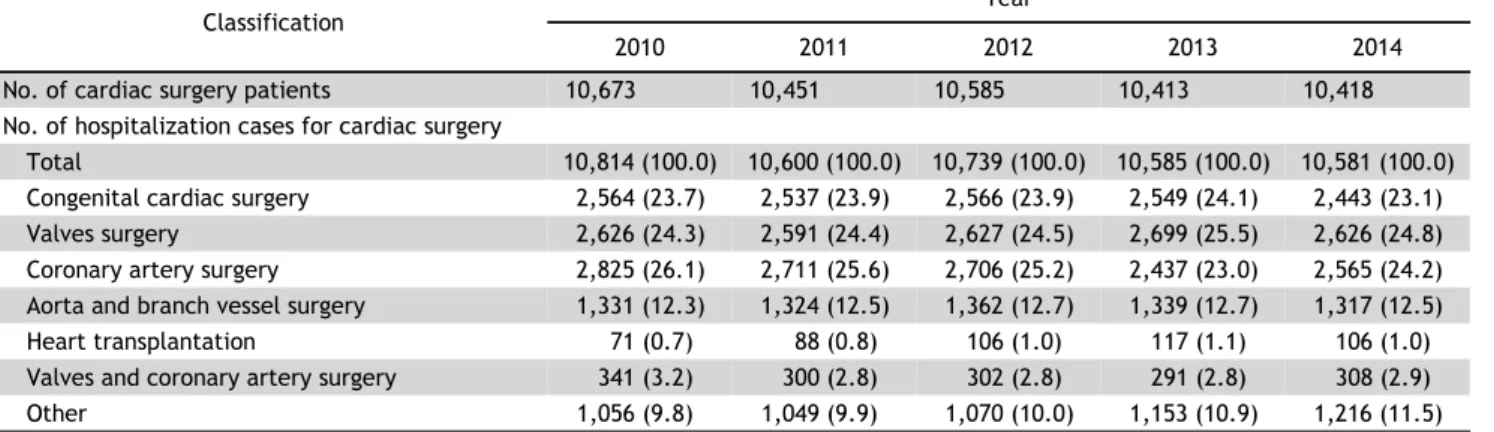
Table 1. Cases of hospitalization for different types of cardiac surgery, by year Classification

Year

2010 2011 2012 2013 2014

No. of cardiac surgery patients 10,673 10,451 10,585 10,413 10,418

No. of hospitalization cases for cardiac surgery

Total 10,814 (100.0) 10,600 (100.0) 10,739 (100.0) 10,585 (100.0) 10,581 (100.0)

Congenital cardiac surgery 2,564 (23.7) 2,537 (23.9) 2,566 (23.9) 2,549 (24.1) 2,443 (23.1)

Valves surgery 2,626 (24.3) 2,591 (24.4) 2,627 (24.5) 2,699 (25.5) 2,626 (24.8)

Coronary artery surgery 2,825 (26.1) 2,711 (25.6) 2,706 (25.2) 2,437 (23.0) 2,565 (24.2) Aorta and branch vessel surgery 1,331 (12.3) 1,324 (12.5) 1,362 (12.7) 1,339 (12.7) 1,317 (12.5)

Heart transplantation 71 (0.7) 88 (0.8) 106 (1.0) 117 (1.1) 106 (1.0)

Valves and coronary artery surgery 341 (3.2) 300 (2.8) 302 (2.8) 291 (2.8) 308 (2.9)

Other 1,056 (9.8) 1,049 (9.9) 1,070 (10.0) 1,153 (10.9) 1,216 (11.5)

Values are presented as number (%).

Table 2. Relevance index of cardiac surgery by region (%) Regions

Year

2010 2011 2012 2013 2014

Average 36.3 35.9 36.4 37.2 36.7

Seoul 94.0 93.8 93.7 92.9 91.8

Gyonggi 34.9 33.8 33.8 38.7 42.0

Incheon 32.6 23.1 34.7 32.9 32.7

Gangwon 19.0 18.5 21.6 18.5 15.4

Chungbuk 6.0 9.8 4.7 5.5 5.9

Chungnam 7.7 5.9 3.0 5.5 8.8

Daejeon 38.6 35.7 35.7 41.0 35.6

Jeonbuk 43.2 43.7 42.9 41.1 42.9

Jeonnam 18.6 21.5 18.7 22.2 15.4

Gwangju 38.1 45.9 50.8 57.1 61.6

Gyongbuk 0.0 0.0 1.1 0.2 0.0

Daegu 76.8 73.6 70.9 75.3 76.9

Gyongnam 40.9 42.9 41.0 43.3 45.5

Busan 48.2 49.3 51.3 47.9 51.0

Ulsan 45.9 46.0 42.1 41.8 36.0

Jeju 36.9 31.1 35.7 30.8 26.4

surgery, gastrectomy, and hysterectomy). For neuro- surgery and colorectal surgery, data were categorized for neurosurgery and colorectal surgery by the diag- nosis-related group codes from the health insurance, medical care assistance, and medical benefits claims data were used from the Health Insurance Review and Assessment Service. For gastrectomy and hyster- ectomy, data were used from the 2014 statistical yearbook of key operations from the National Health Insurance Corporation.

Results

1) The use of medical services for cardiovascular surgery by year

The number of annual cardiovascular surgery pati- ents in 2014 was 10,418, which was a relative de- crease compared to 10,673 in 2010. The number of annual hospitalizations due to cardiovascular surgery in 2014 was 10,581, and of these, congenital malfor- mation heart surgery and cardiovascular valve sur- gery made up more than 70% of the total number of operations. The number of hospitalizations also decr- eased compared to the 10,814 cases in 2010 (Table 1).

2) Relevance index by region

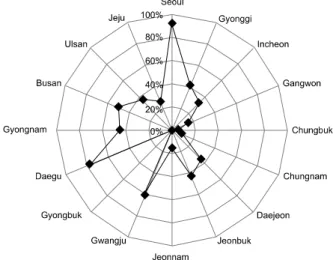
Based on 2014 records, the average regional rele- vance index was 36.7%, 91.8% for the Seoul area, 76.9% for the Daegu area, and 61.6% for the Gwangju area, which demonstrated that residents used local medical services for cardiovascular surgery in metro- politan areas. On the other hand, the relevance index was low for the following regions: 0.0% for the North Gyeongsang area, 5.9% for the North Chungcheong area, 15.4% for the Gangwon area, 15.4% for the South Jeolla area, and 26.4% for the Jeju area.

Examining the relevance index by year, while the 2014 relevance index for Seoul decreased compared to that of 2010, the relevance index for the neighbor- ing Gyeonggi area increased from 34.9% in 2010 to 42.0% in 2014. In the Gwangju area, the relevance index increased from 38.1% in 2010 to 61.6% in 2014.

In the Daegu area, the relevance index decreased

from 76.8% in 2010 to 70.4% in 2012 then increased

(4)

Table 3. 2014 relevance index by surgery type (%)

Surgery type

Cardiac surgery Neurosurgery Colorectal surgery Gastrectomy Hysterectomy

Average of relevance index 36.7 62.7 55.8 49.9 72.5

From Health Insurance Review and Assessment Service; Ministry of the Interior; National Health Insurance Service.

Fig. 1. Relevance index of cardiac surgery.

to 76.9% in 2014. In the Busan area, the relevance index decreased from 48.2% in 2010 to 47.9% in 2013 and then increased to 51.0% in 2014. With the ex- ception of Ulsan, the relevance index regarding car- diovascular surgery in metropolitan cities maintained at a similar level from year to year, or increased slightly. In particular, there was a great increase in the Gwangju area. However, the relevance index stea- dily decreased for the Gangwon area (19.0% in 2010 to 15.4% in 2014) and the Jeju area (36.9% in 2010 to 26.4% in 2014) (Table 2).

3) Comparison between cardiovascular surgery and other types of surgery

Compared to other types of surgery, the relevance index for cardiovascular surgery was low. When com- pared against the average relevance index of the 16 metropolitan cities and provinces, the relevance in- dex for cardiovascular surgery was 36.7%, while the relevance index was 62.7% for neurosurgery, 55.8%

for colorectal surgery, 49.9% for gastrectomy, and 72.5% for hysterectomy (Table 3, Figs. 1 and 2).

Discussion

This study calculated the relevance index by region in order to identify the medical service use imbalance between regions for cardiovascular surgery. The rele- vance index is an indicator that shows the actual outflow pattern of medical service use by patients in the region. Analysis of the 2010–2014 relevance in- dex of cardiovascular surgery patients revealed that the relevance index was high in large cities like Seoul, Daegu, and Gwangju but low in regions that were geographically far from the capital area, such as the Gangwon and Jeju areas. The relevance index also decreased during the study time period for regions with low relevance indexes.

The relevance index can identify how many pa- tients have used medical institutions within the re- gion and at the same time reflect the condition of medical service use within the region by assessing whether or not patients traveled to another region to use medical services, rather than services in their residential region [7]. If the relevance index is high, it means the demand for medical services is mostly satisfied within the region and that the move to oth- er regions is relatively low. The results of this study show that geographical accessibility for cardiovascular surgery patients was very low in regions other than large cities such as Seoul, Daegu, Gwangju, and Busan.

Moreover, the relevance index for cardiovascular sur- gery was lower than the relevance index for other fields such as neurosurgery, colorectal surgery, gas- trectomy, and hysterectomy. These results are similar to those of previous studies on cancer (a representa- tive acute disease), which showed that the 1999 and 2002 relevance index for cancer patients was high in Seoul, Daegu, and Busan, in that respective order [7].

The studies concluded that these results were due to the concentration of medical institutions in those regions.

Kim et al. [6] found that the regional difference

between medical service use differs according to dis-

(5)

Fig. 2. 2014 Relevance indexes of (A) colorectal surgery, (B) gastrectomy, (C) neurosurgery, and (D) hysterectomy.

ease characteristics. In general, the farther the dis- tance to the medical institution that provides the necessary services, the more the use of medical serv- ices decreases, but this scenario differs according to the acuteness of the disease [8,9]. For highly acute diseases such as acute mental illnesses and cancer, the use of medical services does not decrease as much even if the distance increases [6]. Acute dis- ease patients must use medical services even if they must travel to a region afar, so accessibility is very important for acute disease patients.

Reinforcement of cardiovascular surgery functions within regions is needed. Cardiovascular surgery is relatively less selective than cancer and it is harder for patients to travel to another region because car- diovascular surgery more often requires emergency

care. Timing in cardiovascular surgery is a very im- portant factor that affects the mortality rate because services must be provided within a short time after the symptoms occur, and in order to enhance health results, patients must be transported and cared for in the early stages [10]. The concentration of car- diovascular operations in a few large cities indicates that it is more difficult for cardiovascular surgery pa- tients residing in provinces to receive cardiovascular operations in time, compared to those living in large cities. These results highlight the need for policies that will reinforce the treatment functions of cardio- vascular operations in the provinces.

A limitation of this study is that it does not pro-

vide a definite cause for the increase and decrease of

the relevance index by region. It is predicted that scar-

(6)

city of medical resources between regions and the preferences of the residents in the region will affect the relevance index. Because influence factors and the degree of influence may vary depending on re- gional characteristics, additional research is needed.

In conclusion, the significance of a balanced use of regional medical services means guaranteed accessi- bility based on needs and enhancement of treatment opportunities, which in turn influence the health re- sults of patients. This study identified medical service use imbalance between regions could be for car- diovascular surgery, which suggests the need for pol- icy intervention in order to enhance accessibility to necessary special treatment.

Conflict of interest

No potential conflicts of interest relevant to this article are reported.

Acknowledgments

This study is based on the “Study on the manage- ment of cardio-cerebrovascular disease and feasibility evaluation of regional cardiac surgery center,” which was conducted with support provided by the Ministry of Health and Welfare in 2015.

References

1. Organization for Economic Cooperation and Development.

Cardiovascular disease and diabetes: policies for better health and quality of care. Paris: Organization for Economic Cooperation and Development; 2015.

2. Kim YN, Park HJ, Kwon U, Kim KS, Kim MN, Kim SK. Preli- minary feasibility study on Daegu Heart Center. Daegu:

Keimyung University; 2009.

3. Yoon SJ, Park CS, Kim MH, et al. Study on the management of cardio-cerebrovascular disease and feasibility evalua- tion of regional cardiac surgery center. Wonju: Health Insurance Review and Assessment Service; 2015.

4. Nam MH, Kim SS, Park IS, et al. A study in utilization if non-residential areal in operation. J Korean Acad Ind Coop Soc 2010;11:2078-87.

5. Delamater PL, Shortridge AM, Messina JP. Regional health care planning: a methodology to cluster facilities using community utilization patterns. BMC Health Serv Res 2013;13:333.

6. Kim JH, Cho BM, Hwang IK, Son MJ, Yoon TH. Trends of health care utilization and relevance index of stroke in- patient among the self-employed insured and their depen- dents of national health insurance (1998-2005). Korean J Health Policy Adm 2008;18:66-84.

7. Moon YO, Park EC, Shin HR, et al. Regional variation in ac- cessing regional hospitals for cancer patients. Korean J Epidemiol 2006;28:152-61.

8. Nemet GF, Bailey AJ. Distance and health care utilization among the rural elderly. Soc Sci Med 2000;50:1197-208.

9. Joseph AE, Boeckh JL. Locational variation in mental health care utilization dependent upon diagnosis: a Canadian example. Soc Sci Med D 1981;15:395-40.

10. Kim DJ, Park KH, Isamukhamedov SS, Lim C, Shin YC, Kim

JS. Clinical results of cardiovascular surgery in the pa-

tients older than 75 years. Korean J Thorac Cardiovasc

Surg 2014;47:451-7.

수치

Table 1. Cases of hospitalization for different types of cardiac surgery, by year Classification
Table 3. 2014 relevance index by surgery type (%)
Fig. 2. 2014 Relevance indexes of (A) colorectal surgery, (B) gastrectomy, (C) neurosurgery, and (D) hysterectomy.

참조

관련 문서

Autho: Effectiveness of surgery for lumbar stenosis and degenerative spondylolisthesis in the octogenarian population: analysis of the Spine Patient Outcomes Research

Postoperative adhesion formation and reproductive outcome using interceed ® after ovarian surgery: a randomized trial in the rabbit model.. Adhesion reformation

Patient had laparoscopic surgery on the adnexal tumor and excised tissue was removed through Douglas pouch incision by single surgeon.. Results: The mean age

This study prepares an educational program which helps the patients reduce anxiety on surgery which is considered as one of the biggest emotional crises

Using this leap motion, a surgeon can perform the virtual shoulder arthroscopic surgery skillfully and reduce mistakes in surgery.. The simulation using leap motion shows

US-guided FNAB diagnosis and corresponding histologic findings after thyroid surgery of infracentimetric nodule --- 16 Table 3..

Recently, for lumbar disc herniation, Trans-Sacral Epiduroscopic Laser Decompression (SELD) has been a minimally invasive procedure before surgery.. Especially,

Objective: The purpose of this study is to use it as a basis for the health care guidelines for the muscle mass and cardiovascular disease of Korean population by