약 학 회지 제 54 권 제6 호 48L-487 (2010)
Yakhak Hoeji
Vol. 54, No. 6특 울 학
Hop 유래 Xanthohumoi 화함물에 의한 Proteasome 계의 유도발현
이향림 • 이 용 록 * • 곽 미 경 ^
영남 대학 교 약 학 대 학, * 영남 대학 교 디스 플 레 이 화 학 공 학 부
(Received August 23, 2010; Revised November 5, 2010; Accepted November 10, 2010)
Induction of the Proteasome Subunits by Xanthohumoi Compounds from Hops
Hyang-Rim Lee, Yong Rok Lee* and Mi-Kyoung K w ak^
College of Pharmacy, Yeungnam University,
'^College of Engineering, Yeungnam University, 214-1 Dae-dong, Gyeongsan-si, Gyeongsangbuk-do 712-749, Korea
Abstract — The proteasome plays a major role in the degradation of abnormal proteins within the cell. Therefore, repressed proteasome function is accepted as one of factors contributing the pathogenesis of multiple degenerative diseases.
In the present study, we have observed that xanthohumoi C, which is one of prenylated flavonoids from hops, increases the expression of the proteasome subunits through the Nrf2 pathway. Treatment of murine renal epithelial TCMK-1 cells with xanthohumoi C and its methoxymethoxy-derivative elevated the expression of the Antioxidant Response Element (ARE)- driven reporter gene, as well as Nrf2-target genes including NAD(P)H: quinoneoxidoreductaes 1 (Nqol). Transcript levels for the catalytic subunits of the proteasome PsmbS and Psmb6 were increased by these compounds. The activation of the
psmb5
promoter by xanthohumoi C was abolished when the ARE in this promoter was mutated, indicating that proteasome induction was mediated by the Nrf2-ARE pathway. These results suggest that xanthohumoi compounds from hops have a potential benefit on various oxidative stress-associated human diseases through the induction of the proteasome.Keywords □ xanthohumoi, proteasome, Nr£2
Erythroid NF-E2
계열의
bZIP전사인자인
Nrf2는
small Maf및 다른
bZIP단백질파 이중결합체를 이루어
antioxidant response element(ARE)를 활성화함으로써 다양한 항산화인자 및 효소둘의 발현을 조절한다.** 따라서 현재
Nrf2는 항산화 시 스템의 유지 및 적절한 증가률 주도함으로써 산화적 스트레스에 대해 세포보호 기능을 담당하는 것^ 받아들여지고 있다. Nrf2 시스템에 의해 조절되는 하위 유 전 ^^들 을 규명하는 작업은 여 러 그룹에서 시도되어 왔으며 현재
catalase및
glutathione (GSH) peroxidase등을 포함한 직 접 활성산소종을 제거하는 효소군들,
GSH및
thioredoxin(Txn)등
thiol함유인자돌,
NAD(P)H: quinine oxidoreductase-l(NQ01)및
glutathione-S- transferases(GSTs)등을 대표로 하는 해득화 효소군들, 그리고
26S proteasome계의 구성단백질 등이 주된 하위유견자로 밝혀 져 있다.2
Nrf2경로률 통한 이둘 하위유전자군둘의 발현증가
*본논문에 관한문의는 저자에게로
(
전화) 053-810-2823 (
팩스) 053-810-4654 (E-mail) [email protected]
는 다양한 친전자성 물질 및 활성산소종둘을 효과적으로 제거하 고 세포 내 환원능을 유지하며 손상 결과물을 제거하는데 기여 한다. 실제로 nrf2 유전자가 소실된 마우스률 이용한 다양한 실 험결과들은
Nrf2경로가 화학물질 유발성 암예방효과, 독성물질 및 약물에 대한 조직득성 및 섬유화 예방작용, 염증유발 조직손 상에 대한 보호작용 등 면에서 메우 중요한 인자임을 증명하고
있다
26S proteasome
계는
19S및
20S proteasome단위체로 구성
되어 있으며,
20S proteasome내부에 존재하는 세 종류의
catalytic subunit즉
Psmb5, Psmb6및
Psmb7이 각각
chemo- trypsin-, caspase-및
trypsin-유사 효소활성을 담당하여 세포 내
단백질을 분해한다y * 세포주기 관련 단백질 및 견사인자 등의
적절한 분해는 세포생리 및 기능조절을 담 당 하 는 데 , 최근
proteasome이 손상된 단백질을 제거하는데 주된 시스템임이 밝
혀지면서 관심을 받고 있다. 비정상적 구조돌 가지는 단백실둘
은 소수성 잔기의 노출 등으로 인해 세포 내에서 수용성을 잃고
엉긴 부산물울 생성하며 궁극적으로 세포생리률 저해하고 세포
사를 일으킨다. 이러한 일반적인 단백질의 득성에 대한 세포반
응이 이해되면서 특히 산화적 스트레스 상태에서 번성된 구조롤 가지는 단백질의 측적이 스트레스에 의한 세포사의 원인 중 하 나로 제시되고 있다.®'®* 따라서 26S proteasome의 기능을 적절 하게 유지하는 것은 산화적 스트레스에 대해 세포가 손상을 복 구하고 생존을 도모하는데 월수적이다. 그러나, 생체 내 많은 상 황에서 26S proteasome의 기능이 저하될 수 있다는 보고둘과 이러한 현싱■미 산화적 스트레스 관련 퇴행성 신경질환들의 발생 파 연관성이 있옴이 제시되면서 proteasome계의 기능을 유지 또 는 증가시킬 수 있는 방법에 대한 관심이 고조되고 있다.^'
Hop에서 유래하는 다양한 xanthohumol(XH) 유도체들은 prenylation된 chalcone 구조를 공통으로 하며 hop의 총 건조중 량 중 0.1-1%를 차지할 정도로 많은 양이 존재하는 것으로 알 려진다. 이러한 XH 유도체돌의 다양한 생리활성이 밝혀지고 있 는데 특히 에스트로젠 유사효과, 항균작용 및 암에방 작용 등이 관식음 끌고 있다."^"® 특히 암에방 작용으로서의 가능성은 해득 화 효소인 N qol의 중가작용 및 Nrf2 활성화 작용에 근거한 것 으로서 특히 Dietz 등^®>은 hop에서 분러두1 XH 물질들이 Nrf2의 억제성 단백질인 Keapl의 cysteine 잔기를 알킬화하는
기전을 통해 Nrf2를 활성화시킴을 보고?]: 바 있다. 본 연구에서 는 천연에 다량으로 존재하는 이러한 XH 물질들이 Nrf2의 활성 화 작용을 통해 proteasome계률 증가시킬 수 었는지 확인하고 자 하였다. 마우스 유래 신장 상피세포주(TCMK-1) 에서 hop의 xanthohumol C(Hop6) 및 그의 유도체는(Hop7)는 ARE 포함 리 포터 유견자 발현을 증가시켰으며 Nrf2 하위 유전자(Nqol, glutamylcysteine ligase의 catalytic subnut(Gclc))2) 발현을 증가 시켰다. 또한 proteasome의 catalytic subunit인 PsmbS의 발현 을 효과적으로 증가시켰으며 , 특히 Psmb5의 프로모터룰 이용한 결과 리포터 유전자 분석 결과 이러한 증가는 Psmb5의 프로 모터 상 ARE를 통해 매개되는 현상임을 확인하였다. 본 결과 - ;; - hop 유래 천연물들이 Nrf2 경로룰 통해 proteasome의 핵심 catalytic subunit의 발현을 증가시킬 수 있으며 이러한 작
■§서 산화적 스트레스 상태에서 발생하는 손상 단백질을 효율적 으로 제거하고 세포득성을 막을 수 있는 새로운 가눙성을 제시 하고 있다.
실 험 방 법
시약
실험에 시용된 hop 화합물인 xanthohumol C(Hop6) 및 그 유 노체 (Hop5, Hop7)둘은 이전 보고에서와 같이 합성되어 공급되 었다.17^8) 세포배양을 위한 배지 및 시약둘은 Hydone사(Utah, USA)에서 구입하였으며 RT-PCR 분석용 시약 및 효소둘은 Invitrogen사(CA, USA) 및 Epicentere사(WI, USA)에서 구입하 였다. 그 외 시약들은 Sigma사(M 0, USA)에서 구입 하였다.
세포배양
마우스 유래 신장 상피세포주(TCMK-1, ATCC, USA)는 10%
fetal bovine scrumCHyconc)파 1% penicillin/streptomycirti: 첨 가한 Minimum Essential Midium with Earle's Balanced Salts 배지(Hycone)에서 배양하였다. 세포에 Hop 화합물을 DMSO에 녹여 25~100mM 농도로 24시간 동안 반응시키고 이하 실험을 진행하였다.
플라스미드
실험에 사§■한 ARE 및 XRE 리포터 폴라즈미드는 미국 Johns Hopkins 대학의 Wakabayashi 박사로부터 공급 받아 사용했으며 , 마우스 유래 Psmb5 프로모터 (1 kb 길이의 proximal 프로모터) 및 ARE 부분이 제거된 mutation형 프로모터의 리포터 폴라스미 드는 이?i 연구에서 확립되어 시용되었다."®>
RNA 추출 및 RT-PCR 분석
Hop 화합물(50, 100 mM)을 세포에 24시간 동안 반응시킨 후 Trizol(Invitrogen) 용액을 이용해 RNA률 추출하였다. cDNA를 합성하기 위해서 100 ng/20 m/ 농도의 RNA률 사용하였으며 생 성된 cDNA를 이용하여 PCK분석을 수행하였다. PCR은 30s- 95X, 30s-56°C and 40s-72"C에서 27~30 cycles의 조건으로 이 루어졌다. 다옴과 같은 primei들을 Integrated DNA Technology 사 또는 Bioneer사(Daejeon, South Korea)!- 통헤 합성하여 사 용하였으며, primer 염기배열은 다옴과 같다. GCLC, 5'- ATGATGCCAACGAGTCTGAC-3' and 5'-CGCCTTTGCAGA- TGTCTTTC-3'; N Q O l, 5'-ATCCTTCCGAGTCATCTCTA-3' and 5'-CAACGAATCTTGAATGGAGG-3': PSMBS, 5'-GCTG- GCTAACATGGTGTAGC-3' and 5'-AAGTCAGCTACATTGT- CACTGG-3'; PSMB6, 5-GAGGGCAGGTGTACTCTG-TT-3' and 5'-CAAAGCACCTGCCGCTCTA-3'. Visi Doc-It™ Imaging system(UVF| CA, USA>을 이용하쉬 이미지를 얻고 Image J 소 프트웨어률 이용하식 정량하였다.
Transfection 및 리포터 유전자 분석
세포를 12-well plate에서 배앙 후 ARE 또는 XRE 포함의 firefly luciferase 리포터 폴라즈미드률 transfection하였다.
Transfection을 위 해 서 는 Welfect-Ex Plus transfection 시 약
(Welgene, Daegu, South Korea)을 사용하였으며, well 당 0.7
mg DNA, Wellfect reagent 1 m/ 및 Welfect Plus reagent
0.5 m/으로 만든 transfection complex률 가하고 18시 간 동안
transfection을 지속하였다. Transfection complex룰 제거하31 정
상배지에서 6~&시간 동안 안정화시킨 후 Hop 화합물을 24시간
동안 반응시키고 Dual Luciferase 방법을 통해 측정하였다. 죽
즉정 된 firefly luciferase 활성은 함께 co-transfection시킨 대조
H 0 P 6 1 0 0 (ixM)
D
N q o 1 G c ic H P R T
H O P 7
V e h 5 0 1 0 0 (나M )
^ « mmmm
을 용
— — 웰■■Ml
HOP6 50
나M
Nqoi GcIc
HOP7 50
Nqo1 Gcic
Fig. 2
- Activation of the Nrf2-ARE system by the XH compounds. (A) Murine renal epithelial cells (TCMK-1) were transfected with ARE- luciferase plasmid and luciferase activity was measured following incubation with vehicle (DMSO), 50 mM Hop5, Hop
6, or Hop7 for 24 h. (B) Reporter plasmid transfected TCMK-1 cells were treated with Hop
6(25-100 mM) for 24 h and ARE-driven luciferase activity was measured by using Dual Luciferase system. Values are mean±SD from 4 samples. 크 , P<0.05 compared with DMSO vehicle group. (C) Transcript levels for Nqol and Gcic following treatment with Hop
6. TCMK-1 cells were incubated with Hop
6(50 and 100 mM) for 24 h and RT-PCR analysis was performed. (D) Transcript levels for Nqol and Gcic following treatment with Hop 7. Level for hypoxanthine-guanine phosphoribosyltransferase (HPRT) was used to normalize the measured Nqol and Gcic levels as a housekeeping control gene.
Veh HOPS HOP6 H0P7 텍 펴
^ Veh 25 50HOP6
100 i m
Hop
유래Xanthohumol
화합물에 의한Proteasome
계의유도발현483
폴라스미드에서 정하였다.
luciferase 활성을 죽정하여 보
0 0 H실 험 결 과 및 고 찰
Hop 화합물에 의한 Nrf2-ARE 경로 활성화 작용
Hop 유래의 prenylation된 flavonone 중 대부®은 chalcone 형 태로 존재한다. 이들 chalcone 화합물둘은 a, (5-불포화 ketone 구조률 함유하며 이러한 화학적 구조가 phase 2 해득화 효소들
을 증가시킬 수 있는 물질임을 Talalay 등에 의해 오래 전부터 제시한 바 있 다 . 또 한 최근 이돌 XH 계열 화합물들이 Nrf2의 억제단백질인 Keapl을 일:킬화하여 그 기능을 억제함으로써 Nrf2 를 활성화시킬 수 있옴이 보고된 바 있다.^®^ 이러한 작용에 근거
S M e O
H0P5
H0P6
H0P7
Fig. 1
- Chemical structure of xanthohumol C (Hop
6) methylthiooxy- (Hop5) and methoxymethoxy- derivatives.
and its (Hop7)
o
o o 3 2 1
{lalluou/peJBaljo
%
a
sBOJOUlo
o
o 3 2 1
{lojuloo/pajeaji}
0/ 0
1
1 B
il
2
Hioo/p3
JBeJJ0
«0m>j어0^
A
iloJuloo/pe}B0Jl>아아
GSH의 생 합성 과정 의 rate-limiting 효소인 glytamylcysteine ligase의 catalytic subunit 으로서 , 세포 내 가장 주된 thiol 인자 인 GSH 양을 결정하는 효소인다. 즉 이상의 결과는 chalcone 계 열의 XH 화합물이 마우스의 신장 상피세포에서 Nrf2-ARE 경로 를 활성화시키고 Nrf2 하위 항산화 단백질들의 발현을 효파적으 로 증가시킴 수 있옴을 보여주고 있으며 이를 통해 상피세포의 보호에 관여할 가눙성을 제시한다.
Hop 화함물의 X R E를 통한 N q o l 발현증가 가능성
Nq이의 발현은 그 프로모터상의 ARE에 의해 증가할 수 있는 한편 Xenobiotic Response Element(XRE)에 의해서도 조절될 수 있옴이 알려져 있다.오 요 * XRE는 소위 bifunctional inducei들에 의해 활성화될 수 있는 염기서열로서 cytochrome P450 1A와 같 은 효소의 유도발현에 관련하는 부위이다.^^> 흔히 bifunctional inducei듭은 ARE 및 XRE룰 동시에 활성화시킬 수 있는 물질군 으로 알려지며 이는 단순한 Nrf2 활성화제 즉 monofunctional inducei듭에 비해 외인성물질들의 활성화에 관여히는 cytochrome P450 1A 효소 등을 함께 증가시켜 결과적으로 발암화에 깊은 연 관성을 나타낸다. 즉 N qol의 발현이 ARE 및 XRE률 통해 monofunctional 및 bifunctional inducer돌에 의해 모두 증가될 수 있옴을 의미한다. 따라서 N qol 유도발현능을 가진 hop 화합 물들이 XRE를 통해 작용할 가눙성을 확인하고자 XH 화합물이 XRE 매개 luciferase 리포터 유전자 발현에 머치는 영향을 살펴 보았다. XRE-luciferase 폴라즈미드를 TCMK-1 세포에 도입 후 50m M의 Hop6 및 Hop7을 24시간 동안 반응시키고 luciferase 활성을 측정하였다. 실험결파, 이돌 화합물들은 XRE 활성화 작 용을 나타내지 않는 것으로 나타나 이들 물질돌이 monofunctional inducer로서 작용함을 확인하였다(Fig. 3).
V e h H 0 P 6 H 0 P 7
(50 nM)Fig. 3 - Effect of XH on XRE activation. TCMK-1 cells were transfected with XRE-luciferase plasmid and luciferase activity was assessed following incubation of cells with Hop
6
or Hop? for 24 h. Values are mean±SD from 4 samples.
\ F<0.05 compared with DMSO vehicle group.
하여 본 연구에서는 hop 유래 XH 화합물(xanthohumoi C, Hop6)을 합성하고 그의 methyIthiooxy 유도체(Hop5) 및 methoxymethoxy 유도체 (Hop7)을 함성하였으며 , 이듬이 Nrf2 활 성화 작용을 경유하여 proteasome계의 증가를 유도할 수 있는 지 확인하고자 하였다. 합성된 Hop 화합물들의 구조는 Fig. 1파 같으며, 이들을 D M S O t 용매에 녹인 후 미우스 신장 상피세포 에 처처하고 ARE를 활성화시킬 수 있는지 확인하였다. 신장의 상피세포는 외인성 물질에 대?]: 노출위험이 높은 세포이다. 그 러므로 이 세포롤 대상으로 proteasome계의 증가 가능성을 확 인하는 것은 산화적 스트레스에 대한 위험성을 줄일 수 있는 방 안을 제시하는데 도움이 될 것으로 기대된다. ARE는 Nrf2와 타 bZIP계열의 전사인자들이 이종결합체 상태로 작용하는:- ds-acting element로서 다양한 Nrf2 하위 조절 유전자의 프로모터상에서 발견되는 견사활성화 부위이다. 따라서 ARE 포함 luciferase 리 포터 분석을 수행함으로써 Nrf2의 활성화 정도를 알아보았다.
Fig. 2A와 같이 50m M 의 Hop 화합물을 24시간 동안 반응시킨 결과, Hop6 및 Hop7 화합물은 ARE 활성을 DMSO 처리군인 대조군에 비 하 유 의 성 있게 증가시켰다. 또한 Hop6를 대상으 로 농노 의존성을 살핀 결과 25~100mM의 구간에서 ARE 활 성이 농도의존적으로 증가함을 확인하였다(Fig. 2B). 이때 ARE 리포터 유전자 증가폭이 작게 나타나는 현상이 관찰되었는데 100 mM Hop6의 처치는 ARE-luciferase 활성은 2배 이내로 증 가시켰다. 이는 이전 연구에서도 나타난 현상으로서 TCMK-1 세 포주 확립과정에서 사용한 SV-40에 의해 폴라스미드가 과도하게 증폭된 때문으로 파악된다. 실제로 TCMK-1 세포에서는 무자국 상태의 luciferase 활성이 메우 큰 것^ 나타났는데 이와 같이 비정상적으로 높은 폴라스머드의 증폭이 세포 내에서 Nr£2률 고 갈시키는 현상을 유도하고 유도형 활성 증가현상을 방해하는 것 으로 해석된다. ARE 활성화 작■용을 확인하는 결과로서 Hop6 및 Hop7 화합물(50, 100 m M )을 24시간 동안 반응시킨 후, RNA률 추출하고 RT-PCR 분석을 통해 살펴본 N qol 및 Gdc의 mRNA 수준은 증가하는 것으로 나타났다(Fig. 2C, 2D). 즉 100 mM의 Hop6 처치는 DMSO 대조군에 비해 N qol 발현을 3배 이상 증 가시켰으며 Gdc의 수준 역시 1.5배 정도 증가시켰다(Fig. 2C).
또한 Hop7의 처처는 N qol 및 Gdc를 각각 3배 및 2배 증가시 키는 것으로 확인되었다.
험에서 죽정한 Nqc)l은 quinone 화합물둘의 two-electron reduction 반응을 매개하여 hydroquinone으로 번환시킴으로써 semiquinone 및 활성산소종의 생성을 방지하는 해득화 효소로서 의 기능을 담당한다.2^ 또 한 N qol은 외인성물질둘 뿐만 아니 라 생체 내 주된 항산화 인자인 tocopher이파 coenzyme Q 등을 환원상태로 유지하는 기능을 담당하며, p53 단백질의 조절에도 관여함이 밝혀지면서 산화적스트레스 대응 세포반응에 중요한 기여를 하는 것으로 받아들여지고 있는 효소이다. 또한 Gdc는
{lalluco/F>
5
roaJi}wlAuoe3JdX
B H O P 7
V e h 50~ 1 0 0 7 | a M )
H 0P7 50Psm bS Psm b6 Psma1
Hop
유래Xanthohumol
화합물에 의한Proteasome
계의유도발현485
Hop 화함물에 의한 proteasome 구성단백질의 발현증가 26S proteasome이 단백질 분해작용을 나타내는 과정은 먼저 19S proteasome이 ubiquitin 단위로 표식된 단백질을 인식하고 단백질의 3차 구조를 풀어 20S proteasome의 내부로 전달하는 파정으로 시작된다7^ 이와 같이 proteasome에 의해 분해될 수 있는 단백질은 특정방식으로 표식된 것으로 알려져 있었으나 최 근 비정상적으로 산화된 단백질돌의 경우에는 이러한 19S proteasome의 작용이 될요 없이 20S proetasome으로 직접 분해 될 수 있옴이 보고되었다.오 *^^ 또한 20S proteasome을 구성히는 다양한 구성단백질들의 발현은 외부자극 상황에서 증가될 수 있 으며 이러한 증가현상이 어떤 생러적 기능을 담당할 가능성이 꾸 준히 제기되어 왔다. 특히 다수의 그룹이 경한 정도의 산화적 스 트레스가 20S proteasome의 기능을 증가시키는 현상을 보고하 고 있으나, 심한 정도의 산화적 스트레스 상태에서는 proteasome 의 catalytic subunit 들의 활성이 오히려 감소하여 손상 단백질 들의 제거과정에 문제를 일으키는 것으로 알려져 있다.^^'^®^ 이러 한 산화적 스트레스에 대한 상반된 반응성은 proteasome이 스 트레스 상황에서 어떤 중요한 기눙을 담당하고 었옴을 역설하고 있다. 더욱이 노화와 퇴행성 뇌질환 진행과정에서 20S proteasome의 발현 수■준 및 활성이 정상에 비해 감소하는 현상 이 관찰되면서 proteasome 기능의 감소가 단백질 득성 관련 질 환의 공통된 원인 중 하나일 성이 제기된다.^^'^^
이러한 보고들은 proteasome의 기능을 적절히 조절하는 것이 산화적 스트레스로부터 세포틀 보호하고 각중 퇴행성 질환의 진 행을 막을 수 있는 방인이 될 수 있다는 가설을 지지한다. 실제로 이견연구 결과 Nrf2 경로률 활성화시킬 수 있는 물질둘이 ARE 를 통해 proteasome의 구성단백질 특허 Psmb5의 발현을 증가시 킬 수 있옴이 밝혀졌다. 이러한 결과는 Nrf2의 효과적인 활성화 제가 proteasome의 발현을 조절하고 그 결과 산화적 스트레스에 대한 세포저항성을 증가시킬 수 있음을 제시하며 따라서 효과적 인 N r^ 활성화제의 개발에 대한 필요성을 제기하게 된다.^®'^7)
앞서 hop의 주된 활성성분인 XH가 Nrf2 경로롤 증가시킬 수 었옴을 확인한 결과에 이어 이둘 물질듭이 proteasome 구성 단 백질의 발현을 증가시킬 수 있는지 확인하고자 하였다. PsmbS 와 Psmb
6는 core catalytic subunit이며 Psm al 는 20S pro- teasome의 원통형 구조를 구성하는 단백질이다. Hop
6의 처처는 TCMK-1 세포에서 Psmb5 및 Psmb
6의 발현을 증가시켜 각각 250% 및 200% 증7}폭i: 나타냈다(Fig. 4A). Hop7의 처치 역시 Psmb5의 발현능 증가시켜 200% 증가를 보인 반면 Psmb
6및 구조 구성형 단백질인 Psm al의 경우에는 Hop7의 처치가 효과 적인 증가현상을 이끌지 못했다(Fig. 4B). 이러한 결과는 Nrf2 활성화제이자 monofunctional inducer로 밝혀진 XH 물질돌이 proteasome 구성 단백질돌의 발현을 증가시키며 이러한 증가가 proteasome 기능의 증가현상으로 이어질 기능성을 제시한다. 이
A H 0 P 6
V e h 50 100 (n M )
P s m b S P s m b 6 P s m a l H P R T
O tf>
CO
o
u . o c
o o
o% £ t
o o o o o 5 0 5 0 5 2 2
1 1
HOP6 50 mM
PsmbS Psmb6 P sm al
Fig. 4 - Increase m proteasome subunit expression by XH compounds. Transcript levels for PsmbS, Psmbb and Psmal following treatment with Hop6 (A) or Hop? (B). TCMK-1 cells were incubated with Hop6 or Hop? for 24 h and RT-PCR analysis was performed. Relative intensities were obtained following normalization of intensities of each PCR result by using HPRT housekeeping control gene expression.
5 0 5 0 5 2 2
1 1 0/ 0
WT-Psmb5
veh 5 6 7 (hop,
나
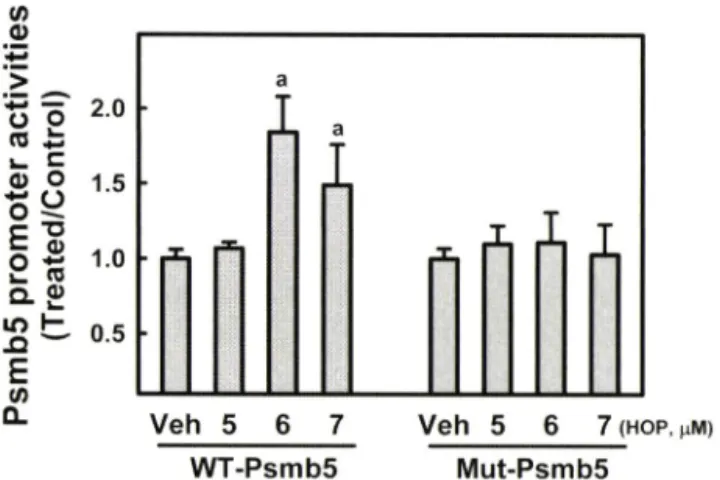
m) Mut-Psmb5Fig. 5 - Activation of the PsmbS promoter by XH through the ARE.
TCMK-1 cells were transfected with luciferase reporter plasmids containing the wild-type (WT) PsmbS promoter or ARE-mutated PsmbS promoter. Then, cells were incubated with Hop
6or Hop? for 24 h and luciferase activity was assessed. Values are mean+SD from 4 samples. 크 , P<0.05 compared with DMSO vehicle group.
러한 총 proteasome 기눙에 대한 효괴는 추후 연구률 통히식 밝 혀겨야 할 것이다.
Hop 회힘물의 proteasom e subunit PsmbS 의 유도발현은 A RE 를 통해 이루어짐
다옴으로는 proteasome의 core catalytic subunit인 Psmb5의 발현증가 현성이 전사과정을 통한 것인지 확인하고 ARE의 기여 도률 확인하기 위하여 마우스의 Psmb5 프로모터를 포함하는 luciferase 리포터 폴라즈머드률 이 용 하 실 험 을 진행하였다. 기 존 연구률 통하늬 마f 스의 Psmb5 프로모터 상에 존재하는 ARE 가 Nr£2에 의한 유도발현을 매개함이 밝혀진 바 있다 [19, 28].
이 리포터 폴라즈미드를 TCMK-1 세포에 도입하고 hop 화합물 에 의한 활성 번화률 관찰한 결과, Hop
6및 Hop7은 프로모터 활성을 각각 1.8 및 1.5배 증가시켰다(Fig. 5). 반면 앞서 ARE 활성화 작용이 없었던 결과와 일관되게 Hop5 화합물의 처치는 PsmbS 프로모터 활성을 증가시키지 못했다. 이러한 프로모터 활 성화 작용이 Nrf2-ARE 경로를 경유하는지 확인하기 위한 방법 으로 ARE룰 point mutation 방법으로 제거한 mutant PsmbS 프 로모터를 이용하식 같은 실험을 진행하였다. 그 결과 ARE가 제 거된 PsmbS 프로모터는 XH 화합물에 대한 반응성을 소실하였 다. 이러한 결과는 Hop 화합물이 Nrf2-ARE 경로를 통하여 proteasome 구성 catalytic subunit Psmb5의 발현을 증가시킬 가 능성을 확인하고 었다.
결 론
비정상적인 단백질의 세포 내 축적과 이로 인한 세포기눙의
저해 및 질환 발생 가눙성이 최근 관심을 끌고 있다. 특히 세포 내 산화적 환경은 단백질 잔기률 산화시키고 3차 구조를 번형시 켜 세포 내의 단백질 응집체률 축적시킨다. 이러한 현상은 산화 적 스트레스 유발 세포사 및 질환 발생의 원인 중 하나로 간주 된다. 그러므로 비정상적인 단백질을 제거하는 기능을 주되게 담 당하는 proteasome계의 유지는 질환발생을 조절을 위해 매우 중 요하다. 본 연구는 외인적으로 투여될 수 있는 proteasome 기눙 의 조절물질돌이 산화적 스트레스성 각종 질환의 발생 또는 악 화틀 막을 수 있을 것을 것이라는 가설 하에 효과적인 proteasome 발현의 증가제를 검색하기 위하여 시도되었다. 특허 기존 연구 결과세서 밝혀진 Nrf2 경로의 활성화제가 proteasome 발현을 증 가시킬 수 있옴에 근거하식 천연물 특히 긍정적인 생리활성이 보 고된 물질 중 하나인 hop 유래 XH 물질들이 proteasome 발현 에 미처는 작용을 살펴보았다. 그 결과 XH 물질둘은 Nrf2 활성 화 작용을 통해 proteasome 구성 단백질 특히 catalytic subunit 인 PsmbS의 발현을 증가시킴을 확인하였다. 이러한 결과는 맥 주에 함유된 hop 유래 물질둘이 proteasome 기능이 저하될 수 있는 다양한 질환 특히 노화, 산화적 스트레스 관련 질환, 퇴행 성 뇌질환 등에서 proteasome 발현을 증가시키고 결과적으로 그 기눙을 유지하도록 하는 긍정적 기능에 대한 가능성을 제시하고 있다.
감 사 의 말 씀
이 논문은 2006년도 정부의 재원으로 학술진흥재단의 지원을 받아 수행된 연구임 (KRF-2006-005-J01102).
참 고 문 헌
1) Itoh, K., Chiba, T, Takahashi, S., Ishii, T, Igarashi, K., Katoh, Y., Oyake, T, Hayashi, N., Satoh, K., Hatayama, I., Yamamoto, M. and Nabeshima, Y. : An Nrf2/small Maf heterodimer mediates the induction of phase II detoxifying enzyme genes through antioxidant response elements. Biochem. Biophys. Res.
Commun. 236, 313 (1997).
2) Kwak, M. K., Wakabayashi, N., Itoh, K., Motohashi, H., Yamamoto, M. and Kensler, T. W : Modulation of gene expression by cancer chemopreventive dithiolethiones through the Keapl-Nrf2 pathway. Identification of novel gene clusters for cell survival. J. Biol Chem. 278, 8135 (2003).
3) Thimmulappa, R. K , Mai, K. H., Srisuma, S., Kensler, T W, Yamamoto, M. and Biswal, S. : Identification of Nrf2-regulated genes induced by the chemopreventive agent sulforaphane by oligonucleotide microarray. Cancer. Res. 62, 5196 (2002).
4) Kensler, T. W, Wakabayashi, N. and Biswal, S. : Cell Survival Responses to Environmental Stresses Via the Keapl-Nrf2- 6
V-
0
5
0
5 0^
1-
-n
었
J이
OLUaJd^CILUMd}
Hop
유래Xanthohumoi
화합물에의한Proteasome
계의유도발현487
ARE Pathway.
Annu. Rev. Pharmacol Toxicol.
47, 89 (2007).5) Kwak, M. K., Wakabayashi, N. and Kensler, T. W. : Chemoprevention through the Keapl-Nrf2 signaling pathway by phase 2 enzyme inducers.
M utat Res.
555, 133 (2004).6) Glickman, M. H. and Ciechanover, A. ; The ubiquitin- proteasome proteolytic pathway: destruction for the sake of construction.
Physiol. Rev.
82, 373 (2002).7) Voges, D., Zwickl, R and Baumeister, W : The 26S proteasome:
a molecular machine designed for controlled proteolysis.
Annu. Rev. Biochem.
6 8, 1015 (1999).8) Shastry; B. S. : Neurodegenerative disorders of protein aggregation.
Neurochem. Int
43, 1 (2003).9) Stefani, M. and Dobson, C. M. : Protein aggregation and aggregate toxicity: new insights into protein folding, misfolding diseases and biological evolution.
J. Mol Med.
27, 27 (2003).10) Halliwell, B. : Hypothesis: proteasomal dysfunction: a primary event in neurogeneration that leads to nitrative and oxidative stress and subsequent cell death. Ann.
N Y Acad. Sci.
962, 182(2002).
11) Hyun, D. H., Lee, M., Halliwell, B. and Jenner, E : Proteasomal inhibition causes the formation of protein aggregates containing a wide range of proteins, including nitrated proteins.
J.
Neurochem.
8 6, 363 (2003).12) Keller, J. N., Dimayuga, E., Chen, Q., Thorpe, J., Gee, J. and Ding, Q. : Autophagy, proteasomes, lipofuscin, and oxidative stress in the aging brain.
Int J. Biochem. Cell Biol
36, 2376 (2004).13) Poppek, D. and Grune, X : Proteasomal defense of oxidative protein modifications.
Antioxid. Redox. Signal.
8, 173 (2006).14) Gerhauser, C. A. A., Heiss, E., Gamal-Eldeen, A., Klimo, K., Knauft, J., Neumann, I., Scherf, H. R., Frank, N., Bartsch, H. and Becker, H. : Cancer chemopreventive activity of Xanthohumoi, a natural product derived from hop.
Mol Cancer.
Ther.
1, 959 (2002).15) Piersen, C . : Phytoestrogens in botanical dietary supplements:
implications for cancer.
Integr. Cancer. Ther.
2, 120 (2003).16) Dietz, BM, K. Y., Liu, G., Eggler, A.
L., Yao,
R, Chadwick, L.R., Pauli, G. E. Farnsworth, N. R., Mesecar, A. D., van Breemen, R. B. and Bolton, J. L. : Xanthohumoi isolated from Humulus lupulus Inhibits menadione-induced DNA damage through induction of quinone reductase.
Chem. Res. Toxicol.
18, 1296 (2005).
17) Lee, Y. R., Li, X., Lee, S. W, Yong, C. S., Hong,