• 검색 결과가 없습니다.

Study of the Optimal Calcination Temperature of an Al/Co/Ni Mixed Metal Oxide as a DeNOx

N/A
N/A
Protected

Academic year: 2021

Share "Study of the Optimal Calcination Temperature of an Al/Co/Ni Mixed Metal Oxide as a DeNOx"

Copied!
7
0
0

로드 중.... (전체 텍스트 보기)

전체 글

(1)

청정환경기술

Study of the Optimal Calcination Temperature of an Al/Co/Ni Mixed Metal Oxide as a DeNO x Catalyst for LNT

Kil Nam Jang

, Kwang Seon Han

, Ji Sook Hong

, Young-Woo You

, Jeong Kwon Suh

, and Taek Sung Hwang

§

*

Sustec Co., LTD

45 Sinilseo-ro, Deadeok-gu, Daejeon 306-230, Korea

Korea Research Institute of Chemical Technology 141 Gajeong-ro, Yuseong-gu, Daejeon 305-600, Korea

§

ChungNam National University

99 Daehak-ro, Yuseong-gu, Daejeon 305-764, Korea

(Received for review July 22, 2015; Revision received September 23, 2015; Accepted September 24, 2015)

요 약

대부분의 LNT 촉매는 낮은 온도 영역에서의 NO

x

산화를 위하여 Pt와 같은 귀금속류를 사용하는 것은 경제적인 부담을 가

지고 있다. 따라서, 본 연구는 이러한 문제를 해결하기 위하여 시도되었다. 즉, Pt, Pd, Rh 등과 같은 귀금속류(platinum group metal, PGM)를 사용하지 않는 LNT (lean NO

x

trap)용 DeNO

x

촉매를 개발하기 위해 시도하였다. 이를 위해서 예비실험을 통 해 Pt등 귀금속류등의 PGM (platinum group metal)을 사용하지 않는 Al/Co/Ni 혼합 금속 산화물을 선정하였다. 궁극적으로

는, 선정된 촉매의 소성온도에 따른 물리화학적 특성 변화가 NO

x

전환율에 미치는 영향을 살펴보고자 하였다. 이들의 물리

화학적인 성질을 평가하기 위해 XRD, EDS, SEM, BET 분석을 실시하였다. 이러한 평가를 실시한 결과, 모든 소성온도에서 혼합금속 산화물은 Co

2

AlO

4

및 NiAl

2

O

4

의 스피넬 구조가 혼재되어 있는 것으로 나타났고, NO

x

기체들의 산화-환원 반응이

이루어지기에는 충분한 기공부피와 기공크기를 갖고 있음을 알 수 있었다. 그러나 NH

3

-TPD 분석 결과에서는 소성온도가

700 ℃ 이하를 유지해야 하는 것으로 판단되었다. 더욱이 ramp test를 통해서는 NO 및 NO

x

전환율을 동시에 만족할 수 있는 시료는 소성온도는 500 ℃에서 처리된 경우임을 알 수 있었다. 이러한 결과 등을 바탕으로, Al/Co/Ni=1.0/2.5/0.3 혼합 금속 산화물의 최적 소성온도는 500 ℃임을 알 수 있었다.

주제어 : DeNO

x

, 촉매, Lean NO

x

trap (LNT), PGM-free, 소성

Abstract : Most of LNT catalysts use noble metals such as Pt for low temperature NO

x

oxidation but there is an economic weakness.

For the purpose of overcoming this, this study is to develop DeNO

x

catalyst for LNT excluding PGM (platinum group metal) such as Pt, Pd, Rh, etc. To do so, Al/Co/Ni catalyst selected as a preliminary test is used to study fundamental property and NO

x

’s conversion according to calcined temperature. Ultimately, that is, Al/Co/Ni mixed metal oxide which does not use PGM is selected and physicochemical characterization is performed by way of XRD, EDS, SEM, BET and ramp test and NO

x

conversion is also analyzed. This study shows that all samples consist of mixed oxides of spinel structure of Co

2

AlO

4

and NiAl

2

O

4

and have enough pore volume and size for redox. But as a result of NH

3

-TPD test, it is desired that calcined temperature needs to be maintained at 700 ℃ or lower. Also only samples which are processed under 500 ℃ satisfied NO and NO

x

conversion simul- taneously through ramp test. Based on this study’s results, optimum calcined temperature for Al/Co/Ni=1.0/2.5/0.3 mixed metal oxide catalyst is 500 ℃.

Keywords : DeNO

x

, Catalyst, Lean NO

x

trap (LNT), PGM-free, Calcination

* To whom correspondence should be addressed.

E-mail: [email protected] http://cleantech.or.kr/ct/

doi: 10.7464/ksct.2015.21.3.184 pISSN 1598-9712 eISSN 2288-0690

This is an Open-Access article distributed under the terms of the Creative Commons Attribution Non-Commercial License (http://creativecommons.org/licences/

by-nc/3.0) which permits unrestricted non-commercial use, distribution, and reproduction in any medium, provided the original work is properly cited.

1. Introduction

Under the environmental standards tightening fuel efficiency regulation following greenhouse gas emissions around the world,

demand for a diesel engine is increasing more and more because it has many advantages such as a power, an economy, and the emission of carbon dioxide into the atmosphere compared with a gasoline engine. But to handle the emissions of particulate matters

184

(2)

and nitrogen oxides, the responsive techniques are necessary to control combustion characteristics of a diesel engine[1].

To decrease nitrogen oxides of exhaust gas from diesel or lean burn gasoline engines, selective catalytic reduction (SCR) [2,3] and a lean NO

x

trap (LNT)[4-6], termed as nitrogen storage reduction (NSR) is recommended.

The SCR method causes a reaction between NO in exhaust gas and ammonia with a metal-substituted zeolite catalyst[7] or the vanadia-tungsta-titania catalyst[8], but the LNT catalyst does not use any reductant species. LNT catalyst systems are use a fuel-lean long cycle with NO

x

gases in the exhaust stored onto the catalyst and a short-cycle fuel-rich area with NO

x

captured by H

2

, CO and hydrocarbons in fuel gas reduced to N

2

alternately [4-6]. A combination of the SCR and the LNT method has been considered as well due to its conversion efficiency[2,9-15], but it is difficult to operate due to the complicated equipment required.

In general, LNT catalyst involve alkali/alkaline earth metals with supporters having a high specific surface area, such as γ -Al

2

O

3,

and a catalyst using CeO

2

with noble metals such as Pt, Rh and Pd[16,17]. General DeNO

x

catalysts use the V

2

O

5

/TiO

2

catalyst, which is active at temperature exceeding 200 ℃ and zeolite-type catalysts but an expensive noble metal, Pt, is ne- cessary for conversion in low temperature region. In order to cope with the regulations on air pollution, improving engine systems and the use of catalysts with noble metals for conversion under low temperature as active species are very important.

However, this requirement is considered to be economically disadvantageous[18]. For this reason, PGM-free metal oxides for oxide diesel gas exhaust excluding the use of platinum group metals (PGM) such as Pt and Pd have been introduced[11-14].

In particular, according to recent research, there is an increasing possibility that perovskite oxide catalysts can replace PGM ca- talysts to remove or decrease NO

x

[19,20].

This study was conducted to develop a DeNO

x

catalyst for LNT without PGMs. For an automotive catalyst, the performance can differ based on the carrier structure, oxide component, manu- facturing method and the method used to contain active species such as noble metals. Therefore, this study analyzes the physico- chemical and NO

x

conversion characteristics according to the calcination temperature of Al/Co/Ni mixed metal oxide selected through a preliminary test[21]. We also provide basic data re- garding the development of catalyst with enhanced performance.

2. Experiment

2.1. Catalyst Preparation

The Al/Co/Ni (henceforth ACN) mixed metal oxide is pro- duced by the following procedure. A mixed solution is produced to dissolve aluminum nitrate nonahydrate at 1 mole and cobalt

(II) nitrate hexahydrate and nickel nitrate hexahydrate, respec- tively at 1.8 mole and 0.2 mole. We slowly added this mixed solution into a buffer solution with NaOH and Na

2

CO

3

at room temperature and identified the creation of the precipitate. At this point, after ascertaining that the mixed solution keeps the pH 11, we obtained a catalyst precursor via a cleansing process until the solution reached a pH of 7 while filtering the precipitate for 16 hours at 65 ℃. After drying and grinding the mixed solution in a dryer at 110 ℃ for more than 12 hours and placing, it into a furnace and increasing the temperature, we produced a mixed metal oxide ACN catalyst with calcination at 500 ℃, 600 ℃, 700 ℃, 800 ℃ and 900 ℃.

2.2. Analysis of the Properties of the Catalyst 2.2.1. X-ray Diffraction Pattern

The X-ray Diffraction Pattern (XRD) to identify the crystal structure was determined at 40 kV and 40 mA using a Rigaku Ultima IV Diffractometer with a Cu tube and Graphite with an attached monochromater. Data reduction was done with the PDXL program.

2.2.2. Analysis of the Components and Morphology In order to analyze the calcined mixed metal oxides, we mea- sured the energy resolution under the following condition : “peak shifts of <127 eV, 5-300 kcps and <5 eV, with a Si drift de- tector (SDD), (Detection : Be (z=4) ~Am (z=95))”-using a Bruker, Quantax 200 energy dispersive X-ray spectrometer. In addition, with a Tescan Mira 3 LMU FEG, scanning electron microscope (SEM), we carried out an analysis of the surface structure and size at an acceleration voltage of 20 kV, with a Quorum Q150TES Coater operated at 10 mA, and 120 s for the Pt coating step.

2.2.3. Pore Characteristics

The pore characteristics and specific surface area of the samples were analyzed by means of the adsorption isotherm of nitrogen gas at the temperature of liquid nitrogen (77 K) using automatic adsorption equipment (Micrometrics, ASAP 2010).

2.2.4. NH

3

-TPD Test

Using an Autochem II2920 TPD (Temperature Programming

Desorption) with an attached thermal conductivity detector, the

ammonia desorption patterns depending on the temperature of the

samples were characterized. After outgassing the calcined samples

up to 800 ℃ at a steady speed of He at 25 mL/min and cooling

70 ℃, the samples were adsorbed with flowing ammonia gas

for 3 hours, followed by purging with He gas until the base line

was stabilized. Ammonia desorption was analyzed with desorbed

gas via TCD by increasing the temperature to 800 ℃ at 5 ℃/min

while injecting He at 25 mL/min.

(3)

Figure 1. Schematic diagram of the ramp test[21].

2.3. Evaluation of the NO

x

conversion

This study, we attempted to forecast the actual performance of the mixed metal oxide catalyst for DeNO

x

. To do this, we determined the NO

x

efficiency while accelerating the catalytic reduction reaction of NO

x

in engine exhaust gas under an excess oxygen condition, using only CO as a reductant in the exhaust gas without the addition of any reductant species. In more detail, in order to ensure similarity of the characteristics of the exhaust gas and to keep the concentration of oxygen at 10% of oxygen, 300 ppm of NO, with 900 ppm of CO and 700 ppm of HC, with the flow of each gas done using a MFC (Mass Flow Controller), we conducted a ramp test while increasing the temperature of the reactor to 470 ℃ at 20 ℃/min. The concentration of the gases coming from the catalytic reactor was assessed using by MK9000 analysis equipment. Figure 1 shows a schematic diagram of ramp test.

3. Results and Discussion

Figure 2 shows the X-ray diffraction patterns of a catalyst sample according to calcination temperature. As shown in Figure 2, the crystallinity increased abruptly when the calcination tem- perature exceeded 800 ℃. In this case, the increase in the tem- perature does not create a new type of crystal as a result of reac- tions such as fusion, when each crystal is increased separately.

Moreover, the crystal structures of the samples calcined from 500 ℃ to 900 ℃ show a mixed oxide of Co

2

AlO

4

and NiAl

2

O

4

, which has a spinal structure. This result differs from those in earlier studies which demonstrated the creation of PGM-free pervoskite oxides as a DeNO

x

catalyst for LNT[19,20]. According to these studies, the perovskite oxide catalyst can be a PGM-free catalyst and can be used to remove or decrease NO

x

. Therefore,

Figure 2. X-ray diffraction patterns of the samples. (a) 500 ℃, (b) 600 ℃, (c) 700 ℃, (d) 800 ℃, (e) 900 ℃.

the spinel structure of Al/Co/Ni mixed oxide as well as perovskite oxide can serve as a PGM-free DeNO

x

catalyst. In order to clarify this, we tested this with another analysis method.

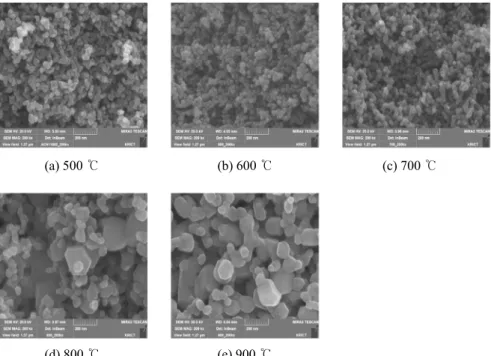
As shown in the scanning microscope images in Figure 3, at calcination temperatures of 500 ℃, 600 ℃ and 700 ℃, the crystal structure remains at tens-of-nanometers in size without a change, but the crystal structures at 200 nm or more start to increase when the calcination temperature exceeds 800 ℃.

However, in Figure 2, instead of a creating new crystal struc- ture with each calcination temperature, it is known that the Co

2

AlO

4

and NiAl

2

O

4

structures are created separately.

Table 1 explains this reason. This table shows the energy dis-

persive x-ray spectrometry results for some locations randomly

selected on each sample, with each structure maintaining a steady

mole fraction of Al/Co/Ni=1/2.5/0.3 at each temperature instead

of showing a different structure.

(4)

(a) 500 ℃ (b) 600 ℃ (c) 700 ℃

(d) 800 ℃ (e) 900 ℃

Figure 3. SEM images of samples according to the calcination temperature.

Table 1. The EDS analysis results of the mixed oxide catalyst samples

Element (molar ratio)

Calcination temperature (℃)

500 600 700 800 900

Al 1.0 1.0 1.0 1.0 1.0

Co 2.5 2.6 2.6 2.6 2.6

Ni 0.3 0.3 0.3 0.3 0.3

O 5.2 6.1 4.9 6.3 5.6

Table 2. The BET properties of the mixed oxide catalyst samples Calcination

temperature (℃)

Surface area (m

2

/g)

Pore volume (cm

3

/g)

Pore size (Å)

500 57 0.303 215

600 59 0.254 172

700 42 0.121 116

800 7 0.008 35

900 7 0.004 21

Table 2 summarizes the pore characteristics of the sample's according to the different calcination temperatures. The pore cha- racteristics were determined with the BET (Brunauer-Emmett- Teller) equation. As shown in Table 2, the more the calcination temperature increases, the more the specific surface area, pore volume, and pore size decrease. Specifically, as identified in the SEM image at the top of Figure 3, this decreased abruptly at 800 ℃ or more due to the increase in the crystal size when the temperature exceeded 800 ℃. However, because the bonding

length between nitrogen atoms and oxygen atoms is 1.188 Å and the bond angle is 126°, even the sample calcined at 900 ℃ with the smallest pore size can have a sufficient pore volume and size to trigger an oxidation-reduction reaction due to the reactive gases in the pores. However, it can be expected that catalyst samples with a greater pore volume and pore size among samples with similar surface areas have an advantage with regard to ca- talysis, needing less time. It is expected that the removal effi- ciency of nitrogen oxide is the most favorable in the samples calcined at 500 ℃.

Figure 4 shows the results of the NH

3

-TPD test conducted to predict the possibility of using the DeNO

x

catalyst for nitrogen oxides. Every five samples showed a trend in which ammonia

Figure 4. NH

3

-TPD profiles of samples according to calcination

temperature.

(5)

(a) 500 ℃ (b) 600 ℃

(c) 700 ℃ (d) 800 ℃

(e) 900 ℃

Figure 5. NO & NO

x

conversions of the mixed oxide catalyst samples.

desorption occurred smoothly at a temperature of 300 ℃ or lower.

This is an encouraging result, considering the LNT condition in which oxidation and reduction occur at the same time in the low-temperature region, as shown by the weak acid point and the strong acid point peaks of approximately 185 ℃ and 290 ℃, respectively. Samples calcined at temperatures of 500 ℃ to 700

℃ are similar in terms of their ammonia desorption amounts, but samples calcined at 800 ℃ to 900 ℃ are substantially lacking in the amount of ammonia desorption. Based on this result, a suitable calcination temperature to use with the DeNO

x

catalyst having a variety of acid sites and a number of ammonia desorption amount is less than 700 ℃.

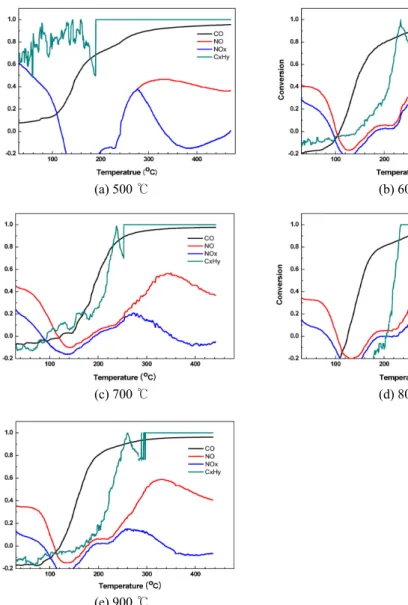
Figure 5 shows the results of the ramp test, which determined the removal or conversion efficiencies of lean gases with excess oxygen to forecast the performance levels of catalytic samples with different calcination temperatures as a DeNO

x

catalyst for LNT. This test was conducted because, among the assessed

characteristics of mixed metal oxide catalysts for DeNO

x

, the NO

x

removal efficiency is a critical factor when using only CO as a reductant without any additional reductant under the condition of an engine exhaust gas operated in an excess oxygen condition.

Therefore, in this case, the ramp test was conducted with gases concentration of oxygen 10%, 300 ppm of NO, 900 ppm of CO, and 700 ppm of HC. This condition is similar to that of an actual engine.

As shown in Figure 5, the more the samples are treated at

a high calcination temperature, the more the NO conversion in-

creases. The reaction for LNT is required simultaneously is that

NO, which exists in exhaust gas, is oxidized to NO

2

and the

newly created NO

2

and NO

2

which originally existed is reduced

to N

2.

That is, the system requires a continuous oxidation-reduction

reaction to progress. However, as shown in Figure 5, samples

which are calcined at a high temperature tend to show a low

conversion of NO

x

. As seen in Figure 4, the catalyst is treated

(6)

up to 800 ℃ did not have a various acid site and a sufficient amount of ammonia adsorption. Lower conversion is considered to be caused from this phenomenon.

As explained earlier, we conclude that the catalyst does not need to be calcined at 800 ℃ or more because it is not suitable for a mixed metal oxide for DeNO

x

if the conversion of NO

x

is not high even when the change rate of NO is high. According to the results of this study, considering the NO and NO

x

rates of change, the calcination temperature that satisfies all of the requirements is 500 ℃. As shown in the SEM images and BET analysis results, considering that samples with the largest specific surface areas, pore volumes and pore sizes are those which were calcined 500 ℃, it can be concluded that these characteristics have an effect on the DeNO

x

reaction.

4. Conclusions

In this study we attempted to develop a DeNO

x

catalyst for LNT without PGMs (platinum group metals) such as Pt in order to overcome this problem. To do this, we reviewed the basic properties and NO

x

conversion of the Al/Co/Ni catalysts according to the calcination temperature. That is, the Al/Co/Ni mixed metal oxides were carried out XRD, EDS, SEM, BET, NH

3

-TPD analyses and a ramp test, and assessed the removal or conversion of NO

x

while also analyzing the physiochemical characteristics.

As a result of these assessment, irrespective of the calcination temperature, all samples show a mixed oxide structure of spinel- type Co

2

AlO

4

and NiAl

2

O

4

with a pore volume and pore size sufficient to trigger an oxidation-reduction reaction. Moreover, it was identified that the mole fraction of Al/Co/Ni is 1.0/2.5/0.3.

However, it was also found that the calcination temperature should remain at 700 ℃ or less because the amount of ammonia desorption is substantially decreased when samples are calcined at temperature of 800 ℃ or more.

This study also found that samples calcined at 700 ℃ or less have weak acid and strong acid characteristics, allowing oxidation and reduction reactions to occur at the same time. As a result of the ramp test, samples calcined at 500 ℃ showed acceptable NO and NO

x

conversion concurrently. According to all of the analyse, it was identified that the optimum calcination temperature of a mixed metal oxide consisting of Al/Co/Ni=1.0/2.5/0/3 as a DeNO

x

catalyst for LNT is 500 ℃.

According to the results of this study, it can be expected that a DeNO

x

catalyst for LNT developed in the future if research concentrates on the conversion change trends based on changes of the components and additions of active species using a catalyst selected based on this study as a basic component.

Acknowledgement

This study was funded by chungcheong institute for regional program evaluation (CIRPE) promotion project of the MOTIE (Ministry of Trade, Industry and Energy) Republic Korea. We appreciated the supported for this study.

References

1. Güthenke, A., Chatterjee, D., Weibel, M., Krutzsch, B., Koc, P., Marek, M., Nova, I., and Tronconi, E., “Current Status of Modeling Lean Exhaust Gas Aftertreatment Catalysts,” Adv.

Chem. Eng., 33, 103-211 (2008).

2. Forzatti, P., “Present Status and Perspectives in de-NO

x

SCR Catalysis,” Appl. Catal. A: Gen., 222, 221 (2001).

3. Epling, W. S., Parks, J. E., Campell, G. C., Yezerets, A., Currier, N. W., Neal, W., and Campbell, L. E., “Further Evidence of Multiple NO

x

Sorption Sites on NO

x

Storage/Reduction Ca- talysts,” Catal. Today, 96(1-2), 21-30 (2004).

4. Matsumoto, S., “Recent Advances in Automobile Exhaust Catalysts,” Catal. Today, 90, 183-190 (2004).

5. Roy, S., and Baiker, A., “NO

x

Storage-Reduction Catalysis:

From Mechanism and Materials Properties to Storage-Reduction Performance,” Chem. Rev., 109, 4054-4091 (2009).

6. Johnson, T., “Diesel Engine Emissions and their Control: an Overview, Platinum Metals Rev., 52(1), 23-37 (2008).

7. Lietti, L., Ramis, G., Berti, F., Toledo, G., Robba, R., Busca, G., and Forzatti, P., “Chemical, Structural and Mechanistic Aspects on NO

x

SCR over Commercial and Model Oxide Ca- talysts,” Catal. Today, 42, 101-116 (1998).

8. Xu, L., McCabe, R., Ruona, W., and Gavataio, G., “Impact of a Cu-zeolite SCR Catalyst on the Performance of a Diesel LNT+SCR System,” SAE International, [special Publication], SP-2254 (Diesel Exhaust Emission Control), pp. 121-132 (2009).

9. Lindholm, A., Sjövall, H., and Olsson, L., “Reduction of NO

x

over a Combined NSR and SCR System,” Appl. Catal. B:

Environ., 98, 112-121 (2010).

10. Forzatti, P., and Lietti, L., “The Reduction of NO

x

Stored on LNT and Combined LNT-SCR Systems,” Catal. Today, 155, 131-139 (2010).

11. Weibel, M., Waldbüber, N., Wunsch, R., Chatterjee, D., Bandl-Konrad, B., and Krutzsch, B., “A NOvel Approach to Catalysis for NO

x

Reduction in Diesel Exhaust Gas,” Topics in Catal., 52(13-20), 1702-1708 (2009).

12. Corbos, E. C., Haneda, M., Courtois, X., Marecot, P., Duprez, D., and Hamada, H., “Cooperative Effect of Pt-Rh/Ba/Al and CuZSM-5 Catalysts for NO

x

Reduction during Periodic Lean- rich Atmosphere, Catal. Commun., 10(2), 137-141 (2008).

13. Corbos, E. C., Haneda, M., Courtois, X., Marecot, P., Duprez, D., and Hamada, H., “NO

x

Abatement for Lean-burn Engines under Lean-rich Atmosphere over Mixed NSR-SCR Catalysts:

Influences of the Addition of a SCR Catalyst and of the Ope-

(7)

rational Conditions,” Appl. Catal. A: Gen., 365, 187-193 (2009).

14. Han, A-R., Hwang, Y.-A., and Chang, K. S., “Adsorption- Desorption Characteristics of N

2

O and O

2

over Mixed Oxide Catalysts of AlCoPd (1/1/0.05) and AlCoFe (1/1/2), Clean Technol., 17(2), 142-149 (2011).

15. Seo, C. K., Kim, H., Choi, B., and Lim, M. T., “The Optimal Volume of a Combined System of LNT and SCR Catalysts,”

J. Ind. Eng. Chem., 17(3), 382-385 (2011).

16. Park, S., Kim, H., and Choi, B., “Effective Parameters for DME Steam Reforming Catalysts for the Formation of H

2

and CO,” J. Ind. Eng. Chem., 16(5), 734-740 (2010).

17. James, E., and Parks, II., “Less Costly Catalysts for Controlling

Engine Emissions,” Science, 327, 1584-1585 (2010).

18. Kim, C. H., Qi, G., Dahlberg, K., and Li, W., “Strontium- Doped Perovskites Rival Platinum Catalysts for Treating NO

x

in Simulated Diesel Exhaust,” Science, 327, 1624-1627 (2010).

19. Matarrese, R., Artioli, N., Castoldi, L., Lietti, L., and Forzatti, P.,

“Interaction between Soot and Stored NO

x

during Operation of LNT Pt-Ba/Al

2

O

3

Catalysts,” Catal. Today, 184, 271-278 (2012).

20. http://www.reseat.re.kr, ReSEAT Analysis Report, Automobile Catalyst(2013).

21. Jang, K. N., Han, K. S., Hong, J. S., You, Y.-W., and Hwang,

T., S., “Basic Research to Develop PGM-free DeNO

x

Catalyst

for LNT,” Clean Technol., 21(2), 117-123 (2015).

수치

Figure 1. Schematic diagram of the ramp test[21].
Figure 3. SEM images of samples according to the calcination temperature.
Figure 5 shows the results of the ramp test, which determined  the removal or conversion efficiencies of lean gases with excess  oxygen to forecast the performance levels of catalytic samples  with different calcination temperatures as a DeNO x  catalyst f

참조

관련 문서

MP Yousef Al-Fadalah, Supervisor of Parliament Business Environment Committee declared that the Public Institution for Housing Care intends to dedicate nearly 150

Kuwait Direct Investment Promotion Authority (KDIPA) said the 2019 Doing Business Report of the World Bank Group, came in recognition of the reforms made between June 2, 2017, and

The main objective of the Bi Regional Center for SMES Development is oriented towards generating the conditions of cooperation among the countries which

Current Tokyo is rich in green compared to other metro cities. In some parts, the greenery has been contributed by the many inherited gardens from the Edo era to today which

In a statement to Kuwait News Agency (KUNA) on the sidelines of a meeting of the Arab Parliament's Foreign Affairs Political and National Security

The meeting was attended by Assistant Foreign Minister for GCC Affairs, Ambassador, Nasser Al-Muzayyen, and Deputy Assistant Foreign Minister for the Office of the

“ Sheikh Nasser has a written message from HH the Amir, Sheikh Sabah Al-Ahmad Al-Jaber Al-Sabah to the Chinese President, Chi Gen Beng related to enhancing mutual

On his part, CEO of Express Roads Authority, Saud Al-Naqqi said that the heavy rains of the previous day led to clogging parts of the express