• 검색 결과가 없습니다.

Development of Measurement Tools for Success and Failure Factors of Education and Training of Korean Bodyguard

N/A
N/A
Protected

Academic year: 2021

Share "Development of Measurement Tools for Success and Failure Factors of Education and Training of Korean Bodyguard"

Copied!
8
0
0

로드 중.... (전체 텍스트 보기)

전체 글

(1)

JKSCI

Development of Measurement Tools for Success and Failure Factors of Education and Training of Korean Bodyguard

1)

Sang-Jin Kim*

*Professor, Dept. of Security Service, Yongin University, Yongin, Korea

[Abstract]

This study was conducted for the purpose of developing a measurement tool for success and failure factors of education and training of Korean bodyguards. conducted a meeting from the fully open questionnaire at first, and then formed the semi-structured questionnaire, finally carried out the survey from the closed questionnaire and analyzed data from SPSS 21.0, AMOS 21.0 and developed the measurements.

It was conducted from May, 2019 to December, 2019. This survey was conducted of 150 security guards after the verification of the content validity though the pilot survey and presented the success attribution factors and standards on the basis of the result form this survey. As a result, the success factors of the training of the bodyguards were accidental education (5 item), vocational mental education (2 item), vocational mental education (2 item), work ability enhancement education (2 item), realistic practical education (2 item) ), Including 4 items, 11 items, The failure factors consisted of 12 item of three factors:

formal education and training (5 item), lack of leadership qualities (4 item), and lack of education (3 item).

▸Key words: Body guard, Success factor, Failure factor, Measuring tools, Education and training, Protection, Private Security

[요 약]

이 연구는 한국 경호원의 교육훈련 성패요인에 대한 측정도구를 개발하기 위한 목적으로 수행 되었다 . 이를 위하여 1차 조사에서는 완전 개방형 질문지를 통하여 면담을 실시하였으며, 2차 조 사에서는 반구조화 질문지를 구성하여 면담을 실시하였다 . 3차 조사에서는 폐쇄형 설문지를 제작 한 후 설문조사를 실시하였다. 데이터는 SPSS 21.0, AMOS 21.O 통계패키지를 통하여 데이터를 처리하는 과정을 거쳤다 . 조사기간은 최초 질문지를 배포한 2019년 5월부터 동년 12월까지 약 7 개월간에 걸쳐 실시하였으며 , 예비조사를 통하여 문항의 구성타당도를 검증한 후 3년 이상 경력 이 있는 150명의 경호원을 대상으로 본 조사를 실시하였다. 조사 결과, 한국 경호원의 교육훈련에 대한 성공요인은 우발상황대처교육 (5문항), 직업정신교육(2문항), 직업정신교육(2문항), 업무능력강 화교육 (2문항), 현실적인실무교육(2문항) 등 4개요인 11개 문항으로 구성되었다. 실패요인은 형식 적인교육훈련(5문항), 지도자자질부족(4문항), 교육 부족(3문항) 등 3개요인 12문항으로 구성되었다.

▸주제어: 경호원, 성공요인, 실패요인, 측정도구, 교육훈련, 신변보호, 민간경비

∙First Author: Sang-Jin Kim, Corresponding Author: Sang-Jin Kim

*Sang-Jin Kim ([email protected]), Dept. of Security Service, Yongin University

∙Received: 2020. 05. 04, Revised: 2020. 06. 02, Accepted: 2020. 06. 02.

Copyright ⓒ 2020 The Korea Society of Computer and Information http://www.ksci.re.kr pISSN:1598-849X | eISSN:2383-9945
(2)

I. Introduction

경호란, 경호대상자의 신변에 직·간접적으로 가해질 수 있는 여러 가지 위해요소로부터 안전을 확보하기 위한 조 직단위의 호위(護衛) 활동이다. 성공적인 경호활동은 경호 를 구성하는 경호원의 자질로부터 기인하게 되는데 이는 조직 역량을 강화하고 임무수행의 성·패를 좌우하는 중요 한 자본이라 할 수 있다[1].

경호원의 역량은 다년간의 실무경험에서 비롯된 교육훈련 에 관한 노하우(knowhow)에서 비롯된다. 그러므로 경호원 의 교육훈련 노하우에 관한 공통분모를 추적하는 것은 경호 원의 역량을 개선하는데 있어서 중요한 작업이라 할 수 있다.

그럼에도 불구하고, 국내 경호원의 교육훈련과 관련된 선행연구를 살펴보면, 박사학위 논문 3편[2, 3, 4], 학술지 에 개제된 논문 6편[5, 6, 7, 8, 9, 10]등 총 9편에 불과한 실정이며, 대부분 무도와 관련된 연구이기 때문에 경호원 에게 요구되는 실무적 환경을 고려하지 못한 채 연구가 진 행되었다는 점을 지적하지 않을 수 없다. 또한 교육훈련 정도를 분석할 수 있는 정량적인 도구도 없는 실정이므로 교육훈련에 대한 숙달정도를 가늠하기도 어려운 실정이다.

일반적으로 교육훈련의 목표는 구성원으로 하여금 잠재 적인 능력을 촉진하고 직무환경에 필요한 기술과 지식을 습득하게 하여 재능을 보강하는데 있다[2]. 그러한 측면에 서 경호원의 교육훈련은 실무적 환경을 고려하여 실질적 으로 경호원에게 요구되는 조건과 역량을 강화하는데 목 표를 두고 개발되어야 한다. 이를 위해서는 신체활동뿐만 아니라, 업무와 관련된 측면에서의 교육훈련의 성패 요인 을 분석하는 것이 필요하다.

그러므로 본 연구는 다양한 경험과 경력을 소유한 현직 경호원들을 중심으로 경호원에게 필요한 교육훈련에 관한 성·패 요인이 무엇인지를 추적하고 규명하도록 하였다. 이 는 경호학에 있어서 좀 더 실제적인 이론교리를 개발하는 데 중요한 자료가 되어 줄뿐만 아니라, 유관변수들 간의 인과관계를 실증적으로 검증하는 데 나름의 역할을 할 수 있을 것이라 판단된다.

따라서 본 연구는 국내에서 경호원으로 근무한 경험이 있거나 또는 현업에 종사하고 있는 경호원을 대상으로 교 육훈련에 대한 성공 및 실패요인을 실증적으로 규명함으 로써, 한국 경호원의 교육훈련 성·패 요인을 측정할 수 있 는 척도를 개발하는데 목적을 두었다.

II. Research procedure and method

2.1 Research procedure and data analysis 본 연구는 측정도구의 신뢰도 및 타당도의 중요성을 강조 하는 선행 연구들[11, 12, 13, 14]과 같이, 통합적 타당도 절차를 정의한 후 경호원의 교육훈련 성패요인에 대한 측정 도구를 개발하였다. 통합적 타당도 프로그램은 개념검토, 내 적구조검토, 외적관계검토 단계로 구성하였다. 그리고 자료 처리는 크게 질적 자료 분석과 양적자료 분석을 실시하였다.

2.1.1 Qualitative data analysis

질적 자료에 대한 분석은 연구자의 주간개입을 최소화 하고자 삼각검증법(investigator triangulation)을 활용하 였으며, 이를 위하여 경호학 박사학위 소지자 3명으로 구 성된 전문가회의를 실시하였다. 질적 자료는 1차 완전개방 형, 2차 반구조화 질문지로 구성되었다. 그리고 2차 자료 분석을 토대로 3차 폐쇄형 설문지를 구성하였다.

2.1.2 Quantitative data analysis

3차 폐쇄형 설문지는 SPSS 21.0 for Windows와 AMOS 21.0을 활용하여 데이터를 처리하였다. 구체적인 분석방법으로는 빈도분석, 기술통계, 탐색적 요인분석 (EFA), 확인적 요인분석(CFA), 신뢰도 분석, 수렴 및 판별 타당도 검증을 실시하였다. 항목에 대한 최종적인 검증을 위한 연구모형에 대한 적합도 지수는 χ 2 , df, GFI, CFI, RMSEA, RMS 등을 통하여 검증하였고, 공분산행렬을 근 거로 할 때 흔히 사용되는 NFI, TLI 등을 추가로 사용하였 다[15, 16]. 설문지는 Likert 5점 척도로 구성하였다.

2.2 Research method

본 연구의 대상 및 조사기간으로는, 수도권에 소재하고

있는 대통령경호처 및 사설경호업체에서 5년-10년 이상

재직 중이거나, 재직했던 경험이 있는 경호원을 모집단으

로 선정하였다. 조사기간은 2019년 5월부터 2019년 12월

까지 약 7개월간에 걸쳐서 실시하였다. 1차 조사는 8명을

대상으로 2019년 5월 10일부터 5월 25일까지 완전 개방

형 질문을 통하여 기초조사를 하였으며, 2차 조사는 1차

조사에서 응답된 내용을 기반으로 반구조화 질문지를 구

성하여 2019년 6월 10일부터 6월 28일까지 20명을 대상

으로 실사하였다. 3차 조사는 집락무선표집법을 통하여,

2019년 10월부터 12월까지 200명을 대상으로 설문조사를

실시하였다. 그중에서 극단치 50부를 제외하고 본 연구에

서는 최종적으로 150부를 확보하여 결과를 도출하였다.

(3)

III. Result

3.1 1st Analysis: Content analysis on open questionnaire

본 연구를 진행하기 위해서 10년 이상 근무한 경험이 있는 경호공무원(대통령경호실) 3명과 사경호 업체에서 10 년 이상 근무경험이 있는 경호원 5명을 대상으로, “경호원 의 교육훈련 성공요인과 실패요인은 무엇이라고 생각하십 니까?”라는 기초 질문으로 인터뷰를 실시하였다. 그에 따 른 1차 개방형 질문지의 응답내용은 Table 1.과 같다.

Bodyguard's Factors in Education Success

R/% Response contents : n (n:33)

1 21.3 Physical fitness and martial arts

education(10) 10

2 19.1 Mental education(9) 9

3 14.9 Situation training(7) 7

4

8.5 Improving physical ability4)

4 8.5 training(4)

8.5 Education posture(4)

5

6.4 Repetitive learning(3)

3 6.4 Sacrifice and consideration(3)

6.4 Practical skills(3)

Causes of Security Service Education Failure

R/% Response contents : n (n:30)

1 29.2 Formal education and training(14) 14 2 14.6 Insufficient bodyguard knowledge

of education and training leaders(7) 7 3 8.3 8.3 Incorrect behavior and posture (4) Insufficient Education (4) 4

4

6.3 Inadequate educational content (3) 3 6.3 Negative mindset (3)

6.3 Practical and Other Education (3)

5

4.2 Poor educational facilities (2)

2 4.2 Injury during training (2)

4.2 Indolence (2) 4.2 Lack of patience (2)

4.2 Lack of instructor responsibility (2)

Table 1. 1st content analysis of educational success factors of Korean bodyguards

Table 1.과 같이, 8명을 대상으로 1차 인터뷰를 실시한 결과, 교육훈련에 대한 성패요인에 관한 응답은 총 63건이 었다. 그중에서 성공요인으로는 체력 및 무도교육(10), 정 신교육(9), 상황대처훈련(7), 신체능력향상(4), 훈련(4), 교 육에 임하는 자세(4), 반복학습(3), 희생과 배려(3), 실무능 력(3) 순으로 총 9개요인 33문항으로 조사되었다. 반면, 실패요인으로는 형식적인 교육훈련(14), 바르지 못한 행동 및 자세(4), 미흡한 교육(4), 부적절한 교육내용(3), 부정적 마음가짐(3), 실전과 다른 교육(3), 열악한 교육시설(2), 훈 련 중 부상(2), 나태함(2), 인내심 결여(2), 교관의 책임감 결여(2)순으로 총 11개요인 총 30문항으로 조사되었다.

3.2 1st Analysis: Concept and content analysis of semi-structured questionnaire

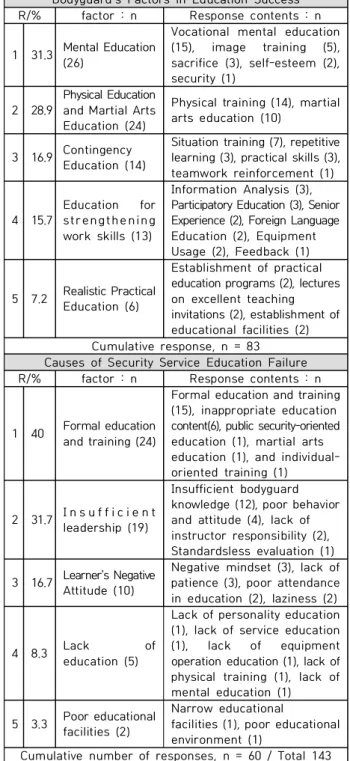
2차 분석은 1차 분석의 내용을 토대로, 요인별로 구분한 뒤 반구조화 질문지로 제작되었다. 연구대상은 경호업무에 종사한지 5년 이상 경력이 있는 경호원 20명을 대상으로 실시 하였으며, 이메일 또는 직접 면담을 통하여 질문지에 직접 작성하도록 하였다. 2차 분석에 대한 결과는 Table 2.와 같다.

Bodyguard's Factors in Education Success R/% factor : n Response contents : n

1 31.3 Mental Education (26)

Vocational mental education (15), image training (5), sacrifice (3), self-esteem (2), security (1)

2 28.9 Physical Education and Martial Arts Education (24)

Physical training (14), martial arts education (10)

3 16.9 Contingency Education (14)

Situation training (7), repetitive learning (3), practical skills (3), teamwork reinforcement (1)

4 15.7

Education for strengthe ning work skills (13)

Information Analysis (3), Participatory Education (3), Senior Experience (2), Foreign Language Education (2), Equipment Usage (2), Feedback (1)

5 7.2 Realistic Practical Education (6)

Establishment of practical education programs (2), lectures on excellent teaching invitations (2), establishment of educational facilities (2) Cumulative response, n = 83 Causes of Security Service Education Failure R/% factor : n Response contents : n

1 40 Formal education and training (24)

Formal education and training (15), inappropriate education content(6), public security-oriented education (1), martial arts education (1), and individual- oriented training (1)

2 31.7 I n s u f f i c i e n t leadership (19)

Insufficient bodyguard knowledge (12), poor behavior and attitude (4), lack of instructor responsibility (2), Standardsless evaluation (1)

3 16.7 Learner's Negative Attitude (10)

Negative mindset (3), lack of patience (3), poor attendance in education (2), laziness (2)

4 8.3 Lack of

education (5)

Lack of personality education (1), lack of service education (1), lack of equipment operation education (1), lack of physical training (1), lack of mental education (1)

5 3.3 Poor educational facilities (2)

Narrow educational

facilities (1), poor educational environment (1)

Cumulative number of responses, n = 60 / Total 143 cases (factors of success or failure)

Table 2. 1st content analysis of educational success

factors of Korean bodyguards

(4)

Table 2.와 같이, 30명을 대상으로 2차 인터뷰를 실시 하였다. 조사결과, 교육훈련에 대한 성공요인은 총 5개요 인, 83건의 응답, 19개의 내용으로 조사되었다. ‘정신교 육’(26)에 관한 내용으로는 ‘직업정신교육’(15), ‘심상훈 련’(5), ‘희생’(3), ‘자부심고취’(2), ‘보안유지’(1) 등의 순으 로 응답되었다. ‘체력 및 무도교육’(24)에 관한 내용으로는

‘체력훈련’(14), ‘무도교육’(10) 순으로 응답되었다. ‘우발 상황대처교육’(14)에 관한 내용으로는 ‘상황대처훈련’(7),

‘반복학습’(3), ‘실무능력’(3), ‘팀웍 강화’(1) 순으로 응답되 었다. ‘업무능력강화교육’(13)에 관한 내용으로는 ‘정보 분 석’(3), ‘계획수립 참여교육’(3), ‘외국어 교육’(2), ‘장비사 용법’(2), ‘선배의 경험’(2), ‘피드백’(1) 등의 순으로 응답 되었다. ‘현실적인 실무교육’(6) 에 관한 내용으로는 ‘질적 교육 프로그램 구축’(2), ‘우수한 교수초빙 강의’(2), ‘교육 시설 구축’(2) 등으로 응답되었다.

교육훈련실패요인에 대한 응답으로는 총 5개요인, 60건 의 응답, 20개의 내용으로 조사되었다. ‘형식적인 교육훈 련’(24)에 관한 내용으로는 ‘형식적 교육훈련’(15), ‘부적절 한 교육내용’(6), ‘공경호 위주의 교육’(1), ‘상황에 맞지 않 는 무도교육’(1), ‘개인위주 훈련’(1) 등의 순으로 응답되었 다. ‘지도자의 자질부족’(19)에 관한 내용으로는 ‘교육훈련 리더의 미흡한 경호지식’(12), ‘바르지 못한 행동 및 자 세’(4), ‘교관의 책임감 결여’(2), ‘기준 없는 평가’(1) 등의 순으로 응답되었다. ‘학습자의 부정적 태도’(10)에 관한 내 용으로는 ‘부정적 마음가짐’(3), ‘인내심 결여’(3), ‘저조한 교육 참석률’(2), ‘나태함’(2) 등의 순으로 응답되었다. ‘교 육부족’(5)에 관한 내용으로는 ‘인성교육 부족’(1), ‘서비스 교육 부족’(1), ‘장비운용교육 부족’(1), ‘체력훈련 부족’(1),

‘정신교육 부족(’1) 등으로 응답되었다. ‘열악한 교육시 설’(2)에 관한 내용으로는 ‘협소한 교육시설’(1), ‘열악한 교육환경’(1) 등으로 응답되었다.

3.3.1 Exploratory factor analysis and reliability analysis

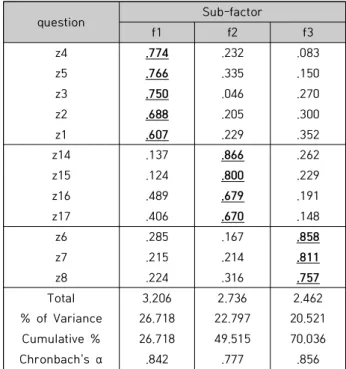
Table. 3, Table. 4와 같이 탐색적 요인분석 (Exploratory Factor Analysis)을 실시한 결과, 교육훈련 성공요인은 f1: 우발상황대처교육 5문항(g8, g14, g9, g10, g12), f2: 정신교육 3문항(g3, g2, g1), f3: 업무능력 강화 3문항(g19, g16, g15), f4: 현실적인실무교육 3문항 (g16, g20, g18) 등으로 구성되어졌다. 교육훈련성공요인 에 대한 전체 설명량은 66.267로 조사되었으며, 신뢰도는 f1 : 우발상황대처교육은 α=.840, f2: 정신교육은 α=.799, f3: 업무능력강화는 α=.715, f4: 현실적인 교육환경은 α

=.665로 비교적 높은 신뢰도가 확보된 것으로 조사되었다.

탐색 적 요인분석 과정에서 g4, g5, g7, g11, g13 등 5개 문항과 체력 및 무도교육 요인은 이 연구에서 제거되었다.

그리고 g14, g12, g17문항은 우발상황대처교육 요인으로, g19는 업무능력강화교육으로, g6은 현실적인실무교육으로 조정되었다. 따라서 교육훈련성공요인은 총 15개 문항, 4 개의 하위요인으로 구성되어졌다.

question Sub-factor

f1 f2 f3 f4

g8. .814 .092 .042 .283

g9. .720 .087 .135 .378

g14. .709 .016 .090 .077

g10. .681 .221 .205 .004

g12. .659 .451 .222 -.107

g17. .475 .129 .383 .415

g2. -.051 .850 .234 .143

g1. .326 .738 .089 .135

g3. .246 .730 -.030 .425

g19. .106 -.065 .816 .257

g16. .187 .223 .779 .133

g15. .363 .340 .570 -.100

g6. .127 .235 .121 .750

g20. .045 .114 .574 .593

g18. .437 .185 .217 .513

Total 3.365 2.355 2.317 1.903

% of Variance 22.436 15.701 15.445 12.685 Cumulative % 22.436 38.137 53.582 66.267

Chronbach's α .840 .799 .715 .665

Table 3. Exploratory Factor Analysis of Success Factors in Education and Training

question Sub-factor

f1 f2 f3

z4 .774 .232 .083

z5 .766 .335 .150

z3 .750 .046 .270

z2 .688 .205 .300

z1 .607 .229 .352

z14 .137 .866 .262

z15 .124 .800 .229

z16 .489 .679 .191

z17 .406 .670 .148

z6 .285 .167 .858

z7 .215 .214 .811

z8 .224 .316 .757

Total 3.206 2.736 2.462

% of Variance 26.718 22.797 20.521

Cumulative % 26.718 49.515 70.036

Chronbach's α .842 .777 .856

Table 4. Exploratory factor analysis of training

failure factors

(5)

factor Success factors for education and training SRW SE CR AVE

f1.

g9. We are conducting repetitive education and training in preparation

for contingencies. .700 .221

.897 .638 g14. We reinforce feedback through successful experiences and examples. .542 .306

g10. Practical training suitable for work performance is being provided. .643 .258 g12. Motivation training is provided to actively perform self-service. .716 .218 g17. We are providing equipment utilization training necessary for

business performance. .687 .236

f2.

g1. Mental education (vocational ethics, morality, responsibility, loyalty,

and dignity) required by the guard is regularly provided. .758 .254 .747 .688 g3. It emphasizes the spirit of sacrifice in education. .728 .248

f3. g16. Foreign language education is provided to fulfill missions. g15. Participation training (planning) for security planning is being conducted. .689 .657 .383 .312 .722 .565

f4. g20. Education environment for theoretical and practical education is provided. g18. Practical training suitable for reality is provided. .555 .865 .374 .129 .738 .677 χ 2 =155.121, χ 2 /df(149)=1.451, ρ=.032, GFI=.903, NFI=.842, TLI=.915, CFI=.942, RMSEA=.072, RMR=.032

f1:우발상황대처교육, f2:직업정신교육, f3:업무능력강화교육, f4:현실적인실무교육

Table 5. Analysis of confirmatory factors for the overall concept of the success or failure of education and training by Korean bodyguards

factor Education and training failure factors SRW SE CR AVE

f1.

z1. The quality of educational programs is low. .704 .371

.884 .604 z2. Education is being conducted with content that does not fit the subject. .742 .342

z3. The educational content of public security is applied to private

(private) security (unreality). .681 .525

z4. There is insufficient education and training to respond to

contingencies. .697 .290

z5. There is a lack of training at the team level(which enhances

collaboration). .804 .203

f2.

z15. Insufficient service education required for security. .712 .376

.901 .697

z16. Lack of physical strength training. .830 .183

z17. Insufficient equipment operation training and education necessary

for work performance. .747 .246

z14. Personality education is insufficient. .809 .243

f3.

z6. The education manager's expertise is insufficient. .876 .151

.902 .755

z7. Education officers lack responsibility. .796 .262

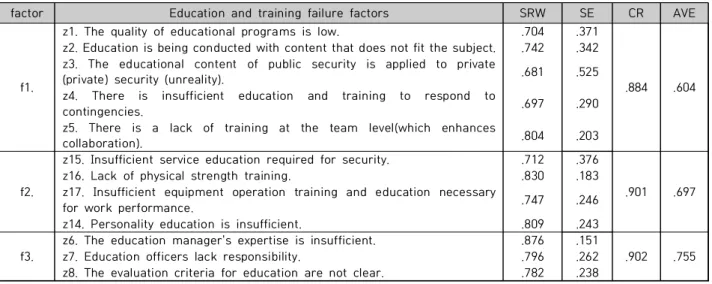
z8. The evaluation criteria for education are not clear. .782 .238 x 2 =76.044, χ 2 /df(51)=1.491, ρ=.031, GFI=.875, NFI=.872, TLI=.939, CFI=.953, RMSEA=.076, RMR=.038 f1:형식적인교육훈련, f2:지도자자질부족, f3:교육인식부족

Table 6. Analysis of confirmatory factors for the overall concept of the success or failure of education and training by Korean bodyguards

교육훈련 실패요인은 f1: 형식적인교육훈련 5문항(z1, z2, z3, z4, z5), 지도자의자질부족 3문항(z15, z16, z18), 교육부족 3문항(z6, z7, z8) 등으로 구성되어졌다. 교육훈 련실패요인에 대한 전체 설명량은 70.036으로 조사 되었 다. 신뢰도는 f1 : 형식적인교육훈련은 α=.842, f2: 지도자 의자질부족은 α=.777, f3: 교육인식부족은 α=.856으로 비 교적 높은 신뢰도가 확보된 것으로 조사되었다. 탐색적 요 인분석 과정에서 z9, z10, z11, z12, z13, z18 등 6개 문 항과 ‘학습자의 부정적 태도’, ‘열악한 교육시설’ 등 2개 요인은 이 연구에서 제거되었다. 따라서 교육훈련 실패요 인은 총 12개 문항, 3개의 하위요인으로 구성되었다.

3.3.2 Confirmative factor analysis

탐색적 요인분석을 토대로 변수간의 관계 및 내재된 요

인 및 차원을 확인하고자 확인적 요인분석(Confirmatory

Factor Analysis)을 실시하였다. 확인적 요인분석을 실시

한 결과, 경호원의 교육훈련 성공요인에 대한 구조모형은

χ 2 =155.121, χ 2 /df(149)=1.451, ρ=.032, GFI=.903,

NFI=.842, TLI=.915, CFI=.942로 나타났다. NFI는 최적

지수인 .90에는 미치지 못하였으나 양호한 것으로 나타났

으며, GFI, TLI, CFI는 .90이상으로 최적모델에 부합한 것

으로 조사되었다. 그리고 RMSEA=.072, RMR=.032로 나

타나 최적모델에 부합한 것으로 조사되었다.

(6)

따라서 교육훈련 성공요인은 최종적으로 총 4개요인 11 개 문항으로 구성되었다.

그리고 경호원의 교육훈련 실패요인에 대한 구조모형은 x 2 =76.044, χ 2 /df(51)=1.491, ρ=.031, GFI=.875, NFI=.872, TLI=.939, CFI=.953으로 나타났다. GFI는 최적지수인 .90에 는 미치지 못하였으나 양호한 것으로 나타났으며, NFI, TLI, CFI는 .90이상으로 최적모델에 부합한 것으로 조사되었다.

그리고 RMSEA=.076, RMR=.038로 나타나 최적모델에 부합 한 것으로 조사되었다. 따라서 교육훈련 실패요인은 최종적 으로 총 3개요인 12개 문항으로 구성되어졌다.

한국 경호원의 교육훈련 성공 및 실패요인을 구성하는 확 인적 요인분석에 대한 전체 모형도는 Fig. 1, Fig. 2.와 같다.

x 2 =55.121(ρ=.032), df=38, x 2 /df=1.451 A: Contingency Education, B :Vocational Mental Education, C: Education for strengthening work ability,

D: Realistic practical education

Fig. 1. Analysis of confirmatory factors for success of education and training of the Korean bodyguard

x2=76.044(ρ=.031), df=51, x2/df=1.491 A: Formal education, B: Lack of leadership qualities,

C: Lack of education

Fig. 2. Analysis of confirmatory factors for failure of education and training of Korean bodyguards

또한, Table. 3과 Table. 4에서 보는 바와 같이, 각 요 인에 대한 표준적재치가 .50이상이기 때문에 개념타당성 은 확보되었다고 할 수 있다. 그리고 각 요인에 대한 분산 추출지수가 .50이상이고, 개념 신뢰도는 .70이상이기 때문 에 수렴타당성은 확보되었다고 할 수 있다[17]. 따라서 한 국 경호원 교육훈련 성패요인에 대한 연구모형은 전체적 으로 수용이 가능하다.

3.3.3 Discriminant validity analysis

판별타당성의 기준은 분산추출지수가 각 요인의 상관계 수의 결정계수(r 2 )보다 크면 요인사이의 판별타당성이 확 보된 것으로 판단한다. 구성개념에 대한 판별타당도는 Table. 7와 Table. 8과 같다.

factor f1 f2 f3 f4

f1. 638*

f2. .740 .688

f3. .827 .577 .565

f4. .703 .690 .513 .677

* = Average Variance Extracted

Table 7. Correlation matrix and Average Variance Extracted for concept of success factors in education and training

factor f1 f2 f3

f1. .604*

f2. .742 .697*

f3. .667 .635 .755*

* = Average Variance Extracted

Table 8. Correlation matrix and variance extraction index for concept of failure factors in education and training

Table. 7과 Table. 8에서 본 바와 같이 모든 요인의 분 산추출지수(대각선 행렬의 수치)가 각 요인의 상관계수의 제곱, 즉 결정계수(r 2 )보다 크기 때문에 요인사이에는 판별 타당성이 확보되었다고 할 수 있다. 즉, 구성 개념간의 관 계를 보여주는 상관계수의 신뢰구간에 1이 포함되지 않아 수렴타당성과 판별타당성이 검증되었다[11].

3.3.4 Descriptive statistics

이 연구에서는 최대우도 추정법(maximum likelihood

estimation: MLE)을 사용하여 측정도구를 최종적으로 분

석하였으므로, 측정된 데이터가 정규성의 특정을 가지는지

평가하도록 하였다[18]. 이를 위하여 기술통계분석을 통하

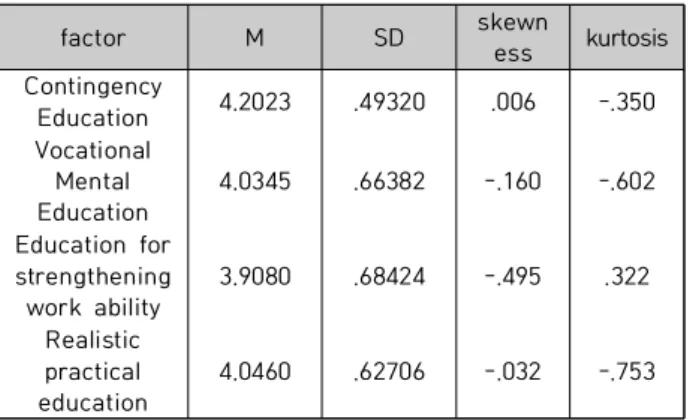
여 검증하였다. Table. 9.와 Table 10에서 보는 바와 같

(7)

이, 한국 경호원의 교육훈련 성패요인에 관한 기술통계 검 증 결과, 첨도와 왜도의 수치가 모두 정규분포를 기준으로 +2.3 이상이거나 한 척도에 50% 이상의 반응비율이 집약 된 요인은 존재하지 않는 것으로 보아, 데이터의 정규성은 모두 적합한 것으로 볼 수 있다[19].

factor M SD skewn

ess kurtosis Contingency

Education 4.2023 .49320 .006 -.350

Vocational Mental

Education 4.0345 .66382 -.160 -.602

Education for strengthening

work ability

3.9080 .68424 -.495 .322

Realistic practical

education 4.0460 .62706 -.032 -.753

Table 9. Technological statistics on success factors of security training

factor M SD skewness kurtosis

Formal

education 3.8368 .66928 -.410 .434

Lack of leadership

qualities 3.8305 .67825 -.199 -.002

Lack of

education 3.7586 .72012 -.479 -.044

Table 10. Descriptive statistics about the failure factors of security training

IV. Conclusions

이 연구는 한국 경호원의 교육훈련 성패요인에 대한 측 정도구를 개발하기 위한 목적으로 수행되었다. 이를 위하 여, 두 차례 전문가 심층 면담을 통하여 반구조화 질문지 및 폐쇄형 설문지를 제작하여 최종적으로 150명의 경호원 을 대상으로 설문조사를 실시하여 결과 값을 도출하였다.

본 연구를 수행한 결과, 경호원의 교육훈련 성공요인은 우발상황대처교육(5문항), 직업정신교육(2문항), 업무능력 강화교육(2문항), 현실적인실무교육(2문항) 등 4개요인 11 개 문항으로 구성되었다. 실패요인으로는 형식적인교육훈 련(5문항), 지도자자질부족(4문항), 교육 부족(3문항) 등 3 개요인 12문항으로 구성되었다.

이 연구를 통하여, 경호원의 교육훈련은 경험많은 유능 한 지도자(팀장) 영입이 무엇보다 중요하다는 사실을 알

수 있다. 경험 많은 지도자는 자신의 경험을 토대로 우발 상황에 대처하는 교육과 경호원의 직업정신 및 업무(실무) 능력을 배양하고, 형식적인 교육을 지양하는 등 현실적인 접근을 시도할 수 있기 때문이다.

이 연구에는 몇 가지 제한점이 있다. 첫째, 이 연구는 표본추출 과정에서 공경호와 사경호를 구분하지 않았다.

그러므로 이 연구의 결과는 공경호와 사경호 등 특정 집단 에 교육훈련 내용을 일반화 시킬 수 없다. 둘째, 경력 있는 경호원을 대상으로 표본을 설정하였기 때문에 많은 표본 을 대상으로 검증하지 못했다. 그러므로 이 연구의 결과가 모든 경호원에게 적용되어야 하는 교육훈련으로 일반화 시키기에는 다소 제한이 있다. 셋째, 이 연구는 측정도구 로 개발되었을 뿐 다른 변수간의 인과관계는 검증하지 못 하였다. 따라서 교육훈련의 영향요인을 다른 변수와의 관 계를 토대로 추측하기엔 한계가 있다.

그러므로 후속 연구에서 이 척도를 토대로 경호원의 교 육훈련과 다른 변수들 간의 인과관계를 분석함으로써 경 호원에게 실질적으로 요구되는 교훈훈련을 좀 더 자세하 게 검토해 볼 필요가 있다.

REFERENCES

[1] Sjkim, "Study for academic establishment of phase of Department of Security Service", Journal of Information and Security, Vol.

13, No. 5, pp. 197-205, 2013.

[2] Smshin, “A study on modeling instruction and training program for Korean private security guard”, Graduate School of Yong-in University, South Korea, p. 26, 2004.

[3] Jmkim, "Plans for establishing a training system in protection martial arts for crisis management", Graduate School of Yong-in University, South Korea, 2009.

[4] Jspark, "The Relationship of Private Guard's Martial Arts Training with Job Satisfaction and Organizational Royalty", Graduate School Kyonggi University, 2011

[5] Ynsong, and Bckim, “Development Devices on Security Martial Arts Education of Private Security Personnel”, Journal of The Korean Alliance of Martial Arts, Vol. 12, No.3, pp. 327-342, 2010.

[6] Kmlee, "A Study on Development measures of Training System for Crisis Reaction Capability of Private Security Personnel -Focussed on Security Service Martial Arts-", Journal of The Korean Society of Private Security, Vol. 13, No. 1, pp. 138-160, 2014.

[7] Smshin, and Tmkim, "Measure to Improve the Martial Arts

Education And Training Relating to Personal Security and Guard

(8)

Works", Journal of The Korean Alliance of Martial Arts, Vol.

11, No. 2, pp. 357-372, 2009.

[8] Ykkang, "A Study on the Development Plan of Education and Training for Private Security and Security in Korea", Journal of The Humanities and Social Sciences, Vol. 1, No. 3, 1999.

[9] Hspark, and Yolee, "A Study about The Motivational Theory-Based Types of Security Guard's Martial Art Training on Job Performance", Korean Security Journal, pp. 179-198, 2009.

[10] Jhkim, and Kskim, and Mhkang, "Development plan of the martial art education for guard throgh Taekwondo training", The Journal of Martial Arts, Vol. 21, No. 1, pp. 77-90, 2010.

[11] Kskim, "AMOS 18.0 Structural Equation Model Analysis", Seoul Korea: Hannarae Publisher, 2008.

[12] Tjsung, "Change of the Concept, Definitions, and Sources of Validity Evidence", The Korean Society for Educational Evaluation, Vol.13, No. 2, pp,1-11, 2000.

[13] Shoh, “A Unified Concept of Construct Validity”, The Korean Journal of Measurement and Evaluation in Physical Education and Sports Science, Vol. 22, pp,67-77, 2000.

[14] Shoh, and Bjkim, “New Concept of Validity for Psychological Assessment Instruments and Its Usage”, Korean Society of Sport Psychology, Vol. 133, pp,111-126, 2002.

[15] Kykim, and HCKang, “Structural Equation Model Analysis Using LISREL SIMPLIS”, Seoul Korea : Free Academy, 2011.

[16] Smlee, "Factor Analysis Basics", Seoul Korea : Kyoyookbook, 2000.

[17] C. Fornell, and D. Lacker, “Evaluating structural equation models with un observables and measurement error”, Journal of marketing research, Vol. 18, 39-50, 1986.

[18] Benson, J, and J. A. Fleishman, "The robustness of maximum likelihood and distribution-free estimators to non-normality in confirmatory factor analysis", Quality and Quantity, Vol. 28, No.

2, pp. 117-136., 1994.

[19] M. Lei, and R. G. Lomax, "The dffect of varying degrees of non-normality in structural equation modeling", Structural Equation Modeling, Vol. 12, No. 1, 1-27, 2005.

Authors

In 2008, Sang-Jin Kim recruited a Doctor of

Security and Security from Gyeonggi

University. He also deserved a master's

degree in 2003 from the Department of

Security at Yongin University and completed

his semester in 2001. Dr. Kim is currently a professor at

Yongin University and is interested in bodyguard, private

security, and criminal science.

수치

Table  1.  1st  content  analysis  of  educational  success  factors  of  Korean  bodyguards
Table  3.  Exploratory  Factor  Analysis  of  Success  Factors  in  Education  and  Training
Table  6.  Analysis  of  confirmatory  factors  for  the  overall  concept  of  the  success  or  failure  of  education  and  training  by  Korean  bodyguards
Fig.  1.  Analysis  of  confirmatory  factors  for  success  of  education  and  training  of  the  Korean  bodyguard
+2

참조

관련 문서

A Study on Critical Success Factors for 6 Sigma Project in Construction Site using Factor Analysis.. 요인분석법을 이용한 건설시공 현장에서의 6시그마

Abstract This study was to develop an instrument for multidimensional measurement of Korean scaling fear (KSF)-1.0 and analyze related factors.. A sample of

I gang, "Impact of corporate training on human resource performance", Moderating effect of job analysis, Korean Society for Management Education, Conference Proceedings,

Finally, based upon the analysis, this study drew implications and ramifications for creativity development studies in the Korean engineering education, elucidated future

Survey of Difficulty, Safety, and Frequency of techniques by Education Training Members of Korean Society of Chuna Manual Medicine for Spine & Nerves..

Second, the teaching methods, instructor and education environment factors had a direct influence on training satisfaction, but the relevance factor didn't.. Third,