Parameter Investigation for Powder Compaction using Discrete-Finite Element Analysis
Jinnil Choi*
Hanbat National University, Mechanical Engineering, Daejeon 34158, Korea (Received October 10, 2015; Revised October 21, 2015; Accepted October 20, 20015)
···
Abstract Powder compaction is a continually and rapidly evolving technology where it is a highly developed method of manufacturing reliable components. To understand existing mechanisms for compaction, parameter investigation is required. Experimental investigations on powder compaction process, followed by numerical modeling of compaction are presented in this paper. The experimental work explores compression characteristics of soft and hard ductile powder materials. In order to account for deformation, fracture and movement of the particles, a discrete-finite element analysis model is defined to reflect the experimental data and to enable investigations on mechanisms present at the particle level. Effects of important simulation factors and process parameters, such as particle count, time step, particle discret- ization, and particle size on the powder compaction procedure have been explored.
Keywords: Powder compaction, Discrete-finite element analysis, Powder metallurgy
···
1. Introduction
The powder compaction process can be defined as the forming of powder material by compaction in a con- tainer into a desired single cohesive part. Powder com- paction is widely used to manufacture products with various materials, such as tool and wear parts, struc- tural parts, electrical and magnetic components, phar- maceutical tablets [1-3]. There are two main methods of modeling the powder compaction process, namely macro and micro-mechanical modeling. The macro- mechanical model considers powder particles as a con- tinuum and utilizes the finite element method as the analysis tool [4-5]. Accurate input parameters are required such as geometry of tool and powders, mate- rial properties, and definition of the force applied. In micro-mechanical modelling, powder particles are con- sidered individually and are modeled using discrete ele- ment method [6-8]. It involves interaction between particles and is designed to incorporate the contact situ- ation for a large number of particles, where separate contact definition is not required.
In order to account for deformation, fracture and move- ment of the particles, combination of finite and discrete element method have been reported [9-12]. It follows the characteristics of a micro-mechanical model with dis- crete elements being divided into finite elements, shown above in Fig. 1. In this paper, in order to explore exist- ing mechanisms in powder compaction, a discrete-finite element analysis model is defined to reflect the experi- mental data on compaction of powders and to enable investigations at the particle level. Effects of important simulation factors and process parameters, such as parti- cle count, time step, particle discretization, and particle size on the powder compaction procedure have been explored.
*Corresponding Author: Jinnil Choi, TEL: +82-42-821-1083, FAX: +82-42-821-1083, E-mail: [email protected]
<PM리뷰>
Fig. 1. Schematic diagram of a discrete-finite element model [9].
Parameter Investigation for Powder Compaction using Discrete-Finite Element Analysis 338
2. Experimental
Powder materials used for the experimental procedure and modeling are itemized in Table 1. To investigate plastic behavior of the material, soft and hard ductile materials were chosen and therefore a von Mises crite- rion was applied as one of the material properties. The model requires specification of elastic properties, the yield stress and hardening response of the material, cap- turing the increased resistance within each particle as deformation proceeds.
Low load of 1 kN was applied using a press after 10 g of metal powder has been filled in the manufactured die for each experiment. Control stabilization for the press and consistency experiments were performed to ensure accuracy of the data.
For modeling, particle scale compactions models have been developed to explore compaction response. Com- paction in the model was achieved by downward motion through a set distance and the friction between the pow- der and die was assigned. These models consist of identi- cal spherical particles in a regular matrix. A number of case studies were considered for simulation, where explo- ration of important simulation factors and process param- eters were performed.
3. Results and Discussion
3.1. Experimental Data
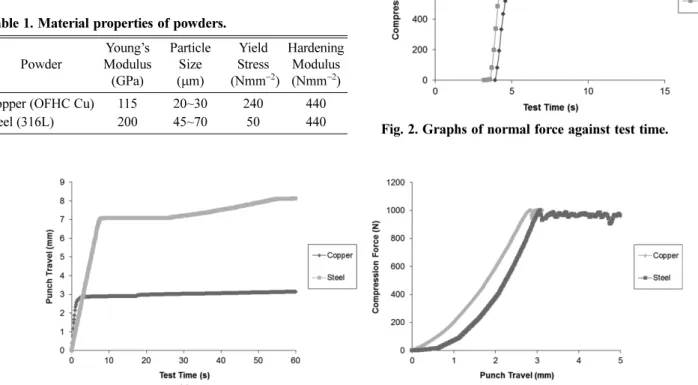
Fig. 2 illustrates the force build up and confirms it achieves a stable level of 1 kN for the duration of the experiment. Observing the force evolution patterns, duc- tile powders exhibit a very sharp build up. This is most likely due to particle shape, where both steel and copper powders are spherical, and hence closely packed.
Fig. 3(a) depicts the punch displacement curves that achieve typically a 1 kN/s loading rate. Copper compacts very quickly due to its low modulus in comparison to steel.
Both powders exhibit some further punch displacement par- ticularly for the steel powder. Fig. 3(b) shows the characteris- tic force against displacement data. This confirms the response similarity for the metal powders.
3.2. Compaction modeling 3.2.1. Particle count effects
Input loads for the compaction model was applied by
Table 1. Material properties of powders.
Powder
Young’s Modulus (GPa)
Particle Size (µm)
Yield Stress (Nmm−2)
Hardening Modulus (Nmm−2)
Copper (OFHC Cu) 115 20~30 240 440
Steel (316L) 200 45~70 50 440
Fig. 2. Graphs of normal force against test time.
Fig. 3. Graphs of (a) punch displacement against time and (b) compression force against punch displacement.
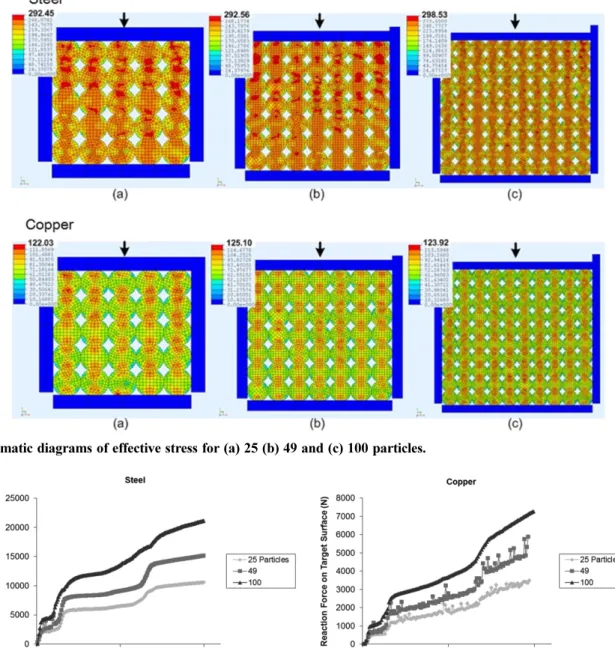
downward movement of the top punch. Compaction was achieved by moving the top punch with a given displace- ment with the same termination time. The friction between the powder and die was assigned a coefficient value of 0.1. Fig. 4 shows the effective stress contours within each particle at notionally identical top punch displacement.
Clearly, the stress values are similar for different number of particles and in comparing hard (steel) and soft (cop- per) materials, the difference is apparent.
Fig. 5 shows the evolution of force on the target sur- face as compaction proceeds. This also includes particle count effects for both hard and soft materials. The com-
paction force displays step increases for all cases, espe- cially for the steel particles. These results were also expressed as an average load on the target surface since the dimen- sion of the die varied for each case (Fig. 4). Since the model was two-dimensional, the force was divided by the length of the target surface. It can be seen that the gen- eral pattern was similar for different particle counts. For copper material, a more instable response could be observed, particularly for the cases of 25 and 49 parti- cles. In general, it can be seen that a model with higher number of particles produced the smoother increase in force and thus resulting in a clearer representation of the Fig. 4. Schematic diagrams of effective stress for (a) 25 (b) 49 and (c) 100 particles.
Fig. 5. Graphs of particle count effects with force against time for (a) Steel and (b) Copper.
Parameter Investigation for Powder Compaction using Discrete-Finite Element Analysis 340
compaction process. This was especially apparent in the case of softer material.
3.2.2. Time step effects
Time step effects were explored by varying time increment with set termination time of the simulation process. For identical punch displacement and termi- nation time, the number of divisions is increased. The critical time step value depends on material and dis- cretization issues. Simulations were undertaken using a model comprising 100 particles with friction between the powder and tool surfaces being captured
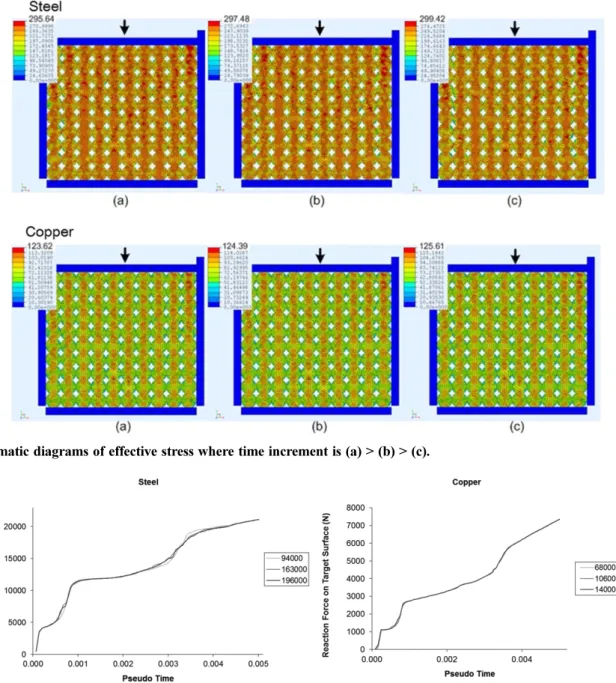
through a coefficient value of 0.1. The results from the simulations for different number of divisions are shown in Fig. 6 and little difference in effective stress was observed.
Although it can be observed from Fig. 7 that generally the increase in number of time steps had little influence on the force value, the effect of a larger number of divi- sions can be observed. For the harder material, a smoother increase in force was observed. The reaction force differ- ence for the softer material was even less. This could be due to the contact and rearrangement process of parti- cles, which is more evident for the harder particles, while
Fig. 6 Schematic diagrams of effective stress where time increment is (a) > (b) > (c).
Fig. 7. Graphs of time step effects with (a) Steel and (b) Copper for different number of divisions.
the softer particles deform plastically.
3.3.3. Particle discretization effects
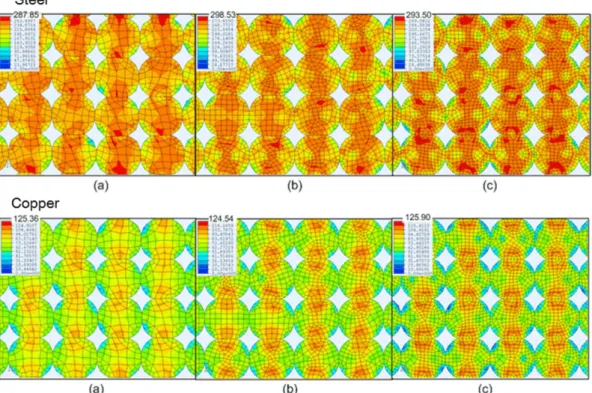
From examining Fig. 8, the stress levels are not signifi- cantly different. Differences that do exist may arise from slight discrepancies in time at which the contours have been plotted, a consequence of data output control from the software. Each particle within the assembly was dis- cretized identically.
Fig. 9 shows the reaction force evolution for which notable differences may be observed for the harder mate- rial. The force fluctuation observed for these particles diminished as the discretization became more fine.
3.3.4. Particle size
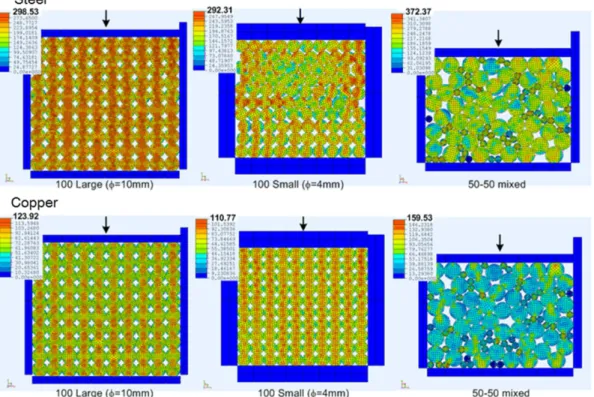
Models with different size of particles are shown in Fig. 10. Although dimensions of the tool sets are differ- ent, constant percentage of compactions were made for identical particles in a regular matrix. For the mixed 50- 50 model, two sizes of particles were used, leading to different initial density. This can be clearly observed from Fig. 11(b), where the initial relative density of the mixture of powders was much lower than the other two models. However, the mixed model reflects a more real- istic experimental environment and therefore displays a similar force evolution pattern. Variation of particle size had larger impact on harder ductile material. This seems Fig. 8. Schematic diagrams of effective stress with particle discretization (a) Coarse, (b) Moderate and (c) Fine.
Fig. 9. Graphs of particle discretization effects with (a) Steel and (b) Copper.
Parameter Investigation for Powder Compaction using Discrete-Finite Element Analysis 342
to be because numerous rearrangement processes taking place for harder particles, while the model with softer material almost maintains the original geometry.
4. Conclusions
Experimental investigations on powder compaction process were reported for soft and hard ductile materials.
Compression force of 1 kN was applied and consistency was achieved for the duration of the experiment. Due to spherical nature of particles, similar response for the metal powders was confirmed. Steel exhibits a very sharp force build up and copper compacts very quickly due to
its low modulus.
The compaction stage was numerically modeled by use of a discrete-finite element analysis to explore compac- tion mechanisms. Effects of important simulation factors and process parameters, such as particle count, time step, particle discretization, and particle size on the powder compaction procedure have been explored. It is clearly seen that a model with large number of particles and time steps with fine discretization produces better results.
However, since it is more time consuming to compute, optimization procedure is required. Round regular pack- ing led to prescribing a high density, exhibiting a stiff response. Rearrangements, such as rotation and slip Fig. 10. Schematic diagrams of effective stress for different particle size.
Fig. 11. Graphs of relative density against stress ratio for different size cases with (a) Steel and (b) Copper.
motion of particles had effects on the compaction, result- ing in a step increase in force. Practical initial density was observed from a random packing of particles dis- playing a more realistic reflection of an experimental environment.
Acknowledgements
This research was supported by the Basic Science Research Program through the National Research Founda- tion of Korea (NRF) funded by the Ministry of Science, ICT
& Future Planning (NRF-2014R1A1A1008010).
References
[1] D. C. Daniel, P. Lindskog, H. Staf and P. L. Larsson: J.
Mater. Eng. Perform., 23 (2014) 2199.
[2] F. Guner, O. N. Cora and H. Sofuoglu: Powder Technol.,
271 (2015) 238.
[3] Z. Cai, R. Wang, C. Peng and C. Zhang: Metall. Mater.
Trans. B, 46 (2015) 824.
[4] A. R. Khoei: Mater. Des., 23 (2002) 523.
[5] J. Almanstotter: Int. J. Refract. Met. Hard Mater., 50 (2015) 290.
[6] Y. He, T. J. Evans, A. B. Yu and R. Y. Yang: Procedia Eng., 102 (2015) 1390.
[7] O. Skrinjar and P. L. Larsson: Comput. Mater. Sci., 31 (2004) 131.
[8] D. T. Gethin and R. W. Lewis: Modelling Simul. Mater.
Sci. Eng., 11 (2003) 101.
[9] J. L. Choi, D. T. Gethin: Modelling Simul. Mater. Sci.
Eng., 17 (2009) 035005.
[10] A. Bagherzadeh Kh., A. A. Mirghasemi and S. Moham- madi: Powder Technol., 205 (2011) 15.
[11] J. P. Morris, M. B. Rubin, G. I. Block and M. P. Bonner:
Int. J. Impact Eng., 33 (2006) 463.
[12] T. K. Nguyen, G. Combe, D. Caillerie and J. Desrues:
Acta Geophys., 62 (2014) 1109.
![Fig. 1. Schematic diagram of a discrete-finite element model [9].](https://thumb-ap.123doks.com/thumbv2/123dokinfo/4914624.536709/1.892.493.797.946.1058/fig-schematic-diagram-discrete-finite-element-model.webp)