© Korean Powder Metallurgy Institute 1254 -1. Introduction
The packing of powder is important behavior in practical powder processing in order to determine the initial condition of the successive powder compaction. In our previous work [1], a new computer simulation was carried out to investigate the fundamental effect of particle size distribution on random packing.
The actual metallic powders have distributions in both sizes and shapes. This fact causes inevitable gaps in the packing density between the ideal spherical powders and the real metallic powders. In order to bridge the gaps we have proposed a particle size-shape dispersion diagram [2] and tried to quantitatively relate the packing density of actual powders with the morphological properties [3-5].
In the present work, the relation between the packing density and powder morphology is discussed according to a packed bed model of non-spherical particles and the packing density of the milled chromium powder is predicted from the relation.
2. Experimental procedure
As non-spherical shaped powder, a milled chromium powder was used. The powder samples as listed in Table 1 were prepared. The sample Cr-0 is an as-received powder and the other samples are prepared by classifying the powder with sieve. The packing densities of all samples were measured.
The random packing simulation of spherical powder having the same particle size distribution as the actual milled chromium powder samples was carried out, and the results obtained from the packing simulation was compared with the measurement data (apparent and tap densities).
Table 1. Powder samples used and their particle size distribution data
Powder sample Cr-0 Cr-1 Cr-2 Cr-3 Cr-4 Cr-5 D10[µm] 157.7 226.4 165.3 115.2 91.5 67.8
D50[µm] 90.1 155.7 116.6 83.5 62.2 41.2
D90[µm] 38.2 111.2 82.1 59.6 42.8 23.5
3. Results and discussions
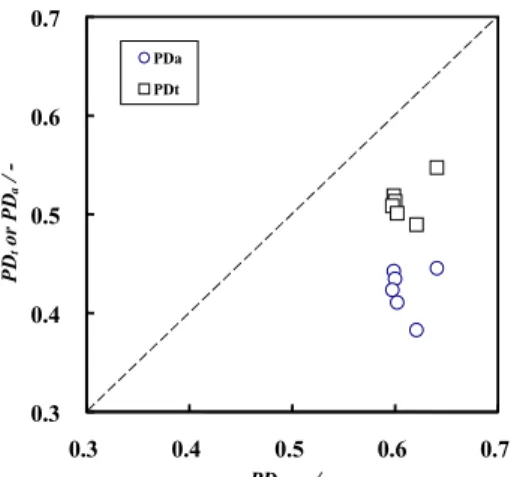
Fig. 1 shows the comparison between the packing densities obtained by simulation and experimental measurement, where PDa [-] and PDt [-] are the apparent and tap packing densities, respectively and
SIM
PD [-] is the packing density obtained by simulation. In order to bridge the gaps, we proposed a packed bed model[7]. This packed bed model is constituted by imaginary shells, each of which is a ellipsoid having vertical axis of revolution symmetry and encloses a non-spherical particle model. The imaginary shell means physically a space necessary for packing in a random direction of a non-spherical particle. Since there is an assumption that all the imaginary shells in the packed bed have the same flakiness s [-], the model can be easily created by reducing vertically by s times the packed bed of the spherical particle group having the same particle size distribution as the non-spherical one. The milled chromium powder has flakelike shaped particles. If all the particles in the powder have similar figures of ellipsoid that has the same flakiness f [-] (s≥ f)and is inscribed with an imaginary shell, the packing density of the packed bed model can be theoretically expressed with Eq. (1).
SIM PB PD s f PD = (1) 2006 POWDER METALLURGY World Congress PD01-W-02
Prediction of Packing Density of Milled Powder Based on Packing Simulation and
Particle Shape Analysis
Yuto Amano1, a, Takashi Itoh2, b, Hoshiaki Terao3, c and Naoyuki Kanetake1, d 1
Department of Materials Science and Engineering, Graduate School of Engineering, Nagoya University, Japan
2
Division of Integrated Research Projects, EcoTopia Science Institute, Nagoya University, Japan
3
Development Section, JFE Precision Corporation, Japan
a
[email protected], b [email protected],
c
[email protected], d [email protected]
Abstract
For precise property control of sintered products, it is important to understand accurately the packing density of the powder. We developed a packing simulation program that could make a packed bed of spherical particles having particle size distribution. In addition, the influence of the particle shape of the actual powder on the packing density was quantitatively analyzed. The predicted packing densities corresponded well to the actual data.
© Korean Powder Metallurgy Institute 1255
-where PDPB [-] is the packing densities obtained from the packed bed model. A factor f s [-] relates to both of the particle shape of powder and the structure of the packed bed. By substituting the packing density PDa or PDt into PD , the factor PB f s can be estimated.
0.3 0.4 0.5 0.6 0.7 0.3 0.4 0.5 0.6 0.7 PDSIM/ -PD t or PD a / -PDa PDt
Fig. 1. Comparison between packing densities obtained by simulation and measurement.
After trial and error, we found a linear relation between the factor f s and the reciprocal of the mean particle size of the powder D50 [m]. The relation is expressed with
the following equation.
B D A s f ⎟+ ⎠ ⎞ ⎜ ⎝ ⎛ = 50 1 (2)
where A [m] and B [-] are constant values. Fig. 2 shows the relation between factors f sand 1 D50 . The
two lines indicate the results of regression analysis according to the apparent and tap densities of powder samples Cr-1, Cr-3 and Cr-5. The constant values A and B are -4.47 and 0.899 for tap density and –6.97 and 0.787 for apparent density, respectively. Though the black symbols in the figure are the data unused in the regression analysis, they are also very close to the regression lines. The first and second terms of the right side in Eq. (2) indicates a size-dependent term and a size-independent term, respectively. Since the value 1 D50 changes from 0.0068
to 0.0243, the absolute value of the first term changes from 0.030 to 0.109 for tap density and from 0.047 to 0.169 for apparent density. Thus, it is obvious that the second term (size-independent term) is the predominant term for the factor f s in spite of the packing mode.
0.5 0.6 0.7 0.8 0.9 1.0 0.005 0.010 0.015 0.020 0.025 1/D50/ µm-1 f/s / -Cr-1 Cr-3 Cr-5 Tap Apparent
Fig. 2. Relationship between factor f s and reciprocal of mean particle size of the powder.
4. Summary
The random packing simulation was carried out according to the particle size distribution of the actual powders. The packing density of milled chromium powders can be sufficiently predicted by combining the packed bed model proposed, the packing simulation and the factor relating to the particle shape and the packed bed structure.
5. References
1. T. Itoh, Y. Wanibe and H. Sakao: J. Japan Inst. Metals, 50[4](1986), 423-429.
2. T. Itoh and Y. Wanibe: Powder Metall., 34[2](1991), 126-134.
3. T. Itoh and Y. Wanibe: Preprints of 5th European Symposium of Particle Characterization, Nuernberg Messe GmbH, 2 (1992), 691-701.
4. T. Itoh and Y. Wanibe: Proc. of 1993 Powder Metallurgy World Congress, Jpn. Soc. of Powder and Powder Metallurgy, Part 1, (1993), 319-322.
5. T. Itoh and Y. Wanibe: Proc. of International Workshop on Modeling of Metal Powder Forming Processes, GPM2, (1997), 169-178.