193
JOURNALOF KOREAN FOREST SOCIETY ISSN 0445-4650(Print), ISSN 2289-0904(Online) http://e-journal.kfs21.or.kr
지역별 산딸기 열매의 유용물질 함량, 항산화 활성 및 암세포 성장억제 효능 분석
최은영1·김은희1·이재봉1·김혜수2·김문섭2·이수광2·김세현2·이 욱2·김동권3·이진태1*
1대구한의대학교 화장품약리학과, 2국립산림과학원 특용자원연구과,
3(주)다이텍 신상품개발센터
Bioactive Component Analysis, Antioxidant Activity, and Cytotoxicity on Cancer Cells on Rubus crataegifolius Clones by Region
Eun-Young Choi
1, Eun-Hee Kim
1, Jae-Bong Lee
1, Hyeu-soo Kim
2, Moon-Sup Kim
2, Su-gwang Lee
2, Sea-Hyun Kim
2, Uk Lee
2, Dong-Kwon Kim
3and Jin-Tae Lee
1*¹Department of Cosmeceutical Science, Daegu Haany University, Gyungbuk 38578, Korea
2Division of Special Purpose Trees, National Institute of Forest Science, Suwon 16631, Korea
3Korea Dyeing & Finishing Technology Institute Advanced Processing Development Center, Daegu 41706, Korea
요 약: 본 연구는 산딸기 열매의 지역별(장성, 화성, 울산, 순창, 포항) 영양성분, 항산화 활성 및 암세포 성장 억제 효능 분석을 통하여 기능성을 갖는 산딸기 품종을 육성하고자 수행하였다. 모든 지역의 산딸기 열매에서 일반성분은 탄수화물 함량이 높게 나타났으며, 무기성분은 칼슘(996.6 µg/g ± 0.8%)이 가장 높은 함량을 보였으 며, 나트륨(6.2 µg/g ± 1.0%)은 가장 낮았다. 유리아미노산은 총 26종, 구성아미노산은 총 18종을 분석하였다. 전 자공여능 실험 결과 울산 산딸기가 500 µg/ml의 농도에서 열수추출물은 80%, 에탄올추출물은 82.6%의 높은 소거능을 보였다. 또한 암세포 성장억제 효과를 확인하기 위한 세포독성 실험 결과, B16F10 cell은 울산 산딸 기 열수추출물과 포항 산딸기 에탄올추출물, H1299 cell은 순창 산딸기 열수추출물과 포항 산딸기 에탄올추출 물 그리고 MCF-7 cell은 장성 산딸기 열수추출물과 순창 산딸기 에탄올추출물에서 각각 세포독성이 나타났다.
따라서 이와 같은 기초자료를 바탕으로 기능성 특성을 지닌 산딸기를 선발하여 기능성 품종으로의 개발 가능 성을 확인할 수 있었다.
Abstract: This study was carried out to analyze the nutritional composition, bioactive components, antioxidant activity, and cytotoxic assay of cancer cells on Rubus crataegifolius (RC) : R. crataegifolius from Jangseong (RC-J), R. crataegifolius from Hwaseong (RC-H), R. crataegifolius from Ulsan (RC-U), R. crataegifolius from Sunchang (RC-S), and R. crataegifolius from Pohang (RC-P). The peroximate composition had the largest amount of carbohydrate content among all kinds of RC. As far as the mineral contents of RC, Calcium comprised the highest amount (996.6 µg/g ± 0.8%) and Natrium the lowest (6.2 µg/g ± 1.0%). A total of 26 kinds of free amino acids and 18 kinds of component amino acids were analyzed in RC. The results of electron donating were high scavenging effects of 80% in water extract (RC-UW) and 82.6% in ethanol extract (RC- UE) in 500 µg/ml concentration from RC-U. Also, the cytotoxic effects of cancer cells B16F10 (RC-UW and RC-PE), H1299 (RC-SW and RC-PE), and MCF-7 (RC-JW and RC-SE) appeared in RC. Therefore, we confirmed that new varieties may possibly be developed with functional materials.
Key words: amino acid, electron donating ability, mineral contents, MTT assay, peroximate composition, Rubus crataegi- folius
서 론
산딸기(Rubus crataegifolius BUNGE.)는 장미과(Rosaceae)
산딸기속(Rubus)에 속하는 낙엽활엽관목으로 전국 각지 산야에서 높이 2 m로 자라며, 열매는 둥글고 6~7월에 붉 게 익는다(Lee, 2006). 분포지는 우리나라를 비롯하여 중 국, 러시아 및 일본이며 공통적으로 열매를 식용한다. 산 딸기와 유사한 복분자(Rubus coreanus)와는 영양학적 측
*Corresponding author E-mail: [email protected]
면에서 다소 차이가 있다(National Rural Living Science Institute, 2001). 한방에는 눈을 밝게 하고 몸을 경쾌하게 하며 머리털을 희지 않게 하며 소변을 바르게 하는 동시 에 살결을 부드럽고 아름답게 해준다고 기록되어 있다 (Ahn, 1998). 특히 산딸기에 함유되어 있는 탄닌 성분은 항암 효과가 있어 암을 예방하고 사포닌은 거담, 진해, 콜 레스테롤 대사를 촉진하여 감기, 열성 질병, 폐렴, 기침 등 에도 좋은 것으로 알려져 있다. 중국에서는 산딸기 뿌리 를 도생근(倒生根)이라고 하여 활혈(活血), 지혈, 조혈, 불 임증, 월경불순 등에 이용하고 있다(Kwon et al., 2006).
지금까지 산딸기 열매의 특성과 주요성분 및 기능성을 살펴본 연구로는, Choi et al.(2008)의 보고에 따르면 산딸 기 추출물에서 획득한 triterpenoid 성분이 동물 실험에서 anti-hyperglycemic 효능과 anti-hyperlipidemic 효능이 있음 을 확인하였다. 일반적으로 산딸기에는 다수의 안토시아닌 과 ellagic acid가 존재하며, cyanidin-3-glucoside, cyanidin- 3-sophoroside, cyanidin-3-(2-glucosyl rutinoside) 등이 주요 안토시아닌 성분인 것으로 밝혀졌고(Suthanthangjai et al., 2005), ellagic acid는 페놀성 화합물로서 유리형, ellagic acid glycoside 및 주로 포도당과 ester 결합한 ellagictannin의 3가 지 형태로 존재한다고 보고되었다(Lee et al., 2014). Lee et al.(2012)이 연구한 국내산 산딸기 열매의 이화학적 특성을 살펴보면, 산딸기 열매의 무게는 1.45~3.10 g, 길이는 11.17~16.20 mm, 과실폭은 13.48~20.39 mm의 범위이고, 경남 포항-2 산딸기가 가장 크고 무거우며, 경남 김해-2 산 딸기의 당도는 16°Brix로 시료 중 가장 높았고 산도는 낮아 과실로서의 이용가능성이 기대된다고 보고된 바 있다.
지금까지 보고된 연구들은 국내에서 재배되는 오디, 블 랙라즈베리, 라즈베리, 블루베리에 대한 화학조성 및 phenolic compound 등의 기능성 성분과 항산화 활성에 대 한 조사(Lee et al., 2015), 국내산 나무딸기류의 씨앗성분 의 항산화능 및 암세포의 항증식 활성의 비교 분석 연구 (Jung et al., 2012), 냉동저장 및 추출방법에 의한 딸기의 생리활성 변화 연구(Youn et al., 2007), 복분자 추출물의 이화학적인 특성(Cha et al., 2001)과 무기성분, 아미노산 및 생리활성 분석(Kim et al., 2013) 및 성숙단계별 생리활 성 비교분석(Cha et al., 2007) 등의 연구가 보고된 바 있 다. 그러나 이러한 다양한 연구에도 불구하고, 국내에서 재배된 산지별 산딸기에 대한 기초자료에 대한 연구는 부 족한 실정이다. 따라서 본 연구에서는 장성, 화성, 울산, 순창 및 포항에서 수집하여 국립산림과학원 산림유전자 원부 산딸기 클론보존원에서 재배되어 수확된 산딸기 열 매에 대한 영양적 가치를 조사하고, 항산화 활성과 암세 포 성장억제 효과를 살펴봄으로써 유용물질 함량과 기능 성 효능을 갖는 산딸기 신품종을 육성하기 위한 기초자료 를 제공하고자 수행하였다.
재료 및 방법
1. 재료
공시재료는 국립산림과학원 산림유전자원부 산딸기 클 론보존원에서 유지 관리되어온 장성(Janseong; RC-J), 화성 (Hwaseong; RC-H), 울산(Ulsan; RC-U), 순창(Sunchang;
RC-S) 및 포항(Pohang; RC-P) 등 5지역에서 수집된 산딸 기 열매이며, 2015년 6월 열매를 수집하여 동결건조된 분 말시료로 제공받아 열수 및 에탄올 추출을 실시하였다. 열 수 추출의 경우 산딸기 열매 중량의 10배 양의 증류수를 첨가하여 85oC에서 3시간 환류 냉각 추출하였으며, 에탄 올 추출의 경우 70% 에탄올에 침지하여 상온에서 24시간 방치하여 상징액과 침전물을 분리하여 3회 반복 추출하였 다. 각 추출물들은 원심분리, 여과 및 농축 후 동결건조하 여 냉장보관하면서 실험에 사용되었다.
2. 일반성분 분석
일반성분은 AOAC(Association of Official Analytical Chemists)법에 따라 분석하였다. 수분 함량은 105oC dry oven에서 항량이 될 때까지 건조시킨 후 무게를 측정하는 상압건조법, 조지방은 soxhlet 추출법, 조단백은 semi micro kjeldahl법, 조회분은 250oC에서 예비 회화한 후 550oC에서 직접 회화법으로 실시하였고, 총 탄수화물 함 량은 위의 측정치를 합한 값에서 100을 뺀 값으로 정량하 였다.
3. 무기성분 분석
무기성분 분석은 유도결합 플라즈마 원자방출분광법을 이용하여 측정하였다. 유도결합 플라즈마 질량분석 장비 (NexION 350D ICP-MS Spectrometer, Perkim Elmer, USA.)와 흑연블럭산순환분해시스템[OD-158003, ODLAB (ECO-PRE), Korea]이 사용되었다. 시료에 함유된 무기질 의 전처리 방법은 건식법으로 하였다. 즉 분말시료 약 2 g 을 도가니에 넣고 전열기에서 예비 가열시킨 후 550oC 전 기 회화로에서 6시간 회화한 다음 방냉하였다. 여기에 탈 이온수 10방울을 가하고 묽은 질산(1:1 HNO3) 4 ml을 넣 은 다음 다시 전열기(120oC)에서 수분을 제거시키고 550oC 전기 회화로에서 1시간 회화, 방냉하였다. 여기에 묽은 염 산(1:1 HCl) 10 ml을 첨가한 다음 이를 50 ml 정용플라스 크로 옮겨 탈이온수로 정용, 여과하여 정량 분석하였다.
4. 아미노산 분석
1) 구성 아미노산 함량분석 방법
동결 건조한 시료 0.1 g을 18 ml test tube에 칭량하여 6 N HCl 3 ml을 가하여 감압 밀봉한 후 110oC로 setting 된 heating block에 24시간 이상 동안 가수분해하였다.
50oC에서 rotary evaporater로 산을 제거한 후 Sodium dilution buffer로 50 ml 정용한 다음, 이중 1 ml을 취하여 membrane filter 0.2 µm로 여과시켜 조작조건에 따라 아미 노산 자동분석기(Biochrom 30, Amersham Pharmacia Biotech, England)로 정량 분석하였다.
2) 유리 아미노산 함량분석 방법
동결 건조한 시료 1 g에 ethanol 2 ml를 가한 후 homogenizer로 10분 동안 교반하여 3,000 rpm에서 20분 간 원심분리하고, 상층액을 감압농축한 후 sample dilution buffer 25 ml로 용해시키고, sulfosalicylic acid 20 mg을 첨가하여 4oC에서 1시간 동안 방치시킨 다음 다시 3,000 rpm에서 20분간 원심분리한 후, membrane filter (0.2 µm) 로 여과시켜 조작조건에 따라 아미노산 자동분석기 (Biochrom 30, Amersham Pharmacia Biotech, England) 로 정량 분석하였다.
5. 안토시아닌 함량 분석
안토시아닌은 pH의 변화에 따라 가역적인 구조적 변형 을 일으켜 유색의 oxonium 형태는 pH 1.0에서, 무색의 Hemiketal 형태는 pH 4.5에서 우세하며, 안토시아닌 함량 을 측정하기 위하여 이 반응에 기초를 둔 pH-differential method(Giusti et al., 2001)를 사용하였다. 0.025 M potassium chloride buffer로 시료를 희석하여 흡광도 값이 0.7~1.0이 나오도록 희석배수를 정하고 그 희석배수로 시 료를 0.025 M potassium chloride buffer(pH 1.0)와 0.4 M sodium acetate buffer(pH4.5)로 각각 희석하였다. 15분 동안 평화시킨 다음 spectrophotometer를 사용하여 최대흡 수파장 (515 nm)과 700 nm에서 흡광도를 측정한 후 다음 식에 의하여 안토시아닌 함량을 산출하였다.
Monomeric anthocyanin (mg/L) =
A = (Aλ vis-max – A700 nm)pH1.0− (Aλ vis-max – A700 nm)pH4.5
Aλ vis-max: 최대 흡수파장에서의 흡광도
A700 nm : 700 nm에서의 흡광도
MW : cyanidin-3-glucoside의 분자량 = 449.2 DF : 희석배수
ε : 몰흡광계수 = 26,900
6. 항산화활성 분석
전자공여능은 Blois(1958)의 방법으로 측정하였다. 각 시료용액 100 µl에 0.2 mM의 1,1-diphenyl-2-picrylhydrazyl 50 µl 넣고 교반한 후 실온에서 30분간 차광하여 방치한 다 음 517 nm에서 흡광도를 측정하였고, 전자공여능은 시료 용액의 첨가군와 무첨가군의 흡광도 감소율로 나타내었다.
7. 암세포 증식 억제 효과 분석
실험에 사용된 암세포주는 mouse melanoma cell line인 B16F10 cell, human breast cancer cell line인 MCF-7 cell 과 human non-small cell lung cancer cell line인 H1299 cell을 전북대학교에서 분주 받아 사용하였으며, 세포주의 배양은 10% FBS(fetal bovine serum)와 peniciline(25 unit/ml) 및 streptomycin(25 mg/L)을 첨가한 RPMI 1640 배지를 사용하였으며, 37oC, 5% CO2의 습윤화 된 배양기 내에서 적응시켜 배양하였다.
암세포 증식 억제는 MTT assay (Mosmann, 1983)에 의 해 세포생존율을 조사하였다. 즉 암세포를 3×10⁵ cells/ml 의 농도가 되도록 조절한 후 96 well microplate에 180 µl 씩 분주하여 24시간 동안 배양하여 세포를 부착시킨 후 추출물을 농도별로 20 µl 씩 첨가하여 배양하였고, 5 mg/
ml 농도로 조제한 MTT (3-(4,5-dimethylthiazol-2-yl)-2, 5- diphenyltetrazolium bromide) 용액을 각 well 당 20 µl 씩 넣고 세포 배양기에 4시간 동안 더 배양시킨 후, MTT 용액이 있는 배지를 제거하고 DMSO 1 ml을 첨가하여 30 분간 교반하여 ELISA reader로 540 nm에서 흡광도를 측 정하였다. 암세포 증식 억제 효과 측정은 시료용액의 첨 가군과 무첨가군의 흡광도 감소율로 나타내었다.
8. 통계처리
실험결과에 대한 통계처리는 SPSS software package (Version 22.0)를 이용하여 평균과 표준편차로 나타내었고, 각 처리군 간의 유의성에 대한 검증은 ANOVA를 이용하 여 유의성을 확인한 후, p<0.05 수준에서 Duncan’s multiple test를 이용하여 분석하였다.
결과 및 고찰
1. 일반성분 분석
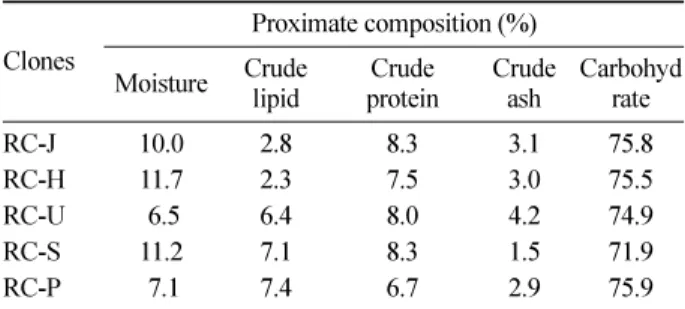
산딸기 열매의 일반성분 함량 분석결과는 Table 1과 같 다. 수분량은 6.5~11.7%였으며, 조단백질은 6.7~8.3%, 조 지방은 2.3~7.4%, 조회분은 1.5~4.2% 그리고 탄수화물은 A MW DF× × ×1 000,
( )
ε 1×
( )
---
Table 1. The proximate composition of Rubus crataegifolius.
Clones
Proximate composition (%) Moisture Crude
lipid
Crude protein
Crude ash
Carbohyd rate
RC-J 10.0 2.8 8.3 3.1 75.8
RC-H 11.7 2.3 7.5 3.0 75.5
RC-U 6.5 6.4 8.0 4.2 74.9
RC-S 11.2 7.1 8.3 1.5 71.9
RC-P 7.1 7.4 6.7 2.9 75.9
RC-J: R. crataegifolius from Jangseong, RC-H: R. crataegifolius from Hwaseong, RC-U: R. crataegifolius from Ulsan, RC-S: R.
crataegifolius from Sunchang, RC-P: R. crataegifolius from Pohang
71.9~75.9%로 나타났다. 특히 수분량은 RC-H와 RC-S가 11.7%, 11.2%, 조회분은 RC-U와 RC-J가 4.2%, 3.1%, 조 단백질은 RC-J와 RC-S가 8.3%, 조지방은 RC-P와 RC-S 가 7.4%, 7.1%, 탄수화물은 RC-P와 RC-J가 75.9%, 75.8%
로 가장 높은 함량을 나타내었으며 지역에 따른 일반성분 에 대한 함량 차이는 유의적인 연관성을 보이지는 않았다.
본 연구의 일반성분 분석 결과에 대하여 다른 품종의 베 리류와의 영양학적인 차이를 알아보기 위해, Kim et al.(2011)이 발표한 복분자 딸기의 숙성시기별 시료 분말 에 대한 일반성분 분석 결과 중에 완숙과와 비교해보았으
며, 복분자 딸기의 수분은 10.94 ± 0.88%, 조단백질은 5.34 ± 0.20%, 조지질은 5.36 ± 0.09%의 함량을 보였으며, 회분은 4.62 ± 0.02%의 함량을 보였다. 이러한 결과는 산 딸기 열매가 조단백질과 조지방의 함량이 좀 더 높았으며 조회분의 함량은 복분자 딸기가 조금 더 높았음을 확인할 수 있었다.
2. 무기성분 분석
산딸기 열매의 무기성분은 총 7종(Ca, Fe, K, Na, Mg, Mn, Zn)을 분석하였으며, 그 결과는 Table 2와 같다. 무기 Table 2. Mineral contents of Rubus crataegifolius.
Mineral (µg/g ± %)
Contents
RC-J RC-H RC-U RC-S RC-P
Ca 882.1±0.4b 1081.1±1.5a 831.2±0.8b 1115.5±0.9a 1072.9±0.2a
Fe 026.6±0.3b 0029.5±0.8a 026.2±0.1b 015.0±0.2c 030.2±1.0a
Mn 009.6±0.6c 0011.1±0.7c 019.4±0.7a 016.0±1.1b 023.7±1.1a
Na 003.7±1.4c 0006.9±0.9b 005.0±0.9c 003.4±0.5c 012.1±1.1a
Zn 012.5±0.3b 0016.7±0.4a 010.1±1.0b 010.1±0.2b 018.2±1.5a
K 318.2±1.4a 0304.1±2.2a 271.0±0.9b 320.7±0.8a 227.0±0.4c
Mg 045.4±2.2b 0041.8±1.3b 041.2±0.6b 058.6±0.4a 035.1±1.2c
RC-J: R. crataegifolius from Jangseong, RC-H: R. crataegifolius from Hwaseong, RC-U: R. crataegifolius from Ulsan, RC-S: R.
crataegifolius from Sunchang, RC-P: R. crataegifolius from Pohang Values are µg/g ± % RSD.
Values are mean of triplicates.
a-cMeans with different superscripts within the same row are significantly different by Duncan’s multiple range test at p<0.05.
Table 3. Contents of component amino acids of Rubus crataegifolius.
Component amino acids (mg/g)
Contents
RC-J RC-H RC-U RC-S RC-P
Methionine 00.63±0.42 00.48±0.18 00.59±0.46 00.54±0.21 00.57±0.07
Phenylalanine 02.23±0.30b 01.84±0.79c 02.37±0.26ab 02.72±0.19a 02.31±0.01b
Threonine 03.14±0.53 02.69±0.42 02.93±0.06 03.29±0.24 02.77±0.32
Valine 03.33±0.21ab 02.78±0.23c 03.26±0.05abc 03.65굇0.32a 03.11±0.38bc
Isoleucine 02.32±0.34 01.86±0.19 02.42±0.20 02.79±0.09 02.40±0.13
Leucine 03.61±0.52b 02.92±0.17c 03.73±0.23b 04.42±0.12a 03.73±0.50b
Lysine 03.81±0.61bc 03.22±0.27b 03.92±0.33bc 04.52±0.02a 03.60±0.47b
Tyrosine 01.21±0.05bc 01.15±0.03c 01.33±0.10ab 01.42±0.02a 01.24±0.07bc
Cystine 01.57±0.59 01.51±0.37 01.62±0.09 01.64±0.36 01.58±0.20
Histidine 01.66±0.45 01.36±0.31 01.66±0.16 01.79±0.35 01.54±0.29
Ammonia 02.54±0.24a 01.70±0.21b 01.92±0.29b 01.93±0.25b 01.54±0.15b
Arginine 03.73±0.72bc 02.98±0.44c 04.14±0.32b 05.27±0.41a 04.06±0.42b
Proline 04.01±0.48 04.15±0.44 03.69±0.49 04.3±0.34 04.24±0.51
Serine 06.04±0.28a 05.49±0.44ab 05.29±0.34ab 05.05±0.71bc 04.30±0.46c
Alanine 10.07±0.37a 08.93±0.25b 06.50±0.31cd 07.04±0.68c 06.16±0.52d
Asparagine 09.00±0.60a 07.62±0.90b 09.51±0.15a 09.76±0.39a 06.54±0.49c
Glycine 03.59±0.51bc 03.15±0.35c 38.67±0.87a 04.41±0.37b 03.59±0.50bc
Glutamic acid 016.00±0.61a 12.91±0.72b 13.65±0.38b 14.94±0.52a 10.79±0.89c
Total contents 77.08 64.04 104.60 56.22 60.92
RC-J: R. crataegifolius from Jangseong, RC-H: R. crataegifolius from Hwaseong, RC-U: R. crataegifolius from Ulsan, RC-S: R.
crataegifolius from Sunchang, RC-P: R. crataegifolius from Pohang Values are mean of triplicates.
a-dMeans with different superscripts within the same row are significantly different by Duncan’s multiple range test at p<0.05.
성분은 Ca이 831.2 µg/g±0.8~1115.5 µg/g ± 0.9%로 가장 높은 함량을 보였으며, 다음으로 K, Mg, Fe, Mn, Zn, Na 순으로 나타났다. Ca은 RC-H (1081 µg/g ± 1.5%)가 가장 높았으며, Fe는 RC-P (30.21 µg/g ± 1.0%), Mn은 RC-P (23.66 µg/g ± 1.1%), Na은 RC-P (18.2 µg/g ± 1.5%), K은 RC-S (321 µg/g ± 0.8%), Mg은 RC-S (58.6 µg/g ± 0.4%) 가 가장 높은 함량을 보였다. Kim et al.(2013)의 복분자 추출물의 무기성분 분석 결과를 보면 Mg이 392.39 mg/
100 g로 가장 높은 함량을 나타냈고 다음으로 Ca, K 및 Na 순으로 함량이 높다는 보고가 있다. 본 연구결과에서 는 산딸기 열매의 Mg의 평균함량이 44.4 ± 1.2 µg/g으로 복분자보다는 낮은 결과였다. 그리고 Lee et al.(2015)은 베리 4종에 대한 무기질 함량을 분석하였고 그 결과, Ca 이 10.8~38.8 mg/100 g, Fe는 0.4~0.9 mg/100 g, Mn은
0.5~2.3 mg/100 g, K은 75.4~198.6 mg/100 g, Mg은 5.7~21.9 mg/100 g라고 보고하였으며, 본 연구의 결과와 비교하면 산딸기 열매가 Fe와 Ca의 함량이 더 높았고, K과 Mg의 함량은 더 낮았다. 또한 베리 4종의 무기질 조성은 K, Ca, Mg의 순서로 많이 함유되어 있다고 보고하였는데, 이는 본 실험과 유사한 결과였다.
3. 아미노산 분석
산딸기 열매(RC)에서의 18종의 구성 아미노산에 대한 분석 결과는 Table 3과 같이 RC-U가 104.60 mg/g으로 가 장 높았다. 그리고 산딸기 열매(RC)에서의 26종의 유리아 미노산 성분 분석 결과는 Table 4에 나타내었다. 필수아미 노산의 함량은 RC-J가 18.48 µg/g으로 가장 높은 함량을 보였고 총 유리아미노산의 함량은 RC-U가 368.60 µg/g으 Table 4. Contents of free amino acids of Rubus crataegifolius.
Free amino acids (µg/g) Contents
RC-J RC-H RC-U RC-S RC-P
Essential amino acid
Methionine 001.72±0.56a 0.64±0.02b 000.42±0.04b 0.32±0.00b 00.59±0.02b Phenylalanine 000.93±0.13b 0.38±0.01 000.65±0.03c 2.00±0.13a 00.56±0.05c Threonine 005.44±0.30a 1.57±0.11c 002.41±0.39b 2.15±0.06b 01.61±0.21c Valine 006.48±0.44a 1.88±0.01d 002.86±0.21c 3.76±0.16b 02.08±0.05d Isoleucine 002.12±0.97a 0.31±0.05c 001.19±0.01b 0.63±0.12bc 000.47±0.01bc Leucine 001.57±0.07a 0.31±0.56d 000.76±0.09b 0.80±0.16b 00.51±0.01c Lysine 000.23±0.05bc 0.12±0.03c 000.43±0.08a 0.31±0.01b 00.42±0.07a
Total essential amino acid 18.48 5.22 8.72 9.97 6.25
Non-Essential amino acid
P-Serine 174.27±3.32d 95.33±0.03e 247.30±4.72a 190.27±0.11b 181.07±0.44c
Taurine 0 0.70±0.07a 00.36±0.04c 000.59±0.01b ND1) ND
Phosphoehanolamine 24.91±0.45a 09.18±0.57b 005.08±0.15d 006.37±0.13c 04.17±0.03e Aspartic acid 0 5.09±0.09c 2.51±0.47d 012.42±0.48a 005.72±0.23b 02.53±0.01d Serine 29.66±0.15a 11.32±0.32c 017.93±0.56b 011.44±0.74c 11.36±0.11c Glutamic acid 13.52±0.32a 5.48±0.49c 011.38±0.18b 013.36±0.99a 05.04±0.01c
Sarcosine ND ND 0 0.35±0.04b 000.53±0.10a 00.49±0.03a
Glycine 0 3.12±0.10a 1.10±0.14c 001.84±0.08b 001.18±0.05c 01.02±0.04c Alanine 62.18±0.71a 25.91±0.90c 030.11±1.42b 030.03±0.77b 22.95±0.53d
α-Aminobutyric acid 00.25±0.01b ND ND 0 0.75±0.35a ND
Tyrosine 01.86±0.05a 0.39±0.05d 000.70±0.13c 0 1.00±0.13b 00.48±0.02d β-Alanine 0 2.14±0.01a 01.18±0.03bc 00 1.13±0.13bc 0 1.25±0.03b 01.06±0.02c γ-Aminobutyric acid 06.99±0.41d 4.79±0.23s 018.51±0.16b 010.25±0.75c 23.84±0.46a Ethanolamine 00.34±0.01c ND 0 0.89±0.12b 0 0.10±0.01d 01.21±0.01a Ammonia 0 0.77±0.04c 0.78±0.04c 001.39±0.09a 0 0.86±0.05c 01.05±0.00b
Ornithine ND 0.05±0.01 ND ND ND
Histidine 00.97±0.05a ND 000.55±0.05b 00.22±0.01c ND Arginine 07.64±0.63b 2.47±0.49d 007.50±0.11b 011.66±0.06a 04.01±0.01c Proline 0 5.95±0.34b 4.12±0.20c 002.22±0.21d 0 1.32±0.02s 06.35±0.08a
Total nonessential amino acid 340.36 164.97 359.88 286.31 266.64
Total contents 358.84 170.19 368.60 296.28 272.89
RC-J: R. crataegifolius from Jangseong, RC-H: R. crataegifolius from Hwaseong, RC-U: R. crataegifolius from Ulsan, RC-S: R.
crataegifolius from Sunchang, RC-P: R. crataegifolius from Pohang.
1)ND: Not detected.
Values are mean of triplicates.
a-eMeans with different superscripts within the same row are significantly different by Duncan’s multiple range test at p<0.05.
로 가장 높았다. 혈중 콜레스테롤의 수치를 낮추는 효과 가 있는 methionine(Kim et al., 2009)은 RC-J가 1.72 ± 0.56 µg/g, phenylalanine은 주의력 향상에 도움을 주고 진 통효과가 있는 것으로 알려진 필수 아마노산(Orlowski et al., 1974)으로 RC-S에서 2.00 ± 0.13 µg/g, 동물성 지방이 풍부한 음식에 함유되어 있으며 단백질 균형을 유지하는 역할을 하는 threonine (Kim et al., 2009)과 근력을 높여 주고 정신적인 안정을 돕는 기능을 하는 필수 아미노산인 valine, 헤모글로빈을 생성하고 쓴맛을 나타내는 isoleucine, 근육을 구성하고 있는 필수 아미노산으로 간 기능과 관계 가 있는 leucine (Lee et al., 2011) 모두 RC-J에서 각각 5.44 ± 0.30 µg/g, 6.48 ± 0.44 µg/g, 2.12 ± 0.97 µg/g, 1.57 ± 0.07 µg/g으로 높은 함량을 보였으며, lysine은 피로 회복과 관련 있어 집중력이나 빈혈, 어지럼증과 연관이 있 는 필수 아미노산으로 (Kim et al., 2009) RC-U가 0.43 ± 0.08 µg/g으로 높은 함량을 보였다. 비필수 아미노산은 RC- U가 359.88 µg/g으로 가장 많은 양을 함유하고 있었다. 이 중 단맛을 나타내는 아미노산인 alanine과 serine (Lee et al., 2011)은 RC-J가 62.18 ± 0.71 µg/g, 29.66 ± 0.15 µg/g 로 가장 높은 함량을 보였다. Kim et al.(2013)에 의하면, 복분자 추출물의 구성 아미노산의 함량은 1,211.92 mg%
로 나타났으며, 그 중 필수 아미노산은 481.65 mg%의 함 량을 보였다고 보고하였다. 그리고 Jeong et al.(2012)은 보 이즌베리 과일의 아미노산 함량 분석을 보고하였으며, 총 아마노산 함량은 411.17 mg/100 g, 필수아미노산 함량은 100.4 mg/100 g이라는 결과를 제시하였다. 이는 본 연구 의 산딸기 열매의 필수아미노산 함량보다 높은 함량의 수 치였다.
4. 안토시아닌 함량 분석
안토시아닌은 베리류, 포도, 적색 양배추, 사과, 순무 등 의 과일과 채소 등에 분포되어 있는 수용성 페놀화합물 중 하나로 적색, 자색, 청색 등을 나타내는 색소이다 (Francis, 1989). 산딸기 열매(RC)의 총 안토시아닌 함량은 Table 5와 같다. 안토시아닌 함량은 RC-JE가 939.6 ± 25.0 mg/L FW으로 가장 높은 함량을 보였고, RC-SE가 218.2 ± 36.9 mg/L FW로 가장 적은 수치를 나타내었다.
Lee et al.(2014)의 연구 결과를 보면, 경남김해의 산딸기
가 30.48 mg/100 g FW로 가장 높았고, 충남 아산의 야생 산딸기가 10.82 mg/100 g FW로 가장 낮았다고 보고하였 으며, 이는 본 연구 결과와 비교하였을 때 더 높은 함량을 보였다.
5. 항산화활성 분석
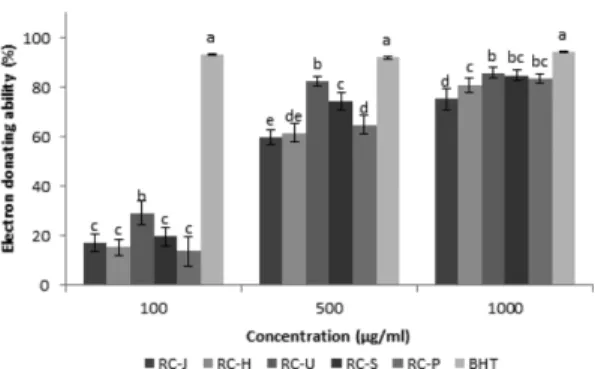
전자공여능 측정에 사용된 1,1-diphenyl-2-picrylhydrazyl (DPPH)는 자체가 매우 안정한 free radical로서 517 nm에 서 특징적인 광흡수를 나타내는 보라색 화합물이다. DPPH 는 알코올 등의 유기용매에 매우 안정하며 항산화 기작 중 proton-radical scavenger에 의하여 탈색되기 때문에 항 산화 활성을 육안으로 쉽게 관찰할 수 있는 장점이 있어 다양한 천연소재로부터 항산화 물질을 검색하는데 많이 이용되고 있다(Heo et al., 2006). 전자공여능 실험결과는 Figure 1과 2와 같다. RC-U가 500 µg/ml의 농도에서 열 수추출물은 80%, 에탄올추출물은 82.6%의 높은 소거활성 을 보였으며, 열수추출물은 1,000 µg/ml의 농도에서 모두 85% 이상의 소거 효과를 나타내었으며, 에탄올추출물 또 한 RC-U가 85% 이상의 소거효과를 보였다. 이는 양성대 조군으로 사용된 BHT(Butylated hydroxytoluene)가 500 µg/ml의 농도에서 90% 이상의 소거능력을 갖는 것과 비 교해서 우수한 결과라고 판단된다. 또한 열수 추출물의 경
Table 5. Total anthocyanins contents of Rubus crataegifolius.
Contents
RC-JE RC-HE RC-UE RC-SE RC-PE
Total anthocyanins (mg/L FW) 939.6±25.0a 775.9±33.7b 473.1±21.7c 218.2±36.9e 408.6±39.1d RC-JE: ethanol extract of R. crataegifolius from Jangseong, RC-HE: ethanol extract of R. crataegifolius from Hwaseong, RC-UE: ethanol extract of R. crataegifolius from Ulsan, RC-SE: ethanol extract of R. crataegifolius from Sunchang, RC-PE: ethanol extract of R.
crataegifolius from Pohang
a-eMeans with different superscripts within the same row are significantly different by Duncan’s multiple range test at p<0.05.
Figure 1. Electron donating ability of water extracts from Rubus crataegifolius. RC-J: R. crataegifolius from Jangseong, RC-H: R. crataegifolius from Hwaseong, RC-U: R. crataegifolius from Ulsan, RC-S: R. crataegifolius from Sunchang, RC-P: R.
crataegifolius from Pohang, BHT: Butylated hydroxytoluene (Positive control), Results are means ± S.D. of triplicate data. a-
eMeans with different superscripts within the same row are significantly different by Duncan’s multiple range test at p<0.05.
우 에탄올 추출물과 비슷한 소거능을 보이고 있었다. Jeong et al.(2012)은 보이즌베리 시료에 대한 전자공여능 실험을 수행하였으며, 그 결과 1.25 mg/ml의 농도에서 89.11%의 소거능을 보였다고 보고하였으며, 이는 본 연구에서의 산 딸기 열매의 전자공여능 결과와 유사한 결과였다.
6. 암세포 성장 억제 효과 분석
암은 세포가 비정상적으로 무제한 증식하면서 몸 전체 로 퍼져 생명을 위협하는 질병으로(Weinberg, 2007), 전 세 계적으로 암으로 인한 사망은 전체의 약 20%를 차지하며 (World Health Organization, 2012) 국내에서도 인구 10만 명당 사망률이 가장 높은 요인(Statistics Korea, 2012)이라 고 보고된다. 그 중 폐암은 국내외에서 그 사망률과 발생 률이 모두 높은 암인데, 특히 발생률 대비 사망률이 높은 특징을 가진다(World Health Organization, 2012; Statistics Korea, 2012). 최근 좀 더 적극적인 암 예방법에 대해 많 은 관심이 제고되고 널리 연구 중에 있다. 암 화학예방은 암의 발생을 예방하거나 암화 과정을 천천히 진행시키는 제제나 천연 화합물을 섭취함으로써 심각한 암이나 질병 을 발생하는 위험부담을 줄이는 것이다(Kim, 2005).
Yellow tetrazolium salt MTT는 담황색 기질로서 살아있 는 세포의 미토콘드리아 내의 reductase에 의해 환원되어 formazan을 생성하는데 죽어있는 세포에서는 형성되지 않 고 살아있는 세포의 수가 많을수록 formazan의 생성도 많 아지고 세포의 성장을 측정할 수 있다(Gross et al., 1962).
먼저 human non-small cell lung cancer cell line인 H1299 cell에서 산딸기의 암세포 성장 억제 효과에 대한 MTT assay 실험을 실시하였으며 그 결과는 Figure 3과 같이 나 타났다. 열수와 에탄올 추출물의 농도가 5,000 µg/ml 미만 에서는 암세포 성장 억제효능이 나타나지 않았으나, 5,000
µg/ml의 농도에서 RC-SW와 RC-PE가 각각 46.5%, 42.9%의 세포 생존율을 보였으며 암세포 성장이 억제되 었다. 다음으로 human breast cancer cell line인 MCF-7 cell에 대한 MTT assay 결과는 Figure 4와 같이 나타났다.
RC-JW와 RC-SE가 67.2%, 69.8%의 세포 생존율을 보였 Figure 2. Electron donating ability of 70% ethanol extracts
from Rubus crataegifolius. RC-J: R. crataegifolius from Jangseong, RC-H: R. crataegifolius from Hwaseong, RC-U: R. crataegifolius from Ulsan, RC-S: R. crataegifolius from Sunchang, RC-P: R.
crataegifolius from Pohang, BHT: Butylated hydroxytoluene (Positive control), Results are means ± S.D. of triplicate data.
a-eMeans with different superscripts within the same row are significantly different by Duncan’s multiple range test at p<0.05.
Figure 3. Cell viability on H1299 cell of Rubus crataegifolius.
The cancer cells were treated for 24 h with the concentration of 5,000 µg/ml of RC. RC-JW: water extract of R. crataegifolius from Jangseong, RC-JE: ethanol extract of R. crataegifolius from Jangseong, RC-HW: water extract of R. crataegifolius from Hwaseong, RC-HE: ethanol extract of R. crataegifolius from Hwaseong, RC-UW: water extract of R. crataegifolius from Ulsan, RC-UE: ethanol extract of R. crataegifolius from Ulsan, RC-SW: water extract of R. crataegifolius from Sunchang, RC-SE: ethanol extract of R. crataegifolius from Sunchang, RC-PW: water extract of R. crataegifolius from Pohang, RC-PE: ethanol extract of R. crataegifolius from Pohang, con: H1299 cells were not treated samples, Results are means ± S.D. of triplicate data. a-dMeans with different superscripts within the same row are significantly different by Duncan’s multiple range test at p<0.05.
Figure 4. Cell viability in MCF-7 cell of Rubus crataegifolius.
The cancer cells were treated for 24 h with the concentration of 5,000 µg/ml of RC. RC-JW: water extract of R. crataegifolius from Jangseong, RC-JE: ethanol extract of R. crataegifolius from Jangseong, RC-HW: water extract of R. crataegifolius from Hwaseong, RC-HE: ethanol extract of R. crataegifolius from Hwaseong, RC-UW: water extract of R. crataegifolius from Ulsan, RC-UE: ethanol extract of R. crataegifolius from Ulsan, RC-SW: water extract of R. crataegifolius from Sunchang, RC-SE: ethanol extract of R. crataegifolius from Sunchang, RC-PW: water extract of R. crataegifolius from Pohang, RC-PE: ethanol extract of R. crataegifolius from Pohang, con: H1299 cells were not treated samples, Results are means ± S.D. of triplicate data. a-cMeans with different superscripts within the same row are significantly different by Duncan’s multiple range test at p<0.05.
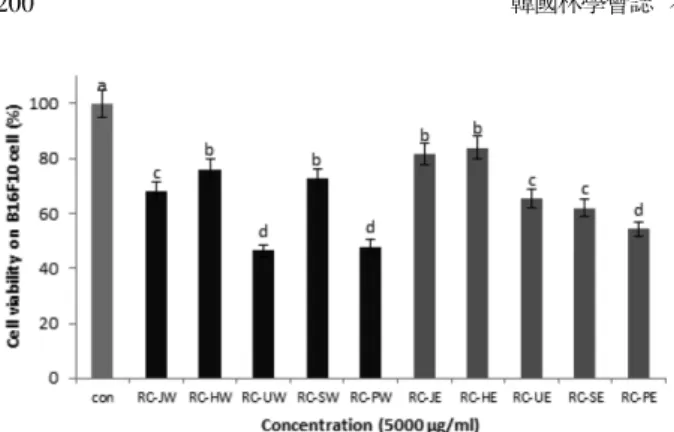
다. Mouse melanoma cell line인 B16F10 cell에 대한 MTT assay 결과는 Figure 5와 같이 나타났다. RC-UW와 RC-PE가 각각 46.4%와 54.3%의 세포 생존율을 나타내었으 며 암세포 성장이 가장 억제되었다. 본 연구에서는 산딸기 추출물 5,000 µg/ml의 농도에서 H1299 cell, MCF-7 cell 그 리고 B16F10 cell에 대하여 산딸기 열매의 열수추출물이 에 탄올추출물보다 평균적으로 높은 암세포 성장 억제효과를 보였고, 특히 H1299 cell과 B16F10 cell에 대한 성장 억제효 과가 뛰어남을 확인할 수 있었다. 산딸기 추출물의 경우 열 수추출물이 에탄올 추출물과 비교해서 우수한 항산화능과 암세포 성장 억제능을 나타내었으며, 이러한 결과는 앞으 로 더욱 심도 있는 연구를 통해 생리활성 물질의 규명과 그 기전에 대한 추가 연구가 필요할 것으로 사료된다.
이러한 결과를 바탕으로, 산딸기 품종개발을 위한 기초 자료로써 산딸기 열매의 영양적인 가치를 확인할 수 있었 고 특히 지금까지의 연구를 살펴볼 때, 아직 산딸기 추출 물에 대한 암세포 성장억제 효과에 대한 연구는 찾아보기 어려웠다. 그러므로 본 연구의 결과를 토대로 하여 향후 유용물질 함량이 우수하고 항산화 생리활성과 암세포 성 장억제 효능을 갖는 기능성 산딸기 품종을 육성하는데 도 움이 될 것으로 기대된다.
감사의 글
본 연구는 국립산림과학원에서 지원하는 2015년 연구
용역사업(과제번호 : 15-164-001)과 환경부에서 지원하는 2015년 환경산업선진화기술개발사업(과제번호 : 15-105- 001)의 연구수행으로 진행되었습니다.
References
Ahn, D.K. 1998. Ilustrated Book of Korea Medicinal Herbs.
Kyohak Publishing Co., Ltd., Seoul, Korea. pp. 946-947.
AOAC (Association of Official Analytical Chemists). 1980.
Official methods of analysis. 14th ed. Association of offi- cial analytical chemists, Washington DC, USA.
Ban, S.E., Jin, S.W., Choi, B.S., Kim, Y.S, Kim, J.K., Hwang, G.B., Seo, I.S., Koh, Y.W., and Seo, K.S. 2013. Biologi- cal active and physicochemical components of Rubus corea- nus Miquel fruits. Korean Journal of Plant Resources 5:
151.
Blois, M.S. 1958. Antioxidant determination by the use of stable free radical. Nature 181: 1199-1200.
Cha, H.S., Lee, M.K., Hwang, J.B., Park, M.S., and Park, K.M.
2001. Physicochemical characteristics of Rubus coreanus Miquel. Journal of Korean Society of Food Science and Nutrition 30(6): 1021-1025.
Cha, H.S., Youn, A.R., Park, P.J., Choi, H.R., and Kim, B.S.
2007. Comparison of physiological activities of Rubus corea- nus Miquel during Maturation. Journal of Korean Society of Food Science and Nutrition 36(6): 683-688.
Choi, J.W. Yoo, Y.M., Kim, M.Y., Nam, J.H., Nugroho, A., and Park, H.J. 2008. Anti-hyperlipidemic and anti-hyper- lipidemic effects of the triterpenoid-rich fractions from Rubus coreanus and Rubus crataegifolius and their main compo- nent, niga-ichi-goside F1, in Streptozotocin-induced dia- betic rats. Natural Product Sciences 14: 260-264.
Francis, F.J. 1989. Food colorants : Anthocyanins. Critical Reviews in Food Science and Nutrition 28: 273-314.
Giusti, M.M. and Wrolstad, R.E. 2001. Characterization and measurement of anthocyanins by UV-visible spectroscopy. In Current Procotols in Food Analytical Chemistry. Wrol- stad RE, ed. John Wiley & Sons, New York. p F1.2.1- F1.2.13.
Gross, J. and Lapiere, C.M. 1962. Collagenolytic activity in amphibian tissues: a tissue culture assay. Proceedings of the National Academy of Science of the United States of America 54: 1197-1204.
Heo, J.C., Park, J.Y., An, S.,M., Lee, J.M., Yun, C.Y., Shin, H.M,, Kwon, T.K., and Lee, S.H. 2006. Antioxidant and antitumor activities of crude extracts by Gastrodia elata Blume. Korean Journal of Food Preservation 13(1): 3-7.
Jeong, C.H., Jang, C.W., Lee, K.Y., Kim, I.H., and Shim, K.H.
2012. Nutritional components and antioxidant activities of Boysenberry. Journal of the Korean Society of Food Sci- ence and Nutrition 41(4): 450-455.
Jung, H.N., Lee, H.J., Cho H.N., and Hwang, K.T. 2012.
Figure 5. Cell viability on B16F10 cell of Rubus crataegifolius.
The cancer cells were treated for 24 h with the concentration of 5,000 µg/ml of RC. RC-JW: water extract of R. crataegifolius from Jangseong, RC-JE: ethanol extract of R. crataegifolius from Jangseong, RC-HW: water extract of R. crataegifolius from Hwaseong, RC-HE: ethanol extract of R. crataegifolius from Hwaseong, RC-UW: water extract of R. crataegifolius from Ulsan, RC-UE: ethanol extract of R. crataegifolius from Ulsan, RC-SW: water extract of R. crataegifolius from Sunchang, RC-SE: ethanol extract of R. crataegifolius from Sunchang, RC-PW: water extract of R. crataegifolius from Pohang, RC- PE: ethanol extract of R. crataegifolius from Pohang, con:
B16F10 cells were not treated samples, Results are means ± S.D. of triplicate data. a-dMeans with different superscripts within the same row are significantly different by Duncan’s multiple range test at p<0.05.
Antioxidant and anti-proliferative activities of Rubus fruits in korea. Journal of Korean Society of Food Science and Nutrition 41(12): 1649-1655.
Kim, K.J., Kim, S.J., Ban, S.E., Jin, S.W., Choi, B.S., Kim, Y.S., Kim, J.K., Hwang, G.B., Seo, I.H., Koh, Y.W., and Seo, K.S. 2013. Biological active and physicochemical components of Rubus coreanus Miquel Fruits. The Plant Resources Society of Korea 5: 151.
Kim, H.Y., Kim, I.H., and Nam, T.J. 2009. Effects of Capso- siphon fulvescens extracts amino acids absorption in rats.
Journal of Life Science 19(11): 1591-1597.
Kim, J.M. and Shin, M.S. 2011. Characteristics of Rubus corea- nus Miq. fruits at different ripening stages. Korean Jour- nal of Food Science and Technology 43(3): 341-347.
Kim, J.S. 2005. Cancer chemoprevention and NSAID-activated gene (NAG-1). Biochemistry and Molecular Biology News 25: 286-291.
Kwon, K.H., Cha, W.S., Kim, D.C., and Shin, H.J. 2006. A research and application of active ingredients in bokbunja (Rubus coreanus Miquel). Korean Journal of Biotechnol- ogy and Bioengineering 21: 405-409.
Lee, C.B. 2006. Korea illustrated plant book I. Hyang- moonsa, Seoul, Korea. pp. 532. (in Korean)
Lee, H.H., Moon, Y.S., Yun, H.K., Park, P.J., and Kwak, E.J.
2014. Contents of bioactive constituents and antioxidant activities of cultivated and wild raspberries. Korean Jour- nal of Horticultural Science & Technology 32(1): 115- 122.
Lee, S.W., Yoon, S.R., Kim, G.R., Kyung, H.K., Jeong, Y.J., Yeo, W.H., and Kwon, J.H. 2011. Effect of Nuruks and crude amylolytic enzyme on free amino acid and Volatile components of Brown Rice Vinegar prepared by static culture. Korean Journal of Food Science and Technology 43(5): 570-576.
Lee, Y.C., Lee, J.H., Kim, S.D., Chang, M.S., Jo, I.S., Kim, S.J., Hwang, K.T., Jo, H.B., and Kim, J.H. 2015. Chemi-
cal composition, functional constituents, and antioxidant activities of berry fruits produced in Korea. Journal of the Korean Society of Food Science and Nutrition 44(9):
1295-1303.
Lee, Y.J. and Kwak, E.J. 2012. Physicochemical properties and functional materials of raspberry in cultivar. Journal of the East Asian Society of Dietary Life 11: 129.
Mosmann, T. 1983. Application to proliferation and cytotox- icity assay. Journal of Immunological Methods 65: 5-63.
National Rural Living Science Institute, 2001. Food composi- tion table. 6th ed. Rural Development Administration, Repub- lic of Korea.
Orlowski, M.G., Sessa, J.P., and Green, J.P. 1974. Glutamyl transpeptidase in brain capilaries : Possible site of a blood brain barrier for amino acid. Science 184: 66-68.
Statistics Korea. 2012. 2011 Cause of Death Statistics. Dae- jeon, Korea. 9-10.
Suthanthangjai, W., Kajda, P., and Zabetakis, I. 2005. The effect of high hydrostatic pressure on the anthocyanins of raspberry (Rubus idaeus). Food Chemistry 90: 193-197.
Weinberg R.A. 2007. The biology of cancer. Garland Sci- ence, New York, NY, USA. 588-597.
World Health Organization. 2012. World Health Statistics 2012.
World Health Organization, Geneva, Switzerland. pp. 80- 81.
Youn, S.J., Cho, J.G., Choi, U.K, and Kwoen, D.J. 2007. Change of biological activity of strawberry by frozen storage and extraction method. Journal of Life Science 17(12): 1734- 1738.
Yang, J.W., Jung, S.K., Song, K.M., Kim, Y.H., Lee, N.H., Hong, S.P., Lee, K.H., and Kim, Y.E. 2015. Quality char- acteristics of Sikhye made with berries. Journal of the East Asian Society of Dietary Life 25(6): 1007-1017.
(Received: April 14, 2016; Accepted: May 23, 2016)