• 검색 결과가 없습니다.

Gradual Encryption of Medical Image using Non-linear Cycle and 2D Cellular Automata Transform

N/A
N/A
Protected

Academic year: 2021

Share "Gradual Encryption of Medical Image using Non-linear Cycle and 2D Cellular Automata Transform"

Copied!
7
0
0

로드 중.... (전체 텍스트 보기)

전체 글

(1)

Gradual Encryption of Medical Image using Non-linear Cycle and 2D Cellular Automata Transform

Tae Hee Nam

ABSTRACT

In this paper, we propose on image encryption method which uses NC(Non-linear Cycle) and 2D CAT(Two-Dimensional Cellular Automata Transform) in sequence to encrypt medical images. In terms of the methodology, we use NC to generate a pseudo noise sequence equal to the size of the original image. We then conduct an XOR operation of the generated sequence with the original image to conduct level 1 NC encryption. Then we set the proper Gateway Values to generate the 2D CAT basis functions.

We multiply the generated basis functions by the altered NC encryption image to conduct the 2nd level 2D CAT encryption. Finally, we verify that the proposed method is efficient and extremely safe by conducting an analysis of the key spatial and sensitivity analysis of pixels.

Key words: NC, CAT, PN(Pseudo Noise) Sequences, Image Encryption, Basis Functions

※ Corresponding Author : Tae Hee Nam, Address: (604- 715) 16, Sari-ro 55 beon-gil, Saha-gu, Busan, Korea, TEL : +82-51-200-3338, FAX : +82-51-200-3235, E-mail

: [email protected], [email protected]

Receipt date : Jul. 30, 2014, Revision date : Oct. 2, 2014

Approval date : Oct. 29, 2014

† Dept. of Biomedical Engineering, Dongju College

※ This research was supported by the campus research funded of the Dongju College in 2014.

1. INTRODUCTION

The rapid progress in information and commu- nications technologies has facilitated the accessing of various information and this has in turn im- proved the quality of life of individuals. Especially notable is the fact that the progress of information and communications technology has allowed digi- tal imagery contents to be circulated beyond the limitations of time and space, providing us with useful multimedia information. Recently, a ubiq- uitous environment has become the focus of atten- tion so as to maximize the utilization of such digital imagery contents. However, a ubiquitous environ- ment raises many serious issues in terms of in- formation security. Important information can be stolen by theirs who many use it for fraudulent purposes, this along with other accompanying is- sues such as hacking or the breach of privacy and copyrights are becoming serious social issues[1,2].

With the protection of information becoming such a high social priority, many studies have proposed methods of image encryption in order to prevent information leaks and to protect information[3-11].

Ateniese proposed using Visual Cryptography to conduct encryption. Scharinger proposed en- cryption using the Kolmogorov flow map, Wong a method based on the chaotic standard map, and Chen proposed an image encryption method utiliz- ing the 3D chaotic cat maps. Zhang also proposed a method of image encryption using chaotic maps, Pareek applied the of chaotic logistic map and Zhou applied the use of discretized chaotic maps[4-10].

The aforementioned method of Visual Cryptogra-

phy breaks down the original image into pixel units

to conduct encryption and therefore has the prob-

lem of being unable to conduct no loss recovery

of the image[4]. Also, encryption methods using

Maps are accompanied by problems such as the

complexity of the stage of generating the Map[7],

(2)

Fig. 2. Proposed NC structure.

the inability to conduct no loss recovery[9], and the low level of encryption[5,6,8-10]. In this paper, we propose a new medical image encryption method using NC(Non-linear Cycle) and 2D CAT(Two- Dimensional Cellular Automata Transform) to overcome the problems of existing methods such as the complexity of the method, the problem with recovery, and the low level of encryption. In terms of the methodology, we first generate PN(pseudo noise) sequences in accordance with the size of the original image, and apply an XOR operation on said sequences and the original image to convert the image into a level 1 NC encrypted image. We then set gateway values to generate 2D CAT basis functions. The generated basis functions are mul- tiplied to the NC converted image to conduct level 2 CAT encryption. Finally, experiments and stabil- ity analysis are conducted to compare the methods proposed herein with other papers in order to verify that the proposed method offers high levels of encryption.

2. PROPOSAL METHOD

This paper proposes an medical image en- cryption method using levels of NC and 2D CAT.

The proposed method is conducted by first using NC to generate PN sequences and then using this to create a basis image. The XOR operation is ap- plied to the generated basis image and the original image to create a level 1 NC encrypted image.

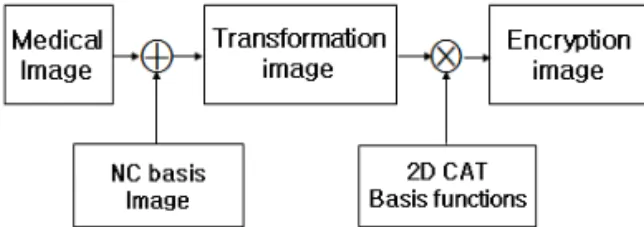
Then, 2D CAT gateway values are used to convert the level 1 encrypted image into the final encrypted image. The flowchart of the proposed encryption process is depicted in Fig. 1.

Fig. 1. Flowchart of proposed encryption method.

2.1 NC

NC is a Non-linear shift register which has the structure of a LFSR(Linear Feedback Shift Register) with an added NOT operator, and the in- put bit of which is non-linear compared to its for- mer state. This method can be used for encryption since it will have a long cycle if the feedback func- tion is efficiently selected. By using NC we can conduct XOR and NOT operations of binary plain- text and binary secret keys to each bit to generate the ciphertext, and in terms of decryption we can generate a stream cipher system that applies XOR and NOT operations to each bit of the secret key to each bit of the ciphertext to acquire the plaintext.

As this method only applies XOR and NOT oper- ators to each bit, there is no expansion of errors and the method is faster and simpler compared to block cipher algorithms. Also, NC has stronger de- fenses against known plaintext attacks compared to LFSR, as well as an enhanced cycle[11].

The structure of the NC proposed by this paper is shown in Fig. 2. The NC structure is composed of 8 bit and Non-linear feedback circuit XOR and NOT operators. The Non-linear feedback function

 is given in equation (1) and is the com- plemented vector and represents the NOT operator.

      ⊕ ⊕ ⊕ ⊕ ⊕ (1) The generation of the NC basis image utilizes equation (1). The generated NC basis image is shown in Fig. 3.

2.2 2D CAT

The basic form of CAT is the 1D CA(One-

Dimensional Cellular Automata) in which all cells

are arranged in a linear manner and form a

(3)

Fig. 3. NC basis image.

Table 1. Gateway Values

Gateway Values

Wolfram Rule 142

Number of Cells per

Neighborhood 3

Number of Cells in Lattice 8 Initial Configuration 106 Boundary Configuration Cyclic

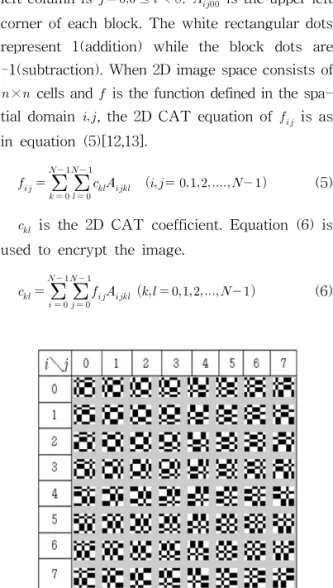
Basis Function Type A ik = 2 a a ik ki - 1 Fig. 4. 2D   dual-coefficient basis functions.

3-neighborhood structure[11]. Equation (2) is a state transition function where is a local tran- sition function which has combination logic and an arrangement state of different neighborhoods.

CA has

  state transition function.

              (2) 2D basis functions generate 2D basis functions

 in 2D CA space ≡        . The 2D basis functions are created using the 1D basis functions  as shown in equation (3).

    ·  (3)

The generation of 2D basis functions equations use the gateway values laid out in table 1. Gateway values are values used to generate 2D CAT basis functions, and are generated using the Wolfram Rule, the Number of Cells per Neighborhood, the Initial Configuration, the Boundary Configuration, and Basis Function Type etc.

The state transition function equation of cells generated by the gateway values in table 1 are as

in equation(4).

         

 

 

  

mod  (4)

In equation (4), when    and    , the con- dition is  ≤  ≤  .  is composed of combinations of neighborhood cell states. This is the 1D 3- neighborhood structure. Therefore, m=3 and

  . Here, the states of the cells are defined as      where     is time.  refers to the state of the cell number when    . The 2D CAT basis functions generated by the gateway values of table 1 are shown in Fig. 4.

 is the block at the extreme upper left corner. The top row represents  ≤  ≺    . The left column is    ≤  ≺  .  is the upper left corner of each block. The white rectangular dots represent 1(addition) while the block dots are -1(subtraction). When 2D image space consists of

 × cells and is the function defined in the spa- tial domain  , the 2D CAT equation of  is as in equation (5)[12,13].

  

  

  

   

  

     (5)

 is the 2D CAT coefficient. Equation (6) is used to encrypt the image.

                  (6)

(4)

Fig. 6. Experimental medical images.

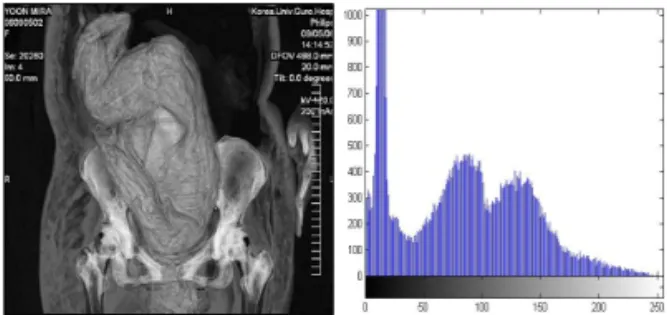
Fig. 7. Original medical image and its Histogram.

PSNR of encrypted image(PSNR=+27.4673 dB) Fig. 8. Encrypted medical image and Histogram by NC.

The steps to getting the 2D CAT basis functions are shown in Fig. 5.

Fig. 5. 2D basis functions generation process.

3. EXPERIMENT AND EVALUATION

To evaluate the performance of this encryption method, 8 bit gray level medical images were used.

The NC and 2D CAT proposed by this paper were each applied to the original image and the ensuing changes were studied. In order to study the various changes of these images, 50 medical images were used in the experimentation and some are shown in Fig. 6.

In terms of the time required to conduct en- cryption and decryption, the proposed method was faster and simpler than the algorithms using maps[6-10] as encryption is conducted by bit stream units. For the purposes of this paper, ex- perimentation was conducted using Matlab on a computer with an Intel(R) Core(TM) i5-2400 CPU

@3.10GHZ, 2G of memory, and running on Win- dows 7. As a result, the average encryption and decryption time was 0.5~1 seconds. The evaluation proposed in this chapter comparatively analyzed the three methods of using NC, 2D CAT, and using both NC and 2D CAT in a 2 level method. The histogram and PSNR(Peak Signal to Noise Ratio) values were used as the standards of evaluation.

  log  



 (7)

    ×

          

In equation (7), 255 is the maximum value of

pixels indicating 8 bit noise or brightness, and is expressed as  . Also,  is the error square average, with the  and  values representing the width and height of the image, respectively, and calculates the variance of the same location of two image data of the same size. The image subjected to experimentation and the histogram are shown in Fig. 7.

First is the stream encryption method using NC a cipher system that has periodic characteristics.

In terms of the methodology, periodic sequences are generated to generate a basis image as shown in Fig. 3. The generated basis image and original image are subjected to a XOR operation to acquire the NC applied encrypted image. Fig. 8 shows the results of XOR operating the NC basis image with the original image.

Next, the encryption method using 2D CAT generates the 2D CAT basis functions shown in Fig. 4 and multiplies it to the original image to en- crypt the image. Fig. 9 shows the results of apply- ing 2D CAT to the original image.

Finally, the image acquired by applying NC and

(5)

PSNR of encrypted image(PSNR=+26.2711 dB) Fig. 9. Encrypted medical image and Histogram by 2D

CAT.

PSNR of encrypted image(PSNR=+23.9837 dB) Fig. 10. Encrypted medical image and Histogram by NC

and 2D CAT.

2D CAT in sequence to the original image is shown in Fig. 10.

To comparatively analyze the performance of each method, the histogram and PSNR values were used to study how the pixels of the images were distributed. If we take a look at the histogram first we see that the methods using NC and 2D CAT individually have irregular cycles and high pixel densities(refer to Fig. 8, Fig. 9). However, in the method applying NC and 2D CAT in sequence, a relatively more even histogram develops compared to the previously mentioned methods and the pixel density is also low, signifying that the level of en- cryption is high(refer to Fig. 10). Also, the PSNR value, which measures the distortion of images, was quite low at 23  with the method applying both methods in sequence, signifying that the im- age distortation was great, as seen in Fig. 10. Also, by applying this method to 50 images with irregu- lar pixel cycles, we found that the PSNR value was even. When the PSNR<35   , we can visually

confirm the distortion of the image.

In conclusion we confirmed through the PSNR values and histogram that the encrypted message had even pixels with no recognizable correlation with the original image when using NC and 2D CAT together in sequence(refer to Fig. 11). There- fore, using the NC and 2D CAT methods in se- quence leads to higher levels of encryption and a stronger defense against external attacks. When decrypting, we use equation (5) to conduct inverse CAT, as the 2D CAT basis functions  are orthogonal. Then, we apply the XOR operator to the NC converted image to recover the original im- age without any loss.

Fig. 11. Original medical images, NC converted images, Encrypted images by NC and 2D CAT, Histo- gram.

4. STABILITY ANALYSIS

4.1 Key spatial analysis

The conditions laid out by this paper are 8-cell, 2-state, and 5-neighborhoods. Therefore, 2D CA is defined in equation (8).

 

        (8)

Here, T is time, K is number of cell state, m is cell number, M and N refer to the space of cell.

Therefore 2D CA generates

  

          

(

      ×  ) keys. This is a greatly improved

result compared to those of image encryption

methods using normal CA keys. Also, NC is a

stream encryption method with 1D periodic se-

(6)

quences, and has    (    ) different sequences.

Here, W and H refer to the width and height of the image. Therefore the encryption method pro- posed by this paper is capable of generating

      keys, thus offering sufficient pro- tection.

4.2 Key sensitivity analysis

and  in equations (9) refer to the value of the neighborhood pixels and refer to the numbers of total pixels.

1 1 1

2 2 2 2

1 1 1 1

( )

( ( ) ) ( ( ) )

N N N

i i i i

i i i

r N N N N

i i i i

i i i i

N x y x y

C

N x x N y y

= = =

= = = =

´ - ´

=

- ´ -

å å å

å å å å (9)

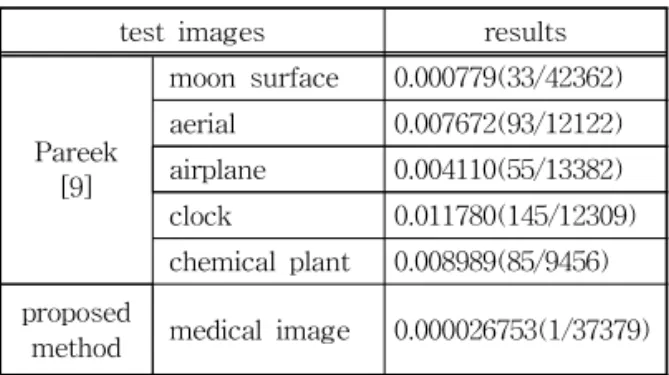
The result in proposed method and Pareek[9] of each key sensitivity is shown in table 2. In this paper, signifies a higher alteration rate in key sen- sitivity compared to Pareek[9].

Table 2. Sensitivity analysis for the cipher to key and proposed image

test images results

Pareek [9]

moon surface 0.000779(33/42362) aerial 0.007672(93/12122) airplane 0.004110(55/13382) clock 0.011780(145/12309) chemical plant 0.008989(85/9456) proposed

method medical image 0.000026753(1/37379)

5. CONCLUSION

This paper proposes a method of applying NC and 2D CAT in sequence to conduct medical image encryption. In terms of the methodology, we first generate PN(pseudo noise) sequences in accord- ance with the size of the original image to create a basis image. Then we apply an XOR operation on said sequences and the original image to convert the image into a level 1 NC encrypted image. We then multiply the 2D CAT basis functions to the

NC converted image to acquire the final encrypted result. By applying two levels of encryption as such, we can enhance the level of protection. The paper also analyzed key space and other points of stability to comparatively analyze the performance of the proposed method with that of other methods.

As a result of the comparative analysis, we con- cluded that the proposed method resulted in higher levels of encryptions than existing methods. This study is significant in that it provides a basis for creating various encryption algorithms, as altering the structure of NC is relatively simple, and differ- ent algorithms can be created by simply changing the initial values of the 2D CAT basis functions.

In future studies, analyzing the properties of 2D CAT basis functions to apply the method in vari- ous fields and studies developing high efficiency image encryption methods should be actively conducted.

REFERENCES

[ 1 ] J.W. Shin, Y. Sook, H.M. Yoo, and D.S. Park,

“A Novel Digital Image Protection using Cellular Automata Transform," The Korean Institute of Communications and Information Sciences, Vol. 35, No. 8, pp. 689-696, 2010.

[ 2 ] H.M. Lim, S.H. Lee, and B.G. Kim, “Design and Implementation of The Ubiquitous Com- puting Environment-Based on Dynamic Smart on/off-line Learner Tracking System,” Journal of Korea Multimedia Society, Vol. 14, No. 1, pp. 24-32, 2011.

[ 3 ] C. Sur, Y.H. Park, and K.H. Rhee, “A Multi- receiver Certificateless Encryption Scheme and Its Application,” Journal of Korea Multi- media Society, Vol. 14, No. 6, pp. 775-784, 2011.

[ 4 ] G. Ateniese, C. Blundo, and A. Santis, “Ex- tended Schemes for Visual Cryptography,"

Theoretical Computer Science, Vol. 250, Issues 1-2, pp. 143-161, 2001.

[ 5 ] J. Giesl and K. Vlcek, “Image Encryption

(7)

based on Strange Attractor,” ICGST-GVIP J ournal, Vol. 9, Issue 2, pp. 154-162, 2009.

[ 6 ] K.W. Wong, S.H. Kwok, and W.S. Law, “A Fast Image Encryption Scheme based on Chaotic Standard Map,” Physics Letters A, Vol. 372, Issue 15, pp. 2645-2652, 2008.

[ 7 ] G. Chen, Y. Mao, and C. Chui, “Symmetric Image Encryption Scheme based on 3D Chaotic Cat Maps,” Chaos, Solitons &

Fractals, Vol. 21, No. 3, pp. 749-761, 2004.

[ 8 ] L. Zhang, X. Liao, and X. Wang, "An Image Encryption Approach based on Chaotic Maps," Chaos, Solitons and Fractals, Vol. 24, Issue 3, pp. 759-765, 2005.

[ 9 ] N.K. Pareek, V. Patidar, and K.K. Sud, "Image Encryption using Chaotic Logistic Map,"

Image and Vision Computing, Vol, 24, Issue 9, pp. 926-934, 2006.

[10] Q. Zhou, K.W. Wong, X. Liao, T. Xiang, and Y. Hu, "Parallel Image Encryption Algorithm based on Discretized Chaotic Map," Chaos, Solitons and Fractals, Vol. 38, Issue 4, pp.

1081-1092, 2008.

[11] T.H. Nam, S.T. Kim, and S.J. Cho, "Image Encryption using Non-linear FSR and Com- plemented MLCA," Proceeding of 2009 International Conference of Maritime Infor- mation and Communication Sciences, Vol. 2, No. 1, pp. 168-171, 2009.

[12] O. Lafe, Cellular Automata Transforms: Theory and Application in Multimedia Compression, Encryption, and Modeling, Kluwer Academic Publishers Norwell, MA, USA, 2000.

[13] H.K. Kim, T.H. Nam, S.J. Cho, and S.T. Kim,

“A Novel Image Encryption using Comple- mented MLCA based on NBCA and 2D CAT,”

The Korean Institute of Communications and Information Sciences, Vol. 36, No. 6, pp. 361- 367, 2011.

Tae-Hee Nam

He received the Ph.D. degree

from the department of elec-

tronics engineering, Pukyong

National University, Republic of

Korea in 2010. Since march

1993, he has been a professor,

department of biomedical en-

gineering, Dongju College, Republic of Korea. His cur-

rent research interests are in medical image processing

and analysis.

수치

Fig. 2. Proposed NC structure.
Table 1. Gateway Values
Fig. 7. Original medical image and its Histogram.
Fig. 11. Original medical images, NC converted images,  Encrypted images by NC and 2D CAT,  Histo-gram.
+2

참조

관련 문서

The thickness of the maxillary sinus lateral wall according to tooth site and measurement level was measured by using image-processing software and its histologic

The magnetic flux leakage inspection method is more advanced than the magnetic particle inspection method in terms of quantitative evaluation and can detect flaws and

In the proposed method, the motion of focused object and the background is identified and then the motion vector information is extracted by using the 9

After the experiment, driver’s drowsiness was identified accurately by using the method of summing up the state of driver’s eyes open and closes over time and

In this regard, to overcome the limitations associated with quantitative evaluation of ECT using the bobbin probe and to consider the field requirements in terms of scanning

In this paper, it is implemented the image retrieval method based on interest point of the object by using the histogram of feature vectors to be rearranged.. Following steps

• Apply principle of impulse and momentum to find variation of linear and angular velocities with time. • Relate the linear and angular velocities when the sphere stops

The results of the UoB database showed that the largest recognition rate of the proposed method was delivered by using five training sets, which is the