Algorithm of Holding Time Control Using Delay-Tolerant Packet for Energy-Efficient Transmission
Ryu Seung Min†⋅Choi Won Seok††⋅Choi Seong Gon†††
ABSTRACT
This paper proposes an energy transmission method to maximize energy efficiency of a based station. This method makes use of classification of service type to solve an inefficient use of transmission power, which is from exponential relationship between the legacy data throughput and transmission power. The proposed one is a way to find the most energy-efficiency points with the transmitted optimal amount of data on users in a base station of wireless network environment. For this, we propose EETA (Energy-Efficient Transmission Algorithm) which can control the amount of data and the holding time at the base station. As a result, the proposed method can improve the energy efficiency of about 10% compared to the legacy base station.
Keywords : Wireless Data Transmission, Energy-Efficiency, Base Station, Next Generation Network, Type of Service
에너지 효율적인 전송을 위한 지연 허용 패킷의 유지시간 제어 알고리즘
류 승 민†⋅최 원 석††⋅최 성 곤†††
요 약
제안된 논문은 기지국의 에너지 효율을 최대화하기 위한 에너지 전송 방식에 관한 것으로, 기존의 데이터 처리량과 송신전력 사이의 지 수 함수적 관계에 따른 비효율적 문제를 해결함으로써 서비스의 유형에 따른 데이터를 분류하고, 무선 네트워크 환경의 기지국에서 사용자 들에게 전송 되는 최적의 데이터 량에 따른 에너지 최적화 지점을 찾아내는 방법이다. 이를 위해, 기지국에서 사용자에게 전송되는 데이터 의 양 및 유지시간을 조절하여 데이터 전송의 에너지 효율 최적화 지점을 찾을 수 있는 EETA 알고리즘(Energy-Efficient Transmission Algorithm)을 제안한다. 결과적으로 제안한 방식은 기존 기지국 대비 에너지 효율이 약 10% 향상됨을 알 수 있다.
키워드 : 무선 데이터 전송, 에너지 효율, 기지국, 차세대 네트워크, 서비스 타입
1. Introduction1)
Next generation networks (NGNs) are evolving to become green networks that are highly energy-efficient.
Because of its growth over the next few years, the IT industry is expected to account for approximately 10% to 15% of the world’s carbon emissions. Owing to this rapid growth in power consumption, energy-saving methods are
※ 이 논문(도서, 작품)은 2014년도 충북대학교 학술연구지원사업의 연구비 지원에 의하여 연구되었음.
※ 이 논문은 2015년도 정부(미래창조과학부)의 재원으로 한국연구재단의 지원을 받아 수행된 연구임(No. NRF-2015R1A2A2A03004152).
†준 회 원 : 충북대학교 전파통신공학전공 석사과정
††비 회 원 : Fisys 선임연구원
†††종신회원 : 충북대학교 정보통신공학부 정교수 Manuscript Received : April 5, 2016 Accepted : April 19, 2016
* Corresponding Author : Seong Gon Choi([email protected])
required [1].
In particular, with the deployment of wireless broadband connectivity and increasing demands to share entertain- ment multimedia over wireless networks around the world, energy-efficient transmission is regarded as one of the most promising technologies for NGNs [2, 3].
Research into improved methods of energy efficiency for hardware [4, 5], sleep mode control schemes based on traffic volume [5-7], base station (BS) operation methods using cell cooperation [8-11] and traffic shaping methods [12-16], has been conducted in order to reduce the total energy consumption of a BS.
However, current wireless transmission systems basically increase transmission power to meet the signal-to-noise ratio (SNR) of the receiver. That is, higher transmission
power translates into higher signal power at the receiver, but it is an inefficient method in terms of energy usage, because the relationship between throughput and transmission power is an exponential function.
The amount of transmitted data, which is one of the most effective factors for power consumption in a BS, can be classified into real-time (RT) data and non-real- time (NRT) data, depending on the nature of the delay sensitivity. In general, RT service is sensitive to quality of service (QoS) factors, such as delay and jitter. On the other hand, NRT service is tolerant to the above mentioned QoS factors, so it is relatively easy to schedule [16, 17].
Therefore, this paper addresses the current challenges of energy-efficient transmission systems by proposing a novel approach. The main contributions of this paper are summarized as follows.
∙ We propose an energy-efficient transmission algorithm (EETA). Specifically, 1) in order to maximize energy- efficiency in the BS, we classified data by the type of service (i.e., RT and NRT); and 2) we verified the most energy-efficient point that indicates the optimal amount of data transmitted by the BS to users in a wireless cellular network.
∙ Based on this classification, the proposed EETA controls holding time and the amount of data transmitted from the BS to users in three possible cases: 1) the total amount of data transmitted from the core network (CN) to the BS is smaller than the optimal point; 2) although the total amount of data transmitted from the CN to the BS is larger than the optimal point, the amount of RT data is smaller than the optimal point; and 3) the total amount of data transmitted from the CN to the BS is larger than the optimal point, and the amount of RT data is also larger than the optimal point.
∙ Numerical results are provided to demonstrate the effectiveness of the proposed EETA in terms of the theoretical approach.
2. Related Works
2.1 Hardware Improvement
A lot of research has been conducted into reducing energy consumption in terms of hardware redesign and the hardware system. In particular, most of this research into energy efficiency in BSs focused on improving PA efficiency. The power consumption of the base station is dominated by the PA, and it is influenced by frequency band, modulation and operating environment [4].
Now, information and communications technology standards are required to consider high speed data trans- mission like LTE, LTE-Advanced and WiMAX. These techniques use multiple-input, multiple-output (MIMO) technology to increase frequency efficiency of the hardware versus energy consumption, with transmission require- ments for high data rates [5].
2.2 Sleep Mode Control
Intuitively, one energy-saving method is to turn the transceiver off or on, according to the need for trans- mission and reception. In order to reduce energy con- sumption, it is one of the best ways to stop using power.
However, it is difficult to handle traffic when the transceiver is completely powered off [5-7].
2.3 Cell Cooperation Techniques
In a cellular network, traffic load has fluctuations in space time, based on user mobility or behavior. In general, traffic load is higher during the day in office areas, compared to home areas, but it is the other way around at night. Therefore, each cell has a different traffic load, based on the above-mentioned factor. However, cell size is not optimized to the fluctuation in traffic load. Because traffic fluctuations can be severe, in cellular networks based on microcells, picocells or femtocells, the power management method requires a solution in which the base station cooperates with adjacent base stations at the network level [8].
Cell breathing is a method for reducing power, load and interference through hand off to an adjacent base station at the network level. Energy savings can be expected through selective operation of the sleep mode based on traffic load and considering the energy con- sumption of the base station. When some cells operate in sleep mode or are switched off, wireless coverage can be guaranteed through cooperation of adjacent base stations that are in active mode [9].
Cell zooming is a power management technique that adaptively controls cell size of the base stations to balance traffic load and reduce energy consumption according to network traffic conditions at the network level. Each cell is cooperatively controlled. When the number of users increases in a cell, the probability of congestion increases in the network. Therefore, the size of the cell is reduced to mitigate the congestion probability, and the size of an adjacent cell expands to share the traffic load. Furthermore, when a cell operates in sleep mode to reduce power consumption, adjacent cells expand
Notations Explanation
The total amount of transmitted data from CN to BS at time t
The amount of RT data transmitted from CN to BS at time t
The amount of NRT data transmitted from CN to BS at time t
The optimal point of the amount of data transmitted from CN to BS
The amount of buffered data in the BS at time t
The total amount of data transmitted from BS to users at time t
The total amount of RT data transmitted from BS to users at time t
The total amount of NRT data transmitted from BS to users at time t
The optimal point of the amount of data transmitted from BS to users Table 1. Summary of Notation
coverage to support users who were served by the cell in sleep mode [10].
2.4 Traffic Shaping Techniques
Traffic shaping technique is an algorithm using traffic characteristics to reduce consumption of energy or to increase transmission efficiency. In general, traffic shaping technique for energy-saving is used to increase time of sleep mode based on delay characteristic [12-16].
Traffic shaping algorithms can be used to save energy in MTs or BSs. Generally, traffic shaping methods have been used as technique to reduce energy consumption by increasing time of sleep mode.
In energy-saving method using traffic shaping, shaped traffic is buffered in storage, and then is transmitted to next hop when opportunity is occurred in accordance with its algorism. An analysis of the buffer is one of issue to be considered in the traffic shaping method.
Even though energy-saving methods for base stations are being proposed with the various approaches mentioned above, a base station basically transmits data by increasing transmission power in order to meet the SNR. Increasing SNR is equal to the effort to provide higher throughput to the user. However, simply increasing the transmission power is inefficient in terms of energy-efficient trans- mission because the relationship between throughput and transmission power is in the form of an exponential function.
Therefore, we propose a novel transmission scheme to optimize energy efficiency by holding time control of transmission data using a protocol property.
3. Proposed Energy-Efficient Transmission Algorithm
In this section, we verify the most energy-efficient point, which indicates the optimal amount of data to be
transmitted from BS to users. Furthermore, we present the procedure for the proposed EETA to deal with three possible situations.
3.1 The Most Energy-Efficient Data Transmission Point in a Base Station
According to Shannon’s theorem [18], we consider the relationship between the average received SNR value among users () and the average transmission capacity among users ( ) as given by :
× log × (1)
where, is the required minimum bandwidth of a user, and is the channel gain factor.
By using Equation (1), transmission power can now be represented as a function of the data transmission rate for the BS, as follows:
××
(2)
where is the path-loss between BS and user, and is the noise power at the receiver [18]. We can now obtain the transmission power by using Equation (2).
The total power consumption in a BS mainly comes from two aspects: 1) transmission power () consumed, which is the product of the transmitted data from BS to users; and 2) circuit power () consumed, which includes baseband processing, DC-DC transfer, cooling, main supply, etc [19]. Therefore, the total power consumption in a BS () is the sum of .
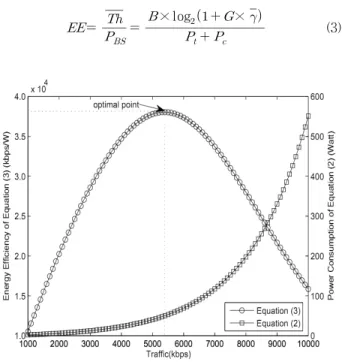
From Schmelz et al. [20], energy efficiency () is defined as the amount of data transferred per unit power consumed by the BS and can be expressed as:
× log ×
(3)
Fig. 1. Energy efficiency and transmission power with respect to throughput.
Fig. 1 shows energy efficiency and transmission power with respect to throughput, and we confirmed the most energy-efficient point for the wireless cellular network by using Equation (3) and Table 1. In order to maintain the optimal point as shown above, the proposed EETA controls holding time and the amount of data transmitted from the BS to users by shaping the amount of NRT data differently for each situation.
3.2 Operating Procedure of the Proposed EETA for Each Possible Situation
We include a summary of notations in Table 1. The proposed EETA classifies data according to RT and NRT service so as to maintain the most energy-efficient point (shown in Fig. 1) and tries to provide service at the optimal point as far as possible. In detail, the pseudo- code in Algorithm 1 shows the procedure of the proposed EETA according to each situation.
∙ In Case 1, i.e., ≺ , if there are no buffered NRT data in a BS, i.e., , the BS transmits all of the incoming data to users; at this time,
. On the other hand, if there are buffered NRT data, i.e., ≻ , the BS transmits the amount of incoming data equivalent to the amount of RT and buffered NRT data in order to meet the optimal point; at this time,
≤ , The amount of NRT data can be expressed as follows:
× ≤ ≤ (4)
where indicates how much of the buffered NRT data must be combined with the RT data when the BS transmits incoming data to users
∙ In Case 2, i.e., ≻ and ≺ , the BS transmits the amount of incoming data equivalent to the amount of all RT data and some NRT data in order to meet the optimal point; at this time,
, and the rest of the NRT data must be buffered in the BS.
∙ In Case 3, i.e., ≻ and ≻ , the BS first transmits the amount of incoming RT data to users in order to meet user’s expected QoS at this time, ≻ . After the amount of RT data becomes smaller than the optimal point (i.e., Case 1 or Case 2), the BS transmits data to users according to each case.
1: Waiting for incoming data at BS
2: Classify incoming data by type of service
3: if ≤ then
4: buffering for
5: transmit data to user as much as ≤ 6: else
7: if ≤ then
8: transmit data to user as much as
9: else
10: buffering for
11: transmit data thuser as much as
12: end if 13: end if
Algorithm 1. Pseudo-code of the proposed EETA
4. Performance Analysis
In this section, we analyze the performance of the proposed method and the existing method.
4.1 Energy-Efficiency Analysis
We present energy-efficiency related metrics for each case to evaluate the performance of the proposed method.
Energy efficiency at time t is expressed as follows:
(5)
And by using Equation (5), the average cumulative energy efficiency (ACEE) is expressed as follows:
(6)
where T in Equation (6) is the total transmission time from BS to users. in equations (5) and (6) is a variable that can be obtained differently in each case.
Specifically, in the existing method, the BS always transmits the total amount of data to users, as much as is received from the CN. That is, always equals
. On the other hand, in the proposed method,
varies depending on each situation.
4.2 Performance Evaluation
We evaluated the performance of the proposed EETA and the existing method, and analyzed them numerically with parameters shown in Table 2. We calculate the noise power and the path loss of Equation (2) through parameters in Table 2.
System Parameters Value/Assumption
Circuit power 95 W
Bandwidth 1.4 MHz
Cell size 3 km
Coding rate 0.5
RT:NRT 56:44
Table 2. System Parameters
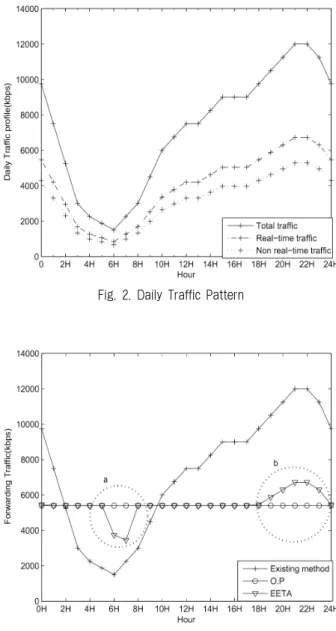
Fig. 2 shows the daily data traffic pattern based on the Energy Aware Radio and Network Technologies (EARTH) project [21], and the ratio of the amount of RT and NRT data based on research by Sandvine [22]. To evaluate energy efficiency in this work, we assumed that the shape of daily traffic pattern can be replaced by a sine function, and the ratio of RT and NRT data is fixed.
The solid line is the total amount, the dashed line is the real-time traffic volume, and the dotted line represents the non-real-time traffic volume of incoming traffic from a network. However, the traffic profile is a profile of the average traffic in the experiment. It may be different with traffic profiles per time in the real world.
Fig. 3 shows the amount of transmitted data from BS to users when the amount of transmitted data is as shown in Fig. 2. The proposed EETA tries to provide service at the optimal point (OP) as much as possible.
When RT traffic is larger than the OP, the RT is transmitted without additional delay to guarantee QoS.
However, as shown in Fig. 3, a base station in existing systems transmits total traffic to a mobile terminal without changing the amount of data.
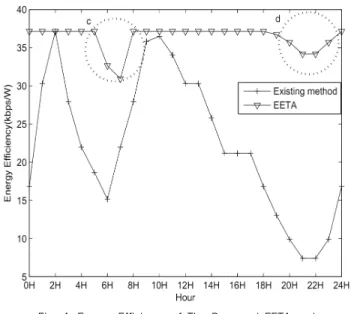
Fig. 4 shows energy efficiency according to Fig. 3, which is obtained with equations (3) and (5). When the amount of incoming RT data exceeds the optimal point, the proposed EETA executes additional transmission of the RT data to guarantee QoS.
Fig. 2. Daily Traffic Pattern
Fig. 3. The amount of transmitted data from base station to users.
Fig. 4. Energy Efficiency of The Proposed EETA and The Existing Method
Fig. 5. ACCE of The Proposed EETA and The Existing Method
As shown in Fig. 4, the existing method, which does not considering energy efficiency, BS always transmits the total amount of data to users as much as received data from CN. As a result, its energy efficiency appears fluctuated according to the Fig. 3. Otherwise, the proposed EETA firstly decides the amount of transmitted data from BS to users considering energy efficiency so its performance in terms of energy efficiency in BS always appears greater than the existing method.
As shown in Fig. 4, in the existing method, which does not considering energy efficiency, the BS always transmits the total amount of data to users as much as is received from the CN. As a result, its energy efficiency fluctuates according to Fig. 3. Otherwise, the proposed EETA first decides the amount of transmitted data from BS to users considering energy efficiency, so its performance in terms of energy efficiency of the BS always appears greater than the existing method. As shown in area c of Fig. 4, energy efficiency is lowered because the transmitted traffic volume is lower than optimal point, according to area a of Fig. 3. As shown in area d of Fig. 4, the energy efficiency is lowered because RT traffic volume is higher than the optimal point according to area b of Fig. 3. In other words, area d of Fig. 4 shows energy efficiency was slightly reduced to satisfy QoS for RT traffic.
Fig. 5 shows the ACEE and the difference between the proposed EETA and the existing method. Unlike the existing method, the proposed EETA controls the amount of data transmitted from BS to users. Therefore, the ACEE of the proposed EETA maintains higher value than the existing method.
5. Conclusion
In this paper, we address the current challenges to energy-efficient transmission by proposing a novel approach. We propose an energy-efficient transmission algorithm. In order to maximize energy efficiency of the base station (BS), we classified data by the type of service and verified the most energy-efficient point, which indicates the optimal amount of data transmitted from BS to users in a wireless cellular network. Based on this classification, the proposed EETA controls holding time and the amount of data transmitted from BS to users in three possible cases. Numerical results are provided to demonstrate the effectiveness of the proposed EETA in terms of the theoretical approach. When compared with the existing method, the proposed EETA gives significantly increased energy efficiency. In conclusion, we anticipate that our approach will provide a good solution for enhancing energy efficiency of a BS.
Moreover, we plan to analyze loss rate, buffer size, and more for buffered non-real-time data in near future.
References
[1] V. Coroama and L. M. Hilty, “Energy consumed vs. energy saved by ict–a closer look,” Proc. EnviroInfo, pp.353-361, 2009.
[2] D. G. Yun, H. J. Kim, and S. G. Choi, “The delay-guaranteed mechanism for providing real-time service in intergrated
architecture of epon and wimax,” ICT Convergence (ICTC), 2011 International Conference on, IEEE, pp.614-615, 2011.
[3] J. Lee, B. C. Yeo, J. S. Kim, M. S. Jang, and J. K. Choi, “Energy efficient scalable video coding based cooperative multicast scheme with selective layer forwarding,” Communications Letters, IEEE, Vol.17, No.6, pp.1116-1119, 2013.
[4] J. Louhi, “Energy efficiency of modern cellular base stations,”
Telecommunications Energy Conference, 2007. INTELEC 2007. 29th International, IEEE, pp.475-476, 2007.
[5] J. Chang, Z. Abichar, and C. Y. Hsu, “Wimax or lte: Who will lead the broadband mobile internet?” IT Professional, Vol.12, No.3, pp.26-32, 2010.
[6] R. Wang, J. S. Thompson, H. Haas, and P. M. Grant, “Sleep mode design for green base stations,” Communications, IET, Vol.5, No.18, pp.2606-2616, 2011.
[7] L. M. Correia, D. Zeller, O. Blume, D. Ferling, Y. Jading, I.
Gódor, G. Auer, and L. Van Der Perre, “Challenges and enabling technologies for energy aware mobile radionetworks,” Com- munications Magazine, IEEE, Vol.48, No.11, pp.66-72, 2010.
[8] Z. Hasan, H. Boostanimehr, and V. K. Bhargava, “Green cellular networks: A survey, some research issues and challenges,” Communications Surveys & Tutorials, IEEE, Vol.13, No.4, pp.524-540, 2011.
[9] L. Schmelz, J. Van Den Berg, R. Litjens, K. Zetterberg, M.
Amirijoo, K. Spaey, I. Balan, N. Scully, and S. Stefanski,
“Self-organisation in wireless networks-use cases and their interrelation,” Wireless World Res. Forum Meeting, pp.1-5, 2009.
[10] Z. Niu, Y. Wu, J. Gong, and Z. Yang, “Cell zooming for cost-efficient green cellular networks,” Communications Magazine, IEEE, Vol.48, No.11, pp.74-79, 2010.
[11] M. Wildemeersch, T. Quek, C. Slump, and A. Rabbachin,
“Cognitive small cell networks: energy efficiency and trade-offs,” Communications, IEEE, Vol.61, No.9, pp.4016- 4029, 2013.
[12] R. Gupta and E.C. Strinati, “Base station duty cycling and traffic buffering as a means to achieve green communi- cations,” Vehicular Technology Conference (VTC Fall), 2012 IEEE, pp.1-6, 2012.
[13] S. Yang, X. Li, and T. F. Ngai, “Diadem: Prefetch-based traffic shaping for energy saving in wireless networks,”
Proceedings of the 2011 IEEE/ACMInternational Conference on Green Computing and Communications, pp.114-119, IEEE Computer Society, 2011.
[14] A. Cenedese, M. Michielan, F. Tramarin, and S. Vitturi, “An energy efficient traffic shaping algorithm for ethernet based multimedia industrial traffic,” Emerging Technology and Factory Automation (ETFA), 2014 IEEE, pp.1-4, 2014.
[15] M. Hoque, M. Siekkinen, J. K. Nurminen, et al., “On the energy efficiency of proxy-based traffic shaping for
mobile audio streaming,” Consumer Communications and Networking Conference (CCNC), 2011 IEEE, pp.891-895, 2011.
[16] W. S. Choi, Y. Lee, and S. G. Choi, “Energy-efficient l2 transmission scheme in ieee 802.11 wlan,” Communications Letters, IEEE, Vol.19, No.3, pp.455-458, 2015.
[17] ITU-T, “End-user multimedia qos categories,” 2001.
[18] L. L. Peterson and B. S. Davie, Computer Networks: a systems approach 5th ed., MorganKaufmann, 2011.
[19] Xin Li, Hao Wang, Nan Liu, and Xiaohu You, “Dynamic user association for energy minimization in macro-relay network,”
Wireless Communications & Signal Processing (WCSP), 2012 IEEE, pp.1-5, 2012.
[20] ITU-T, “Energy efficiency metrics and measurement methods for telecommunication equipment,” 2012.
[21] A. Ambrosy, M. Wilhelm, W. Wajda, and O. Blume,
“Dynamic bandwidth management for energy savings in wireless base stations,” Global Communications Conference (GLOBECOM), 2012 IEEE, pp.3502-3507, 2012.
[22] B. Don, “Global internet phenomena report,” tech. rep., Sandvine, 2011.
Ryu Seong Min
e-mail : [email protected]
He received B.S degree in School of Electrical & Computer Engineering, Chungbuk National University, Korea in 2015 respectively. He is currently a M.S candidate in School of Electrical &
Computer Engineering, Chungbuk National University. His research interests include mobile communications, Smart grid, network architectures and protocol.
Choi Won Seok
e-mail : [email protected]
He received B.S degree in School of Electrical & Computer Engineering, Chungbuk National University, Korea in 2008 respectively. M.S. and Ph.D. degree from Chungbuk National University, Korea in 2008 and 2015, respectively. He is currently a senior researcher in Fisys. His research interests include NGNs, energy-saving networks, and mobility.
Choi Seong Gon
e-mail : [email protected]
He received B.S. degree in Electronics Engineering from Kyeongbuk National University in 1990, and M.S. and Ph.D.
degree from KAIST, Korea in 1999 and 2004, respectively. He is currently an professor in School of Electrical & Computer Engineering, Chungbuk National University. His research interests include mobile communications, green networks, and high-speed network architectures and protocols