1. INTRODUCTION
Vision is the main way that humans perceive the world. The information obtained by the human brain through the visual system accounts for more than 80% of all sensory information. To realize the intelligence of the video surveillance system, it is necessary to let the surveillance system not only passively provide video data, but also can auto- matically analyze and process the video content.
The computer vision technology is to realize the surveillance system from “visible” to “seeing clear- ly” The key technology for change [1]. By con- tinuously improving the video analysis technology, the monitoring system can accurately and timely detect abnormal behavior in the monitoring picture in a large amount of video data, give the alarm in the fastest and best way, and identify the suspi- cious target. Realize automatic intelligent monitor-
ing.
2. RELATED WORK
2.1 Intelligent video analysis method
Video Analysis (VA), also known as Video Content Analysis (VCA), the industry will use vid- eo analytics technology video surveillance called intelligent video surveillance (Intelligent Video Surveillance IVS).
Intelligent video analysis technology was born in the 90s of last century. Once this technique or- iginated in computer vision, it has attracted the at- tention of some advanced scientific research in- stitutes abroad and set off an upsurge of research.
The VSAM system[2] belongs to the early devel- oped intelligent monitoring system, which can only identify and track simple targets such as in- dividuals and vehicles. Afterwards, the ADVISOR
Low Resolution Rate Face Recognition Based on Multi-scale CNN
Ji-Yuan Wang
†, Eung-Joo Lee
††ABSTRACT
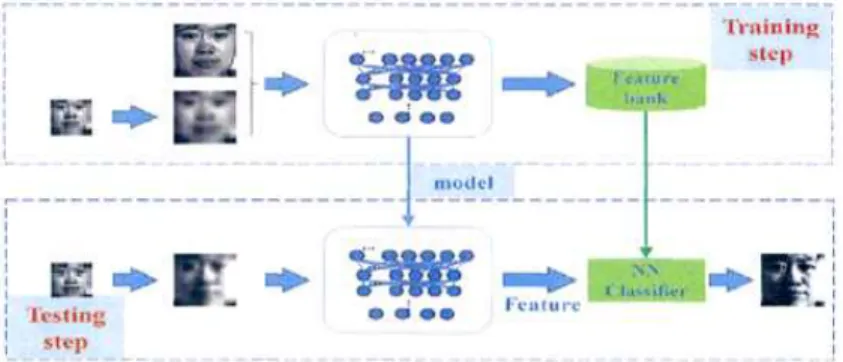
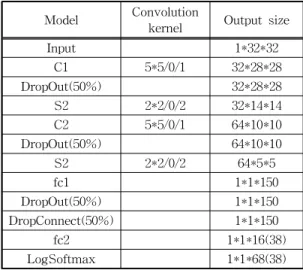
For the problem that the face image of surveillance video cannot be accurately identified due to the low resolution, this paper proposes a low resolution face recognition solution based on convolutional neural network model. Convolutional Neural Networks (CNN) model for multi-scale input The CNN model for multi-scale input is an improvement over the existing "two-step method" in which low-resolution images are up-sampled using a simple bi-cubic interpolation method. Then, the up sampled image and the high-resolution image are mixed as a model training sample. The CNN model learns the common feature space of the high- and low-resolution images, and then measures the feature similarity through the cosine distance. Finally, the recognition result is given. The experiments on the CMU PIE and Extended Yale B datasets show that the accuracy of the model is better than other comparison methods. Compared with the CMDA_BGE algorithm with the highest recognition rate, the accuracy rate is 2.5%~9.9%.
Key words: Face Recognition; Intelligent Video Analysis Method; CNN; Multi-scale CNN
※ Corresponding Author : Eung-Joo Lee, Address: 428, Sinseon-ro, Nam-gu, Busan, Korea, TEL : +82-51-629- 1143, FAX : +82-, E-mail : [email protected], ej- [email protected]
Receipt date : Oct. 8, 2018, Approval date : Oct. 31, 2018
††
Dept. of Information and Communication Engineering, Tongmyong University
(E-mail : [email protected],[email protected])
††