반도체디스플레이기술학회지 제19권 제2호(2020년 6월) Journal of the Semiconductor & Display Technology, Vol. 19, No. 2. June 2020.
96
A Study of Machine Learning based Face Recognition for User Authentication
Chung-Pyo Hong*†
*†Chief Technology Officer, LG Electronics
ABSTRACT
According to brilliant development of smart devices, many related services are being devised. And, almost every service is designed to provide user-centric services based on personal information. In this situation, to prevent unintentional leakage of personal information is essential. Conventionally, ID and Password system is used for the user authentication. This is a convenient method, but it has a vulnerability that can cause problems due to information leakage. To overcome these problem, many methods related to face recognition is being researched. Through this paper, we investigated the trend of user authentication through biometrics and a representative model for face recognition techniques. One is DeepFace of FaceBook and another is FaceNet of Google. Each model is based on the concept of Deep Learning and Distance Metric Learning, respectively. And also, they are based on Convolutional Neural Network (CNN) model. In the future, further research is needed on the equipment configuration requirements for practical applications and ways to provide actual personalized services.
Key Words : Machine Learning, Deep Learning, Neural Network, Authentication, Face Recognition
1. Introduction1
According to brilliant development of smart devices, many related services are being devised. And, almost every service is designed to provide user-centric services based on personal information. In this situation, to prevent unintentional leakage of personal information is essential. Conventionally, ID and Password system is used for the user authentication. This is a convenient method, but it has a vulnerability that can cause pro- blems due to information leakage. Therefore, in recent years, as a part of utilizing the characteristics of the face- to-face authentication method, biometric based Multi- Factor Authentication is gradually being used [1]. These days, as machine learning technologies are being applied to the biometrics field, FAR (False Acceptance Rate) and FRR (False Rejection Rate) are reduced. Based on this circumstances, many methods of authenticating users by
†E-mail: [email protected]
using biometrics alone have been introduced. Biometric recognition refers to personal identification using bio- metric information such as fingerprint, iris, hand vein, retina, handwriting, face, and voice. Recently, a finger- print or face recognition is used as a biometric technology for user identification in a smart phone.
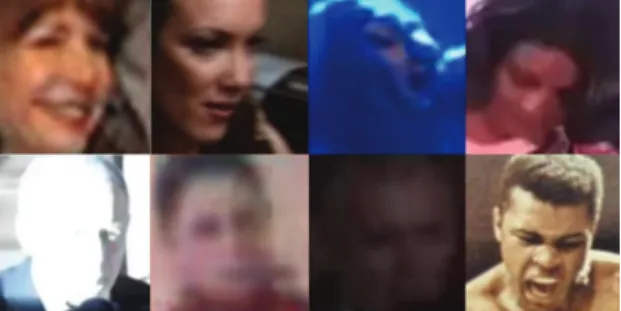
Specially, face recognition technology can be utilized in many ways, for its characteristics of easy identifi- cation without contact [2]. However, there are difficulties in authenticating the user through the face due to various factors such as light and shadow. Fig. 1. shows the examples of face images that can be obtained in a real environment [3].
This paper introduces several studies of face recognition model, specially based on machine learning techniques. In Section 2, we review the basic concept machine learning. Section 3 shows representative face recognition schemes. Finally, conclusions are presented in Section 4.
A Study of Machine Learning based Face Recognition for User Authentication
Journal of KSDT Vol. 19, No. 2, 2020 97
Fig. 1. Examples of face images that can be obtained in a real environment.
2. Background
In this section, we describe basic concept of machine learning techniques, and we also describe the object recognition scheme based on vision information.
2.1 Machine Learning
Machine learning is a method of operating a machine through reasoning ability based on the results of learning.
In other words, when a specific data set is provided to a machine, the machine learns the related rules by itself and outputs the result of applying the rule for additional data.
Among these machine learning techniques, deep learning, which mimics human neurons and configures multiple layers of learning layers between inputs and outputs to provide more advanced results, is in the spotlight [4]. Fig. 2. presents the diagram of Deep Learning Model [5].
Fig. 2. A Diagram of Deep Learning Model.
Among the machine learning models based on deep learning, a convolutional neural network (CNN) is an important technique used for object recognition. The next section describes the basic concept of CNN and object recognition through it [6].
2.2 Convolutional Neural Network
The convolutional neural network (CNN) adopts a feed-forward network method that extracts a topological feature from an input image. CNN removes features from the input image and then classifies the features extracted through a classifier [6,7]. Therefore, it has strong characteristics in basic shape transformation such as scaling, transformation, squeezing, rotation, and de- formation. The CNN structure consists of a convolu- tional layer, a pooling layer and a fully connected layer [8]. The convolutional layer, consisting of the weights of the local links and inter-functions, is a key part of CNN.
In this layer, the input function expression is interpreted, and a number of functional maps are constructed. The pooling layer located in the middle of the two con- volutional layers.
It has a function extraction effect and plays a role of reducing the size of the function map and increasing the robustness of the function extraction. The size of the functional map of the pooling layer is determined according to the moving stage of the kernel. The con- volutional neural network classifier has one or more fully connected layers, and every single neuron in one layer is connected to every single neuron in the next layer [9].
Fig. 3. shows a Typical Convolutional Neural Network (CNN) model [10].
Fig. 3. A Typical Convolutional Neural Network.
3. Face Recognition Scheme
Among machine learning-based face recognition techniques, Google's FaceNet and Facebook's DeepFace are typical examples. FaceNet is based on distance metric learning, however DeepFace is based on deep learning model. We will introduce each one through the following sections. And also, the face data sets which can be used for learning phase of each face recognition model.
Chung-Pyo Hong
반도체디스플레이기술학회지 제19권 제2호, 2020 98
3.1 Deep Learning Approach
DeepFace uses CNN technology. Before providing learning data or inference data to a CNN-based network, it performs preliminary work to build accurate data. This includes 3D facial geometry-based landmark extraction and alignment through rotation (Affine). Then, learning is performed through a convolution network composed of 9 layers. DeepFace achieved a 97.35% accuracy on the Labeled Faces in the Wild (LFW) data set, leading the way in a highly successful era of face recognition [11]. However, it is a disadvantage of learning about 120 million neural network parameters. Fig. 4. shows the 3D landmark extraction and alignment steps [11].
Fig. 4. 3D landmark extraction and alignment.
3.2 Distance Metric Learning Approach
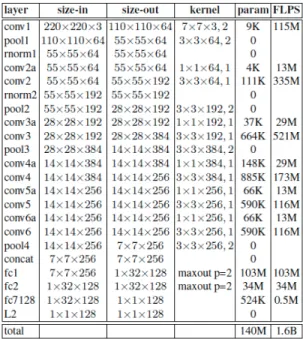
FaceNet is a face recognition model based on Distance Metric Learning, as mentioned earlier. This is based on the redefinition of the loss function. The loss function utilized by FaceNet is a triplet-loss technique. This is based on the fact that the embedding value output through CNN has a smaller Mahalanobis Distance than if it is the same person [12]. The basic structure is com- posed of 22 layers of Deep Network. Fig. 5. is a structure of FaceNet Network Model and Fig. 6. is a conceptual diagram of Triplet-Loss mechanism [13].
Fig. 5. Machine Learning Concept based on Triplelet-Loss.
Fig. 6. Structure of FaceNet Network Model.
3.3 Large Size Public Face Data Set
In practice, a large data set is required for face learning.
Companies that are easy to collect face data, such as Google and Facebook, use their own data. However, these data are not available from an academic standpoint.
To solve this problem to some extent, public data sets exist. The most widely used among them are LFW [14]
and YouTube Face [15].
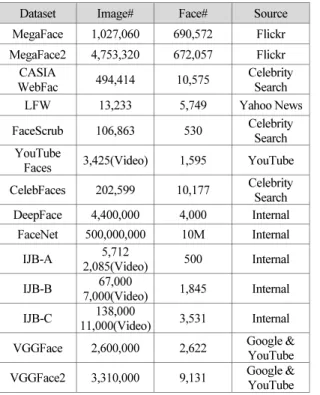
The most widely used LFW was released in 2009. It consists of 13,233 photos of 5,749 celebrities. Since it is data obtained in a natural environment, it provides vari- ous features such as lighting, shadows, facial expressions, and poses that can be encountered in real situations.
Unfortunately, learning and verification data are not distinguished, so they are mainly used for verification of recognition performance. The verification accuracy using LFW in face recognition through recent research reaches 99.73%. Table 1. shows the Data Sets for Face Reco- gnition [3]
4. Conclusion
Through this paper, we investigated the trend of user authentication through biometrics and a representative model for face recognition techniques. Various studies
A Study of Machine Learning based Face Recognition for User Authentication
Journal of KSDT Vol. 19, No. 2, 2020 99
Table 1. Data Sets for Face Recognition
Dataset Image# Face# Source
MegaFace 1,027,060 690,572 Flickr MegaFace2 4,753,320 672,057 Flickr
CASIA
WebFac 494,414 10,575 Celebrity Search
LFW 13,233 5,749 Yahoo News
FaceScrub 106,863 530 Celebrity Search YouTube
Faces 3,425(Video) 1,595 YouTube CelebFaces 202,599 10,177 Celebrity Search DeepFace 4,400,000 4,000 Internal
FaceNet 500,000,000 10M Internal IJB-A 5,712
2,085(Video) 500 Internal IJB-B 67,000
7,000(Video) 1,845 Internal IJB-C 138,000
11,000(Video) 3,531 Internal VGGFace 2,600,000 2,622 Google &
YouTube VGGFace2 3,310,000 9,131 Google &
YouTube are in progress and as a result, it was found to be very useful. In the future, further research is needed on the equipment configuration requirements for practical appl- ications and ways to provide actual personalized services.
References
1. Hyung-Jin Mun, “A Study on the User Identification and Authentication in the Smart Mirror in Private”, Journal of Convergence for Information Technology, vol.9, no.7, pp.100-105, 2019.
2. H. J. Moon, S. H. Kim, “Face Recognition : A Survey”, Korea Information Processing Society Review, vol.20, no.3, pp.14-23, 2013.
3. H. I. Kim, J. Y. Moon, J. Y. Park, “Research Trends for Deep Learning-Based High-Performance Face Recogni- tion Technology”, Electronics and Telecommunications Trends, vol.33, no.4, pp.43-53, 2018.
4. H. S. Choi, Y. H. Cho, “Analysis of Security Problems of Deep Learning Technology”, Journal of the Korea Convergence Society, vol.10, no.5, pp.9-16, 2019.
5. Artem Oppermann, “What is Deep Learning and How does it work?”, (https://towardsdatascience.com/what- is-deep-learning-and-how-does-it-work-2ce44bb692ac), Nov. 2019.
6. Y. H. Lee, Y. S. Kim, “Comparison of CNN and YOLO for Object Detection”, Journal of the Semiconductor &
Display Technology, vol.19, no.1, pp.85-92, 2020.
7. Alex Krizhevsky, Ilya Sutskever, Geoffrey E. Hinton,
“ImageNet Classification with Deep Convolutional Neural Networks”, Communications of the ACM, vol.
60, no.6, 2017.
8. Rahul Haridas, Jyothi RL, “Convolutional Neural Networks: A Comprehensive Survey”, International Journal of Applied Engineering Research, vol.14, no.3, pp.780-789, 2019.
9. Ali Sharif Razavian, Hossein Azizpour, Josephine Sullivan, Stefan Carlsson, “CNN Features Off-the-Shelf:
An Astounding Baseline for Recognition”, IEEE Con- ference on Computer Vision and Pattern Recognition, pp.512-519, 2014.
10. Hyochang Ahn, Yong-Hwan Lee, “A Research of CNN- based Object Detection for Multiple Object Tracking in Image”, Journal of the Semiconductor & Display Technology, pp.110-114, 2019.
11. Yaniv Taigman, Ming Yang, Marc’Aurelio, Lior Wolf,
“DeepFace: Closing the Gap to Human-Level Perfor- mance in Face Verification”, CVPR 2014, 2014.
12. Jae Sung Choi, “Predictive Maintenance of the Robot Trouble Using the Machine Learning Method”, Journal of the Semiconductor & Display Technology, 2020.
13. Florian Schroff, Dmitry Kalenichenko, James Philbin,
“FaceNet: A Unified Embedding for Face Recognition and Clustering”, CVPR 2015, 2015.
14. Labeled Faces in the Wild,
UMass(http://vis-www.cs.umass.edu/lfw/) 15. YouTube Faces DB,
TAU(https://www.cs.tau.ac.il/~wolf/ytfaces/)
접수일: 2020년 6월 25일, 심사일: 2020년 6월 26일, 게재확정일: 2020년 6월 26일