한국 전통 목조건축 숭례문의 구조성능 및 동적특성 평가
김 영 민1†
1명지대학교 건축학부
Evaluation of Structural Performance and Dynamic Characteristics of Korean Traditional Timber Structure Sungnyemun
Yeong-Min Kim1†
1College of Architecture, Myongji Univ., Yongin, 17058, Korea
Abstract
In this research, the structural analysis and safety evaluation for Sungnyemun -No.1 national treasure of Korea- was performed.
Roof loads were calculated in detail, and structural analysis model was constructed using Midas Gen ver.820. Static structural analysis under vertical loads was performed and safety of main structural members and serviceability of main horizontal members were evaluated. To evaluate dynamic characteristics of Sungnyemun, both field measurements by impact hammer test and eigenvalue analysis by structural analysis software were performed and the results were compared. Sungnyemun showed rooms in their structural capacity.
Keywords : sungnyemun, structural analysis, safety evaluation, eigenvalue analysis
†Corresponding author:
Tel: +82-31-330-6490; E-mail: [email protected] Received October 11 2015; Revised November 1 2015;
Accepted November 2 2015
Ⓒ 2015 by Computational Structural Engineering Institute of Korea
This is an Open-Access article distributed under the terms of the Creative Commons Attribution Non-Commercial License(http://creativecommons.
org/licenses/by-nc/3.0) which permits unrestricted non-commercial use, distribution, and reproduction in any medium, provided the original work is properly cited.
1. Introduction
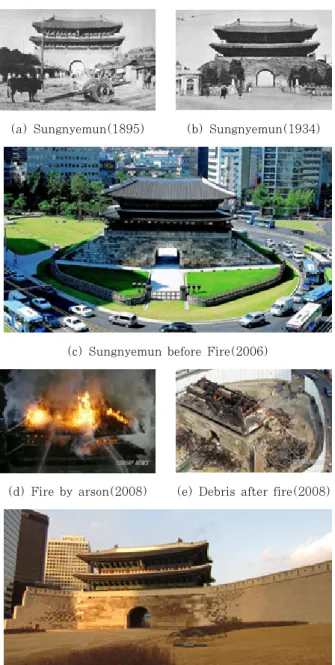
Sungnyemun as shown in Fig. 1(a)~(c) is currently No.1 national treasure of South Korea. It was built in 1398 - the early establishment stage of Chosun Dynasty - in the capital city of Chosun Dynasty, in the process of building new capital city.
At that time, it took about three years to build Sungnyemun. Sungnyemun served as a main gate of Seoul and survived numerous wars and natural disasters for about 600 years. But, unfortunately, Sungnyemun was burned out by arson 10th Feb. 2008 as shown in Fig.1(d)~(e). Most parts of the 2nd floor were demolished, but fortunately most parts of the 1st floor survived the fire. After about five years of hard restoration work, Sungnyemun took back its original appearance as shown in Fig 1(f). In the
restoration processes, traditional materials and construction methods were taken.
Researches on the Korean traditional timber structures have been carried out consistently by domestic researchers. Generally, researches were carried out on the (1) traditional timber residential house, which is called Hanok, (2) Buddhist temple building, and (3) palace buildings. Min et al.(2011) performed dynamic analysis for Heunginjimum, which has similar appearance to the Sungnyemun, and evaluated its structural capacity, and Han et al.(2005) and Seo et al.(1999) studied on the structural performance of tenon joints under lateral load. Hwang et al.(2009) performed shaking table test on the timber Buddhist temple building and evaluated its dynamic characteristics. Lee et al.(2006) and Lee et al.(2007) performed both
(a) Sungnyemun(1895) (b) Sungnyemun(1934)
(c) Sungnyemun before Fire(2006)
(d) Fire by arson(2008) (e) Debris after fire(2008)
(f) Sungnyemun after restoration(2013)
Fig. 1 The history of Sungnyemun-before fire and after restoration.
(Reference : (a)~(c) : Report on detailed measurement survey of Sungnyemun 2006,
(d)~(e) :Yonhap news 2008).
experiments and structural analysis and evaluated lateral load capacity of Korean traditional timber structures.
As researches on the new-styled Hanok, recently built by the modernized construction method, Kim (2014a) performed both eigenvalue analysis and dynamic experiments for a two-storied new-styled Hanok and extracted its dynamic characteristics.
Large sized timber, which is used as main structural
members of Hanok, has characteristics of cracking and splitting as it dries. The most influential factor to the splitting of timber is moisture contents.
Kim(2014b) monitored moisture contents for both traditional and new-styled Hanok and analyzed the effecting factors to the moisture contents.
In abroad, on researches to the timber structure, Kang et al.(2011) evaluated stiffness of mortise and tenon joint in Chinese traditional column and tie timber structure. Lindt et al.(2010) performed shaking table test on a light frame wooden building to evaluate seismic response. Fang et al.(2001a, b) performed full-scale shaking table test on an ancient Chinese timber structure to analyze load-displacement rela- tionship.
In this research, structural analysis and safety evaluation for Sungnyemun was performed. Roof loads were calculated in detail, and analysis model was constructed using structural analysis software, Midas Gen ver.820. Static structural analysis under vertical loads was performed and safety of main structural members and serviceability of main horizontal members were investigated. To evaluate dynamic characteristics of Sungnyemun, eigenvalue analysis was performed using structural analysis software, and these results were compared with the field measurements of impact hammer test done by Prof. Hwang, from Cheonnam University.
2. Constructing the Analysis Model
Sungnyemun is two-story Korean traditional timber structure used as official building to guard the main gate to the capital city, Seoul. The size of Sungnyemun is 28m in width, 12.6m in depth and 11.4m in height as shown in Fig. 2. The main vertical loads acting on Sungnyemun is its roof loads.
The roof load of 2nd floor is about 8.3kN/m2, and that of 1st floor is about 7.2kN/m2. The roof loads act as shown in Fig. 3. The timbers used in Sungnyemun are 1st grade Pine, and this was adopted in analysis model.
Due to the heavy roof loads, long-spanned main
(a) Front elevation of Sungnyemun
(b) Side elevation of Sungnyemun
Fig. 2 Elevation and main dimension of Sungnyemun
(a) Load distribution on main horizontal beams
(b) Distribution of roof loads
Fig. 3 Roof loads and load distribution of Sungnyemun
(a) Deflection of main horizontal beams on 1st floor
(b) Deflection of main horizontal beams on 2nd floor
(c) Column splitting on 1st floor
(d) Column splitting on 2nd floor
Fig. 4 Deflection of main horizontal members and splitting of columns
horizontal framing members of Sungnyemun undergo severe deflection which can be seen by naked eyes as shown in Fig. 4(a)~(b). And large sized timbers
are used as the structural members of Sungnyemun, most members undergo severe splitting as shown in Fig. 4(c)~(d).
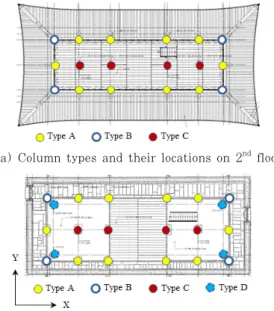
Fig. 5 shows column types of both on 1st and 2nd floors according to their locations and compositions method. Fig. 6 shows structural analysis model of Sungnyemun constructed by structural analysis software, Midas Gen ver. 820. In constructing structural analysis model, the construction methods and connection types were considered in detail. Fig.
6(a) shows the whole structural analysis model, Fig.
6(b) shows analysis model hiding roof envelope, and Fig. 6(c)~(d) show structural frames in both Y and X directions.
(a) Overall deflection by long-term loads
(b) Deflection of Y-directional frames where columns exist
(c) Deflection of Y-directional center frames
(d) Deflections of X-directional center frames Fig. 7 Deflection of Sungnyemun by structural analysis
(unit : mm) (a) Column types and their locations on 2nd floor
(b) Column types and their locations on 1st floor Fig. 5 Column types and their locations both on 1st
and 2nd floors
(a) The whole structural analysis model
(b) Structural analysis model without roof envelope
(c) Main structural frames in Y direction
(d) Main structural frames in X direction
Fig. 6 Structural analysis model of Sungnyemun by Midas Gen
3. Results of Structural Analysis 3.1 Static Analysis
The static structural analysis of Sungnyemun under long-term vertical loads was performed by structural analysis software, Midas Gen. The overall deflection is shown in Fig. 7(a). In Fig. 7(b)~(d), deflection of main frames both in Y and X direction
(a) Detailed deflection of main span horizontal members
(b) Deflection of main horizontal beams on 2nd floor
(c) Deflection of main horizontal beams on 1st floor Fig. 8 Detailed deflection of peripheral main
horizontal members(unit : mm)
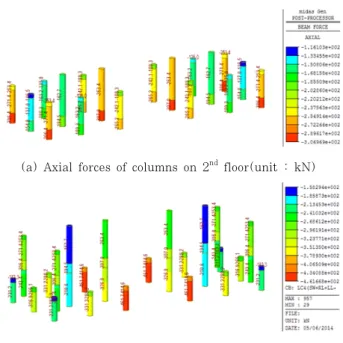
(a) Axial forces of columns on 2nd floor(unit : kN)
(b) Axial forces of columns on 1st floor(unit : kN) Fig. 9 Axial forces of columns on 2nd and 1st floors
(a) Bending moment diagram of peripheral main horizontal members of 2nd floor(unit : kNm)
(b) Shear force diagram of peripheral main horizontal members of 2nd floor(unit : kN)
Fig. 10 Member forces of peripheral main horizontal members
Member
Measured Deflection
(mm)
Analyzed Deflection
(mm)
Allowable Deflection
(mm) South of 2nd floor 33.0 27.4 29.2 North of 2nd floor 33.0 27.4 29.2 South of 1st floor 45.0 12.3 29.2 North of 1st floor 20.0 12.3 29.2 Table 1 Structural evaluation of long-term deflections are shown.
Fig. 8 shows detailed deflection of peripheral main horizontal members. In Table 1, long-term deflections are compared both by field measurement and structural analysis. The field measurement was done by Prof. Hong, Seoul national University. Although structural analysis is very hard to simulate the actual situations, the results show that the structural analysis was done in a very accurate level.
But, the deflection of ChangBang in south of 1st floor showed much difference between measured and analyzed deflection. It is thought that, the material properties of this member is somewhat lower than the ordinary members.
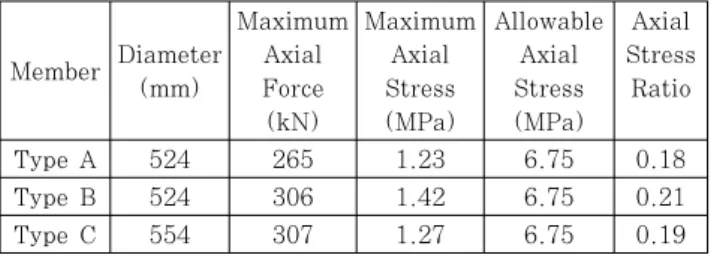
Fig. 9 shows axial forces of columns on both 2nd and 1st floors. In Table 2 and 3, axial stresses of columns on both 2nd and 1st floors are evaluated.
The maximum axial stress ratio of columns on 2nd floor is 0.21 and that of the 1st floor is 0.28.
Member Diameter (mm)
Maximum Axial Force (kN)
Maximum Axial Stress (MPa)
Allowable Axial Stress (MPa)
Axial Stress
Ratio
Type A 524 265 1.23 6.75 0.18
Type B 524 306 1.42 6.75 0.21
Type C 554 307 1.27 6.75 0.19
Table 2 Axial stress evaluation of 2nd floor columns
Member Diameter (mm)
Maximum Axial Force (kN)
Maximum Axial Stress (MPa)
Allowable Axial Stress (MPa)
Axial Stress
Ratio
Type A 554 462 1.92 6.75 0.28
Type B 554 231 0.96 6.75 0.14
Type C 554 326 1.35 6.75 0.20
Type D 524 243 1.13 6.75 0.17
Table 3 Axial stress evaluation of 1st floor columns
Member
Maximum Moment
(kNm)
Maximum Flexural
Stress (MPa)
Allowable Flexural
Stress (MPa)
Flexural Stress
Ratio PyeongBang of 2nd fl. 16.76 3.59 6.75 0.57 ChangBang of 2nd fl. 61.04 5.79 6.75 0.86 PyeongBang of 1st fl. 7.76 1.60 6.75 0.24 ChangBang of 1st fl. 36.10 2.77 6.75 0.41 Table 4 Flexural stress evaluation of peripheral main
horizontal members
Member
Maximum Shear Force
(kN)
Maximum Shear Stress (MPa)
Allowable Shear Stress (MPa)
Shear Stress Ratio
PyeongBang of 2nd fl. 8.79 0.127 0.45 0.28 ChangBang of 2nd fl. 32.17 0.334 0.45 0.74 PyeongBang of 1st fl. 5.21 0.074 0.45 0.16 ChangBang of 1st fl. 24.22 0.223 0.45 0.49 Table 5 Shear stress evaluation of peripheral main
horizontal members
It shows that columns have much room in their loading capacity. In Table 4 and 5, both flexural and shear stresses of peripheral main structural members are evaluated. The results show that the main horizontal members satisfy stress requirements.
3.2 Dynamic Analysis
Two methods were taken to evaluate dynamic characteristics of Sungnyemun. One method is field measurement using impact hammer test done by
Prof. Hwang, Cheonnam University, and the results are shown in Table 6. The other method is eigenvalue analysis using structural analysis software. The mass for the eigenvalue analysis was constructed by converting roof loads and framing weight into masses, and it is shown in Table 7.
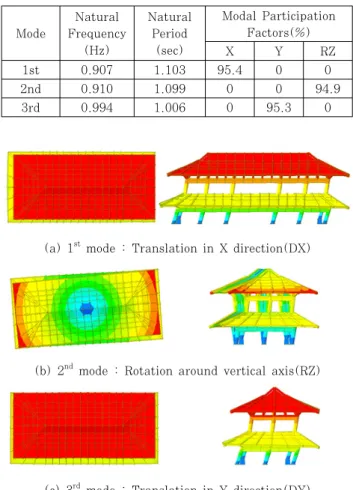
To perform dynamic analysis, the rotational stiffness of the member joints should be defined in advance. In this research, trial and error method was taken to define these relative rotational stiffness of the main structural joints between column and beam as shown in Fig. 11. By comparing results of eigenvalue analysis to those of the field measure- ments, 5% of relative rotational stiffness was chosen as an adequate value. The dynamic characteristics from eigenvalue analysis is shown in Table 8.
Vibration mode shapes for the first three modes are shown in Fig. 12. Sungnyemun had its first vibration mode in X direction, second vibration mode in rotational direction and third vibration mode in Y direction.
Mode
Natural Frequency
(Hz)
Natural Period
(sec)
Modal Participation Factors(%)
X Y RZ
1st 1.350 0.753 100 0 0
2nd 1.603 0.622 0 0 100
3rd 1.780 0.553 0 100 0
Table 6 Dynamic characteristics from field measurement
Floor Mass(kN sec2/m)
Roof Loads Frame Loads Total
2nd floor 306.2 66.1 372.3
1st floor 194.8 64.7 259.5
Summation 501.1 130.8 631.8
Table 7 Mass of Sungnyemun for eigenvalue analysis
Fig. 11 Positions where relative rotational stiffness were considered
Mode
Natural Frequency
(Hz)
Natural Period
(sec)
Modal Participation Factors(%)
X Y RZ
1st 0.907 1.103 95.4 0 0
2nd 0.910 1.099 0 0 94.9
3rd 0.994 1.006 0 95.3 0
Table 8 Dynamic characteristics from eigenvalue analysis
(a) 1st mode : Translation in X direction(DX)
(b) 2nd mode : Rotation around vertical axis(RZ)
(c) 3rd mode : Translation in Y direction(DY) Fig. 12 Main vibration modes and their shapes
4. Conclusions
In this research, structural analysis and safety evaluation for Sungnyemun was performed both by analysis software and field measurements. Analysis model was constructed considering in detail the actual construction method and materials. Structural analysis was performed by Midas Gen ver.820. As a result of static analysis, peripheral main horizontal members are somewhat dissatisfy serviceability criteria, but they satisfy stress requirements. Column members show much room in their stress capacity. As a result of dynamic analysis, Sungnyemun showed its first vibration mode in X direction, second vibration mode in rotational direction and third vibration mode in Y direction. The relative rotational stiffness of the main structural joints such as between column and beam was extracted by comparing dynamic chara- cteristics of the field measurement to those of the
eigenvalue analysis, and the relative stiffness of the joint was turned out to be 5%.
Acknowledgment
This work was supported by 2015 Research Fund of Myongji University. The author thanks to Prof.
Hong, Seoul national University and Prof. Hwang, Cheonnam University for their dedicated effort in field measurements of Sungnyemun.
References
Fang, D.P., Iwasaki, S., Yu, M.H., Shen, Q.P., Miyamoto, Y., Hikosaka, H. (2001a) Ancient Chinese Timber Architecture I: Experimental Study, J. Struct. Eng., 127(11), pp.1348~1357.
Fang, D.P., Iwasaki, S., Yu, M.H., Shen, Q.P., Miyamoto, Y., Hikosaka, H. (2001b) Ancient Chinese Timber Architecture Ⅱ: Dynamic Chara- cteristics, J. Struct. Eng., 127(11), pp.1358~
1364.
Han, J.S., Kim, C.J. (2005) An Experimental Study on Mechanical Performance of Tenon for Analysis of Structural System and Modernization of Traditional Wooden Architecture, J. Archi. Inst.
Korea : Struct. & Constr., 21(4), pp.121~128.
Hwang, J.G., Hong, S.G., Lee, Y.W., Jung, S.J.
(2009) Natural Frequency Characteristics of Tradi- tional Wooden Structure for Vibration Amplitude, J. Archi. Inst. Korea : Struct. & Constr., 25(5), pp.3~10.
Kang, M., Yang, N., Cha, Q. (2011) Studies on Static Performance of Mortise and Tenon Joint in Traditional Column and Tie Construction Timber Structure, Electric Technology and Civil Enginee- ring (ICETCE) 2011 International Conference, pp.6197~6200.
Kim, Y.M. (2014a) Dynamic Experiments on a 1-4 Scale New-styled Korean Traditional Wooden House. Appl. Mech. & Mater., 598, pp.743~746.
Kim, Y.M. (2014b) Monitoring of Moisture Contents in Korean Traditional Wooden Houses. In Procee- dings of the World Congress on Engineering 2014, pp.1298~1303.
Lee, Y.W., Bae, B.S., Hong, S.G., Hwang, J.G.,
요 지
본 논문에서는 전통 목조건축물로 되어 있는 대한민국의 국보 1호인 숭례문의 구조해석을 수행하고 안전도를 평가하였다.
전통 목조건축의 대부분의 하중을 차지하고 있는 숭례문의 지붕하중을 상세히 산정하고 숭례문의 가구구성 특징을 면밀히 살펴 범용 구조해석 소프트웨어인 midas Gen으로 구조해석모델을 구축하였다. 수직하중에 대한 정적구조해석을 수행하고 주요 수직 수평 구조부재의 안전성과 주요 수평부재의 사용성을 평가하였다. 숭례문의 동적거동특성을 평가하기 위하여 현 장에서의 충격해머실험과 구조해석 소프트웨어를 이용한 고유치해석을 수행하고 그 결과를 비교하고 주요모드를 도출하였 다. 수직하중에 대한 검토결과 숭례문은 구조적 능력에 여유가 있는 것으로 나타났다.
핵심용어 : 숭례문, 구조해석, 안전도 평가, 고유치해석 Kim, N.H., Jung, S.J. (2006) An Analytical Modelling of the Beam-Direction Frame of Traditional Wood Structure System, J. Archi. Inst.
Korea : Struct. & Constr., 22(3), pp.29~36.
Lee, Y.W., Hong, S.G., Hwang, J.G., Bae, B.S.
(2007) Capacity of Lateral Load Resistance of Dori-Directional Frame with Jangbu-connection in Traditional Wood Structure System, J. Archi. Inst.
Korea : Struct. & Constr., 23(2), pp.35~42.
Lindt, J.W., Pei, S., Pryor, S.E., Shimizu, H., Isoda, H. (2010) Experimental Seismic Response
of a Full-scale Six-Story Light-Frame Wood Building, J. Struct. Eng., 136(10), pp.1262~1272.
Min, K.W., Park, S.A. (2011) Simple Structural Model and Seismic Analysis of Heunginjimum, J.
Archi. Inst. Korea : Struct. & Constr., 27(4), pp.23~30.
Seo, J.M., Choi, I.K., Lee, J.R. (1999) Static and Cyclic behavior of Wooden Frames with Tenon Joints under Lateral Load, J. Struct. Eng., 125(3), pp.344~349.