일반 및 동물복지농장 돼지의 혈액 및 근육 내 스트레스 인자 비교*
1)
이정은
**․박진룡
**․강다래
***․김희은
****․남기창
*****․심관섭
******Comparison of Stress Indicators in Blood and Muscle of Pigs in Conventional and Animal Welfare Farms
Lee, Jeong-Eun․Park, Jin-Ryong․Kang, Da-Rae․
Kim, Hee-Eun․Nam, Ki-Chang․Shim, Kwan-Seob
Intensive farming methods that do not guarantee animal welfare can induce stress in pigs. Stress, in turn, can reduce their disease resistance and influence their hormones and metabolites in such a manner that productivity is negatively affected. This study was conducted to compare the stress related factors and blood characteristics of pigs raised on conventional farms and those raised on animal welfare farms. We measured the levels of cortisol, epinephrine and norepinephrine, biochemical parameters in blood and glycogen, L-lactate and heat shock protein 70 (HSP70) in muscle, as physiological markers of indicating the stress in conventional farm pigs (Control, n=10) and animal welfare farm pigs (Welfare, n=10). We found that there was a significant difference in the albumin-globulin ratio (A/G ratio), as well as the albumin (ALB), blood urea nitrogen (BUN) and aspartate aminotransferase (AST) levels between the two farms. Epinephrine was significantly higher in conventional farm, while level of norepinephrine was higher in animal welfare farm. There was no significant difference in cortisol, which is known as a stress hormone, across the two groups of farms. Muscular glycogen content was significantly high in animal welfare farm pigs. While L-lactate tended to be low in the animal welfare farm pigs, the difference between them and the
******
본 결과물은 농림축산식품부의 재원으로 농림식품기술기획평가원의 농생명산업기술개발사업의
지원을 받아 연구되었음(318022-04-2-CG000).
******
전북대학교 축산학과 석사과정, 박사수료
******
전북대학교 동물생명공학과 박사
******
전북대학교 농축산식품융합학과 석사과정
******
순천대학교 동물자원과학과 교수
******
Corresponding author, 전북대학교 동물생명공학과, 농축산식품융합학과 교수([email protected])
conventional farm cohorts was not significant. HSP70 showed high levels of expression in conventional farm. Thus, we suggested that blood parameter results showed a stress response in the livers of conventional farm, and that catecholamine hormones, glycogen, L-lactate and HSP70 can be used as physiological factors of assessing animal welfare.
Key words : animal welfare, blood parameter, hormone, pig, stress
Ⅰ. 서 론
세계동물보건기구(OIE)는 동물복지란 ‘동물이 건강하고 안락하며 좋은 영양 및 안전한 상황에서 본래의 습성을 표현할 수 있으며, 고통 ․ 두려움 ․ 괴롭힘 등의 상태를 겪지 않는 것’이라 하였다(Park, 2017). 최근 수십 년간 전 세계적으로 축산물 소비가 증가함에 따라 동물에게 스트레스를 유발하는 집약적 방식으로 축산물 생산이 이루어져왔으며, 밀집사육 으로 인한 가축의 면역력 저하로 인해 계속되는 질병의 발생으로 지속가능하고 안전한 식 품에 대한 소비자들의 관심이 전 세계적으로 증가하고 있다(Webster, 2001; Grunert et al., 2018). 이에 따라 소비자들은 육류생산과정과 관련하여 동물의 위생, 건강 및 동물복지를 고려한 축산물 생산을 원하고 있다(Briggeman and Lusk, 2011; Van Loo et al., 2014). 또한 2009년 한-EU FTA에서 동물복지가 주요 의제로 채택되었다. 따라서 동물복지는 앞으로 축 산업에서 경쟁력을 확보하고 이를 유지하기 위한 필수적인 요소이다(Broom, 2010; Velarde et al., 2015).
일반적으로 축산업에서 가축의 스트레스는 기후, 영양, 사육시설 및 밀도, 피로도 및 취 급방법에 의해 발생되며(Etim et al., 2014), 스트레스 환경에 노출되면 시상하부-뇌하수체- 부신 축(HPA axis, Hypothalamic-pituitary-adrenal axis)을 활성화시키며, 면역계, 자율신경계 및 내분비계에서 생리적 변화를 야기한다(Burchfield, 1979). 스트레스로 인해 활성화된 HPA axis는 cortisol, epinephrine및norepinephrine을 혈액으로 방출시키고, 이들은 항상성 유지를 위해 체내 에너지 대사를 변화시킨다(Foury et al., 2005; Candiani et al., 2008). 특히 돼지에서 epinephrine 및 norepinephrine이 증가하면 골격근에서 glycogen함량이 감소하고, lactate 함량 은 높아지며 이로 인해 DFD (Dark-firm-dry)육의 생성이 유도된다(Bliss and Zwanziger, 1966;
Fernandez and Tornberg, 1991; Levy et al., 2003). 또한 밀집사육으로 인한 공기 중의 암모니 아 증가가 지속되어 체내 암모니아가 축적되면 근육 세포에 독성을 나타낸다(Jones et al., 1972). 따라서 집약적 사육 방식으로 인해 동물에 스트레스가 가해지는 것은 동물의 건강과 육질에 부정적인 영향을 주며, 동물이 질병에 더 취약하게 됨을 의미한다(Broom and Corke, 2002).
Etim 등(2014)은 동물이 스트레스를 받는 환경에서 동물복지가 실현될 수 없다 하였다.
일반적으로 사용되는 스트레스의 정의는 항상성에 변화가 생겼을 때 유발되는 생물학적 반 응이며(Moberg and Mench, 2000), Duncan (2005)은 생물학적 기능의 측정, 특히 건강 저하 및 생리적 스트레스 반응 증가와 관련된 인자들을 분석함으로 동물복지가 보장되고 있는지 에 대한 증거를 제공할 수 있다 하였다.
최근 돼지의 스트레스 감지 및 관리와 동물복지 측정 지표에 관한 연구 필요성이 강조되 면서(Etim et al., 2014; Martínez-Miró et al., 2016), 동물복지를 통한 가축의 건강 및 생리적 스트레스 완화에 관한 연구의 중요성이 대두되고 있지만, 현재 국내 일반농장과 동물복지 농장 돼지의 스트레스 인자와 혈액 성상을 분석하여 스트레스 수준을 비교한 논문은 거의 없다. 따라서 본 연구는 국내 집약적 사육방식의 일반농장과 동물복지농장 돼지의 건강상 태와 생리적 스트레스 수준을 분석하여 두 농장의 동물복지 수준을 나타내는 스트레스 관 련 인자에 대한 기초자료로 활용하기 위해 수행하였다.
Ⅱ. 재료 및 방법
1. 공시동물
본 연구에 이용된 공시동물은 일반농장(Control)과 동물복지농장(Welfare)에서 사육된 돼 지(LYD; Landrace × Yorkshire × Duroc)를 각 10두씩 사용하였다. 동물복지농장의 돼지는 한 국 축산법에서 제시한 동물복지 양돈농장 지침 밀도에 따라 60 kg 이상일 때, 최소 휴식공 간이 0.66 m2 이상이고 최소 소요면적이 두당 1 m2 이상의 동물 복지가 저해되지 않는 공 간에서 사육되었다. 샘플은 평균 180일령의 돼지를 도축 후 등심(Longissimus dorsi) 부위를 채취하여 실험실로 이동하였고, 분석 전까지 -80℃에 보관하였다. 혈액 샘플은 도축 시 방 혈되는 혈액을 채취하여 분석에 이용하였다.
2. 혈액 내 생화학인자
도축 시 채취한 혈액을 원심 분리(3,000 rpm, 10 min, 4℃) 후 혈청을 수거하여 분석 전까 지 -80℃에 보관하였다. 혈청 내 alkaline phosphate (ALP), total protein (TP), total bilirubin (T-BIL), creatinine (CREA), cholesterol (CHOL), albumin-globulin ratio (A/B Ratio), triglyceride (TG), uric acid (UA), alanine aminotransferase (ALT), albumin (ALB), blood urea nitrogen (BUN), glucose (GLU), aspartate aminotransferase (AST), globulin (GLOB), creatine kinase (CK)는 Hitachi 2070 (Hitachi, Tokyo, Japan)를 이용하여 분석하였다.
3. 혈액 내 호르몬
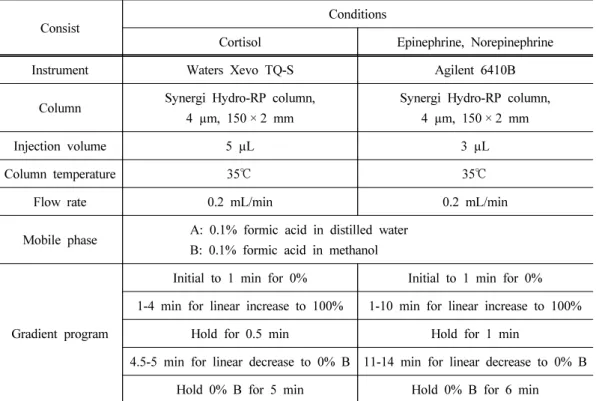
혈액 내의 cortisol, epinephrine 및 norepinephrine 함량은 LC-MS/MS를 이용하여 분석하였 다. 혈청 100 µL에 methanol 900 µL를 넣고 vortexing 하여 -20℃에서 1시간 동안 incubation 하였다. 모든 샘플은 다시 원심분리(14,000 rpm, 10 min, 4℃) 후, 상등액을 분주하여 샘플 vial에 넣고 LC-MS/MS에 주입하였다. 각 호르몬의 표준물질은 Sigma (St. Louis, MO, USA) 에서 구입하여 사용하였다. Cortisol (Waters Xevo TQ-S, USA)과 epinephrine 및 norepinephrine (Agilent 6410B, USA)의 분석 조건은 Table 1과 같다.
Table 1. LC-MS/MS condition for cortisol, epinephrine, and norepinephrine analysis
Consist
Conditions
Cortisol Epinephrine, Norepinephrine
Instrument Waters Xevo TQ-S Agilent 6410B
Column Synergi Hydro-RP column, 4 µm, 150 × 2 mm
Synergi Hydro-RP column, 4 µm, 150 × 2 mm
Injection volume 5 µL 3 µL
Column temperature 35 ℃ 35 ℃
Flow rate 0.2 mL/min 0.2 mL/min
Mobile phase A: 0.1% formic acid in distilled water B: 0.1% formic acid in methanol
Gradient program
Initial to 1 min for 0% Initial to 1 min for 0%
1-4 min for linear increase to 100% 1-10 min for linear increase to 100%
Hold for 0.5 min Hold for 1 min
4.5-5 min for linear decrease to 0% B 11-14 min for linear decrease to 0% B Hold 0% B for 5 min Hold 0% B for 6 min
4. 근육 내 glycogen 및 L-lactate 함량
근육 내 glycogen 함량은 제조업체의 지침에 따라 액체 질소와 막자사발을 이용하여 잘 게 분쇄된 근육조직 50 mg에서 Glycogen Assay kit (ab65620, Abcam)를 이용하여 분석하였 다. L-lactate 함량은 근육조직 30 mg에서 L-lactate Assay kit (ab65330, Abcam)로 제조업체의 지침에 따라 분석하였다.
5. 단백질 추출 및 Western blotting
근육 내 단백질은 근육 조직을 액체질소를 이용하여 분쇄한 다음, 분쇄된 조직에 protease inhibitor가 포함된 Radio immune precipitation assay buffer (RIPA buffer, Biosesang, Sungnam, Korea)를 넣고 균질화 한 후 원심분리(12,000 rpm, 15 min, 4℃) 하였다. 원심분리 하여 얻은 상등액을 DC kit (Bio-Rad, Hercules, CA, USA)를 이용하여 단백질 농도를 결정하였다. 단백 질 정량 후 sample은 12% acrylamide gel에서 전기영동하여 분리하였고, 분리된 단백질은 PVDF (polyvinylidene fluoride) membrane으로 옮겼다. Membrane을 TBST (20 mM Tris, 137 mM NaCl, 5 mM KCl, 0.05% Tween 20)에 5%로 희석한 skim milk로 실온에서 1시간 30분 동안 blocking 한 다음, 1차 항체 HSP70 (1:2500, ADI-SPA-820, Enzo, San Diego, CA, USA) 과 GAPDH (1:2500, sc-47724, Santa Cruz, CA, USA)를 5% Skim milk에 희석하여 4℃에서 overnight 하였다. TBST로 membrane을 washing하고 2차 항체는 goat anti-mouse IgG (Enzo, San Diego, CA, USA)를 1:5000으로 5% Skim milk에 희석하여 실온에서 1.5 h 반응시킨 후, TBST로 washing 하였다. 단백질 발현 수준은 ECL kit (SuperSignal WestPico Plus, Thermo Fisher, USA)로 반응시킨 후 iBright CL100 Imaging System (Thermo Fisher Scientific, USA)을 사용하여 시각화 하였다. 단백질 발현은 GAPDH로 표준화하였다.
6. RNA 추출 및 Real-time qPCR
근육 내 total RNA는 Accuzol Total nucleic acid extraction kit (Bioneer, Korea)로 추출하였 고 Spectrophotometer (µDrop plate, Thermo Fisher Scienctific, USA)를 사용하여 정량 하였다.
1 µg의 RNA를 cDNA synthesis kit (Bioneer, Korea)를 사용하여 cDNA로 역전사하고, mRNA 의 발현은 1 µL의 cDNA와 19 µL의 AMPIGENE® qPCR Green Mix (Enzo, San Diego, CA, USA), ultrapure distilled water (Invitrogen, Carlsbad, CA, USA)를 사용하여 CFX Real-Time System (C1000 Thermal cycler, Bio-Rad, Hercules, CA, USA)로 Real-time qPCR을 수행하였 다. 샘플을 95℃에서 5 min 동안 initial denaturation하고 40사이클 동안 95℃에서 5 sec, 60℃
Genes Primer sequences Accession number Product size (bp)
HSP70
F: 5'-GACCACGCTAATCCAGAGGA-3'
NM_001123127.1 88
R: 5'-CAGGACTCCAGGTTGGTTGT-3'
GAPDH
F: 5'-ACCCAGAAGACTGTGGATGG-3'
NM_001206359.1 79
R: 5'-AAGCAGGGATGATGTTCTGG-3'
Table 2. The primer sequences for Real-time qPCR에서 30 sec 동안 annealing을 하였다. 각 primer는 primer3 software (v.0.4.0)을 이용하여 제작 하였다(Table 2). 유전자 발현은 GAPDH 발현을 측정하여 표준화하였다.
7. 통계 분석
통계 분석은 SAS 9.4 Software program (SAS Institute Inc., USA)을 이용하여 수행되었다.
일반농장과 동물복지농장 간 비교는 Student’s t-test를 통해 유의성 검정을 하였다. 모든 결 과 값은 평균과 표준오차(Mean±SE)로 나타내었으며, 유의 수준은 P<0.05 및 P<0.01에서 분 석하였다.
Ⅲ. 결 과
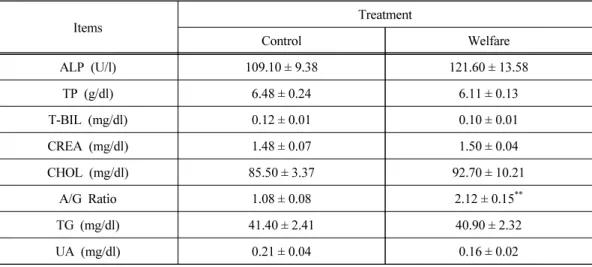
1. 혈액 내 생화학 인자일반농장과 동물복지농장 간의 혈액 내 생화학 인자 분석 결과는 Table 3와 같다. ALP, TP, T-BIL, A/G Ratio, ALT, ALB, AST, GLOB는 간 건강 상태를 간접적으로 표현하는 인자 이며, CREA. CK, BUN은 신장 기능, GLU는 당 대사, CHOL 및 TG는 지질대사와 관련된 인자이다. A/G Ratio와 ALB는 일반농장에서 낮았고(P<0.01), AST는 일반농장에서 높게 나타 났으며(P<0.05), BUN은 일반농장에서 높은 수치를 보였다(P<0.05). ALP, TP, T-BIL, CREA, CHOL, TG, UA, ALT, GLU, GLOB, CK는 두 농장 간 유의적인 차이를 보이지 않았다.
Items
Treatment
Control Welfare
ALP (U/l) 109.10 ± 9.38 121.60 ± 13.58
TP (g/dl) 6.48 ± 0.24 6.11 ± 0.13
T-BIL (mg/dl) 0.12 ± 0.01 0.10 ± 0.01
CREA (mg/dl) 1.48 ± 0.07 1.50 ± 0.04
CHOL (mg/dl) 85.50 ± 3.37 92.70 ± 10.21
A/G Ratio 1.08 ± 0.08 2.12 ± 0.15
**TG (mg/dl) 41.40 ± 2.41 40.90 ± 2.32
UA (mg/dl) 0.21 ± 0.04 0.16 ± 0.02
Table 3. Blood biochemical parameter values of experimental groups
2. 혈청 내 스트레스 관련 호르몬
혈청 내 스트레스 관련 호르몬 함량을 분석한 결과(Table 4), 일반적으로 스트레스 호르 몬으로 알려진 cortisol은 두 농장 간에 유의적인 차이를 보이지 않았다. Epinephrine은 일반 농장에서 유의적으로 높게 나타났으며(P<0.01), norepinephrine은 동물복지농장에서 더 높은 수치를 보였다(P<0.01).
Table 4. Cortisol, epinephrine, and norepinephrine levels of serum (µg/100 ml)
Items
Treatment
Control Welfare
Cortisol 3.80 ± 0.45 2.85 ± 0.43
Epinephrine 0.61 ± 0.10
**0.20 ± 0.06
Norepinephrine 55.23 ± 3.18 71.71 ± 3.95
**Values are presented as the mean ± SE, Control (n=10), Welfare (n=10).
Significant differences are indicated by ** P<0.01.
3. 근육 내 Glycogen 및 L-Lactate 함량
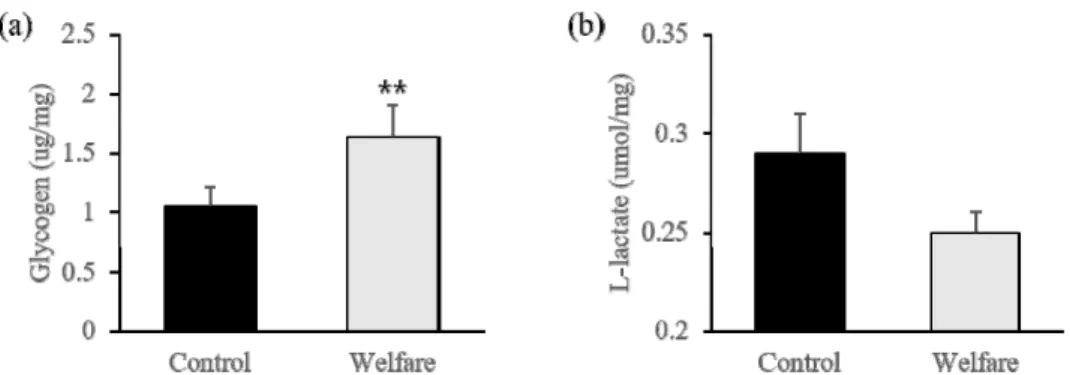
근육 내 glycogen과 L-Lactate에 대한 결과는 Fig. 1과 같다. Glycogen은 동물복지농장에서 높은 수치를 보였고(P<0.01) L-lactate는 일반농장에서 높은 경향을 보였다(P=0.122).
Items
Treatment
Control Welfare
ALT (U/l) 44.40 ± 4.60 40.67 ± 2.67
ALB (g/dl) 3.34 ± 0.17 4.12 ± 0.14
**BUN (mg/dl) 13.50 ± 1.20
*10.05 ± 0.88
GLU (mg/dl) 97.10 ± 5.36 87.60 ± 3.83
AST (U/l) 91.90 ± 18.04
*42.60 ± 4.67
GLOB 3.14 ± 0.15 2.40 ± 0.41
CK (U/l) 3683.50 ± 576.25 2461.10 ± 476.52
Values are presented as the mean ± SE, Control (n=10), Welfare (n=10).
Significant differences are indicated by * P<0.05 and ** P<0.01.
Fig. 1. Glycogen (a), and L-lactate (b) levels in the muscle tissue. Values are presented as the mean±SE. Significant differences are represented ** P < 0.01.
4. HSP70 단백질 및 mRNA 발현
근육 내 HSP70의 단백질 및 mRNA 발현 분석 결과(Fig. 2), 일반농장의 HSP70 단백질 발 현이 동물복지농장보다 높은 수준을 보였으며(P<0.01) HSP70의 mRNA 발현은 두 농장 간 에 유의차가 없었다.
Fig. 2. HSP70 protein and gene expression level of muscle tissue. (a) Protein expression bands of HSP70 and GAPDH in muscle tissue. (b) Quantification of HSP70 protein level calculated by GAPDH. (c) mRNA level of HSP70 in muscle tissue. Values are presented as the mean±SE. Significant differences are represented ** P < 0.01.
Ⅳ. 고 찰
밀집 사육으로 인한 미흡한 동물복지는 돼지의 스트레스를 유발하며 스트레스 호르몬과 체내 대사물질의 영향으로 육질 특성에 부정적인 영향을 미친다고 알려져 있다(Bliss and Zwanziger, 1966; Fernandez and Tornberg, 1991; Broom and Corke, 2002; Levy et al., 2003).
또한 Moberg (1987)는 스트레스를 받은 동물의 병리학적 상태와 생리학적 인자의 스트레스 관련 변화를 측정하는 것이 동물의 스트레스 수준을 비교하는 가장 좋은 지표라고 하였다.
혈액 내 생화학 인자 중 AST, ALT, ALP, TP, T-BIL, A/G Ratio, ALB 및 GLOB는 간 건 강 상태를 나타내는 물질이다(Kim, 2009). 본 실험에서 AST, A/G Ratio및 ALB가 두 처리구 간 유의적인 차이를 보였다. AST는 일반적인 상황에서 혈액 내 낮은 농도를 보이지만, 간 과 심장이 손상되거나 스트레스를 받게 되면 농도가 증가한다(Zhang et al., 2011; Cho and Oh, 2013; Kim et al., 2015; Ismail and Mahboub, 2016). A/G ratio와 ALB는 AST와 더불어 간 기능과 영양상태를 간접적으로 나타내는 물질로, 간 손상과 체내 단백질 대사 이상의 지표 로 사용된다(Hwang, 2009; Cho and Oh, 2013). 특히, 혈액 내 ALB 수치의 감소는 영양결핍, 소화기질환의 흡수장애, 급 ․ 만성 염증, 간 질환 등의 의의를 가진다(Cho and Oh, 2013).
Chida 등(2006)은 스트레스를 받으면 HPA axis가 활성화 되어 glucocorticoid와 catecholamine 을 증가시키고, 이는 간의 염증반응을 촉진시키며 간 질환을 유발한다 하였다. 본 연구 결 과, 일반농장에서 AST는 높은 수치를 보였고, A/G ratio와 ALB는 낮은 수치를 나타내었다.
따라서 일반농장의 돼지가 낮은 수준의 동물복지로 인해 유발된 스트레스에 의해 간 손상 을 입은 것으로 판단된다.
CREA, CK 및 BUN은 신장 기능 상태를 나타내는 물질이다(Cho and Oh, 2013). Creatine 은 신장과 간에서 합성되고, 주로 근육에 저장되며, 근 수축 에너지로 사용된 후 CK에 의해 CREA이 되고, CREA은 혈액으로 방출되어 신장을 통해서만 배설되는 물질이다(Adhihetty and Beal, 2008; Kim et al., 2015). CK는 cortisol, glucose 및 lactate와 함께 스트레스 수준을 나타내는 물질로 사용되며(Siegel and Gross, 2000), 돼지에서 CK는 신체적 스트레스 및 조직 손상의 좋은 지표로 스트레스가 증가할수록 수치가 증가한다(Fàbrega et al., 2002; Aradom et al., 2012). 본 연구 결과, 일반농장과 동물복지농장 돼지의 CREA농도는 두 농장 간 큰 차이 를 보이지 않았고, CK 농도는 일반농장의 돼지에서 더 높은 경향을 보였으나 유의적인 차 이는 없었다. BUN은 신장의 배설 기능을 나타내는 물질로 간에서 합성되는 단백질 대사의 최종 산물이다(Chu et al., 2007; Cho and Oh, 2013). Sutherland 등(2010)은 돼지가 고밀도로 밀집된 공간에서 발생한 스트레스에 반응하여 혈중 BUN농도가 증가한다고 보고하였다. 본 연구에서, 동물복지농장 보다 밀집된 공간에서 자란 일반농장에서 BUN 수치가 유의적으로 높았다.
가축이 스트레스 환경에 노출되면 HPA axis의 활성으로 방출되는 cortisol과 catecholamine
은 체내 에너지 대사에 중요한 역할을 하기 때문에, 동물복지 수준을 평가하는 인자로 이 용되어왔다(Foury et al., 2005; Candiani et al., 2008). Cortisol은 급 ․ 만성 스트레스 상황에서 지속적으로 상승하는 호르몬으로(Barnett et al., 1987; Cronin et al., 1991) 돼지가 수송 및 열 스트레스 조건 하에 있을 때 cortisol의 상향 조절이 유도된다(Dalin et al., 1993; Pérez et al., 2002; Breinekova et al., 2007; Ju et al., 2014). 본 연구에서는 두 농장의 cortisol 수치는 일반 농장에서 더 높은 경향을 보였으나 유의적인 차이는 없었다.
Catecholamine계 호르몬인 epinephrine과 norepinephrine은 급성 및 만성 스트레스에 반응 하여 혈액 내에서 증가하는 호르몬이다(Bliss et al., 1968; Roth et al., 1982; Goldstein, 1995;
Koopmans et al., 2005). 그러나 Bliss 등(1968)은 급성스트레스를 받은 mice, rats, guinea pigs, dogs, cats, rabbits 및 monkey에서 norepinephrine 수치가 감소된다고 하였다. 따라서, 동물복 지농장에 비해 일반농장에서 낮은 수준으로 분석된 norepinephrine 수치는 일반농장의 돼지 들이 동물복지농장의 돼지보다 급성 스트레스에 반응한 것으로 사료된다.
스트레스에 의한 epinephrine의 활성화는 cori cycle을 통해 골격근에서 glycogen함량을 감 소시켜 포도당을 생성하고, 근육 내 lactate 함량을 증가시킨다(Bliss and Zwanziger, 1966;
Levy et al., 2003). 또한 급성 및 만성 스트레스에 의해 근육 내 glycogen이 감소하면, 도축 후 육색이 어둡고 단단하며 건조한 DFD의 생성이 유도되며(Fernandez and Tornberg, 1991;
Adzitey and Nurul, 2011), 급성 스트레스에 의해 근육 내 glycogen이 감소하고 lactate가 축적 되어 근육 내 pH가 낮아진 경우 PSE (pale-soft-exudative)육이 생성된다(Bowker et al., 2000;
Adzitey and Nurul, 2011). 근육 내 glycogen과 L-lactate분석결과 일반농장에서 glycogen은 유 의적으로 낮은 함량을 보였고, L-lactate는 유의적인 차이는 없었으나 높은 함량을 나타냈다.
이는 일반농장에서 만성 및 단기 스트레스로 인해 유도된 epinephrine이 근육 내 glycogen을 분해해 L-lactate를 증가시킨 것으로 사료된다.
스트레스에 대한 HSP의 발현은 대부분의 살아있는 동물에서 관찰되었으며, 거의 모든 형태의 스트레스에 반응하여 합성이 유도되고, 만성 스트레스의 척도로 사용된다(De Maio, 1999; Gupta et al., 2010; Valros et al., 2013). HSP70은 스트레스 조건에서 가장 많이 유도되 는 HSP이다(Lachapelle et al., 2007; Gupta et al., 2010). Liu와 Steinacker (2001)는 HSP70은 일반적으로 스트레스를 받은 후 단백질 합성이 8~10시간 후에 최고조에 달하며 그 농도가 며칠 동안 유지된다고 하였다. 또한 Sepponen과 Pösö (2006)는 단기 스트레스 및 사전 도축 처리는 HSP70 발현 수준에 크게 영향을 주지 않으며, 돼지가 농장에서 받은 만성 스트레스 를 나타낸다 하였다. 또한 인간 근육에서 HSP70 단백질은 증가한 후 5일 동안 유지되고, Rat의 조직에서는 몇 주 동안 증가된 상태가 유지된다(Currie and White, 1983; Khassaf et al., 2001). 본 연구 결과, HSP70 단백질은 일반농장에서 유의적으로 높은 발현양을 보였으 며, HSP70은 일반농장과 동물복지농장 돼지의 스트레스 수준을 비교하는데 있어, 만성 스 트레스의 지표로 쓰일 수 있을 것으로 판단된다.
Ⅴ. 결 론
본 연구는 국내 일반 및 동물복지농장 돼지의 건강상태와 생리적 스트레스 수준을 비교 분석하여, 환경에 따른 스트레스 관련 인자들을 확인하고자 수행되었다. 혈액성상 분석결 과 일반농장의 돼지가 낮은 수준의 동물복지로 인해 간 기능 저하를 보였고, epinephrine, norepinephrine, glycogen 및 L-lactate는 급 ․ 만성 스트레스로 인하여 생리적 반응이 일어났으 며, HSP 70은 만성 스트레스에 의해 일반농장에서 단백질 발현 수준이 증가하였다. 결론적 으로, 혈액성상 분석결과 간 관련 지표에서 스트레스 반응을 보였고, catecholamine계 호르 몬과 glycogen, L-lactate 및 HSP70은 만성 스트레스 인자에 대한 동물복지 평가 인자로의 가능성을 보였으며 향후 이에 대한 검증을 위한 추가연구가 필요하다.
[Submitted, October. 13, 2020; Revised, November. 9, 2020; Accepted, November. 9, 2020]
References
1. Adhihetty, P. J. and M. F. Beal. 2008. Creatine and its potential therapeutic value for targeting cellular energy impairment in neurodegenerative diseases. Neuromolecular Med. 10:
275-290.
2. Adzitey, F. and H. Nurul. 2011. Pale soft exudative (PSE) and dark firm dry (DFD) meats:
causes and measures to reduce these incidences-a mini review. Int. Food Res. J. 18.
3. Aradom, S., G. Gebresenbet, F. S. BULITTA, E. Y. Bobobee, and M. Adam. 2012. Effect of transport times on welfare of pigs. J. Agric. Sci. 2: 544.
4. Barnett, J., P. Hemsworth, C. Winfield, and V. Fahy. 1987. The effects of pregnancy and parity number on behavioural and physiological responses related to the welfare status of individual and group-housed pigs. Appl. 17: 229-243.
5. Bliss, E. L., J. Ailion, and J. Zwanziger. 1968. Metabolism of norepinephrine, serotonin and dopamine in rat brain with stress. J. Pharmacol. Exp. Ther. 164: 122-134.
6. Bliss, E. L. and J. Zwanziger. 1966. Brain amines and emotional stress. J. Psychiatr. Re. 4:
189-198.
7. Bowker, B., A. Grant, J. Forrest, and D. Gerrard. 2000. Muscle metabolism and pse pork.
J. Anim. Sci. 79: 1-8.
8. Breinekova, K., M. Svoboda, M. Smutna, and L. Vorlova. 2007. Markers of acute stress in
pigs. Physiol. Res. 56: 323.
9. Briggeman, B. C. and J. L. Lusk. 2011. Preferences for fairness and equity in the food system. Eur. Rev. Agric. 38: 1-29.
10. Broom, D. and M. Corke. 2002. Effects of disease on farm animal welfare. Acta. Vet. Brn.
71: 133-136.
11. Broom, D. M. 2010. Animal welfare: an aspect of care, sustainability, and food quality required by the public. J. Vet. 37: 83-88.
12. Burchfield, S. R. 1979. The stress response: a new perspective. Psychosom. Med. 41: 661- 672.
13. Candiani, D., G. Salamano, g. E. Mellia, L. Doglione, R. Bruno, M. Toussaint, and E.
Gruys. 2008. A combination of behavioral and physiological indicators for assessing pig welfare on the farm. J. Appl. Anim. Welf. Sci. 11: 1-13.
14. Chida, Y., N. Sudo, and C. Kubo. 2006. Does stress exacerbate liver diseases? J. Gastroen- terol. Hepatol. 21: 202-208.
15. Cho, N. W. and E. H. Oh. 2013. A study on mda analysis & blood chemical test for mouse which were exposed hf gases from fire. J. Korean Inst. Gas. 17: 58-66.
16. Chu, K. S., S. G. Hyong, J. Y. Lee, J. Y. Kim, L. W. Seo, and B. W. Jung. 2007.
Seroprevalence of porcine reproductive and respiratory syndrome (prrs), porcine circovirus 2 (pcv-2), and mycoplasmal pneumonia of swine farms in jeonbuk-iksan. Korean J. Vet. Serv.
30: 305-312.
17. Cronin, G., J. Barnett, F. Hodge, J. Smith, and T. Mccallum. 1991. The welfare of pigs in two farrowing/lactation environments: cortisol responses of sows. Appl. 32: 117-127.
18. Currie, R. W. and F. P. White. 1983. Characterization of the synthesis and accumulation of a 71-kilodalton protein induced in rat tissues after hyperthermia. Can. J. Biochem. Cell Bio.
61: 438-446.
19. Dalin, A., U. Magnusson, J. Hæggendal, and L. Nyberg. 1993. The effect of transport stress on plasma levels of catecholamines, cortisol, corticosteroid-binding globulin, blood cell count, and lymphocyte proliferation in pigs. Acta Vet. Scand. 34: 59.
20. De Maio, A. 1999. Heat shock proteins: facts, thoughts, and dreams. Shock. 11: 1-12.
21. Duncan, I. J. 2005. Science-based assessment of animal welfare: farm animals. Rev. Sci.
Tech. Oie. 24: 483.
22. Etim, N. N., E. E. Offiong, G. D. Eyoh, and M. D. Udo. 2014. Stress and animal welfare:
an uneasy relationship. Eur. J. Med. Sci. 2.
23. Fâbrega, E., X. Manteca, J. Font, M. Gispert, D. Carriõn, A. Velarde, J. L. ruiz-de-la-torre,
and A. Diestre. 2002. Effects of halothane gene and pre-slaughter treatment on meat quality and welfare from two pig crosses. Meat Sci. 62: 463-472.
24. Fernandez, X. and E. Tornberg. 1991. A review of the causes of variation in muscle glycogen content and ultimate ph in pigs. J. Muscle Foods. 2: 209-235.
25. Foury, A., N. Devillers, M. P. Sanchez, H. Griffon, P. Le Roy, and P. Mormêde. 2005.
Stress hormones, carcass composition and meat quality in large white× duroc pigs. Meat Sci.
69: 703-707.
26. Goldstein, D. S. 1995. Stress, catecholamines, and cardiovascular disease, Oxford University Press.
27. Grunert, K. G., W. Sonntag, V. Glanz-Chanos, and S. Forum. 2018. Consumer interest in environmental impact, safety, health and animal welfare aspects of modern pig production:
results of a cross-national choice experiment. Meat Sci. 137: 123-129.
28. Gupta, S. C., A. Sharma, M. Mishra, R. K. Mishra, and D. K. Chowdhuri. 2010. Heat shock proteins in toxicology: how close and how far? Life Sci. 86: 377-384.
29. Hwang, E. 2009. Effect of quercetin supplement on major biochemical parameters in sera of rats fed high fat and high cholesterol diet. J. vet. Clin. 26: 413-418.
30. Ismail, H. T. H. and H. H. H. Mahboub. 2016. Effect of acute exposure to nonylphenol on biochemical, hormonal, and hematological parameters and muscle tissues residues of nile tilapia; oreochromis niloticus. Vet. World. 9: 616.
31. Jones, E., T. Nelson, I. Anderson, D. Kerr, and T. Burnap. 1972. Malignant hyperthermia of swine. Anesthesiology. 36: 42-51.
32. Ju, X. H., H. J. Xu, Y. H. Yong, L. L. An, P. R. Jiao, and M. Liao. 2014. Heat stress upregulation of toll-like receptors 2/4 and acute inflammatory cytokines in peripheral blood mononuclear cell (pbmc) of bama miniature pigs: an in vivo and in vitro study. Animal. 8:
1462-1468.
33. Khassaf, M., R. B. Child. A. Mcardle, D. A. Brodie, C. Esanu, and M. J. Jackson. 2001.
Time course of responses of human skeletal muscle to oxidative stress induced by non- damaging exercise. J. Appl. Physiol. 90: 1031-1035.
34. Kim, K. A. 2009. Understanding and application of liver function tests. Korean J. Intern.
Med. 76: 163-16.
35. Kim, D. W., E. C. Hong, S. Y. Ji, W. S. Lee, H. T. Bang, H. K. Kang, H. S. Kim, and S. H. Kim. 2015. Effects of dietary resveratrol on growth performance, blood biochemical parameter, immunoglobulin, and blood antioxidant activity in broiler chicks. Korean J. Poult.
Sci. 42: 33-40.
36. Koopmans, S. J., M. Ruis, R. Dekker, H. Van diepen, M. Korte, and Z. Mroz. 2005.
Surplus dietary tryptophan reduces plasma cortisol and noradrenaline concentrations and enhances recovery after social stress in pigs. Physiol. Behav. 85: 469-478.
37. Lachapelle, G., S. M. Radicioni, A. R. Stankiewicz and D. D. Mosser. 2007. Acute acidification or amiloride treatment suppresses the ability of hsp70 to inhibit heat-induced apoptosis. Apoptosis. 12: 1479-1488.
38. Levy, B., A. Mansart, P. E. Bollaert, P. Franck and J. P. Mallie. 2003. Effects of epin- ephrine and norepinephrine on hemodynamics, oxidative metabolism, and organ energetics in endotoxemic rats. Intensive Care Med. 29: 292-300.
39. Liu, Y. and J. M. Steinacker. 2001. Changes in skeletal muscle heat shock proteins:
pathological significance. Front. biosci. 6: D12-D25.
40. Martïnez-mirõ, S., F. Tecles, M. Ramõn, D. Escribano, F. Hernãndez, J. Madrid, J. Orengo, S. Martïnez-subiela, X. Manteca, and J. J. Cerõn. 2016. Causes, consequences and biomarkers of stress in swine: an update. BMC Vet. Res. 12: 171.
41. Moberg, G. P. 1987. A model for assessing the impact of behavioral stress on domestic animals. Anim. Sci. J. 65: 1228-1235.
42. Moberg, G. P. and J. A. Mench. 2000. The biology of animal stress: basic principles and implications for animal welfare. CABI. New york, USA.
43. Përez, M., J. Palacio, M. Santolaria, M. Aceóa, G. Chacõn, M. Gascõn, J. Calvo, P.
Zaragoza, J. Beltran, and S. Garcıa-Belenguer. 2002. Effect of transport time on welfare and meat quality in pigs. Meat Sci. 61: 425-433.
44. Park, J. W. 2017. Legal issues on livestock animal welfare in korea. Environ. Policy Law.
19: 131-176.
45. Roth, K. A., I. M. Mefford, and J. D. Barchas. 1982. Epinephrine, norepinephrine, dopamine and serotonin: differential effects of acute and chronic stress on regional brain amines. Brain Res. 239: 417-424.
46. Sepponen, K. and A. R. Pösö. 2006. The inducible form of heat shock protein 70 in the serum, colon and small intestine of the pig: comparison to conventional stress markers. Vet.
J. 171: 519-524.
47. Siegel, P. and W. B. Gross. 2000. Livestock handling and transport. T. Grandin, 3rd ed., Biddles., King’s Lynn, UK, pp. 19-29.
48. Sutherland, M. A., P. J. Bryer, B. L. Davis, and J. J. Mcglone. 2010. A multidisciplinary approach to assess the welfare of weaned pigs during transport at three space allowances. J.
Appl. Anim. Welf. Sci. 13: 237-249.
49. Valros, A., C. Munsterhjelm, E. Puolanne, M. Ruusunen, M. Heinonen, O. A. Peltoniemi, and A. R. Pøsø. 2013. Physiological indicators of stress and meat and carcass characteristics in tail bitten slaughter pigs. Acta Vet. Scand. 55: 75.
50. Van Loo, E. J., V. Caputo, R. M. Nayga Jr, and W. Verbeke. 2014. Consumers’ valuation of sustainability labels on meat. Food policy. 49: 137-150.
51. Velarde, A., E. Fâbrega, I. Blanco-penedo, and A. Dalmau. 2015. Animal welfare towards sustainability in pork meat production. Meat Sci. 109: 13-17.
52. Webster, A. J. 2001. Farm animal welfare: the five freedoms and the free market. Vet. J.
161: 229-237.
53. Zhang, M., L. Xin, E. Bao, J. Hartung, and Z. Yue. 2011. Variation in the expression of hsp27, αb-crystallin mrna and protein in heart and liver of pigs exposed to different transport times. Res. Vet. Sci. 90: 432-438.