CFD를 이용한 폐쇄생태계 내 토양표면의 열전달계수 분석
노상목
1
․ 남상운1
*1
An Analysis of Heat Transfer Coefficient of Soil Surface in Closed Ecosystems Using CFD
Sang-Mok Roh
1
․ Sang-Woon Nam1
*ABSTRACT
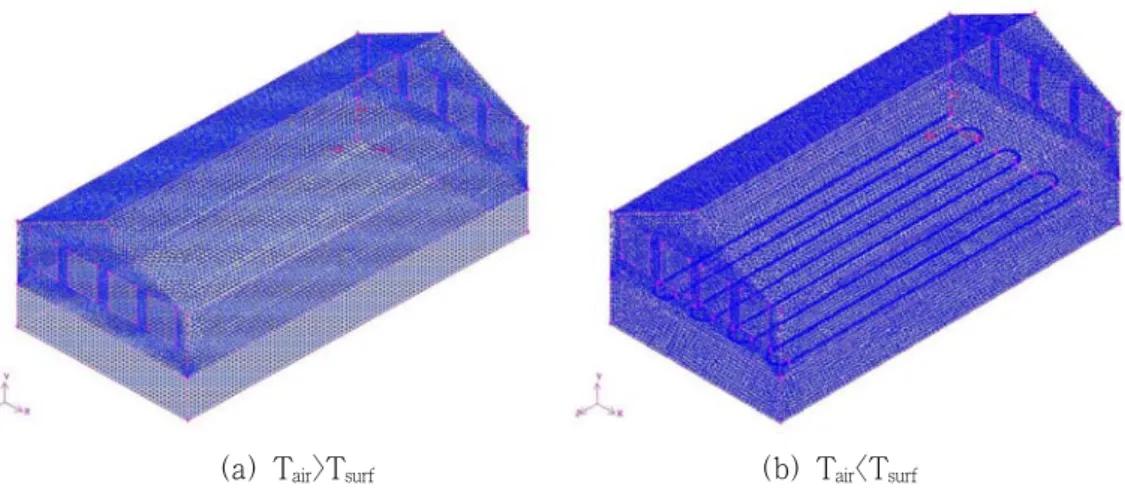
A model experiment has been performed to get the heat transfer coefficient on the soil surface in the closed ecosystem. The heat flux on the soil surface was measured and the heat transfer coefficient was derived in the following two cases with 5-stepped control of inside air current speed. One case was that heat flowed from air to soil and the other case was that heat flowed from soil to air. Three dimensional CFD model has been set to simulate thermal environment in the closed ecosystem including soil layers. The standard k-ε model of the CFD program was chosen for turbulence model and heating wire buried in the soil layers was set as heat source option to simulate the case when the temperature of soil surface was higher than that of inside air in the closed ecosystem. Between one case that heat flowed from air to soil and the other case that heat flowed from soil to air, there were big differences in the temperature distribution of soil layers and the heat transfer coefficient of the soil surface. The increasing rate of heat transfer coefficient on each case according to the increase of inside air current speed was similar to each other and it respectively increased linearly. But the heat transfer coefficient on the case that heat flowed from soil to air was much bigger than that of the other case. The model was validated by
1 충남대학교 농업생명과학대학 생물자원공학부(Division of Bioresources Engineering, College of Agriculture and Life Sciences, Chungnam National University, Daejeon 305-764, Korea)
* 교신저자 : 남상운(E-mail; [email protected], Tel: 042-821-5794)
comparing simulated values of CFD model with measured values of the model experiment.
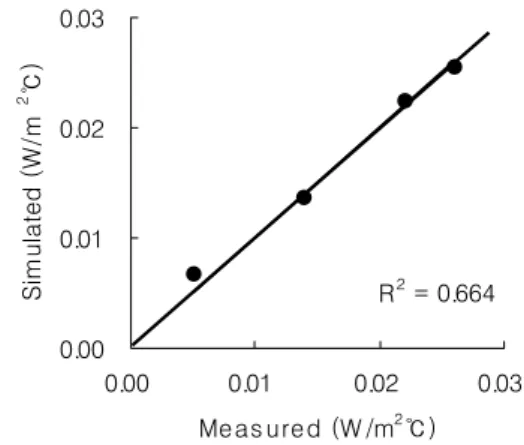
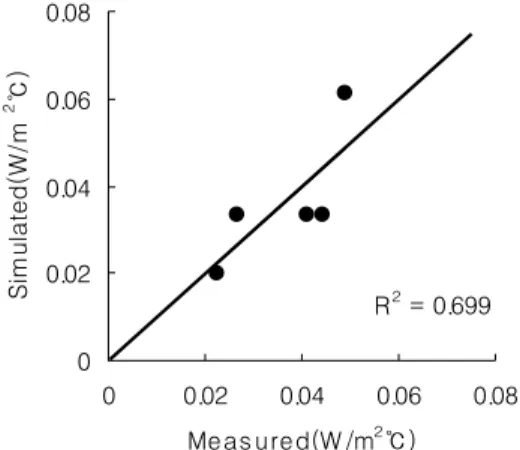
Simulated and measured temperature of inside air and soil layers, and heat transfer coefficient of the soil surface were well accorded and the range of corrected R 2 was 0.664 to 0.875. The developed CFD model was well simulated in parts of the temperature of inside air and soil layers, the distribution of the inside air current speed, and heat transfer coefficient of the soil surface were able to be quantitatively analyzed by using this model. Therefore, the model would be applied and used for analysis of heat transfer coefficient between air and surface in various agricultural facilities.
Key words ; CFD, Closed ecosystem, Heat flux, Model experiment, Soil surface
Ⅰ. 서 론
지중가온이나 지중냉각시스템을 설계하기 위해 서는 지중난방부하와 지중냉각부하의 산정이 필 요하고, 지중가온과 냉각시 온실 지상부의 열환경 에 미치는 영향을 분석하기 위해서는 토양과 지상 부의 경계를 이루는 지표면에서의 열전달계수를 도출하여 토양으로부터 지상부 그리고 지상부로부 터 토양으로 전류되는 열량을 정량적으로 파악할 필요가 있다. 그동안 온실의 환경을 예측하기 위 한 수많은 수학적 모델들이 개발되어 왔으나, 대 부분 실내 토양 표면의 열전달계수는 다양한 환경 조건의 변화와 상관없이 상수값으로 취급하는 등 지상부와 근권부 사이에 상호 교환되는 열량에 대 한 정량적인 분석 연구는 거의 없는 실정이다.
CFD 시뮬레이션 기법은 실험하기 어려운 조 건에 대한 시뮬레이션이 가능하고 실험에 대한 시간적 공간적 제약이 없으며 다양하게 실용적인 응용이 가능하다는 장점이 있어, 최근 온실의 공 기유동과 관련된 연구에 많이 이용되고 있다. 온 실연구에서 CFD 이용 사례를 보면, Okushima 등(1989)에 의해 처음으로 온실환기 연구를 위해
사용되었으며, 이후 CFD 소프트웨어 패키지가 컴퓨터의 발달과 함께 급속히 발전하기 시작하였 다. Bot 등(2001)은 홈통에 연속된 지붕 환기창이 있는 2-span 온실에서의 실험을 통해 환기창 부근 에서의 평균 기류속도에 대해 CFD 결과와 잘 일 치함을 보였고, Mistriotis 등(1997)은 Okushima와 함께 더 효과적인 온실구조와 환기창의 설계를 위해 많은 연구에서 CFD기법을 이용하였다. 또 한 Woodruff(1997)는 CFD기법을 이용하여 자연 환기 온실의 설계에 관한 연구를 수행하였으며, Al-Heral (1998)은 건조지역의 온실에서 자연환 기를 연구하기 위해 CFD 모델을 이용하였다.
뿐만 아니라, 국내에서도 Lee(1998)는 자연환
기시스템을 갖춘 상업용 연동온실에 CFD 시뮬
레이션을 적용한 바 있으며, 윤(2000)은 CFD 시
뮬레이션에 의해 아치형 연동온실에서의 자연환
기 성능 및 공기유동 특성을 분석하였다. 권
(2002)은 증발냉각 온실에서의 습도 분포를 시뮬
레이션 하였고, 유 등(2002)은 CFD를 이용하여
포그냉방시스템을 가동한 유리온실에서의 열환경
분석을 수행하는 등 CFD를 이용하여 다양한 연
구가 이루어져 왔다.
따라서, 본 연구에서는 CFD를 이용하여 토양 수분을 고려한 토양 열전도 모델과 지상부 열환 경 모델을 포함하는 폐쇄생태계내의 지표면 열류 모델을 개발하고 실험을 통하여 검증한 후, 다양 한 환경조건에 따른 지표면에서의 열전달계수를 도출하여 토양과 지상부 사이에 전류되는 열량을 정량적으로 파악함으로써, 에너지이용 효율 분석, 온실 지중가온과 지중냉각시스템의 설계를 위한 기초자료를 제공하고자 한다.
Ⅱ. 재료 및 방법
1. 실험장치 및 계측방법 1) 실험장치
실험장치(Closed Ecosystem)는 농촌진흥청에 서 제시한 표준형 단동 유리온실(3-1 S형)을 1/10로 축소한 크기로 제작하였다. 각목과 합판 을 이용하여 뼈대구조를 만들고, 두께 30mm의 스티로폼을 사용하여 외부환경의 영향을 최소화 할 수 있는 단열시스템으로 설계하였다.
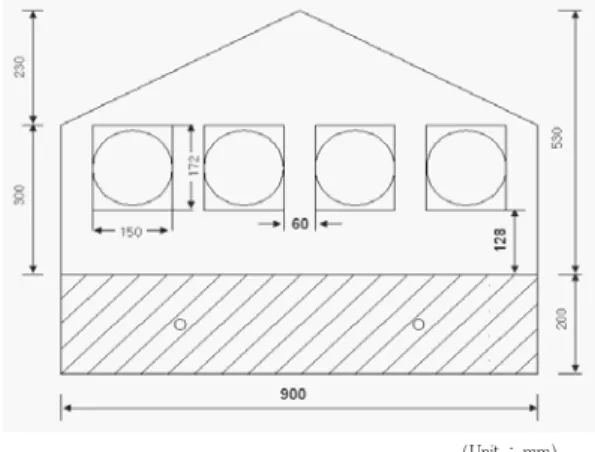
Fig. 1은 실험장치의 정면도이며, 폭 900mm, 처마높이 300mm, 지붕높이 530mm 그리고 길이 1,800mm로 제작하였다. 바닥으로부터 흙을 채워 200mm 깊이의 토양층을 형성하였고, 한쪽 벽면 에는 강제환기를 위한 4개의 소형팬을 설치하였 으며, 반대쪽 벽면의 같은 위치에 팬과 동일한 크기로 4개의 환기창을 구성하였다.
2) 환경 및 열류량 계측
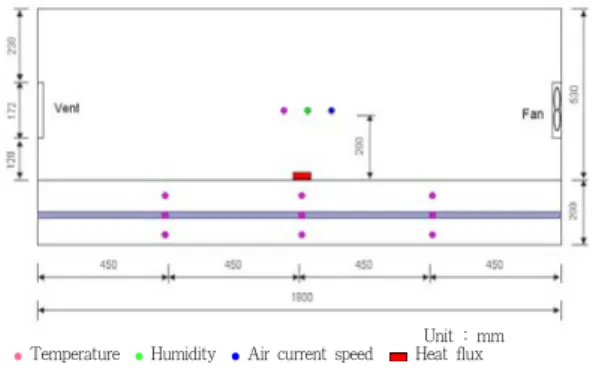
실험데이터는 Fig. 2와 같이 지상부, 토양표면 그리고 토양층의 3부분으로 나누어 각각의 열환 경 인자(factor)를 계측하였다. 지상부에서는 온 도, 습도 및 공기유속을 측정하였고, 지표면에서
는 지상부와 토양층 사이에서 교환이 이루어지는 열류량을 계측하였으며, 토양층에서는 높이 및 위치에 따라 토양층의 온도를 측정하였다.
(Unit : mm)
Fig. 1. Front view of experimental apparatus
온습도 센서(Hobo, Onset Computer Corporation) 를 실험장치 중앙 및 실외에 설치하여 30초 간격 으로 실내외 온습도를 계측하였다. 그리고 열선 풍속계(Series 640-0, Dwyer Instrument. Inc)를 팬의 중심축에 맞춰 실험장치 중앙에 설치하여 실내공기 유속을 계측하였다.
토양층에서의 온도는 열전대(T-type, 0.3㎜)를
Fig. 2와 같이 실험장치 중앙 및 전․후 1/4 지
점에 각각 50, 100, 150mm 깊이로 매설하여, 총
9지점에서 각각의 토양온도를 계측하였다. 토양
층의 지표면 중앙에 열류판(MF-140, EKO
Instruments Trading Co. Ltd.)을 설치하여 토양
표면에서의 열류량을 계측하였다. 또한 열류판
바로 옆의 토양표면에 열전대를 설치하여 토양표
면온도를 계측하였다. 열선풍속계, 열전대 및 열류
판의 계측값은 Data Recorder(KM-180, Konics)를
이용하여 10분 간격으로 기록하였다.
Unit : mm
●