• 검색 결과가 없습니다.

Fluorescence in situ Hybridization Karyotype Analysis of Seven Platycodon grandiflorum (Jacq.) A. DC. Cultivars

N/A
N/A
Protected

Academic year: 2021

Share "Fluorescence in situ Hybridization Karyotype Analysis of Seven Platycodon grandiflorum (Jacq.) A. DC. Cultivars"

Copied!
9
0
0

로드 중.... (전체 텍스트 보기)

전체 글

(1)

Fluorescence in situ Hybridization Karyotype

Analysis of Seven Platycodon grandiflorum (Jacq.) A. DC. Cultivars

Remnyl Joyce Pellerin

1

, Nomar Espinosa Waminal

1,2

, Ji Young Kim

1

, Yurry Um

3

, and Hyun Hee Kim

1*

1

Department of Life Sciences, Chromosome Research Institute, Sahmyook University, Seoul 01795, Korea

2

Department of Plant Science, Plant Genomics and Breeding Institute, and Research Institute of Agriculture and Life Sciences, College of Agriculture and Life Sciences, Seoul National University, Seoul 08826, Korea

3

Forest Medicinal Resources Research Center, National Institute of Forest Science, Yeongju 36040, Korea

*Corresponding author: [email protected].

Platycodon grandiflorum has long been cultivated for its medicinal properties and economic value, prompting crop improvement programs that have spurred the development of new cultivars. However, limited cytogenetic information is available for this species, especially for different P. grandiflorum cultivars. Karyotype analysis via fluorescence in situ hybridization (FISH) provides essential information about chromosome count and the localization of DNA sequences, thus providing a chromosome-level understanding of genome structure. Here, we carried out triple-color FISH karyotype analysis of various P. grandiflorum (Jacq.) A. DC.

cultivars using 5S and 45S ribosomal DNA (rDNA) and telomeric repeat probes. The karyotype is composed of 2n = 18 chromosomes consisting of seven pairs of metacentric chromosomes, one pair of submetacentric chromosomes, and one pair of subtelocentric chromosomes. The chromosome length ranges from 1.92 to 4.98 µm. One pair of 5S rDNA loci was observed on either the intercalary or pericentromeric regions of chromosome 3. All cultivars showed 45S rDNA signals on chromosome 9, and in two closely related cultivars, one additional pair of 5S rDNAs co-localized with these 45S rDNAs. Arabidopsis -type telomeric repeats were observed in most telomeric regions of the chromosomes in all seven cultivars. Our data lay the foundation for future cytogenetic studies of P. grandiflorum focusing on breeding and the elucidation of its genome structure.

HORTICULTURAL SCIENCE and TECHNOLOGY 35(6):784-792, 2017

URL: http://www.kjhst.org pISSN : 1226-8763 eISSN : 2465-8588

This is an Open-Access article distributed under the terms of the Creative Commons Attribution NonCommercial License which permits unrestricted non-commercial use, distribution, and reproduction in any medium, provided the original work is properly cited.

Copyrightⓒ2017 Korean Society for Horticultural Science.

OPEN ACCESS Received:

Revised:

Accepted:

April 19, 2017 August 24, 2017 September 27, 2017

Abstract

Additional key words: bell flower, chromosome, FISH analysis, 5S rDNA, 45S rDNA, telomeric repeats

Introduction

Platycodon grandiflorum ( Jacq .) A . DC ., which is commonly known as bell flower or balloon flower , is

an herbaceous perennial plant in the monotypic genus Platycodon in the Campanulaceae family ( Jang et

al ., 2013 ). This species is native to China , Japan , Korea , and East Siberia ( Wu et al ., 2012 ). In addition to its

ornamental flowers , P. grandiflorum is used as a traditional medicine to treat bronchitis , asthma ,

(2)

hyperlipidemia , hypertension , diabetes , and atopic dermatitis ( Lee et al ., 2008 ; Jeong et al ., 2010 ; Urbańska et al ., 2014 ). Recent studies have shown that its roots are a valuable source of saponins such as platycodins and spinasterol ( Choi et al ., 2008 ; Kim et al ., 2015 ). These bioactive compounds are responsible for its many health benefits , including its anti - inflammatory , anti - carcinogenic , immune - enhancing , hepatoprotective , and spermicidal effects ( Lee et al ., 2001 ; Lu et al ., 2013 ; Qin et al ., 2014 ).

Several P. grandiflorum cultivars have been developed ( Park et al ., 2005 ; Shi et al ., 2011 ; Um et al ., 2016 ). In a recent study , molecular markers using SNPs were developed to explore its genetic diversity ( Kim et al ., 2015 ). Nevertheless , P. grandiflorum is still considered to be an orphan crop because genetic studies of this plant have been limited . In addition , very little cytogenetic information is available to support genetic and genomic studies of this plant ( Wu et al ., 2012 ; Kim et al ., 2015 ).

Molecular cytogenetics via fluorescence in situ hybridization ( FISH ) plays an important role in clarifying plant genome structures , thus supporting genome - sequencing research ( Macas et al ., 2007 ; Michael and Jackson , 2013 ; Choi et al ., 2014 ). Such studies can provide chromosome counts , identify the physical locations of repeat elements and genes , and reveal genome rearrangements , such as chromosomal segment inversions and translocations ( Khrustaleva and Kik , 2001 ; Devi et al ., 2005 ; Kato et al ., 2006 ; Macas et al ., 2007 ; Huang et al ., 2009 ; Sybenga , 2012 ).

Tandem repeats [ e . g . ribosomal DNA ( rDNA ), centromeric and telomeric repeats ] are valuable cytogenetic markers that provide information about genome organization and allow for the identification of homologous chromosome pairs ( Heslop - Harrison 2000 ; Tigano et al ., 2004 ). Both 5S and 45S rDNAs have highly conserved coding regions , as they are essential for ribosome function ( Harrison and Heslop - Harrison , 1995 ; Buckler et al ., 1997 ; Cabral et al ., 2006 ). Additionally , inter - genera and inter - specific differences exist in terms of rDNA loci number and distribution ( Castilho and Heslop - Harrison , 1995 ; Li and Arumuganathan , 2001 ), a characteristic that has been exploited to identify individuals at the species level or even at the subspecies or variety level ( Hasterok et al ., 2006 ). Telomeric repeats , which are usually found on chromosome ends , have also proven to be an effective molecular marker for mapping telomere locations across a wide range of species ( Cox et al ., 1993 ).

The basic chromosome number in Campanulaceae was reported to be x = 7 , 8 , or 9 ( Sugiura , 1942 ; Raven , 1975 ; Hong , 1994 ; Zhang et al ., 2011 ). Karyotype data have been reported for a diploid ( 2n = 2x = 18 ) and an induced tetraploid ( 2n = 4x = 36 ) line of P. grandiflorum ( Linchu , 1986 ; Wu et al ., 2012 ; Ma et al ., 2015 ). The use of only conventional karyotyping techniques and the lack of sophisticated cytogenetic markers have resulted in the reporting of different karyotype formulae for P. grandiflorum ( Wang et al ., 2005 ; Yang et al ., 2015 ). On the other hand , FISH - based karyotype analysis enables the identification of cytotypes , such as those from the same Brassica rapa species ( Xiong and Pires , 2011 ). Thus , FISH - based karyotype analysis between several P. grandiflorum cultivars would provide chromosome - level polymorphism information .

In this study , we performed FISH karyotype analyses using 5S and 45S rDNAs and telomeric repeat probes in seven cultivars of P. grandiflorum. Our results provide a foundation for future cytogenetic mapping of major repeat elements , as well as for integrating genetic maps to elucidate genome structure and dynamics in P. grandiflorum.

Materials and Methods Plant Samples

Seven P. grandiflorum cultivars , including ‘ Astra Semi - Double Blue ’, ‘ Astra White ’, ‘ Fuji Blue ’, ‘ Fuji Pink ’, ‘ Fuji White ’,

‘ Hakone Double Blue ’ and change to : ‘ Maries II ’, which were obtained from Swallowtail Garden Seeds ( Santa Rosa , CA , USA ),

(3)

were kindly provided by the Department of Herbal Crop Research , National Institute of Horticultural and Herbal Science , RDA , Eumseong , Republic of Korea and used for karyotype analysis .

Chromosome Spread Preparation

Briefly , root tips treated with 2 mM 8 - hydroxyquinoline and fixed in Carnoy ’ s solution were enzymatically digested with pectolytic enzyme solution [ 2 % Cellulase R - 10 ( C224 , Phytotechnology Laboratories ) and 1 % Pectolyase Y - 23 ( P8004 . 0001 , Duchefa ) in 100 mM citrate buffer ] for 1 h . The root tips were transferred into a microtube containing aceto - ethanol ( 1 : 3 , v / v ) solution and vortexed for 30 seconds . The supernatant was discarded , and the pellet was resuspended in ( 9 : 1 v / v ) aceto - ethanol and spread onto slides that had been pre - cleaned with 70 % ethanol and pre - warmed in a humid chamber ( Waminal et al ., 2011 ).

Air - dried slides were fixed in 2 % formaldehyde ( Vranaet al ., 2012 ) for 5 min and dehydrated in a graded ethanol series ( 70 %, 90 %, and 100 %).

Probe Preparation

The PCR product from 18S rDNA amplification ( Matoba et al ., 2007 ) was labeled with DEAC - 5 - dUTP via nick translation . The 5S rDNA from Brassica oleracea was PCR - amplified ( Koo et al ., 2002 ) and labeled with Alexa Fluor

®

488 - 5 - dUTP ( C11397 , Invitrogen ) via nick translation . The Arabidopsis- type telomere sequence was PCR - amplified in the absence of the template using primers ( TTTAGG )

5

and ( CCCTAAA )

5

( Abd El - Twab and Kondo , 2006 ) and labeled with Texas Red - 5 - dUTP ( NEL417001EA , Perkin Elmer ).

Fluorescence in situ Hybridization

The hybridization mixture consisted of 100 % formamide , 50 % dextran sulfate , 20X SSC , 50 ng · μL

-1

of each DNA probe , and Sigma purified water . The mixture was denatured at 90 ° C for 10 min , and 40 μL was pipetted onto each slide . The slides were incubated at 80 ° C for 5 min , followed by overnight incubation in a pre - warmed humid chamber at 37 ° C . The incubated slides were washed in 2 × SSC at room temperature ( RT ) for 10 min , 0 . 1 × SSC at 42 ° C for 25 min , and 2 × SSC at room temperature for 5 min , followed by dehydration in a graded ethanol series ( 70 %, 90 %, 95 %) at room temperature . The slides were counterstained with Vectashield ( Vector Labs , H - 1000 , USA ) containing 1 µg · mL

-1

4 ’, 6 - diamidino - 2 - phenylindole ( DAPI ) and examined under an Olympus BX53 fluorescence microscope with a built - in CCD camera ( CoolSNAP

cf ) using an oil lens (× 100 magnification ).

The images were edited using Adobe Photoshop CS6 . Chromosome types were classified according to Levan et al . ( 1964 ). The chromosomes were paired based on their FISH signals , morphological characteristics , and lengths .

Results and Discussion

We performed FISH karyotype analysis of seven P. grandiflorum cultivars using 5S rDNA , 45S rDNA and telomeric repeat probes . All cultivars examines had 2n = 2x = 18 chromosomes ( Fig . 1 ), which is in agreement with previous karyotype reports ( Suzuka and Koriba , 1949 ; Wu et al ., 2012 ; Yang et al ., 2015 ).

The chromosomes were arranged in decreasing length ( Table 1 ), and homologous chromosomes were paired according to

chromosomal features and FISH signals from the 5S and 45S rDNA and telomeric repeat probes . Linchu ( 1986 ) and Yang et al .

(4)

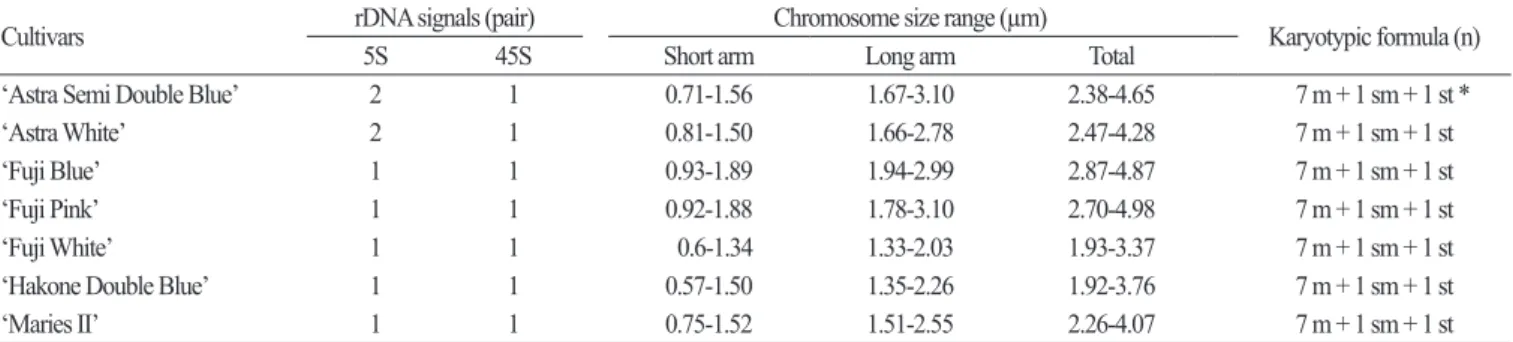
( 2015 ) reported that the karyotypic formula of P. grandiflorum is 2 n = 2 x = 18 = 12 m + 6 sm ( 2SAT ) and 2 n = 2 x = 18 = 10 m + 8 sm ( 2SAT ), respectively . Our results were a bit different from these , i . e . 2 n = 2 x = 18 = 14 m + 2 sm + 2 st ( 2SAT ), a type 2A pattern according to the classification of Yang et al . ( 2015 ). These karyotypic differences might be due to the different chromosome condensation stages examined or the lack of more sophisticated centromere - specific probes , which could make it difficult to

A

E

B

F D C

G

Fig. 1. FISH mitotic metaphase spreads from seven Platycodon grandiflorum (Jacq.) A. DC cultivars. Chromosome spread from

‘Astra Semi-Double Blue’ (A), ‘Astra Whites’ (B), ‘Fuji Blue’ (C), ‘Fuji Pink’ (D), ‘Fuji White’ (E), ‘Hakone Double Blue’ (F), and

‘Maries II’ (G) showing 5S (green) rDNA, 45S rDNA (yellow), and telomeric repeats (red). White arrows indicate the satellite

chromosomes. Green arrows indicate co-localized 5S and 45S rDNA signals. Scale bar = 5 µm.

(5)

Cultivars rDNA signals (pair) Chromosome size range (µm) Karyotypic formula (n)

5S 45S Short arm Long arm Total

‘Astra Semi Double Blue’ 2 1 0.71-1.56 1.67-3.10 2.38-4.65 7 m + 1 sm + 1 st *

‘Astra White’ 2 1 0.81-1.50 1.66-2.78 2.47-4.28 7 m + 1 sm + 1 st

‘Fuji Blue’ 1 1 0.93-1.89 1.94-2.99 2.87-4.87 7 m + 1 sm + 1 st

‘Fuji Pink’ 1 1 0.92-1.88 1.78-3.10 2.70-4.98 7 m + 1 sm + 1 st

‘Fuji White’ 1 1 0.6-1.34 1.33-2.03 1.93-3.37 7 m + 1 sm + 1 st

‘Hakone Double Blue’ 1 1 0.57-1.50 1.35-2.26 1.92-3.76 7 m + 1 sm + 1 st

‘Maries II’ 1 1 0.75-1.52 1.51-2.55 2.26-4.07 7 m + 1 sm + 1 st

m; metacentric, sm; submetacentric, st; subtelocentric, *; satellite chromosome.

Table 1. Karyotype analyses of the seven cultivars of Platycodon grandiflorum (Jacq.) A. DC.

perform accurate measurement considering the small chromosome sizes ( Liehr et al ., 2004 ). The development of more sophisticated probes , such as centromere - or chromosome - specific probes , would greatly enhance karyotype analysis in the future .

Ribosomal DNA arrays , comprising long repeat units with highly conserved coding regions , are commonly used for chromosome characterization . These arrays are categorized into different families , including nucleolar organizing region ( NOR )- forming 45S rDNA and non - NOR - forming 5S rDNA ( Rogers and Bendich , 1987 ; Tigano et al ., 2004 ). The locations of these two families usually vary across genera and species , which can be exploited in taxonomic and phylogenetic studies ( Shi et al ., 1993 ; Vaio et al ., 2005 ). Telomeric repeats are also effective molecular markers for use at the species level ( Cox et al ., 1993 ), as they have conserved repeat sequences in plants ( Levin , 2002 ).

In the present study , we detected rDNA signals on separate chromosomes in most cultivars . Signals from 5S rDNA were located at interstitial or pericentromeric regions of the chromosomes , while 45S rDNA signals were found on NORs ( Figs . 1 and 2 ) . Independent localization of rDNA loci is more informative than co - localization of signals when identifying chromosomes ( Krinski et al ., 2012 ) and constructing a cytogenetic map , which are important for deducing species relationships ( Maghuly et al ., 2010 ). We found that in general , one 5S rDNA locus was localized on the interstitial region of the short arm of chromosome 3 ( Fig . 2A – C , F , G ) , a common pattern in some plant species ( Castilho and Heslop - Harrison , 1995 ). Exceptions were observed in

‘ Fuji Pink ’ and ‘ Fuji White ’, where 5S rDNA hybridized on the pericentromeric region of chromosome 3 ( Fig . 2D , E ). In all cultivars , 45S rDNA signals were present at the NOR of the satellite on chromosome 9 . The NOR is a secondary constriction on satellite chromosomes containing 18S - 5 . 8S - 26S DNA that is used as a signal for chromosome identification ( Mukai et al ., 1991 ; Devi et al ., 2005 ).

In ‘ Astra ’, 5S and 45S rDNA co - localized on the NOR of chromosome 9 ( Fig . 2A , B ). This pattern is not often observed , but it occurs in several plant species such as some cucurbits ( Muravenko et al ., 2004 ; Abd El - Twab and Kondo , 2012 ). The 5S rDNA signals on chromosome 3 and its augmentation on the NOR of chromosome 9 suggest the occurrence of sequence recombination ( Rogers and Bendich , 1987 ; Scoles et al ., 1988 ). The distribution of rDNA loci can vary between cultivars within a species ( Ørgaard et al ., 1995 ; Xiong and Pires , 2011 ). This difference in rDNA distribution also implies that genes in this species tend to undergo frequent rearrangements .

The Arabidopsis- type telomeric repeat ( TTTAGGG ) hybridized onto most terminal regions of the chromosomes in all seven

cultivars , as occurs in most plant species ( Fuchs et al ., 1995 ). Complete and intense telomeric signals were observed in ‘ Maries

II ’, while signals were weaker or absent in ‘ Astra White ’ ( chromosomes 1 , 5 , 6 , and 7 ), ‘ Fuji Pink ’ ( chromosomes 5 , 6 , and 8 ), ‘ Fuji

(6)

2 3 4 5 6 7 8 9 1

A B

G C

E D

F

White ’ ( chromosomes 5 and 7 ), and ‘ Hakone Double Blue ’ ( chromosome 4 ) ( Fig . 2B , D , E , F ). These discrepancies are likely due to experimental variations in sequence length or deletions in telomeric repeats resulting from extensive rearrangements ( Schubert et al ., 1998 ). Differing degrees of chromosome condensation might be responsible for the co - localization of 5S rDNA and telomeric repeats on chromosome 3 in ‘ Hakone Double Blue ’ and ‘ Maries II ’ ( Fig . 2F , G ).

Um et al . ( 2016 ) classified P. grandiflorum cultivars based on morphological characterization and the use of molecular markers . Based on the genetic relationships deduced by examining SSR markers and morphological traits , the cultivars ‘ Fuji ’,

‘ Hakone Double Blue ’, and ‘ Maries II ’ belong to one group , whereas ‘ Astra Semi Blue ’ and ‘ Astra White ’ fall into separate , distinct groups . Based on our results , the 5S and 45S rDNA loci co - localized in the two ‘ Astra ’ cultivars but not in ‘ Fuji - Blue , Pink , White ’, ‘ Hakone Double Blue ’, or ‘ Maries II ’, corroborating the previous classification based on differences in morphological characteristics and the genetic relatedness of the cultivars ( Um et al ., 2016 ).

Repetitive sequences are frequently investigated and used to examine plant genome organization or to establish phylogenies ( She et al ., 2007 ). In particular , tandemly repeated DNA sequences are useful cytogenetic markers because such sequences account for a considerable proportion of the plant genome and are localized to specific chromosomal regions ( Macas et al ., 2011 ; Waminal et al ., 2016 ). In this study , we performed FISH using the most commonly used 5S and 45S rDNA and telomeric cytogenetic markers . However , more cytogenetic markers , such as major or minor repeats and transposable elements , could be developed as more sequence information becomes available in the future . These markers would be useful for karyotyping and discriminating species or cultivars . Research aimed at refining our understanding of the genome constitution of P. grandiflorum should include additional cytogenetic studies to develop repeat - based probes based on genome - wide repeat analysis of next - generation sequencing data or through self - genomic in situ hybridization ( self - GISH ). A well - established karyotype serves as a backbone for integrating genetic linkage maps with genome sequence assemblies .

Fig. 2. Karyogram of seven Platycodon grandiflorum cultivars. (A) ‘Astra Semi-Double Blue’, (B) ‘Astra White’, (C) ‘Fuji Blue’, (D)

‘Fuji Pink’, (E) ‘Fuji White’, (F) ‘Hakone Double Blue’, and (G) ‘Maries II’. 5S rDNA, 45S rDNA, and telomeric repeats appear as

green, yellow and red signals, respectively. White arrows indicate satellite chromosomes with NOR regions, and green arrows

indicate co-localization of 5S and 45S rDNA. Scale bar = 5 µm.

(7)

Literature Cited

Abd El-Twab MH, Kondo K (2006) FISH physical mapping of 5S, 45S and Arabidopsis -type telomere sequence repeats in Chrysanthemum zawadskii showing intra-chromosomal variation and complexity in nature. Chromosome Bot 1:1-5. doi:

10.3199/iscb.1.1

Abd El-Twab MH, Kondo K (2012) Physical mapping of 5S and 45S rDNA in Chrysanthemum and related genera of the Anthemideae by FISH, and species relationships. J Genet 91:245-249

Buckler ES, Ippolito A, Holtsford TP (1997) The evolution of ribosomal DNA divergent paralogues and phylogenetic implications.

Genetics 145:821-832. doi:10.1007/s12041-012-0177-z

Cabral JS, Felix LP, Guerra M (2006) Heterochromatin diversity and its co-localization with 5S and 45S rDNA sites in chromosomes of four Maxillaria species (Orchidaceae). Genet Mol Biol 29:659-664. doi:10.1590/S1415-47572006000400015

Castilho A, Heslop-Harrison J (1995) Physical mapping of 5S and 18S-25S rDNA and repetitive DNA sequences in Aegilops umbellulata . Genome 38:91–96

Choi HI, Waminal NE, Park HM, Kim NH, Choi BS, Park M, Choi D, Lim YP, Kwon SJ, et al (2014) Major repeat components covering one-third of the ginseng ( Panax ginseng C.A. Meyer) genome and evidence for allotetraploidy. Plant J 77:906-916. doi:10.1111/

tpj.12441

Choi Y, Yoo D, Choi C, Cha M-R, Kim Y, Lee H, Lee K, Ryu S (2008) Platyconic acid A, a genuine triterpenoid saponin from the roots of Platycodon grandiflorum . Molecules 13:2871. doi:10.3390/molecules13112871

Cox AV, Bennett ST, Parokonny AS, Kenton A, Callimassia MA, Bennett MD (1993) Comparison of plant telomere locations using a PCR-generated synthetic probe. Ann Bot 72:239-247. doi:10.1006/anbo.1993.1104

Devi J, Ko J, Seo B. (2005). FISH and GISH: Modern cytogenetic techniques. Ind J Biotechnol 4:307-315

Fuchs J, Brandes A, Schubert I (1995) Telomere sequence localization and karyotype evolution in higher plants. Plant Syst Evol 196:227-241. doi:10.1007/BF00982962

Harrison G, Heslop-Harrison J (1995) Centromeric repetitive DNA sequences in the genus Brassica .Theoret Appl Genet 90:157-165.

doi:10.1007/BF00222197

Hasterok R, Wolny E, Hosiawa M, Kowalczyk M, Kulak-Ksiazczyk S, Ksiazczyk T, Heneen WK, Maluszynska J (2006) Comparative analysis of rDNA distribution in chromosomes of various species of Brassicaceae. Ann Bot 97:205-216. doi:10.1093/aob/mcj031 Heslop-Harrison J (2000) Comparative genome organization in plants: from sequence and markers to chromatin and chromosomes.

Plant Cell 12:617-635. doi:10.1105/tpc.12.5.617

Hong D (1994) The geography of the Campanulaceae: on the distribution centres. Acta Phytotaxon Sin 33:521-536

Huang S, Li R, Zhang Z, Li L, Gu X, Fan W, Lucas WJ, Wang X, Xie B, et al (2009) The genome of the cucumber, Cucumis sativus L. Nat Genet 41:1275-1281. doi:10.1038/ng.475

Jang KJ, Kim HK, Han MH, Oh YN, Yoon HM, Chung YH, Kim GY, Hwang HJ, Kim BW, et al (2013) Anti-inflammatory effects of saponins derived from the roots of Platycodon grandiflorus in lipopolysaccharide-stimulated BV2 microglial cells. Int J Mol Med 31:1357-1366. doi:10.3892/ijmm.2013.1330

Jeong CH, Choi GN, Kim JH, Kwak JH, Kim DO, Kim YJ, Heo HJ (2010) Antioxidant activities from the aerial parts of Platycodon grandiflorum . Food Chem 118:278-282. doi:10.1016/j.foodchem.2009.04.134

Kato A, Albert PS, Vega JM, Birchler JA (2006) Sensitive fluorescence in situ hybridization signal detection in maize using directly labeled probes produced by high concentration DNA polymerase nick translation. Biotech Histochem 81:71-78.

doi:10.1080/10520290600643677

Khrustaleva LI, Kik C (2001) Localization of single-copy T-DNA insertion in transgenic shallots ( Allium cepa ) by using ultra-sensitive FISH with tyramide signal amplification. Plant J 25:699-707. doi:10.1046/j.1365-313x.2001. 00995.x

Kim HJ, Jung J, Kim MS, Lee JM, Choi D, Yeam I (2015) Molecular marker development and genetic diversity exploration by RNA-seq in Platycodon grandiflorum . Genome 58:441-451. doi.10.1139/gen-2015-0017

Koo DH, Hur Y, Jin DC, Bang JW (2002) Karyotype analysis of a Korean cucumber cultivar ( Cucumis sativus L. cv. Winter Long) using C-banding and bicolor fluorescence in situ hybridization. Mol Cell13:413-418

Krinski D, Fernandes A, Rocha MP (2012) Cytogenetic analysis: a new era of procedures and precision. INTECH Open Access Publisher, pp 108-121

Lee KJ, Hwang SJ, Choi JH, Jeong HG (2008) Saponins derived from the roots of Platycodon grandiflorum inhibit HT-1080 cell invasion and MMPs activities: regulation of NF-κB activation via ROS signal pathway. Cancer Lett 268:233-243. doi:10.1016/

j.canlet.2008.03.058

Lee KJ, You HJ, Park SJ, Kim YS, Chung YC, Jeong TC, Jeong HG (2001) Hepatoprotective effects of Platycodon grandiflorum on acetaminophen-induced liver damage in mice. Cancer Lett 174:73-81. doi:10.1016/S0304-3835(01)00678-4

Levin DA (2002) The role of chromosomal change in plant evolution. Oxford University Press on, pp 1-17

Li L, Arumuganathan K (2001) Physical mapping of 45S and 5S rDNA on maize metaphase and sorted chromosomes by FISH.

Hereditas 134:141-145. doi:10.1111/j.1601-5223.2001. 00141.x

Liehr T, Starke H, Weise A, Lehrer H, Claussen U (2004) Multicolor FISH probe sets and their applications. Histol Histopathol 19: 229- 237

Linchu L (1986) A karyotypic study of Platycodon grandiflora [J]. J.Wuhan. Bot Res 4:2

(8)

Lu Z, Wang L, Zhou R, Qiu Y, Yang L, Zhang C, Cai M, Mi M, Xu H (2013) Evaluation of the spermicidal and contraceptive activity of platycodin D, a saponin from Platycodon grandiflorum . PLoS ONE 8: e82068. doi:10.1371/journal.pone.0082068

Ma Y, Lin Y, Zhang H, Liang F, Sun L, Wang M, Xin H (2015) Lodging-resistance breeding of Platycodon grandiflorus using distant hybridization. Am J Plant Sci 6:2844-2849. doi:10.4236/ajps.2015.618281

Macas J, Kejnovsk E, Neumann P, Novák P, Koblí ková A, Vyskot B (2011) Next generation sequencing-based analysis of repetitive DNA in the model dioceous plant silene latifolia. PLoS ONE 6:e27335. doi:10.1371/journal.pone.0027335

Macas J, Neumann P, Navratilova A (2007) Repetitive DNA in the pea ( Pisum sativum L.) genome: comprehensive characterization using 454 sequencing and comparison to soybean and Medicago truncatula. BMC Genomics 8:427.doi:10.1186/1471-2164-8- 427

Maghuly F, Schmoellerl B, Temsch EM, Laimer M (2010) Genome size, karyotyping and FISH physical mapping of 45S and 5S genes in two cherry rootstocks: Prunus subhirtella and Prunus incisa × serrula . J Biotechnol 149:88-94. doi:10.1016/j.jbiotec.2010.06.022 Matoba H, Mizutani T, Nagano K, Hoshi Y, Uchiyama H (2007) Chromosomal study of lettuce and its allied species ( Lactuca

spp., Asteraceae) by means of karyotype analysis and fluorescence in situ hybridization. Hereditas 144:235-243. doi:

10.1111/j.2007.0018-0661.02012x

Michael TP, Jackson S (2013) The first 50 plant genomes. Plant Genome 6:1-7. doi:10.3835/plantgenome2013.03.0001in

Mukai Y, Endo T, Gill B (1991) Physical mapping of the 18S. 26S rRNA multigene family in common wheat: identification of a new locus. Chromosoma 100:71-78. doi:10.1007/BF00418239

Muravenko O, Amosova A, Samatadze T, Semenova OY, Nosova I, Popov K, Shostak N, Zoschuk S, Zelenin A (2004) Chromosome localization of 5S and 45S ribosomal DNA in the genomes of Linum L. species of the section Linum (syn. Protolinum and Adenolinum ). Russ J Genet 40:193-196 doi:10.1023/B:RUGE.0000016994.89043.2b

Ørgaard M, Jacobsen N, Heslop-Harrison J (1995) The hybrid origin of two cultivars of Crocus (Iridaceae) analysed by molecular cytogenetics including genomic Southern and in situ hybridization. Ann Bot 76:253-262. doi:10.1006/anbo.1995.1094

Park CG, Yan ZY, Lee SC, Shon TK, Park HW, Jin DC (2005) Genetic diversity and DNA polymorphism in Platycodon grandiflorum DC.

collected from East-Asian area. Korean J Med Crop Sci 13:115-120

Qin H, Du X, Zhang Y, Wang R (2014) Platycodin D, a triterpenoid saponin from Platycodon grandiflorum , induces G2/M arrest and apoptosis in human hepatoma HepG2 cells by modulating the PI3K/Akt pathway. Tumour Biol 35:1267-1274.

doi:10.1007/s13277-013-1169-1

Raven PH (1975) The bases of angiosperm phylogeny: cytology. Ann Mo Bot Gard 62:724-764. doi:10.2307/2395272

Rogers S, Bendich A (1987) Ribosomal RNA genes in plants: variability in copy number and in the intergenic spacer. Plant Mol Biol 9:509-520. doi:10.1007/BF00015882

Schubert I, Shi F, Fuchs J, Endo TR (1998) An efficient screening for terminal deletions and translocations of barley chromosomes added to common wheat. Plant J 14:489-495. doi:10.1046/j.1365-313X.1998. 00125.x

Scoles G, Gill B, Xin Z-Y, Clarke B, McIntyre C, Chapman C, Appels R (1988) Frequent duplication and deletion events in the 5S RNA genes and the associated spacer regions of the Triticeae. Plant Syst Evol 160:105-122. doi: 10.1007/BF00936713

She C, Liu J, Diao Y, Hu Z, Song Y (2007) The distribution of repetitive DNAs along chromosomes in plants revealed by self-genomic in situ hybridization. J Genet Genomics 34:437-448. doi:10.1016/S1673-8527(07)60048-4

Shi FH, Sui C, Yang CM, Wei JH, Jin Y, Chen HJ, Huang LQ, Zhao YK, Zhao XS, et al (2011) Development of a stable male-sterile line and its utilization in high yield hybrid of Platycodon grandiflorum . J Med Plants Res 5:3488-3499

Shi Y, Draper J, Stace C (1993) Ribosomal DNA variation and its phylogenetic implication in the genus Brachypodium (Poaceae). Plant Syst Evol 188:125-138. doi:10.1007/BF00937726

Sugiura T (1942) Studies on the chromosome numbers in Campanulaceae. Cytologia 12:418-434. doi:10.1508/cytologia.12.418 Suzuka O, Koriba S (1949) Chromosome numbers of medicinal plants. Jpn J Pharmacol 3:68-74

Sybenga J (2012). Cytogenetics in plant breeding. Springer - Verlag Berlin Heidelberg, Germany. pp 1-22

Tigano C, Rocco L, Ferrito V, Costagliola D, Pappalardo A, Stingo V (2004) Chromosomal mapping and molecular characterization of ribosomal RNA genes in Lebias fasciata (Teleostei, Cyprinodontidae). Genetica 121:95-100. doi:10.1023/

B:GENE.0000019931.89458.dc

Um Y, Lee Y, Jin ML, Lee DY, Lee JW, Kim GS, Kim CK, Hong CP, Kim OT (2016) Morphological characteristics and genetic diversity analysis of Platycodon grandiflorum (Jacq.) A. DC determined Using SSR Markers. Korean J Med Crop Sci 24:55-61. doi:

10.7783/KJMCS.2016.24.1.55

Urban ´ ska N, Giebułtowicz J, Olszowska O, Szypuła WJ (2014) The growth and saponin production of Platycodon grandiflorum (Jacq.) A. DC.(Chinese bellflower) hairy roots cultures maintained in shake flasks and mist bioreactor. Acta Soc Bot Pol 83:229-237 Vaio M, Speranza P, Valls JF, Guerra M, Mazzella C (2005) Localization of the 5S and 45S rDNA sites and cpDNA sequence analysis in

species of the Quadrifaria group of Paspalum (Poaceae, Paniceae). Ann Bot 96:191-200. doi:10.1093/aob/mci168

Waminal NE, Kim NS, Kim HH (2011) Dual-color FISH karyotype analyses using rDNAs in three Cucurbitaceae species. Genes Genom 33:521-528. doi:10.1007/s13258-011-0046-9

Waminal NE, Perumal S, Lee J, Kim HH, Yang TJ (2016) Repeat Evolution in Brassica rapa (AA), B. oleracea (CC), and B. napus (AACC) genomes. Plant Breed Biotechnol 4:107-122. doi:10.9787/PBB.2016.4.2.107

Wang X, Xiong L, Qu Y, Yang J, Gu Z (2005) The ployploid induction and identification of Platycodon grandiflorus (Campanulaceae) in

China. Acta Bot Yunnanica 28:593-598

(9)

Wu Y, Yang F, Zhao X, Yang WD (2012) Cytogenetic characterization of induced tetraploids in medicinal plant ( Platycodon grandiflorus ). Caryologia 65:182-186. doi:10.1080/00087114.2012.726518

Xiong ZY, Pires JC (2011) Karyotype and identification of all homoeologous chromosomes of allopolyploid Brassica napus and Its diploid progenitors. Genet 187:37-49. doi:10.1534/genetics.110.122473

Yang F, Li L, Rong E, He Y, Zhao X, Wu Y (2015) Karyotype analysis of obtained tetraploid in medicinal plant ( Platycodon grandiflorus ).

J Med Plants Res 9:294-300. doi:10.5897/JMPR2015.5763

Zhang YF, Zhang CY, Zhang T, Guang HL (2011) Karyotypic studies on Campanumoea (Campanulaceae)—endemic to China. Genet

Resourc Crop Evol 58:461-470. doi:10.1007/s10722-010-9655-4

수치

Fig. 1. FISH mitotic metaphase spreads from seven  Platycodon grandiflorum (Jacq.) A. DC cultivars
Table 1. Karyotype analyses of the seven cultivars of Platycodon grandiflorum (Jacq.) A
Fig. 2. Karyogram of seven  Platycodon grandiflorum cultivars. (A)  ‘Astra Semi-Double Blue’, (B) ‘Astra White’, (C) ‘Fuji Blue’, (D)

참조

관련 문서