Vol. 22, No. 5 (2012)
243
†
Corresponding author
E-Mail : [email protected] (J.- H. Lee)
Size Tailored Nanoparticles of ZrN Prepared by Single-Step Exothermic Chemical Route
Sang-Ki Lee*, Kyung-Tae Park*, Hong-Youl Ryu*, Hayk H. Nersisyan**, Kap-Ho Lee** and Jong-Hyeon Lee* , ** †
*Graduate School of Green Energy Technology, Chungnam National University
**Graduate School of Department of Advanced Materials Engineering, Chungnam National University (Received April 16, 2012 : Received in revised form May 8, 2012 : Accepted May 8, 2012)
Abstract
ZrN nanoparticles were prepared by an exothermic reduction of ZrCl4 with NaN3 in the presence of NaCl flux in a nitrogen atmosphere. Using a solid-state combustion approach, we have demonstrated that the zirconium nitride nanoparticles synthesis process can be completed in only several minutes compared with a few hours for previous synthesis approaches. The chemistry of the combustion process is not complex and is based on a metathesis reaction between ZrCl4 and NaN3. Because of the low melting and boiling points of the raw materials it was possible to synthesize the ZrN phase at low combustion temperatures. It was shown that the combustion temperature and the size of the particles can be readily controlled by tuning the concentration of the NaCl flux. The results show that an increase in the NaCl concentration (from 2 to 13 M) results in a temperature decrease from 1280 to 750oC. ZrN nanoparticles have a high surface area (50-70 m2/g), narrow pore size distribution, and nano-particle size between 10 and 30 nm. The activation energy, which can be extracted from the experimental combustion temperature data, is: E = 20 kcal/mol. The method reported here is self-sustaining, rapid, and can be scaled up for a large scale production of a transition metal nitride nanoparticle system (TiN, TaN, HfN, etc.) with suitable halide salts and alkali metal azide.Key words
zirconium nitride, nanoparticles, combustion synthesis, particle size, sodium chloride.1. Introduction
Zirconium Nitride (ZrN) is one of the hardest coating material and its unique characteristics, such as extreme hardness, good electrical conductivity, excellent thermal properties, wear, chemical and corrosion resistance, good lubricity and ductility make this material unchangeable for extending life of cutting tools, punching and forming dies, and wear components. Materials coated include most metals, ceramics, and some plastics. ZrN thin films can be applied to metal base transistors and three-dimensional integrated circuits since it can be grown epitaxially on Si.
Due to its shiny and golden appearance, it can be used in the jewelry industry. With this regard the cost-effective synthesis of nanoscale zirconium nitride particles is tech- nologically attractive and ZrN powder itself can be used for thermal plasma spraying to make uniform protective coating.
1)Several approaches were reported for synthesizing ZrN nanopowders. Among them the followings can be noted:
reduction-nitridation reaction,
2)benzene-thermal synthesis,
3)pulsed wire discharge synthesis
4)high-energy ball milling,
5)microwave plasma synthesis
6)and solid-state metathesis reaction.
7-11)In reduction-nitridation method
2)nanocrystalline ZrN powder was synthesized from nanosized ZrO
2powder in ammonia gas with magnesium as the reducing agent. Cubic phase ZrN powder with a 30-100-nm particle size was obtained at 1000
oC for 6 h, under a Mg:ZrO
2mole ratio of 10:1. In benzene-thermal synthetic route
3)a stainless steel autoclave containing anhydrous zirconium tetrachloride (ZrCl
4), lithium nitride (Li
3N) was heat treated at a temperature of 380-400
oC to produce ZrN nanopowder.
As-prepared ZrN powder exhibits cubic crystal shape and
average particle size was estimated to be about 180 nm
in diameter. In pulsed wire discharge method reported
in
4)ZrN nanoparticles were synthesized by explosion of
Zr wire in nitrogen. The results of measurement revealed
the average particle sizes in the range of 20-70 nm. High-
energy ball mill technique
5)a mixture of ZrCl
4and Li
3N
powders was milled in a high-energy ball mill under Ar
atmosphere. After the extraction of LiCl from the final
product, c-ZrN nanoparticles with an average diameter of
40 nm was obtained. In microwave plasma synthesis tech-
nique
6)ZrCl
4was used as a precursor material and
hydrogen was used as carrier gas. ZrCl
4was evaporated
in the heater and the vapor was injected uniformly into
the plasma reaction region where it reacts with nitrogen
long period of treatment and complicated experimental procedure.
In this study, we report a metathesis combustion reaction for the synthesis of extra-small size ZrN nanoparticles (less than 10 nm), using exothermic reduction of ZrCl
4with NaN
3in the present of NaCl flux. The control of the combustion temperature and ZrCl
4evaporation process was reached throw application of an inert gas pressure and sodium chloride flux. The method reported in here is self- sustaining, rapid and could be scaled up for a large scale production of ZrN nanoparticles.
2. Experimental Procedure
Zirconium tetrachloride (ZrCl
4) powder (99.0% purity, Aldrich, USA), sodium azide (NaN
3) powder (99.0%
purity, particle size < 50 µm, Daejung Chemical and Metals Co., Ltd., South Korea) and sodium chloride (NaCl), (98.5% purity, particle size 50-150 µm, Daejung Chemical and Metals Co., Ltd., South Korea) were used in the experiments.
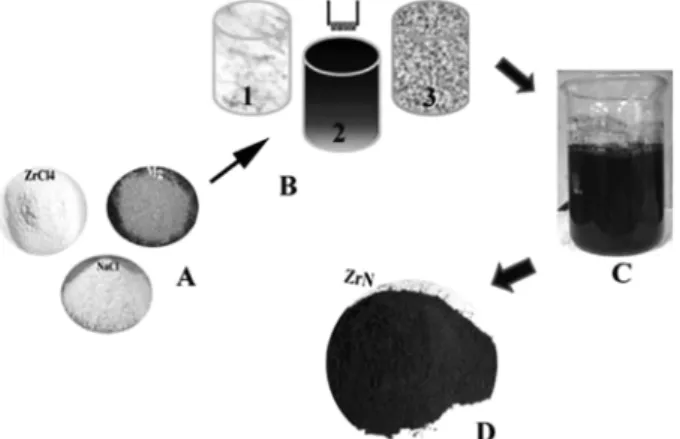
A simplified scheme of the combustion process used
purified via washing with distilled water in order to remove the NaCl Purified black powder was dried under the vacuum at 40-50
oC.
We used “HSC Chemistry 6” software to predict adia- batic combustion temperature (T
ad) and concentration of equilibrium phases in the combustion wave.
12)The calcu- lation of equilibrium characteristics was based on minim- izing the thermodynamic potential of the system. The initial parameters (temperature and pressure) of the system were set to 25
oC and 2.0 MPa, respectively. The analysis was performed under a NaClconcentration of 2-13 M.
The crystal structure and morphology of the ZrN nano- particles were characterized using an X-ray diffractometer with Cu K α radiation (Siemens D5000, Germany), field emission scanning electron microscopy (FESEM; JSM 6330F) and transmission electron microscopy (TEM, JEM 2010, Japan). The specific surface area was determined from the linear part of the BET plot. The micropore size distribution was calculated by using the adsorption branch of the N
2adsorption-desorption isotherm.
3. Results and Discussion
Fig. 2. shows the adiabatic combustion temperature (T
ad) and equilibrium phases for the ZrCl
4+ 4NaN
3+ kNaCl system. Thermodynamic analysis indicates that adiabatic combustion temperature calculated for k = 0 is about 1656
oC. This result may lead to an intensive evaporation of ZrCl
4(T
evap.= 331
oC) during the combustion process, even under 2.0 MPa pressure. Therefore, NaCl was employed as effective diluent to decrease the adiabatic combustion temperature. It is noteworthy that the response of T
adto the NaCl concentration is very effective; the decrease in the temperature is about 100
oC per each mol of NaCl.
Therefore at k = 8 the overall system temperature drops to the melting point of NaCl (800
oC). Further increase in k(k > 8) affects on the proportion of NaCl(s)/NaCl(l), while T
adremains constant. Reaction products assumed by the thermodynamic analysis consists of two main phases, Fig. 1. A simplified scheme of the combustion process used for the
experiments: A-initial components; B- reaction sample before (1),
during (2) and after the combustion process (3); C-sample purification
into glass beaker; (D)-ZrN nanopowder.
solid ZrN and water soluble NaCl. In the given condition, NaCl can be in liquid, solid, or gaseous states depending on processing temperature. Thus, thermodynamic analysis indicates that the control of the temperature by NaCl flux is attractive and under the given thermodynamic circum- stances the synthesis of ZrN nano particles seems to be realistic.
The experimental conditions were employed for the ther- modynamic analysis. Preliminary tests in ZrCl
4+ NaN
3binary system revealed that essential evaporation of ZrCl
4during the combustion process occurred. Starting with 2 M of NaCl, the combustion process in ZrCl
4+ NaN
3system is thermodynamically stabilized and loss in mass of sample is negligible. Reaction temperature profiles at different NaCl concentrations (k) are shown in Fig. 3(a).
All profiles exhibit a single-stage character with an abrupt temperature increase in the beginning part of the reaction zone. The ignition point (T*) of ZrCl
4+ 4NaN
3+ kNaCl
system defined by inflection point of temperature profiles is located between 300-400
oC where a thermal decompo- sition of NaN
3(280-300
oC) and boiling of ZrCl
4(331
oC) take places. In this point, any visible change in T* from k was observed in Fig. 3(a). However decrease in the combustion temperature (T
c) and velocity (U
c) upon k is essential. As shown in Fig. 3(b) the combustion tempera- ture decrease from 1280 to 750
oC in 2-13 range of k.
Combustion wave velocity also displays a continuously retarded characteristic with reaching to the minimum value (0.15 cm/s) at k = 13.
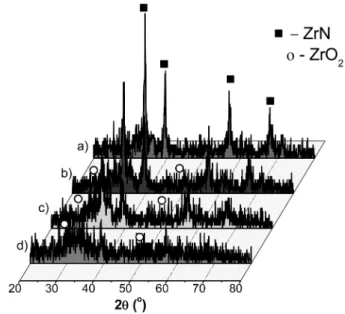
X-ray diffraction patterns of water purified combustion products upon k are shown in Fig. 4. As depicted, at 1280
oC (k = 2) all XRD peak is well matched to ZrN phase. With increasing of k the intensities of ZrN peaks are continuously decreased, simultaneously ZrO
2impurity peaks are appeared on patterns. At k = 13 the XRD peaks of ZrN become very week; it imply that the powder is getting quasi-amorphous.
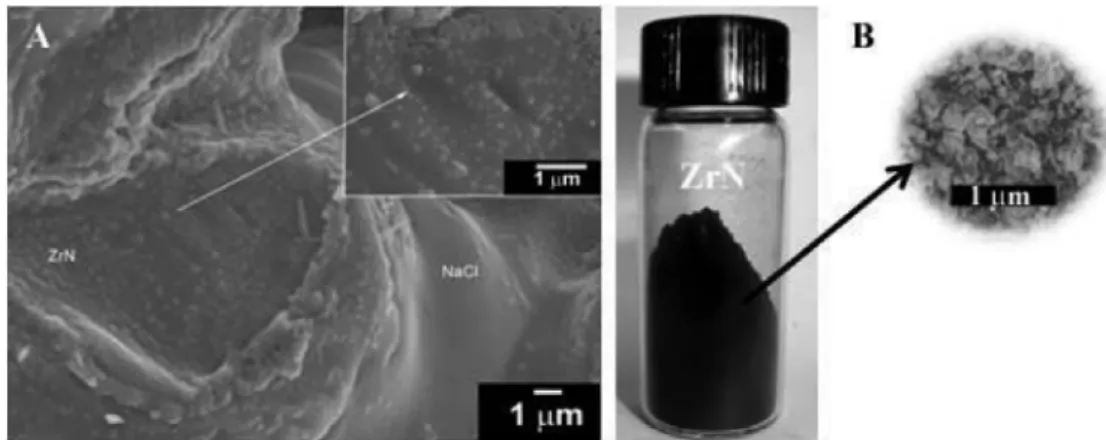
SEM micrograph of the sample after the combustion process (Fig. 5A) shows large volume of molten NaCl in which the small particles of ZrN are randomly distributed.
The reaction sample after water purification was trans- formed to a homogenously colored black powder as shown in Fig. 5(B). This powder is somewhat agglomerated and the size of agglomerates is less than 1 µm.
Typical TEM (A, B), high-resolution cross-sectional TEM image (C), and electron diffraction pattern of ZrN nanopowder (D) are shown in Fig. 6. Fragments A and B represent the TEM images of ZrN nanopowders prepared with 2 and 8 M of NaCl. With 2 M of NaCl the average size of paricles is about 30 nm, whereas 8 M of NaCl may produce ZrN particles with average size less than 10 nm.
Fig. 4. XRD patterns of ZrCl
4-4NaN
3- kNaCl: (a) k = 2; (b) k = 5;
(c) k = 8 and (d) k = 13.
Fig. 3. Temperature-time profiles (a) and combustion parameters (b) of ZrCl
4-4NaN
3- kNaCl system upon k.
Fig. 2. Thermodynamic analysis of ZrCl
4-4NaN
3- kNaCl system.
Fig. 6(C) high resolution transmission electron microscopy (HRTEM) images further support the interplaner distances of d = 2.65 Å which is identical with the plane d
220= 2.65 Å. Fig. 6(D) shows the selected area diffraction (SAD) pattern of ZrN, which is in exact/or in good agreement with the XRD results. The ring type SAD pattern consists of a NaCl type cubic structure and it indicates the ultrafine character of ZrN nanoparticles. And also, diffraction ring from (220) of ZrO
2is dimly visible, which represents the inclusion of small amount of ZrO
2. Taken together, the results of XRD, TEM and HRTEM, show that the synthesized ZrN nanoparticles are in range of 5-30 nm and it can be crystalline or quasi-amorphous depending on the reaction temperature.
The surface area and porosity of the ZrN nanoparticles were investigated by using Brunauer-Emmett-Teller (BET) analysis and the nitrogen adsorption-desorption isotherm.
Because the ZrN nanoparticles were small, a high surface Fig. 6. Typical TEM (A, B), high-resolution cross-sectional TEM
image (C) and SAD diffraction pattern of ZrN nanopowder (D).
Fig. 7. (a) N
2adsorption-desorption isotherm and (b) HK pore-size
distribution plot of ZrN nanopowder.
area was expected, which is also verified from results of the BET analysis. The BET specific surface area was from 50.27 to 70.15 m
2/g. Fig. 7(a) shows the adsorption/
desorption isotherms of nitrogen measured at liquid nitro- gen temperature (77.3 K). Here, p/p
ois relative pressure, and V
ais volume of adsorbed and desorbed amount of N
2. A hysteresis loop can be observed between the adsorption and desorption branch indicating the porous structure of zirconium nanoparticles. The ZrN nanoparticles showed a type II isotherm according to the IUPAC classification.
13)There were sharp increases at P/P
o< 0.05 and P/P
o> 0.9, as shown in Fig. 7(a) The inflection position at P/P
o= 0.05-0.5 was due to the presence of primary mesopores, whereas the second increase at P/P
o> 0.9 arose from capillary condensation with multilayer adsorption onto the inner surface. Fig. 7(b) shows the Horvath-Kawazoe (HK) pore volume-diameter distribution plots for N
2at 77.3 K.
The plot revealed that the ZrN nanoparticles possessed porous structures with a size distribution of 1-10 nm, the average pore diameter (d
p) of the zirconium was 9.29 nm, and the corresponding BET cumulative pore volume (dV
p/ dlogdp) was 0.195 cm
3/g.
Chemistry of the combustion process is not complex and it is based on the metathesis reaction between ZrCl
4and NaN
3. Because of low melting and boiling points of raw materials it was possible to synthesized ZrN phase at low combustion temperatures. Generally the formation process of ZrN nanoparticles proceeds with participation of solid, liquid and gas phases and entire synthesis process may be presented by following sequential chemical reactions:
As shown in Fig. 3, the ignition point of ZrCl
4-NaN
3mixture is low (300-400
oC), and therefore a low activation energy is needed for activation of the combustion process.
According to the concept of wide reaction zones developed by Merzhanov
14)the combustion velocity is connected with the combustion temperature by the following equation:
U
2= AT
ce
−E/RTc(5)
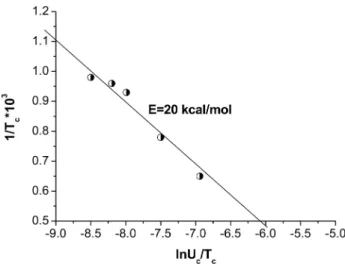
It is obvious that the activation energy for the combus- tion process can be derived from the experimental values U
cand T
cin Eq. (5). For it the values of T
cand U
cwere processed in coordinates ln U
c/T
c− 1/T
c.The results are presented graphically in Fig. 8. The activation energy which
can be extracted from the plot is: E = 20 kcal/mol.
4. Conclusion
A combustion approach has been developed to produce ZrN nanoparticles from ZrCl
4-4NaN
3mixture diluted with NaCl flux. Thermodynamic and kinetic analysis through the in situ measurement of the sample temperature in- dicates that the combustion reaction has high exother- micity and may develop a temperature from 1280 to 750
oC with increasing the flux concentration from 2 to 13 M. The calculated effective value for activation energy in this process is 20 kcal/mol. The average size of ZrN particles under the given circumstances was decreased from 30 nm to 10 nm (or less) with increasing NaCl con- centration. ZrN nanoparticles have high surface area (50- 70 m
2/g) and narrow pore size distribution (1-10 nm).
This synthetic method can be easily applied for other transition metal nitride systems (TiN, TaN, HfN, etc.) with suitable chloride salts and alkali metal azide.
Acknowledgements
This work was supported by the R&D program of the Korea Evaluation Institute of Industrial Technology (KEIT), funded by the Knowledge Economy, Korea, via Grant No. 10040084.
References
1. S. C. Cho, Y. C. Hwang, K. W. Lee, S. J. Han, I. B. Kim, H. Jeon and Y. Kim, Kor. J. Mater. Res., 15(9), 594 (2005) (in Korean).
2. B. Fu and L. Gao, J. Am. Ceram. Soc., 87(4), 696 (2004).
3. Y. Gu, F. Guo, Y. Qian, H. Zheng and Z. Yang, Mater.
Lett. 57(11), 1679 (2003).